9
Volume 66 1 Number 1, 2018
https://doi.org/10.11118/actaun201866010009
COVERAGE OF THE SPRAYED OBJECTS
IN THE ASPECT OF THE COEFFICIENT
OF THE SPRAY SURFACES
Beata Cieniawska
1, Deta Łuczycka
1, Jan Červinka
2, Katarzyna Dereń
11 University of Environmental and Life Sciences in Wroclaw, Institute of Agricultural Engineering, Wroclaw, Poland 2 Mendel University in Brno, Faculty of AgriSciences, Zemědělská 1, Brno, Czech Republic
Abstract
CIENIAWSKA BEATA, ŁUCZYCKA DETA, ČERVINKA JAN, DEREŃ KATARZYNA. 2018. Coverage of the Sprayed Objects in the Aspect of the Coefficient of the Spray Surfaces. Acta Universitatis Agriculturae et Silviculturae Mendelianae Brunensis, 66(1): 9 – 16.
The aim of the study was to compare the degree of coverage of the sprayed objects with the selected nozzles in the aspect of the characteristics of the sprayed object, determined by the coefficient of the position of the sprayed surfaces. Studies were conducted in two stages, in laboratory conditions, in which the first step was to determine the characteristics of the sprayed objects, and in the second there were conducted the studies of the degree of coverage. Based on the analysis of the obtained results from the first stage it was stated that the studied plants were characterised by great differentiation of morphological features having a significant influence on the parameters of their spray characteristics. Important was the fact that the use of the coefficient of the spray surfaces Wpo, determining the mutual relation of particular sprayed surfaces facilitates the selection of the most appropriate nozzles and treatment parameters in relation with the morphological features of the plant. In the second stage, concerning the studies of the degree of the coverage it was stated that the selected nozzles differed strongly in the degree of coverage of vertical and horizontal objects. Differentiated coverage for particular nozzles had a strong relationship with the coefficient of spray surfaces, except that the dual‑spray nozzles covered the vertical surfaces better compared to the single‑spray nozzles, which covered the horizontal surfaces better.
Keywords: degree of coverage, coefficient of the spray surfaces, nozzle, spraying
INTRODUCTION
Plant protection is one of the most important branches of crop production, which makes it possible to prevent crop losses, resulting from threats connected with the harmful activity of pests. At the current stage of development of food production, moving away from the use of pesticides may cause the reduction of crops by approx. 70 % (Pruszyński 2010). Pesticides, used in plant protection, as is well known, are often highly harmful substances. Often contradictory features and properties are often expected from them, namely:
• high toxicity to other pests,
• low toxicity to other living organisms, • adequate durability,
• high susceptibility to degradation.
While from their users it is required to use them: • where necessary,
• in such amount, which is necessary,
indicators of the treatment quality depend on many technical conditions, technological conditions and meteorological conditions. None of the methods of determining quality indicators of the treatment so far has not included the characteristics of the sprayed object. According to the authors, taking this factor into consideration will allow the increase of the effectiveness of spraying, with the simultaneous limitation of the threat for the environment (Cieniawska 2014a, b).
The interest of researchers in the characteristics of plants is evidenced by many published literature positions. The issues raised in the article relate to, among others, determination of the photosynthetic surface of plants with the video‑computer method (Kiełbasa and Juliszewski 2005), the influence of the diversified nitrogen fertilisation on the yield and the influence of the chemical plant protection in conditions of various crop systems (Andruszczak
et al., 2012; Gołębiowska and Sekutowski, 2007). The experiments also apply to the indicator of the foliar state: LAI – leaf area and MTA – leaf inclination angle (Biskupski et al. 2007; Biskupski
et al. 2009; Woźniak 2008). However, during the studies connected with the use of plant
protection means the authors’ methods cannot be used, because they do not relate to the surface of projections. During the spraying, the application surfaces are “seen” by the nozzle as horizontal and vertical projections, which are the essential aim of the emitted droplets of the sprayed liquid.
Aim of the study
The aim of the study was to determine the influence of the spray surface coefficient on the degree of coverage of the sprayed objects using the selected single‑ and dual‑spray nozzles.
MATERIALS AND METHODS
First, as preliminary studies, there were performed experiments in the chamber to test the spray characteristics of plants. For the experiments there were selected five plants of alfalfa and rape in the shoot elongation phase. The position scheme is shown in Fig. 1.
The plant selected for the tests was placed in the measurement chamber, on the rotator. Then, there were taken the photos of the vertical and horizontal projections, rotating the dial and taking 1: Scheme of the position for tests of the plant spray surface
photos every 60°. The photos of the vertical and horizontal projections of plants were subjected to the graphic treatment in the program AutoCad 2011 (Fig. 2).
After obtaining the results of the graphic analysis in the program AutoCad 2011, there was calculated the coefficient of the spray surfaces. The formula, proposed by the authors, related to the ratio of the spray surfaces in the vertical and horizontal projection.
Wpo
projection of vertical surfaces projection of horizontall surfaces
Following the model of the results of measurements obtained in the first step, in order to eliminate the external factors and to provide the repetition of the tests, in the second step, as the sprayed objects, there were used the artificial plants with such a structure to obtain the coefficient selected by the authors as Wpo = (0.50; 1; 1.50; 2). In the particular case of the given coefficient this resulted from the following system of the sprayed surfaces:
• 0.50 – 4 horizontal surfaces and 2 vertical surfaces, • 1 – 2 horizontal surfaces and 2 vertical surfaces, • 1.50 – 4 horizontal surfaces and 6 vertical surfaces, • 2 – 2 horizontal surfaces and 4 vertical surfaces.
the nozzle carrier, which worked as the self-propelled sprayer.
Fig. 3. Scheme of the test position for the degree of coverage for the sprayed objects 1 – artificial plant, 2 – trajectory, 3 – nozzle carrier, a – acceleration section, b – measurement section, c – final section
1
3
2
3m
3m
3m
a
b
c
3: Scheme of the test position for the degree of coverage for the sprayed objects
1 – artificial plant, 2 – trajectory, 3 – nozzle carrier, a – acceleration section, b – measurement section, c – final section
their number is represented by the coefficient of the spay surfaces (fig. 4).
Fig. 4. Photo of the artificial plant: 1 – vertical overrun (Anj), 2 – vertical stellar (Aoj), 3 – top horizontal (Apog), 4
– bottom horizontal (Apod)
3
4 Direction of the
ride
1
2
4: Photo of the artificial plant
In the second step there were conducted the studies of the degree of coverage. The scheme of the experiment position is presented in Fig. 3. The key element of the position was the nozzle carrier, which worked as the self‑propelled sprayer.
On the measurement section there were placed three artificial plants, representing three repetitions of the given measurement. To the artificial plants there were mounted probes in the form of water‑sensitive papers, so they represent characteristic vertical and horizontal surfaces, and their number is represented by the coefficient of the spay surfaces (Fig. 4).
In the studies there were used the following standard and ejector nozzles: AXI 11002, CVI 11002, CVI TWIN 11002, AVI TWIN 11002. As the spray parameters there were adopted the following values: speed – 8 km·h−1, location of the nozzles in the longitudinal perpendicular plane to the surface – −10º, 0º, 10º, spray expense – 0.91 l·min−1 and the height of the nozzles −0.5 m.
The degree of coverage was determined based on the computer analysis of the area. On the area
of the water‑sensitive paper there were randomly selected three fragments of the surface of the 10 × 10 mm size. Then, using the formula, there was calculated the degree of coverage:
P W W
sp k p
100 % ,
where:
Psp ....degree of coverage [ %],
Wk ....surface covered with liquid [pixels], Wp ....surface of 1 cm2 [pixels].
RESULTS AND DISCUSSION
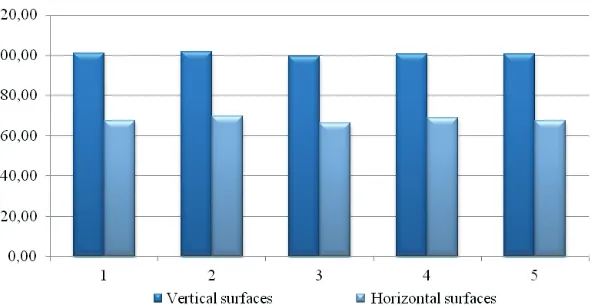
Fig. 5 and 6 presents the results of measurements of the horizontal and vertical projections of the studied plants. The figures show five repetitions of the obtained results of the surface measurements for two types of plants, which substantially differ with morphological features. Alfalfa characterised by a greater surface of vertical projections, while rape in the phase of shoot elongation had a greater surface of horizontal projections.
5: Surfaces of horizontal and vertical projections of alfalfa
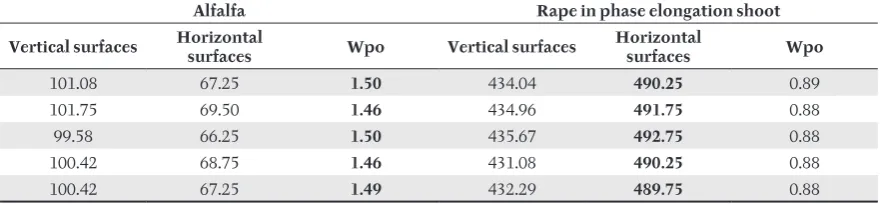
Table 1 presents the values of the coefficient of the location of the spray surfaces.
Alfalfa, for which the surface of vertical projections was greater than the surface of horizontal projections – therefore, the coefficient of the location of spray surfaces was greater than 1. While in case of rape in the phase of shoot elongation, which surface of vertical projections was smaller than the surface of horizontal projections – this coefficient was smaller than 1.
Coefficients of the spray surfaces presented in Tab. I calculated based on the conducted
measurements were discussed by the authors in publication on their usefulness in plant protection technology (Cieniawska et al., 2014a, b).
Results of the studies of the degree of coverage are presented in diagrams (Fig. 7 and 8).
Fig. 7 shows the results of studies of the degree of coverage of the sprayed horizontal objects. The degree of coverage of these surfaces was the highest in the application of the single‑spray nozzles AXI and AVI. In contrast to the dual‑spray nozzles AVI TWIN and CVI TWIN, for which there was noted the lowest degree of coverage. I: Results of the coefficient of the location of spray surfaces
Alfalfa Rape in phase elongation shoot
Vertical surfaces Horizontal surfaces Wpo Vertical surfaces Horizontal surfaces Wpo
101.08 67.25 1.50 434.04 490.25 0.89
101.75 69.50 1.46 434.96 491.75 0.88
99.58 66.25 1.50 435.67 492.75 0.88
100.42 68.75 1.46 431.08 490.25 0.88
100.42 67.25 1.49 432.29 489.75 0.88
7: Degree of coverage of top horizontal objects
For each setting of the nozzle in the longitudinal perpendicular plane to the surface both in the direction of driving and the opposite one.
Fig. 8 shows the test results of the degree of coverage of the vertical overrun and stellar objects. In this case dual‑spray nozzles have a better coverage of both vertical surfaces compared to the single‑spray nozzles. It was also interesting that the degree of coverage increased with the nozzle deflection in the direction of driving.
During all measurements conducted during the studies there were not stated any traces of coverage of the bottom horizontal objects.
For the statistical study of the test results there was used the multivariate analysis of variance, which results are presented in Tab. II and the statistical analysis Post‑hoc, which results can be found in Tab. III.
From the presented data of the statistical analysis it results that the studied factors had a significant influence (at the level of α = 0,05) on the degree of coverage of the studied objects, except for the lack of significance of the influence of the nozzle setting (Tab. II).
From the statistical analysis Post‑hoc results that in case of every sprayed surface there are significant differences in the degrees of coverage.
Interpretation of the obtained results is in line with what is emphasized by many researchers in their publications in connection with the importance of the selection of the right nozzle for the treatment as an important factor of quality of the work performed during the plant protection treatments both in the field and horticultural conditions and in the crops under covers (Guler et al., 2007).
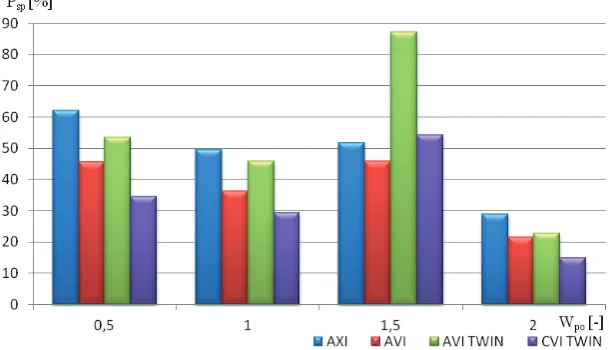
Fig. 9 presents the average degree of coverage depending on the coefficient of the location of spray surfaces. In case of plants, for which the coefficient of location of spray surfaces is smaller than 1, (predominance of horizontal surfaces), the studied surfaces will have a better coverage with liquid with the single‑spray nozzle. While in case of dual‑spray nozzles, a better coverage was stated in plants characterised by the coefficient Wpo greater than unity.
II: Results of the multivariate variance analysis
Factor Value of the test function F Value of the probability level p
Nozzle 10.6018 0.0000
Surface 295.7085 0.0000
The angle of the nozzle 0.1141 0.8923
III: Results of the statistical analysis Post‑hoc
Surface 52.848{1} 9.8275{2} 4.9636{3}
Apog 0.0000 0.0000
Anj 0.0000 0.0270
Aoj 0.0000 0.0270
CONCLUSION
Nozzles used for the studies were characterised by the different ability of spraying the vertical and horizontal objects. Dual‑spray nozzles had a better coverage of the vertical surfaces in contrast to the single‑spray nozzles, with a better coverage of horizontal surfaces.
Plants selected for the studies were characterised by the great differentiation of morphological features determining their spray characteristics, i.e., the surface of the horizontal projection, the surface of the vertical projection and the general surface of exposure to the spray.
The analysis of the obtained test results indicates that the application of the coefficient of the spray surfaces Wpo, determining the mutual relation of particular sprayed surfaces facilitates the selection of the most appropriate nozzles and the treatment parameters depending on the morphological features of the sprayed plants.
The multivariate analysis of variance showed a significant effect, at the significance level of α = 0,05, of the applied nozzle and the location of the sprayed surfaced on the degree of coverage, except for the lack of significance of the influence of the nozzle location in the longitudinal surface, perpendicular to the surface.
REFERENCES
ANDRUSZCZAK, S., KWIECIŃSKA‑POPPE, E., KRASKA, P. and PAŁYS, E. 2012. The influence of some plant protection chemical means on leaf area and their tip angle of some winter spelt wheat varieties (Triticum aestivum ssp. spelta L.) [in Polish: Wpływ niektórych środków ochrony roślin na kształtowanie powierzchni liści i kąta ich nachylenia u wybranych odmian ozimych pszenicy orkisz (Triticum aestivum ssp. spelta L.)]. Postępy w ochronie roślin/Progress in plant protection, 52(1): 163−166.
BISKUPSKI, A., KAUS, A., WŁODEK, S., and PABIN, J. 2007. Differentiated nitrogenous fertilization as against yielding and selected indices of the canopy architecture of several spring wheat cultivars [in Polish: Zróżnicowane nawożenie azotem a plonowanie i wybrane wskaźniki architektury łanu kilku odmian pszenicy jarej]. Inżynieria Rolnicza, 91(3): 29−36.
BISKUPSKI, A., WŁODEK, S. and PABIN, J. 2009. The influence of differetiated tillage on selected indices of canopy architecture and yielding of crops [in Polish: Wpływ zróżnicowanej uprawy roli na wybrane wskaźniki architektury łanu oraz plonowanie roślin]. Fragmenta Agronomica, 26(4): 7−13.
CIENIAWSKA, B., ŁUCZYCKA, D. and SZEWCZYK, A. 2014a. Characteristics crop plants in the aspect of the process of spraying. Mechanization in Agriculture, 6: 29−33.
CIENIAWSKA, B., ŁUCZYCKA, D. and SZEWCZYK, A. 2014b. The quality of procedure spraying on crops flat in the aspect of sprayed plants. Mechanization in Agriculture, 6: 34−38.
GOŁĘBIOWSKA, H. and SEKUTOWSKI, T. 2007. Effectiveness of herbicides selectivity applied in maize monoculture with of leaf area index (LAI) and mean tip angle (MTA) [in Polish: Ocena selektywności herbicydów stosowanych w monokulturze kukurydzy z wykorzystaniem wskaźnika powierzchni liści (LAI) i kąta nachylenia liści (MTA)]. Inżynieria Rolnicza, 91(3): 51−58.
GULER, H., ZHU, H., ÖZKAN, H. E., DERKSEN, R. C., YU, Y. and KRAUSE, C. R. 2007. Spray characteristics and drift reduction potential with air induction and conventional flat‑fan nozzles. Transactions of the ASABE, 50(3): 745−754.
KIEŁBASA, P. and JULISZEWSKI, T. 2005. Measurement of the leaf surface for the selected plants using video‑ computer method [in Polish: Pomiar powierzchni liści wybranych roślin metodą video‑komputerową].
Inżynieria Rolnicza, 74(14): 169−175.
NIERÓBCA, A. and ZALIWSKI, A. and HOROSZKIEWICZ‑JANKA, J. 2010. The development of an internet decision support system for crop protection [in Polish: Rozwój internetowego systemu wspomagania decyzji w ochronie zbóż]. Inżynieria Rolnicza, 125(7): 167–173.
NUYTTENS, D., DE SCHAMPHELEIRE, M., VERBOVEN, P., BRUSSELMAN, E. and DEKEYSER, D. 2009. Droplet size‑velocity characteristics of agricultural sprays. Trans. ASABE, 52(5): 1471–1480.
ÖZKAN, H. E. 2008. Technological Solution to Problems Associated with Application of Pesticides Jour. Of Agricultural Machines Sciences, 4(2): 193−198.
PRUSZYŃSKI, S. 2010. Present state and predicted directions of changes in plant protection by 2020 [in Polish: Stan obecny i przewidywane kierunki zmian w ochronie roślin do 2020 roku]. Studia i raporty IUNG – PIB Puławy, 14: 207–242.
SZEWCZYK, A. 2010. Analysis of the setting, parameters and working conditions of a nozzle and quality of spray application in field crops [in Polish: Analiza ustawienia, parametrów i warunków pracy rozpylacza w aspekcie jakości opryskiwania upraw polowych]. Monografie XCVII. Wroclaw: Wydawnictwo Uniwersytetu Przyrodniczego we Wrocławiu.
WOŹNIAK, A. 2008. Influence of different share of spring wheat in crop rotation on leaf area index (LAI) [in Polish: Wpływ zróżnicowanego udziału pszenicy jarej w zmianowaniu na indeks powierzchni liści (LAI)].
Acta Agrophysica, 12(1): 269−276.