Abstract
GERARD, SCOTT NEAL. Designing, Verifying, and Evolving Commitment-based Protocols for Business. (Under the direction of Professor Munindar P. Singh.)
© Copyright 2013 by Scott Neal Gerard
Designing, Verifying, and Evolving Commitment-based Protocols
for Business
by
Scott Neal Gerard
A dissertation submitted to the Graduate Faculty of North Carolina State University
in partial fulfillment of the requirements for the Degree of
Doctor of Philosophy
Computer Science
Raleigh, North Carolina 2013
APPROVED BY:
Professor Jon Doyle Professor Tao Xie
Dedication
Biography
I was born in Decatur, Illinois in 1956 and grew up in Council Bluffs, Iowa. Throughout my life, my parents, family, teachers, and friends helped shape my love of all things scientific and technological. I received my Bachelor of Science in Physics and Mathematics in 1974 from Nebraska Wesleyan University in Lincoln, Nebraska, followed by a Masters of Science of Physics in 1978 from the University of Wisconsin in Madison, Wisconsin. After school, I joined IBM where I have worked for nearly 34 years, first in Rochester, Minnesota and now in Raleigh, North Carolina.
When my family moved to Raleigh, I decided to explore computer science more deeply and sys-tematically than I had been able to do on my own. I entered the graduate program in the Department of Computer Science at North Carolina State University, and I have enjoyed (almost) every minute of this unusual, late-in-life endeavor.
Acknowledgements
First, I thank Munindar, my advisor. His deep knowledge, insights, intuitions, and exacting standards have significantly improved my research directions, approaches, and ultimate goals. Under his careful direction, I have improved my English, my writing, and my LATEX skills. He is a great advisor and
teacher, and it is has been my privilege to know and work with him.
Second, I thank my loving and supportive wife, Nancy, for proof-reading texts outside her back-ground, for making a number of interesting suggestions, for often listening to me ramble on about obscure topics, and for giving me the time and support to devote to this research. I thank my parents and family for their love, support, and encouragement. These loved ones have given me far more than I could ever list here.
Third, I thank (in no particular order) the excellent NCSU teaching faculty: Professors Dennis Bahler, Jon Doyle, Xiaohui (Helen) Gu, Nagiza Samatova, and William Stewart; members of my research group for their insightful and thought-provoking discussions: Pankaj Telang, Anup Kalia, Kartik Tadanki, Chung-Wei Hang, Nirmit Desai, and Amit Chopra; and others who helped in one way or another: Joe Bigus, Jennifer Bigus, James Carey, Jeffrey Gerard, Michael J. J. Moore, A. Carolyn Neal, and Eileen Townsend.
Finally, I thank Jesus Christ, my Lord, my Savior, my Teacher.
Table of Contents
List of Tables. . . ix
List of Figures. . . x
List of Algorithms. . . xi
Chapter 1 Overview . . . 1
1.1 Motivation . . . 1
1.2 Problem Statement . . . 2
1.2.1 General Problem . . . 2
1.2.2 Specific Problem . . . 3
1.2.3 Concrete Scenario . . . 3
1.3 General Concepts . . . 4
1.3.1 Protocols . . . 4
1.3.2 Agent Autonomy and Commitments . . . 4
1.3.3 Orchestration and Choreography . . . 4
1.3.4 State Space . . . 5
1.3.5 Verification . . . 5
1.4 Our Approach . . . 6
1.4.1 Commitments . . . 6
1.4.2 Protocols . . . 7
1.4.3 Refinement . . . 8
1.4.4 Requirements Evolution . . . 8
1.4.5 First Class Entities . . . 8
1.4.6 Automated Tooling . . . 10
1.5 Alternative Approaches . . . 10
1.6 Complete Scenario . . . 11
1.7 Who Can Benefit? . . . 12
1.8 Summary of Contributions . . . 12
1.9 Outline . . . 12
Chapter 2 Background . . . 13
2.1 Running Examples . . . 13
2.2 Commitments . . . 15
2.3 Interpreted Systems . . . 16
2.4 Interceptors . . . 18
Chapter 3 Approach and Overview . . . 19
3.1 Terminology . . . 19
3.2 Commitments . . . 19
3.2.1 Serial Composition of Commitments . . . 19
3.2.2 Scalar Serial Composition . . . 21
3.3 Proton . . . 23
3.3.1 Proton Syntax . . . 23
3.3.2 Proton Semantics . . . 25
3.3.3 Proton Specification Examples . . . 26
Chapter 4 Composing Commitment Protocols . . . 28
4.1 Introduction . . . 28
4.1.1 Real-Life Scenario: AGFIL . . . 28
4.1.2 Contributions and Organization . . . 29
4.2 Technical Approach . . . 30
4.2.1 Protocol Composition . . . 30
4.2.2 Role Requirements . . . 31
4.2.3 Enactment Requirements . . . 32
4.2.4 Coupling Commitments . . . 33
4.2.5 Verification . . . 33
4.2.6 Composite Protocol Diagrams . . . 34
4.3 Methodology . . . 35
4.4 Evaluation . . . 36
4.4.1 AGFIL Evaluation . . . 37
4.4.2 Quote To Cash Evaluation . . . 39
4.4.3 ASPE Evaluation . . . 40
4.5 Results and Experience . . . 41
4.6 Discussion . . . 42
4.6.1 Relevant Literature . . . 42
4.6.2 Future Work . . . 45
Chapter 5 Formalizing and Verifying Protocol Refinements . . . 46
5.1 Introduction . . . 46
5.1.1 Proton: Approach and Contributions . . . 47
5.1.2 Contributions . . . 48
5.1.3 Organization . . . 48
5.1.4 Mapping Abstractions across Protocols . . . 49
5.2 Formalizing Protocols and their Refinement . . . 51
5.2.1 Protocol Enactment . . . 51
5.2.2 Protocol Refinement . . . 53
5.3 Verifying Protocol Refinement . . . 55
5.3.1 Intuition: Decomposition . . . 56
5.3.2 Intuition: Diffusion . . . 56
5.3.3 Accommodating Abstraction Mapping . . . 58
5.3.4 Verifying Refinement: Summary . . . 59
5.3.5 Generating CTL Formulas for Verification . . . 60
5.4 Tooling, Detailed Examples, and Experimental Results . . . 61
5.5 Correctness of Our Refinement Verification Method . . . 66
5.6 Discussion . . . 67
5.6.2 Directions for Future Research . . . 69
Chapter 6 Evolving Protocols and Agents in Multiagent Systems. . . 70
6.1 Introduction . . . 70
6.1.1 Problem: Requirements Evolution . . . 71
6.1.2 Approach: Refactoring Interactions . . . 71
6.2 Approach Illustrated . . . 72
6.2.1 Applying Rule-Based Interceptors . . . 72
6.3 Interceptors and Refactorings . . . 74
6.3.1 Interceptor Chains . . . 74
6.3.2 Interceptor Syntax and Semantics . . . 75
6.3.3 Refactorings Formalized . . . 76
6.3.4 Protocol Designer Independence . . . 76
6.3.5 Agent Designer Independence . . . 78
6.3.6 Designer Collaboration . . . 78
6.4 Methodology and Application . . . 79
6.4.1 Methodology for Protocol Evolution . . . 79
6.4.2 Evolve Pay to PayViaCheck . . . 79
6.4.3 Guard Propagation . . . 82
6.5 Evaluation . . . 83
6.6 Discussion . . . 84
6.6.1 Comparison to Design Patterns . . . 85
6.6.2 Comparison to Agent Designs . . . 85
6.6.3 Comparison to Other Work . . . 86
6.6.4 Comparison of Mechanistic Capabilities . . . 87
6.6.5 Future Directions . . . 87
Chapter 7 Case Study . . . 89
7.1 Application Selection Desiderata . . . 91
7.2 Software Development Protocol Description . . . 91
7.3 SWDev Modifications for Positron . . . 92
7.4 Design and Composition . . . 93
7.5 Requirement Changes . . . 96
7.5.1 Implement Requirement Changes by Applying Refactorings . . . 96
7.5.2 Refactoring Summary . . . 97
7.6 Results . . . 97
7.7 Evaluation . . . 100
7.7.1 Weaknesses Uncovered . . . 100
7.7.2 Strengths Demonstrated . . . 101
Chapter 8 Conclusions. . . 103
8.1 Claims . . . 103
8.2 Summary of Contributions . . . 104
8.2.1 Protocol Composition . . . 105
8.2.3 Interaction Refactorings . . . 106
8.2.4 Case Study . . . 107
8.3 Future Work . . . 107
References . . . 109
Appendices. . . 115
Appendix A Proton Source Code . . . 116
Appendix B Refinement Theorems . . . 121
Appendix C Rho Refactoring Library . . . 130
C.1 Protocol Designer Independence Refactorings . . . 130
C.2 Agent Designer Independence Refactorings . . . 131
C.3 Designer Collaboration Refactorings . . . 132
List of Tables
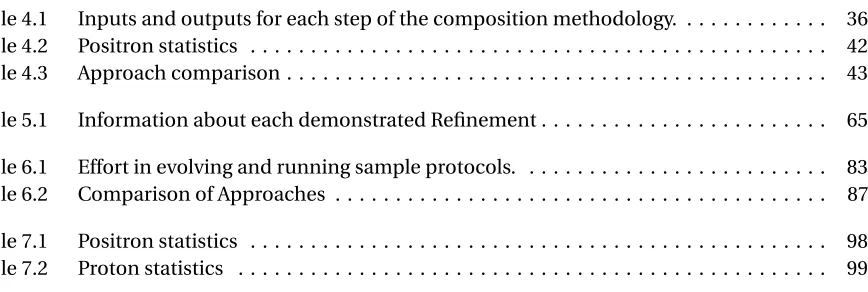
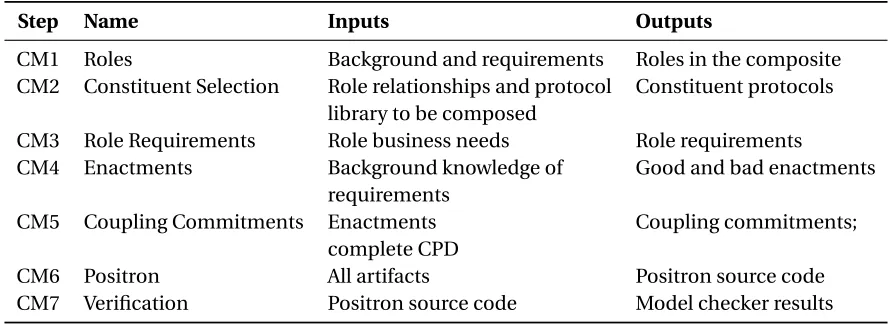
Table 4.1 Inputs and outputs for each step of the composition methodology. . . 36
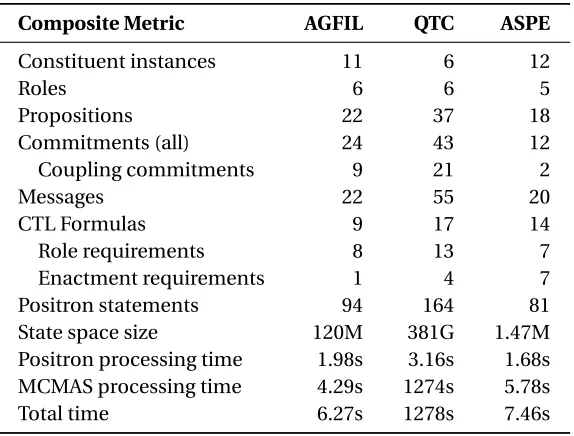
Table 4.2 Positron statistics . . . 42
Table 4.3 Approach comparison . . . 43
Table 5.1 Information about each demonstrated Refinement . . . 65
Table 6.1 Effort in evolving and running sample protocols. . . 83
Table 6.2 Comparison of Approaches . . . 87
Table 7.1 Positron statistics . . . 98
List of Figures
Figure 1.1 Process overview. . . 3
Figure 1.2 One suggestive message sequence diagram for the PayViaCheck protocol. . . 7
Figure 1.3 Inclusion (part-whole) relationships between first class entities . . . 9
Figure 2.1 Suggestive sequence diagrams for selected protocols . . . 14
Figure 2.2 State transition diagram for commitments . . . 15
Figure 3.1 Proton input syntax in BNF. . . 24
Figure 4.1 Traditional model of a cross organizational insurance claim processing. . . 29
Figure 4.2 Selected states and transitions for AGFIL. . . 34
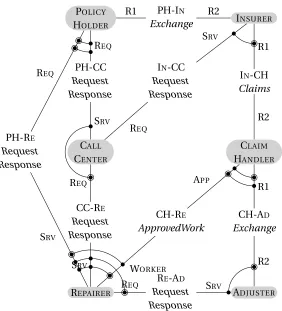
Figure 4.3 Composite protocol diagram for AGFIL . . . 35
Figure 4.4 CPD for Quote To Cash. . . 39
Figure 4.5 Composite protocol diagram for ASPE. . . 41
Figure 5.1 Refinements demonstrated by Proton . . . 48
Figure 5.2 Proton process flow . . . 55
Figure 5.3 A schematic of some possible enactments of theOrderPayShipprotocol. . . 56
Figure 5.4 Protocol refinement . . . 59
Figure 6.1 EvolvingReqResptoOrder. . . 73
Figure 6.2 Detailed enactment of Figure 6.1. . . 73
Figure 6.3 Interaction architecture . . . 74
Figure 6.4 Evolution ofPaytoPayViaCheck . . . 80
Figure 6.5 Removing unused message (false guard). . . 82
Figure 7.1 Protocol transformations and verifications . . . 89
Figure 7.2 SWDev as a composite protocol diagram. . . 94
Figure 7.3 Nested protocol structure for SWDev composite. . . 94
Figure 8.1 Refinements demonstrated by Proton . . . 106
List of Algorithms
Algorithm 3.1 Using (including) a constituent protocol. . . 25
Algorithm 3.2 PayProtocol . . . 27
Algorithm 3.3 PayViaMMProtocol . . . 27
Algorithm 4.1 Positron source for AGFIL. . . 38
Algorithm 5.1 Mapping M1:PaytoPayViaMM. . . 49
Algorithm 5.2 Alternative Mapping M2:PaytoPayViaMM . . . 50
Algorithm 5.3 Alternative Mapping M3:PaytoPayViaMM . . . 50
Algorithm 5.4 Nonrefining Mapping B1:PaytoPayViaMM. . . 50
Algorithm 5.5 Calculaterefines(P,M,Q) . . . . 62
Algorithm 6.1 PayProtocol . . . 80
Algorithm 6.2 PayViaCheckProtocol . . . 81
Algorithm A.1 Pay Protocol . . . 116
Algorithm A.2 PayViaMM Protocol . . . 117
Algorithm A.3 PayViaCheckProtocol . . . 118
Algorithm A.4 PayViaCredit Protocol . . . 119
Chapter 1
Overview
Businesses interoperation motivates our work.
1.1
Motivation
There are a number of major trends in the modern business environment. Some of those trends pose problems.
Many businesses are focusing on their core competencies. First, some business are small and just getting started, without the time or resources to provide a complete solution on their own. Second, some businesses see the need to interoperate with partners, providing value to their end users that is bigger than the sum of its parts. These businesses are becoming increasingly integrated. Third, some businesses are large monolithic businesses that need to become more agile by downsizing and transferring peripheral, distracting, or low value functions to other organizations. These businesses are becoming more dis-integrated. In all of these cases, the level of integration is not the crucial issue. Rather the commonality is that multiple, autonomous, interdependent businesses and organizations mustinteroperateto form virtual enterprises. The difficulty of arranging inter-business interoperation is hard enough. Businesses must also initiate and terminate interoperations with increasing speed. Grefen and Eshuis[2009]describe the need forInstantVirtual Enterprises (IVE).
Supply chain management is just one specific example of the need for organizations to better interoperate, both internally and externally. Monczka et al.[2011, Chapter 4]describe the importance of internal and external integration in supply chain management, and integration is a central element in their two most evolved levels of supply management strategy[2011, p. 231].
Businesses are autonomous and without centralized control. No business will willing relinquish its ability to pursue its own self-interests. Any approach that depends upon a single, centralized planner or controller will never be widely adopted by businesses.
service oriented. According to Spohrer[2007]and Fitzsimmons and Fitzsimmons[2008], over eighty precent of the US economy is service-based and the size of the service economy is expected to grow ever larger. Businesses provide a growing number of on-line versions of their services (e-commerce). The growing number of on-line services can be the building blocks for cross-organizational interoper-ation.
These major business trends demonstrate the need for modern methodologies and tools so that multiple business partners, from different organizations, can efficiently and effectively interoperate and share each others’ business services.
1.2
Problem Statement
We state both a general and a specific version of the problem.
1.2.1 General Problem
This leads us to the general problem:
General Problem: In modern business environments, how can two or more business partners design and verifybusiness processesfor interoperation that satisfies each partner’s self-interests.
Each business partner implements one or more software business agents that interoperate with other agents to enact abusiness process. Each partner’sself-interestsare partner- and protocol-specific.
We approach these important issues within a generic, multiagent systems framework, because multiagent systems support multiple, distinct partners interoperating without central control.
General Approach: Address the General Problem above using a set ofautonomous, dis-tributed, softwareagents, in anopen,businessenvironment, enactingbusiness services and interoperating viabusiness processes.
Consider the key ideas in this statement.Agentsare software entities that represent a specific business organization or person. Agents areautonomous, making their own decisions as to when and which messages to send; no organization has authority or control over another organization’s agents. And there is no centralized controlling entity. Agents can be geographicallydistributed, communicating via messages. The agents exist in anopenecosystem, are designed by different organizations, and enter and leave the ecosystem whenever they choose.
Composition
(Positron) Refinement(Proton) Evolution(Rho) Case Study
(SWDev)
Figure 1.1: Process overview.
1.2.2 Specific Problem
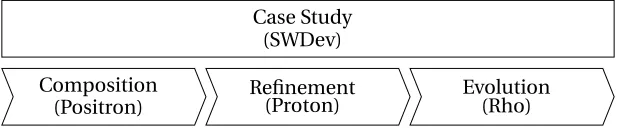
In this dissertation, we address a subset of the broad spectrum of challenges contained in the General Problem. We restate a narrower, more specialized problem, focusing on aspects from the three functional areas shown in Figure 1.1: composition protocoldesign, protocolverification, and protocol evolution.
Specific Problem:Design,verify, andevolvedemonstrably correctprotocols, forbusiness interoperation, using socially visiblecommitments, as openmultiagent systems.
We consider a protocol designer plus multiple, self-interested, agent designers, each representing a different organization. Each agent designer is motivated to collaborate with the other agent designers to solve a problem that none of them can solve on their own.
Business protocol and agent designers need todesigna protocol for their interoperation,verify whether the protocol satisfies a set of properties, andevolvethe protocol as requirements change over time. Rather than depending on agent-internal, mentalistic states (e.g., beliefs, desires, and intentions), we use commitments which are explicit and visible to other agents. We model the partners and their interaction as a multiagent system.
We describe our Positron functionality for protocol composition and single-protocol verification, Proton functionality for protocol refinement verification, and Rho library for interaction refactoring. Finally, we demonstrate our end-to-end approach on a realistic case study (SWDev).
1.2.3 Concrete Scenario
As a specific concrete example, consider the following, realistic example of multipartner interopera-tion. This software development example (SWDev) is further elaborated in Section 1.6 and is the case study for the end-to-end evaluation in Chapter 7.
One business partner, CLIENT, conceives of a new software product that he cannot
platforms. These are the design-time business partners. Other partners might include additional, run-time-only, business partners that are not selected until run time.
A number of questions arise. How do the partners go about designing a protocol for their interop-eration? Will the protocol enable them to successfully develop the software? Does the protocol satisfy each partner’s self-interests (e.g. CLIENTgetting functioning software or the other partners getting
paid)? Can the partners understand the resulting protocol? How much technical sophistication is required to answer these questions? How much confidence do the partners have in the answers?
1.3
General Concepts
The following general concepts encapsulate the key background for understanding business protocols and facilitating communication.
1.3.1 Protocols
We describe a business process as one or more protocols, and we treat protocols as first class entities. Protocols specify the set of actions each agent can take at each state. In a well-designed protocol, these actions are compatible with correct enactments. On the one hand, a large set of choices gives agents more flexibility than just a single prescribed action at each state. On the other hand, a large set requires more extensive agent decision machinery to choose an action.
1.3.2 Agent Autonomy and Commitments
In our infrastructure, agents act autonomously and unilaterally. Agents cannot arrange to act simulta-neously, thereby exposing agents to the risk of other agents not reciprocating. To partially mitigate this risk, agents can make businesscommitmentsto each other, enabling an agent to choose to act only after another agent has made an appropriate commitment. Commitments a major topic throughout this dissertation.
1.3.3 Orchestration and Choreography
There are two broad approaches to decision making in business processes: orchestration and chore-ography. Inorchestration, a central controller directs all the other agents when and how they are to act. The metaphor suggests a conductor directing all the musicians in an orchestra.
Orchestration permits simpler agent design than the distributed designs required in choreography, but only the conductor is fully autonomous. In choreography, all agents are fully autonomous.
1.3.4 State Space
Newton’s calculus interrelates two viewpoints on the evolution of continuous physical systems. Such a system is roughly similar to a strip of movie film containing multiple frames. The differential, or frame-by-frame, viewpoint describes how any one frame of the system evolves into its successor frame. The integral, or end-to-end, viewpoint describes how the first frame evolves into the last frame. Newton used differential equations to describe frame-to-frame evolution, and then he integrated the differential equations to create the integral viewpoint, stepping directly from the first frame all the way to the last frame.
Modern-day model checkers perform a similar function for discrete systems. Although the details are different, both differential and integral viewpoints exist for discrete state spaces. Instead of a single, linear strip of film, the state space of our business process is a graph of states. The graph branches as it progresses through time. From any given state, a protocol describes the possible state-to-state evolutions, and reflects the differential viewpoint. We use temporal logic formulas to describe properties that are validated over the entire state space, from beginning to end, which is the integral viewpoint.
Both differential and integral viewpoints are important to our work. We use the differential view to define the state-to-state evolution functions as a protocol of guarded messages. But many properties cannot be stated in purely differential terms, for example, commitment satisfaction. To verify commitments, we must use the integral viewpoint provided by temporal formulas. This is important because we describe agents’ interests as commitments.
1.3.5 Verification
We use model checking to bridge between differential and integral viewpoints of the problem, and verify integral properties. Temporal logic approaches formally prove whether user specified temporal properties hold in the model’s state space.
1.4
Our Approach
Multiagent systems are multidesigner, multithreaded, distributed systems in open environments. Designing these types of systems are significantly more difficult than designing threaded, single-designer systems. Like all multithreaded systems, designing protocols between multiple, autonomous agents is hard work.
We reduce protocol design effort and complexity by treating protocols asfirst class entities, employingchoreography,modularity,composition,loose couplingandflexible enactment. Our protocols, described and processed byProton,Positron, and amodel checker, are based on a formal definition ofprotocol refinement, usingcommitmentsand explicit assignment ofresponsibilitiesandaccountabilitiesto roles.
In an open environment, agents don’t generally know their run-time partners at design time, but they must be designed tosomeinterface. We proposeprotocolsas a conceptual interface that is both clear and easy-to-understand. Protocols arefirst class entitiesthat interconnect multiple abstract (agent) roles and are designed by protocol designers. Software agents are then designed to use a protocol and its abstract roles.
We usechoreographyrather than orchestration, because businesses retain their autonomy when using choreography. Real-world businesses will not give up their autonomy to a central controller, as is required for orchestration.
Modularityandcompositionare standard approaches to reducing design complexity and effort, but they require a clear definition and a means of combining multiple constituent protocols into a composite protocol. To enable wider reuse of protocols, agents areloosely coupledto each other, enablingflexible enactments, reducing strict sequencing of messages.
Responsibilitiesandaccountabilitiesare explicitly assigned to roles. When we specify protocol properties that must hold, we identify which roles are responsible for achieving them. The debtors are explicitly responsible for satisfying a commitment’s consequent. When we compose protocols together, we use coupling commitments to specify accountabilities that each role must ensure between the component protocols. Business partners who are debtors of coupling commitments are accountable for ensuring those commitments are satisfied.
1.4.1 Commitments
when developing programs in general purpose imperative programming languages. Large protocols written in such low-level terms are incomprehensible to most business people.
Although we don’t fully eliminate the need for low-level propositions, where ever possible, we prefer protocols designed with commitments, because they naturally describe business situations. Commitmentsare a high-level and formal concept, and they are essential to our approach to protocols. Commitments are written as
C{debtors},{creditors}(antecedent,consequent),
which represents a commitment (or promise or obligation) from a set of debtors, to a set of creditors, that if the antecedent condition becomes true, then the debtors commits to make the consequent condition true, at some point in the future.
Commitments can be formally manipulated as first class entities. The commitment covering relation describes when one commitment is “more general than” another. The serial composition operator constructs a result commitment from two input commitments, capturing the effect of a chain of commitments.
1.4.2 Protocols
Agents require some minimum level of common understanding to interoperate. We assume agents share (1) a common set of terms, or a mapping across their terms, (2) a protocol description written in Proton’s source language, (3) a common understanding of the structure and meaning of commitments, and (4) a message communication mechanism.
PAYER BANK PAYEE
open // acct
o
o
deposit // confirm
o
o
choose // check //
redeem
o
o
payB //
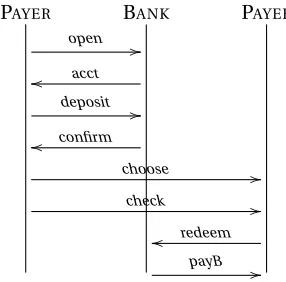
Protocol PayViaCheck is a small example, where role PAYERmakes a payment to role PAYEEvia a
check. A suggestive message sequence diagram is shown in Figure 1.2, and the corresponding Proton source code is shown in Algorithm 6.2 on page 81. PAYERopens an account with BANK, receiving
account information in response. PAYERthen makes a deposit and receives a confirmation. PAYER
commits to paying and tells PAYEEabout its commitment (message choose). At some later point, PAYER
sends a check to PAYEE who then redeems the check at BANKand receives payment.
1.4.3 Refinement
Given that protocols are first class entities, one can ask about relationships between protocols. We propose a definition of protocol refinement, where a subprotocol cannot execute any path that is not enabled by its superprotocol. We describe a computational test for refinement using temporal logic, and we prove the two are equivalent.
1.4.4 Requirements Evolution
Given the difficulty of constructing protocols, and given that realistic business processes undergo many requirement changes throughout their life, we must address how protocols can evolve. We pro-pose an interaction architecture, and use interactionrefactoringsto incrementally evolve interactions in response to requirement changes.
1.4.5 First Class Entities
First class entities must have a clear definition and provide a collection of well-defined transfor-mations, single-entity properties, or entity-to-entity relations. Figure 1.3 illustrates the inclusion (part-whole) relationships between the major first class entities we study. Next we describe the primary first class entities, shown in boxes.
Interactions and Interceptors
Interactions and interceptors are supra-protocol elements. Their identification and introduction were not foreseen from the start, but arose out of a need to introduce executable elements that are neither part of the protocol nor part of agent implementations. Others have noted the dichotomy between inter-agent concerns referred to asprotocolsand intra-agent concerns referred to aspolicies. Interceptors emerged as a third set of concerns, between protocols and policies, that are captured by our interaction architecture. Interceptors are always associated with exactly one agent, but exist outside the agent’s implementation, in the middleware. Treating interactions and interceptors as first class entities involves:
Interaction
Protocol Interceptor
Role Proposition Commitment Message CTL
Figure 1.3: Inclusion (part-whole) relationships between first class entities. Boxed concepts received our primary focus.
• Interceptor syntax and semantics (Section 6.3.2). • Definition of interaction refactoring (Section 6.3.3).
• Three types of interaction refactorings:Protocol Designer Independence,Agent Designer Inde-pendence, andDesigner Collaboration(Section 6.3.3).
• A library of interaction refactorings (Section 6.3.3 and Appendix C).
Protocols
Protocols are the primary, first class entities we study. A full definition of a protocol also requires the important first class entities of roles, propositions, commitments, and messages. We use computa-tional temporal formulas written in CTL as the language for verifying properties of protocol state spaces. Treatment of protocols as first class entities involves:
• Protocol definition as a set of roles, propositions, commitments, guarded messages, used constituent protocols, and verification conditions (Section 3.3).
• Protocol syntax (Section 3.3.1). • Protocol semantics (Section 3.3.2).
• Expansion of a constituent protocol inside a composite protocol (Section 4.2.1).
• Refinement relation between a putative superprotocol and a putative subprotocol (Chapter 5).
Commitments
Commitments are another significant first class entity we study, particularly in the context of commitment-based protocols. Treatment of commitments as first class entities involves:
• Commitment definition (Section 2.2).
• Serial composition of two commitments (Section 3.2.1).
• Commitment covering relation between two commitments (Section 3.2.3).
1.4.6 Automated Tooling
Throughout the dissertation, we rely upon automated tooling we implemented for this research. The Proton program contains two distinct functionalities:ProtonandPositron. The two names refer to distinct functionalities of the single program, developed in distinct phases to address dis-tinct issues. Both read the same declarative source language statements for protocols (differential viewpoint), perform various protocol transformations, and construct models of the protocol plus temporal logic checks written in computational tree logic (CTL). The models and temporal logic formulas are read by the MCMAS model checking tool[Lomuscio et al., 2009], which performs the detailed verification (integral viewpoint).Protoncreates MCMAS models to verify protocol refinement between two protocols.Positroncreates MCMAS models to verify role and enactment properties of a single protocol.
TheRhorefactoring library is a collection of callable refactoring routines. Each refactoring trans-forms one interaction into another interaction.
We name our tools after elementary particles in Physics, but little significance should be given to the names. We show similarities between the names and the concepts as capitalized and italicized characters:PROTOn forPROTOcol,POSITron for comPOSITe, andRhOforRefactOring.
The Rho elementary particle is a meson. A meson is composed of a quark and an antiquark, and mesons transmit the nuclear force that holds atomic nuclei together. A parallel mental image for refactorings is: a refactoring is typically composed of (one or more instances of ) a send interceptor and a receive (“anti-send”) interceptor, and a refactoring bridges between (holds together) two adjacent interactions.
1.5
Alternative Approaches
Businesses can choose hand-crafted software for their interoperation. But, hand-crafted approaches typically (1) cannot be designed or reviewed by business users, because their only definition is their implementation in a programming language, (2) have long development cycles, (3) are multithreaded applications that are difficult to test and debug, and (4) are brittle to modify. Because of these serious difficulties, the hand-crafted approach does not scale to a wide population of users.
Theπ-calculus is an advanced process calculus for describing processes. However, it requires specialized skills that business personnel lack, making it unsuitable for business process development. Business personnel must be able to read and understand their business processes. It is also an operational approach and omits the business meaning of the interactions.
1.6
Complete Scenario
The following, realistic example illustrates the end-to-end interoperation of the multiple elements of our approach. It is subject of our case study in Chapter 7.
One business partner, CLIENT, conceives of a new software product that it cannot develop and deploy alone. It proposes the idea to a set of potential partners that might want to collaborate on the project: PSP, a primary software provider; SP, a second software provider; TESTER, a software tester; and EXPERT, a deployer of software on hardware platforms. These are the design-time business partners. Other partners might include additional, run-time-only, business partners that are not selected until run time.
Business development personnel and technical protocol designers from each design-time business partner meet in a design session to design a mutually agreeable protocol for their interoperation. The business development personnel focus on business aspects, while the technical protocol designers focus on translating business requirements into protocols. Each partner wants to know the protocol satisfies its interests.
If any run-time-only partners exist (e.g., customers), the design-time partners must also clearly identify and describe their self-interests. We propose a methodology and business-friendly diagram to facilitate this design session (Chapter 4).
A natural question is how two similar protocols relate to each other. We propose a definition for protocol refinementwhere a subprotocol refines a superprotocol (Chapter 5).
After the protocol is designed, each business partner implements his own software agent. At each state, the agent chooses between the alternatives open to it by the protocol. Then all the partners deploy their agents into operation.
1.7
Who Can Benefit?
This dissertation can be beneficial to many audiences: (1) start-up organizations that want to leverage existing partners to minimize their startup costs, to minimize their learning curve, or to exploit their partner’s high quality services; (2) organizations that want to restructure; (3) organizations undergoing mergers and acquisitions; and (4) organizations that want to “rightsize” or refocus on their core competencies.
1.8
Summary of Contributions
We now summarize the main contributions of this dissertation here. Section 8.2 revisits these contri-butions in detail.
Define the protocol refinement relation between a putative superprotocol and a putative subpro-tocol, and implemented it using CTL formulas. Extend commitments to enable sets of debtors and creditors. Define two forms of serial composition of commitments and the commitment covering relation between two commitments.
Define protocol composition, based on role specific concepts and high-level verification functions. Describecomposite protocol diagramsas a graphical notation, which conveys important features of the composite protocol to business and technical stakeholders. Implement a decision procedure and mechanical verification of protocols.
Define an architecture for evolving requirements, usingrefactorings. We identify three types of interaction refactorings, and a library of automated refactorings.
1.9
Outline
Chapter 2
Background
Our approach builds upon the examples and concepts in this chapter.
2.1
Running Examples
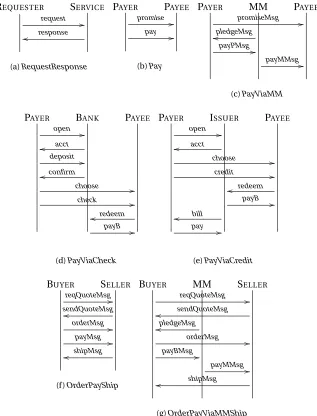
We introduce a number of running examples of protocols in Figure 2.1 which are used throughout this dissertation. The diagrams are suggestive message sequence diagrams; other message sequences are possible. We understand a protocol semantically in terms of exactly the set of runs (i.e., computations) it allows.
1. ProtocolRequestResponse: A simple and common protocol. REQUESTERmakes a request to
SERVICE, who then responds.
2. ProtocolPay: Our simplest payment protocol. If PAYERchooses to do so, it may promise to pay
PAYEE, creating a commitment. Once committed, PAYERpays at some future point.
3. Protocol PayViaMM: Similar toPay, except PAYERfirst pays a middleman (MM), who in turn
pays PAYEE. BothPay(directly) andPayViaMM(indirectly) send a payment from PAYERto PAYEE.
4. ProtocolPayViaCheck: Similar toPayViaMM, except PAYERmust first open an account with BANK.
At any time, PAYERcan make confirmed deposits and can send PAYEEa check that it redeems for payment at BANK.
5. ProtocolPayViaCredit: Similar toPayViaCheck, except PAYERmust first open an account with a
credit card ISSUER. At any time, PAYERcan make confirmed deposits or can send PAYEEa credit
that it may redeem for payment at ISSUER. ISSUERperiodically sends bills to PAYER, who then
REQUESTER SERVICE
request // response
o
o
(a)RequestResponse
PAYER PAYEE
promise // pay // (b)Pay
PAYER MM PAYEE
promiseMsg // pledgeMsg
o
o
payPMsg //
payMMsg // (c)PayViaMM
PAYER BANK PAYEE
open // acct
o
o
deposit // confirm
o
o
choose // check //
redeem
o
o
payB // (d)PayViaCheck
PAYER ISSUER PAYEE
open // acct
o
o
choose // credit //
redeem
o
o
payB // bill
o
o
pay // (e)PayViaCredit
BUYER SELLER
reqQuoteMsg// sendQuoteMsgoo orderMsg // payMsg // shipMsg
o
o
(f )OrderPayShip
BUYER MM SELLER
reqQuoteMsg // sendQuoteMsg o o pledgeMsg o o
orderMsg // payBMsg //
payMMsg // shipMsg
o
o
(g)OrderPayViaMMShip
Figure 2.1: Suggestive sequence diagrams for selected protocols (in general, alternative sequences may occur).
6. ProtocolOrderPayShip: BUYERrequests a price quote for a good from SELLER. SELLERreturns the
price quote along with its implicit commitment to ship that good if BUYERpays for it. At this
point, the BUYERmay place an order for the good, along with its implicit commitment to pay for
the good if SELLERships it. Then, in either order, BUYERpays and SELLERships.
2.2
Commitments
Commitments are a formal and concise method of describing how agent roles commit to performing future actions[Singh, 1999; Yolum and Singh, 2002]. Commitments state the debtorshouldmake the consequent true whenever the antecedent is true, but agents are notrequiredto do so. Debtors can break their commitments. Further, commitments do not require immediate fulfillment by debtors.
We extend previous commitment definitions in two ways. First, we allow both debtors and credi-tors to be sets of roles, enabling us to handle commitment chains with multiple debcredi-tors and multiple creditors. Second, we introduce a newTRANSFERcommitment operation to unify and replace prior
uses ofDELEGATEandASSIGN.
A commitmentC{debtors},{creditors}(antecedent,consequent)means that the debtors commit to the creditors, that if the antecedent holds, they will bring about the consequent. In an active commitment whose antecedent is false, the debtors are conditionally committed to the creditors. When the an-tecedent becomes true, we say the commitment isdetached, and the debtors become unconditionally committed to the creditors.
Consider the following example commitments drawn from the running examples. In Equation 2.1 forRequestResponse, SERVICEcommits to REQUESTERto respond to requests. In Equation 2.2 forPay,
the PAYERconditionally commits to paying PAYEE. In Equation 2.3 forPayViaMM, PAYERand MM
commit to paying PAYEEviapayP(PAYER’s payment) andpayM(MM’s payment).
CSERVICE,REQUESTER(request,response) (2.1) CPAYER,PAYEE(promise,pay) (2.2) C{PAYER,MM},PAYEE(promise,payP∧payM) (2.3)
null
CREATE // CREATE //
CREATE //
cond
DETACH DISCHARGE
TRANSFER
RELEASE
CANCEL
detached
DISCHARGE TRANSFER RELEASE CANCEL
dis xfer rel can
Figure 2.2: State transition diagram for commitments (states in lowercase; transitions in small caps).
Figure 2.2 shows the state transition diagram for a commitment. The states of a commitment are (i)null: where the commitment does not yet exist; (ii)cond(active and conditional): afterCREATE
and detached): afterCREATEwith antecedent true, consequent false, and with no other operations;
(iv)dis(discharged): afterCREATEand consequent being true; (v)xfer(transferred): afterCREATEand TRANSFER; (vi)rel(released): afterCREATEandRELEASE; and (vii)can(canceled): afterCREATEandCANCEL.
A commitment in statescondordetachedis said to beactive. A commitment in statesdis,xfer,rel, or canis said to beresolved.
The commitment operations are (i)CREATE, performed only by debtors, creates an active commit-ment; (ii)DETACH, which occurs implicitly when the antecedent becomes true; (iii)DISCHARGE, which
occurs implicitly when the consequent becomes true; (iv)TRANSFER, performed by either debtors or
creditors, deactivates the current commitment and replaces it by another commitment; (v)RELEASE, performed only by creditors, deactivates the commitment, thus releasing the debtors; and (vi)CANCEL,
performed only by debtors, which cancels, deactivates, and “breaks” the debtors’ commitment. As in previous work, in a correct enactment of a protocol, each detached commitment must eventually resolve. Debtors may act before they are required to do so and the consequent may become true before the antecedent. In general, there is no guarantee that autonomous debtors do not arbitrarilyCANCEL. In practice, the creditors would assume the debtors are trustworthy or the setting
would include an external mechanism (such as penalties) to ensure the debtors’ compliance.
2.3
Interpreted Systems
We adopt Lomuscio and colleagues’[2006; 2009]formalization of a multiagent system as aninterpreted system. Importantly, protocols involve roles, not agents. We presume no knowledge of the internals of an agent playing a role and consider all possible strategies that a role may follow in a protocol.
Each role is described by a set of possible local states, a set of local actions, a local strategy listing the legal actions in each local state, and a local progression function defining the progression of the role’s local state based on the actions performed by all the roles. To clarify the terminology, ourrole andstrategyrespectively map toagentandprotocolin work by Lomuscio and colleagues.
Definition 2.3.1(Interpreted System). An interpreted systemI is
I = 〈Σ,P,PV,Li,Acti,APi,ti,G,G0,F〉
Σ ={1, . . . ,n,e}is a set of three or more roles, including a distinguished role e that stands for the environment. P is a set of atomic propositions. Let i∈Σrange over all roles and the environment e . Li is a nonempty set of possible local states for each i .Actiis a set of actions for each i .APi:Li×Le7→2Acti is the local strategy for each i . In local state l ∈Li, le ∈Le, role i can perform only the actions in APi(l,le). G ⊆L1× · · · ×Ln×Le is the set of reachable global states. For any global state g ∈G , we write gi for the i -th component in g , i.e., the local state of role i in g . G
0⊆G is a nonempty set of
Act=Act1× · · · ×Actn×Acte. ti :Li×Le×Act7→Li is the local progression function for role i∈Σ\e , and te:Le×Act7→Le is the progression function for the environment. All roles progress simultaneously. The global progression function is T:G×Act7→G and is defined such that T(g,a) =g0iff∀i∈Σ\e: ti(gi,ge,ai) =g0i and te(ge,ae) =g0e. T must be serial (∀g∈G,∃a ∈Act,∃g0∈G:T(g,a) =g0). F is a set of Boolean fairness conditions, each of which must be true infinitely often on all legal execution paths. A pathπinI is an infinite sequence of global states〈g0,g1, . . .〉in G such that every pair of
adjacent states is a legal transition, i.e.,∀i≥0 :∃a ∈Act:T(gi,a) =gi+1. The i -th state in pathπis
denotedπi, and the set of all paths starting at g ∈G is denotedΠ(g).
Given an interpreted systemI, we associate with it a Kripke modelK = (G,G0,T,PV)where
G is the set of possible worlds understood as the reachable states ofK, built from the set of initial statesG0by iterating the global progression functionT; and, the temporal relationT⊆G×Act×G
connects global states based on the joint actions. The labeling functionPVis the propositional labeling function.
The grammar of the temporal language CTL is (PropNameis an atomic proposition)
φ ::= PropName| ¬φ|φ∨φ|φ∧φ|AGφ|AFφ|A[φUφ]|EGφ|EFφ|E[φUφ]
Our temporal formulae use the standard CTL temporal logic operators:A(for all paths),E(for some path),G(on all future states on a path), andF(eventually on the path). The following is the semantics for CTL, specified relative to the Kripke structureK at stateg. Given a modelK for an interpreted system,I satisfies a CTL formulaφif and only ifK,g0|=φ, whereg0∈G0is a starting state.
K,g|=p iff p∈g
K,g|=¬φ iff it is not the caseK,g|=φ K,g|=φ∧ψ iff K,g|=φandK,g|=ψ K,g|=φ∨ψ iff K,g|=φorK,g|=ψ K,g|=AGφ iff ∀π∈Π(g),∀i≥0,K,πi |=φ K,g|=AFφ iff ∀π∈Π(g),∃i≥0,K,πi |=φ
K,g|=A[φUψ] iff ∀π∈Π(g),∃k≥0,K,πk|=ψand∀0≤j<k,K,πj |=φ K,g|=EGφ iff ∃π∈Π(g),∀i≥0,K,πi |=φ
K,g|=EFφ iff ∃π∈Π(g),∃i≥0,K,πi|=φ
K,g|=E[φUψ] iff ∃π∈Π(g),∃k≥0,K,πk|=ψand∀0≤j<k,K,πj|=φ
2.4
Interceptors
Chapter 3
Approach and Overview
In this chapter, we introduce a number of our contributions that are used through out, including new commitment operations, Proton’s syntax and semantics, and the Proton source code for two example protocols.
3.1
Terminology
We adopt the following terminology. Asubprotocolrefines asuperprotocol. In hyphenated form, super-xandsub-xrefer to elementxas it occurs in the superprotocol and subprotocol, respectively. For example, asuper-roleis a role defined in the superprotocol and asub-commitmentis a commitment defined in the subprotocol.
3.2
Commitments
Commitments are crucial element of our approach.
3.2.1 Serial Composition of Commitments
InPayViaMM, where the payer commits to a middleman who commits to the payee, the two commit-ments together effectively commit the payer to the payee. We introduce serial composition as a general way to chain commitments over intermediaries, computing a single, resultant commitment. The serial composition of commitments is a static construct, but the resultant commitment dynamically progresses through the states in Figure 2.2 as the protocol progresses.
Definition 3.2.1. Let CA and CB be two commitments that satisfy the well-defineness condition
components are specified precisely as follows:
C⊕.debt := CA.debt∪CB.debt (3.1)
C⊕.cred := CA.cred∪CB.cred (3.2)
C⊕.ant := CA.ant (3.3)
C⊕.csq := CA.csq∧CB.ant∧CB.csq (3.4)
The state ofC⊕is defined based on the states ofCAandCB.C⊕is created exactly when bothCAand
CBare created.C⊕is respectively transferred, released, or canceled when at least one ofCAandCBis transferred, released, or canceled.
Singh’s[2008]formalization of commitments includes the similar idea of commitment chain-ing, but serial composition additionally captures the intuition of a coalition of roles. The above well-defineness conditionCA.csq|=CB.antfollows Singh’s[2008]definition for chaining, although serial composition accommodates different roles. The second commitment becomes active (CB.ant) whenever the first commitment resolves (CA.csq), including the case where the first debtors perform without being required to do so (CA.antalways false).
Informally, we say debtors areresponsiblefor their commitments, and creditors arebeneficiariesof their commitments. In a detached commitment, the debtors are responsible for eventually making the consequent true. Responsibility can beseveral(each debtor is responsible for just its portion),joint (each debtor is individually responsible for the entire commitment), orjoint and several(the creditors hold one debtor fully responsible, who then pursues other debtors). We useseveralresponsibility so that, in serial composition of commitments, a debtor is never compelled to assume additional responsibilities. The result of serial composition is useful for reasoning about multiple commitments, but the original commitment expression, with its individual commitments, must be retained to determine which role(s) failed to perform if the resultant consequent is not produced.
C⊕states the union of debtors is committed to the union of creditors to bring about the consequent
CA.csq∧CB.ant∧CB.csqwhen antecedentCA.antis true. Debtors areseverallyresponsible forC⊕, so that debtors are never compelled to assume additional responsibilities. Every debtor inCA.debtis partially responsible for dischargingCA, and thus is partially responsible for dischargingC⊕. Also, every debtor inCB.debthas some responsibility forC⊕. Equation 3.1 captures this intuition for debtors. Equation 3.2 captures the analogous intuition for creditors.
If we order the states of a commitment asnull<can<rel<xfer<cond<detached<dis, then the state of a serial composition is the minimum of its constituents’ states:C⊕.state=min(CA.state,CB.state). That is, a serial composition progresses no further than its least constituent.
CA⊕CBis typically stronger thanCAbecause, even though both have the same antecedent (CA.a n t), in general,CA⊕CBhas a stronger consequent (CB.c s q vs.CA.c s q∧CB.a n t∧CB.c s q). The lemma below shows serial composition is not always stronger, because⊕is idempotent: a commitment can be usefully added to a commitment chain only once.
Lemma 3.2.2. IfCk is any commitment in a commitment chainL
1≤i≤nCi, then composingCk again does not increase the strength.
( M
1≤i≤n
Ci)⊕Ck =
M
1≤i≤n
Ci
Proof. IfL
iCi is well defined, then so is(LiCi)⊕Ck. By inspection, Equations (3.1–3.4) yield the same results for both sides.
3.2.2 Scalar Serial Composition
Definition 3.2.3(Scalar Serial Composition). Let SAbe a set of Boolean expressions (terms) andCBbe a commitment that satisfy the well-defineness condition SA|=CB.ant. Then, the scalar serial composition of SAandCBis the commitmentC⊕=SA⊕CBwhose components are specified precisely as follows:
C⊕.debt := CB.debt (3.5)
C⊕.cred := CB.cred (3.6)
C⊕.ant := SA∧CB.ant (3.7)
C⊕.csq := CB.csq (3.8)
If all terms inSAare true at some state of an interaction, andCBhas been created, thenCB.debt unconditionally commits to makingCB.csqtrue at some point in the future.
Scalar serial composition simply adds all the terms inSA toCB’s antecedent. It enables us to efficiently encode statements of the form “ifSAis true, thenCB.csq”, and represent it as a commitment, which can then be serially composed with other commitments. It enables a set of propositions to be added to the front of a commitment chain.
3.2.3 Commitment Covering
Def-inition 3.2.4 extends Chopra and Singh’s[2009]notion ofcommitment strength. In addition to the logical relationships between antecedents and consequents, this definition incorporates the mapping of roles and propositions.
Definition 3.2.4(Commitment Covering). A stronger commitmentCScovers (is stronger than) a weaker commitmentCW with respect to mapping M , writtenCW ≤MCS, if and only if
∀d∈CW.d e b t M(d)∩CS.d e b t 6= ; (3.9)
∀c∈CW.c r e d M(c)∩CS.c r e d 6= ; (3.10) M(CW.a n t) |= CS.a n t (3.11)
CS.c s q |= M(CW.c s q) (3.12)
where M(x)maps (super-) element x in CW to an expression of (sub-) elements in CS.
Every super-debtor is partially (severally) responsible for discharging the super-commitment. Each super-role is mapped to (implemented by) a set of sub-rolesM(d). We require each super-debtor’s responsibilities be passed to one or more of its sub-debtors. Together these sub-debtors assume the debtor’s responsibilities. Equation 3.9 captures the requirement that every super-debtor’s responsibilities must pass to at least one of its sub-debtors, so that responsibilities are not lost. Similarly, each super-creditor is a partial beneficiary of the super-commitment. Equation 3.10 captures the requirement that every super-creditor’s benefit pass to at least one of its sub-creditors.
In many situations, multiple sub-commitments must be combined to cover a single super-commitment. In those cases, a super-commitment is covered by the serial composition of multiple sub-commitments.
We visualize our explanations by diagramming a commitment as a labeled arrow.
Cname(⊕)
debt(∪) cred(∪) ant(∧) csq(∧//)
The name of the commitment is written in the top center of the arrow. Debtors and creditors are above the arrow and the antecedent and consequent below it. When multiple terms appear in a position, they are implicitly combined using the operator in parentheses.
As a simple example, consider commitmentsC1=CPayer,Payee(promise,pay),C2=CBuyer,Seller(order,pay),
(ii)Payee7→ {Seller}, (iii)promise7→order, and (iv)pay7→pay. The diagram showsC2coversC1.
C1
Payer Payee
promise pay//
C2
Buyer Seller
order pay//
≤M
G
G
As another example, we obtainC(order,ship)≤C(order∨freeCoupon,ship)by Equation 3.11, since the stronger commitment detaches whenorderorfreeCouponis true. And, likewiseC(order,ship)≤ C(order,ship∧expressDelivery)holds by Equation 3.12, since to discharge the stronger commitment requiresexpressDeliveryin addition toship.
3.3
Proton
This section covers the syntax and semantics of Proton and Positron source statements. It also contains source examples.
3.3.1 Proton Syntax
We describe protocols using Gerard and Singh’s[2013]Proton syntax in Figure 3.1, where|separates alternatives,〈A〉∗is zero or more repetitions ofA,〈A〉+is one or more repetitions ofA, and〈A〉?is an
optional occurrence ofA.
TheProtocolnonterminal describes the syntax for a protocol (as Listing 3.2 on page 27 exemplifies). A protocol declares roles, propositions, commitments, messages, and usages of component protocols.
Protocols contains sets of guarded statements of the form:
sender→receiver:[guard]messagemeans{actions}
For example, PAYER→PAYEE:[promise]paymeans{SET(pay)}. Each messagemis sent from a sender
(m.snd) to a receiver (m.rcv), has a guard (m.guard) which must be true before the message can be sent, a set of actions (m.actions), and means a conjunction of these actions (m.actexp).initis a pseudo-message for initialization. Actions are either propositions (being set true) or a commitment operation (being performed). Boolean negation (¬) is allowed in antecedent, consequent, and guard expressions to check state, but not in message meanings.
Protocol ::= 〈packagepackageName;〉?〈importProtoName;〉∗protocolProtoName〈ArgList〉∗{ role〈RoleName;〉∗prop〈PropName;〉∗commitment〈Commit;〉∗message〈Message;〉∗ use〈Usage;〉∗}
ArgList ::= (〈〈role|prop|commitment〉name〉+)
Usage ::= InstanceName=ProtoName(〈〈role|prop|commitment〉name=name〉∗) Commit ::= ComName:C(Debtor,Creditor,Ant,Csq)
Message ::= Snd→Rcv:〈[G u a r d]〉?MsgNamemeans{Actions} | |Snd:initMsgNamemeans{Actions}
Debtor ::= RoleExp Creditor ::= RoleExp Ant ::= ActExp Csq ::= ActExp Snd ::= RoleName Rcv ::= RoleName Guard ::= MsgExp
Map ::= mapMapName:ProtoName7→ProtoName{role〈RoleMap;〉∗ prop〈PropMap;〉∗commitment〈CommitMap;〉∗}
RoleMap ::= RoleName7→RoleExp PropMap ::= PropName7→ActExp CommitMap ::= ComName7→CommitExp
RoleExp ::= RoleName| {RoleName〈,RoleName〉∗}
MsgExp ::= MsgName| ¬MsgExp|MsgExp∨MsgExp|MsgExp∧MsgExp|MsgExp→MsgExp ActExp ::= Action| ¬ActExp|ActExp∨ActExp|ActExp∧ActExp|ActExp→ActExp
CommitExp ::= ComName|CommitExp⊕CommitExp Actions ::= Action〈,Action〉∗
Action ::= PropName|CREATE(ComName)|TRANSFER(ComName)| RELEASE(ComName)|CANCEL(ComName)
agent does not violate the protocol’s guard. Each message’s meaning is a set of actions on propositions (SETandCLR) and commitments (CREATE,TRANSFER,RELEASE, andCANCEL).
TheMapnonterminal describes the syntax for a mapping between two protocols (as Listing 5.1 exemplifies). A mapping maps individual roles, propositions, and commitments from the putative su-perprotocol to expressions in the putative subprotocol.ProtoName,MapName,RoleName,PropName, ComName,MsgName, andActionare names.
The serial composition operator,⊕, chains two commitments together and is described in Sec-tion 3.2.1. We writeL
iCi for a left-associated chain((C1⊕C2)⊕. . .)⊕Cn. In Section 3.2.3, we compare
commitments between superprotocol and subprotocol, under an abstraction mappingM, using commitment covering (≤M).
Protocols may be parameterized with an ArgList of roles, propositions, and commitments, en-abling a component protocol to be instantiated in composite protocols byuse, with different values for those arguments.usefunctions like a macro expansion, expanding the contents (roles, propositions, commitments, and messages) of a component protocol into the composite protocol. For example, the protocol in Listing 3.1 instantiates an instances of constituent instances ofRequestResponseusing Proton’susestatement.
Listing 3.1Using (including) a constituent protocol. 1: protocolSomeComposite{(
2: . . . 3: use
4: A_B=agfil.RequestResponse(
5: roleREQUESTER=A,proprequest=true, 6: roleSERVICE=B,propresponse=true) 7: . . .
8: }
3.3.2 Proton Semantics
Proton’s semantics is based on interpreted systems: it constructs an interpreted system from an input superprotocol, subprotocol, and mapping.
Each stateg is a set of true propositionspi. All propositions are false in the initial stateg0. Actions
ActC={CREATE,TRANSFER,RELEASE,CANCEL}, for allCj ∈ C, andnoprepresents no-operation.
Operationally, messaging is point-to-point and synchronous. All protocol state is stored in the “environment” (effectively, a distinguished agent), and is globally accessible by all roles (a current simplification). At each time step, the environment schedules one role to execute next (interleaved execution). When scheduled, the role’s agent (i) determines which of its messages are currently enabled, by accessing the protocol’s global state and evaluating each message’s guard expression, (ii) chooses an enabled message to send or chooses “no-operation”, (iii) performs all actions in message’s meaning, in any order, and (iv) updates the protocol’s state.
In every global state g of the interpreted system, each commitmentCi has a state,Ci.state∈ StatC, whereStatC={null,cond,detached,dis,xfer,rel,can}, whose value can be any of the states in
Figure 2.2. We define propositions for the expressionsC.state=x andC.state6=x in each state g. For each commitmentCi, we evaluate the occurrence of the commitment operations using the four propositions:
CREATE(Ci) =4 Ci.state6=null
TRANSFER(Ci) =4 Ci.state=xfer
RELEASE(Ci) =4 Ci.state=rel
CANCEL(Ci) =4 Ci.state=can
As Section 5.1.1 mentions and Definition 5.2.6 formalizes, refinement depends upon a mapping between protocols to account for their different levels of abstraction. Specifically, we must map each (i) super-role to a set of sub-roles, (ii) super-proposition to a Boolean expression of sub-propositions, and (iii) super-commitment to an expression of sub-commitments. Proton combines two protocols and a mapping to (i) construct an interpreted system modelI from the subprotocol’s propositions, commitments, and guarded actions, as specified in Definition 5.2.2 and (ii) generate appropriate CTL formulas as specified in Section 5.3.5. The refinement in consideration holds if and only if the constructed model satisfies all the CTL formulas that Proton generates.
3.3.3 Proton Specification Examples
Listing 3.2 shows the Proton specification of protocolPay. Lines 2–5 declare roles Payer and Payee, propositionspromiseandpay, and the commitment. BothpromiseMsgandpayMsgmessages are sent by Payer to Payee. A message may be sent only if its guard (the expression between[and]) is true. The guard forpayMsgin Line 8 ispromiseMsg. If no guard is explicitly specified, as is the case for promiseMsgin Line 7, it is implicitly true. A message’s meaning is expressed as a set of actions after
meansand between{and}.
Listing 3.2PayProtocol 1: protocolPay{
2: rolePayer;Payee; 3: proppromise;pay;
4: commitment
5: Cpay:C(Payer,Payee,promise,pay);
6: message
7: Payer→Payee:promiseMsgmeans{promise,CREATE(Cpay)}; 8: Payer→Payee:[promiseMsg]payMsgmeans{pay};
9: }
Listing 3.3PayViaMMProtocol 1: protocolPayViaMM{ 2: role Payer;MM;Payee; 3: prop promise;
4: payP; //payment from Payer to MM 5: payM; //payment from MM to Payee
6: commitment
7: CpayP:C(Payer,Payee,promise,payP); 8: CpayM:C(MM,Payer,payP,payM);
9: message
10: Payer→Payee:promiseMsgmeans{promise,CREATE(CpayP)}; 11: MM→Payer:pledgeMsgmeans{CREATE(CpayM)};
Chapter 4
Composing Commitment Protocols
Pankaj Telang and Anup Kalia contributed to the material in this chapter ([Gerard et al., 2013]).
4.1
Introduction
We adopt an interaction-oriented stance on multiagent systems, e.g., as applied in cross-organizational service engagements. We consider(commitment) protocols, which specify the interactions between two or more roles in terms of how their messages relate to theircommitments[Singh, 1999], obtain-ing well-recognized benefits in dealobtain-ing with the autonomy and heterogeneity of business partners
[Baldoni et al., 2010b; Yolum and Singh, 2002].
Composition is a key construct in software engineering. We address two role-specific aspects of composition:role requirementswhich capture the benefits a role receives from the composite and role accountabilitywhich captures the commitments a role must make to other roles.
4.1.1 Real-Life Scenario: AGFIL
We illustrate our approach using the real-life, automobile insurance claims processing case for AGF Irish Life Holding (AGFIL) from Browne and Kellett[1999]. As Figure 4.1 illustrates, this case involves four parties along with POLICYHOLDERand ADJUSTER(not shown). AGFIL underwrites automobile
insurance policies and covers losses incurred by POLICYHOLDER. Europ Assist (CALLCENTER) provides
a 24-hour help-line service for receiving claims. Approved REPAIRERs provide repair services. Lee
Consulting Services (COORDINATOR) coordinates with AGFIL, repairers, and adjusters to handle a
claim.
The traditional model of the AGFIL scenario describes the workflows of each partner along with how they relate to one another. Such a description, even if supported by standards such as BPMN
Notify Lee CS Amend estimate Reconcile info Finalize claim Gather info Validate info Assign garage Notify AGFIL Receive car Estimate repair cost Inspect car Repair car Invoice Obtain details Contact garage Assign adjustor Agree repair Check invoice Estimate < 500 Check claim form Obtain claim form
Figure 4.1: Traditional model of a cross organizational insurance claim processing.
a formal notation[HL7, 2007; RosettaNet, 2009; WS-CDL, 2005]. These approaches express constraints on the ordering and occurrence of the messages exchanged by the business partners.
In contrast, a commitment protocol emphasizes the social state of an interaction, expressed here in terms of commitments. A protocol describes the roles involved, the messages they exchange, and any preconditions on and effects of the messages on the social state. An agent adopts a role and enacts the specified protocol by autonomously choosing (in accordance with its internal policies) how to interact.
4.1.2 Contributions and Organization