NEW FRAMEWORK FOR SECURING MOBILE ADHOC NETWORK USING LIGHTWEIGHT AUTHENTICATION AND SIGNATURE-BASED
INTRUSION DETECTION SYSTEM
SATRIA MANDALA
NEW FRAMEWORK FOR SECURING MOBILE ADHOC NETWORK USING LIGHTWEIGHT AUTHENTICATION AND SIGNATURE-BASED
INTRUSION DETECTION SYSTEM
SATRIA MANDALA
A thesis submitted in fulfilment of the requirements for the award of the degree of
Doctor of Philosophy (Computer Science)
Faculty of Computer Science and Information Systems Universiti Teknologi Malaysia
iii
iv
ACKNOWLEDGMENT
All prays be to God, Allah. Without His mercy and clemency nothing would have been possible. First and foremost, I would like to express my gratitude to my main supervisor, Prof. Dr. Abdul Hanan Abdullah, for encouragement, guidance and critics throughout my graduate studies. It is difficult to find supervisor that always allocate the time for listening to the little problems and roadblocks that unavoidably appear in the performing research. I am also very thankful to both of my co-supervisors, Associate Prof. Dr. Md. Asri Ngadi and Prof. Dr. Abdul Samad bin Haji Ismail, for their guidance, advices, motivation and friendship. Their technical and editorial advice was essential to the completion of my thesis and taught me innumerable lessons and insights while working on my academic research.
I would like to thank Ministry of Science, Technology & Innovation, Malaysia for supporting research funding of my study. I would also like to thank Professor Douglas Lea from State University of New York at Oswego, Dr. Suhartono from ITS, Indonesia, and Assistant Professor Loukas Lazos from University of Arizona, for inspiring discussion given throughout my study. They gave me feedbacks on my ideas and experiment results. I owe some colleagues and friends lots of thanks for their help and contribution. I would mention they are Miss Maznah Kamat and Saiful Adly. I should recognize their support.
v
ABSTRACT
Mobile Adhoc Network (MANET) is vulnerable to network attacks due to its open communication medium. Blackhole and wormhole attacks are the most severe attacks in the network. The attacks cause congestion and increase the possibility of confidential data theft. Unfortunately, the existing security solutions are insufficient to protect the network. This work proposed a new security framework, named Extra Secure Adhoc on Demand Distance Vector (ESAODV). This framework provides a defense-in-depth protection through layered security measures: secure protocol and intrusion detection system (IDS) with extra countermeasures. The first layer implements lightweight packet authentication, and the second layer monitors and counters malicious packets. In this study, ESAODV was implemented using Java in Time Simulator/Scalable Wireless Adhoc Network Simulator, and analyzed using R-Statistics, Sigma Plot and Minitab. Results showed that ESAODV had contained the blackhole attack and the hybrid blackhole attack (HBHA) effectively. The number of corrupting routing tables of benign nodes could be minimized to be near zero even if the number of attackers were increased. In addition, the IDS accurately detected the wormhole and the variant of wormhole attack called diversion of packet over the wormhole link (DP-WHL). The false positive for live attack detection was small. The accuracy of detection was more than 94.5 percent. Although attackers changed the pattern of packets diversion, the IDS detected the new attack pattern in near real time. In addition to these findings, this research has also modeled four performance metrics data of ESAODV, i.e., memory usage, elapsed time for completing routing tasks, number of route replies and route success, based on both linear regression and neural network. Goodness of fit parameters for the models based on the neural network was higher than the linear regression. ESAODV has been proven to provide a comprehensive protection from the most severe attacks in the network. Furthermore, the performance metrics of ESAODV based on the neural network produced a superior model.
vi
ABSTRAK
vii
TABLE OF CONTENTS
CHAPTER TITLE PAGE
DECLARATION ii
DEDICATION iii
ACKNOWLEDGMENT iv
ABSTRACT v
ABSTRAK vi
TABLE OF CONTENTS vii
LIST OF TABLES xiii
LIST OF FIGURES xvi
LIST OF ABBREVIATIONS xxii
LIST OF APPENDICES xxiv
1 INTRODUCTION 1
1.1 Overview 1
1.2 Research Motivations 3
1.3 Background of the Problem 4
1.3.1 Limitations of MANET Routing Protocols 4 1.3.2 Limitations of the Existing Security
Frame-works against the Attacks 5
1.3.3 Limitations of Performance Analysis on the Existing Proposed Security for MANET 8
1.4 Research Questions 9
1.5 Research Objectives 11
1.6 Scopes 11
1.7 Research Contributions 12
1.8 Outline of Thesis 13
2 LITERATURE REVIEW 14
viii
2.1.1 Adhoc On Demand Vector (AODV) Routing
Protocol 17
2.1.1.1 Route discovery mode 18
2.1.1.2 Route Maintenance 19
2.1.2 Optimized Link State Routing Protocol
(OLSR) 20
2.1.3 Zone Routing Protocol (ZRP) 22
2.2 Cryptographic Primitives 25
2.2.1 Cryptographic Hash Functions 27 2.2.2 Hash-based Digital Signature Scheme 27
2.2.2.1 Hash Chain 29
2.2.2.2 Merkle Signature Scheme (MSS) 29 2.2.2.3 Chaining Merkle Signature Scheme
(CMSS) 32
2.2.2.4 Generalized Signature Scheme
(GMSS) 35
2.3 Layered Security Design 38
2.4 Attacks On MANET Routing Protocol 40
2.4.1 Black Hole attack 43
2.4.2 Worm Hole attack 45
2.5 A Review of Secure Routing Protocols on MANET 46
2.5.1 AODV Secure Extension 48
2.5.1.1 Secure AODV (SAODV) 48
2.5.1.2 Authenticated Routing for Adhoc
Networks (ARAN) 51
2.5.2 OLSR Security Extension 53
2.5.3 ZRP Security Extension 57
2.6 Intrusion Detection on MANET 57
2.6.1 Detection classification 58
2.6.1.1 Anomaly-Based Detection 58
2.6.1.2 Misuse Detection 58
2.6.1.3 Specification-Based Detection 59
2.6.2 Architectures of IDS 59
2.6.2.1 Standalone IDS 59
2.6.2.2 Collaborative IDS 60
2.6.2.3 Hierarchical IDS 60
2.6.3 The Existing works in IDS for Mobile Adhoc
Network 61
ix
2.7.1 Methods for Evaluating Performance 63 2.7.1.1 Linear Regression Analysis 64 2.7.1.2 Artificial Neural Network 64 2.7.2 Current Works On MANET Performance
Analysis 67
2.8 Summary 69
3 RESEARCH METHODOLOGY 72
3.1 Details Limitation of Existing Protection for MANET
Routing Protocol 72
3.1.1 Insecurity of Secure Routing to Crypto
Attack 73
3.1.2 Vulnerability of Secure Routing Protocol to
Simple Attacks 73
3.1.3 Inefficient Solutions to Sophisticated Attacks 76 3.1.4 High Overhead Due to Lacks in
Cryptogra-phy Utilization 78
3.1.5 Insufficient Data Analysis in Performance Metrics Model of MANET Security 78
3.2 Proposed Solutions 78
3.3 Research Framework 80
3.3.1 New General Class of Attacks and Measuring the Vulnerability of Existing MANET
Rout-ing Protocols 81
3.3.2 New Framework for securing AODV from
blackhole attack 82
3.3.2.1 New Secure Routing Protocol 83 3.3.2.2 New IDS with Counter Measure 83 3.3.2.3 Cryptography Selection 84 3.3.3 Enhanced the Framework for Securing AODV
from Wormhole Attack 85
3.3.4 Performance Models of the Proposed Security
Framework 85
3.4 Research Environment 86
3.5 Data and Comparative Study 87
3.5.1 Subjects and data sources 88
3.5.2 Comparative Study 89
x
4 ENHANCED SECURITY FOR MANET ROUTING
PROTOCOL 91
4.1 New General Class of Attacks and Measuring the Vulnerability of Existing MANET Routing Protocols 91
4.1.1 Hybrid Blackhole Attack 92
4.1.1.1 HBHA Architecture 92
4.1.1.2 HBHA Scenarios 95
4.1.1.3 Severity Analysis of HBHA 96 4.1.1.4 Performance Analysis of Network
Under HBHA Scheme 104
4.1.1.5 Discussions 110
4.1.2 Generating Worm Hole Attack 112 4.1.2.1 Diversion of Packets over the Worm
Hole Link (DP-WHL) 113
4.1.2.2 Simulation Setup 114
4.1.2.3 Severity of DP-WHL attack Analysis 115 4.1.2.4 DP-WHL Patterns in AODV
rout-ing Protocol 120
4.1.2.5 Network Performance Under
DP-WHL Attack 121
4.1.2.6 Discussions 123
4.2 Correcting Architectural Flaws of SAODV 123 4.2.1 Correcting SAODV for Single Signature Scheme124 4.2.2 Correcting SAODV for Double Signature
Scheme 125
4.2.3 Corrected SAODV Under HBHA 127 4.2.4 Corrected SAODV Under DP-WHL 139
4.2.5 DP-WHL Pattern in SAODV 142
4.2.6 Discussions 146
4.3 Extra Secure AODV - ESAODV 147
4.3.1 ESAODV Architecture 148
4.3.1.1 Node Architecture in ESAODV 148
4.3.1.2 Packet Formats 149
4.3.2 Lightweight Secure Protocol 149 4.3.3 Lightweight Intrusion Detection 154
4.3.4 Countermeasures 155
4.3.5 Cryptography Selection and Analysis 155 4.3.6 Simulation on ESAODV Under HBHA 161
xi
4.3.7.1 Severity Analysis of HBHA in
ESAODV 162
4.3.7.2 Network Performance Analysis 167
4.3.7.3 Discussion 170
4.4 Strengthening IDS of ESAODV from Worm Hole Attacks170 4.4.1 Requirement for IDS with Countermeasures 171 4.4.2 Detection Algorithm for DP-WHL 171 4.4.3 Fast isolation on attackers 174 4.4.4 Efficient Multicast Warning Messages 176 4.4.5 Simulation on the New IDS Architecture 177 4.4.6 Severity of Attack Analysis 178 4.4.7 Network Performance Analysis 183
4.4.8 Discussion 184
4.5 Summary 185
5 MODELING DATA OF PERFORMANCE 187
5.1 Existing Adhoc Network Performance Models 187
5.2 Data Source and Methodology 192
5.2.1 MANET Simulation Configurations 192 5.2.2 Metric Selection and Treatment of Data for
Analysis 193
5.3 Linear Regression Analysis 196
5.3.1 Simple Linear Regression Analysis 197 5.3.1.1 The Candidates of Best Model in
Simple Regression 204
5.3.1.2 Confidence Intervals and Tests 205 5.3.2 Multiple Linear Regression Analysis 208
5.3.2.1 Fitting and Evaluating the
Signifi-cance of Predictors 209
5.3.2.2 Stepwise Selection on the Predictors 217 5.3.2.3 Best Subsets Regression for
select-ing Predictors 220
5.3.3 Summary of Performance Models based on
Multiple Linear Regression 222
5.4 Neural Network 223
5.4.1 Data Source and Methodology for ANN
computation 223
xii
5.4.4 Discussion 230
5.5 Summary 232
6 SUMMARY AND FUTURE WORKS 233
6.1 Summary of Research 233
6.2 Research Achievements 235
6.2.1 Vulnerability of MANET Routing Protocols 235 6.2.1.1 AODV and SAODV under HBHA 235 6.2.1.2 AODV and SAODV under
DP-WHL attack 238
6.2.2 ESAODV Security Framework to Protect
AODV from HBHA 239
6.2.3 Enhanced ESAODV to Protect AODV from
DP-WHL Attack 240
6.2.4 Modeling of Layered Security of MANET 240
6.3 Comparison to Previous Research 242
6.3.1 Features Comparison on the Performance of
Security Scheme in MANET 242
6.3.2 Features Comparison of the Security Scheme in Protecting Routing from Attacks 243
6.4 Future Research Directions 244
6.5 Conclusions 245
REFERENCES 246
A-D
xiii
LIST OF TABLES
TABLE NO. TITLE PAGE
2.1 Routing Protocols for MANET 15
2.2 Values of RREQ and RREP 17
2.3 The activities of relay nodes based on the RREQ fields 19
2.4 Practical on Hash-based Digital Signature 28
2.5 Secure Routing Protocols for MANET 47
3.1 IDS dataset features 84
3.2 Type of Data for Security Analysis 88
3.3 Type of Data for Performance Metric Model 89
4.1 HBHA Simulation Parameters 96
4.2 Zero Rate of Independent Attack and Collaborative Attack
Scenarios 100
4.3 Rate of Malicious RREP Level 1 for both HBHA Scenarios 104 4.4 Comparison of Independent Attack and Collaborative Attack
Scenarios 105
4.5 ANOVA on Ranks Using Turkey’s Test 110
4.6 DP-WHL Simulation Parameters for AODV Without Security 115 4.7 Fitting Equations of Attacks Launched by Malicious nodes
and Attacks Rejected by Benign Nodes under HBHA
(CSS-SAODV) 127
4.8 Fitting Equations of Attacks Launched by Malicious nodes and Attacks Rejected by Benign Nodes under HBHA -
(CDS-SAODV) 129
4.9 Weakness of SOADV to HBHA based on the Security Metrics 135 4.10 Zero Rate of Independent Attack and Collaborative Attack
Scenarios in SAODV 136
xiv
4.13 Selected Cryptographic Algorithms 160
4.14 HBHA Simulation Parameters 161
4.15 HBHA Simulation Parameters 177
5.1 Snippet of data experiments for 10 - 100 nodes 188
5.2 Simulation Parameters 192
5.3 Observations, Fitted Values, and Residuals 201 5.4 The Analysis of Variance Table for Simple Regression 202 5.5 Performance Metrics Model Based on Simple Linear Regression205 5.6 The Best Model in Each Group of Performance 208 5.7 Summary Data Of Y4 (Route Success) and its Predictors
- ESAODV Using GMSS Digital Signature with Intrusion
Detection 211
5.8 Multiple Linear Model of Route Success 212
5.9 Residuals Summary of Route Success Metric 213
5.10 Useful Parameters in Linear Model 214
5.11 Performance Metrics Model Based on Multiple Linear
Regression for All Predictors 218
5.12 New Performance Metric Model of ESAODV based on GMSSwithSHA1 (Stepwise Implementation) 219 5.13 New Performance Metric Model of ESAODV based on
RSA-1024 (Stepwise Implementation) 220
5.14 New Performance Metric Model of ESAODV based on GMSSwithSHA1 (Best Subset Regression Implementation) 221 5.15 New Performance Metric Model of ESAODV based on
RSA-1024 (Best Subset Regression Implementation) 222 5.16 Four Metrics on Secure Protocol based on GMSS and IDS
with Countermeasures 229
5.17 Four Metrics on Secure Protocol based on RSA and IDS with
Countermeasures 230
5.18 Comparison of ‘Goodness of Fit Parameters’ in Memory
Metric (Y1) 232
6.1 Features Comparison of ESAODV to Other Security Schemes in Protecting Routing from Blackhole Attack 244 6.2 Features Comparison of ESAODV to Other Security Schemes
in Protecting Routing from Wormhole Attack 244 A.1 ESAODV Using GMSS Digital Signature with Intrusion
xv
A.2 Correlation Matrix Of ESAODV Using GMSS Digital
Signature with Intrusion Detection 274
A.3 Correlation Matrix Of ESAODV Using RSA Digital Signature
with Intrusion Detection 275
A.4 Correlation Matrix Of ESAODV Using GMSS Digital Signature with Intrusion Detection (Free Multi-collinearity) 276 A.5 Correlation Matrix Of ESAODV Using RSA Digital Signature
with Intrusion Detection (Free Multi-collinearity) 277
A.6 Memory Usage - Simple Regression Model 278
A.7 Elapsed time (for completing all routing tasks) - Simple
Regression Model 279
A.8 RREP Generation - Simple Regression Model 280
A.9 Route Success - Simple Regression Model 281
A.10 Result T-Test on Performance Metrics Based on Simple
Regression 282
A.11 AODV Without Attack Data 283
A.12 HBHA - Independent Attack Scenario Data 285
A.13 HBHA - Collaborative Attack Scenario Data 287
xvi
LIST OF FIGURES
FIGURE NO. TITLE PAGE
1.1 MANET Susceptibility 2
1.2 Illustration of the problems background 8
2.1 A Scenario of Route Discovery in AODV 17
2.2 Generation of RERR messages in AODV 20
2.3 Flooding message propagation without MPR (left) and with
MPR (right) 21
2.4 Generation of a route from topology table 22
2.5 Routing zone of S0 and S1, which have radius (ρ) = 2 hops 23
2.6 ZRP Architecture 23
2.7 Construction of the Merkle Hash Tree 30
2.8 Example of Merkle authentication tree 32
2.9 The tree chaining method on CMSS 33
2.10 GMSS general construction 35
2.11 Layered defenses 38
2.12 A Route Discovery of S without blackhole attack 43
2.13 Black Hole Attacks by RREP falsification 44
2.14 Black Hole Attacks by RREQ falsification 44
2.15 Worm Hole Attack 45
2.16 RREQ and RREP single signature extension 49
2.17 RREQ double signature extension 50
2.18 RREP double signature extension 50
2.19 ARAN operational procedure 52
2.20 Basic signature extension 55
2.21 Challenge message 55
2.22 Challenge response message 55
2.23 Response message 55
2.24 ADVSIG message format 56
2.25 ZBIDS for MANETs 62
xvii
2.27 Feed Forward Neural Network 66
2.28 Chapter 2 Summary 70
3.1 Single Security Layer for MANET 73
3.2 The weakness of SAODV routing protocol 74
3.3 The weakness of ARAN routing protocol 76
3.4 Layered Security Design 79
3.5 Research Framework 80
3.6 SWANS Tester, A tool to accelerate java based simulation 87
4.1 AODV Route Receive and Route Reply Events 92
4.2 A Hybrid of Blackhole Attack (HBHA) Architecture 93 4.3 A scenario of Attacking Based on HBHA in MANET 94
4.4 A Snapshot Simulation on HBHA 96
4.5 Comparison of DRT Under Independent and Collaborative
HBHA on AODV Routing Protocol 98
4.6 Average Number of Malicious RREP vs Attackers in both of
HBHA scenarios 99
4.7 Zero Rate of Malicious RREP in both HBHA scenarios 100 4.8 Number of Malicious RREP Disrupts Routing Table of
Originator Nodes based on Level of Latency 102 4.9 Number of Malicious RREP Disrupts Routing Table of Relay
Nodes Nodes based on Level of Latency 103 4.10 Malicious RREP Rate Level 1 and RREP Rate Level 2 under
HBHA 104
4.11 RREQ Number Without Attack and Under Attack (Using
both HBHA Scenarios) 106
4.12 RREP Number without Attack and Under Attack (Using
both HBHA Scenarios) 107
4.13 RERR Number without Attack and Under Attack (Using
both HBHA Scenarios) 109
4.14 PDR of AODV’s Packet without Attack Vs Under Attack
(Using both HBHA Scenarios) 110
4.15 The Networks Under Attack at t=x secs 112
4.16 Wormhole Attack Under DP-WHL Scenario 114
4.17 Average of Number of Diversion to the Legitimate RREP (by
Attackers) 116
4.18 RREP Traffic from Benign Nodes 117
xviii
4.19 Rate Outgoing RREP traffics in benign nodes 119 4.20 Average Number of Routing Table Entry (in benign nodes)
Updated to Attacker Destination 119
4.21 Comparison of RREP’s PDR With No Attack Support And
Under DP-WHL Attack 122
4.22 Route Request Message on SS-SAODV 125
4.23 Route Discovery and Response on DS-SAODV 126 4.24 Attacks Launched by Malicious nodes and Attacks Rejected
by Benign Nodes under HBHA (CSS-SAODV) 128 4.25 Attacks Launched by Malicious nodes and Attacks Rejected
by Benign Nodes under HBHA (CDS-SAODV) 130
4.26 DRTbng in CSS-SAODV 132
4.27 DRTbng in CDS-SAODV 133
4.28 Disruption Routing Table in CSS-SAODV and CDS-SAODV 134 4.29 Number of Malicious RREP Disrupts Routing Table of
Originator Nodes based on Level of Latency (CSS-SAODV) 137 4.30 Number of Malicious RREP Disrupts Routing Table of Relay
Nodes Nodes based on Level of Latency (CSS-SAODV) 138 4.31 Comparison PDR Without Attack and Under Attack 140 4.32 Average of Diversion to the Legitimate RREP packets 141 4.33 Average of Number of RREP Sent to Attackers 143 4.34 Average Number of RREP with Attacker’s Destination
Updated in Benign Nodes 144
4.35 Comparison of RREP’s PDR Without Attack And Under
DP-WHL Attack in SAODV 145
4.36 Node Architecture in ESAODV 148
4.37 ESAODV Packet Formats 150
4.38 Hop count computation 151
4.39 Measuring of SVRM Process for Several Digital Signatures 157 4.40 Time Series Data of Measuring the Speed of SVRM 159 4.41 Timings average of the SVRM in Several Digital Signature 160 4.42 Independent HBHA in ESAODV (Secure Protocol
Imple-ments GMSS) 163
4.42 Independent HBHA in ESAODV (Secure Protocol
Imple-ments GMSS) 164
4.43 Number of Malicious RREP Disrupts Routing Table of Originator Nodes based on Level of Latency (ESAODV-GMSS)165 4.44 Number of Malicious RREP Disrupts Routing Table of Relay
xix
4.45 Security Metrics of ESAODV Implements GMSS Digital
Signature 167
4.46 PDR in ESAODV Under HBHA 168
4.47 RERP Sent in ESAODV Under HBHA 169
4.48 Detection Evaluation of ESAODV 179
4.49 Isolating To Attackers 180
4.50 ESAODV Protection Results under DP-WHL attack 181 4.50 ESAODV Protection Results under DP-WHL attack 182 4.50 ESAODV Protection Results under DP-WHL attack 183
4.51 PDR in ESAODV Under DPWHL 184
5.1 A snippet of datagram in Java 189
5.2 Ratio of route discovery success for 10 - 100 nodes 190 5.3 Ratio of route discovery success for 10 - 100 nodes, A Fitting
Curve 191
5.4 A plot of the steam data—Y4 and Yb4 onX19 200 5.5 Y4 and Yb4 with its predictors - Route Success metric
(ESAODV Using GMSS Digital Signature with Intrusion
Detection) 215
5.6 A Procedure for Computing ESAODV’s Performance Metric
Model 223
5.7 Training and Testing Results on ‘Route Reply Generated’ Data with Nine Hidden Neurons (Y3, ESAODV-GMSS). 227 5.8 Predicted Model vs Raw Data from Simulator for ‘Route
Reply Generated’ Metric (GMSS). 228
5.9 Neural Net Diagram for the total time elapsed for secure
routing Using GMSS 231
6.1 Design and Development Sequence 234
C.1 Timing of Signing and Verifying in RSA, DSA, CMSS, and
GMSS 294
C.2 The Best of SVRM Timings on Several Cryptographic
Algorithms 294
C.3 Number of Route Table Entry Updated in HBHA 295 C.4 Number of RREP Received by Originator of Route Request
in HBHA 295
C.5 Number of RREP Forwarded by Relay Node in HBHA 295
C.6 DONbng in CSS-SAODV 296
xx
C.8 DRNbng in CSS-SAODV 297
C.9 DRNbng in CDS-SAODV 297
C.10 Disruption Originator Nodes in CSS-SAODV and CDS-SAODV297 C.11 Disruption Relay Nodes in CSS-SAODV and CDS-SAODV 298 C.12 Number of RREQ Without Attack and Under DP-WHL Attack298 C.13 Number of RREP without Attack and Under DP-WHL Attack)298 C.14 Number of RERR without Attack and Under DP-WHL Attack)299 C.15 Number of Malicious RREP Disrupts Routing Table of
Originator Nodes based on Level of Latency (CDS-SAODV) 299 C.16 Number of Malicious RREP Disrupts Routing Table of Relay
Nodes Nodes based on Level of Latency (CDS-SAODV) 299 C.17 Collaborative HBHA in ESAODV (Secure Protocol
Imple-ments GMSS) 300
C.18 Independent HBHA in ESAODV (Secure Protocol
Imple-ments RSA) 301
C.19 Collaborative HBHA in ESAODV (Secure Protocol
Imple-ments RSA) 302
C.20 Number of Malicious RREP Disrupts Routing Table of Originator Nodes based on Level of Latency (ESAODV-RSA) 302 C.21 Number of Malicious RREP Disrupts Routing Table of Relay
Nodes Nodes based on Level of Latency (ESAODV-RSA) 303 C.22 Security Metrics of ESAODV Implements RSA Digital
Signature 303
C.23 RREQ Sent in ESAODV Under HBHA 304
C.24 RREQ Received in ESAODV Under HBHA 304
C.25 RERP Received in ESAODV Under HBHA 305
C.26 RERR Sent in ESAODV Under HBHA 305
C.27 RERR Received in ESAODV Under HBHA 305
D.1 Independent HBHA in ESAODV (Secure Protocol
Imple-ments GMSS And RSA) 306
D.1 Independent HBHA in ESAODV (Secure Protocol
Imple-ments GMSS And RSA) 307
D.2 Y1 and Yb1 with its predictors - Memory metric (GMSS) 307 D.3 Y2 and Yb2 with its predictors - Elapsed time metric (GMSS) 308 D.4 Y3 andYb3 with its predictors - Route Reply Generated metric
(GMSS) 308
xxi
D.7 Y3 andYb3 with its predictors - Route Reply Generated metric
(RSA) 309
D.8 Y4 and Yb4 with its predictors - Route Success metric (RSA) 309 D.9 Training and Testing Results on ‘Memory’ Data with Ten
Hidden Neurons (Y1, ESAODV-GMSS). 310 D.10 Predicted Model vs Raw Data from Simulator for ‘Memory’
Metric (Y1 vs Y1, ESAODV-GMSS). 310
D.11 Training and Testing Results on ‘Elapsed time’ Data with Nine Hidden Neurons (Y2, ESAODV-GMSS). 311 D.12 Predicted Model vs Raw Data from Simulator for ‘Elapsed
time’ Metric (Y2 vs Y2, ESAODV-GMSS). 311 D.13 Training and Testing Results on ‘Route Success’ Data with
Ten Hidden Neurons (Y4, ESAODV-GMSS). 312 D.14 Predicted Model vs Raw Data from Simulator for ‘Route
Success’ Metric (Y4 vs Y4, ESAODV-GMSS). 312 D.15 Training and Testing Results on ‘Memory’ Data with Ten
Hidden Neurons (Y1, ESAODV-RSA). 313
D.16 Predicted Model vs Raw Data from Simulator for ‘Memory’
Metric (Y1 vs Y1, ESAODV-RSA). 313
D.17 Training and Testing Results on ‘Elapsed time’ Data with Nine Hidden Neurons (Y2, ESAODV-RSA). 314 D.18 Predicted Model vs Raw Data from Simulator for ‘Elapsed
time’ Metric (Y2 vs Y2, ESAODV-RSA). 314 D.19 Training and Testing Results on ‘Route Reply Generated’
Data with Ten Hidden Neurons (Y3, ESAODV-RSA). 315 D.20 Predicted Model vs Raw Data from Simulator for ‘Route
Reply Generated’ Metric (Y3 vs Y3, ESAODV-RSA). 316 D.21 Training and Testing Results on ‘Route Success’ Data with
Ten Hidden Neurons (Y4, ESAODV-RSA). 316 D.22 Predicted Model vs Raw Data from Simulator for ‘Route
xxii
LIST OF ABBREVIATIONS
AODV – Adhoc On Demand Vector
ARAN – Authenticated Routing for Adhoc Networks A-SAODV – Adaptive Secure AODV
ANN – Artificial Neural Network
CPDRT – Cutting Point of Disruption of Routing Table CPDON – Cutting Point of Disruption of Originator Node CPDRN – Cutting Point of Disruption of Relay Node
CDS-SAODV – Corrected Double Signature of Secure Adhoc On Demand Vector
CSS-SAODV – Corrected Single Signature of Secure Adhoc On Demand Vector
DRT – Disruption of Routing Table
DON – Disruption of Originator Node
DP-WHL – Diversion of Packet over Wormhole Link
DRN – Disruption of Relay Node
ESAODV – Extra Secure AODV
ECCDSA – Elliptic Curve Cryptography Digital Signature Algo-rithm
HBHA – Hybrid Blackhole Attack
IDS – Intrusion Detection System
IDSE – IDS Engine
JiST/SWANS – Java in Time Simulator/Scalable Wireless Adhoc Network Simulator
NRC – Non Repudiation Control
RREQ – Route Request
RREQSec – Route Request Secure
RREP – Route Reply
RREPSec – Route Reply Secure
xxiii
RERRSec – Route Error Secure
RSA – Rivest, Shamir and Adleman
SAODV – Secure AODV
SS-SAODV – Single Signature of SAODV
SPE – Secure Protocol Engine
ZDRT – Zero rates of DRT
ZDON – Zero rates of DON
xxiv
LIST OF APPENDICES
APPENDIX TITLE PAGE
A Experiment Data and Theory 270
B Pseudocodes, Listings, andbAlgorithms 291
C Charts1 294
CHAPTER 1
INTRODUCTION
1.1 Overview
In recent years, Mobile Adhoc Network (MANET) has been rapidly developed and has been used in many applications, ranging from military to civilian and commercial. The setting up of such network can be performed without either any human intervention or existence of infrastructure. Search and rescue missions, data collection, and virtual classrooms and conferences, are examples of applications for the network. Devices such as laptops, Personal Digital Assistants (PDAs), and smartphones are some of the MANET nodes that use wireless media in order to communicate among themselves.
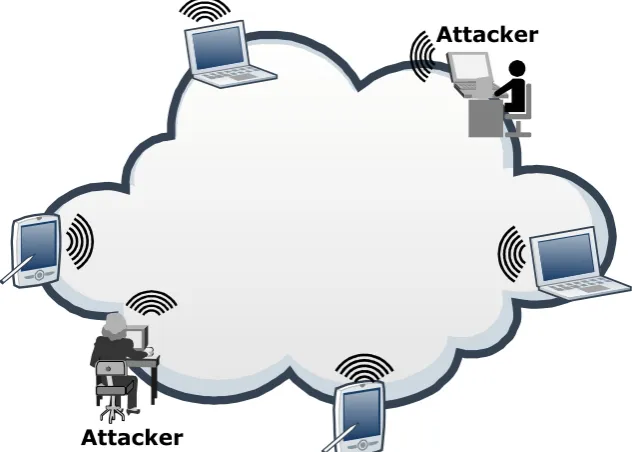
MANET is more vulnerable than wired network because of its open medium. Figure 1.1 shows the susceptibility of benign nodes to attack conducted by attackers. In that figure, attackers can threaten and attack the benign nodes at any time from any node. Mobility, unavailability of a central administration in this network, and auto organizing capability among the nodes contribute to the network security holes. Moreover, the unique characteristics and constraints of the mobile nodes, which are incapable of generating their own power and limited power supply, also contribute to the network security risks.
The intrinsic vulnerabilities of mobile adhoc network lies within the wireless links, its routing protocols, and the auto-configuration mechanisms as detailed below.
a. Wireless links
2
Attacker
Attacker
Figure 1.1: MANET Susceptibility
confidential information. It is also easier for them to enter or leave the network because no physical connection is required. The attackers can also attack nodes for deleting messages, injecting false packets, or impersonating identities (Bellardo and Savage, 2003; Bicakci and Tavli, 2009). The final goal of the attack is to disrupt network service and to violate the network’s goals, i.e., availability, integrity, authentication, and non-repudiation.
b. Routing protocols and end-to-end packets forwarding.
3
c. Auto configuration.
As indicated by Buiati et al. (2004), and Wang et al. (2005), the auto-configuration brings up new functional vulnerabilities to false replies regardless of the protocols used. In this case, an attacker can utilize the information from the neighbors to deny a new host from joining the network. First, the attacker may verify all occupied addresses, thus claims the unoccupied addresses are in use. As a result a new host cannot join the network.
1.2 Research Motivations
The vulnerabilities of wireless link and auto configuration are native features of MANET that cannot be removed. However, the vulnerability of routing protocol can be managed or eliminated through security patches or security updates. Moreover, Caballero (2006) has proven that routing protocol is the most vulnerable point in the mobile adhoc network. As such many attacks are easily generated to cripple MANET operations.
Many works have been proposed to address the vulnerability of MANET through secure routing and packet forwarding. However, most of them only provide single security layer approach, i.e., either cryptographic authentication or intrusion detection system. In addition, their results have been also conducted without considering the extensive data analysis. Le Boudec (2010) stated that insufficient data analysis produces misinformative and incomprehensive results.
4
1.3 Background of the Problem
This section presents a discussion on the limitations of exiting MANET routing protocols and the weakness of the proposed securities solutions. Last but not least, it discusses the limitation of performance analysis on the existing proposed security for MANET.
1.3.1 Limitations of MANET Routing Protocols
The early studies on MANET were focused on some fundamental problems of MANET routing protocols. The design of efficient routing protocols and new mobility models received many attentions from researchers. During the development, most researchers assumed that the protocols run in a trusted environment (Yang et al., 2004; Djenouriet al., 2005).
Routing protocol are normally categorized into three gorups. They are proactive, reactive, and hybrid routing protocols (Changling Liu, 2003; Abusalah et al., 2008; Arora et al., 2010). Djenouri et al. (2005) stated that the reactive protocols are more adaptable to MANET environment than the proactive. Bai and Singhal (2006) showed the reactive outperforms the proactive in terms of the packet delivery ratio, overhead and energy efficiency. Meanwhile, Junhai et al. (2009) concluded that the reactive is more scalable than the proactive routing protocol, although their source nodes might suffer from long delays of route searching. The hybrid adopts both features of proactive and reactive techniques in determining efficient routes. However, the hybrid routing protocol receives little attentions from MANET community since it needs more resources, such as computation and memory.
5
AODV suffers from falsification of both destination sequence number (DSN) and hop count fields (Djenouri et al., 2005). This protocol is also susceptible to tunneling, spoofing, falsifying a route error and rushing attacks. Jiejun Kong (2003) showed that AODV is more vulnerable than anonymous on-demand routing protocol (ANODR). Weerasinghe and Fu (2008) demonstrated that AODV greatly suffers from cooperative blackhole attack. Through simulation, Arora et al. (2010), concluded that the AODV is also vulnerable to wormhole attack compared to DSR.
1.3.2 Limitations of the Existing Security Frameworks against the Attacks
Zhang and Lee (2005), and Wu et al. (2007) differentiated attacks in MANET routing into simple and sophisticated attacks. Based on the simplicity in triggering the attacks, blackhole attack (Denget al., 2002; Sunet al., 2003a) is the most dangerous attack in the type of simple attacks. Meanwhile, wormhole attack (Hu et al., 2003a, 2006) is the most severe attack in the type of sophisticated attacks. Therefore, many efforts have been devoted to address both types of attacks. In general, the defense from those attacks can be categorized into preventive and reactive techniques (Wu et al., 2007; Limaet al., 2009).
The preventive technique adopts cryptography as the basis of defense to those attacks. The technique often employs symmetric key, digital public key and digital certificate for authenticating and for maintaining the integrity of routing packets. Some researchers, e.g. Smith et al. (1997); Jacobs and Corson (1999); Binkley and Trost (2001); Zapata and Asokan (2002); Sanzgiriet al.(2002, 2005); Papadimitratos and Haas (2002), and Hu and Perrig (2005), use the technique in their works. Unfortunately, these works are conducted without considering extensive test based on attacks. Therefore, the strength of the cryptography to the attacks cannot be demonstrated.
6
packet has a different of routing path compared to the RREP. The goal of the modification is to improve the security strength of SAODV. Unfortunately, this modification decreases the number of delivered packets and degrades the network performance compared to the original SAODV.
Other researchers, Lu et al. (2009), proposed Secure AODV (SAODV). It should be noted that the name of their proposed scheme is similar to Zapata and Asokan’s scheme but no correlation between the twos schemes. The authors also implement blackhole attack in evaluating the proposed security. This attack is generated by a node that has been setup as attacker or Bad Adhoc On-demand Distance Vector (BAODV). Thus, based on testing results, the authors developed a mechanism for defending MANET routing from this attack. Unfortunately, the results show that the SAODV (Luet al., 2009) consumes extra memory and CPU resources.
All proposed secure protocols as described so far also suffer from factorization attack (crypto attack). The digital signatures or certificates, used by the secure protocols, are tractable in the quantum computer. Shor (1997) has proven that factoring the digital signatures are simple. Moreover, Roblot (2004); Ch ˜A´lze and Galligo (2006); Wallace and White (2008) and Zhai (2009) strengthen Shor’s results.
The reactive technique keeps track or monitors to their neighbor activities for determining whether suspicious activities occur. The technique is well known as intrusion detection. In real world, the technique is realized as an intrusion detection system (IDS). There are three groups of IDS based on the mechanism of detection (Mishra et al., 2004). They are signature based IDS, anomaly based IDS, and specification based IDS (a hybrid both signature and anomaly based IDS). The signature based IDS compares incoming packets with pre-known attacks (or signature of attack). The anomaly based IDS attempts to detect activities that differ from the normal expected system behavior. Meanwhile, the specification based IDS performs monitoring on operation of a system using security specification (security rule).
7
several attacks (blackhole, route disruption, and DOS attacks). Meanwhile, Lauf et al. (2010) proposed IDS for identifying spoofing attacks in MANET. These IDSes consider the anomaly detection. In fact, anomaly detection needs large memory, requires much CPU resources and slow in detecting attacks. Indeed, since the goal of these IDSes is to detect simple attacks, they are incapable of identifying sophisticated attacks such as the wormhole attack.
Some researchers, such as Hu et al. (2003a, 2006), Poovendran and Lazos (2007), Qian et al. (2007), Vu et al. (2008), Nait-Abdesselam (2008), and Su (2010) proposed mechanisms to defend MANET from wormhole attack. However, Hu et al. (2003a, 2006) technique needs extra hardware, i.e., Global Positioning System (GPS)-disciplined clock for time synchronization. Poovendran and Lazos’s technique incurs huge computation resources since they adopt graph theory in detecting the wormhole attack. Intrusion detection based on statistical analysis of multi-path (SAM) (Qian et al., 2007) considers anomaly as the mechanism of detection. As such SAM is slow in detecting wormhole attack and needs huge data for learning a normal behavior. A security solution for the wormhole by Nait-Abdesselam (2008) is inaccurate to detect wormhole attack in a high density of adhoc network. Moreover, Wormhole Avoidance Routing Protocol (WARP) (Su, 2010) suffers in performance because it removes the capability of answering route request packets in the middle nodes even though the nodes have the requested route.
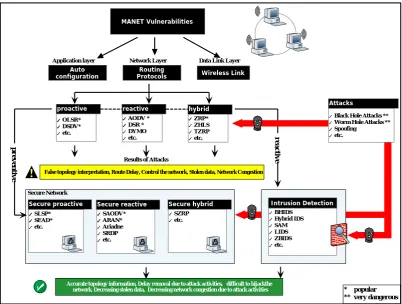
Figure 1.2 summarizes the security problems and the existing works to secure the network. Referring to the figure, routing protocols of the network suffer from spoofing, blackhole, and wormhole attacks. The attacks disrupt MANET’s routing, determine inaccurate interpretation of the network topology, and contribute to the abnormality of packet’s delivery. In the worst case, the attacks cause congestion within the network and increase the possibility of confidential data theft. In short, most of the existing protections for MANET are insufficient to defend the network from both simple and sophisticated attacks. They have a limitation to the effect of prevention techniques in general since most of them consider only single security layer in the network. It is incomprehensive in term of security mechanism since attackers can directly strike to the target after they succeeded in breaking the single security layer.
8 MANET Vulnerabilities Wireless Link Routing Protocols Auto configuration
Application layer Network Layer Data Link Layer
False topology interpretation, Route Delay, Control the network, Stolen data, Network Congestion Results of Attacks
preventiv
e
reactiv
e
* popular ** very dangerous
AODV * DSR * DYMO etc. OLSR* DSDV* etc. ZRP* ZHLS TZRP etc.
proactive reactive hybrid
Secure Network
Black Hole Attacks ** Worm Hole Attacks ** Spoofing etc. Attacks SLSP* SEAD* etc. Secure proactive SAODV* ARAN* Ariadne SRDP etc. SZRP etc. Secure reactive Secure hybrid
Accurate topology information, Delay removal due to attack activities, difficult to hijackthe network, Decreasing stolen data, Decreasing network congestion due to attack activities
BHIDS Hybrid IDS SAM LIDS ZBIDS etc. Intrusion Detection
Figure 1.2: Illustration of the problems background
need much resources, e.g., memory and CPU, and slow in detecting both types of attacks. It is contradictory to the natures of mobile adhoc network, which have limited power supply, memory and CPU resources. Furthermore, the existing protections based on authentication also suffer from factorization attacks, and some of the proposed defenses from wormhole attack require extra hardware.
1.3.3 Limitations of Performance Analysis on the Existing Proposed Security for MANET
9
relies on a simulator software to demonstrate the network performance, such as in Gnana Durai and Parthasarathy (2005); Razak et al. (2008), and Komninos and Douligeris (2009).
The network parameters and variables increase proportionally with the complexity of the network. Simplifying the parameters and variables can reduce the reliability of the network models. Meanwhile, the development of models that consider many network parameters and variables are complicated. For an example, the reliability of route in MANET is often impossible to be simplified and to be modeled due its NP-complete problems (Ghalavand et al., 2010). Therefore, simplifying parameters such in analytical approaches are unreliable methods for describing the network performance. In this situation, DES can be used to demonstrate the network performance. However, it needs extensive analysis on the data of experiments.
Most of MANET performance analyses based on simulation do not provide extensive analysis on the experimental results. Gnana Durai and Parthasarathy (2005); Ramaswami and Upadhyaya (2006); Razak et al. (2008); Komninos and Douligeris (2009), and Lu et al. (2009) perform simple analysis based on raw data from simulators in their reports. They present the results of performance in simple graphs based on the data, and disregards mathematical models. As such, their works are insufficient to predict the future outcomes without rerunning the simulation in the new configuration. In addition, the results are also incapable in describing which potential source has contributed to the results.
1.4 Research Questions
10
a. On measuring the vulnerability of existing MANET routing protocol to existing and future types of attacks, the following research questions are answered:
(i) How to objectively measure the vulnerability of MANET routing protocol?
(ii) What are the possible future attacks for MANET and how to measure the severity of the attacks?
(iii) How to represent the attacks in the simulation test-bed?
b. On designing, improving and analyzing a new lightweight layered security framework to counter simple attack that is represented by blackhole attack, the following research questions are answered:
(i) What are the components of the new security framework that counter the above attack?
(ii) How to maintain integrity, prevent from deceiving activities and provide immune from factorization attack?
(iii) How to design a light weight framework that require smaller packet size and less computation resources?
c. On designing, improving and analyzing the enhancement of the security framework to counter sophisticated attack that is represented by wormhole attack, the following research questions are answered:
(i) What are the components of the enhancement of the security framework that counter wormhole attack?
(ii) How to design the detection algorithms for detecting the attack in near realtime?
(iii) How to design the countermeasures that can react efficiently on the attacks detected?
11
d. On proposing and analyzing the performance of the security framework based on regression and neural network data analysis, the following research questions are answered:
(i) How to design the models of the security framework performance based on experimental data?
(ii) Why the model considers more than one techniques to profile the security framework performance?
From those points above, the following is the main research question to be answered: “How to develop a robust security mechanism to protect AODV routing protocol?”
1.5 Research Objectives
There are four research objectives of this research:
(a) To objectively measure the vulnerability of existing MANET routing protocol to existing and future types of attacks.
(b) To design, improve and analyze a new lightweight layered security framework to counter simple attack that is represented by blackhole attack.
(c) To design, improve and analyze the enhancement of the security framework to counter sophisticated attack that is represented by wormhole attack.
(d) To propose and analyze the performance of the security framework based on regression and neural network data analysis.
1.6 Scopes
12
(a) This research enhances AODV routing protocol security as it is the most widely used protocol for MANET.
(b) This research focuses on the security of network layer, and assume that all benign nodes consider all security protections when the network under attacks (blackhole and wormhole attacks)
(c) This research considers using ideal data link communication of MANET. (d) All nodes participants implements conventional IPv4 addressing model.
(e) For analysis based on regression, this research assumes that each of the performance metrics (response) is independent of each others; it means that there is no relationship between the performance metrics.
1.7 Research Contributions
This work has primary research contributions and secondary research contributions. The following is the primary research contributions.
(a) A new MANET security metrics for the measurement of the severity of attacks.
(b) A new efficient secure protocol that is immune from factorization attack. (c) Novel algorithms of IDS to detect both simple and sophisticated attacks. (d) The network performance models based on regression and neural network
data analysis for profiling the security of MANET routing protocols.
The secure protocol and IDS with countermeasures complements each other for preventing MANET from the attacks. They are bounded within new security framework for securing the network. In addition, the proposed securities do not add the complexity of the network. Thus, the secondary research contribution is as below:
(a) New variants of blackhole and wormhole attacks to represent possible future class of attacks.
13
(c) Enhanced Java in Time Simulator/Scalable Wireless Adhoc Network Simulator (JiST/SWANS) (http://jist.ece.cornell.edu/, 2010) as a MANET security simulator.
1.8 Outline of Thesis
This work studied three important topics in MANET: secure routing protocol, intrusion detection with countermeasure and performance metrics models. The chapter of this thesis is organized as follows.
Chapter 1, Introduction. Chapter 1 discusses overview, motivations, background of problems, research question, and contributions of this research.
Chapter 2, Literature Review. Chapter 2 discusses and reviews the current research works in securing MANET routing.
Chapter 3, Research Methodology. Chapter 3 discusses the research methodology adopted in designing security and in modeling performance of the MANET routing protocol.
Chapter 4, Enhanced Security for MANET Routing Protocol. Chapter 4 implements the research framework in order to design and develop enhanced security for AODV routing protocol.
Chapter 5, Modeling Data of Performance. Chapter 5 analyzes the data of ESAODV to develop the performance of the layered security of MANET routing.
246
REFERENCES
Aad, I., Hubaux, J.-P. and Knightly, E. W. (2004). Denial of service resilience in ad hoc networks. InMobiCom ’04: Proceedings of the 10th annual international conference on Mobile computing and networking. September 26 - October 01. New York, NY, USA: ACM. ISBN 1-58113-868-7, 202–215. doi:http://doi.acm. org/10.1145/1023720.1023741.
Aad, I., Hubaux, J.-P. and Knightly, E. W. (2008). Impact of Denial of Service Attacks on Ad Hoc Networks. IEEE/ACM TRANSACTIONS ON NETWORKING. 16(4), 791–802. doi:10.1109/TNET.2007.904002.
Abusalah, L., Khokhar, A. and Guizani, M. (2008). A survey of secure mobile Ad Hoc routing protocols. IEEE Communications Surveys & Tutorials. 10(4), 78–93. doi:10.1109/SURV.2008.080407.
Acs, G. (2009). Secure Routing In Multi-hop Wireless Networks. Ph.D. Thesis. Budapest University of Technology And Economics.
Adjih, C., Clausen, T., Jacquet, P., Laouti, A., M., P. and Raffo, D. (2003). Securing the OLSR protocol. In Proceedings of Med-Hoc-Net. June. Mahdia, Tunisia, 25–27.
Aiello, W., Lodha, S. and Ostrovsky, R. (1998). Fast digital identity revocation, Springer Berlin / Heidelberg, vol. 1462. 137–152–152.
Albers, P., Camp, O., marc Percher, J., Jouga, B. and Puttini, R. (2002). Security in Ad Hoc Networks: a General Intrusion Detection Architecture Enhancing Trust Based Approaches. In Proceedings of the First International Workshop on Wireless Information Systems (WIS-2002). April. 1–12.
Andel, T. and Yasinsac, A. (2007). The invisible node attack revisited. In SoutheastCon, 2007. Proceedings. IEEE. 686 –691. doi:10.1109/SECON.2007. 342988.
Anderson, J. P. (1980). Computer security threat monitoring and surveillance. Technical report. Fort Washington, PA: James P. Anderson Co.
247
Arora, M., Challa, R. and Bansal, D. (2010). Performance Evaluation of Routing Protocols Based on Wormhole Attack in Wireless Mesh Networks. InComputer and Network Technology (ICCNT), 2010 Second International Conference on. April. 102 –104. doi:10.1109/ICCNT.2010.34.
Bai, R. and Singhal, M. (2006). DOA: DSR over AODV Routing for Mobile Ad Hoc Networks.Mobile Computing, IEEE Transactions on. 5(10), 1403 –1416. ISSN 1536-1233. doi:10.1109/TMC.2006.150.
Baras, J. S., Radosavac, S., Theodorakopoulos, G., Sterne, D., Budulas, P. and Gopaul, R. (2007). Intrusion Detection System Resiliency to Byzantine Attacks: The Case Study of Wormholes in OLSR. InMilitary Communications Conference, 2007. MILCOM 2007. IEEE. 1 –7. doi:10.1109/MILCOM.2007. 4455008.
Barbeau, M. and Kranakis, E. (2007). Principles of Ad Hoc Networking. ISBN: 978-0-470-03290-9. The Atrium, Southern Gate, Chichester - West Sussex PO19 8SQ, England: John Wiley & Sons, Ltd.
Barr, R., Haas, Z. J. and van Renesse, R. (2005). JiST: an efficient approach to simulation using virtual machines: Research Articles. Softw. Pract. Exper. 35, 539–576. ISSN 0038-0644. doi:10.1002/spe.v35:6. Retrievable at http: //portal.acm.org/citation.cfm?id=1060168.1060170.
Bellardo, J. and Savage, S. (2003). 802.11 Denial-of-Service Attacks: Real Vulnerabilities and Practical Solutions. In the Proceedings of 12th USENIX Security Symposium. August. 15–28.
Bellur, B. and Ogier, R. (1999). A reliable, efficient topology broadcast protocol for dynamic networks. vol. 1. mar. 178 –186 vol.1. doi:10.1109/INFCOM.1999. 749266.
Bennett, C. H., Bernstein, E., Brassard, G. and Vazirani, U. (1997). Strengths and Weaknesses of Quantum Computing.SIAM Journal on Computing. 26(5), 1510–1523. doi:10.1137/S0097539796300933. Retrievable at http://link. aip.org/link/?SMJ/26/1510/1.
Bettstetter, C., Resta, G. and Santi, P. (2003). The node distribution of the random waypoint mobility model for wireless ad hoc networks. Mobile Computing, IEEE Transactions on. 2(3), 257 – 269. ISSN 1536-1233. doi: 10.1109/TMC.2003.1233531.
248
csi.2008.09.038. Retrievable at http://www.sciencedirect.com/science/ article/B6TYV-4TYYT70-1/2/1a7949e3362b28628f5ba216c1306f83, specifi-cation, Standards and Information Management for Distributed Systems. Binkley, J. and Trost, W. (2001). Authenticated ad hoc routing at the link
layer for mobile systems. Wireless Networks. 7(2), 139–145. Kluwer Academic Publishers.
Bishop, C. M. (2006). Pattern Recognition and Machine Learning. Springer Science Business Media, LLC.
Blazevic, L., Buttyan, L., Capkun, S., Giordano, S., Hubaux, J.-P. and Le Boudec, J.-Y. (2001). Self organization in mobile ad hoc networks: the approach of Terminodes. Communications Magazine, IEEE. 39(6), 166 –174. ISSN 0163-6804. doi:10.1109/35.925685.
Bolch, G., Greiner, S., de Meer, H. and Trivedi, K. S. (2006). Queueing Networks and Markov Chains, Modeling and Performance Evaluation with Computer Science Applications. (2nd ed.). John Wiley & Sons, Inc.
Bononi, L. and Tacconi, C. (2007). Intrusion detection for secure clustering and routing in Mobile Multi-hop Wireless Networks. International Journal of Information Security. 6, 379–392. ISSN 1615-5262. Retrievable at http: //dx.doi.org/10.1007/s10207-007-0035-9.
Bragg, R. (2003). CISSP Training Guide. Que Publishing.
Brutch, P. and Ko, C. (2003). Challenges in intrusion detection for wireless ad-hoc networks. In Proceedings of the Applications and the Internet Workshops. Jan. 368–373.
Buchegger, S. and Boudec, J. Y. L. (2002). Performance Analysis of the Confidant protocol. In Proceedings of the 3rd ACM International Symposium on Mobile Ad hoc networking and Computing. June. 226–236. Retrievable at http://
doi.acm.org/10.1145/513800.513828.
Buchmann, J., Dahmen, E., Klintsevich, E., Okeya, K. and Vuillaume, C. (2007). Merkle Signatures with Virtually Unlimited Signature Capacity. In Katz, J. and Yung, M. (Eds.)Applied Cryptography and Network Security. (pp. 31–45). Lecture Notes in Computer Science, vol. 4521. Springer Berlin / Heidelberg. Retrievable athttp://dx.doi.org/10.1007/978-3-540-72738-5_3.
249
Retrievable athttp://dx.doi.org/10.1007/11941378_25.
Buiati, F., Puttini, R., de Sousa, R., Abbas, C. B. and Villalba, L. G. (2004). Authentication and Autoconfiguration for MANET Nodes. In Yang, L. T., Guo, M., Gao, G. R. and Jha, N. K. (Eds.) Embedded and Ubiquitous Computing. (pp. 64–66). Lecture Notes in Computer Science, vol. 3207. Springer Berlin / Heidelberg. Retrievable at http://dx.doi.org/10.1007/ 978-3-540-30121-9_5.
Caballero, E. J. (2006). Vulnerabilities of Intrusion Detection Systems in Mobile Ad-hoc Networks - The routing problem. InSecurity and Privacy in Pervasive Computing - TKK T-110.5290 Seminar on Network Security, Autumn 2006. ISBN: 978-951-22-8595-2. http://www.tml.hut.fi/Publications/C/22/.
Capkun, S., Butty ˜Aan, L. and Hubaux, J.-P. (2003). SECTOR: secure tracking, of node encounters in multi-hop wireless networks. In In ACM Workshop on Security of Ad Hoc and Sensor Networks (SASN. 21–32.
Carter, E. and Hogue, J. (2006).Intrusion Prevention Fundamentals. Cisco Press. Castelluccia, C., Saxena, N. and Yi, J. H. (2005). Self-configurable key pre-distribution in mobile ad hoc networks. In in: IFIP Networking Conference. 1083–1095.
Cerri, D. and Ghioni, A. (2008). Securing AODV: the A-SAODV secure routing prototype. IEEE Communications Magazine. 46(2), 120–125. doi:10.1109/ MCOM.2008.4473093.
Chakeres, I. and Perkins, C. (2008). Dynamic MANET on demand Routing Protocol. INTERNET-DRAFT (draft-ietf-manet-dymo-12.txt). Retrievable at
http://ianchak.com/dymo/draft-ietf-manet-dymo-12.txt.
Chan, E., Chan, H., Chan, K., Chan, V., Chanson, S., Cheung, M., Chong, C., Chow, K., Hui, A., Hui, L., Lam, L., Lau, W., Pun, K., Tsang, A., Tsang, W., Tso, S., Yeung, D.-Y. and Yu, K. (2004). IDR: an intrusion detection router for defending against distributed denial-of-service (DDoS) attacks. InProceedings of the 7th International Symposium on Parallel Architectures, Algorithms and Networks. May. ISSN 1087-4089, 581–586. doi:10.1109/ISPAN.2004.1300541.
Changling Liu, J. K. (2003). A Survey of Mobile Ad Hoc network Routing Protocols. Technical report. Department of Computer Structures - University of Ulm - Germany: University of Ulm.
250
–36. doi:10.1109/ICWMC.2006.14.
Cheng, B., Chen, H., Tseng, R. and Nov, D.-. (2008). A Good IDS Response Protocol of MANET Containment Strategies. Ieice T Commun Ieice T Commun Ieice Transactions on Communications. E91b(11), 3657–3666.
Cherkassky, V. and Mulier, F. (2007). Learning from Data Concepts, Theory, and Methods. (2nd ed.). IEEE Press - A John Wiley & Sons, Inc.
Chiang, C.-C., Wu, H.-K., Liu, W. and Gerla, M. (1997). Routing in Clustered Multihop, Mobile Wireless Networks with Fading Channel. InIEEE Singapore International Conference on Networks, SICON’97, April 16-17, 1997, Singa-pore. April. IEEE, IEEE, 197–211. Retrievable at http://www.ics.uci.edu/
~atm/adhoc/paper-collection/gerla-routing-clustered-sicon97.pdf. Chiu, H. and Wong Lui, K. (2006). DelPHI: wormhole detection mechanism for
ad hoc wireless networks. In The 1st International Sysmposium on Wireless Pervasive Computing. 10.1109/ISWPC.2006.1613586. Retrievable at http:
//hdl.handle.net/10722/45913.
Ch ˜A´lze, G. and Galligo, A. (2006). From an approximate to an exact absolute polynomial factorization. Journal of Symbolic Computation. 41(6), 682 – 696. ISSN 0747-7171. doi:DOI:10.1016/j.jsc.2005.11. 004. Retrievable at http://www.sciencedirect.com/science/article/ B6WM7-4J32JDX-1/2/2c721593ed4b3c873a6a242c25f8268b.
Clausen, T. and Jacquet, P. (2003). Optimized Link State Routing Protocol (OLSR). Internet draft 3626 (rfc3626.txt). Retrievable at http://www.ietf.
org/rfc/rfc3626.txt.
Currell, G. and Dowman, A. (2009). Essential Mathematics and Statistics for Science Second Edition. A John Wiley & Sons, Ltd.
Dahmen, E. (2009). Post-quantum signatures for today. Ph.D. Thesis. Technischen Universit ˆA´lat Darmstadt genehmigte.
Darmstadt, T. U. (2010). The FlexiProvider. Retrievable at http://www. flexiprovider.de, accessed on Oct 2010.
Deng, H., Li, W. and Agrawal, D. P. (2002). Routing security in wireless ad hoc networks. IEEE Communications Magazine. 40(10), 70–75. doi:10.1109/ MCOM.2002.1039859.
251
Diffie, W. and Hellman, M. (1976). New directions in cryptography. Information Theory, IEEE Transactions on. 22(6), 644 – 654. ISSN 0018-9448. doi:10. 1109/TIT.1976.1055638.
Djenouri, D., Khelladi, L. and Badache, A. N. (2005). A survey of security issues in mobile ad hoc and sensor networks. IEEE Communications Surveys & Tutorials. 7(4), 2–28. doi:10.1109/COMST.2005.1593277.
Dong, D., Li, M., Liu, Y., Li, X.-Y. and Liao, X. (2009a). Topological detection on wormholes in wireless ad hoc and sensor networks. In Network Protocols, 2009. ICNP 2009. 17th IEEE International Conference on. ISSN 1092-1648, 314 –323. doi:10.1109/ICNP.2009.5339673.
Dong, Y., Chim, T. W., Li, V. O., Yiu, S. and Hui, C. (2009b). ARMR: Anonymous routing protocol with multiple routes for com-munications in mobile ad hoc networks. Ad Hoc Networks. 7(8), 1536 – 1550. ISSN 1570-8705. doi:DOI:10.1016/j.adhoc.2009.04. 010. Retrievable at http://www.sciencedirect.com/science/article/ B7576-4W4JDSN-1/2/771d6d33da7d945c864a1601026c5a75, privacy and Se-curity in Wireless Sensor and Ad Hoc Networks.
Dong, Y., Sui, A.-F., Yiu, S., Li, V. O. and Hui, L. C. (2007). Providing distributed certificate authority service in cluster-based mobile ad hoc networks. Computer Communications. 30(11-12), 2442 – 2452. ISSN 0140-3664. doi:DOI:10.1016/j.comcom.2007.04.011. Retrievable at http://www.sciencedirect.com/science/article/B6TYP-4NMC89M-1/
2/6315e5e8e907baf77bb11270787c5816, special issue on security on wireless ad hoc and sensor networks.
Douceur, J. R. (2002). The Sybil Attack. In Druschel, P., Kaashoek, F. and Rowstron, A. (Eds.) Peer-to-Peer Systems (Lecture Notes in Computer Science Volume 2429). (pp. 251–260). vol. 2429/2002. Springer-Verlag Berlin Heidelberg NewYork: Springer Berlin / Heidelberg.
Drapper, N. and Smith, H. (1998). Applied Regression Analysis 3rd Ed. John Wiley & Sons, Inc.
Dube, R., Rais, C., Wang, K.-Y. and Tripathi, S. (1997). Signal stability-based adaptive routing (SSA) for ad hoc mobile networks.Personal Communications, IEEE. 4(1), 36 –45. ISSN 1070-9916. doi:10.1109/98.575990.
252
Engelbrecht, A. P. (2007). Computational Intelligence, An Introduction. (2nd ed.). ISBN:978-0-470-03561-0. John Wiley & Sons Ltd. Retrievable at www. wiley.com.
Faraway, J. J. (2005). Linear Models with R. Chapman & Hall/CRC. Retrievable atwww.crcpress.com.
Feeney, L. M. (1999). A Taxonomy for Routing Protocols in Mobile Ad Hoc Networks. Technical report. Box 1263, SE-164 29 Kista, Sweden: Swedish Institute of Computer Science.
Fourati, A., Al Agha, K. and Dec, D.-. (2008). Detecting forged routing messages in ad hoc networks. Telecommun Syst Telecommun Syst Telecommunication Systems. 39(3-4), 205–214 ST – Detect. 379RA Times Cited:0 Cited References Count:14.
Galmacci, G. (1996). Collinearity detection in linear regression models. Computational Economics. 9, 215–227. ISSN 0927-7099. Retrievable at http://dx.doi.org/10.1007/BF00121635.
Garcia-Luna-Aceves, J. J. (2002). Flow-oriented protocols for scalable wireless networks. InMSWiM ’02: Proceedings of the 5th ACM international workshop on Modeling analysis and simulation of wireless and mobile systems. New York, NY, USA: ACM. ISBN 1-58113-610-2, 1–6. doi:http://doi.acm.org/10.1145/ 570758.570759.
Garcia-Luna-Aceves, J. J. and Spohn, M. (1999). Source-Tree Routing in Wireless Networks. In Proceedings of the 7th International Conference on Network Protocols (IEEE ICNP 99), October 1999, Toronto, Candada. October. IEEE, 273–282.
Garetto, M. and Leonardi, E. (2007). Analysis of Random Mobility Models with Partial Differential Equations.Mobile Computing, IEEE Transactions on. 6(11), 1204 –1217. ISSN 1536-1233. doi:10.1109/TMC.2007.1023.
Ghalavand, G., Dana, A., Ghalavand, A. and Rezahosieni, M. (2010). Reliable routing algorithm based on fuzzy logic for Mobile Ad Hoc Network. In Proc. 3rd Int Advanced Computer Theory and Engineering (ICACTE) Conf, vol. 5. doi:10.1109/ICACTE.2010.5579341.
253
Goetz, B., Peierls, T., Bloch, J., Bowbeer, J., Holmes, D. and Lea, D. (2006). Java Concurrency in Practice. ISBN-10: 0-321-34960-1. Addison Wesley Professional.
Groenevelt, R., Nain, P. and Koole, G. (2005). The message delay in mobile ad hoc networks. Performance Evaluation. 62(1-4), 210 – 228. ISSN 0166-5316. doi:DOI:10.1016/j.peva.2005.07.018. Retrievable at http://www.sciencedirect.com/science/article/B6V13-4GWBDNX-1/2/
e649f31bf9844b2a5d949445d9e0e2be, performance 2005.
Grossglauser, M. and Tse, D. (2002). Mobility increases the capacity of ad hoc wireless networks.Networking, IEEE/ACM Transactions on. 10(4), 477 – 486. ISSN 1063-6692. doi:10.1109/TNET.2002.801403.
Gunther, F. and Fritsch, S. (2010). neuralnet: Training of Neural Networks. The R Journal. 2, 30–37.
Guti ˜Al’rrez, R., del Pozo, F. and Boccaletti, S. (2011). Node Vulnerability under Finite Perturbations in Complex Networks. PLoS ONE. 6(6), e20236. doi: 10.1371/journal.pone.0020236. Retrievable at http://dx.doi.org/10.1371% 2Fjournal.pone.0020236.
Haas, Z. and Barr, R. (2005). Density-independent, scalable search in ad hoc networks. In Personal, Indoor and Mobile Radio Communications, 2005. PIMRC 2005. IEEE 16th International Symposium on, vol. 2. September. 1401 –1408 Vol. 2. doi:10.1109/PIMRC.2005.1651669.
Haas, Z. and Pearlman, M. (2001). The performance of query control schemes for the zone routing protocol. Networking, IEEE/ACM Transactions on Networking, IEEE/ACM Transactions on. 9(4), 427–438.
Haas, Z. J., Pearlman, M. R. and Samar, P. (2002). The Zone Routing Protocol (ZRP) for Ad Hoc Networks. Internet draft (draft-ietf-manet-zone-zrp-04.txt). Retrievable at http://www.ietf.org/proceedings/55/I-D/ draft-ietf-manet-zone-zrp-04.txt, expires January 2003.
Hafslund, A., T˜A¨ynnesen, A., Rotvik, R. B., Andersson, J. and ˜A¨Yivind Kure (2004). Secure Extension to the OLSR protocol. In OLSR Interop and Workshop. August. 1–4.
Haller, N. and Bellcore (1995). RFC 1760 - The S/KEY One-Time Password System. Request for Comments 1760 (rfc1760.html). Retrievable at http:
254
Hallgren, S. and Vollmer, U. (2009). Quantum computing. In Bernstein, D. J., Buchmann, J. and Dahmen, E. (Eds.) Post-Quantum Cryptography. (pp. 15– 34). Springer Berlin Heidelberg. ISBN 978-3-540-88702-7. Retrievable athttp: //dx.doi.org/10.1007/978-3-540-88702-7_2.
Hamma, T., Katoh, T., Bista, B. B. and Takata, T. (2006). An Efficient ZHLS Routing Protocol for Mobile Ad Hoc Networks. In Proc. 17th Int. Workshop Database and Expert Systems Applications DEXA ’06. 66–70. doi:10.1109/ DEXA.2006.24.
Hanbali, A. A., Nain, P. and Altman, E. (2008). Performance of ad hoc networks with two-hop relay routing and limited packet lifetime (extended version). Per-formance Evaluation. 65(6-7), 463 – 483. ISSN 0166-5316. doi:DOI:10.1016/j. peva.2007.12.005. Retrievable at http://www.sciencedirect.com/science/ article/B6V13-4RFSCRB-1/2/05051b09a3fbeadc6496a2d38bd7bea6, inno-vative Performance Evaluation Methodologies and Tools: Selected Papers from ValueTools 2006.
Haykin, S. (1999). Neural Network - A Comprehensive Foundation. (2nd ed.). Prentice-Hall, Inc.
Heberlein, L., Dias, G., Levitt, K., Mukherjee, B., Wood, J. and Wolber, D. (1990). A network security monitor. In Proceedings IEEE Computer Society Symposium on Research in Security and Privacy. May. 296–304. doi:10.1109/ RISP.1990.63859.
Hilewitz, Y., Yin, Y. and Lee, R. (2008). Accelerating the Whirlpool Hash Function Using Parallel Table Lookup and Fast Cyclical Permutation. In Nyberg, K. (Ed.) Fast Software Encryption. (pp. 173–188). Lecture Notes in Computer Science, vol. 5086. Springer Berlin Heidelberg. ISBN 978-3-540-71038-7.
Hornik, K., Stinchcombe, M. and White, H. (1989). Multilayer feedforward networks are universal approximators. Neural Networks. 2(5), 359 – 366. ISSN 0893-6080. doi:DOI:10.1016/0893-6080(89)90020-8. Retrievable at http://www.sciencedirect.com/science/article/B6T08-485RHTR-5R/ 2/5d13881c0b9d8128fde7950a6f55849d.
255
http://jist.ece.cornell.edu/ (2010). JiST / SWANS - Java in Simulation Time / Scalable Wireless Ad hoc Network Simulator. Internet. Retrievable at http:
//www.r-project.org/.
Hu, L. and Evans, D. (2004). Using Directional Antennas to Prevent Wormhole Attacks. In Network and Distributed System Security Symposium. San Diego, 5-6 February 2004. Retrievable athttp://citeseerx.ist.psu.edu/viewdoc/ summary?doi=10.1.1.135.7144.
Hu, Y. C. and Perrig, A. (2005). Ariadne: A Secure On-Demand Routing Protocols for Ad Hoc Networks.Wireless Networks. 11(1-2), 21–38.
Hu, Y.-C., Perrig, A. and Johnson, D. (2006). Wormhole attacks in wireless networks. Selected Areas in Communications, IEEE Journal on. 24(2), 370 – 380. ISSN 0733-8716.
Hu, Y.-C., Perrig, A. and Johnson, D. B. (2003a). Packet leashes: a defense against wormhole attacks in wireless networks. InProceedings of the INFOCOM 2003. Twenty-Second Annual Joint Conference of the IEEE Computer and Communications Societies, vol. 3. April. 1976–1986.
Hu, Y.-C., Perrig, A. and Johnson, D. B. (2003b). Rushing attacks and defense in wireless ad hoc network routing protocols. In Proceedings of the 2nd ACM workshop on Wireless security. San Diego, CA, USA: ACM, New York, NY, USA, 30–40.
Ihaka, R., Gentleman, R. and Team, R. D. C. (1997).The R Project for Statistical Computing. Internet. Retrievable athttp://www.r-project.org.
J Wu, Y. J. T., H Z Deng and Zhu, D. Z. (2007). Vulnerability of complex networks under intentional attack with incomplete information. Journal of Physics A: Mathematical and Theoretical. 40, 2665–2671.
Jacobs, S. and Corson, S. (1999). MANET authentication architecture. Internet draft (draft-jacobs-imep-auth-arch-01.txt ).
Jiejun Kong, M. G., Xiaoyan Hong (2003). An Anonymous On Demand Routing Protocol with Untraceable Routes for Mobile Ad-hoc Networks. Technical report. University of California, Los Angeles, CA 90095: UCLA COMPUTER SCIENCE DEPARTMENT TECHNICAL.
256
Johnson, D., Y.Hu and D.Maltz (2007). The Dynamic Source Routing Protocol (DSR) for mobile Ad hoc network for IPV4. Request for Comments 4728 (rfc4728.txt). Retrievable athttp://www.ietf.org/rfc/rfc4728.txt. Johnson, D. A., David B.and Maltz (1996). Dynamic Source Routing in Ad Hoc
Wireless Networks. In Imielinski and Korth (Eds.)Mobile Computing. vol. 353. Kluwer Academic Publishers. Retrievable athttp://citeseer.ist.psu.edu/ johnson96dynamic.html.
Jou, Y. F., Gong, F., Sargor, C., Wu, X., Wu, S. F., Chang, H. C. and Wang, F. (2000). Design and Implementation of a Scalable Intrusion Detection System for the Protection of Network Infrastructure. In Proceedings of the DARPA Information Survivability Conference and Exposition. January. 25–27.
Junhai, L., Danxia, Y., Liu, X. and Mingyu, F. (2009). A survey of multicast routing protocols for mobile Ad-Hoc networks.IEEE Communications Surveys & Tutorials. 11(1), 78–91. doi:10.1109/SURV.2009.090107.
Kachirski, O. and Guha, R. (2003). Effective Intrusion Detection Using Multiple Sensors in Wireless Ad Hoc Networks. InProceedings of the 36th Annual Hawaii International Conference on System Sciences (HICSS’03, vol. 2. 6-9 Jan. 2003. IEEE Computer Society Washington, DC, USA, 57.1.
Kadri, B., Feham, M. and M’hamed, A. (2009). Securing reactive routing protocols in MANETs using PKI (PKI-DSR). Security and Communication Networks Security Comm. Networks. 2(4), 341–350.
Khabbazian, M., Mercier, H. and Bhargava, V. (2009). Severity analysis and countermeasure for the wormhole attack in wireless ad hoc networks.Wireless Communications, IEEE Transactions on. 8(2), 736 –745. ISSN 1536-1276. doi:10.1109/TWC.2009.070536.
Khalil, I., Bagchi, S. and Shroff, N. B. (2007). LiteWorp: Detection and isolation of the wormhole attack in static multihop wireless networks. Computer Networks. 51(13), 3750 – 3772. ISSN 1389-1286. doi:DOI:10. 1016/j.comnet.2007.04.001. Retrievable at http://www.sciencedirect.com/ science/article/pii/S1389128607001004.
Ko, Y.-B. and Vaidya, N. H. (2000). Location-aided routing (LAR) in mobile ad hoc networks. Wireless Networks. 6(4), 307–321. ISSN 1022-0038. doi: http://dx.doi.org/10.1023/A:1019106118419.