ISSN(Online): 2320-9801
ISSN (Print) : 2320-9798
I
nternational
J
ournal of
I
nnovative
R
esearch in
C
omputer
and
C
ommunication
E
ngineering
(An ISO 3297: 2007 Certified Organization)
Vol. 4, Issue 3, March 2016
Simulation of Mouse using Image Processing
Via Convex Hull Method
Ahemad Siddique1, Abhishek Kommera2,Divya Varma3
UG Student, Dept. of CSE, Ballarpur Institute of Technology, Ballarpur, Maharashtra, India1
Professor, Dept. of CSE, Ballarpur Institute of Technology, Ballarpur, Maharashtra, India2
UG Student, Dept. of CSE, Ballarpur Institute of Technology, Ballarpur, Maharashtra, India3
ABSTRACT: Computer and human life is co-related with communication. For better performance it is mandatory that the user interact with the machine to enhance productivity. Based on extrapolation of past trends and examination of technologies under development the following paper serves to be a new approach for controlling mouse movement using image processing technique. Most existing approaches involve changing mouse components or miniaturization of mouse design with advancement in computing. We propose to change the hardware design itself. The following paper is similar to the base research for Human Computer Interaction (HCI) which observe the way in which human interacts with computer and design technologies. The proposed paper makes use of image processing via Convex Hull Method and uses human hand gestures to replace mouse functions. (i.e. left click, right click, and cursor movement)
KEYWORDS:Human Computer Interaction (HCI), image processing, Convex Hull Method, hand gestures..
I.INTRODUCTION
All most forty years ago, the concept of mouse has been and continues to be a critical part of computer interface. It’s most ubiquitous part of any GUI. With a phases of evolution, mouse with multiple buttons, strollers and other sensing devices were discovered. More over with the extrapolation of past trends the concept of mouse moreover remains the same: a single-point interaction device. While noting the new interaction paradigms are evolving along with the research in this area, this paper supports the legacy applications in both todays and future system, which requires mouse based input as a support.
Human Computer interaction (HCI) serves as the area of research which observe the way in which human interact with computer and design new technologies. It’s an important area where people try to improve the Computer Technology. Vision based gestures and objects recognition is another area of research which do make of image processing technique for its implementation.
A simple interface like embedded keyboards and mouse do exist in market. However, these interfaces require some amount of space and cannot be used while moving or may have restrained area of usage. By applying image processing technique as a part of computer vision technology, controlling the mouse by natural hand gestures can be done also the workspace required could be reduced. The following paper propose a novel approach the make use of convex hull algorithm to make the mouse function on hand gestures rather with the help of hardware
II. RELATED WORKS
ISSN(Online): 2320-9801
ISSN (Print) : 2320-9798
I
nternational
J
ournal of
I
nnovative
R
esearch in
C
omputer
and
C
ommunication
E
ngineering
(An ISO 3297: 2007 Certified Organization)
Vol. 4, Issue 3, March 2016
tapes in the fingers. In their paper [16] K N Shah et al have represented some of the innovative methods of the finger tracking used to interact with a computer system using computer vision. They have divided the approaches used in Human Computer Interaction (HCI) in two categories: 1. HCI without using interface and 2. HCI using interface. Moreover, they have mentioned some useful applications using finger tracking through computer vision. (ed all fonts, in particular symbol fonts, as well, for math, etc.
Based Human-Computer Interaction through Real-Time Hand Tracking and Gesture Recognition Vision-based interaction is an appealing option for replacing primitive human computer interaction (HCI) using a mouse or touchpad. We propose a system for using a webcam to track a user’s hand and recognize gestures to initiate specific interactions. The contributions of our work will be to implement a system for hand tracking and simple gesture recognition in real time [1].
Many researchers in the human computer interaction and robotics fields have tried to control mouse movement using video devices. However, all of them used different methods to make a clicking event. One approach, by Erdem et al, used fingertip tracking to control the motion of the mouse. A click of the mouse button was implemented by defining a screen such that a click occurred when a user’s hand passed over the region [2, 3]. Another approach was developed by Chu-Feng Lien [14]. He used only the finger-tips to control the mouse cursor and click. His clicking method was based on image density, and required the user to hold the mouse cursor on the desired spot for a short period of time. Paul et al, used still another method to click. They used the motion of the thumb (from a ‘thumbs-up’ position to a fist) to mark a clicking event the
III. PROPOSED SYSTEM ARCHITECTURE
The proposed paper serves to be the research paper for the simulation of mouse and its functionalities via human hand gesture recognition. It makes the use of convex hull algorithm to replace the actual mouse with human hand.
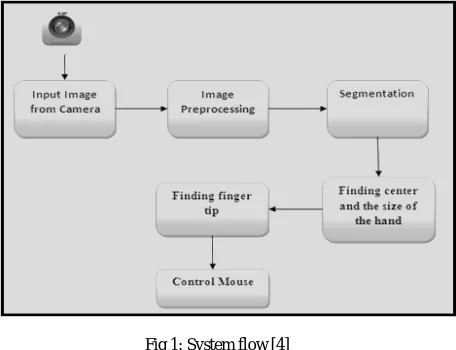
System architecture is an overview of hand gesture recognition and mouse control system. First the input image is converted to a binary image to separate hand from the background. Then centre of hand is calculated and computed radius of the hand is found. Fingertip points are being calculated using the Convex Hull algorithm. All the mouse movements are controlled using the hand gesture.
Once we get an image from the camera, the image is converted to YCbCr from the color space RGB as shown in figure 1. Then, we define a range of colors as ‘skin color’ and convert these pixels to white; all other pixels are converted to black. Then, the centric of the dorsal region of the hand is computed. Once the hand is identified, we find the circle that best fits this region and multiply the radius of this circle by some value to obtain the maximum extent of a ‘non-finger region’. From the binary image of the hand, we get vertices of the convex hull of each finger. From the vertex and canter distance, we obtain the positions of the active fingers. Then by extending any one vertex, we control the mouse movement.
Fig 1: System flow [4]
ISSN(Online): 2320-9801
ISSN (Print) : 2320-9798
I
nternational
J
ournal of
I
nnovative
R
esearch in
C
omputer
and
C
ommunication
E
ngineering
(An ISO 3297: 2007 Certified Organization)
Vol. 4, Issue 3, March 2016
algorithm, we can detect finger tips on the hand. We will use this algorithm to recognize if a finger is folded or not. To recognize those states, we multiplied 2 times to the hand radius value and check the distance between the center and a pixel which is in convex hull set. If the distance is longer than the radius of the hand, then a finger is spread. In addition, if two or more interesting points existed in the result, then we regarded the longest vertex as the index finger and the hand gesture is clicked when the number of the result vertex is two or more. The result of convex hull algorithm has a set of vertexes which includes all vertexes. Thus sometimes a vertex is placed near other vertexes. This case occurs on the corner of the fingertip. To solve this problem, we deleted a vertex whose distance is less than 10 pixels when comparing with the next vertex. Finally, we can get one interesting point on each finger.
IV. IMPLEMENTATION OF ALGORITHM
A convex hull algorithm for Hand detection and gesture recognition can be used in many helpful applications, implementation of some efficient techniques and algorithms to detect hand gestures to be able to control the PC and other applications using the detected gestures. One of the techniques used, depends on the skin color features in the YCrCb color space. This color space is much preferable than RGB and HSV, as the skin color can be much efficiently differentiated in the YCrCb Color Model.
For a more efficient detection, implementation of a background subtraction algorithm is used to differentiate between skin like objects and real skin colors. Initially, a frame is captured with only the background in the scene, after that, for every captured frame, each pixel in the new frame is compared to its corresponding one in the initial frame, if they pass a certain threshold according to specific algorithm computations, then this pixel is considered from the human body and it will be drawn in a new frame with its original color. If this pixel is below the threshold, then those two pixels are considered the same and they are considered as background so the corresponding pixel will take a zero color in the third frame. After repeating this for all frames' pixels, now we will have a new frame with only a human appearing in it, and all the background took a color of zero.
Fig 2: Hand Detection before Convex hull algorithm[4]
ISSN(Online): 2320-9801
ISSN (Print) : 2320-9798
I
nternational
J
ournal of
I
nnovative
R
esearch in
C
omputer
and
C
ommunication
E
ngineering
(An ISO 3297: 2007 Certified Organization)
Vol. 4, Issue 3, March 2016
Now we are having the detected hand as shown in figure 2 and 3, I applied on this hand object an efficient gesture recognition algorithm, that draws a convex hull over the hand object, and counts the number of defects in this hull, if no defects found, then it is a closed hand, if five defects found, then there are five fingers waving, and so on. [4]
V. GUI IMPLEMENTATION
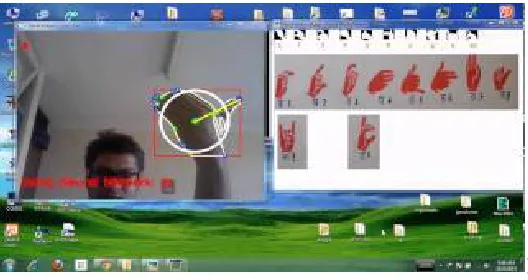
Once the hand gesture is being captured one can easily integrate the mouse functionality with the help of mouse libraries available for java, c#, Unixetc.The following images shows the gestures recognition via the proposed algorithm and its functioning.
Fig 4. Hand detection via web-cam [18]
Figure 4. demonstrate the detection of hand via web cam and the operation of mouse functionality through gesture movement. The area of hand is tracked by the web cam with the help of convex hull algorithm and the centre of the palm serves to be the geometric centre for hand geometry so it’s easy to trace out the movement.
]
Fig 5. Implementing mouse function with hand gestures [17]
ISSN(Online): 2320-9801
ISSN (Print) : 2320-9798
I
nternational
J
ournal of
I
nnovative
R
esearch in
C
omputer
and
C
ommunication
E
ngineering
(An ISO 3297: 2007 Certified Organization)
Vol. 4, Issue 3, March 2016
VI.CONCLUSION AND FUTURE SCOPE
Thus a new system has been proposed with enhanced dimensionality and usage of computing system. We have developed a system to control the mouse system with hand gesture recognition with the help of real time camera i.e. web-cam. The goal of this project is to enhance the human computing methodology and increase the productivity of human, thus creating an impact on human computing trends.Advancement in the existing project can be done for the enhancement in the functionalities of traditional computing methodologies and replacing the traditional hardware by human gesture. The complete computer system could be then operated with the help of human gesture we can also integrate the human voice command for computing operations to be performed. This then would turn the phase of human computing.
REFERENCES
[1] A. Erdem, E. Yardimci, Y. Atalay, V. Cetin, “ Computer vision based mouse” , (ICASS). IEEE International Conference. 2002. [2] Hart Lambur, Blake Shaw, “ CS4731 Project: Gesture Recognition” , Department of Computer Science Columbia University
December 21,2004.
[3] Dodiac,UmeshPrajapatid and Prof. SandipDawdae, Virtual Mouse using Colour Tracker , International Journal of Innovative and Emerging e-ISSN: 2394 - 3343 e-ISSN: 2394 - 5494 Research in Engineering.
[4] Ashwini M. Patil,Sneha U. Dudhane,andMonika B. Gandhi,“Cursor Control System Using Hand Gesture Recognition”, International Journal of Advanced Research in Computer and Communication Engineering Vol. 2, Issue 5, May 2013.
[5] Hojoon Park. “A Method for Controlling Mouse Movement using a Real-Time Camera”, Master’s thesis 2010.
[6] Alan Esenther, Kathy Ryall Fluid DTMouse: Better Mouse Support for TouchBased Interactions, Mitsubishi Electric Research Laboratories.
[7] Mark Bayazit, Alex Couture-B eil, Greg Mori, “Real-time Motion-base d Gesture Re cognition using the GPU”,School of Computing Science Simon Fraser University Burnaby, BC, Canada ∗
[8] Seung Il Han, JeonYeongMi, Jung Hye Kwon, Hwang-Kyu Yang, Byung Gook Lee, Vision Based hand tracking for Interaction, The 7th International Conference on Applications and Principles of Information Science (APIS2008)
[9] Shany Jophin1, Sheethal M.S2, Priya Philip3, T M Bhruguram, “Gesture Based Interface Using Motion and Image Comparison”, Dept of Computer .Science AdiShankara Institute of Engineering And Technology, Kalady.
[10]Christian Steins, Sean Gustafson, Christian Holz and Patrick Baudisch, “Imaginary Devices: Gesture-Based Interaction Mimicking Traditional Input Devices”,HassoPlattner
[11]Abhik Banerjee1, Abhirup Ghosh2, KoustuvmoniBharadwaj 3, HemantaSaikia,” Mouse Control using a Web Camera based on Colour Detection”, International Journal of Computer Trends and Technology (IJCTT) – volume 9 number 1– Mar 2014. [12]Jo chenTriesch 1 and Christoph von der Malsburg 2,” Hand Gesture Recognition System”, Computer Engineering Department,
The Islamic University of GazaGaza Strip , Palestine, 2011.
[13]Hand Gesture Recognition in Camera-Projector,University of Veszprém, Department of Image Processing and Neurocomputing, [email protected] 2 Analogical & Neural Computing Laboratory, Computer & Automation Research Institute, System†Attila Licsár1 H-8200 Veszprém, Egyetem u. 10. Hungary Hungarian Academy of Sciences, H-1111 Budapest, Kende u. 13-17, Hungary [email protected] , Tamás Szirányi1,2.
[14]Chu-Feng Lien, Portable Vision-Based HCI - A Real-time Hand Mouse System on Handheld Devices.
[15]Vikram Kumar, Kamran Niyazi, SwapnilMahe, SwapnilVyawahare , Mouse Simulation Using Two Coloured Tapes, (IJIST) Vol.2, No.2, March 2012
[16]K N. Shah, K R. Rathod and S. J. Agravat, “A survey on Human Computer Interaction Mechanism Using Finger Tracking” International Journal of Computer Trends and Technology, 7(3), 2014, 174-177
![Fig 3: Hand Detection after Applying Convex Hull Algorithm[4]](https://thumb-us.123doks.com/thumbv2/123dok_us/1457677.1178594/3.595.230.379.460.577/fig-hand-detection-applying-convex-hull-algorithm.webp)