Student Decision-Making Ability As A Preparation
For Facing The Industrial Revolution 4.0
Budi Astuti, Rizqi Lestari, Caraka Putra Bhakti
Abstract: Industrial revolution 4.0 brings challenges for universities to prepare their graduates capabilities. This study aimed to determine students decision-making ability as one of the capabilities that need to be developed to face the industrial revolution 4.0. This study used descriptive quantitative methods to obtain an overview of the decisions making skills of students. The sample in this study were 107 students of the Guidance and Counseling study program at Ahmad Dahlan University, Yogyakarta. The instrument in this study is a scale consisting of 4 answer choices based on aspects of decisions making abilities. The validity test was carried out using the factor analysis test and obtained the results of 39 valid items and has a reliability value of 0.921. The data analysis technique in this study was carried out using descriptive statistics by looking for average values and standard deviations. The results showed that students had decision-making skills that were in the high category with an average cost of 116.3. The indicators that have the highest score are evaluating the results of implementing decisions and estimating the advantages and risk of a choice. Meanwhile, the lowest score is to describe the problem and solve the problem creatively. Overall, students already can make the right decisions as one of the skills needed in the face of the disruption area.
Terms Index : decision making, the industrial revolution, universities, students.
—————————— ——————————
1.
INTRODUCTION
The development of information and communication technology has become crucial in various fields of life. Human activities in the areas of economics, politics, education, government, and different other public sectors have changed with the use of computerized and automatization systems. The development of this technology has led humans to a more advanced era, namely the industrial revolution 4.0. Rajko [2] states that the industrial revolution is a change in human life, especially in industries, which is caused by technological developments. The industrial revolution will change the classical production system that uses humans as the primary resource, into a system that can work collaboratively with machines and automated technology tools. This system will be organized through the use of the Internet of Things (IoT) on these machines and other devices. Nagy et al. [12] suggested that the basis of industrial revolution 4.0 is the use of data, this data can be analyzed and processed in such a way that it can support the production process. The purpose of this system is expected to produce higher quantities of production. Meanwhile, Schwab [21] explains that the industrial revolution 4.0 not only affects the production sector and the economy, but also affects the way of life, how to work, and interaction between humans. Today, thousands of people are accustomed to using gadgets and connected to millions of people from various parts of the world. The extensive use of technology throughout the world can produce a variety of new products in human life, namely artificial intelligence, robots, Internet of Things (IoT), biotechnology, nanotechnology, energy storage, and a variety of products that did not exist before. Xu et al. [16] argue that industrial revolution 4.0 is not only about changes caused by technological advances, further, but also industrial
revolution 4.0 is closely related to disruptive innovation which can have an impact on core sectors such as education, health, and economic sectors. The creation of a more sophisticated and more productive system will undoubtedly have an effect on the human resources needed in various areas Industrial Revolution 4.0 requires creative, innovative, superior human resources, and can utilize technological sophistication to work optimally. The role of humans will shift to become managers and users of technology in the industrial revolution 4.0.
In the education sector, technological developments have brought new impacts and challenges to the formal education system [24]. Shahram & Hussin [1] indicates that innovations in the industrial revolution era 4.0 have brought a new model in the education world, namely education 4.0. This education system in period 4.0 should be able to prepare graduates for future life and possess skills that cannot be replaced by robots or machines. Industry and tertiary institutions need to work together to develop and the skills of their graduates [7]. Education 4.0 is a response to the needs of the industrial revolution 4.0, where humans and technology can co-exist and collaborate to create various innovations.As part of the educational environment, universities have crucial challenges to prepare themselves through education 4.0. Shahram & Hussein [1] expressed concern that universities would not survive in the 4.0 industrial revolution if they did not immediately equip students with the various skills needed in the work environment. Colleges need to prepare graduates to face the workforce through the implementation of a curriculum that focuses on technical and non-technical skills required for the disruption era [4]. One of the universities in Indonesia is Ahmad Dahlan University. As an educational institution, Ahmad Dahlan University has a vital role in education 4.0 by preparing students to have various skills needed in the disruption era. Grzybowska & Lupicka [13] propose three core competencies that need to be possessed in the 4.0 industrial revolution, namely technical skill related to the ability to operate machinery and technology. This competency including mastery of statistics, coding, media, design, and other technology. The second competency is managerial skills, which include problem-solving, creativity, decision making, and analytical and research skills. Meanwhile, the third competency is social competencies, which include the ability to convey knowledge, leadership, to cooperate with other ————————————————
Budi Astuti is a lecturer at the Guidance and Counseling Study Program, Yogyakarta State University, Indonesia. Phone +6281328709734. Email: [email protected].
Rizqi Lestari is pursuing master degree program of Guidance and Counseling Study Program, Yogyakarta State University, Indonesia. Phone +6285868553428. Email: [email protected] Caraka Putra Bhakti is a lecturer at the Guidance and Counseling
people. In this study, we will focus on managerial competencies, especially decision-making ability. Universities, as educational institutions need to equip students with excellent decision-making skills before entering the workforce. Mackall [10] explain that the decision-making process consists of 5 aspects, namely identification of problems, composing alternative decisions, thinking about risks and consequences, determining and evaluating decisions. In the element of problem identification, people can set systematic goals, describe problems, analyze and interpret questions, be responsive, and be creative in addressing an issue. Meanwhile, in the aspect of preparing alternative decisions, people must be able to collect information and develop alternative choices that can be taken. In aspects of risk and consequences, individuals must be able to estimate the advantages and risk of a decision, see the impact of decisions that will be applied, and make decisions based on several available alternatives. The aspects of determining decisions include the ability able to plan decisions implementation and commit to decisions that have been taken. After making a decision, people must be able to review the results of decisions that have been taken, evaluate the effects of implementing the resolution and be able to plan choices in the future. The decision-making ability needs to be possessed by every labor in the disruption era. Students who are studying in universities need to prepare themselves by developing decision-making skills before they graduate from college. Research on decision-making abilities of students in universities is essential to do as a part of education 4.0 preparation. This study aimed to determine students 'decision-making abilities as a manifestation of students' readiness to enter the disruption era.
2.
RESEARCH
METHODS
2.1. Research Type
This study used a quantitative approach with a type of descriptive methods. The quantitative approach used to get a generalization of amount sample about the decision making abilities of students. Descriptive methods in this study were conducted to obtain an overview of specific skills that were good or need to be improved based on the decision-making aspect.
2.2 Place and time of research
This research was conducted at Ahmad Dahlan University in May-June 2019.
2.3 Research Subjects
The subjects of this study were 107 students of the guidance and counseling study program at Ahmad Dahlan University.
2.4. Research Instruments
The instrument in this study is a scale consisting of four answer choices which arranged based on aspects of decision-making abilities, according to Ferguson (2004). The validity test in this research instrument was carried out using the Pearson product moment's different power test and obtained the results of 9 items are invalid. The number of valid objects
is 39 items and has a reliability value of 0.921.
2.5. Data Analysis Techniques
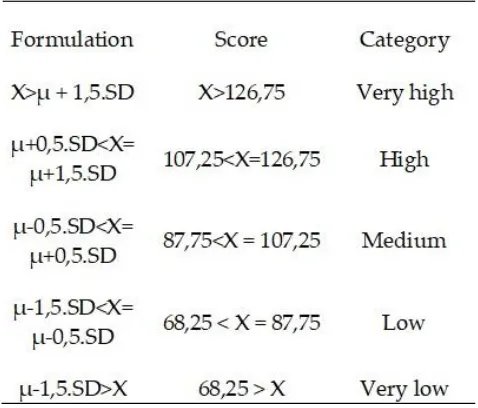
The data analysis technique in this study was carried out using descriptive statistics by looking for average values and standard deviations. This average value is then compiled using the categorization formula as in table:
TABLE 1.
CATEGORIZATION OF DECISION-MAKING SCORE
The categorization in the table. 1 will be used as a reference to determine the decision-making abilities of students.
3
RESEARCH
FINDINGS
Based on the data obtained from 107 students of the Ahmad Dahlan University Guidance and Counseling study program, the results of the study are as follows:
TABLE 2.
DISTRIBUTION OF DECISION MAKING CAPABILITY SCORES
Figure 1. Student Decision-Making Ability
Based on figure 1, we know that 62% of student have decision-making ability in the very high category. There are the details of the scores of each item:
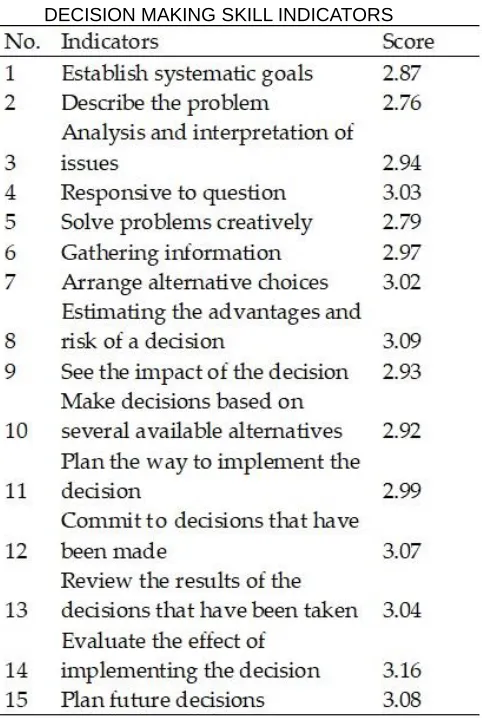
TABLE 3.
DECISION MAKING SKILL INDICATORS
Based on the table 3, it is known that the indicator that gets the highest score in evaluating the results of implementing decisions and estimating the advantages and risk of a choice Meanwhile, the lowest score is to describe the problem
correctly and solve the problem creatively.
4.
DISCUSSIONS
The results showed that students' decision-making abilities obtained a mean rating of 116.3, which was included in the high category. Only 16% of students who have decision-making abilities in the medium category. Meanwhile, none of the students had decision-making abilities in the low or deficient class. Overall, students already have the decision-making skills needed in the era of industrial revolution 4.0. Based on the results of decision-making indicators, it was known that students get the highest score on the index of evaluating the decisions implementation results and estimating the benefits and risk of a decision. This results showed that students have been able to involve cognitive processes by making estimates about the advantages and risks that will be obtained if they make a decision. This capability is essential for the disruptive era, and this is in accordance with the opinion of Shah, et al. [15] that in the decision-making process it is necessary to carry out a risk analysis based on the criteria and trends possessed by an organization or decision-maker. This risk analysis is essential to do because, in the era of industrial revolution 4.0, there will definitely be many risks that have not been encountered in the previous period. This is in accordance with the opinion of Birkel et al. [11] that in the era of industrial revolution 4.0, there will be 27 risks that can occur in various sectors of human life. These risks or losses will appear in the industrial area, which includes finance, competition, investment, and dependency. Meanwhile, in the ecological dimension, the 4.0 industrial revolution can bring risks to pollution, excessive consumption, and environmental pollution due to products that are difficult to recycle because of the high individuality of product use. In addition, the risks from the industrial revolution 4.0 can also arise in the field of technology such as weak privacy, the unpreparedness of resources, and lack of knowledge about technology optimization. Among the many risks, the risk most associated with students of Guidance and Counseling study program at Ahmad Dahlan University is a social risk. Students, as prospective counselors need to know the hazards that can occur in the industrial revolution era 4.0. The social dangers include job-losses, decrease resource requirements in various fields because they have been replaced by robots and machinery, and stress that may occur due to working under high pressure to achieve production targets. The many risks that arise need to be understood so they will not make a wrong decision in the future. The decision which is taken must be a decision that can bring many benefits and a little risk. Students can minimize the failure of decision making by considering the risks of each arrangement that will be taken. Decision making is an important skill to be possessed by people to determine attitudes and actions in various situations. Decision making can be defined as a process of identifying and selecting a decision from multiple available alternative arrangements by involving cognitive and affective aspects to achieve a specific goal [17]. Individuals must reason in choosing one among the many alternative decisions that can be taken. Meanwhile, Turpin & Marais ]20] state that decision-making is a comprehensive process and can be assessed from many perspectives. In general, the decision-making process consists of two stages, namely the different stage or the exploration stage, which allows individuals to think of as many solutions as possible that can be taken from the 22%
62% 16%
Decision-Making Ability
Very high
High
problems. The next stage is convergent, where individuals will begin to select alternative solutions before finally making a decision by choosing an alternative solution as a way to achieve the desired goal. The exploration stage in decision- building on the industrial revolution 4.0 settings will be more challenging to do because of the availability of various accesses and sources of information. This access to data can support the exploration process on a different stage. In addition, speed is an essential thing in Industry 4.0. Therefore, humans are required to have fast and appropriate decision-making abilities in various situations [22]. Changes that always occur quickly and unexpectedly make the ability to make decisions rapidly and precisely as an essential ability that must be possessed by individuals. In addition, students have also been able to evaluate their decisions. Students already have an awareness that the decision-making process does not only stop at the selection of choice but also must evaluate the results of implementing the decision. This evaluation can be used as a reference for future decision making when faced with similar problems. Assessment in this decision-making process includes evaluating the consequences of a decision for themselves, for others (clients or members), as well as for the organization or institution as a whole. In conducting this evaluation, ethical principles need to be applied, namely, to see whether the decision is in accordance with the values used in institutions and society [9]. Evaluation by applying ethical principles or moral principles needs to be done to ensure that the decisions taken are in accordance with the rules and culture in the environment. This is in accordance with Negulescu [18] that every decision which is taken must make decision-makers feel satisfied and happy. The resolutions also must be able to arouse enthusiasm for the team to achieve better results. In contrast, if the decision taken has not brought satisfaction and energy to the decision-maker, then the decision needs to be reviewed again, it will be implemented in the future. Although the majority of students already have excellent decision-making abilities, students still get low scores on several indicators, namely the signs describe the problem correctly and solve problems creatively. This results showed that students always have difficulty explaining the problem. They are trying to determine the cause of the problem and have not been able to understand the issues that occur in depth. The ability to describe and analyze the purposes of this problem needs to be improved to face the era of industrial revolution 4.0. This is in accordance with the opinion of Huitt [23] that in the process of problem-solving and decision-making there is an input stage where the individual will be aware of the problem and begin to make an effort to understand the situation or problem in depth. The ability to understand and describe this problem is essential to have by the student so that they will know in detail the causes and what parts have been affected by the problem. This ability needs to be reflected in students so that the decision-making process can run smoothly. If students do not understand the problem, students will have difficulty in determining alternative solutions or choices of decisions that will be taken to solve the problem. Meanwhile, students' decision-making abilities are also still low on indicators to solve problems creatively. Creativity is a process of thinking that involves imagination intelligence, knowledge, and ideas as a solution to a puzzle [6]. Students are still having difficulty to find creative alternative solutions to their problems. In general, they tend to choose something based on their past decision-making experience.
This condition will inhibit and has many shortcomings because students have a lack of renewal in the mindset to get creative ideas. This is similar to the opinion of Wilson et al. [8] that students in higher education still have difficulties in developing creativity due to several factors, especially there are feelings of shame, lack of motivation, limited time and opportunity, and the existence of social pressures. This lack of creativity needs to be improved as preparation for the 4.0 industrial revolution. This is in line with Mustapha et al.[19] that efficiency, productivity, and innovation that emerge from creativity are things that are needed by future workers to be able to compete and survive in a modern workforce. Creativity is an essential thing to survive and compete in the 4.0 industrial revolution. A decision can be categorized as a creative decision if the choice is not standard or rarely applied in that situation. Creativity is needed to be used in the decision-making process so that decisions which are implemented in accordance with the atmosphere or needs and are not rigid [14]. Afrianto [5] explained that educators must have new awareness as agents of change in the education era 4.0. Not only because the ability of the machine can store and even transfer knowledge in a sophisticated manner, but also because students today can easily get the experience quickly. Furthermore, the new mindset is a challenge for educators to keep looking for new learning approaches. Likewise, current guidance and counseling students as guidance and counseling teacher candidates are expected to focus on developing students' skills and character, such as empathic communication skills, promoting tolerance, being responsible, open-minded, able to work together, and others skills needed in a disruptive era. Overall, students of Guidance and Counseling study program at Ahmad Dahlan University already have excellent decision-making abilities, although there are still 16.8% of students who have decision-making abilities in the medium category. The differences in decision-making abilities in these students can be influenced by various factors such as personality, experience, knowledge, and perceptions of decisions. This is in accordance with Huitt's [23] that decision-making abilities are influenced by individual differences, which include own personalities such as thinking, feeling, judging, and perceiving according to the Myer-Briggs personality theory. This personality type has a different influence on individual decision-making abilities based on their respective characteristics, which were not examined in this study. This research was done in one study program as a sample at Ahmad Dahlan University. It is a limitation that need to be improved because the student in other study programs also must have decision-making ability as a basic skill for facing the Industrial Revolution. The next research should get more students from various study program to get a larger sample and more complex data about student decision-making ability.
5.
CONCLUSION
face the disruptive area.
ACKNOWLEDGMENT
The authors wish to Guidance and Counseling Study Program at Ahmad Dahlan University and Yogyakarta State University.
REFERENCES
[1] A. Shahroom, and N. Hussin. "Industrial Revolution 4.0 and Education". International Journal of Academic Research in Business and Social Sciences, vol. 8, no. 9, pp. 314–319 October. 2018)
[2] A. Rajko. "Industry 4.0 Concept: Background and Review". International Journal of Interactive Mobile Technology, vol. 11,no ,5 pp 77-90. 2017. Available at
https://online-journals.org/index.php/ijim/article/view/7072
[3] A.A. Hussin. ―Education 4.0 Made Simple: Ideas For Teaching‖. International Journal of Education & Literacy Studies, vol. 6, no. 3, pp. 92-98, Juli. 2018.
[4] A.N. Azmi, Y.Kamin, M.K Noordin, and A.N.M. Nasir. ―Towards Industrial Revolution 4.0: Employers' Expectations on Fresh Engineering Graduates.‖ International Journal of Engineering & Technology, vol. 7, no. 4.28, pp 267-272 December. 2018.
[5] Afrianto. "Being a Professional Teacher in the Era of
Industrial Revolution 4.0: Opportunities, Challenges, and Strategies for Innovative Classroom Practices‖. English Language Teaching And Research, vol. 2, no.1, pp 1-13, December. 2018.
[6] B. Birgili. "Creative and Critical Thinking Skills in Problem-based Learning Environments." Journal of Gifted Education and Creativity, vol.2, no.2, pp. 71-80, November. 2015.
[7] B.S. Tessema, and S.B. Abejehu. ―University-Industry
Collaboration in Curriculum
Development: Analysis of Banking and Finance Graduates’ Attributes from Educators and Industries Perspective‖. Education Journal, vol. 6, no. 2, pp. 87-93 March. 2017.
[8] C. Wilson, P.P. Lennox, G. Hughes, and M. Brown. How to develop the creative capacity for the fourth industrial revolution: creativity and employability in higher education in Reisman, F. Ed., Creativity, Innovation, and Wellbeing. London: KIE Conference Publications. (2017).
Available online at
http://www.conference.kiecon.org/publications/.
[9] D. Verma. ―Study and Analysis of Various Decision-Making Models in an Organization." OSR Journal of Business and Management (IOSR-JBM), vol. 16, no. 2, pp. 171-175, February. 2014.
[10] D.D. Mackall. Careers Skill Library: Problem Solving. New York: Facts on File. Pp. 121-128, 2004.
[11] H.S. Birkel, J.W. Veile, J.M. Muller, E.Hartmann, and K.I. Voigt. ―Development of a Risk Framework for Industry 4.0 in the Context of Sustainability for Established Manufacturers‖. Sustainability Journal, vol.11, no.384, pp. 1-27, January. 2019. Available at
http://www.sciedu.ca/journal/index.php/ijfr/article/view/13
194/8136.
[12] J. Nagy, J. Olah, E. Erdei, D. Mate, and J. Popp. ―The Role and Impact of Industry 4.0 and the Internet of Things on the Business Strategy of the Value Chain— The Case of Hungary‖. Sustainability Journal, vol. 10, no. 3491, pp, 1-25, September. 2018.
[13] K. Grzybowska and A. Łupicka. ―Key competencies for Industry 4.0‖. Economics & Management Innovations (ICEMI), vol.1, no.1, pp. 250-253, October. 2017.
[14] K.G. Stoycheva and T.I. Lubart, ―The Nature of Creative Decision Making. In: Allwood C.M., Selart M. (eds) Decision Making: Social and Creative Dimensions. Springer, Dordrecht, pp 15-33. 2001.
[15] L.A. Shah, A. Etienne, A. Siadat, and F. Verna Bernard."Decision-making in the manufacturing environment using a value-risk graph." Journal of Intelligent Manufacturing, vol. 27, no. 3, pp 617–630, June. 2016.
[16] M. Xu, J.M. David, and S.H. Kim. ―The Fourth Industrial Revolution: Opportunities and Challenges." International Journal of Financial Research, vol. 9, no. 2, pp-, March. 2018.
[17] M.T., Ahmed, and H. Omotunde. "Theories And
Strategies of Good Decision Making." International journal of scientific & technology research, vol.1, no.10, November 2012
[18] O.H. Negulescu. ―Using a decision-making process model in strategic management." Review of General Management, vol. 19, no. 1, pp. 111-123. 2014.
[19] R. Mustapha, F. Karim, R.M. Yasin, N.Azman, H. Yamat, A.W. Muhammad, S. Tariff. "K-Economy and Globalisation - Are our student ready?" Jurnal Personalia Pelajar, vol. 11, no.-, pp. 1–23 June. 2008
[20] S.M. Turpin, and M.A. Marais. "Decision-making: Theory and practice." Orions Journal, vol. 20, no. 2, pp. 143–160, December. 2004.
[21] Schwab, Klaus. The Fourth Industrial Revolution. New York: Crown Business. Pp 6-13. 2017.
[22] T.Z. Win and N. S. M. Kham. ―Transformation of Project
Management," Proceedings of the 12th International
Conference on Project Management (ProMAC2018).
2018.
[23] W.G. Huitt. "Problem Solving and Decision Making: Consideration of Individual Differences Using the Myers-Briggs Type Indicator." Journal of Psychological Type, vol. 24, pp. 33-44. 1992.
[24] Xing, B. & Marwala, T. Implications of the Fourth Industrial Age on Higher Education. Available at
https://www.researchgate.net/publication/315682580_Imp lications_of_the_Fourth_Industrial_Age_on_Higher_Educ