Article
Simulation of mTBI Utilizing White Matter
Properties from MRE
Amit Madhukar1and Martin Ostoja-Starzewski1,2
1 Department of Mechanical Science & Engineering, University of Illinois at Urbana-Champaign, Urbana, IL
61801, U.S.A.
2 Beckman Institute and Institute for Condensed Matter Theory, University of Illinois at Urbana-Champaign,
Urbana, IL, 61801, U.S.A.
Abstract: We extend our high-resolution MRI-based Finite Element (FE) head model, previously
presented and validated in [1–3], by considering the heterogeneities of the white matter structures
captured through the use of Magnetic Resonance Elastography (MRE). This approach imparts more
sophistication to our numerical model and yields results that more closely match experimental
results. It is found that the peak pressure more closely matches the experiments as compared to the
heterogeneous case. Qualitatively, we find differences in stress wave propagation near the corpus
callosum and the corona radiata, which are stiffer on average than the global white matter. We are
able to study the effects of these stiff structures on transient stress wave propagation within the
cerebrum, something that cannot be done with a homogenized material model.
1. Introduction
Traumatic brain injury (TBI) commonly occurs by impacts - direct blows to the head; or by impulse
- a sudden movement of the head, especially prevalent in car crashes. TBI remains a pressing concern
for study with approximately 2.8 million cases of TBI-related injuries reported in the United States
[4]. Clinical studies have shown that damage to the brain in blunt head injuries is primarily confined
to the cerebral white matter, with a propensity for lesions in the brainstem and the corpus callosum,
i.e.,regions with highly organized axon tracts. [5–10]. These regions serve as vital connection points to other parts of the brain, meaning damage to them is potentially more dangerous. In this work we
introduce a heterogeneous material description of white matter structures to our high-resolution Finite
Element (FE) model to account for the local differences in mechanical response between different
regions of the brain.
The FE method is commonly used to determine the mechanical response of brain tissue in order
to develop improved diagnostic tools and protective measures to reduce the prevalence of TBI. The
accuracy of these FE models are highly dependent on the accuracy of the material model. To date most
finite element models have utilized mechanical properties averaged over large portions of the brain, as
reviewed in [11], thus ignoring potentially significant effects of local structures. In actuality, the tissues
of the brain are heterogeneous, their constitutive response varying from location to location. This is
most noticeable for white matter due to the presence of axons with diverse orientations. Overall, the
shear stiffness of white matter is 1.2-2.6 higher than that of gray matter [12]. Locally, white matter tracts
with highly oriented fibers such as the corpus callosum and corona radiata have material properties
vastly different from other regions. Johnson et al. [13] determined that global white matter was softer
on average than either the corpus callosum or the corona radiata. This can be explained by considering
the structure of these regions. The corpus callosum is a tight bundle of highly aligned fibers which is
expected to provide more structural rigidity than the superficial white matter. The fan-like structure
of the corona radiata provides a similar response, though to a lesser extent since the fibers are not
as highly aligned. As such the corpus callosum was found to be approximately 11% stiffer than the
corona radiata. The brainstem is another structure with a high level of heterogeneity. Arbogast and
Margulies [10] investigated the prevalence of trauma observed in the brainstem after head injuries.
They determined that the brainstem was 80-100% stiffer than the cerebrum and concluded this regional
stiffness variation is one reason for the selective vulnerability of this region to rotational motion. FE
models that utilize homogenized white matter material properties have no way to resolve these local
features.
A very useful tool to measure heterogeneity in-vivo is Magnetic Resonance Elastography (MRE)
[14] where the head is excited with shear waves to quantitatively assess the local mechanical properties
of brain tissue. This technique has been successfully applied to a variety of different applications such
as decrease in whole-brain stiffness with age [15] and as a result of certain neurodegenerative diseases
[16]; measurement of tumor stiffness [17]; and as a marker for TBI severity [18]. MRE is applied as a
three-step process beginning by first inducing shear waves in tissue with frequencies ranging from
50-500 Hz using an external driver. Second, the waves are imaged using a phase-contrast MRI pulse
sequence synchronized with the frequency of the applied vibration. Finally, the mechanical properties
of the tissue are estimated by inverting the observed displacements using a viscoelastic material model;
such as that presented by Van Houten et al. [19].
In this work, we utilize our previously homogeneous FE model - presented and validated in
our previous works [1–3] - and introduce a voxel-based heterogeneous material model using results
from Johnson et al. [13]. In order to properly resolve the high-frequency waves generated during
such vibrations, the finite element mesh must be properly refined, as argued in [11]. The mechanical
captured during the MRE process. This in turn generates a finite element mesh that has more than
sufficient resolution to accurately capture the dynamic shear wave propagation during impacts. To the
best of our knowledge, this is the first attempt to include heterogeneity of brain tissue via MRE in a
high-resolution FE model.
2. Model Formulation
2.1. MRE Aquisiton and Inversion
The heterogeneous properties of the white matter are taken from the work by Johnson et al. [13].
A brief overview of the acquisition and inversion is presented here. A more detailed discussion of this
process can be found in [20]. Shear waves are generated at a frequency of 50Hz by placing the subject’s
head on a custom cradle attached to an electromagnetic shaker via a rigid rod. The actuator imparts
a nodding motion to the head. Displacement data is captured via a Siemens 3T Allegra head-only
scanner (Siemens Medical Solutions; Erlangen, Germany). A multi-shot MRE sequence utilizing spiral
readout gradients [21] with periods matching that of the applied shear wave was developed to reduce
errors during the inversion step. In total, the imaging volume comprised twenty axial slices of 2mm
thickness covering the ventricles, corpus callosum and corona radiata resulting in a 2×2×2mm3 isotropic spatial resolution for the reconstructed mechanical properties.
A non-linear inversion (NLI) algorithm [19] was applied to estimate the material properties from
the measured dusplacement data. The inversion is performed by minimizing the function
Φ(θ) =
N
∑
i=1(uci(θ)−umi )(uci(θ)−umi )∗ (2.1)
by iteratively updating the material property description, given by θ. Here, umi is the measured
displacement amplitude at the locationi;uci(θ)is the computed displacement amplitude sampled at
the same point; and∗indicates the complex conjugate.
Following the development in [22], a Rayleigh damping model is used to represent the material
response of brain tissue under time-harmonic conditions. The motion amplitude fieldu, was calculated from Navier’s equation for an inhomogeneous, locally isotropic linear elastic medium
∇ ·G(∇u+∇uT) +∇(λ∇ ·u) =ρω2u (2.2)
whereλis the first Lamé parameter;Gis the second Lamé parameter, or shear modulus;ρis the density;
andωis the activation frequency. The Rayleigh damping model introduces the complex-valued shear
imaginary shear modulus includes damping effects due to inertial forces, while the imaginary part of
the density includes damping related to inertial forces. Including inertial damping effects - something
that commonly used viscoelastic models do not include - allows for better characterization of material
response when performing the inversion. We use the notationG0andG00to denote the storage and loss shear moduli respectively, which are the real and imaginary part of the complex valued shear modulus
G=G0+iG00 (2.3)
whereiis the imaginary unit. Due to the nearly incompressible nature of brain tissue, we assume that
λis very large compared to the shear modulus. The damping ratio
ξ:=G00/2G0 (2.4)
can be determined as well which physically describes the level of motion attenuation in the tissue.
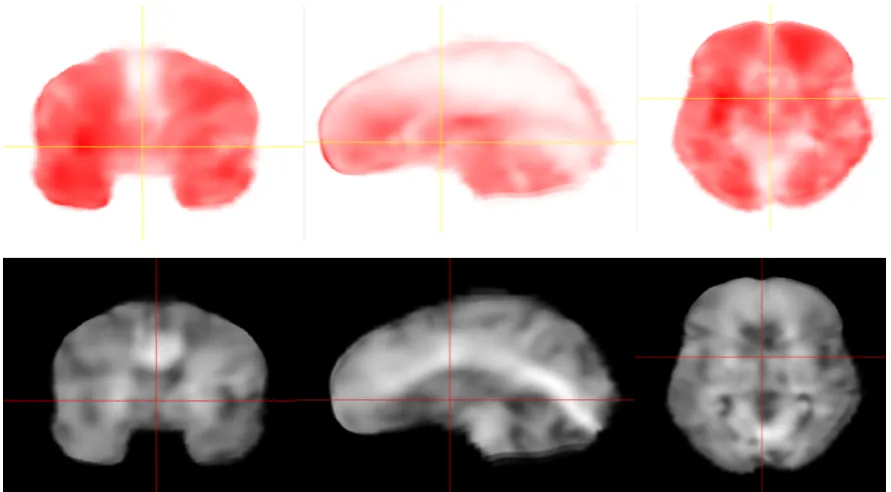
The distribution of storage and loss moduli within the white matter in the imaging resolution
(2×2×2mm3) is presented in Figure1for the coronal, sagittal and horizontal planes. The relative stiffness of the corpus callosum and corona radiata can be clearly observed. The average values and
the standard deviation for the global white and gray matter is presented in Table1as well as those for
the corpus callosum and corona radiata.
Figure 1.Distribution of Loss (top) and Storage (bottom) modulus in the FE model. Darker regions
Table 1.Average values and standard deviations for different tissues within the model: gray Matter (GM), White Matter (WM), Corpus Callosum (CC), Corona Radiata (CR)
GM WM CC CR
G’ (kPa) 2.02±0.09 2.66±0.30 3.09±0.39 2.78±0.37
G” (kPa) 1.04±0.12 1.54±0.15 1.23±0.26 1.97±0.12
ξ 0.32±0.03 0.31±0.03 0.23±0.07 0.37±0.05
2.2. Finite Element Mesh Generation
In addition to the MRE image acquisition, T1-weighted anatomical images with a resolution
of 1×1×1mm3 are generated for the purposes of mesh segmentation. Image voxels are directly converted to eight-noded hexahedral elements through a custom code, thus preserving the same
spatial resolution as the MRI scans. The resulting mesh consists of approximately 2.2 million elements.
The mesh is segmented into the following tissue types: scalp, skull, cerebrospinal fluid (CSF), gray
matter and white matter. Each element is assigned a different material definition based on the results
of the segmentation, as detailed in section2.3. Features that are below the imaging resolution such
as membranes, blood vessels, bridging veins, and draining sinuses are excluded from the model.
Since T2-weighted scans were not collected, the segmentation of the interfaces between tissue types is
negatively affected. We perform a mesh smoothing operation at these interfaces to minimize this effect.
We utilize a volume-preserving Laplacian smoothing algorithm as outlined in [1]. Smoothing has the
added benefit of eliminating numerical artifacts that may manifest from jagged edges along interfaces.
We ensure traction and displacement continuity at all material interfaces.
Our MRI voxel-based approach produces meshes which more realistically model the complicated
folding structure of the cerebral cortex (i.e. gyri and sulci) as well as the differentiation of gray and
white matter of brain tissues. Additionally, in order to accurately resolve the shear wave motion within
the brain, the mesh must be sufficiently refined [11]. For example, using the typical speeds of shear
wave propagation in brain tissue,cT ≈5m/s, and the frequency of the vibration as 50Hz, we arrive at
a minimum element size of 10mm (using a conservative choice of 10 elements per wavelength [23]).
For vibrations of higher frequency or more transient loading (such as the cases for impact loads), this
requirement is even more stringent.
2.3. Material Properties
As discussed above, we assign different material definitions to each voxel based on the result of
the mesh segmentation. Due to the presence of highly oriented tracts of myelin-sheathed axonal fibers
in white matter, significant heterogeneity exist in this region, especially within the corpus callosum
(CC) and corona radiata (CR). On the other hand, gray matter is made up of cell bodies and supporting
Table 2. Material properties of different tissues used in the FE model. For the heterogeneous white matter, only the average values ofG0andG∞are presented, denoted by the “∗".
Tissue Mass Density (kg/m3) Bulk Modulus K (Pa) Short Term Shear ModulusG0(Pa)
Long Term Shear
ModulusG∞(Pa) Decay Factorβ(sec
−1)
Skull 2070 3.61E+9 2.7E+9 N/A
gray
matter 1040 2.19E+9 3.4E+4 6.4E+3 400 White
matter 1040 2.19E+9 4.1E+4
∗ 7.8E+3∗ 400
CSF 1004 2.19E+7 5.0E+4 N/A
allows for the MRE imaging to be performed over a manageable acquisition volume. As such, we
allow for only the white matter to have material heterogeneity whereas other tissues are assumed to
be homogeneous.
For homogeneous tissues, the choice of material properties is based on data available in the
literature, presented in Table2, and is the same as that presented in our earlier works [1,3]. The skull is
assumed to be linear elastic and modelled as a single-layer structure with homogenized properties
given in [25]. We assume a linear viscoelastic material model for the shear response of the brain tissues.
The standard linear solid model is chosen for its simplicity where the shear relaxation modulus is
given by
G(t) =G∞+ (G0−G∞)e−βt. (2.5)
Here,G0is the short-term shear modulus,G∞is the long-term shear modulus andβis the decay factor.
For the white matter, we assume that onlyG0andG∞are heterogeneous with averages scaled to match the values taken from literature [26]. The mass density, bulk modulus and decay factor are maintained
to be homogeneous. For the material model for the CSF, we have the choice of three models, previously
presented in [3]: incompressible elastic, viscoelastic, and fluid-like elastic using an equation of state
model. We determined that the choice of CSF affects the shear wave propagation within the brain
while the peak pressure is not significantly altered. For the first iteration of our heterogeneous model,
we choose the most commonly utilized model - nearly incompressible elastic model with bulk modulus
to be very large compared to the shear modulus, with values taken from [27].
2.4. Boundary Conditions
We consider two extreme assumptions for the head-neck junction, free and fixed boundary
conditions mostly following previous work in [1]. The free boundary condition allows for
predominantly rectilinear motion under frontal impacts while rotational motion cannot be represented.
We consider the fixed boundary condition as the other extreme case where the nodes around an area of
the foramen magnum are fully constrained. Research reported in [1] showed that the responses from
2.5. Experimental Verification
We use Nahum et al. linear impact experiments [28] to verify the accuracy of our model. In
the experiment, a seated cadaver was impacted by a cylindrical impactor with a constant velocity of
9.94m/s. The impact was along the specimen’s mid-sagittal plane in an anterior-posterior direction. The skull was rotated as depicted in Figure2a. The resultant input force time history is given in Figure
2b. Intracranial pressure history was recorded during the impact event. The results of this comparison
are presented in the next section. Our homogeneous model was also verified using tagged MRI and
harmonic phase (HARP) imaging analysis technique in [2] where displacement time history from
head-drop experiments is compared to numerical results. Finally, we directly compare displacement
data during impact utilizing experimental data from Hardy et al. brain translational motion experiment
[29,30]. Brain motion was captured using neutral density targets (NDT) under linear accelerations
ranging from 38 to 291g.
(a) (b)
Figure 2.(a) Impact location in Nahum et al.’s experiments (adapted from [31]). (b) Input force time
history (adapted from [1]).
3. Results and Discussion
3.1. Simulation of Impact
Blunt forces are applied to the head in the frontal region. The recorded impact force from the
frontal cadaveric impact experiment conducted by Nahum, as discussed in the preceding section, is
directly applied to the model in the form of a distributed load with the peak pressure input of 4.37
MPa. The impact pulse lasts about 9 ms and the simulation is run for 15 ms. The base of the skull is
not constrained to allow the rotation of the model under impact. The finite element simulations are
carried out using Abaqus/Explicit.
The pressure-time history for the Nahum loading is presented in Figure3at the coup impact
site. We plot the results for both the homogeneous and heterogeneous model. At the coup site, the
pressure of 180KPa at 5 ms; the model with fixed boundary condition shows variations of compression
and tension and the peak pressure reached is 80KPa. Hence, the model with free boundary condition
gives better correlation of coup pressure with experimental results. At the contrecoup site, the model
with free boundary condition predicts mostly tensile pressure for the 15ms simulation and the response
for the first 6ms is in good agreement with the test data. However, the transition from tension to
compression found in the cadaver experiment for the contrecoup site is replicated better by the model
with fixed boundary condition. The maximum and minimum contrecoup pressures obtained by the
simulations are 65KPa and 60KPa, respectively. For both cases, the heterogeneous model predicts
responses more closely matching the experimental results, indicating that the inclusion of heterogeneity
leads to a more realistic model.
Figure 3.Comparison of heterogeneous model with experimental data from [28]. We find that the
heterogeneous model exhibits response closer to the Nahum data.
We next compare the displacement response to the C383-T1 impact from Hardy et al. experiments
[29]. We plot the response for relative displacements for thex−andy−directions for two NDTs each in the anterior (A) and posterior (P) positions, see Figures4and5. We find good agreement between
our model and the experimental data as shown. Additionally, we have previously validated our
homogeneous model using tagged MRI and HARP imaging analysis techniques in [2] which allows
0 50 100 -5
0 5
Displacement (mm)
A1 X
0 50 100
-5 0
5
A2 X
0 50 100
Time (ms)
-50 5
Displacement (mm)
P1 X
0 50 100
Time (ms)
-50
5
P2 X
Experimental Model
Figure 4.Comparison of displacements in thex−direction for two positions in the anterior (A) and
posterior (P) to Hardy C83-T1 experiment
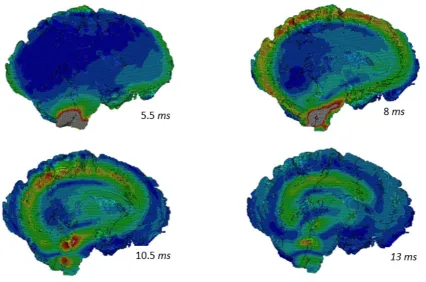
We plot the contours of the von Mises stress distribution on the sagittal plane due to the frontal
impact in Figure6. The spherically convergent structure of the shear wave is observed quite clearly.
As the wave travels inwards towards the center of the brain, it attenuates and eventually dissipates
before traveling a large distance towards the center of the brain. Reflections of wave due to scattering
from heterogeneous white matter structures can also be observed at later times.
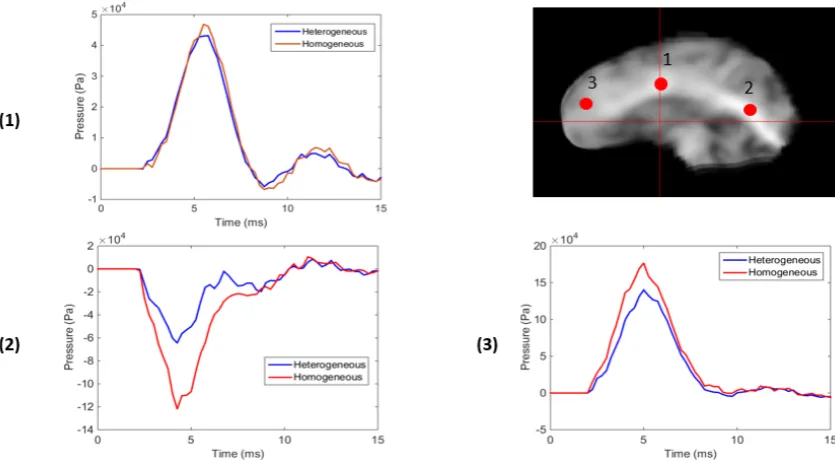
Next, we consider three distinct points along the sagittal plane, as depicted in Figure7. The points
are chosen within regions of strong heterogenities due to the presence of highly aligned axon tracts,
such as the corpus callosum and corona radiata. The differences in mechanical properties of these
regions are given in Table3. We see that the material phases at these points are relatively stiffer than
the corresponding points in the homogeneous model. As a result, the response in Figure7is affected
accordingly. We find that the difference in peak pressure response is proportional to the difference in
shear stiffness between the homogeneous and heterogeneous models. However, the time at which
these events occur is not significantly affected. This indicates that the pressures in regions of high
stiffness within the brain are over-estimated in the homogeneous models. In summary, relative to
the MRI-based model, the new MRE-based heterogeneous model more accurately predicts the local
response within the white matter by taking into account the differences in tissue stiffness of local white
0 50 100 -5
0 5
Displacement (mm)
A1 Z
0 50 100
-5 0
5
A2 Z
0 50 100
Time (ms)
-5 0 5
Displacement (mm)
P1 Z
0 50 100
Time (ms)
-5 0
5
P2 Z
Experimental Model
Figure 5.Comparison of displacements in thez−direction for two positions in the anterior (A) and
posterior (P) to Hardy C83-T1 experiment
A few points are in order regarding the qualitative differences between the shear modulus of
different regions in our model. Globally, the white matter is found to be approximately 32% stiffer
than the gray matter. In general, the white matter properties in local regions differ significantly from
the average ones. For instance, the storage modulusG0is significantly lower in the rest of the white matter than within the corpus callosum and the corona radiata. This is quite logical given the fact
that the corpus callosum contains highly oriented, tightly packed axon tracts. The corpus callosum in
turn is stiffer than the corona radiata, again evident from the composition of the corona radiata which
contains axon fibers that fan out and are not as highly aligned as the corpus callosum. Additionally,
while both white and gray matter have similar values of damping ratio,ξ(which reflects the amount
of motion attenuation within the tissue), the corpus callosum has a lower value while the corona
radiata has a higher value. This can be explained by examining the microstructure of each of these
regions. Experiments by Guo et al. [32] demonstrated that damping ratio (and thus the attenuation)
in soft tissue composites increases as the number of cross-links between fibers increases. The corona
radiata consists of fibers arranged in a grid-like pattern [33] with a large number of cross-links. These
crossings do not exist in the corpus callosum, offering a possible explanation for the distribution ofξ.
Since mechanical measures from MRE and diffusivity measures from diffuse tensor imaging (DTI)
are essentially measures of the distribution of axon tracts within white matter, a natural question arises
Figure 6.Shear wave propagation due to frontal impact. Notice the attenuation of the wavefront as time progresses.
Table 3.Difference of material properties and peak pressure response for three distinct points (indicated
in Figure7) along the sagittal plane within the white matter.
Location
% Difference in Shear Modulus (
G
∞)
% Difference in Peak Pressure
1
13.34
-7.86
2
28.62
-47.25
3
15.48
-20.75
anisotropic FE models where fiber anisotropy is determined from DTI scans? Many such examples
of the latter exist in the literature: for instance in [34–37]. Johnson et al. [13] performed both MRE
and DTI measurements on a group of seven volunteers to determine the correlation of mechanical
and diffusivity measures within the corpus callosum and corona radiata. They determined that MRE
and DTI measures correlate well with each other within the corpus callosum - not surprising since
they are both sensitive to the underlying tissue microstructure. They hypothesize that these measures
are highly dependent on axon diameter since larger axons provide greater structural rigidity to the
tissue [38]. Within the corona radiata, however, the correlation is not as significant. The corona radiata
comprises fiber tracts that fan towards the cortex and contain numerous crossings [33] which are not
captured well by DTI [39]. This has been hypothesized as the reason for the poor correlation within the
corona radiata. More work is needed to determine the differences between these two methods when
Figure 7. Comparison of pressure at three points on the sagittal plane. The difference in the heterogeneous and homogeneous models is most evident in regions of high relative stiffness.
3.2. Stochastic Wave Propagation
The highly heterogeneous structure of the brain tissue introduces wave scattering that competes
with wave amplification due to spherically convergent implosion. Following the development in [40],
we investigate this effect by considering the theory of wavefronts. For the case of one-dimensional
wave motion, we assume that a compressive load produces a shock wavefront that propagates from
a disturbed domain to an undisturbed one with a speedcT. The initial conditions can be given as
u(x, 0) =u,t(x, 0) =0;τ(0,t) =−τ0H(t)whereHis the Heaviside function.
First, assuming a plane wave in a homogeneous medium, we have the dynamic compatibility
condition[τ] = −ρcT[u,t]in the(x,t)- plane, where the notation[f]denotes the discontinuity in
functionf across the boundary of two material domains 1 and 2,σis the shear stress,ρis the mass
density,uis the displacement normal to the direction of wave motion, andcTis the transverse wave
speed. The linear viscoelastic stress-strain relation for a process that started at timet=t+0 is
τ(t) =G(0)ε(t) +
Z t
t+0 G,t(t−s)ε(s)ds=G(0)
1 c1u,x
(t) +
Z t
t+0 G,t(t−s)
1 c1u,x
(s)ds (3.1)
whereεis the shear strain. We can derive the relationship for the wavespeed ascT =
p
G(0)/ρ, where
dT
dt[τ] = 1 2
G,t(0)
G(0) [τ]. (3.2)
Given the initial conditions given above, the solution of equation3.2can is given as
[τ] =−τ0exp 1
2 G,t(0)
G(0) [τ]
(3.3)
Given thatG,t(0)≤0, andG(0)>0, the stress jump exhibits exponential attenuation and has a tendency for blow-up asr→0. As our simulations here and in [3] show, the attenuation is strong enough so that the impact-generated imploding waves do not seem to blow up into a singularity at the
head center.
The impact gives rise not only to a fast pressure wave, but also to a slower shear wave. Due to
its relatively low shear modulus, brain tissue deforms more readily to shearing forces. Therefore, the
shear wave has the potential to be more damaging. The spherically convergent shear wave patterns
are observed even in the case of homogeneous material description, c.f. [1]. The attenuation of the
pressure along the sagittal plane for both the homogeneous and heterogeneous models are presented
in Figure8. It is clear that the attenuation is greater in the heterogeneous model as predicted.
0 20 40 60 80
Location (mm) 0 1000 2000 3000 4000 5000 6000 7000 8000 Pressure (Pa) Homogeneous Heterogeneous (a)
0 20 40 60 80
Location (mm) 0 500 1000 1500 2000 2500 3000 3500 4000 Pressure (Pa) Homogeneous Heterogeneous (b)
Figure 8.Comparison of attenuation of pressure wave along the sagittal plane between homogeneous
and heterogeneous model. (a) At 3ms and (b) at 7ms.
3.3. Limitations
We list here a few limitations in our methodology, some of which we hope to improve in future
works. Features that are below the imaging resolution such as membranes (in particular, the falx
cerebri and tentorium), blood vessels, bridging veins, and draining sinuses are excluded from the
current model. However, we argue that the inclusion of heterogeneous MRE-derived parameters
since the MRE inversion was performed assuming locally linear viscoelastic material model, we have
chosen to utilize linear viscoelasticity for white and grey matter. Research has shown that the the shear
modulus of the brain tissue is much lower than that used in this paper [41]. We aim to perform an
optimization study to tune the values chosen here to better match experimental results.
4. Conclusion
We present a high-resolution, voxel-based heterogeneous finite element head model to study
transient wave dynamics during traumatic brain injury. We utilize heterogeneous shear modulus
determined using a nonlinear inversion technique from MRE experiments performed by [13]. While
many FE models employ homogenized or averaged, mechanical properties to approximate constitutive
relations of brain tissues, our approach allows us to investigate response due to local structures within
the white matter. We note that both the corpus callosum and corona radiata are significantly stiffer
than overall white matter, with the corpus callosum exhibiting greater stiffness and less viscous
damping than the corona radiata. These differences are explained by examining the organizational
and compositional characteristics of each structure. Incorporating this heterogeneity in our model
affects wave propagation within the cerebrum and yields results that more closely match experimental
results. We find that local variations in stiffness affect the local mechanical response. For instance,
intracranial pressure magnitude following an impact is lower in regions of high local stiffness.
The unique architecture of the human head, consisting of the hard solid skull, the membranes,
CSF, and the viscoelastic brain core, leads to partial conversion of the pressure impact into a shear wave
converging towards head’s center. However, the shear wave attenuates as it converges inward due to
(1) wave damping due to brain tissue viscoelasticity and (2) the heterogeneous brain structure which
introduces extra wave scattering. The magnitude of this attenuation is greater for the heterogeneous
material model.
References
1. Chen, Y.; Ostoja-Starzewski, M. MRI-based finite element modeling of head trauma: spherically focusing shear waves. Acta Mechanica2010,213, 155–167.
2. Chen, Y.; Sutton, B.; Conway, C.; Broglio, S.P.; Ostoja-Starzewski, M. Brain Deformation Under Mild Impact: Magnetic Resonance Imaging-Based Assessment and Finite Elmenent Study. International Journal of Numerical Analysis and Modeling, Series B2012,3, 20–35.
3. Madhukar, A.; Chen, Y.; Ostoja-Starzewski, M. Effect of cerebrospinal fluid modeling on spherically convergent shear waves during blunt head trauma. International Journal for Numerical Methods in Biomedical Engineering2017,33.
4. Taylor, C.A.; Bell, J.M.; Breiding, M.J.; Xu, L. Traumatic Brain Injury-Related Emergency Department Visits, Hospitalizations, and Deaths-United States, 2007 and 2013. Morbidity and mortality weekly report. Surveillance summaries (Washington, DC: 2002)2017,66, 1–16.
6. Gentry, L.R.; Godersky, J.C.; Thompson, B.; Dunn, V.D. Prospective comparative study of intermediate-field MR and CT in the evaluation of closed head trauma. American journal of Roentgenology1988,150, 673–682. 7. Gentry, L.R.; Godersky, J.C.; Thompson, B. MR imaging of head trauma: review of the distribution and
radiopathologic features of traumatic lesions.American Journal of Roentgenology1988,150, 663–672. 8. Ng, H.; Mahaliyana, R.; Poon, W. The pathological spectrum of diffuse axonal injury in blunt head trauma:
assessment with axon and myelin stains. Clinical Neurology and Neurosurgery1994,96, 24–31.
9. Arfanakis, K.; Haughton, V.M.; Carew, J.D.; Rogers, B.P.; Dempsey, R.J.; Meyerand, M.E. Diffusion tensor MR imaging in diffuse axonal injury.American Journal of Neuroradiology2002,23, 794–802.
10. Arbogast, K.B.; Margulies, S.S. Material characterization of the brainstem from oscillatory shear tests. Journal of Biomechanics1998,31, 801–807.
11. Madhukar, A.; Ostoja-Starzewski, M. Finite element methods in human head impact simulations: a review. Annals of Biomedical Engineering2019, pp. 1–23.
12. Chatelin, S.; Constantinesco, A.; Willinger, R. Fifty years of brain tissue mechanical testing: from in vitro to in vivo investigations. Biorheology2010,47, 255–276.
13. Johnson, C.L.; McGarry, M.D.; Gharibans, A.A.; Weaver, J.B.; Paulsen, K.D.; Wang, H.; Olivero, W.C.; Sutton, B.P.; Georgiadis, J.G. Local mechanical properties of white matter structures in the human brain. Neuroimage2013,79, 145–152.
14. Muthupillai, R.; Lomas, D.; Rossman, P.; Greenleaf, J.F.; Manduca, A.; Ehman, R.L. Magnetic resonance elastography by direct visualization of propagating acoustic strain waves. science1995,269, 1854–1857. 15. Sack, I.; Streitberger, K.J.; Krefting, D.; Paul, F.; Braun, J. The influence of physiological aging and atrophy
on brain viscoelastic properties in humans.PloS one2011,6, e23451.
16. Murphy, M.C.; Huston III, J.; Jack Jr, C.R.; Glaser, K.J.; Manduca, A.; Felmlee, J.P.; Ehman, R.L. Decreased brain stiffness in Alzheimer’s disease determined by magnetic resonance elastography. Journal of magnetic resonance imaging2011,34, 494–498.
17. Murphy, M.C.; Huston, J.; Glaser, K.J.; Manduca, A.; Meyer, F.B.; Lanzino, G.; Morris, J.M.; Felmlee, J.P.; Ehman, R.L. Preoperative assessment of meningioma stiffness using magnetic resonance elastography. Journal of neurosurgery2013,118, 643–648.
18. Boulet, T.; Kelso, M.L.; Othman, S.F. Microscopic magnetic resonance elastography of traumatic brain injury model. Journal of neuroscience methods2011,201, 296–306.
19. Van Houten, E.E.; Miga, M.I.; Weaver, J.B.; Kennedy, F.E.; Paulsen, K.D. Three-dimensional subzone-based reconstruction algorithm for MR elastography. Magnetic Resonance in Medicine: An Official Journal of the International Society for Magnetic Resonance in Medicine2001,45, 827–837.
20. Johnson, C.L.; McGarry, M.D.J.; Van Houten, E.E.W.; Weaver, J.B.; Paulsen, K.D.; Sutton, B.P.; Georgiadis, J.G. Magnetic resonance elastography of the brain using multishot spiral readouts with self-navigated motion correction. Magnetic Resonance in Medicine2013,70, 404–412. doi:10.1002/mrm.24473.
21. Glover, G.H. Simple analytic spiral K-space algorithm. Magnetic Resonance in Medicine1999,42, 412–415. doi:10.1002/(SICI)1522-2594(199908)42:2<412::AID-MRM25>3.0.CO;2-U.
22. McGarry, M.D.J.; Van Houten, E.E.W. Use of a Rayleigh damping model in elastography. Medical & Biological Engineering & Computing2008,46, 759–766.
23. Bradshaw, D.; Morfey, C. Pressure and shear response in brain injury models. Proceedings of the 17th international technical conference on the enhanced safety of vehicles, Amsterdam, The Netherlands, 2001. 24. Prange, M.; Margulies, S. Regional, directional, and age-dependent properties of the brain undergoing
large deformation. Journal of Biomechanical Engineering2002,124, 244–252. doi:10.1115/1.1449907. 25. Khalil, T.B.; Hubbard, R.P. Parametric study of head response by finite element modeling. Journal of
Biomechanics1977,10, 119–132.
26. Zhang, L.; Yang, K.H.; King, A.I. A proposed injury threshold for mild traumatic brain injury. Journal of Biomechanical Engineering2004,126, 226–236.
27. Zhou, C.; Khalil, T.B.; King, A.I. A new model comparing impact responses of the homogeneous and inhomogeneous human brain. Technical report, SAE Technical Paper, 1995.
29. Hardy, W.N.; Foster, C.D.; Mason, M.J.; Yang, K.H.; King, A.I.; Tashman, S. Investigation of head injury mechanisms using neutral density technology and high-speed biplanar X-ray. Stapp Car Crash Journal2001, 45, 337–368.
30. Hardy, W.N.; Mason, M.J.; Foster, C.D.; Shah, C.S.; Kopacz, J.M.; Yang, K.H.; King, A.I.; Bishop, J.; Bey, M.; Anderst, W.; others. A study of the response of the human cadaver head to impact.Stapp car crash journal
2007,51, 17.
31. Kleiven, S.; von Holst, H. Consequences of head size following trauma to the human head. Journal of Biomechanics2002,35, 153–160.
32. Guo, J.; Posnansky, O.; Hirsch, S.; Scheel, M.; Taupitz, M.; Braun, J.; Sack, I. Fractal network dimension and viscoelastic powerlaw behavior: II. An experimental study of structure-mimicking phantoms by magnetic resonance elastography. Physics in Medicine & Biology2012,57, 4041.
33. Wedeen, V.J.; Rosene, D.L.; Wang, R.; Dai, G.; Mortazavi, F.; Hagmann, P.; Kaas, J.H.; Tseng, W.Y.I. The geometric structure of the brain fiber pathways. Science2012,335, 1628–1634.
34. Ji, S.; Zhao, W.; Ford, J.C.; Beckwith, J.G.; Bolander, R.P.; Greenwald, R.M.; Flashman, L.A.; Paulsen, K.D.; McAllister, T.W. Group-wise evaluation and comparison of white matter fiber strain and maximum principal strain in sports-related concussion.Journal of Neurotrauma2015,32, 441–454.
35. Giordano, C.; Kleiven, S. Connecting fractional anisotropy from medical images with mechanical anisotropy of a hyperviscoelastic fibre-reinforced constitutive model for brain tissue. Journal of The Royal Society Interface2014,11, 20130914.
36. Giordano, C.; Cloots, R.; Van Dommelen, J.; Kleiven, S. The influence of anisotropy on brain injury prediction.Journal of Biomechanics2014,47, 1052–1059.
37. Garimella, H.T.; Kraft, R.H. Modeling the mechanics of axonal fiber tracts using the embedded finite element method. International Journal for Numerical Methods in Biomedical Engineering2017,33.
38. Arbogast, K.B.; Margulies, S.S. A fiber-reinforced composite model of the viscoelastic behavior of the brainstem in shear. Journal of biomechanics1999,32, 865–870.
39. Wedeen, V.J.; Hagmann, P.; Tseng, W.Y.I.; Reese, T.G.; Weisskoff, R.M. Mapping complex tissue architecture with diffusion spectrum magnetic resonance imaging. Magnetic resonance in medicine2005,54, 1377–1386. 40. Ostoja-Starzewski, M.; Costa, L. Shock waves in random viscoelastic media. Acta Mechanica2012,
223, 1777–1788.
![Figure 2. (a) Impact location in Nahum et al.’s experiments (adapted from [31]). (b) Input force timehistory (adapted from [1]).](https://thumb-us.123doks.com/thumbv2/123dok_us/8066703.1344900/7.595.154.493.342.488/figure-impact-location-nahum-experiments-adapted-timehistory-adapted.webp)
![Figure 3. Comparison of heterogeneous model with experimental data from [28]. We find that theheterogeneous model exhibits response closer to the Nahum data.](https://thumb-us.123doks.com/thumbv2/123dok_us/8066703.1344900/8.595.93.505.302.590/figure-comparison-heterogeneous-experimental-theheterogeneous-exhibits-response-closer.webp)