IJEDR1402208
International Journal of Engineering Development and Research (www.ijedr.org)2608
Drupal Content Management System based
Ecommerce Portal
1
Sandeep Krishna Kumbhar,
2Mrs. Suneeta Angadi
1M. Tech CSE, 2Assistant ProfessorDept. Computer Science & Engineering, RNS Institute of Technology, Bangalore, India
1[email protected], 2[email protected]
________________________________________________________________________________________________________ Abstract—Internet is widely acceptable nowadays; the result of this adoption moved us to rapid advancement in information technologies. Starting with social networking and e-commerce we use web applications everywhere. While using these web applications we deal with our sensitive data and because of this web security attacks such as phishing and spamming have become quite common. The consequences of these attacks are ruthless. Hence, providing increased amount of security for the users and their data becomes essential. Many websites, especially small or older websites, are built using static web pages. To solve this website design and maintenance problem, a new technology called a Content Management System (CMS) was developed. A CMS uses the database to store, retrieve, and edit the content of your website. Each page of your site is stored as simple text - making it easy to edit, search, and manipulate. When someone visits your website the CMS automatically converts your text into the required HTML and JavaScript.
Index Terms— Drupal, Ecommerce, CMS, web security
________________________________________________________________________________________________________
I.INTRODUCTION
Internet came to our life decades ago but now it is the part of our day today life. Using internet we can access any information from anywhere. We can also do shopping over the internet and ecommerce plays very important role while doing this. But most of nowadays websites holds static data as their web content. Due to this static content, customer who is willing to buy the products online from those websites will not get the updated information and because of this many people doesn‟t trust those websites. Also these websites are main target of the hackers, who tries to get access to the critical data of the online customers.
The Drupal comes up with the solution for these websites. The Drupal is a Content Management System (CMS) which allows you to easily organize, manage and publish your content, with an endless variety of customization. Drupal is open source software maintained and developed by a community of 630,000+ users and developers.
There are many other Content Management Systems such as WordPress, Joomala etc. but reason behind choosing Drupal is powerful, developer-friendly tool for building complex sites. Like most powerful tools, it requires some expertise and experience to operate. For complex, advanced and versatile sites; for sites that require complex data organization; for community platform sites with multiple users; for online stores therefore it makes Drupal as more suitable CMS for the ecommerce marketplace web portals.
Drupal provides number of pre-developed modules to make use in our projects at free which makes our speed of development very fast. It also provides flexibility of developing our own modules as we required so that we can build our own module which works as we want. Drupal provides huge number of API‟s to integrate with our site such as Google Maps, payment gateways etc.
Drupal customizable, we can get number of themes just by including them we can get the customizable layout for our site, and further more we can modify it according to our requirements. This also reduces lots of time in UI development of marketplace site, which essentially gives us more time to concentrate on user‟s ease of use over our marketplace website. Generally user takes about 5 to 8 seconds to make the opinion about the web portal. Therefore we have less time to hold user to stay on our site and to make him to buy products from our marketplace site.
Drupal also provides strong security over the attacks on web data. The built-in functions such as t() and l()helps us to stop attacks like SQLIA or XSS. These functions can also be used for language translations, it means we can launch same website with multiple language options.
In existing marketplace websites, due to lack of updating of the websites many times user will get wrong information regarding the products, such as old product price, inventory level, availability of product, product reviews etc. due to this user will avoid to buy products from such websites.
Problems with the existing system
No updating - static sites are difficult and/or impossible to update.
No search function - users cannot search your site to find the content they are looking for
Limited features - user login, forums, mailing lists, and calendar features require custom code and are expensive to implement
Time consuming – takes much time to update the contents of web page.
IJEDR1402208
International Journal of Engineering Development and Research (www.ijedr.org)2609
II.ABOUT THE SYSTEMOnline Marketplace (or Online Ecommerce Marketplace) refers to a type of ecommerce site where product and inventory information is provided by multiple third parties, whereas transactions are processed by the marketplace operator. Online marketplaces are the primary type of multichannel ecommerce.
In an online marketplace, consumer transactions are processed by the marketplace operator and then delivered and fulfilled by the participating retailers or wholesalers (often called Drop shipping).
In general, because marketplaces aggregate products from a wide array of providers, selection is usually wider, availability is higher, and prices are more competitive (compared to vendor-specific online retail stores).
Drupal CMS based ecommerce portal is aimed towards implementation of more secure and easy to use as well as easy maintainable marketplace web portal for ecommerce. This project envisages bridging the gap between the end user and website manger. It is a very user-friendly, „quick to learn‟ and reliable web portal for ecommerce marketplace which also provides much more security for the online transactions. It runs on any operating system that is capable of running modern web browsers such as Mozilla Firefox, Chrome, Opera or Internet Explorer 8 or higher.
a. Product Perspective
Drupal CMS based ecommerce portal is going to be developed using Drupal commerce which provides the functionality of Dynamic Shopping Cart, Order Management & Fulfillment System, Stock Keeping Unit (SKU) Inventory System Integration. It also provides the Web Service for Data Exchange with Intranet Systems using Blowfish Encrypted Serialized JSON (Javascript Object Notation) Data and more secure online transactions to prevent critical web data such as user details, credit card details etc. from attacks like SQLInjection, XSS attacks etc.
b. Product Functions
The users of the system are customer and the administrator who maintain the system. The users are assumed to have basic knowledge of the computers and Internet browsing. The administrator of the system to have more knowledge of the internals of the system and is able to rectify the small problems that may arise due to disk crashes, power failures and other catastrophes to maintain the system. The proper user interface, user manual, online help and the guide to install and maintain the system must be sufficient to educate the users on how to use the system without any problems.
III.SYSTEM ARCHITECTURE
The Fooda ecommerce marketplace we developed is by using Drupal 7.x core. Fooda is Chicago based company which supplies food for the various companies from its chain of restaurants. Only the employees of registered company can order the food from Fooda.
The Fooda Manifests and Settlements
This describes in detail the critical daily operations, documents, reports and procedures associated with Fooda Select Events. A. Ordering Window
Each Select Event has a particular Ordering Window (e.g. 2014-03-20 2:00pm to 2014-03-21 10:00am).
Orders are accepted for that Event only within this Ordering Window.
When the Ordering Window End Time passes, the Select Event is considered “closed” and will not accept any more Orders.
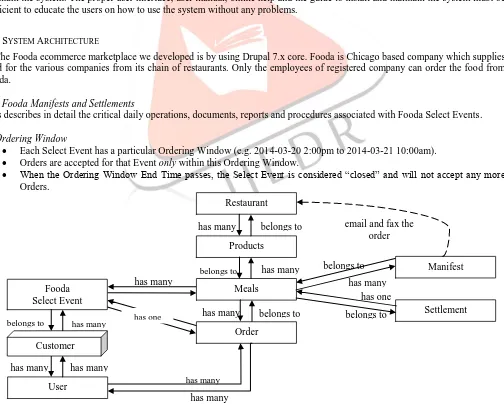
Figure 1: Fooda data model has many has many has many has many has many has many
has many has many
Manifest Settlement Restaurant Products Meals Order User Fooda Select Event Customer belongs to belongs to belongs to belongs to has many has one belongs to has one has many belongs to
IJEDR1402208
International Journal of Engineering Development and Research (www.ijedr.org)2610
Race-conditions: Customers, who may be in the checkout process, at the time the Event closes, should not be able to successfully checkout if the final Order confirmation comes in after the Ordering Window.
Therefore, Ordering Window of the Event needs to be verified for each request during the Select shopping cart & checkout actions
B. Routine Operations (Crontab / Scheduler)
1. Close Events
Runs every 30 minutes all day, everyday – at the top of the hour & 30 minutes past the hour (e.g. 11:00am, 11:30am, 12:00pm, 12:30pm etc.)
Closes all Select Events where the Ordering Window has passed (i.e. Ordering )
Runs the Manifest Operations for all closed Events (see Manifests section).
Generates the Hot Bags Report (see Hot Bags Report section).
Generates the Event Financials Report (see Event Financials Report section)
2. End-of-day Settlements
Runs at 1:45pm every day. Note: Although the current Drupal system runs this operation only once per day, it may be preferred to redevelop the code in a way such that it can run every hour and settle those Events which closed X hours ago and are “pending settlement”.
For each Event which is closed but pending settlement, charge the Customers Credit Card/Payment Method for each Order they've placed for that Event.
For each unique Manifest previously sent, calculate the per-Product Item and Total Amounts pending settlement (with the Vendor, across all Events for the day) and generate the Settlement document (see Settlements section).
Mark all the relevant Events as “settlement completed”.
C. Delivery Grouping
To achieve efficiency in delivering items from multiple Vendors to multiple Customers, we use a system of Delivery Groups & Delivery Priorities, as explained below:
Delivery Group is a property of the Customer. Typically, we group Customers within the same physical/delivery area so that a single driver can be responsible for all deliveries.
Delivery Priority is the priority order within a Delivery Group, so that Customers with a higher priority are served before customers with a lower priority.
Delivery Priority uses an inverse scale of weights – e.g. Priority #1 is the top priority to be served first, Priority #2 is lower priority, Priority #3 is lower still, and so on.
Special case for Customers within same Building: Delivery Groups may contain Customers from within the same Building, or from different Buildings. If Customers are within the same Building, they should be further grouped together within the Delivery Group (in Priority order).
Delivery Group & Priority are inherited by the Event from the Customer defaults. However, these may be modified by the Ops team on a case-by-case basis. Therefore, it's important that all the logic associated with Delivery Group & Priority needs to be based on the settings within the Select Event, and not based on the Customer settings.
D. Manifests
The Manifest contains the list of Product Items, Food Labels & Delivery Information consolidated across all closing Events, and unique to a Vendor. This information is used by the Vendor to prepare the necessary food and have it packaged & split into different groups ready for delivery.
Since a single Select Event may have multiple Vendors supplying the food, it may be necessary to split up the Orders for the Event into one or more Manifests (i.e. one per-Vendor).
Since a single Vendor may be supplying multiple Select Events which end at the same time, it is necessary to consolidate all Orders across multiple Select Events into a single Manifest which is unique to that Vendor.
Since a single Vendor may be supplying multiple Select Events which end at different times, they should receive separate Manifests in such cases. (e.g. Fooda Classics @ 11am vs. Fooda Classics @ 12pm).
Simplified Logic:
- Find the list of Orders across all closing Events for this particular Vendor
- Find the unique list of Customers to serve (based on the list of Orders), and split them into various Delivery Groups, sorted by Delivery Priority (see Delivery Grouping section).
IJEDR1402208
International Journal of Engineering Development and Research (www.ijedr.org)2611
E. Hot Bags Report “Hot Bags Needed?” is a BOOLEAN property of the Restaurant.
Items per Hot Bag are also a property of the Restaurant, and are used to calculate the No. of Hot Bags needed on a per-Vendor per-Delivery Group basis.
The Hot Bags Report contains the following columns: Event Date, Restaurant Name & Address, Delivery Group, Company Name(s) & Address(es), No. of Items Ordered, No. of Hot Bags needed.
F. Event Financials Report
The Event Financials Report contains the top-level financial reporting for all relevant closed Events.
It contains the following columns: Event Name, Date, Delivery Group, Customer, Vendor, Orders, Items, Revenue, COGS, Gratuity Collected, Delivery Fees Collected, Total Tax, Total Subsidy, Total Credit Card Charges, Fully Subsidized? (Yes/No), Running Late Email Time & Delivery Confirmation Email Time.
G. Settlements
Daily Settlements with the Vendor are sent for accounting after the Customers Credit Cards/Payment Methods have been charged for their respective Orders.
Typically, we have one Settlement for each Manifest which was previously sent to the Vendor.
The Settlement contains a list of all Product Items ordered along with quantities. However, the Pricing used for calculation is the Cost of Goods Sold (COGS).
The Settlement contains the following columns: SKU ID, Name, Cost, Quantity, and Total.
IV.RESULTS
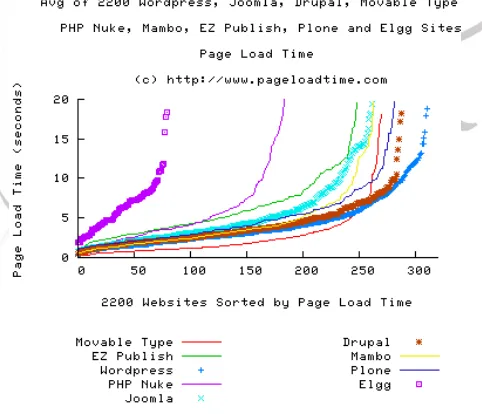
According to survey done by Page Load Time, they had tested the Page Load Times of 2200 websites[12] of the following CMSs: Movable Type, WordPress, EZ Publish, PHP Nuke, Joomla, Drupal, Mambo and Plone.
Note: Websites were selected by searching on “powered by …” in Google and selecting the first 300 to 700 websites for each CMS.
Average page load time across all 9 CMSs tested: 5.4 seconds. Top 10 percent fastest CMS sites: 0.7 seconds Movable Type: bottom red line. Movable Type has a static publishing model build in. Obviously most people use that. That makes Movable Type the undisputed champion where page load times are concerned. As shown in figure below
Figure 2: Page load time of Drupal & other CMS.
IJEDR1402208
International Journal of Engineering Development and Research (www.ijedr.org)2613
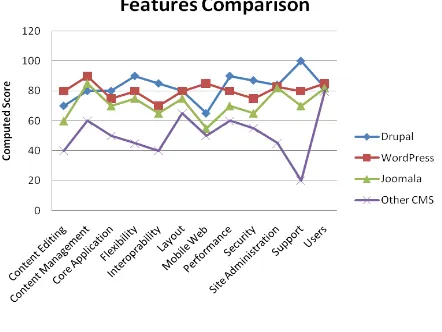
From the comparison done in figure 4 below we can say that Drupal and WordPress are on the same rating for content management features while Joomla get little lower rating for the same. If you see the flexibility then Joomla and WordPress are less flexible then Drupal. If you consider the layout of the CMS then as per the above figure WordPress and Drupal are almost on the same rating while Joomla get little low rating compare to others.Figure 4: Features comparison
V.CONCLUSION
This project deals with an ecommerce marketplace website by making use of Drupal Content Management System (CMS) to provide Dynamic Shopping Cart, Order Management & Fulfilment System. It also provides Stock Keeping Unit (SKU) Inventory System Integration and Web Service for Data Exchange with Intranet Systems using Blowfish Encrypted Serialized JSON (JavaScript Object Notation) Data which makes this system more user-friendly and easy to maintain. As well as it provides more secure online transactions which eventually prevents attacks like SQL Injection, XSS attacks etc. Further its effectiveness will be compared with other existing techniques and its performance will be quantified. Hence we can take up this ecommerce marketplace web portal to protect users‟ data in web applications, since it is very confidential and sensitive.
REFERENCES
[1] Dries Buyaert, “Beginners Guide To Drupal”, www.awakenedvoice.vom
[2] Esmerel, Drupal Concepts, Feb 20, 2014 https://drupal.org/documentation/concepts [3] “Complete CMS solutions” by Jasonsalter.com/cms
[4] Matt Jurmann, “Reasons Why a Web CMS Will Make Your Life Easier and Your Wallet Fatter”, August 4, 2008 [5] Todd Tmlinson, Pro Drupal Development Third Edition
[6] Robert T. Douglass, Mike Little, Jared W. Smith, Building online communities with Drupal, php BB and WordPress [7] Greg James Knaddison, Cracking Drupal: A drop in the bucket
[8] Angela Byron, Addison Berry, Nathan Haug, Jeff Eaton, James walker, Jeff Robbins, “Using Drupal: Choosing and configuring modules to build dynamic websites”
[9] Seyyed Mohsen Hashemi, Soodabeh Hedayati, Design a B2B Electronic Commerce System, IJCSMR, Vol. 1 Issue 4 November 2012, ISSN 2278-733X
[10]Ana Belén Sánchez, Sergio Segura and Antonio Ruiz Cortés, The Drupal Framework: A Case Study to Evaluate Variability Testing Techniques
[11]Savan K.Patel, “Performance Analysis Of CMS” International Journal of Computer Applications (0975 – 8887) Volume 21– No.4, May 2011
[12]Paul Andrew, “2200 CMS Load Time Comparisons, Which is the Fastest?” January 15, 2009 [13]Ian Sommerville, Software Engineering 9th edition.