R E S E A R C H
Open Access
Ren-He’s method for solving dropping
shock response of nonlinear packaging
system
An-Jun Chen
**Correspondence: [email protected] Department of Packaging Engineering, Jiangnan University, Wuxi, 214122, China
Key Laboratory of Food Packaging Techniques and Safety of China National Packaging Corporation Wuxi, 214122, China
Abstract
In this paper, Ren-He’s method for nonlinear oscillators is adopted to give
approximate solutions for the dropping shock response of cubic and cubic-quintic nonlinear equations arising from packaging system. In order to improve the accuracy of the solutions, a novel technique combining Ren-He’s method with the energy method is proposed, the maximum values of the displacement response and acceleration response of the system are obtained by the energy method, and the approximate solution is corrected. An analytical expression of the important parameters including the maximum displacement, the maximum acceleration of dropping shock response and the dropping shock duration is obtained. The illustrative examples show that the dropping shock response obtained by this method is very similar to the one by the fourth order Runge-Kutta method. The result provides a new simple and effective method for the dropping shock response of a nonlinear packaging system.
Keywords: Ren-He’s method; energy method; displacement maximum value;
acceleration maximum value; dropping shock duration
1 Introduction
It is a well known fact that the dynamic model of some engineering problems can be de-scribed by nonlinear differential equations. In the field of packaging engineering, due to the nonlinear characteristics of cushion packaging materials, the dynamics model of a packaging system usually have strong nonlinear characteristics for the theoretical analysis process of packaged product damage evaluation. Therefore, it is general difficult to ob-tain the theoretical analytical solution for this kind of problems. The numerical analysis method such as Runge-Kutta method is often adopted to analyze the dynamics perfor-mance and dropping shock damage evaluation of the packaging systems [–]. Despite the effectiveness of numerical method, the explicit expression of approximate solutions is still expected to be obtained to conveniently discuss the influence of initial conditions and parameters on the solution.
Finding approximate, and if possible in closed-form, solutions of nonlinear differential equations is the subject of many researchers. Recently, various analytical approaches for solving nonlinear differential equations have been widely applied to analyze engineer-ing problems, such as the variational iteration method (VIM) [–], the energy
ance method (EBM) [–], the homotopy perturbation method (HPM) [, ], He’s frequency-amplitude formulation (FAF) [, –], the Hamiltonian approach [], and many others. Although these methods have been applied to obtain approximate solutions of nonlinear equation with large amplitude of oscillations, the solving process of these methods involve sophisticated derivations and computations, and they are difficult to im-plement. A simple approximate method to nonlinear oscillators is proposed by Ren and He [] (Ren-He’s method) and the analysis process of this method is very simple, anyone with basic knowledge of advanced calculus can apply the method to finding the approxi-mate solution of a nonlinear oscillator.
In this paper, for getting analytical results of the cubic and cubic-quintic nonlinear equa-tion arising from packaging system, Ren-He’s method is used to solve the dropping shock dynamic equations of the system, and the approximate solutions including the displace-ment response, acceleration response and the dropping shock duration are obtained. In order to improve the accuracy of the solution, the correction method combining the Ren-He’s method with the energy method (EM) is developed. The research provides an effec-tive method for solving dropping shock problems of the nonlinear packaging systems.
2 Basic idea of approximate analysis 2.1 Analysis process of Ren-He’s method
For a generalized un-damped conservative nonlinear oscillator, the dynamic equation of system can be expressed as
¨
x+v(x) = ()
with initial conditions
x() =A, x˙() = , ()
where a dot denotes differentiation with respect tot,v(x) is a nonlinear function ofx. In order to satisfy the initial conditions, the trial function can be expressed as
x=Acos(ωt), ()
whereωis the angular frequency of the nonlinear oscillator. Substituting equation () into equation () results in
¨
x+vAcos(ωt)= . ()
Integrating equation () twice continuously with respect tot, we have the following two equations:
˙
x= –
t
v(x) dt= –
t
vAcos(ωt)dt, ()
x=
t
˙
xdt=
t
–
t
vAcos(ωt)dt
For the trial function, the following expression is obtained by equation ():
x(t)|ωt=π/= . ()
By equation () or through other special points, we can obtain amplitude-frequency rela-tionship, and can also get the approximate analytic solution of the equation (). The anal-ysis process of this method is very simple, and for a more detailed analanal-ysis of the process one may refer to [].
2.2 Basic idea of EM
For the dropping impact problem of a nonlinear packaging system, the energy method is usually used to solve the maximum displacement and maximum acceleration of the sys-tem, but it is not convenient to obtain the dropping shock duration and the time course of the system response. In order to illustrate the basic idea of the energy method, system damping is not considered in the process of dropping impact, the gravitational poten-tial energy of the system translates into the elastic potenpoten-tial energy of system completely, while the deformation of the cushion material reaches the maximum. Assume the drop-ping height of the packaging system ish, the weight of the product isW. When the system is in the position of heighth, the gravitational potential energy of the system can be ex-pressed as
U=Wh. ()
For the nonlinear cushion packaging system, f(x) denotes the corresponding restoring force of the cushion materials. According to the ideas of the EM, we have
Wh=
xm
f(x) dx, ()
wheref(x) is a nonlinear function ofx, depends upon only the function ofx. The maximum deformationxmcan be obtained by solving equation ().
Due to the dynamics, the equation of the system can be expressed in the form
mx¨+f(x) = . ()
The maximum accelerationx¨mcan be obtained by solving the dynamics equation. In view of the un-damped conservative systems, when the maximum deformation of the buffer occurs, the restoring force of system will be the maximum, the velocity of system is equal to zero and the acceleration response of the system obtains the maximum value, this is the real physical process. In the following discussion, combining Ren-He’s method with EM according to the physical process, a correction method of the approximate analytic solution of Ren-He’s method is put forward for the drop impact problems in packaging engineering.
3 Approximate solution of the dropping shock response
The approximate solution of the dropping shock response is obtained by using Ren-He’s method, and the correction method of approximate solutions is proposed.
3.1 Cubic nonlinear system
First of all, we consider the cubic nonlinear cushion packaging system [, , ]; the drop-ping shock dynamics equation can be expressed as
mx¨+kx+rx= ; ()
equation () can also be expressed as
¨
x+ωx+kx= () with initial conditions
x() = , x˙() =gh, ()
whereω= √
k/mis the frequency parameter,mis the mass of the packaged product,his
the dropping height of the packaging system,ris the nonlinear constants of cushion pack-aging material,kis the initial elastic constants of the buffer material,gis the acceleration
of gravity,k=εω, andε=r/k, respectively.
Different from equation (), the initial condition equation () describes the dropping shock. In order to satisfy the initial conditions, the following trial function is chosen:
x=Asin(ωt), () whereAandωdenote the amplitude and angular frequency of the nonlinear oscillator to be further determined. Notice the following expression:
sin(ωt) =
sin(ωt) –
sin(ωt). ()
By the equation (), we have
˙
x= –
t
v(x) dt= –
t
vAsin(ωt)dt,
wherev(x) =ωx+kx, the above equation can be expressed as
˙
x=
ω
Aω+ kA
cos(ωt) – kA
ωcos(ωt) +C. ()
To satisfy the initial conditionx˙() =gh, from the equation (), we have
C=
gh+kA
ω–
ω
Aω+ kA
. ()
Integrating equation () with respect tot, we have the following equation:
x=
ω
Aω+ kA
sin(ωt) – kA
To satisfy the initial conditionx() = , we haveC= . In order to obtain the
amplitude-Solving the above equation leads to
ω=ω √
+ εA/. ()
The displacement, velocity and acceleration approximate solution of dropping shock dynamics equation () can be obtained as follows, respectively:
x=
The dropping shock duration can be expressed as
τ=π/ω. ()
Letωt=π/, from equation () and equation (), the maximum values of displacement and acceleration of the dropping shock response can be written as follows, respectively:
xm= In order to evaluate the accuracy of the approximate solution, the numerical exam-ple in [] is chosen. The parameter values of the examexam-ple are m= kg, h= . m,
k= Ncm–,r= Ncm–,ε= . cm–, andω= . s–. Using the dropping
shock initial conditionsx˙() =gh, the two key parametersAandωcan be obtained by solving equation () and equation () simultaneously. The displacement and accel-eration response curves of dropping shock process by Ren-He’s method (denoted RHM) are compared with those by the Runge-Kutta method (denoted R-K) as shown in Figures and , respectively. Comparison of the important parameters including the maximum dis-placement, the maximum acceleration of the system response and the dropping shock du-ration by RHM with those by the R-K method are shown in Table , the relative errors of the maximum values of displacement and acceleration and the dropping shock duration are .%, .%and .%, respectively. These results show that the approximate solution needs further discussion as regards the demands of engineering.
For the cubic nonlinear cushion packaging system, the corresponding restoring force of the cushion materials can be expressed as
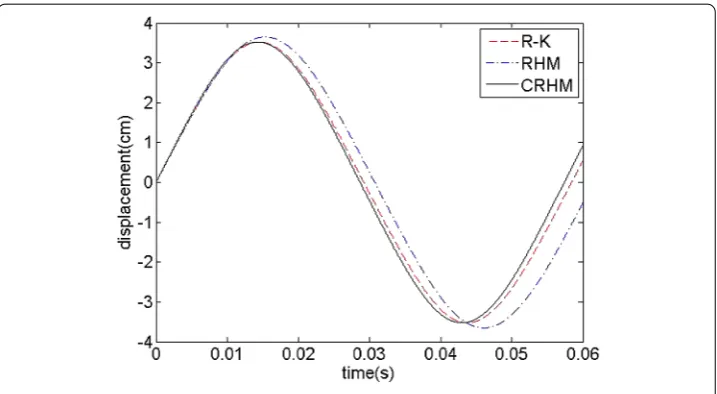
Figure 1 Comparison of the displacement response by RHM and CRHM with R-K method for the cubic nonlinear packaging system.
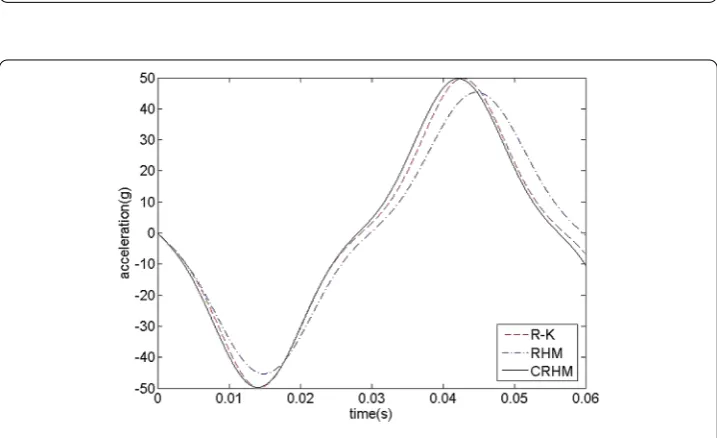
Figure 2 Comparison of the acceleration response by RHM and CRHM with R-K method for the cubic nonlinear packaging system.
Table 1 Comparison of the important parameters by RHM with R-K method for the cubic nonlinear packaging system
xm(cm) x¨m(g) τ(s)
R-K 3.4 49.74 0.02854
RHM 3.51 45.35 0.02984
According to the ideas of the EM, we have the following expression:
The maximum value of displacement can be obtained by above equation and can be ex-pressed as
Under the condition of no system damping, the displacement and the acceleration achieve the maximum value at the same time in the dropping shock process. Through the equa-tion (), the maximum value of acceleraequa-tion can be obtained:
¨
Substituting equation () and equation () into equation () and equation (), respec-tively, we get the following two equations:
xm=
Combining equation () with equation (), the parametersAandωare obtained as fol-lows, respectively:
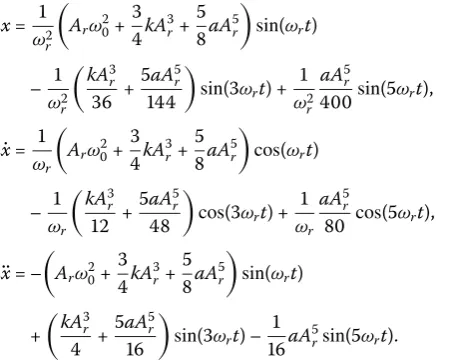
The parameterAandωdenoteArandωr, respectively. SubstitutingArandωr into the equation (), equation (), and equation (), then the correction solutions of the ap-proximate solutions by RHM (denoted CRHM) are obtained:
x=
Substitutingωrinto the equation (), then the correction solutions of the dropping shock duration can be expressed as
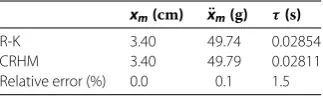
Table 2 Comparison of the important parameters by CRHM with R-K method for the cubic nonlinear packaging system
xm(cm) x¨m(g) τ(s)
R-K 3.40 49.74 0.02854
CRHM 3.40 49.79 0.02811
Relative error (%) 0.0 0.1 1.5
SubstitutingArandωrinto the equation () and equation (), the correction solutions of the maximum displacement and the maximum acceleration of the system can be obtained, respectively.
The dropping shock displacement response and acceleration response of the CRHM are compared with those by the R-K method as shown in Figures and , respectively, the response curve is very close to ones by the R-K method. Comparisons of the important parameters by CRHM with those by the R-K method are shown in Table , the relative errors of the maximum displacement, the maximum acceleration, and the dropping shock duration are .%, .%and .%, respectively. These results show the good accuracy.
3.2 Cubic-quintic nonlinear system
We consider the cubic-quintic nonlinear cushion packaging system [, , ] as the sec-ond example, the dropping shock dynamics equation and initial csec-onditions can be written as
mx¨+kx+rx+qx= , ()
x() = , x˙() =gh, ()
whereqis the coefficient of nonlinear term, the physical meaning of other parameters is the same as in the previous example. The restoring force of the system can be represented as
f(x) =kx+rx+qx. ()
Introducing the new parameters a=σ ω andσ =q/k, the dropping shock dynamics
equation and the initial conditions can also be rewritten as
¨
x+ωx+kx+ax= , ()
x() = , x˙() =gh. ()
In order to satisfy the initial conditions, we chose the trial function
x=Asin(ωt). () Notice the following expressions:
sin(ωt) =
sin(ωt) –
sin(ωt), ()
sin(ωt) =
sin(ωt) –
sin(ωt) +
By equation (), we have
Integrating equation () with respect tot, we have the following equation:
x= To satisfy the initial conditionx() = , we haveC= . In order to obtain the
amplitude-frequency relations, settingx(t)|ωt=π= in equation () yields
The displacement, velocity, and acceleration approximate solutions of dropping shock dy-namics equation () can be obtained as follows, respectively:
Letωt=π/, from equation () and equation (), the maximum displacement and the maximum acceleration of the system can be written as, respectively,
xm=
ω
Aω+ kA
+
aA
, ()
¨
xm=
Aω+kA+aA. ()
In order to facilitate comparison, the related parameter values of the example are set equal to m= kg,h= . m,k= Ncm–, r= Ncm–, σ = . cm–, ε=
. cm–, andω= . s–, respectively. Using the dropping shock initial condition ˙
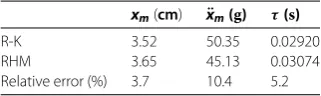
x() =gh, the two key parametersAandωcan be obtained by solving equation () and equation () simultaneously. The displacement and acceleration response of dropping shock process by RHM are compared with those by the R-K method as shown in Figures and , respectively. The comparison of the important parameters including the maximum displacement, the maximum acceleration of the system response and the dropping shock duration by RHM with those by the R-K method are shown in Table , the relative errors of maximum displacement, maximum acceleration and the dropping shock duration are .%, .%and .%, respectively. The results shows that the errors still cannot meet the requirement of engineering application, the results need to be further discussed.
For the dropping shock problem of the un-damped cubic-quintic nonlinear packaging system, the correction method of analytical solutions is the same as the above example. According to the ideas of the EM, we have the following expression:
Wh=
xm
kx+rx+qx
dx. ()
Substituting the related parameter values of example into equation (), the maximum
Figure 4 Comparison of the acceleration response by RHM and CRHM with R-K method for the cubic-quintic nonlinear packaging system.
Table 3 Comparison of the important parameters by RHM with R-K method for the cubic-quintic nonlinear packaging system
xm(cm) x¨m(g) τ(s)
R-K 3.52 50.35 0.02920
RHM 3.65 45.13 0.03074
Relative error (%) 3.7 10.4 5.2
displacement can be solved by the above equation,
xm= . cm. ()
By equation (), the maximum acceleration can be obtained:
¨
xm=ω
xm+εxm+σxm
. ()
Substituting equation () and equation () into equation () and equation (), respec-tively, the following two relations are obtained:
xm=
ω
Aω+ kA
+
aA
, ()
¨
xm=Aω+kA+aA=ω
xm+εxm+σxm
. ()
Combining equation () with equation (), the parameterAand the parameterωare obtained as follows, respectively:
A=xm= . cm, ()
ω=ω +
The parametersAandωdenoteArandωr, respectively. SubstitutingArandωrinto equa-tion (), equaequa-tion (), and equaequa-tion (), then the correcequa-tion soluequa-tions of the approxi-mate solutions by using RHM (denoted CRHM) are obtained:
x=
The correction solutions of the dropping shock duration can be expressed as
τ=π/ωr. ()
SubstitutingArandωrinto the equation () and equation (), then the correction so-lutions of the maximum displacement and the maximum acceleration of system can be written as, respectively,
The dropping shock displacement response and acceleration response of the correction solutions by CRHM compared with those by R-K method are given in Figures and , respectively, the response curve is very close to the ones by R-K method. Comparison of the important parameters by CRHM with those by R-K method are shown in Table , the relative errors of the maximum displacement, the maximum acceleration, and the drop-ping shock duration are .%, .%and .%, respectively. These results show that the approximate solution by CRHM has accuracy enough for engineering application.
4 Conclusions
The evaluation of the dropping impact dynamics, the maximum displacement, the maxi-mum acceleration of the system response, and the dropping shock duration is in focus as
Table 4 Comparison of the important parameters by the CRHM with the R-K method for the cubic-quintic nonlinear packaging system
xm(cm) x¨m(g) τ(s)
R-K 3.52 50.35 0.02920
CRHM 3.52 50.32 0.02869
regards the important parameters. Ren-He’s method has been successfully used for the cu-bic and cucu-bic-quintic nonlinear equations arising from a packaging system; the analytical solutions of the system are obtained, the analytic expression of the above three important parameters is obtained at the same time. In order to further improve the accuracy of the solution, a new method combining the RHM with the energy method, which is defined as a correction method of the RHM (denoted CRHM), is proposed and successfully used to study the cubic and the cubic-quintic nonlinear packaging system. The numerical exam-ples indicate that the lowest order analytical solution obtained by the CRHM has higher accuracy, which outperforms a similar analytical method. The CRHM is obviously advan-tageous in that it is simple and it can avoid solving the complicated nonlinear algebraic equation. The results show that the CRHM is effective and easy for solving the dropping shock problem of a nonlinear packaging system.
Competing interests
The author declares that they have no competing interests.
Received: 13 August 2016 Accepted: 19 October 2016
References
1. Wang, ZW: On evaluation of product dropping damage. Packag. Technol. Sci.15(3), 115-120 (2002)
2. Wang, ZW: Dropping damage boundary curves for cubic and tangent package cushioning system. Packag. Technol. Sci.15(5), 263-266 (2002)
3. Wang, ZW, Jiang, JH: Evaluation of product dropping damage based on key component. Packag. Technol. Sci.23(4), 227-238 (2010)
4. Wang, J, Wang, ZW, Lu, LX, Zhu, Y, Wang, YG: Three dimensional shock spectrum of critical component for nonlinear packaging system. Shock Vib.18(3), 437-445 (2011)
5. Wang, J, Duan, F, Jiang, J: Dropping damage evaluation for a hyperbolic tangent cushioning system with a critical component. J. Vib. Control18(10), 1417-1421 (2012)
6. Chen, AJ: The shock characteristics of tilted support spring packaging system with critical components. Shock Vib.
2014, Article ID 496035 (2014)
7. Duan, NN, Song, S, Chen, AJ: The dynamic evaluation of tilted support spring nonlinear system with critical components under the action of a rectangular pulse. Math. Probl. Eng.2014, Article ID 404163 (2014)
8. He, JH, Wu, XH: Variational iteration method: new development and applications. Comput. Math. Appl.54, 881-894 (2007)
9. He, JH: Variational iteration method - some recent results and new interpretations. J. Comput. Appl. Math.207(1), 3-17 (2007)
10. He, JH: Variational iteration method - a kind of non-linear analytical technique: some examples. Int. J. Non-Linear Mech.34(4), 699-708 (1999)
11. Song, S, Duan, NN, Chen, AJ: Application of variational iteration method for dropping damage evaluation of the suspension spring packaging system. Abstr. Appl. Anal.2014, Article ID 385404 (2014)
12. Chen, AJ: Application of variational iteration method with energy method for nonlinear equation arisen from packaging system. Math. Probl. Eng.2013, Article ID 326239 (2013)
13. Ganji, DD, Tari, H, Babazadeh, H: The application of He’s variational iteration method to nonlinear equations arising in heat transfer. Phys. Lett. A363(3), 213-217 (2007)
14. Mehdipour, I, Ganji, DD, Mozaffari, M: Application of the energy balance method to nonlinear vibrating equations. Curr. Appl. Phys.10, 104-112 (2010)
15. Zhang, HL: Periodic solutions for some strongly nonlinear oscillations by He’s energy balance method. Comput. Math. Appl.58, 2480-2485 (2009)
16. Younesian, D, Askari, H, Saadatnia, Z, Kalamiyazdi, M: Frequency analysis of strongly nonlinear generalized Duffing oscillators using He’s frequency-amplitude formulation and He’s energy balance method. Comput. Math. Appl.59(9), 3222-3228 (2010)
17. He, JH: The homotopy perturbation method for nonlinear oscillators with discontinuities. Appl. Math. Comput.
151(1), 287-292 (2004)
18. Rafei, M, Ganji, DD, Daniali, H: Solution of the epidemic model by homotopy perturbation method. Appl. Math. Comput.187(2), 1056-1062 (2007)
19. He, JH: An improved amplitude-frequency formulation for nonlinear oscillators. Int. J. Nonlinear Sci. Numer. Simul.
9(2), 211-212 (2008)
20. He, JH: Comment on He’s frequency formulation for nonlinear oscillators. Eur. J. Phys.29(4), L1-L4 (2008)
21. Fan, J: He’s frequency-amplitude formulation for the Duffing harmonic oscillator. Comput. Math. Appl.58, 2473-2476 (2009)
22. Khan, Y, Kalamiyazdi, M, Askari, H, Saadatnia, Z: Dynamic analysis of generalized conservative nonlinear oscillators via frequency amplitude formulation. Arab. J. Sci. Eng.38(1), 175-179 (2013)
24. Ren, ZF, He, JH: A simple approach to nonlinear oscillators. Phys. Lett. A373, 3749-3752 (2009)
25. Wang, J: He’s max-min approach for coupled cubic nonlinear equations arising in packaging system. Math. Probl. Eng.2013, Article ID 382509 (2013)
26. Jiang, JH, Wang, ZW: Dropping damage boundary curves for cubic and hyperbolic tangent package cushioning systems based on key component. Packag. Technol. Sci.25, 397-411 (2012)
27. Wang, J, Wang, ZW, Duan, F, Lu, LX, Gao, D, Chen, AJ: Dropping shock response of corrugated paperboard cushioning packaging system. J. Vib. Control19(3), 336-340 (2012)