R E S E A R C H
Open Access
Performance of multicarrier
complementary-coded CDMA under frequency-selective
Nakagami-m fading channels
D. Judson
1*and A. Albert Raj
2Abstract
Multicarrier complementary-coded code division Multiple Access (MC CC-CDMA) is becoming an attractive multiple access technique for high data rate transmission in future wireless communication systems. MC CC-CDMA systems transmitting over frequency-selective channels suffer from multiple access interference (MAI) owing to non-ideal correlation properties of complementary codes (CC). MC CC-CDMA with equalization has recently gained much attention for its ability to offer an excellent performance than traditional systems in frequency-selective fading channels. In this paper, the authors present an analytical study and investigation of MC CC-CDMA downlink system using different combining schemes. The use of parallel interference cancellation (PIC) under frequency-selective Nakagami-m fading channels is also analyzed. A comparison among different combining schemes is provided to show the impact of PIC with minimum mean square error combining (MMSEC) and maximal ratio combining (MRC) on the performance of MC CC-CDMA system. The analytical and simulation results show that the combination of general combining schemes with PIC provides an efficient solution to suppress MAI in downlink MC CC-CDMA system than conventional MC-CDMA systems using Walsh codes under frequency-selective channels.
Keywords:Code division multiple access (CDMA), Complementary codes (CC), Multiple access interference, Frequency-selective fading, Nakagami-m fading
1 Introduction
Next generation wireless communication is expected to provide multimedia services with different quality of service, offering high throughput and reliability under limited power and bandwidth resources. The main im-pairments limiting the capacity and maximum data rate offered to the end users of wireless communication system are multipath fading, delay spread, and multiple access interference (MAI). Multiple access (MA) tech-niques allow different users to share the same channel effectively as possible. Direct sequence code division multiple access (DS-CDMA) is one of the MA tech-niques for its improved performance in terms of system
capacity and coverage compared to time division mul-tiple access and frequency-division mulmul-tiple access [1].
In CDMA, each user uses a unique code sequence that allows multiple users to share the system bandwidth. The codes used for CDMA should have low or zero cross-correlation in order to overcome multiple access interference and multipath interference, which limits the capacity of the current 3G system to half of its process-ing gain (PG) [2]. The major limitation of existprocess-ing signa-ture sequences [3], such as Gold codes, M-sequence, Kasami sequence, and Walsh-Hadamard sequence, are that they are no longer orthogonal in real-time scenarios such as uplink transmission, multiple access, and multi-path interference which reduces the system capacity, ini-tiating the need for perfect orthogonal codes.
In [4], orthogonal complementary codes (OCC) were introduced which offer zero autocorrelation (except zero shift) and zero cross-correlation for all possible shifts * Correspondence:[email protected]
1Department of Electronics and Communication Engineering, St. Xavier’s
Catholic College of Engineering, Chunkankadai 629003Tamilnadu, India Full list of author information is available at the end of the article
between any pair of OCC. Here, the orthogonality is pre-served by assigning a flock of element codes to a user in-stead of a single code as in traditional CDMA systems with unitary codes. The use of complete complementary codes for CDMA was investigated using quadrature amplitude modulation in [5]. Most of the attractive fea-tures of OCC were reported in [6, 7] to show the super-iority of complementary codes in multipath and multiuser scenarios. In [8], a superset of perfect comple-mentary codes was proposed to increase the set size of the OCC to its processing gain. In order to achieve interference-free OCC, the flock size of the signature code must be equal to the set size of the codes. This problem was addressed in [9] where the code generated was able to support more users compared to complete complementary codes.
In a complementary-coded (CC) CDMA, each user data is spread withNelement codes of a particular
com-plementary code and transmitted using N independent
subcarriers [10] to form a multicarrier CC-CDMA sys-tem. At the receiver, the signals received using different subcarriers are passed to their corresponding chip matched-filters and summed up with an equal gain to reconstruct ideal correlation properties. Such equal gain summation is hard to achieve over frequency-selective fading channels, where different subcarriers may suffer from different fading levels.
The ideal orthogonality of complementary correlation function under frequency-selective fading channels is lost due to multiple access interference and multipath interference existing between users transmitting over a common bandwidth. The performance degradation caused due to channel selectivity in MC CC-CDMA was addressed for both downlink [11] and uplink [12] under Rayleigh fading channels. Even though channel selectivity reduces orthogonality of CC, the multi-sequence spreading and summation at the receiver of MC CC-CDMA system offers additional diversity gain which cannot be achieved in traditional CDMA systems using single carrier.
The combining algorithms play a vital role in enhan-cing the performance of MC CC-CDMA systems. Equal gain combining (EGC) works well only in correlated channel conditions. In frequency-selective fading condi-tions, orthogonal restoring combining (ORC), maximal ratio combining (MRC), and minimum mean square error combining (MMSEC) have been a promising tech-nique in reducing MAI [13]. In [14], multiple-input and multiple-output orthogonal frequency-division multi-plexing systems were proposed for downlink transmis-sion using orthogonal variable spreading factor codes to obtain spatial diversity for existing single-input and single-output systems. Different types of gain combining schemes were employed in frequency domain to recover the data symbols of desired code channels.
In our study, we aim to enhance the performance of downlink MC CC-CDMA system by mitigating MAI in frequency-selective Nakagami-m fading channels. The impacts of different combining schemes such as ORC, MRC, and MMSEC on bit error rate (BER) performance of CC-CDMA are examined under frequency-selective fading channels. Parallel interference cancellation (PIC) with MRC and MMSEC is suggested for obtaining MAI-free performance in CC-CDMA systems with uncorre-lated channel gain in each subcarrier under frequency-selective Nakagami-m fading channels. The accuracy of the derived BER expressions is verified with the simulated ones for MC CC-CDMA systems with different combin-ing methods under different system parameters. Further, we compare the BER performance of complementary-coded CDMA with conventional CDMA systems employ-ing Walsh codes to show the advantage of CC-CDMA in obtaining large diversity gain when incorporating PIC with different combining schemes.
The rest of the paper is organized as follows: in Section 2, we describe the system model of MC CC-CDMA system under frequency-selective Nakagami-m fading channels. Section 3 provides finite summation expressions and the resultant performance analysis of CC-CDMA using different combining schemes. The analytical and simulation results with discussions are presented in Section 4. Finally, Section 5 presents the conclusions.
2 MC CC-CDMA system model
In this section, the system model for MC CC-CDMA is discussed.
2.1 MC CC-CDMA transmitter descriptions
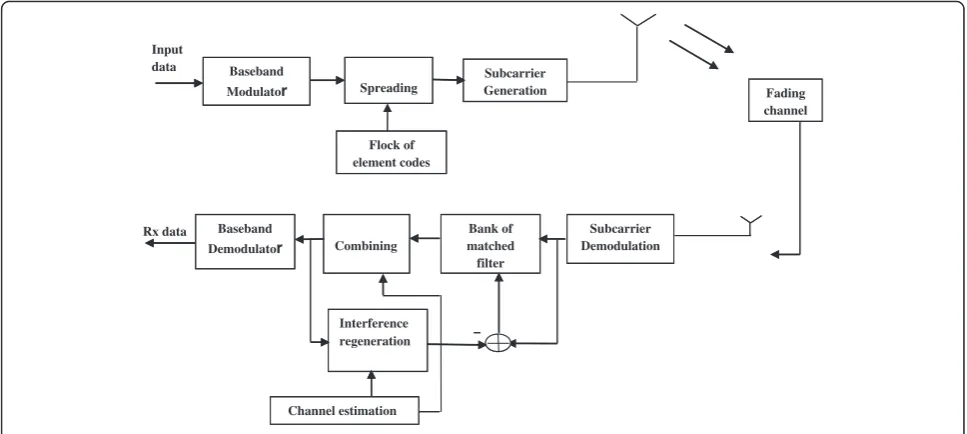
The transmitter section for MC CC-CDMA is shown in Fig. 1. There are Kusers in the multiple access system.
The kth user information symbol after baseband
modu-lation denoted as ak(t) is a sequence of positive and negative pulses of durationTbwith amplitude +1 or −1.
The baseband modulated symbols of user k are spread
with a flock of element codes represented as
Cð Þk ¼ Cð Þ1k ; Ck
ð Þ
2 ; …Ck
ð Þ
N
h iT
; ð1Þ
wherek= 1,2,…,K, andn= 1,2,…,N.
Here, C(k) and Cð Þnk represent the complementary
code and the corresponding element code, respectively.K
and the flock size N denote the number of users and
number of element codes used by the same user, respectively.
its processing gain is equal to the length of the unitary code. Walsh codes are commonly used in downlink channels due to better cross-correlation property of code set. Synchronous users modulated using Walsh codes can be separated at the receiver with less interference as long as its orthogonality is not corrupted due to MAI. However, in CDMA system with CC, the orthogonality
of each complementary codeC(k)is based on a flock of
element codes offering zero cross-correlation character-istics than conventional CDMA system. The processing gain of a CDMA system with CC is the product of flock size and the length of element code.
In MC CC-CDMA, the spreading data matrix of user kis given by
S kð Þ ¼
ak1C1ð Þk ak2C1ð Þk ⋯ akNC1ð Þk
ak1C2ð Þk ak2C2ð Þk ⋯ akNC2ð Þk
ak1C3ð Þk ak2C3ð Þk ⋯ akNC3ð Þk
⋮ ⋯ ⋮
⋮ ⋯ ⋮
ak1CNð Þk ak2CNð Þk ⋯ akNCNð Þk
2 6 6 6 6 6 6 4
3 7 7 7 7 7 7 5
;
ð2Þ
where [ak1, ak2…, akN] represents the data
correspond-ing to userk.
The spreaded data of user k is sent through
mul-tiple carriers to the receiver. The transmission using multiple carriers provides ideal autocorrelation func-tion and cross-correlafunc-tion funcfunc-tion behaviors. In spite of the occurrence of many side lobes during autocorrelation among individual element codes, the
sum of correlation between N element sequences of
two different complementary codes is zero, as given below
XN
n¼1
ρ Cð Þnk Cð Þnl;τ
¼ NLc ; τ¼0;k¼l
0; τ≠0 ;
ð3Þ
where 0≤τ< Lc represents the relative chip delay
be-tween the local correlator and the received signal. Lc
represents the length of the element code, and N de-notes the number of element codes. The data ak(t)
spread with N element codes followed by subcarrier modulation is denoted as
Sð Þkð Þ ¼t pffiffiffiffipX
N
n¼1
akð Þt Cð Þnkð Þt ejφn; ð4Þ
where p ¼ Eb
NTb andTbrepresent the transmitter power
and the bit interval given by Tb=LcTc, respectively. Eb
and Tc are the bit energy and chip interval, respectively.
ejφn is the subcarrier assigned to nth element code. Cð Þk
n
t
ð Þis the spreading waveform of userkdefined as
Cð Þnkð Þ ¼t
X
Lc−1
m¼0
Cð Þnk;mФðt−mTcÞ; 0<t≤Tb; ð5Þ
where Cð Þnk;m represents the chip values of the spreading sequence assigned to user k. Ф(t) represents the rect-angular shape of chip limited waveform.
The signal fromKusers undergoes subcarrier
modula-tion and transmitted synchronously over frequency-selective fading channel. Downlink transmission is con-sidered where coherence bandwidth of each subcarrier is assumed to be smaller than the system bandwidth. Each Interference
regeneration Baseband
Demodulator
Channel estimation Combining
Bank of matched filter Flock of
element codes
Subcarrier Demodulation
Spreading Fading
channel Subcarrier
Generation Baseband
Modulator Input
data
Rx data
subcarrier is modeled as independent flat fading channel with the bandwidth of each subcarrier being less than the coherence bandwidth. Therefore, each subcarrier does not have selectivity, and it is also assumed that the channel coefficient is constant throughout the transmis-sion period of 1-bit duration.
2.2 Receiver section of MC CC-CDMA
Suppose that the desired user of interest is l, the demo-dulated signal from subcarriernin a mobile station can be written as
rð Þnlð Þ ¼t hð Þnl
XK
k¼1
sð Þnkð Þ þt nnð Þt ; ð6Þ
where hð Þnl ¼hð Þnlejφ
l ð Þ
n represents the channel coefficient
of subcarriernfrom the base station to the userl.sð Þnkð Þt denotes the spreaded data ofnth element code of userk. nn(t) is the zero mean white Gaussian noise with
vari-anceNo/Tcin the subcarriernandNois the power
spec-tral density of complex additive white Gaussian noise (AWGN). Here, it is assumed that the N noise samples are uncorrelated.
In multicarrier CC-CDMA system, the
carrier-demodulated signals of each user are passed through N
chip-matched filters corresponding to N element
se-quences. If yð Þnlð Þt represents the chip-matched filter out-put for the element sequencecð Þnl at the receiver of desired userl, the matched filter output fornth element sequence under perfect carrier, code, and bit synchronization is de-noted as
yð Þnlð Þ ¼t
ZT
0
rð Þnlð Þt cnð Þlð Þt dt: ð7Þ
Substituting (4) and (5), in (6), we have
yð Þnlð Þ ¼t hð Þnl
ffiffiffi
p
p XK
k¼1
bkð Þt ρð Þkn;l;0þIn; ð8Þ
whereInrepresents the sampled additive white Gauss-ian noise with zero mean and varGauss-ianceLcσn2expressed as
In¼
ZT
0
nnð Þt cð Þnlð Þt dt: ð9Þ
The outputs ofNchip-matched filters of desired userl are combined before taking decision. Here, the signals
received through N subcarriers results in N-branch
di-versity with each branch representing replicas of source data spread bynth element sequence. Hence, in order to achieve ideal correlation characteristics of the received sig-nal under frequency-selective fading channel, a suitable
combining method should be employed to achieve
fre-quency diversity gain, from the signal received over N
subcarriers.
3 Interference cancellation with different receivers for MC CC-CDMA
The discrete-time signal component at the combiner output for desired userlin theith symbol interval is de-noted as
yð Þclð Þ ¼i
XN
n¼1
yð Þnlð Þi wð Þnl; ð10Þ wherewð Þnl is the equivalent combining weight of thenth subcarrier for desired user l. yð Þnlð Þi represents the discrete-time equivalent of (8).
The different types of combining techniques normally used are orthogonal restoring combining (ORC), max-imal ratio combining (MRC), and minimum mean square error combining (MMSEC). ORC performs well when the number of active users is high and the system is interference limited. However, ORC will enhance noise due to the requirements of larger weights at low signal to noise ratio (SNR). The equivalent weight for ORC is given by
wð Þnl ¼ 1
hð Þnl
: ð11Þ
Using MRC, multiple uncorrelated signals at the
output of N matched filters are combined to obtain a
frequency diversity gain. The equivalent weight corre-sponding to MRC is given by
wð Þnl ¼ hð Þnl
h i
; ð12Þ
where * denotes the complex conjugate operation. MMSEC is obtained based on the information of the number of active users, the noise power, and the channel gain of each subcarrier. The equivalent weight of MMSE combining is given by [15],
wð Þnl ¼
hð Þnl
h i
hð Þnl
2þ NNo
KuEb
; ð13Þ
where Ku is the number of active users and Eb/No
de-notes the bit energy to noise density ratio.
3.1 MRC-based parallel interference cancellation
performance gets degraded in frequency-selective fading channels due to MAI existing between interfering users. Parallel interference cancellation (PIC) can be used to achieve performance improvement in multiuser CDMA systems affected due to MAI. Further, PIC using suitable interference estimation techniques such as MMSE, ORC, and MRC can be used to estimate, regenerate, and cancel the effect of interfering users [17].
In MC CC-CDMA, PIC is applied to Nsubcarriers to
obtain per-carrier parallel interference cancellation (PC-PIC). The main aims of PIC are to regenerate the signal mixed with MAI and recover the useful signal from the desired user. It is normally operated in two stages. In the first stage, the initial data estimates due to interfering users is estimated using (15) with suitable combining method and PIC is applied using (14) to regenerate and cancel MAI existing in the received signal. In the second stage, the interference-cancelled signal is combined using MRC to form PIC-MRC.
The interference-cancelled signal for subcarrier n,
based on the estimated interference, channel gain, and the number of interfering users can be written as
rpic;nð Þ ¼t rnð Þt −hnpffiffiffip sents the interference at the output of chip-matched filter from interfering userkwhich is estimated based on specific combining weight denoted as
J^ð Þk ð Þ ¼i X
N
n¼1
wð Þnlyð Þnkð Þi ; k≠l: ð15Þ
After interference cancellation, the signals fromN sub-carrier are despread using complementary code of de-sired userland combined to give the estimated data for
element sequencenas
b^picð Þlð Þ ¼i
Using (12) in (16), the data signal of desired user l
after interference estimation using a specific estimation scheme and MRC is given by
b^picð Þlð Þ ¼i Lcpffiffiffip
whereNpicis the noise term andJpicis the residual MAI
represented as
It can be observed from (18) that the performance of MC CC-CDMA depends on the equivalent combining weight and the correlation properties of each element sequence. In addition, the accuracy of the estimated MAIJ^ (k)(i) depends heavily on perfect available channel state information at the receiver of the desired user.
3.2 Error probability of MC CC-CDMA system under Nakagami-m fading channel with MRC
We consider downlink MC CC-CDMA communication system under frequency-selective fading channel where the signal from the base station (BS) is transmitted toK
simultaneous active mobile users. Each user employs N
element codes, and binary phase-shift keying (BPSK) is
used. The flock sizeNdetermines the bandwidth of each
subcarrier for the fixed system bandwidth, and each subcarrier is assumed to experience slowly varying Nakagami-m fading channel. All the element codes are assumed to experience flat, but uncorrelated fading.
The error probability for MC CC-CDMA under Nakagami-m fading channel is obtained by averaging the conditional error probability with respect toγas follows
PeNaka¼
Z∞
0
PeAWGNð Þγ :fγð Þγ dγ: ð19Þ
For a Nakagami-m fading channel with parameter m, the PDF of the fading channel with Nakagami random variablerand instantaneous SNRγ¼ r2Eb
No overLpaths with MRC diversity is given by [18] as
fγð Þ ¼γ mγ
m is defined as the ratio of moments called the fading figure [19], given bym¼ γ
2
EðR2−γÞ2.
Using (17) and (20) in (19), we get the error probability
forNindependent subcarriers with Nakagami-m fading as
function in probability theory obtained from [19] and is related to the Gaussian probability integral as
Q xð Þ ¼12 1−erf pxffiffi2
:
Using equation (6.286/1) from [20], we get
Z∞
whereβ,μ, andvrepresent the constants associated with the variablexin (22).
Comparing (22) with (21) and using equation (3.381/4) of [20] in (21), the error probability for MC CC-CDMA system under Nakagami-m fading channel is given by
PNake ¼ [20]. The above equation can be numerically evaluated using MATLAB for each value of diversity orderN, fad-ing parameterm, and average SNRγ.
4 Analytical and simulation results
In this section, analytical and simulation results are presented for illustrating the performance of MC CC-CDMA system under different channel conditions. In simulations, downlink communications with an uncoded BPSK modulation is considered. Here, each subcarrier is modeled as independent Nakagami-m flat fading
chan-nel and Nchannel coefficients are considered as
uncor-related zero-mean complex Gaussian random variables with unit variance. The channel coefficients are constant throughout the transmission period of 1-bit duration. Throughout the simulation, it is assumed that perfect channel state information (CSI) is available at the re-ceiver. We assume supercomplementary codes (SCC) in simulations, where in SCC, the flock size can be equal to their processing gain [9], thus supporting more users compared to complete complementary codes.
4.1 A. BER performance of MC CC-CDMA without PIC
We first illustrate the performance of MC CC-CDMA system without PIC under different fading conditions using various combining schemes such as ORC, MRC, and MMSE. The propagation channel considered is frequency-selective Nakagami-m fading channel with each subcarrier experiencing uncorrelated fading. The comparison is made using SCC having PG of 64 with flock size 16 and element code length 4.
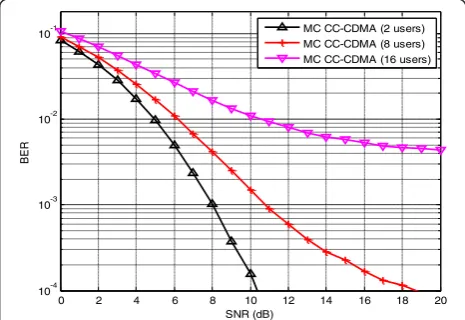
Figure 2 shows the BER performance of MC CC-CDMA using MRC with variations in number of users
for fading parameter m =4 under frequency-selective
Nakagami-m fading channel. It can be observed that with variations in number of users accessing the system, the effect of multiple access interference and hence BER increases. From Fig. 2, it can be seen that for BER of 10−2, the additional required SNR is 4 dB for 16 user system compared to eight user system. This occurs due to the increase in MAI with increase in number of users in the system and lack of suitable equalization schemes to improve the error rate performance.
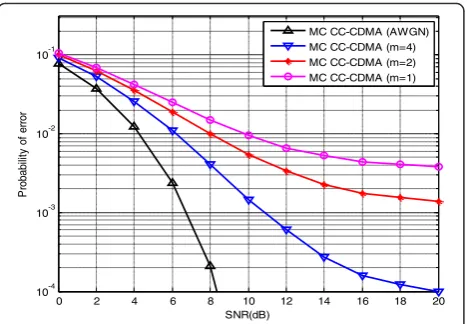
Figure 3 shows the reduction in error probability with
increase in fading parameter m for MC CC-CDMA
system using MRC and its comparison with AWGN channel. The performance for AWGN channel is ob-tained without considering the effect of fading on each subcarrier. The number of users used for comparison is 8. It can be visualized from the plot that with increase in the fading parameterm, the probability of receiving the signal with less error increases, thereby increasing the system performance.
The simulated performance of MC CC-CDMA gener-ated using SCC under frequency-selective Nakagami-m fading channel with different combining techniques is shown in Fig. 4. The comparison is with fading
param-eter m =2. The number of users used for comparison is
16. Here, the simulated performance of different com-bining schemes such as MRC, ORC, and MMSEC is compared using (11), (12), and (13). It can be observed that with more number of active users (interference lim-ited system), the performance of ORC is better than that of MRC, but MMSEC offers diversity gain with know-ledge of number of active users and noise power. Fur-ther, it can be seen that at Low SNR, MMSEC offers SNR gain of about 6 dB compared to ORC for BER of
0 2 4 6 8 10 12 14 16 18 20
MC CC-CDMA (2 users) MC CC-CDMA (8 users) MC CC-CDMA (16 users)
10−2 and at high SNR, the SNR gain is twofold com-pared to ORC for BER of 10−3, respectively.
4.2 B. BER performance comparison of MC CC-CDMA with PIC
In this section, we discuss the error rate performance of MC CC-CDMA using different combining schemes with PIC to show the superiority of PIC in reducing the effect of MAI in frequency-selective Nakagami-m fading chan-nel. The simulated BER performance of MC CC-CDMA is compared with analytical results to validate the theoretical results obtained. Further, we compare the performance of single carrier (SC) and multicarrier CDMA employing Walsh codes with multicarrier CC-CDMA to show the significance of complementary codes in obtaining larger diversity gain with PIC compared to non-interference cancellation techniques.
Figure 5 shows the performance improvement achieved by using PIC with suitable combining schemes under frequency-selective fading channels using identical simula-tion parameters as in Fig. 4. The per-carrier parallel inter-ference cancellation (PC-PIC) is performed in two stages. In the first stage, the initial data estimates of all interfering users are obtained using MRC, ORC, and MMSEC and PC-PIC is obtained using (15) resulting in MRC-PIC, ORC-PIC, and MMSEC-PIC. In the second stage, the interference-cancelled signal is dispread and combined using MRC to provide the desired users data. Here, the interference-cancelled signal using different interference estimation schemes is finally combined using MRC to ob-tain MRC-PIC-MRC, ORC-PIC-MRC, and MMSE-PIC-MRC. For instance, the notation MMSE-PIC-MRC refers to a PIC receiver using MMSE technique at the first stage and MRC at the second stage. It can be observed from Fig. 5 that the performance of PIC has a higher slope as compared to the system without interference cancellation (Fig. 4). This is mainly due to the reduction in MAI due to PIC. Further, it can be observed that at SNR of 10 dB, the MC CC-CDMA with MRC-PIC-MRC, ORC-PIC-MRC, and MMSE-PIC-MRC provides BER of 0.0113, 0.0050, and 0.0003, respectively, which is much lower than the error rate of MC CC-CDMA without PIC.
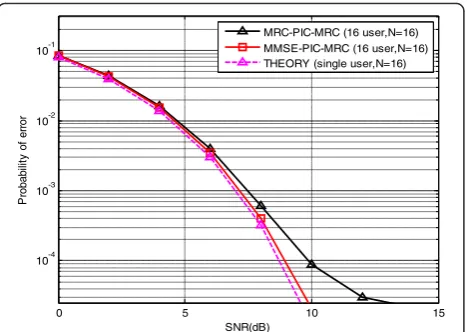
The analytical versus simulated performance com-parison of MC CC-CDMA using PIC-based MRC under frequency-selective Nakagami-m fading channel is shown in Fig. 6. The simulated performance is
ob-tained using OCC with set size, N =16 and Lc =4
with PG of 64 for different parallel interference cancellation techniques such as MRC-PIC-MRC and MMSE-PIC-MRC. It can be observed that the simu-lated performance of MMSE-PIC-MRC agrees very well with the analytical result in (23) for the case of
m =6 and N =16. This improvement in performance
0 2 4 6 8 10 12 14 16 18 20
Fig. 3BER performance comparison of MC CC-CDMA system with AWGN and MRC under frequency-selective Nakagami-m fading channel for different values of fading parameter m
0 2 4 6 8 10 12 14 16 18 20
Fig. 4Performance comparison of MC CC-CDMA using different combining schemes in frequency-selective Nakagami-m fading channel
is mainly due to the reduction in MAI due to MMSE-based PIC. Further, it can be visualized that
for BER of 10−4, MMSE-PIC-MRC offers SNR gain of
3 dB compared to MRC-PIC-MRC, validating the su-periority of MMSE-PIC-MRC in reducing the effect of MAI.
Figures 7 and 8 show the performance comparison of CDMA system using complementary codes with Walsh-coded CDMA to show the superiority of com-plementary codes in suppressing MAI in frequency-selective Nakagami-m fading channel. The PG of CC
is 64 with element code length Lc =4 and flock size
N =16 with m = 2. The PG of Walsh code is assumed to be 64, and the number of users used is 16 for fair comparison. It can be observed from Fig. 7 that at
BER of 10−3, with decrease in fading parameter m,
there is not much degradation in performance of
complementary-coded CDMA compared to Walsh-coded
CDMA. At SNR of 10 dB and withm =2, it can be seen
that complementary-coded CDMA employing MMSE-PIC-MRC offers 10 dB improvement in performance gain compared to Walsh-coded CDMA providing controlled BER with reduced MAI.
In Fig. 8, we compare the BER performance of MC CC-CDMA with single carrier (SC) and multicarrier CDMA (MC-CDMA) employing Walsh code using MMSE combining and PIC in a frequency-selective Nakagami-m fading channel. The number of users considered in all the three systems is 16 and fading
parameter m is 2. The number of subcarriers used for
both MC-CDMA and MC CC-CDMA systems are 64. It can be examined that the BER performance of MC CC-CDMA system using MMSE-PIC-MRC as a final combining scheme is more robust in frequency-selective Nakagami-m fading channels compared to other traditional SC and MC-CDMA systems using Walsh codes.
From Fig. 8, we can observe that the combining algo-rithms play a critical role in the performance of MC CC-CDMA system. In addition, the use of PIC with different combining schemes in MC-CC-CDMA results in per-formance improvement at the cost of increased com-putational complexity compared to non-interference cancellation schemes. In MC-CDMA system employing Walsh codes and complementary codes, the per-carrier computational complexity of hard decision PIC detector as a function of usersKisO(K(K−1)), whereO(.) denotes the order of complexity [21]. Although the complexity in-curred by both the systems are in the same order, MC
CC-CDMA offers additional 8 dB gain at BER of 10−4
compared to MC CDMA using Walsh codes. This
0 5 10 15
Fig. 6Performance comparison of analytical and simulated BER for MC CC-CDMA using different interference cancellation techniques under frequency-selective Nakagami-m fading channels
0 5 10 15 20 25 Complementary Coded CDMA (m = 2) Complementary Coded CDMA (m = 4) Complementary Coded CDMA (m = 6)
Fig. 7BER performance comparison of CDMA systems using CC and Walsh code in frequency-selective fading channels with variations in fading parameterm
SC CDMA, Walsh (MMSE) SC CDMA, Walsh (MMSE-PIC-MRC) MC CDMA, Walsh (MMSE) MC CDMA, Walsh (MMSE-PIC-MRC) MC CC-CDMA (MMSE)
MC CC-CDMA (MMSE-PIC-MRC)
performance improvement is achieved due to additional diversity gain, which makes MC CC-CDMA suitable for system requiring higher data rate and capacity.
5 Conclusions
In this paper, we analyzed the performance of MC CC-CDMA system with different combining schemes for downlink transmissions under frequency-selective Nakagami-m fading channels. Performance measures in terms of BER versus SNR are plotted for different combining schemes to show the superiority of
com-plementary codes in frequency-selective channels
under different channel conditions. It was shown that in the presence of MAI, only MMSE-PIC with MRC can be more tolerant to interference with much higher gain than MRC-based PIC. Furthermore, the simulation results have revealed that an MC-CDMA system using CC offers a higher diversity gain than traditional MC-CDMA systems using Walsh codes.
Competing interests
The authors declare that they have no competing interests.
Acknowledgements
The authors would like to thank the anonymous reviewers for their valuable comments which greatly improved the quality of the paper.
Author details
1Department of Electronics and Communication Engineering, St. Xavier’s
Catholic College of Engineering, Chunkankadai 629003Tamilnadu, India.
2Department of Electronics and Communication Engineering, DMI
Engineering College, Aralvaimozhi 627105, Tamilnadu, India.
Received: 21 August 2015 Accepted: 18 February 2016
References
1. KS Gilhousen, IM Jacobs, R Padovani, A Viterbi, On the capacity of cellular CDMA systems. IEEE Trans. Commun.40(2), 303–312 (1991)
2. S Moshavi, Multiuser detection for DS-CDMA communications. IEEE Commun. Mag.34, 124–136 (1996)
3. EH Dian, B Jabbari, Spreading codes for direct sequence CDMA and wideband CDMA cellular networks. IEEE Commun. Mag.36(9), 143–146 (1998) 4. HH Chen, JF Yeh, N Suehiro, A multicarrier CDMA architecture based on
orthogonal complementary codes for new generations of wideband wireless communications. IEEE Commun. Mag.39(10), 126–135 (2001) 5. ME Magana, T Rajatasereekul, Complete complementary orthogonal (CCO)
code based CDMA using natural mapping QAM constellations. Wireless Pers. Commun.38(4), 435–442 (2006)
6. L Lu, V Dubey, Performance of a complete complementary code based spread-time CDMA system in a fading channel. IEEE Trans. Vehicular Technol.57(1), 250–259 (2008)
7. H Chenggao, N Suehiro, T Hashimoto, A systematic frame work for the construction of optimal complete complementary codes. IEEE Trans. Inf. Theory57(9), 6033–6042 (2011)
8. HH Chen, SW Chu, N Kuroyanagi, AJH Vinck, An algebraic approach to generate a superset of perfect complementary codes for interference-free CDMA. Wireless Commun. Mobile Comput.79(5), 605–622 (2007) 9. HH Chen, SW Chu, M Guiziani, On next generation CDMA technologies: the
real approach for perfect orthogonal code generation. IEEE Trans. Vehicular Technol.57(5), 2822–2833 (2008)
10. HH Chen, The next generation CDMA technologies.(John Wiley and sons, NJ, USA, 2007)
11. WH Meng, SY Sun, HH Chen, Multiuser interference cancellation in complementary coded CDMA with diversity gain. IEEE Wireless Commun. Lett.2(3), 303–306 (2013)
12. SY Sun, WH Meng, HH Chen, Uplink pre-equalization for CC-CDMA systems under frequency selective fading. Proc. of IEEE ICC. 2013, 5317-5321 (2013) 13. S Hara, R Prasad, Overview of multicarrier CDMA. IEEE Commun. Mag.
39(12), 126–133 (1997)
14. P Li, W Hamouda, Performance of multiple-input and multiple output orthogonal frequency and code division multiplexing systems in fading channels. IET Commun.5, 1–11 (2012)
15. S Kaiser, On the performance of different detection techniques for OFDM-CDMA in fading channels. Proc. Globecom3, 2059–2063 (1995) 16. S Verdu,Multiuser detection(Cambridge University Press, UK., 1998) 17. BA Al-fuhaidi, HEA Hassan, MM Salah, SS Alagooz, Parallel interference
cancellation with different linear equalization and Rake receiver for the downlink MC-CDMA systems. IET Commun.6(15), 2351–2360 (2012) 18. VA Aalo, Performance of maximal-ratio diversity system in a correlated
Nakagami-faded environment. IEEE Trans. Commun.43(8), 2360–2369 (1995) 19. JG Proakis,Digital communications, 4th edn. (McGraw Hill Inc, NY, 2001) 20. IS Gradshteyn, IM Ryzhik,Table of integrals, series and products, 6th edn.
(Academic, San Diego, 2000)
21. DR Brown, Multistage parallel interference cancellation: convergence behavior and improved performance through limit cycle mitigation. IEEE Trans. Signal Process.53(1), 283–294 (2005)
Submit your manuscript to a
journal and benefi t from:
7Convenient online submission
7Rigorous peer review
7Immediate publication on acceptance
7Open access: articles freely available online
7High visibility within the fi eld
7Retaining the copyright to your article