Volume 2010, Article ID 482975,13pages doi:10.1155/2010/482975
Research Article
The Waterfilling Game-Theoretical Framework for Distributed
Wireless Network Information Flow
Gaoning He,
1Laura Cottatellucci,
2and M´erouane Debbah
31Research & Innovation Center, Alcatel-Lucent Shanghai Bell, 388 Ningqiao Road, Pudong, Shanghai 201206, China 2Department of Mobile Communications, EURECOM, 06904 Sophia-Antipolis Cedex, France
3Alcatel-Lucent Chair on Flexible Radio, 3 Rue Joliot-Curie, 91192 Gif sur Yvette, France
Correspondence should be addressed to Gaoning He,[email protected]
Received 1 October 2009; Revised 13 May 2010; Accepted 2 July 2010
Academic Editor: Zhi Tian
Copyright © 2010 Gaoning He et al. This is an open access article distributed under the Creative Commons Attribution License, which permits unrestricted use, distribution, and reproduction in any medium, provided the original work is properly cited.
We present a general game-theoretical framework for power allocation in the downlink of distributed wireless small-cell networks, where multiple access points (APs) or small base stations send independent coded network information to multiple mobile terminals (MTs) through orthogonal channels. In such a game-theoretical study, a central question is whether a Nash equilibrium (NE) exists, and if so, whether the network operates efficiently at the NE. For independent continuous fading channels, we prove that the probability of a unique NE existing in the game is equal to 1. Furthermore, we show that this power allocation problem can be studied as a potential game, and hence efficiently solved. In order to reach the NE, we propose a distributed waterfilling-based algorithm requiring very limited feedback. The convergence behavior of the proposed algorithm is discussed. Finally, numerical results are provided to investigate the price of anarchy or inefficiency of the NE.
1. Introduction
Recently, there has been an increasing interest for small-cell networks. In fact, they have been recognized as an effective and low-cost architecture to provide wireless data rate access to Internet users [1,2]. These networks consist of numerous and densely deployed APs, known as outdoor femto cells or small-cells, connected to an existing backbone network with heterogeneous links, for example, fibers, ADSLs, and power lines. The general idea is to provide signal coverage and high data rates in dense environments, that is, areas with high user concentrations, by installing low-cost wireless access nodes and exploiting the existing heterogeneous wired infrastructures without a new high-cost cabling. In reality, the femto nodes may belong to different service providers eventually organized in coalitions to maximize their own rev-enues. In such a context, there is a critical trade-offbetween cooperation and competition among different providers who may share information and resources to maximize their own revenues. In order to enable both cooperation among providers and network scalability, the femto nodes need self-organizing mechanisms to perform communications and
network control functions. Thus, distributed algorithms accounting for the revenues of different providers play a key role in this context.
In contrast to the legacy cell networks, in a small-cell network a user may be served by more than one femto node. This feature is strategic to cope with the heterogeneity of the core network. In fact, if a user were only connected to a single out-door femto-cell, it would suffer from low throughput from time to time due to the limited-backhaul capacity, despite the presence of a high-speed wireless link. As a result, users would access simultaneously to different femto-cells in order to aggregate the sum capacity of the backhaul links.
system is substantially different from the ones typically analyzed in literature. In fact, it does not reduce to a classical downlink of a cellular network modeled as a broadcast channel since there are several APs transmitting information simultaneously to the same MT. Nor does it reduce to N independent multiple access channels when considering each mobile as a receiver because of the power constraints at the APs. Finally, the considered system does not reduce to a multicellular or an adhoc network modeled as an interference channel since all the signals received at each MT carry useful information to be decoded. In this paper we assume that each signal of interest is decoded considering the remaining signals as interference. This scheme is susceptible to improvement by joint decoding of all the received signals. However, this decoding approach exceeds the scope of this paper.
In traditional wireless cellular networks, the power allocation is often implemented with centralized algorithms aiming at maximizing the sum of the Shannon transmission rate [4]. The maximization problem is solved by waterfill-ing algorithms [5–8] extended to multiuser contexts. The optimization is in general nonconvex but algorithms that reach local maximum are available [9–11]. Such a centralized power control scheme usually requires a unique shared resource allocation controller and complete channel state information (CSI) with consequent feedback and overhead. It is worth noting that this overload scales exponentially with the number of transmitters and receivers. Thus, such a fully centralized approach is not suitable for small-cell net-works without centralized devices and with multiple service providers interested in their own revenues. Additionally, it is not scalable in dense networks.
Game theory [12] provides a possible analytical frame-work to develop decentralized and/or distributed algorithms for resource allocation in the context of interacting entities having eventually conflicting interests. Recently, nonco-operative game theory and its analytical methodologies have been widely applied in wireless systems to solve communication control problems [13]. Distributed power allocation algorithms based on noncooperative games have been proposed for uplink single cell systems, that is, multiple access channels, and downlink multicellular networks or ad hoc networks, that is, interference channels. In [14], general results on potential games are provided and specialized to an uplink single-cell system with multiple access channel based on code division multiple access (CDMA). In [15], a digital subscriber line (DSL) is modeled as a multiple access system based on an OFDM scheme and an iterative waterfilling algorithm is proposed along the lines of the results in [16]. The classical uplink single-cell scenario is relaxed in [17] to include a jammer in the system and an iterative waterfilling algorithm is proposed.
In [16], power allocation on the interference channel is modeled as a noncooperative game, and the conditions for the existence and uniqueness of Nash equilibrium (NE) are established for a two-player version of the game. Similar conditions for the existence and uniqueness have been extended to the multiuser case in [18], where the authors focus on the practical design of distributed algorithms to
compute the NE and propose an asynchronous iterative waterfilling algorithm for an interference channel. In [9], the so-called symmetric waterfilling game was studied. The authors assume that for a set of subchannels and receivers the channel gains from all transmitters are the same. The game is shown to have an infinite number of equilibria. The framework of the interference channel has been relaxed in [19] to include cognitive radio systems with transmitters and receivers equipped with multiple antennas, that is, multiple input multiple output (MIMO) systems. A distributive algorithm for the design of the beamformers at each secondary transmitter based on a noncooperative game is developped. Uniqueness and global stability of the Nash equilibrium are studied. Finally, it is worth to note that the DSL power allocation game in [15] is similar to our game from the mathematical point of view. However, it can be shown that with DSL crosstalk link channel coefficients the game in [15] is not a potential game. Therefore, in general, all the nice properties from potential games do not necessarily hold in their case.
AP1
AP2
Femto-c ell group Interne
t
Figure1: Illustration of femto-cell group with distributed network information flow.
which requires the transmission of the total received power at each MT at each iteration step. With this distributed algorithm, the overhead scales only linearly with the number of receivers. The convergence rate of the proposed algorithm is analyzed. The price of anarchy is also investigated by numerical analysis.
The paper is organized as follows. In Section 2, we introduce the system model and formulate the problem. In Section 3, we study the existence and uniqueness of NE and characterize the NE set. In Section 4, we show that the game at hand is a potential game. Based on the property of potential games and observations on the required information, we propose a distributed algorithm converging to the NE. We investigate the convergence issue. Numerical analysis of the price of anarchy and the convergence rate are provided inSection 5.Section 6concludes the paper by summarizing the main results and insights on the system behaviour acquired in this work.
2. System Model and Problem Statement
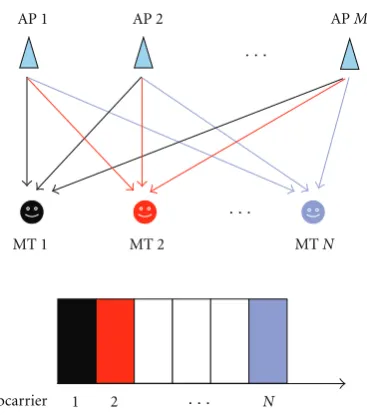
2.1. MultiSource MultiDestination System Model. We con-sider a wireless system in downlink withMnoncooperative APs simultaneously sending information to N MTs over N orthogonal channels, for example, different time slots, frequency bands, or groups of subcarriers in time division multiple access (TDMA), frequency division multiple access (FDMA), or OFDM systems, respectively, as shown in Figure 2. Each channel is preassigned to a different MT by a scheduler and each MT receives signals only on the assigned channel. Without loss of generality, throughout this paper we assign channeln to MT n, forn = 1,. . .,N. This implies that both the MT set and the channel set share the same index in our model. Note that the system model at hand does
Subcarrier
AP 1 AP 2 APM
MT 1 MT 2 MTN
1 2 · · · N
· · · · · ·
Figure2: The multiuser OFDM model.
not reduce to a classical multiple access channel, a broadcast channel, or an interference channel [6].
We assume that the channels are block fading (in diff er-ent scier-entific communities these channels are also referred to as quasi-static fading or delay constrained channels), that is, the fading coefficients are constant during the transmission of a codeword or block. Within a given transmission block, letG∈RM×N
++ be the channel gain matrix whose (m,n) entry is gm,n, the channel gain of the link from AP m to MT n on the preassigned channeln. The matrixGis random with independent entries. We further assume that the distribution function of each positive entrygm,nis acontinuousfunction.
By assuming that the MTs use low-complexity single-user decoders [6], the signal-to-interference-plus-noise-ratio (SINR) of the signal from APmreceived at MTnis given by
γm,n= gm,npm,n
σ2+M
j=1,j /=mgj,npj,n, (1) where pm,n is the power transmitted from AP m on subchanneln, andσ2is the variance of the white Gaussian noise. For APm, write the maximum achievable sum-rate as [6]
Rm=
N
n=1
log1 +γm,n
, ∀m, (2)
and the power constraint as
N
n=1
pm,n≤Pmmax, ∀m, (3)
wherePmax
m is maximum transmit power of APmandPmmax> 0, for allm.
strategic game. Because of the competitive nature of the APs, belonging in general to different service providers, AP m aims to maximize its own transmission rate Rm (2) by choosing its transmit power vectorpm [pm,1,. . .,pm,N]T, subject to its power constraint (3). Denote by vector p = [pT
1,. . .,pTM]
T
the outcome of the game in terms of transmit power levels of all M APs on the N channels. We can completely describe this noncooperative power allocation game as
G[M,{Pm}m∈M,{um}m∈M], (4)
where the elements of the game are (i)Player set:M= {1,. . .,M}; 1)Nconsisting of elements of pother than themth element, that is,
In such a noncooperative game setting, each player m acts selfishly, aiming to maximize its own payoff, given other players’ strategies and regardless of the impact of its strategy may have on other players and thus on the overall performance. The process of such selfish behaviors usually results inNash equilibrium, a common solution concept for noncooperative games [21].
Definition 1. A power strategy profilep is a Nash equilib-rium If, for everym∈M,
From the previous definition, it is clear that an NE simply represents a particular “steady” state of a system, in the sense that, once reached, no player has any motivation to unilaterally deviate from it. The powers allocated in our system correspond to an NE.
3. Characterization of Nash Equilibrium Set
In many cases, an NE results from learning and evolution processes of all the game participants. Therefore, it is fun-damental to predict and characterize the set of such points
from the system design perspective of wireless networks. In the rest of the paper, we focus on characterizing the set of NEs. The following questions are addressed one by one.
(i) Does an NE exist in our game?
(ii) Is the NE unique or there exist multiple NE points? (iii) How to reach an NE if it exists?
(iv) How does the system perform at NE?
Throughout this section we investigate the existence and uniqueness of a Nash equilibrium.
It is known that in general an NE point does not necessarily exist. In the following theorem we establish the existence of a Nash equilibrium in our game.
Theorem 1. A Nash equilibrium exists in gameG.
Proof. Since Pm is convex, closed, and bounded for each m; um(pm,p−m) is continuous in both pm and p−m; and um(pm,p−m) is concave inpm for any setp−m, at least one Nash equilibrium point exists forG[12,22].
Once existence is established, it is natural to consider the characterization of the equilibrium set. The uniqueness of an equilibrium is a rare but desirable property, if we wish to predict the network behavior. In fact, many game problems have more than one NE [12]. As an example of games with infinite NEs, we could consider a special case of our gameG, namely, thesymmetric waterfilling game[9] where the channel coefficients are assumed to be symmetric. Then, in general, our gameGdoes not have a unique NE. But with the assumption of independent and identically distributed (i.i.d.) continuous entries inG, we will show that the probability of having a unique NE is equal to 1.
For any playerm, given all other players’ strategy profile
p−m, thebest-response power strategypm can be found by solving the following maximization problem:
max
and are given by variables associated with the power constraint and transmit power positivity, respectively. The solution to (11)–(13) is known as waterfilling [6]:
pm,n=
In order to analyze the equilibrium set, we establish necessary and sufficient conditions for a point being an NE in the gameG.
Theorem 2. A power strategy profile{p1,. . .,pM}is a Nash
equilibrium of the gameGif and only ifeach player’s power
pm is the single-player waterfilling result (9) while treating other players’ signals as noise. The corresponding necessary and sufficient conditions are:
gm,n
The proof can be found inAppendix A.
From (16), it is easy to verify that necessarilyλm>0, since
This equation implies that, at the NE, all APs transmit at their maximum power by conveniently distributing the power over all the orthogonal channels.
However, it is still difficult to find an analytical solution from (16)–(18), since the system consisting of (14) and (15) is nonlinear. To simplify this problem, we could consider
linear equations instead of nonlinear ones. The following lemma provides a key step in this direction.
Lemma 1. For any realization of channel matrixG, there exist unique values of the Lagrange dual variablesλandν for any
Nash equilibrium of the gameG. Furthermore, there is a unique vectors=[s1,. . .,sn]Tsuch that any vectorpcorresponding to
a Nash equilibrium satisfies
M
m=1
gm,npm,nsn, ∀n. (20)
The proof can be found inAppendix B.
Now, letZbe the following (M+N)×MNmatrix: following vector of lengthM+N:
c=Pmax
Define the following sets:
X(m,n) :νm,n=0 ofc. Then, any NE solution must satisfy
Zp=c. (25)
Let Z be the (M +N)× |X| matrix formed from the columns ofZthat correspond to the elements ofX. Similarly, letpbe the vector of length|X|with entries pm,nsuch that (m,n) ∈ X(same order as they were inp). Then, any NE solution satisfies
Zp=c. (26)
The proofs of Lemmas 2 and 3 can be found in AppendicesCandD, respectively.
Based on Lemmas1,2, and3, we derive the following theorem.
Theorem 3. For any realization of a randomM×Nchannel gain matrix G with statistically independent continuous entries, the probability that a unique Nash equilibrium exists in the gameGis equal to1.
The proof can be found inAppendix E.
Thus, from Theorems1and3, we have established the existence and uniqueness of NE in our gameG.
4. Distributed Power Allocation and Its
Convergence to the Nash Equilibrium
An equilibrium has practical interests only if it is reachable from nonequilibria states. In fact, there is no reason to expect a system to operate initially at equilibrium. The convergence of an algorithm to an equilibrium is in general a very hard problem usually related to the specific algorithm and requiring the analysis of synchronous or asynchronous update mechanisms (for power allocation algorithms in interference channels see [18,23]).
4.1. Potential Game Approach. Fortunately, our gameGcan be studied as a potential game (The notation of potential games was firstly used for games in strategic form by Rosenthal (1973) [24], and later generalized and summarized by Monderer (1996) [25]). Potential games are known to have appealing properties for the convergence of the best-response or greedy algorithms to the equilibrium. All the potential games admit a potential function. This potential function is a unique global function that all the players optimize when they optimize their own utility functions. Thus, the set of pure Nash equilibria can be found by simply locating the local optima of the potential function. Such games have received increasing attention recently in wireless networks [14,26,27], since the existence of potential function enables the design of fully distributed algorithms for resource allocation problems. In fact, there are various notions of potential games such as exact potential, weighted potential, ordinal potential, generalized ordinal potential, pseudo potential, and so forth. These potential games could possess slightly different properties for the existence and convergence of NE. Here, we consider only the exact potential games, since they are closely related to our game. Exact potential games are defined in the following statement.
Definition 2. A strategic gameGis an exact potential game if there exists a functionv:P →Rsatisfying
vpm,p−m to as exact potential of the game.
Equation (27) implies that the NE of the original game
Gmust coincide with the NE of the potential game, which is defined as a new game with v as an identical utility function for all the players. Therefore, we can transform the noncooperative strategic gameGinto a potential game, if we can find a potential function that quantifies the variation in terms of utility due to unilateral perturbation of each player’s strategy, as indicated in (27).
Taking inspiration from the result derived in the single channel case [14], we have the following lemma.
Lemma 4. The game Gis an exact potential game with the following potential function: aggregate interference+noise ⎤
which implies that the property of exact potential (28) is satisfied. This completes the proof.
We denote byζm,n the term (σ2+
j /=mgj,npj,n) which stands for the aggregate interference plus noise of user m on subchanneln. In order to find userm’s single-user best-response in the potential game, one needs to solve the following maximization problem: vex optimization, when the private channel gain gm =
{gm,1,. . .,gm,N} and the aggregate interference plus noise
ζm = {ζm,1,. . .,ζm,N} are both known to player m. It is
easy to verify that this single-user best-response is the same waterfilling solution expressed in (14), due to the property of potential function.
the uniqueness of the NE guaranties that each AP can determine independently the power allocation at the NE in a decentralized manner. In order to acquire information about the whole matrixGat each AP, a feedback channel is usually needed to transmit the channel estimations from MTs to APs. With this information, each AP can solve locally the system of equations (16)–(18) or perform locally a best-response algorithm based on the repeated maximization of problem (30) by starting from a random point p−m ∈ $
j /=mPj.However, the structure of problem (30) suggests an alternative distributed approach to reduce eventually the signalling on the feedback channel. In fact, the repeated optimization of problem (30) can be performed in a distributed way by feeding back at each APmonly the private channel gaingmand the aggregate interference plus noiseζm. Nevertheless, note that such a distributed implementation of the algorithm would lead to a transition phase where the APs are not transmitting at an equilibrium point. In our numerical results, we ignore the cost of feedback, and we focus on analyzing the theoretical upper-bound.
The above discussion yields a simple algorithm based on the iterative waterfilling [28] detailed in the following.
In this algorithm, we assume that the same game could be myopically played repeatedly: in each round, every myopic player (a myopic player has no memory of past game-rounds) chooses its best-response according to the single-player waterfilling that depends on the current state of the game. The following theorem shows the convergence and optimality of the algorithm.
Theorem 4. The DPIWF algorithm converges to a unique Nash equilibrium of the noncooperative gameG.
The proof can be found inAppendix F.
A more general discussion about the convergence and stability properties of potential games can be found in [25, 29]. In [25], it shows that every bounded potential game (a game is called a bounded game if the payofffunctions are bounded) has the approximate finite improvement property
(AFIP), that is, for every>0, every-improvement path is finite. Then, it is obvious that every such finite improvement path of the exact potential games terminates in an -equilibrium point (an-equilibrium is a strategy profile that approximately satisfies the condition of Nash equilibrium). In other words, thesequential best-response(players move in turn and always choose a best-response) converges to the -equilibrium independent of the initial point. Note that this is a very flexible condition for the convergence, sinceorder of playing can be deterministic or random and need not to be synchronized.It is one of the most interesting properties of the potential games, especially in order to distributively find the equilibrium in self-organizing systems. In [29], it shows that potential games are characterized by strong stability properties (Lyapunov stable, see its definition in Theorem 5.34 of [29]). Also note that if the game has a unique NE, then it is globally stable.
In thesimultaneous best-responsealgorithm all the players choose their best-responses simultaneously at each iteration. It is not difficult to verify that, in the general case, it
does not necessarily converge, due to the “ping-pong” effect generated by myopic players. However, [30] has shown that for infinite pseudopotential games, a general class of games including also exact potential games, with convex strategy space and single-valued best-response (games with strictly multiconcave potential, concave in each players’ unilateral deviation, have single-valued best-response), the sequence of simultaneous best-responses, reminiscent of fictitious play, also converges to the equilibrium.
It is interesting to note that for many practical systems with finite transmit power states, similar results still hold for the convergence of the sequential best-response. The only difference is that, in the finite case, the existence of exact potential function implies the finite improvement property
(FIP), and therefore, the sequential best-response converges to the exact NE instead of an-equilibrium.
Although the final convergence of the DPIWF algorithm is proved, one may wonder whether the optimum of the potential function (28) coincides with the optimum social welfare, that is, the optimal total information rate transmitted in the network. We discuss the price of anarchy in the following section.
5. Numerical Evaluation
In this part, numerical results are provided to validate our theoretical claims and assess the price of anarchy, that is, the performance loss in terms of the transmit sum-rate of all APs in the network due to a noncooperative game compared to the maximum social welfare. We denote this transmit sum-rate in the network as the actual total network sum-rate, and defined it as
up=
M
m=1 um
p. (31)
We consider frequency-selective fading channels with channel matrix G of size M × N, where M is the total number of transmitters (players) andNis the total number of receivers. We assume that the Rayleigh fading channel gain gm,n are i.i.d. among players and channels. The maximum power constraint for each playermis assumed to be identical and normalized toPm=1.
initializet=0, p(0)m,n=0,∀m ∀n
repeat t=t+ 1
form=1 toMdo forn=1 toN do
ζm(t,)n=σ2+ j /=mgj,np
(t) j,n
end for
[p(mt+1),1 ,. . .,p(mt+1),N]=arg maxpm≥0npm,n≤Pm
n log(ζ (t)
m,n+gm,npm,n)
end for untilconvergence
Algorithm1: DPIWF algorithm.
0 10 20 30 40 50
15 20 25 30 35 40 45
Iterations
T
o
tal
n
etw
o
rk
ra
te
(bits/s)
Actual rate Potential
(a) An example of “ideal” convergence
0 10 20 30 40 50
20 22 24 26 28 30 32 34 36 38 40
Iterations
T
o
tal
n
etw
o
rk
ra
te
(bits/s)
Actual rate Potential
(b) An example of “defective” convergence Figure3: Convergence and performance of potential function and actual total network rat.
In order to measure the performance efficiency of distributed networks operating at the unique NE, we provide here the optimal centralized approach as a target upper-bound for the total network rate. We ignore the performance loss caused by the necessary uplink and downlink signalling transmission. The total network rate maximization problem can be formulated as
max
p u
p
s.t. n
pm,n≤Pm, ∀m
pm,n≥0, ∀m∀n.
(32)
The optimization problem (32) is difficult to solve since the objective function isnonconvex inp. However, a relaxation of this optimization problem [11] can be considered as a geometric programming problem [31]. As well known, a geometric programming can be transformed into a convex optimization problem and then solved in an efficient way. A
low-complexity algorithm was proposed in [11] to solve the dual problem by updating dual variables through a gradient descent. Note that the algorithm always converges, but may converges to a local maximum point in a few cases. We use this algorithm in our simulations.
In the following part, we address two main practical questions through numerical results.
(1) How does the network performance behave in aver-age at the unique NE in comparison to the global optimal solution or global welfare? More precisely, we are interested in comparing theaveragetotal network rate instead of theinstantaneoustotal network rate. We denote byu(M,N) the average total network rate for aMtransmitters andNreceivers system, that is,
u(M,N)=EG
⎡ ⎣M
m=1 N
n=1 log
1 + pm,ngm,n
σ2+
j /=mpj,ngj,n ⎤
⎦,
0 5 10 15 20 25 0
10 20 30 40 50 60 70 80 90
M- total number of transmitters
N=15 (centralized) N=15 (decentralized) N=10 (centralized)
N=10 (decentralized) N=5 (centralized) N=5 (decentralized)
T
o
tal
n
etw
o
rk
ra
te
(bps/Hz)
(a)σ2=0.1
0 5 10 15 20 25
0 5 10 15 20 25 30 35 40 45
T
o
tal
n
etw
o
rk
ra
te
(bps/Hz)
M- total number of transmitters
N=15 (centralized) N=15 (decentralized) N=10 (centralized)
N=10 (decentralized) N=5 (centralized) N=5 (decentralized)
(b)σ2=1
Figure4: Average total network rate, decentralized versus centralized optimality.
0 5 10 15 20 25
0.982 0.984 0.986 0.988 0.992 0.994 0.996 0.998 1.002
0.99 1
P
robabilit
y
o
f
con
ve
rgenc
e
w
ithin
5
it
er
ations
M- total number of transmiters
N=5 N=10 N=15
(a)σ2=0.1
0 5 10 15 20 25
0.984 0.986 0.988 0.992 0.994 0.996 0.998 1.002
0.99 1
P
robabilit
y
o
f
con
ve
rgenc
e
w
ithin
5
it
er
ations
M- total number of transmiters
N=5 N=10 N=15
(b)σ2=1
Figure5: Probability of convergence within 5 iterations.
(2) What about the convergence behavior for the actual total network rate when using DPIWF algorithm? Does it converge as rapidly as inFigure 3(a)for the most of the cases?
Let us consider the first question. InFigure 4, we compare the average total network rate of both decentralized and
centralized optimal approach always outperforms the decen-tralized noncooperative algorithm. Additionally, for a fixed number of transmittersN, when we increase the number of receivers M, the performance loss of decentralized systems compared to the centralized social welfare becomes greater and greater. This phenomenon can be intuitively understood as follows:when there is a great number of selfishplayers, the hostile competition turns the multiuser communication system into an interference-limited environment, where interference significantly degrade the performance efficiency.
InFigure 4, we also note that for a fixedN the average performance of centralized systems is an increasing function ofM, and the average performance of decentralized systems corresponding to NE reaches a maximum and then decreases flatting out. For the typical values ofN, that is,N=5, 10, 15, in Figure 4(a), when σ2 = 0.1 the average performance of decentralized systems are maximized at M = 4, 9, 14, respectively; in Figure 4(b), when σ2 = 1 the average performance of decentralized systems are maximized atM= 6, 11, 16, respectively. This comparison simply shows that different noise variance (in general channel condition) have a different impact on the decentralized system performance. This observation is fundamental for improving the spectral efficiency of a distributed multiuser small cell networks:For a given area, that is, a given number of receiversNand given channel conditions, there exists an optimal number of access points, denoted asM,to be installed in the network.Roughly speaking, when M > M, the system is saturated due to the increasing competition for the shared limited resources;
whenM < M, the system operates in aunsaturatedstate,
since system resources are not fully exploited.
Let us now consider the second question. In Figure 5, we show the probability of convergence to the NE within 5 iterations forσ2=0.1 and 1, respectively. To be more precise, we say that the algorithm converges at the fifth iteration if the total network rate exceeds 99% of the rate at the NE. We find that the probability of convergence is satisfactory. It is greater than 0.982 in all cases and tends to 1 when M N and M N. Another interesting observation is that the minimal convergence probability always occurs whenM=N, regardless of the noise valueσ2.
6. Conclusions and Future Works
In this paper, we study the power allocation problem in the wireless small-cell networks as a strategic noncooperative game. Each transmitter (AP) is modeled as a player in the game who decides, in a distributed way, how to allocate its total power through several independent fading channels. We studied the existence and uniqueness of NE. Under the condition of independent continuous fading channels, we showed that the probability of having a unique equilibrium is equal to 1. The game at hand is shown to be a potential game. A distributed algorithm requiring very limited feedback has been proposed based on the potential game analysis. The convergence and stability issues have been addressed. Numerical studies have shown that the DPIWF algorithm can converge rapidly within 5 iterations with very high probability.
Appendices
A. Proof of
Theorem 2
Proof. We prove the necessary and sufficient parts separately.
(1)Proof of necessary condition (the only if part). From the definition of NE (Definition 1), if a power set{pm}is an NE, it must satisfy all the best-response conditions in (8) simultaneously. Suppose a situation that all the players’ power except playerm’s power reaches the NE point: {p1,. . .,pm−1,pm,pm+1,. . .,pM}. In this case when all other players’ powers are fixed, as shown in (9), the best-response of playermis to set its power according to (14).This is exactly given by the single-player waterfilling treating all other players’ signals as noise.
(2)Proof of sufficient condition (the if part). From convex optimization theory [5], we know that the KKT conditions of the convex optimization problem are necessary and sufficient conditions for optimality. Therefore, we can say that a power strategy pm satisfies the best-response condition if and only if it satisfies the single-player KKT conditions (11)–(13). Then collectively, we say a set {pm}satisfies all the best-response conditions simultaneously if and only if it satisfies (16)–(18). From Definition 1, if a set {pm}satisfies all the best-response conditions, it must be an NE.
This completes the proof.
λ=
Now, let us assume that there exist two different Nash equilibria, for example,p0,p1 (p0
/
=p1).Then, the following equation must also hold:
Equation (B.3) implies that
αTβ=p1−p0Tφp0+p0−p1Tφp1
From the previous expressions, it is easy to see that (B.3) holds if and only if we haveαTβ = 0 andαTγ = 0.These conditions are equivalent to the following:
K positive power coefficient, for example, p0
k∗,n∗ >0, we must while the number of unknown parameters isM+N, since the remainingdn, n /∈N are known to bedn=1/σ2.It is well known that the set of solutions to a system of linear equations is empty, if the number of independent equations is larger than the number of variables [32]. Since each random entry gm,n is independently distributed with continuous distribution function, it is obvious that, with probability 1, the equations of the system (C.1) are independent from each other. Therefore, we must have|X| ≤M+N.
D. Proof of
Lemma 3
i.i.d. random variables. So, with probability 0, any leading coefficient takes the value of 0. Therefore, we have rank(Z)= τ+ξ2= |X|with probability 1.
E. Proof of
Theorem 3
Proof. IfMN > M +N, we have fromLemma 2that, with probability 1, rank(Z) = |X|. Any NE must satisfy (26); assume that two different power strategiespandpare both solutions to (26). ThenZ(p−p)=0. Since the rank ofZis equal to the number of its columns, the rank-nullity theorem [32] impliesp−p=0.Then, if the NE exists it is unique.
If MN ≤ M +N, we have from Lemma 3 that, with probability 1, there is at most one solution to (25). Since any NE must satisfy (25) and we know that there is at least one NE solution, we conclude that NE is unique.
F. Proof of
Theorem 4
Proof. We prove this theorem in two steps.
(1)Algorithm convergence. It is easy to see that the potential function v(P) is nondecreasing within each round of the single-player waterfilling. More-over, since each player’s transmit power is limited by a maximum but finite power constraint, there must exist an upper-bound for the potential function v(P). This confirms the convergence.
(2)Converge to NE. From the discussions above, we directly have that the KKT condition of the poten-tial game coincide with the KKT condition of the original OFDM game G, due to the property of potential function (27). By using the sufficient part of Theorem 2, we know that if each player’s power allocationpmis given by the single-player waterfilling while treating other players’s signals as noise, the set {pm} must be an NE of the original game G. Therefore, we can conclude that if the algorithm DPIWF converges (through the process of iterating single-player waterfilling), it converges to an NE point.
This completes the proof.
Acknowledgment
This paper was supported by the French research agency ANR by the Project ANR-09-VERS0: ECOSCELLS.
References
[1] M. Debbah, “Mobile flexible networks: the challenges ahead,” inProceedings of International Conference on Advanced Tech-nologies for Communications (ATC ’08), pp. 3–7, Hanoi, Vietnam, October 2008, invited paper.
[2] http://iosc-workshop.homeip.net/.
[3] S. Kandula, D. Katabi, S. Sinha, and A. Berger, “Dynamic load balancing without packet reordering,”ACM Journal of
Computer and Communication Review, vol. 37, no. 2, pp. 51– 62, 2007.
[4] C. E. Shannon, “A mathematical theory of communication,”
Bell System Technical Journal, vol. 27, pp. 379–423, 623–656, 1948.
[5] S. Boyd and L. Vandenberghe, Convex Optimization, Cam-bridge University Press, CamCam-bridge, UK, 2004.
[6] T. M. Cover and J. A. Thomas,Elements of Information Theory, John Wiley & Sons, New York, NY, USA, 1991.
[7] A. J. Goldsmith and P. P. Varaiya, “Capacity of fading channels with channel side information,”IEEE Transactions on Information Theory, vol. 43, no. 6, pp. 1986–1992, 1997. [8] D. Tse and P. Viswanath,Fundamentals of Wireless
Communi-cation, Cambridge University Press, Cambridge, UK, 2005. [9] E. Altman, K. Avrachenkov, and A. Garnaev, “Closed form
solutions for symmetric water filling games,” inProceedings of the 27th IEEE Communications Society Conference on Computer Communications (INFOCOM ’08), pp. 673–681, Phoenix, Ariz, USA, April 2008.
[10] K. B. Song, S. T. Chung, G. Ginis, and J. M. Cioffi, “Dynamic spectrum management for next-generation DSL systems,”
IEEE Communications Magazine, vol. 40, no. 10, pp. 101–109, 2002.
[11] J. Papandriopoulos and J. S. Evans, “Low-complexity dis-tributed algorithms for spectrum balancing in multi-user DSL networks,” inProceedings of the IEEE International Conference on Communications (ICC ’06), pp. 3270–3275, July 2006. [12] D. Fudenberg and J. Tirole,Game Theory, MIT Press,
Cam-bridge, Mass, USA, 1991.
[13] S. Lasaulce, M. Debbah, and E. Altman, “Methodologies for analyzing equilibria in wireless games: a look at pure, mixed, and correlated equilibria,”IEEE Signal Processing Magazine, vol. 26, no. 5, pp. 41–52, 2009.
[14] G. Scutari, S. Barbarossa, and D. P. Palomar, “Potential games: a framework for vector power control problems with coupled constraints,” inProceedings of IEEE International Conference on Acoustics, Speech and Signal Processing (ICASSP ’06), pp. 241– 244, Toulouse, France, May 2006.
[15] Z.-Q. Luo and J.-S. Pang, “Analysis of iterative waterfilling algorithm for multiuser power control in digital subscriber lines,” EURASIP Journal on Applied Signal Processing, vol. 2006, Article ID 24012, 10 pages, 2006.
[16] W. Yu, G. Ginis, and J. M. Cioffi, “Distributed multiuser power control for digital subscriber lines,”IEEE Journal on Selected Areas in Communications, vol. 20, no. 5, pp. 1105–1115, 2002. [17] R. H. Gohary, Y. Huang, Z.-Q. Luo, and J.-S. Pang, “A generalized iterative water-filling algorithm for distributed power control in the presence of a Jammer,”IEEE Transactions on Signal Processing, vol. 57, no. 7, pp. 2660–2674, 2009. [18] G. Scutari, D. P. Palomar, and S. Barbarossa, “Asynchronous
iIterative water-filling for Gaussian frequency-selective inter-ference channels,”IEEE Transactions on Information Theory, vol. 54, no. 7, pp. 2868–2878, 2008.
[19] G. Scutari and D. P. Palomar, “MIMO cognitive radio: a game theoretical approach,”IEEE Transactions on Signal Processing, vol. 58, no. 2, pp. 761–780, 2010.
[20] G. He, M. Debbah, and E. Altman, “A Bayesian game-theoretic approach for distributed resource allocation in fading multiple access channels,”EURASIP Journal on Wireless Communications and Networking, vol. 2010, Article ID 391684, 10 pages, 2010.
[22] J. B. Rosen, “Existence and uniqueness of equilibrium points for concave N-person games,”Econometrica, vol. 33, pp. 520– 534, 1965.
[23] G. Scutari, D. P. Palomar, and S. Barbarossa, “Simultane-ous iterative water-filling for Gaussian frequency-selective interference channels,” in Proceedings of IEEE International Symposium on Information Theory (ISIT ’06), pp. 600–604, July 2006.
[24] R. W. Rosenthal, “A class of games possessing pure-strategy Nash equilibria,”International Journal of Game Theory, vol. 2, no. 1, pp. 65–67, 1973.
[25] D. Monderer and L. S. Shapley, “Potential games,”Games and Economic Behavior, vol. 14, no. 1, pp. 124–143, 1996. [26] J. O. Neel, J. H. Reed, and R. P. Gilles, “Convergence of
cognitive radio networks,” in Proceedings of IEEE Wireless Communications and Networking Conference (WCNC ’04), vol. 4, pp. 2250–2255, Atlanta, Ga, USA, March 2004.
[27] T. Heikkinen, “A potential game approach to distributed power control and scheduling,”Computer Networks, vol. 50, no. 13, pp. 2295–2311, 2006.
[28] W. Yu,Competition and cooperation in multi-user communi-cation environements, Ph.D. thesis, Stanford University, June 2002,http://www.comm.utoronto.ca/∼weiyu/thesis 2.pdf. [29] J. Neel, Analysis and design of cognitive radio networks
and distributed radio resource management algorithms, PhD dissertation, September 2006,http://scholar.lib.vt.edu/theses/ available/etd-12082006-141855/.
[30] P. Dubey, O. Haimanko, and A. Zapechelnyuk, “Strategic complements and substitutes, and potential games,” Games and Economic Behavior, vol. 54, no. 1, pp. 77–94, 2006. [31] M. Chiang, “Geometric programming for communication
systems,” Foundations and Trends in Communications and Information Theory, vol. 2, no. 1-2, pp. 1–153, 2005.