R E S E A R C H
Open Access
A low-complexity user selection scheme in a
multicell MIMO environment
Doohee Kim
1, Oh-Soon Shin
2and Kwang Bok Lee
1*Abstract
An efficient user selection scheme for the downlink of multiuser MIMO systems is proposed in a multicell
environment. In a multicell environment, the intercell interference is one of the most influential factors limiting the performance. Thus, a user selection scheme that considers intercell interference is essential to increase the sum rate. The proposed scheme is based on an interference-aware precoding. It sequentially selects users such that the sum rate is maximized. In particular, we develop a simple incremental metric for the sum rate. The use of the derived metric enables a significant reduction in the computational complexity of the user selection process, as compared to the optimal exhaustive search. Numerical results show that the proposed scheme provides near-optimal performance with substantially reduced complexity.
1 Introduction
Intercell interference is one of the most challenging issues limiting the performance of cellular systems, espe-cially when the spectrum is highly reused across cells. In multiple-input multiple-output (MIMO) systems, in particular, it has been reported that in a multicell environ-ment, the performance of spatial multiplexing is signifi-cantly degraded due to intercell interference [1]. Recently, there have been several works on multicell MIMO that attempt to mitigate the effect of intercell interference [1-5]. Most of the works have focused on precoding or beamforming strategies. For instance, centralized precod-ing schemes were proposed for a case in which the channel state information (CSI) is available at the transmitter [2] and for the case when it is not available [4]. In [5], a dis-tributed precoding scheme was proposed by introducing a new precoding metric known as the signal-to-generated-interference-plus-noise ratio (SGINR).
Precoding schemes rely on the condition that the set of users to be served is given. In practice, an appropri-ate choice of users may have a substantial impact on the overall system performance in multiuser MIMO scenarios [6-8]. A general framework for user selection was devel-oped in [6] based on convex utility functions. In [7],
*Correspondence: [email protected]
1School of Electrical and Computer Engineering and INMC, Seoul National University, 151-742 Seoul, South Korea
Full list of author information is available at the end of the article
successive user selection schemes were proposed along with the optimization of transmit beamforming vectors. In [8], various low-complexity user selection schemes were proposed. However, these schemes may suffer from severe performance degradation in multicell MIMO sys-tems, as they do not take the intercell interference into account. This motivates us to investigate a user selection scheme applicable to multicell MIMO systems.
In this article, we propose a user selection scheme that works jointly with the SGINR-based precoding scheme in [5] for a downlink multicell MIMO system. The SGINR precoding is also known as the SLNR (signal-to-leakage-and-noise ratio) precoding [3], which was dis-cussed in 3GPP LTE-Advanced [9]. The proposed scheme is designed to select users in a successive manner such that the sum rate is maximized. We derive a simple incremen-tal metric, which enables the system to determine whether adding a particular user would increase the sum rate or not. Owing to the derived metric, the proposed scheme requires considerably reduced computational complexity as compared to the optimal exhaustive search over all possible combinations of users. Numerical results will be presented to validate the performance of the proposed user selection scheme under various environments.
The rest of this article is organized as follows. Section 2 describes the system model. In Section 3, we develop an efficient user selection algorithm by deriving a sim-ple increment metric for the sum rate. Numerical results
are presented in Section 4, and conclusions are drawn in Section 5.
2 System model
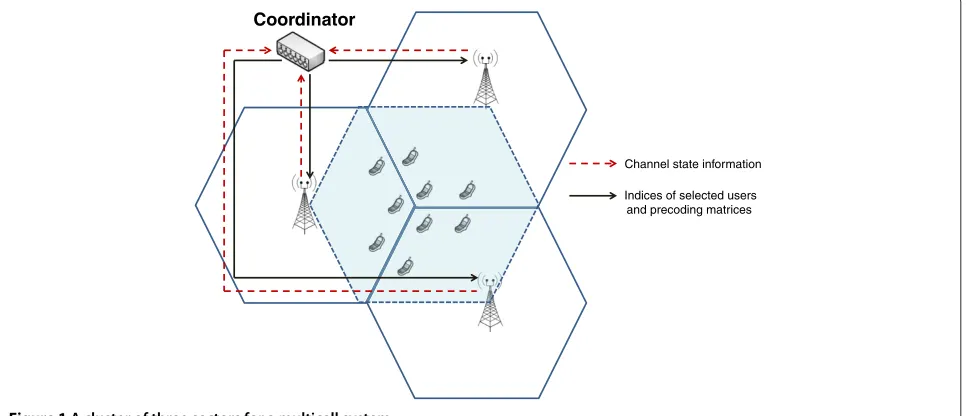
We consider the downlink of a cellular system com-prised ofLcells or sectors andK users per cell or sector. Each base station (BS) and each mobile station (MS) are assumed to be equipped withNttransmit antennas andNr receive antennas, respectively. TheLcells or sectors are grouped into a cluster, as depicted in Figure 1 for the case ofL=3. Each BS is assumed to serve only the users in its own cell using the interference-aware precoding scheme in [5]. The received signal vectory(ik)at thekth MS of the ith cell can be expressed as
y(ik) =
ρi(k)H(i,ki)W(ik)x(ik)+ K
j=1,j=k
ρi(k)H(i,ki)W(ij)x(ij)
+ L
m=1,m=i K
j=1
ηi(,km)H(i,km)Wm(j)x(mj)+n(ik),
(1)
wherex(ik)denotes the transmit symbol destined for the kth MS in theith cell,W(ik)is the corresponding precod-ing matrix,H(i,km) is an Nr ×Nt channel matrix between the BS in themth cell and thekth MS in theith cell. The entries of the channel matrixH(i,km) are assumed to follow independent and identically distributed (i.i.d) complex Gaussian distribution with zero mean and unit variance.
n(ik)denotes the additive white Gaussian noise (AWGN),
ρi(k)denotes the signal-to-noise ratio (SNR) of thekth MS in theith cell, andη(i,km) denotes the interference-to-noise ratio (INR) for the interference that the BS in themth cell causes at thekth MS in theith cell. The transmit symbols and noise are assumed to be normalized to have unit power. We assume that every BS has the same transmit
powerPand that each BS allocates equal transmit power to the selected users in the corresponding cell; when M users are selected from a BS, each user is allocated to the power ofP/M. The first term in (1) corresponds to desired signal, and the second and third terms repre-sent the intracell interference and intercell interference, respectively, within a cluster. Note that both the intracell interference and intercell interference constitute the intr-acluster interference, and the intercluster interference is not considered.
The cell coordination model considered in this paper falls into the category of coordinated scheduling/coor-dinated beamforming (CS/CB) in the context of LTE-Advanced. In a CS/CB, BSs need to share only the CSI through a coordinator, and each BS serves users in its own cell [10]. We assume that the precoding matrixW(ik)
for each MS in (1) is formed based on the SGINR crite-rion [5]. It was shown that the SGINR-based beamforming improves the sum rate in a multicell environment. Specif-ically, the SGINR covariance matrixKGI(ik)at thekth MS in theith cell is defined as
KGI(ik)=ρi(k)
INt+G (k) i
H
G(ik)−1Hi(,ki)HH(i,ki), (2)
where
G(ik)≡
HG(1,ki) T
· · ·HG(i,ki) T
· · ·HG(Lk,i) TT
(3)
denotes a composite matrix containing both the intercell interference channels and the intracell interference chan-nel that thekth MS in theith cell may cause to other users,
(·)Hdenotes the conjugate transpose, and(·)Tdenotes the transpose of a matrix. Each submatrix ofG(ik)is defined as
Coordinator
Channel state information
Indices of selected users and precoding matrices
HG(j,ki)=
To construct a beamforming matrixW(ik), we express
KGI(ik)in (2) using the eigenvalue decomposition as
KGI(ik)=VGIi(k)DGI(ik)VGI(ik) H
, (5)
whereDGI(ik)andVGI(ik)denote the diagonal matrix com-posed of eigenvalues and unit-norm eigenvector matrix of
KGI(ik), respectively. Then,VGI(ik)corresponds to a beam-forming matrixW(ik) = VGI(ik) [5]. Thus, the precoding and user selection require centralized processing, i.e., CSI sharing among cells. As illustrated in Figure 1, each BS in a cluster collects information on both the desired chan-nel and interference chanchan-nels for each MS. For thekth MS in theith cell, for example, H(iK,i) corresponds to the desired channel matrix, and HG(j,ki),j = i corresponds to interference channel matrices. It is assumed that the MS perfectly estimates both the desired and interference channels and feeds them back to the BS without error. The BS transports the CSI to a cluster coordinator, which then performs the beamforming and user selection and notifies the results back to the associated BSs.
Assuming that each MS employs the maximum likeli-hood (ML) detection, the achievable rateR(ik) of thekth MS in theith cell can be computed as
R(ik)=log2det
where(ik)denotes a matrix associated with the received signal-to-interference-plus-noise ratio (SINR) of thekth MS in theith cell [2]. It is given as
wherei(k)represents the noise plus interference power
(ik)=INr+
On the right hand side of (8), the first term is due to the AWGN, and the second and third terms represent the
intracell interference and intercell interference, respec-tively. Using (6), the corresponding sum rateRsumfor all MS’s in the cluster ofLcells is given by
Rsum=
3 Proposed user selection scheme
In this section, we propose a user selection scheme that works in a multicell environment. Because the achievable rate in (6) is affected by the intercell interference as well as by the intracell interference, it may not be optimal in terms of the sum rate that each BS serves allKusers at the same time. Therefore, the proper selection of simultaneously served users will be important to optimize the overall per-formance. The greedy user selection algorithm in [11] is known to provide near-optimal sum rate performance in a single-cell scenario. However, the greedy algorithm does not consider the intercell interference, which may lead to inevitable performance degradation in a multicell envi-ronment. In [2], it was shown that the optimal solution approaches a single stream transmission scheme as the intercell interference becomes strong.
3.1 User selection criterion
Given that the proposed user selection scheme succes-sively adds users to the set of its served users one-by-one, we need to develop a criterion to determine whether to add a user or not at each step. Suppose that (n − 1)
(n ≥ 2) users are already selected and they are rep-resented by a set of the user indices, S∗(n − 1) ≡
{(i1,k1),(i2,k2),· · ·,(in−1,kn−1)}, where ij and kj repre-sent the BS index and MS index of thejth selected user, respectively. LetR(n)be the increment in the sum rate when user(in,kn)is added to the setS∗(n−1) to form
when thenusers inS∗(n)are simultaneously served. We approximateR(n)in (11) as
which follows from the assumption that the selected users have high SINRa[5]. signal component and the noise plus interference compo-nent for theth selected user, when thenusers inS∗(n)
are served simultaneously. These can be expressed as
S(n)=det
whereRI(n)denotes the noise plus received interference matrix, when thenusers inS∗(n)are served. The notation
iindicates theselected user associated to the BS in the icell. The matrixRI(n)can be expressed as
andW(ik) denotes the SGINR precoding matrix whenn users in S∗(n) are simultaneously served. Note that the inequality in (13) is due ton−=11S(n)≤n=−11S(n−1), which follows from the term-by-term inequalitiesS(n)≤
S(n−1),=1, 2,· · ·,n−1. The term-by-term inequal-ities are valid due to the following reasons. First, when the nth user is added up,n−1 users that are already selected should be allocated to transmit power equal to or less than the value for the case when onlyn−1 users are selected, owing to the assumption of transmit power in Section 2. Moreover, when thenth user is added, it generates addi-tional interference to the othern−1 users, and thus will decrease the received signal power of each MS.
We further assumen=−11I(n−1)≤(n−2)IG(n)and n
=1I(n) ≤nIG(n), whereIG(n)denotes the noise plus generated interference component of thenth selected user
IG(n)=det(GIn(n)),
The assumptions are reasonable in that the generated interference power of the last selected user will be greater than those of the previously selected users, because all users have similar received signal power and the user selection is performed sequentially based on the SGINR. Figure 2 verifies that then−=11I(n−1)to(n−2)IG(n) ratio and then=1I(n)tonIG(n)ratio are less than unity in the typical SNR range. Using the inequality of the arith-metic and geometric means with the two assumptions, we can derive the following two inequalities:
Figure 2n−j=11Ij(n−1)to(n−2)IG(n)ratio andnj=1Ij(n)to
nIG(n)ratio vs. SNR, whenK=10,Nt=4andNr=2.
Using the upper bounds in (13) and (17), we approxi-mateR(n)as
R(n)≈log2 ⎡ ⎢ ⎣
n−2 n−1IG(n)
n−1 Sn(n)
(IG(n))n
⎤ ⎥
⎦, n≥2.
(18)
Accordingly, we define the metricr(n)as
r(n)≡2R(n)=
n−2 n−1
n−1S n(n) IG(n)
, n≥2. (19)
It is observed that the metricr(n)in (19) corresponds to a weighted SGINR. For a specific case ofn = 1, it is obvious that selecting the user associated with the maxi-mum SNR is optimal in terms of the sum rate. Hence, we definer(1)≡det
ρi(k)(Hi(,ki))(H(i,ki))H
. Note thatr(n), which is the proposed criterion for user selection, depends on the transmit beamforming vector forn≥2.
3.2 User selection algorithm
In this section, we propose a user selection algorithm with the objective of sum rate maximization. In the previous subsection, we have definedr(n)as a criterion for user selection. In order to maximize the sum rate, BSs select users by using r(n). If r(n) is larger than 1, which means that sum rate is increased by selecting thenth user, and thenth user is selected and added toS∗. Otherwise,
thenth user are not selected and the user selection proce-dure is terminated. Specifically, the proposed algorithm is described as the following three steps:
Step 1. Initialize asS∗(0)= φandn=1.
Step 2. Computeri(k)(n), and find(in,kn)such that
(in,kn)= arg max (i,k)∈(U1···∪UL)−S∗(n−1)
r(ik)(n),
wherer(ik)(n)denotes ther(n)corresponding to thek th MS in the i th cell. whereri(k)(n)denotes the
r(n)corresponding to thek th MS in the i th cell. Step 3. Ifr(kn)
in (n) >1, then setS
∗(n)=S∗(n−1)
∪{in,kn},n=n+1and go back to step 2; otherwise,
terminate the algorithm.
In step 1, the set of selected usersS∗(0) is initialized as an empty set. In step 2, a user associated with the maximumr(n)is chosen from among the users not in
S∗(n−1). In step 3, if the value ofr(n)is greater than
1, the corresponding user index is added to S∗(n) and the algorithm is repeated from step 2. Otherwise, the algorithm terminates and the final set of selected user is determined asS∗(n−1).
It should be noted that the proposed algorithm requires much lower computational complexity than the exhaus-tive search. Since the computational complexity of a user selection scheme mainly comes from computation of the precoding matrices, we measure the computational com-plexity in terms of the required number of computing pre-coding matrices. The proposed scheme requires at most L(Nt/Nr)iterations and one user is selected at each iter-ation. Correspondingly, the complexity of the proposed
scheme can be found to be Nt/Nr
i=1
(LK−i+1). The
exhaus-tive search needs to compute precoding matrices for all possible sets of users, and the max-user exhaustive search also needs to compute precoding matrices for all possible sets of(Nt/Nr) users. Based on these computations, the overall computational complexity of each scheme is tabu-lated in Table 1. It can be seen that the complexity of the proposed scheme is much lower than that of the exhaus-tive search and max-user exhausexhaus-tive search. WhenL=3, K = 10, Nt = 4, and Nr = 2, for instance, the over-all computational complexity of the proposed scheme is 165, whereas that of the exhaustive search and max-user exhaustive search is 4,397,880 and 3,562,650, respectively.
Table 1 Comparison of computational complexity
Proposed scheme Exhaustive search Max-user exhaustive search
Complexitya L
(Nt/Nr)
i=1
(LK−i+1)
L(Nt/Nr)
i=1
(i×LKCi) L(Nt/Nr)×LKCL(Nt/Nr)
Figure 3Average sum rate vs. SNR under the scenario 1, when K=10,Nt=4andNr=2.
4 Numerical results
In this section, we evaluate the performance of the pro-posed user selection scheme. We consider a cluster com-posed of three cells (L=3), each of which corresponds to a sector of sectored cells, as depicted in Figure 1. The aver-age channel gain between the BS in theith cell and thekth
MS in the cell is defined asE
H(i,ki)2
=ρ0
di,k/dr −α
,
where di,k denotes the distance between a BS in theith cell and kth MS, and ρ0denotes the SNR at a distance dr from the base station. The reference distancedr can be regarded as the cell radius. The values ofdr,ρ0, and the pathloss exponentα are set to 500 m, 8 dB, and 3.7, respectively. The performance of the proposed scheme is compared with that of the exhaustive search, the max-user exhaustive search, and the single-cell greedy selection in [11]. In addition, a joint processing scheme based on
Figure 4Average sum rate vs. SNR under the scenario 2, when K=10,Nt=4andNr=2.
Figure 5Average sum rate vs. SNR under the scenario 3, when K=10,Nt=4andNr=2.
the dirty paper coding (DPC) is used to provide an upper bound as in [12,13]. However, it should be noted that the joint processing requires sharing of data as well as the CSI among cells in each cluster, while the other schemes require sharing of only the CSI. In the exhaustive search, all the BSs in the cluster selects optimal user set that maximizes sum rate. The max-user exhaustive search is a modified version of the optimal exhaustive search, in which each BS always selects a set of Nt/Nr users that maximizes the sum rate differently from the exhaustive search. The max-user exhaustive search can be considered as a form of coordinated greedy selection. In the single-cell greedy selection, each BS independently selects users associated with the maximum SINR without considering the intercell interference.
We consider three scenarios of user distribution to eval-uate the performance of the coordinated user selection
Figure 7Average number of selected users vs. SNR under the scenario 2, whenK=10,Nt=4andNr=2.
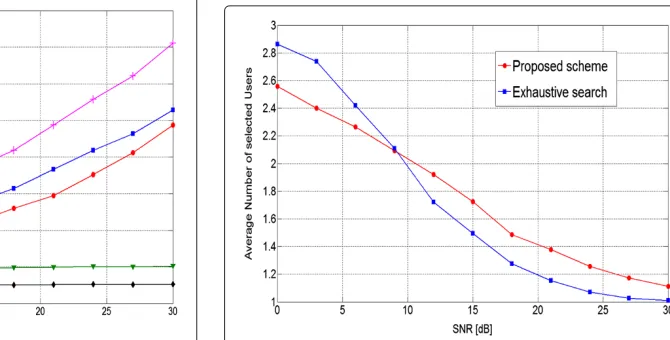
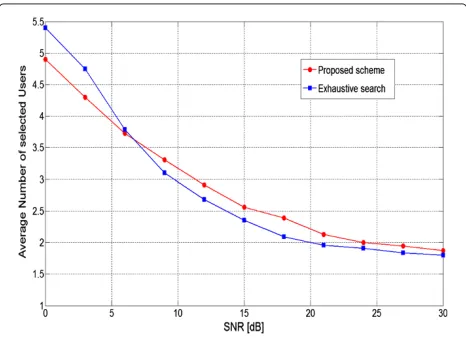
schemes. Scenario 1 corresponds to the case in which all users are located in cell edge areas in between 0.9R andR, scenario 2 corresponds to the case where all the users are located in between 0.5RandR, whereRdenotes the cell radius, and scenario 3 corresponds to the case where all the users are located uniformly over the entire cell. The reason why we consider scenarios 1 and 2 is that users around cell center can be served separately by each cell without coordination, since the impact of the intercell interference will be limited [10,14]. Figures 3, 4, 5 depict the achievable sum rate and Figures 6, 7, 8 illustrate the average number of selected users vs. SNR under these three scenarios, respectively, whenK = 10, Nt = 4, andNr = 2. From Figures 3, 4, 5, the proposed scheme is shown to significantly outperform the single-cell greedy selection and the max-user exhaustive search. Moreover, the performance degradation as compared to
Figure 8Average number of selected users vs. SNR under the scenario 3, whenK=10,Nt=4andNr=2.
the exhaustive search seems not that much considering the substantial reduction in the complexity. For instance,
when L = 3, K = 10, Nt = 4, and Nr = 2, the
proposed scheme achieves about 94% of the sum rate of the exhaustive search, while the reduction in com-putational complexity amounts to about 26,600-fold. As expected, the performance of the joint processing is bet-ter than the other schemes at the cost of the backhaul overhead for data sharing among cells. From Figures 6, 7, 8, it can be observed that not all the degrees of free-doms at the BS are used to transmit as many streams as possible. This suggests that using all the degrees of free-doms is not always optimal for sum rate. Some degrees of freedoms need to be used for interference mitigation, in such a way that the average sum rate is maximized. As an extreme case, when the SNR is sufficiently high, the proposed solution is shown to approach the single-user scheme, as discussed in [2]. The results in Figure 5 also verify that the performance gain of the proposed scheme is substantial even when users are uniformly distributed throughout the cell.
5 Conclusions
In this article, we have proposed a successive user selec-tion scheme for the downlink of MIMO cellular systems in a multicell environment. The proposed scheme works jointly with SGINR beamforming and attempts to max-imize the sum rate over all of the users in a cluster of cells. As compared to the optimal exhaustive search, the proposed scheme is much less complex due to the derivation of a simple incremental metric for the sum rate. Numerical results confirm that the proposed user selection scheme achieves a sum rate close to that of the exhaustive search. In a particular case, the proposed scheme has been shown to achieve 94% of the sum rate of the exhaustive search, while reduction in computational complexity amounts to about 26,600-fold.
Endnote
aIt should be noted that the approximation is used just
to simplify the incremental metric for user selection. The high SINR assumption should not restrict the derived metric to being used only at high SINR. In Section 4, we will consider a situation in which all the MSs are distributed over the cell edge area where the SINR is generally low.
Competing interests
The authors declare that they have no competing interests. Acknowledgements
This work was supported by the National Research Foundation of Korea (NRF) grant funded by the Korea government (MEST) (no. 20110020262). Author details
Received: 15 November 2012 Accepted: 9 May 2013 Published: 5 June 2013
References
1. S Catreux, PF Driessen, LJ Greenstein, Simulation results for an interference-limited multiple-input multiple-output cellular system. IEEE Commun. Lett.4(11), 334–336 (2000)
2. S Ye, RS Blum, Optimized signaling for MIMO interference systems with feedback. IEEE Trans. Signal Process.51(11), 2839–2848 (2003) 3. M Sadek, A Tarighat, AH Sayed, A leakage-based precoding scheme for
downlink multi-user MIMO channels. IEEE Trans. Wireless Commun.6(5), 1711–1721 (2007)
4. RS Blum, MIMO capacity with interference. IEEE J. Select. Areas Commun. 21(5), 793–801 (2003)
5. BO Lee, HW Je, OS Shin, KB Lee, A novel uplink MIMO transmission scheme in a multicell environment. IEEE Trans. Wireless Commun.8(10), 4981–4987 (2009)
6. KN Lau, Analytical framework for multiuser uplink MIMO spacetime scheduling design with convex utility functions. IEEE Trans. Wireless Commun.3(5), 1832–1843 (2004)
7. Y Hara, L Brunel, K Oshima, inProceedings of the IEEE International Symposium on Personal, Indoor & Mobile Radio Communications. Uplink spatial scheduling with adaptive transmit beamforming in multiuser MIMO systems (Helsinki Finland, 11–14 September 2006)
8. S Serbetli, A Yener, inProceedings of the Asilomar Conference on Signals, Systems & Computers. Beamforming and scheduling strategies for time slotted multiuser MIMO systems (Pacific Grove, CA, USA, p. 7–10 November 2004
9. 3GPP, Leakage-based precoding for CoMP in LTE-A. 3GPP R1–090028 (2009). http://www.3gpp.org/ftp/tsg_ran/wg1_rl1/TSGR1_55b/Docs/R1-090028.zip
10. 3GPP, Coordinated multi-point operation for LTE physical layer aspects (release 11). 3GPP TR 36.819, V11.1.0 (2011). http://www.3gpp.org/ftp/ Specs/archive/36_series/36.819/36819-110.zip
11. G Dimic, ND Sidiropoulos, On downlink beamforming with greedy user selection: performance analysis and a simple new algorithm. IEEE Trans. Signal Process.53(10), 3857–3868 (2005)
12. P Patcharamaneepakorn, A Doufexi, S Armour, inProceedings of the IEEE Vehicular Technology Conference. Reduced complexity joint user and receive antenna selection algorithms for SLNR-based precoding in MU-MIMO systems Yokohama, 6–9 May 2012)
13. T Yoo, A Goldsmith, On the optimality of multiantenna broadcast scheduling using zero-forcing beamforming. IEEE J. Select. Areas Commun.24(3), 528–541 (2006)
14. 3GPP, Further consideration on enhanced SRS for CoMP/non-CoMP user group. 3GPP R1–095087 (2009). http://www.3gpp.org/ftp/tsg_ran/ wg1_rl1/TSGR1_59/Docs/R1-095087.zip
doi:10.1186/1687-1499-2013-154
Cite this article as:Kimet al.:A low-complexity user selection scheme in
a multicell MIMO environment.EURASIP Journal on Wireless Communications
and Networking20132013:154.
Submit your manuscript to a
journal and benefi t from:
7Convenient online submission
7Rigorous peer review
7Immediate publication on acceptance
7Open access: articles freely available online
7High visibility within the fi eld
7Retaining the copyright to your article