i
How do teachers deal with uncertainty in relation
to working with children with autism in the
context of the introduction of a new technology
tool?”
JOSEPH MINTZ
A thesis submitted in partial fulfilment of the requirements of the University of East London
for the degree of Doctor of Philosophy
ii
Abstract
This study is an exploration of how teachers deal with uncertainty in the
classroom. The particular context of the European Commission funded HANDS project, which developed a mobile technology tool to help children with autism to develop social and life skills. The first prototype of the HANDS tool, running on smartphones, was tested at four special schools across Europe in the 2009/10 academic year. The context of teachers working with children with autism combined with the introduction of a technology innovation is viewed as a fertile crucible for exploring teacher uncertainty.
The concept of uncertainty is developed via an integration of Donald Schön‘s idea of reflection in action and Wilfred Bion‘s epistemology. In tandem, a
psycho-social interpretivist approach to understanding the teachers‘ work in the classroom, based on infant observation, is developed and applied to a detailed consideration of the work of five teachers at the UK school using HANDS.
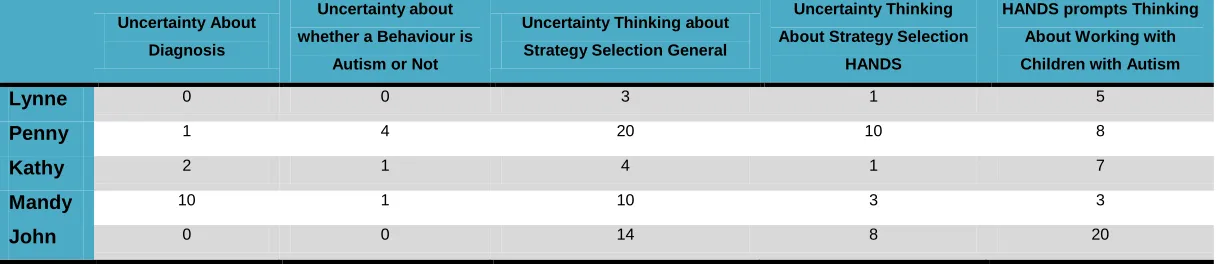
Several areas of potential uncertainty are identified, including uncertainty
relating to areas of practice including diagnosis, the relationship between expert knowledge and practice, the implications of autism for autonomy and agency, and uncertainties in relation to the understanding of and use of new
technologies per se.
Conclusions are drawn about teacher identifications to new technology, the potentially productive role of uncertainty in the intersubjective relationship between teacher and child, and the relevance of a psycho-social approach to considering professional thinking.
Declaration
iii
Contents
1. Introduction ... 1
1.1 Teacher Uncertainty and Autism ... 1
1.2 The Context for the PhD ... 2
1.3 The HANDS Project ... 3
1.4 How HANDS works ... 5
1.5 Technical Problems ... 10
1.6 Randall School ... 11
1.7 General Approach to Working with the Teachers ... 11
1.8 The Demarcation of the PhD Sub-Project ... 12
1.9 About Uncertainty ... 13
1.10 Sources of Uncertainty for Teachers working with Children with Autism .. 14
1.10.1 The Social and Medical Models of Special Educational Needs ... 14
1.10.2 Sociological and Psychological Positions ... 15
1.10.3 Uncertainty about Autism ... 16
1.10.4 Uncertainty about Agency and Autonomy in Autism ... 18
1.11 Sources of Uncertainty for Teachers working with Technology ... 19
1.12 The Policy Context – teacher training and teacher knowledge ... 21
1.12.1 Scope ... 21
1.12.2 Autism Pedagogy and Teacher Training in the UK ... 22
1.12.3 The relevance of specialist knowledge ... 23
1.13 Towards a psycho-social approach to understanding teacher thinking and uncertainty ... 24
1.13.1 The hyphen in the Psycho-Social ... 26
2. Teacher Thinking ... 28
iv
2.2 Approaches to investigating teacher thinking ... 29
2.3 Categories of Teacher Knowledge ... 30
2.4 Common Themes in the Cognitive Literature ... 30
2.5 Schön – Reflection in Action ... 31
2.6 Socio-cultural approaches to Teacher Thinking ... 33
2.7 Where does Schön sit in the split? ... 33
2.8 Intersubjectivity ... 36
2.9 Educational Technology and Teacher Thinking... 39
2.9.1 The Impact of Technology on Learning... 39
2.9.2 Teacher Attitude Towards Technology ... 40
2.9.3 Emotional Involvement with Technology ... 43
2.9.4 Innovation’s Role in Stimulating Reflection on Practice – the link to Teacher Thinking ... 44
3. Autism Spectrum Disorders, Impairment and Exclusion ... 48
3.1 What is Autism? ... 48
3.2 The neurobiological basis of autism ... 49
3.3 A Broad Spectrum: Asperger’s Syndrome and High Functioning Autism ... 50
3.4 Cognitive Theories in Autism ... 50
3.4.1 Theory of Mind ... 50
3.4.2 Executive Function... 51
3.4.3 Weak Central Coherence... 52
3.4.4 A Core Aetiology? ... 53
3.5 Deficit or Difference? ... 54
3.6 Psychoanalytic Accounts of Autism: Moving on from “Frozen Mother” ... 55
3.7 Bion’s Influence ... 57
3.8 Pedagogical Approaches to Working with ASD in Schools ... 57
3.8.1 TEACCH and modified TEACCH approaches... 57
v
3.9 Other pedagogical perspectives ... 61
3.10 Thinking about Adolescence ... 64
3.10.1 Adolescence ... 64
3.10.2 Adolescence and Mobile Smartphone Technology... 66
3.10.3 Adolescence and Autism ... 67
4. Methodological Considerations ... 69
4.1 The Realist Perspective ... 69
4.1.1 The Essentialist/Realist vs. Constructionist Debate ... 69
4.1.2 Towards a Realist Position ... 69
4.1.3 Counterpoints to Realism ... 73
4.1.4 The Realist Position ... 74
4.1.5 Interpretivist Approaches vs. Psychological Approaches in Educational Research ... 75
4.1.6 Evidence in the Realist Position ... 76
4.1.7 Towards a Meeting of the Minds ... 77
4.2 Psychoanalysis and Sociological Research ... 79
4.2.1 Psychoanalysis as Science? ... 79
4.2.2 Psychoanalysis and Sociology: Overlaps in Emotional Life ... 80
4.2.3 Towards psycho-social research ... 83
4.2.4 A Psycho-social approach ... 85
4.3 A Psychodynamic Approach – Bion and Uncertainty ... 85
4.3.1 Bion’s epistemology ... 85
4.4 Back to Schön and Bion ... 90
4.4.1 Theoretical and Tacit Knowledge ... 93
5. Methods ... 96
5.1 Overall Approach ... 96
vi
5.3 Applying an Observation+Interview Approach based on an infant observation model 98
5.3.1 Interviews ... 98
5.3.2 Observations ... 101
5.3.3 Emotional Register in Interviews ... 104
5.3.4 Variations to Infant Observation ... 105
5.3.5 Challenges to Infant Observation ... 106
5.3.6 Issues of Timing ... 110
5.4 Ethical approval ... 110
5.5 Approach to Data Analysis ... 111
5.5.1 Deductive and Inductive Approaches ... 111
5.5.2 Critiques of Induction ... 111
5.5.3 Overcoming the Split ... 112
5.5.4 Approaches to Coding ... 114
5.5.5 Strauss and Corbin – Theory Building via Open and Axial Coding ... 114
5.5.6 Deductive Coding... 115
5.5.7 Initial Deductive Coding Schemes ... 115
5.5.8 Coding for Process ... 116
5.5.9 Case Studies ... 117
5.5.10 A Psychodynamic Perspective ... 118
5.6 My Analysis ... 121
5.6.1 Scope ... 121
5.6.2 Developing a Coding Structure ... 122
5.6.3 Coding for Context/Process ... 123
5.6.4 Use of Software ... 123
5.6.5 Outcomes from the Analysis Process ... 124
5.7 Introduction to the Cases ... 126
vii
6. Lynne - Getting There ... 128
6.1 Introduction ... 128
6.1.1 Background, attitude to ICTs, the FE Context ... 128
6.2 Key Information Sources for Lynne ... 130
6.3 Lynne’s Children ... 130
6.3.1 Tom’s pattern of use of HANDS ... 132
6.3.2 Working with Tom ... 133
6.3.3 Lynne’s Positioning towards HANDS – magical thinking? ... 138
7. Kathy - Live Company ... 150
7.1 Introduction ... 150
7.1.1 Background, attitude to ICTs ... 150
7.2 Key Information Sources for Kathy ... 151
7.3 Ability/Attitude to ICT in General ... 152
7.4 Bereavement ... 155
7.5 Approach to dealing with Autism and conflicts with the school... 155
7.6 Kathy’s Children ... 158
7.6.1 Mark’s Pattern of Use of HANDS ... 160
7.6.2 Kathy - Live Company? ... 161
7.6.3 Crossing the Boundary with Me ... 161
7.6.4 Working with Mark ... 162
7.6.5 Live Company? ... 164
7.6.6 Crossing the Boundary ... 168
7.6.7 Methodological Conclusions ... 170
7.7 Positioning Towards HANDS ... 171
7.8 Live Company ... 177
8. John - The Cognitive Patrician? ... 181
8.1 Introduction ... 181
viii
8.2 Key Information Sources for John ... 183
8.3 John’s Positioning in the School ... 183
8.4 Jeremy ... 184
8.4.1 Jeremy’s pattern of use of HANDS ... 185
8.5 John, Jeremy and HANDS ... 187
8.5.1 The Academic Patrician? ... 187
8.5.2 John’s thinking about knowledge, experience and intuition ... 191
8.6 John and HANDS ... 198
8.6.1 A rabbit in the headlights ... 199
8.6.2 John, Jean and HANDS ... 200
8.6.3 John as Papa-Freud to Jean’s Mamma-Klein ... 205
8.7 John and HANDS – Flight in to Theory ... 206
9. Mandy ... 211
9.1 Introduction ... 211
9.1.1 Background, attitude to ICTs ... 211
9.2 Key Information Sources for Mandy ... 212
9.3 Ability/Attitude to ICT in General ... 212
9.4 Mandy’s Children ... 215
9.5 Kevin ... 216
9.5.1 Kevin’s pattern of use of HANDS ... 223
9.6 About Mandy ... 225
9.6.1 Mandy – the confident teacher ... 225
9.6.2 Thinking about children with autism ... 230
9.7 Positioning Towards HANDS ... 239
9.7.1 Methodological Considerations ... 243
9.7.2 Back to Mandy and HANDS... 244
10. Penny ... 247
ix
10.1.1 Background, attitude to ICTs ... 247
10.2 Key Information Sources for Penny ... 248
10.3 Ability/Attitude to ICT in General... 248
10.4 Penny’s Children... 249
10.4.1 Oscar ... 250
10.4.2 Dwight ... 250
10.4.3 Andy ... 251
10.4.4 Oscar’s Pattern of Use of HANDS ... 251
10.5 About Penny ... 253
10.5.1 Close to the Action ... 253
10.5.2 Working with children with autism... 255
10.6 Positioning Towards HANDS ... 264
10.6.1 Not Technosavvy ... 264
10.6.2 Negative Orientation to HANDS ... 265
10.6.3 Residual Positivity ... 267
11. Cross Case Comparison and Conclusions ... 273
11.1 Cross Case Comparison ... 273
11.1.1 Descriptive Codes ... 273
11.1.2 Teacher Uncertainty and Autism ... 273
11.1.3 Teacher Conceptualization of Autism and Ways of Working with Autism………...276
11.1.4 What sources of knowledge do teachers make use of in the classroom?...280
11.1.5 Teacher Positioning and Autonomy and Independence ... 283
11.1.6 Conclusions about Descriptive Node Comparison ... 285
11.2 Emergent Themes and Conclusions ... 286
11.2.1 Identifications to HANDS and Technology ... 286
x
11.2.3 How Should Teachers Deal with Uncertainty ... 294
11.2.4 Ways Forward in Tolerating Uncertainty ... 297
References ... 305
Appendix 1 Data Nodes in Nvivo ... 321
Appendix 2 Bion’s Grid ... 329
List of Figures and Tables
Figure 1 Personal Trainer Application for getting the bus ... 7Figure 2 Diary Function Day Page and linked Personal Trainer Application for making toast (extract of full sequence) ... 8
Figure 3 HANDS Application Landing Page and Rewards Screens ... 8
Figure 4 Teacher Set Up Application... 9
Table 1 Number of Source References for Autonomy/Capacity Data Nodes by Teacher... ...129
Table 2 Teacher Perception of HANDS ……...……… ……...….261
Table 3 Teacher Uncertainty……….………...270
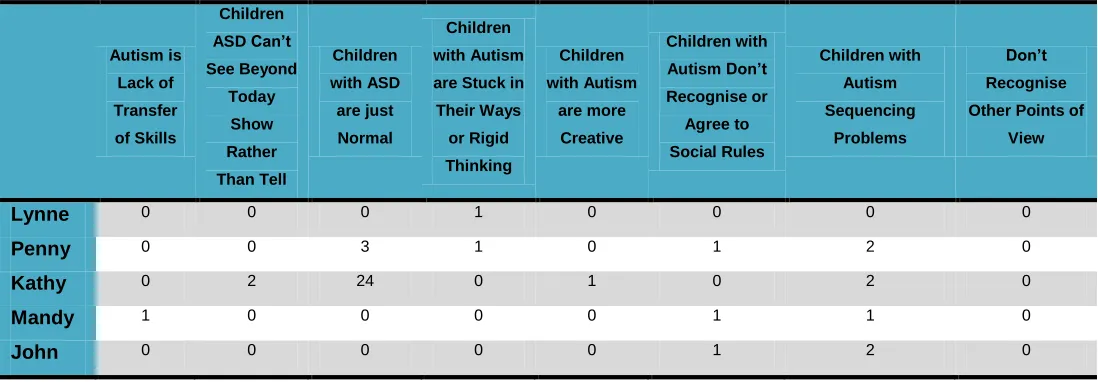
Table 4 Conceptualization of Autism, showing number of Source References by Teacher ………...….273
Table 5 Ways of Working with Children with Autism, showing number of Source References by Teacher ………...…………274
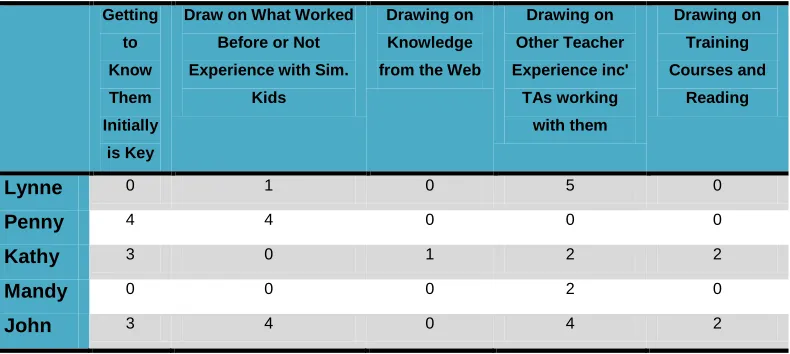
Table 6 What do Teachers draw on when making decisions about what to do in the classroom ………...276
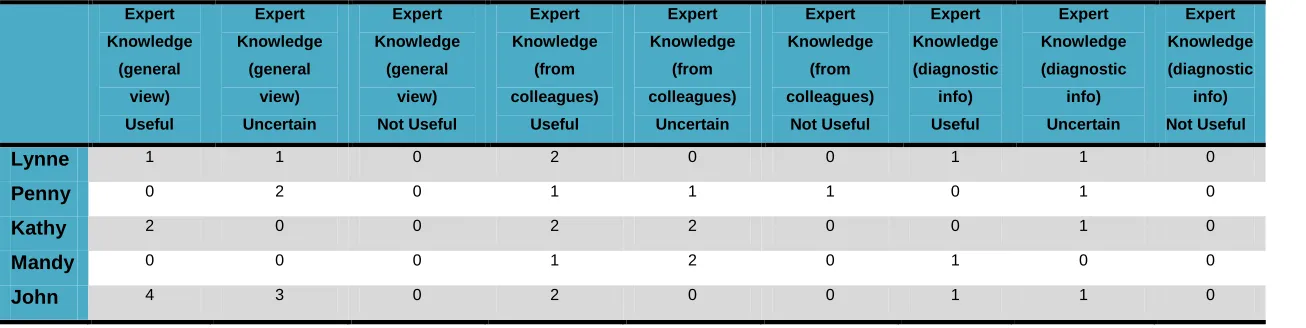
Table 7 Teacher Positioning in relation to expert/theoretical knowledge, number of Source References by Teacher ………...… 277
Table 8 Teacher Positioning on Autonomy and Independence …………...279
xi
Acknowledgements
xii
Dedication
1
1.
Introduction
1.1
Teacher Uncertainty and Autism
Teaching is a difficult job. In no other profession does one need, for up to six hours a day, day in and day out, to interact with and meet the varied learning, social and emotional needs of groups of young people who daily are changing, developing, and negotiating their identities and the boundaries between
themselves and the world. I know from my personal experience working as a mainstream primary school teacher that the complexity of the task can often mean that teachers are unsettled, anxious and uncertain about what is the ―right‖ thing to do in any given teaching moment. When the young people concerned also have difficulties with learning, often with diagnostic labels attached to those difficulties, then this can add an additional layer of complexity and uncertainty to the experience of being a teacher in the classroom. This study is an exploration of how teachers deal with and respond to this
uncertainty. Such an exploration raises questions including:
1. In dealing with uncertainty what recourse do teachers make to expert knowledge such as cognitive accounts of particular diagnostic
categories?
2. How is this balanced with their on-going experiential or tacit knowledge gained from working with other similar children or from working with the same child over time?
The study focuses on one particular diagnostic category of Special Educational Needs (SEN) – namely Autism or more commonly Autism Spectrum Disorders (ASD). Autism raises significant questions in the minds of caring professionals, particularly around issues of agency, autonomy and independence because its impairments strike at the heart of what we often take to be a given in human experience, namely the ability to engage in social communication. My
2
The study also focuses on the work of a group of teachers at one special school in the United Kingdom (UK) working with children with autism in a particular context, namely the introduction of a new technology tool. The tool in question is a mobile application; created as part of the European Commission (EC) funded ―HANDS‖ project (see Section 1.3 below), and designed to help children with autism to develop social and life skills.
As I will explore, when technological innovations are introduced into the
classroom, as with any change, this tends to provoke for teachers anxiety and uncertainty about both the significance of the new technology and how it might be used in relation to their current practice. Mobile technology in particular also raises particular issues for teachers, due to its associations with emerging new teenage modes of communication and interaction. These raise, for teachers, questions of both modern adolescent identity and how schools and teachers relate to the development of that identity. These questions are even more acute when applied to teenagers with problems with social communication, namely young people with autism. Autism and new technology, therefore, can be thought of representing a productive crucible for the exploration of teacher uncertainty.
The particular lens that I employ to think about this idea of uncertainty is mainly, although not exclusively, a psychoanalytic one. I make particular use of Wilfred Bion‘s epistemology, a system of thinking about how we think and come to know about the world. Bion‘s epistemology, in fact, foregrounds uncertainty, with knowledge, particularly about the human other, arising from the toleration of a state of uncertain ―not knowing‖.
1.2
The Context for the PhD
3
generally. I did, however, have an on-going interest in autism specifically, which grew out of the focus of my Tavistock D11 Masters course on my experiences of working with one boy with autism as a class teacher. In 2008, the opportunity arose to become involved in the HANDS project based on my attendance at autism-related conferences, which led to a collaboration with the project
coordinators, Aalborg University in Denmark. I was also interested in the project because of my background working with technology, initially in the computing industry before I went into teaching, and subsequently in my role as Information Communications Technology (ICT) Coordinator at several primary schools.
This potential involvement in HANDS was not foreseen at initial enrolment and registration but it provided an opportunity to further develop my interests in both autism and technology, whilst still keeping the original focus of the PhD study on teachers‘ professional practice and on the place of uncertainty in that practice, when working with children with SEN. More importantly and independently both autism and technology had the potential to stimulate
uncertainty for teachers in the classroom. The combination of both these factors was therefore rightly viewed as an appropriate context for the exploration of teacher uncertainty.
1.3
The HANDS Project
The HANDS project evaluated the use of a smart-phone application, which allows teachers to flexibly develop interventions on smart-phone devices which support children with ASD with social skills and life skills functioning. The software was developed using the principles of Persuasive Technology as the basis for the design process. Persuasive Technology is an emergent sub-discipline within the field of Human Computer Action, which was originally formulated by Fogg (2003). Drawing on elements of social psychology, persuasion research and communication theory, persuasive technology
1
4
considers how computers can be used in a broadly consensual manner to persuade people to adopt particular attitudes of behaviours.2
Implementation of an initial prototype took place at four special schools for children with ASD (in the age range 11-16) located in Denmark, Sweden, Hungary and the UK in 2009-2010. The software consists of a web-based flexible toolkit that teachers use to develop specific support and intervention sequences specific to the need of each child. These sequences consist of a series of linked screens, each of which can include customizable text, images, video and sound. These customized ―personal trainer‖ (PT) sequences can be linked to the associated comprehensive diary function also included in the
software. Personal trainer sequences can be stored as templates, and a sharing function allows teachers to adapt existing sequences for other children. The software also includes a function-rich diary system that allows for the creation of appointments, reminders and prompts, that can be directly linked to personal trainer functions. Intervention sequences developed using the flexible toolkit are then loaded via a synchronization function onto the client application on the child‘s smartphone. The system also includes an electronic footprint feature that creates a log file record for every use of the mobile application by the child. Test implementation and quantitative and qualitative evaluation of the first prototype was undertaken between 2009 and 2011 at four test site schools involving 15 teachers and 47 children. The demarcation of the PhD as part of the qualitative strand is detailed in section 1.8 below.
The focus of the HANDS software was on developing social and life skill functions. In social skills, these included prompts to support children in
remembering to consider other people‘s perspectives and short personal trainer sequences to help children calm down in situations likely to lead to emotional
2
It is not my intention in the thesis to give any detailed treatment of Persuasive Technology,
although I have elsewhere developed a consideration of the potential and implications of its use
in educational settings (see Mintz, J., & Aagard, M. (2012). The Application of Persuasive
Technology to Educational Settings. Educational Technology Research and Development,
5
outbursts. Teachers also used the personal trainer function to adapt ―social stories‖ (Gray 2007) presenting a narrative about a situation, skill, or concept in terms of relevant social cues, perspectives, and common responses, to an electronic platform. Life skills interventions developed in HANDS included managing money, dealing more effectively with time management, managing public transport and aiding self-monitoring of the administration of medication. Problems with life and social skills functioning are a central concern for teachers and other professionals working with children with ASD. They are linked
particularly to issues of agency and autonomy. As such, introducing a technology innovation related to these domains is likely to have stimulated teacher reflection and uncertainty around questions such as: What can these young people do by themselves? Will they ever be able to engage in
independent social communication that will allow them to live independently? Will they be more capable of organisation and planning than they are now? Does their ASD diagnosis mean that they will be unable to engage in independent adult life or are they all individuals with different strengths?
1.4
How HANDS works
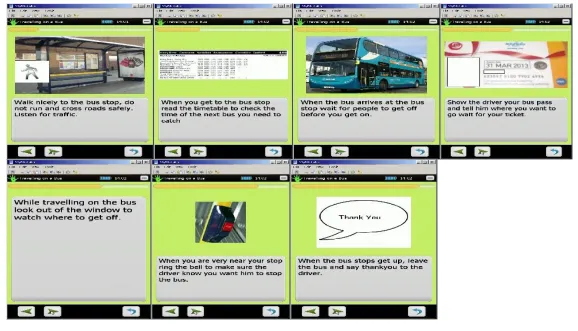
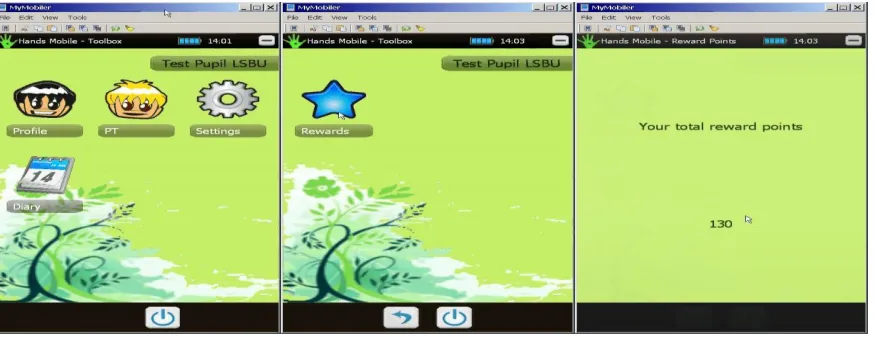
Figure 1, 2 and 3 show a sequence of screens from the HANDS application, illustrating how the software works on the child‘s mobile device. These screens were developed for one of the children at the UK School, ―Randall‖ School3
, a boy of 17 with an autism diagnosis, placed in the school‘s Further Education department. The key issue that his teacher focused on with him with HANDS was his problems with organisation, and she developed a Personal Trainer to help him with accessing public transport independently, and one to help him with the steps involved in making toast in the school kitchen (and at home). His school diary was also implemented on the HANDS diary function.
3
The name of the school and names of all the teachers and children referred to in the thesis are
6
Personal Trainer sequences can be linked to diary appointments, as with the sequence for making toast, which as
Figure 2 shows, is linked to an appointment scheduled for a lesson on daily living skills. Reward points are generated when particular HANDS functions such as a Personal Trainer sequence are completed, with their allocation determined by the teacher.
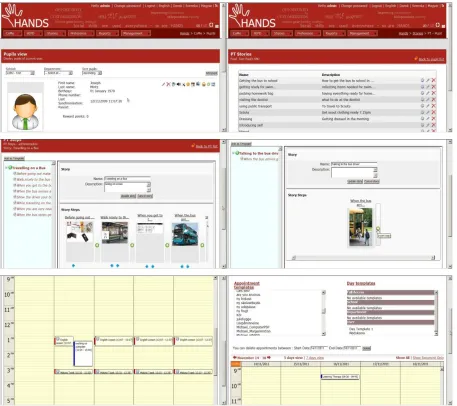
Figure 4 shows the teacher set-up server application, which runs as a web based application accessible from any computer with a web connection. The first screen shown is the landing screen for set-up application. Also shown is the set-up procedure for a Personal Trainer, as well as two screens for setting up the child‘s Diary function timetable.
8
Figure 2 Diary Function Day Page and linked Personal Trainer Application for making toast (extract of full sequence)
[image:20.792.117.554.303.472.2]10
1.5
Technical Problems
The implementation of the HANDS prototype from October 2009 involved a number of significant technical problems. Out of the four schools using HANDS, these problems were most significant at Randall School. The largest problem was that involving synchronization. Once the teacher has set up interventions such as Personal Trainer sequences or diary entries for the child on the web based set-up application, these then need to be downloaded over the web to the child‘s HANDS application on the mobile device. This is known as
synchronization and requires a web data connection on the mobile device. There were significant problems at Randall School with achieving a stable data connection, partly due to problems with the service provided by the airtime contract provider. The procedure for synchronization in the first prototype was also somewhat clumsy and difficult to use. The combination of these problems made the process of synchronization highly problematic, particularly for those teachers without advanced technical skills.
Again, partly due to problems with the airtime provider, for a period towards the end of the autumn term 2009 it was not possible to securely prevent children from going over their data download limit on the HANDS mobile. This meant that they could potentially incur high data charges if they went onto applications such as YouTube. This problem was rectified by switching off the data
connection at the start of the spring term 2010. This meant, however, that the HANDS phones were removed from the children for a couple of weeks at the start of January 2010, and that from then on they could not access the Internet or applications like YouTube. The gap in availability of the phones, but more significantly the removal of internet access, had a negative effect on the perception of some of the children about HANDS.
11
reset, and some functions, particularly on the teacher set-up application were perceived as clumsy and/or difficult to use.
1.6
Randall School
Randall School is a school for children with autism from the ages of 5 to 18. It is located in a rural part of England, and has around 80 children and 10 teachers, as well as a large number of support workers who act in what is essentially a teacher assistant role. There is also an Educational Psychology and Speech and Language Department on site at the school.
It is a successful and well-regarded school, which gained an Outstanding Grade on its last Ofsted inspection. The children attend the school from a radius of around 30 miles, and many children are brought to school via a taxi service.
All children admitted to the school need to have a psychiatric diagnosis that places them on the autism spectrum. Most of the children are higher
functioning, with most children having an IQ on WISC-IV of over 70.
Randall School is part of Non-Governmental Organisation providing autism services across the UK. Its technical support is provided by the NGO‘s central ICT service and, as such, teachers in the school have limited control over the installation and modification of software and hardware. Difficulties in
communication with the central ICT service contributed towards the technical problems experienced with HANDS, in that it was often difficult to get the required support which would have allowed for a more rapid resolution of some of the problems that arose.
1.7
General Approach to Working with the Teachers
12
(whether this was theoretical or practice-based was not specified). As such, researchers at Aalborg and London South Bank University (LSBU) both
undertook interviews with teachers in 2008/2009 about what they felt should be included in the software and this fed into the development of the software specification.
When the first version of the developed software was released in September 2009, training courses in the use of the software, as well as a user manual, were developed and on-site face-to-face training was delivered in October 2009 to all the teachers expected to use HANDS at the schools. At Randall School, this training was mainly delivered by colleague researchers, and amounted to two half-day training sessions for each teacher.
1.8
The Demarcation of the PhD Sub-Project
The overall HANDS project encompassed an evaluation of the implementation of the HANDS smartphone and software, including an evaluation of the impact on teachers, teaching assistants, children, parents and other professionals working in the 4 project schools.
It covers all four special school test sites for HANDS and included a multiple mixed method approach as follows:
1. Cognitive psychology testing, involved a quasi-randomized crossover controlled trial making use of standardized instruments (such as the Social Responsiveness Scale) to measure the effect of the introduction of an ICT tool based on persuasive technology in developing the
children‘s social skills, self-management skills and social integration The effect and efficiency of the HANDS toolset was measured as the
progress relative to an individual baseline established before the tests. 2. Applicability to the Learning Environment, involved a qualitative
13
learning environment, and qualitative evaluation of the effect of the ICT tool in developing social skills.
It is important to note that my role in the overall HANDS project was to lead on the second qualitative evaluation, as well as to take the lead on the
implementation of the software at the four test site schools.
However, the PhD Study is clearly demarcated as focusing specifically on the teachers at Randall school, the school in the UK, and on their professional thinking. Five teachers at the school were included in the study. Although other researchers were involved in the overall HANDS project, all observations and interviews used in the PhD Study were undertaken by me. Whilst the data so collected was of use in the overall HANDS project, activities, data collection and data analysis relating to the PhD Study were clearly demarcated within the overall HANDS project.
As indicated in this example, specific interventions on HANDS were
individualized to social and life skills situations appropriate to the needs of each child. In considering the customization for each child, the teachers were closely involved in working with the children to select particular social and life skills situations and considering the customization of the technology tool in relation to those situations.
1.9
About Uncertainty
14
from specialist colleagues such as educational psychologists, or their ongoing tacit experience of working with that particular child. A particular question, both for teachers themselves and for those observing and thinking about their practice is perhaps, ‗What is the balance between the uses of explicit versus tacit knowledge?‘ As such, my framing of uncertainty inevitably calls to mind the work of Donald Schön (1983). Schön emphasized the importance for
professionals of tacit as well as explicit knowledge. His concept of ―reflection in action‖ is based on the premise that all professionals make use of a
combination of both types when working ―in the moment‖ on solving
professional problems. However, as I will explore, Schön‘s consideration of what goes on ―in the moment‖ is under theorized, particularly for professionals working in the caring services. My contention is that applying a psychoanalytic lens, particularly one based on Bion‘s epistemology of how knowledge arises in the intersubjective relationship between two people, can serve to illuminate what goes on in that ―uncertain moment‖ when teachers come to decisions about how to work with children with autism. In particular, a Bionic lens suggests that there is something inherently uncertain in ―the moment‖ when caring professionals relate intersubjectively to their clients, and that this
uncertainty is a crucial part of, or even defines, the process of coming to know, in a truly useful sense, about the client.
This bringing together of Schön and Bion in the context of considering teacher uncertainty is, I believe, something new, and as such represents an original contribution.
1.10
Sources of Uncertainty for Teachers working with Children with
Autism
1.10.1The Social and Medical Models of Special Educational Needs
15
models of disability, expressed in ongoing political and policy debates about inclusion. Put briefly, there has been a continuing shift towards a social model (Oliver 1990) whereby any difficulties experienced are viewed as arising from a mismatch between the specific needs of the child and the provision made by the educational system. The ―progression‖ to inclusion is seen as moving away from locating problems with learning within the child, placing greater emphasis on the role of the environment in creating difficulties with learning – a ―social‖ model of disability. Thus an inclusion model sees difficulties in learning as being socially produced, as being an effect of the social environment. It is inclusive because in this model all children‘s needs are produced in this way, and all children are viewed as having equal rights to an education which meets their needs. The prevalence of an inclusion model as a way of thinking in relation to disability across the developed world can be illustrated by any number of
references in the contemporary literature on education practice. A few examples are Knight (1999) who discusses practical issues involved with implementing inclusion policies in mainstream schools, Forbes (2007) who discusses the development of inclusion as an overall approach in Australia, and Jones (2005) who considers children‘s interpretations of inclusion and special educational needs in the American context.
1.10.2Sociological and Psychological Positions
It is possible to identify an ontological split in the positions adopted by theorists about how to conceptualize SEN, which mirrors the split between the medical and social models of disability. On the one hand we have clinical and cognitive psychology and psychiatry, intimately involved with the ―diagnosis‖ and
―treatment‖ of conditions given diagnostic labels. This might be termed the psychological position, with theorists/clinicians such as Detterman and
16
but rather see the special needs of individual children arising mainly as a result of the response of the social and educational environment to an impairment, whose expression can vary and develop depending on the effectiveness of that response.
National and local policies in schools, on curriculum, assessment, the
application of diagnostic labels and so on have been influenced over the last thirty years by people whose views come from one or other of these positions. It seems reasonable to suggest, therefore, that these heavily conflicting signals may engender significant uncertainty in the teachers who actually have to work with the children concerned.
1.10.3Uncertainty about Autism
This is a (modified) extract from the HANDS Project Proposal:
‛Autism is typically regarded as a developmental disorder of the human nervous system which is characterized by mild to severe impairments in(1) reciprocal social engagement, (2) reciprocal communication, and (3) flexible regulation of self, behaviour and interest (See the ‗autism triad‘ – e.g. Bailey et al. 1996). These are especially striking features of autism, as affected individuals often have non-impaired general intellectual capacities (so-called ―high-functioning‖ individuals with autism). Impairments in social and communicative reciprocity and in adaptive, flexible regulation of self and behaviours in individuals with autism lead to significant difficulties in both social and life skills (Howlin 2005).‘
This definition was largely developed by my esteemed colleague Miklos Györi on the HANDS Project, at Eötvös Loránd University (ELTE). It is typical of psychological definitions of autism and is clearly located firmly within the medical model. Such conceptualizations of autism have been subject,
17
Asperger‘s Syndrome as a diagnostic term in educational and other settings, accusing psychologists and other professionals who have developed its use of unnecessarily pathologizing a group of children. Bogdashina (2006) has, to the considerable annoyance of the targets of her criticism, also applied what is effectively a sociological critique to the way in which clinical professionals, in her opinion, use and abuse the label ASD.
At the same time, more essentialist accounts of autism contend that the biological, genetic and clinic evidence is clear in pointing towards the
psychological definition of ASD as being the key starting point for thinking about this condition. Such accounts have significant force in schools as they tend to be the ones which are directly operationalized by the educational and clinical psychologists with whom teachers of children with autism often closely work alongside.
For teachers working with children with autism, the competing psychological and sociological positions raise in particular the issue of capability, leading to on-going questions such as: Is their social impairment so significant that it is not possible to change the classroom or society to meet their needs? Do they need ―different‖ (and separate) educational provision? Should we let them stay in their ―shells‖ or encourage them to come out in to the social world? Is such social development possible or desirable? Can children with autism function effectively in the social, educational and economic world, or should we be happy to consign them to a different level of existence which suits them?
This discussion serves to illustrate that the conceptual tensions and
uncertainties that teachers experience when working with children with SEN in general, can be even more acute for teachers working with children with ASD.
Teacher uncertainty which relates to ASD can be considered to include:
18
diagnostic labels such as Asperger‘s Syndrome vs. High Functioning Autism in relation to specific children.
Uncertainty about the implication for practice of specific diagnostic labels within the spectrum or of the autistic spectrum in general. ASD is a syndrome and as such, it has a very broad range of expression. In a sense, then, the use of the term ASD can be even more of an
abstraction than for other conditions. This can make it more difficult for teachers to balance the significance of an autism diagnosis with the specific knowledge of and relationship with the individual child that they know. The tension between these two aspects is a potential source of considerable uncertainty for teachers working with children with autism. Uncertainty by teachers about their level of knowledge and
understanding about the autism spectrum, and uncertainty as to the significance of this in relation to their effectiveness as teachers.
Uncertainty about the implications of an autism diagnosis for the child‘s ability to act autonomously and independently in the world
1.10.4Uncertainty about Agency and Autonomy in Autism
As the autism definition from the HANDS project proposal indicates, there is a clear link between impairments in social communication and reciprocal
communication and the ability to function independently in the wider world. The whole premise of the HANDS project is that mobile technology interventions designed to support the development of social and life skills might be able to contribute to improving the extent to which children with autism can engage with social, educational and employment opportunities. Howlin (ibid) has shown in detail the devastating effect on ongoing life trajectories and life chances that autism and ASD can have. Teachers working with children with autism,
19
be able to take decisions for themselves, to express themselves as rational choosing agents, or will they forever be in a dependent role where decisions are made for them? Is it even in their interests for teachers and carers to promote their independence and autonomy?
There is a partial mapping between questions of autonomy and independence and the psychological and social positions on autism, although it is far from straightforward. Psychologists who take an essentialist position, such as
Detterman and Thompson (ibid.) often tend to see children‘s attributes as fixed – they can‘t do it now, they won‘t ever be able to do it. However, those taking the sociological position, such as Barton (1988), by underplaying the role of the individual/self, can also, sometimes unintentionally, lessen the focus on the development of individual agency. Such conflicts tend to be played out in public policy debates, in fact there is, in 2011 and 2012, a significant debate about inclusion policy going on in the UK (ALFIE 2011). Such policy debates
interpenetrate with teachers‘ ongoing thinking, and can be a significant source of uncertainty in terms of their day-to-day practice. For example, they might feel a general commitment to developing the autonomy of a child, but also wonder if there is not some truth to an essentialist position, that is if they can‘t do it now they might never be able to, and encouraging them might be setting them up to fail.
A key focus, therefore, of my exploration of teacher uncertainty in working with children with autism, is how they position themselves in relation to the child‘s agency and autonomy.
1.11
Sources of Uncertainty for Teachers working with Technology
The introduction of any new innovation in the classroom (whether technology based or not) can be considered as an impetus for teacher reflection on
20
of the key effects of technology introduction. In the context of technology change, Hennessy et al. (2005) and Sandholtz et al.(1997) indicate that encountering new technology similarly requires teachers to consider how they will assimilate the innovation in to their practice, which typically stimulates them to reflect on their existing practice.
The introduction of innovation can concomitantly be a source of considerable anxiety and uncertainty for teachers (one could regard such uncertainty as the flipside of the process of reflecting on practice). In an important sense, in fact, technology innovations in the classroom can be considered similarly to other classroom interventions – i.e. the introduction of new technology can be understood in terms of change, and as Hennessy et al. (2003) suggest, we should conceptualize technology alongside the teacher-thinking literature that has focused on the impact of change on teachers and teaching.
However, there are strong indications in the literature that there is a specific type of anxiety and uncertainty associated with technology. In the human-computer interaction literature in particular, the construct ―human-computer anxiety‖ is used to refer to a fear of computers when either using them or considering their use.
Chua et al. (1999) present a meta-analysis which correlates this construct with age and extent of computer experience. Russell and Bradley (1997),in
reviewing the literature on the application of this construct to teachers, indicate that this shows that such anxiety is often related to a fear of ―getting it wrong‖, which itself is related to lack of knowledge and experience.
21
of this distinction has been challenged recently on empirical grounds. For
example, at the recent Word Conference on Educational Technology and Media (Bastiaens and Ebne 2011), a number of studies of secondary school and undergraduate student attitudes indicated that it is not clear that positive feelings towards technology always directly correlate with age (Ranieri et al. 2011; Bullen et al. 2011). Nevertheless, Prensky does highlight at the least the potential for intergenerational conflicts about the significance of technology. Smartphone technology is associated for teenagers in particular with new modes of communication around social networking and instant messaging, and as such is likely to throw into relief for some teachers and schools differences between adult and adolescent identities. This is likely to be a source of anxiety and uncertainty for teachers working with adolescents. They may experience anxieties related to questions such as: Can I relate to these young people? What is the significance of this new technology for them and for me? Is there a place for me and my ―old‖ knowledge in the face of these new ways of deriving and developing facts?
Further, for teachers working with young people with autism they might also ask: Can these young people join in with these new ways of communicating? Do their impairments in social communication mean that they are cut off from new ways of relating? Or, in contrast, does this technology offer them new ways to join in with their ―normal‖ peers?
1.12
The Policy Context – teacher training and teacher knowledge
1.12.1Scope
22
1.12.2Autism Pedagogy and Teacher Training in the UK
As I will explore, although it is the subject of debate, there is a more or less accepted autism specific best practice pedagogy (Jordan 2008).
In some territories, teachers who are going on to work with children with autism learn about this in their initial teacher training. As Hegarty (1998) indicates, many European countries, as well as the USA, have a tradition of specialist initial teacher training for SEN teachers, who would in the past go on to teach in specialist provisions for children with SEN, although there is an increasing trend for such teachers to start and continue their careers in mainstream settings as well. In contrast, there has never been any established tradition of specialist education for teachers of SEN, at least in initial teacher training, in the UK. The historical reasons for this approach are not very clear. In a useful historical review, Hodkinson (2009) describes the development of SEN training in initial teacher education in the UK since the 1960s, but doesn‘t provide a rationale for this overall difference in approach. It could be argued that since 1980, UK education policy has been very heavily influenced by the social model of
disability and sociological discourses of SEN. However, I have not identified any clear evidence to link this to policy decisions on teacher training. It seems
possible that the relatively low levels of funding for initial teacher training in the UK may be equally implicated.
There is, as with teacher competencies and knowledge on SEN, virtually no extant literature on the issue of teacher training and ASD in the UK context. A search was performed on the broad spectrum education database, ―Education Research Complete‖, using the search terms ―teacher training‖ and ―autism‖. Although a significant number of published papers were returned, these all related to research done in the USA or to the Far East.
23
special schools. Only five relevant articles, two of which were media reports in the Times Educational Supplement, were located. This result seems to reflect a general lack of interest in the topic, certainly in the UK literature. In one of the articles, Parsons et al. (2009) report on a medium scale questionnaire-based study comparing the levels of satisfaction with their child‘s educational provision of parents of children with ASD and parents of children with other disabilities. It is relevant to note that there was only one minor qualitative reference in the reported study to perceptions of teacher knowledge and training. It seems difficult, therefore, to draw any robust conclusions on what level of specialist knowledge teachers in special schools in the UK have. However, given the lack of emphasis on SEN in initial teacher training, it seems reasonable to speculate that the level of specialist knowledge in special schools is not likely to be high compared to some other territories such as the USA.
1.12.3The relevance of specialist knowledge
This study, in exploring teachers‘ uncertainty in working with children with autism, implicitly considers what they know about autism and autism pedagogy. It illuminates, therefore, albeit based on a very limited sample in one UK school, what teachers do and do not know about a) psychological theories about
autism, and b) autism specific pedagogy, including the influence of their pre- and in-service training.
The question remains, however, as to what difference it makes whether teachers know lots or little about these domains. If their explicit knowledge is low, does this mean that they are poor teachers of children with autism? Or that they could be much better teachers if they knew more? Or that it does not make much difference? Would they be more or less uncertain?
24
place of theory in how the therapist comes to know the client. In doing so, there is a working assumption that there is something inherently uncertain in the relationship between therapist and client, and by extension between teacher and child, and that this uncertainty has a productive and generative aspect to it which can potentially lead to a useful ―knowing‖ about the human other. It is in this context that I explore the actual significance of what teachers of autism do or should know about specialist expert knowledge about autism and autism pedagogy.
1.13
Towards a psycho-social approach to understanding teacher
thinking and uncertainty
The title of the study is: ―How do teachers deal with uncertainty in relation to working with children with autism in the context of the introduction of a new technology tool?‖ This specifies the key research question. The focus is on ―how teachers deal with uncertainty‖, and the study will explore how such
uncertainties are expressed and can be detected, what teachers‘ responses are when faced with uncertainty, what positions they adopt in relation to the children they are working with and in relation to a new technology tool in the context of such uncertainties.
The focus is on teacher uncertainty that arises from the (perhaps threatening) crucible of teachers working both with autism and with new technology, and how teachers deal, whether productively or destructively with such uncertainty. However, exploring how such uncertainties are expressed and can be detected requires the definition of a methodological approach.
I have already identified a split in thinking about SEN between psychological and sociological positions. This reflects, of course, a split with much wider applications about how to conceptualize the Human Sciences. On the one hand there is an orientation towards discrete categorisation, expressed in the
25
towards ―thick‖ descriptions and investigations which take into account more of the complexities of human social activity. David Byrne (2011), in exploring how these tensions are played out in Social Science, quotes Hayles (1999), who uses the term the ―Platonic Backhand‖:
‗The Platonic Backhand works by inferring from the world‘s noisy multiplicity, a simplified abstraction. So far so good: this is what
theorizing should do. The problem comes when the move circles around to constitute the abstraction as originary form from which the world‘s multiplicity derives. Then complexity appears as ―fuzzing up‖ of essential reality, rather than a manifestation of the world‘s holistic nature‘.
(Hayles ibid, p. 12)
This can be applied to diagnostic labels in SEN, and their potential misuse, in the psychological position as ―abstractions as originary form‖. Equally, it can be applied to the use of psychological or scientist orientations within Social
Science.
There is also a second and related critique of the ―psychological position‖ in respect of considering complex social fields such as teacher thinking.
―Psychological‖ here refers to cognitive or clinical psychology. As Alvarez (1992) points out, these domains can be considered as reflecting a one person psychology. The psychologist acts as disinterested observer, turning their
objective lens on the individual in order to discover particular attributes assigned to them such as attention, executive function, or ability in relation to theory of mind. There is no space for the relationship between psychologist and subject to be of significance, in fact the necessity for objective categorization precludes this. Further, the orientation towards objectively obtained categories in
psychology has tended to reduce the ability of psychology to give explanations for human behaviour that properly reflect the rich complexities of human
26
Psychoanalysis, as well as strands within humanistic psychology, has adopted a different position, which Alvarez terms a ―2 person psychology‖. Here the intersubjective relationship between the therapist and client is the key to deriving knowledge about human experience. This allows for a more in-depth capturing of the complexities of such experience and as a consequence the construction of a much more complex explanatory model for human behaviour. In this 2-person psychology, the psychoanalytic concept of desire tells us much more than psychology‘s restricted term motivation ever could about what human beings are and why they act as they do.
It is possible to combine the two orientations implied above in relation to conceptualizing an appropriate theoretical and research position. A ―social‖ interpretivist orientation which seeks thick descriptions and investigation of human experience can be linked to a 2-person ―psycho‖ – logy which uses intersubjective experience between researcher and research subjects as a method to find out more about that complexity.
1.13.1The hyphen in the Psycho-Social
Psycho-social studies, which make use of a combination of both
psychodynamic theory and traditional approaches in sociology to understanding human experience and behaviour, is an emerging albeit still small area of cross-disciplinary study. There are considerable ongoing debates about how and to what extent psychoanalytic thought should be so integrated. I give some considerable attention to various aspects of these debates in Section 4.2
One key issue for the definition and adoption of a psycho-social approach in this study, is the particular debate within psycho-social studies about how the
relationship between the individual and society should be conceived of when considering the integration of psychoanalytic thought in to sociology and social research methods. As Hoggett (2008, p.380) discusses, ―strong social
constructionist‖ approaches within psycho-social studies propose that too strong a focus on Freudian and Kleinian inner reality can eclipse a proper
27
delineation between individual and society (or inner and outer reality)
disappears or at least becomes more fuzzy. In this flavour of ―psycho-social‖ studies, as Hoggett (op cit) notes, the hyphen, signifying the separation of inner and outer becomes superfluous, so the sub-discipline can be referred to as ―psychosocial‖ studies. When such a position is adopted, making judgements about the inner reality of research subjects using techniques such as counter-transference can sometimes be regarded with a significant degree of suspicion. Hoggett (op cit) sets out the alternative position within psycho-social studies. In this, whilst one might maintain a healthy scepticism about too simple a
conception of individuals as unitary subjects immune from the influence of social forces, there is also a recognition that, as Hoggett puts it, ―I am
nevertheless a realist before I am a constructionist‖ (op cit, p.380). In the realist flavour of ―psycho-social‖ studies the re-introduction of the hyphen indicates that there is an acceptance of a) the potential of psychoanalysis to tell us something real about the individual experience and (importantly) desires of individual subjects, and b) the potential explanatory power of psychoanalytic techniques when adopted as social research tools. It is this realist flavour of psycho-social studies that I adopt in this study.
I will give the debates around psycho-social research methods further detailed consideration in Sections 4.2.2 and 5.3.5.
There has been increasing use of such a psycho-social approach to thinking about complex social fields such as teaching in recent years. For example, Price (2004) uses this approach to think about the emotional context of young children‘s literacy learning. However, it is still early on in the use of such an approach, and there remain a number of open issues related to epistemology, validity and reliability.
I intend to use such a psycho-social approach in my detection and evaluation of teachers‘ uncertainties about working with children with autism. In doing so I will also explore some of the extant methodological issues involved with the
28
2.
Teacher Thinking
2.1
Teacher Thinking – Cognitive Approaches
There is a significant literature on teacher thinking, which explores how teachers come to decisions about what they do in the classroom. There was significant interest in teacher thinking in the 1980s and early 1990s.
As Denicolo and Kompf (2005) discuss, in a later exploration of this body of work, teacher thinking can potentially be delineated temporally, as:
1. Teacher planning in advance of lesson delivery 2. In the moment, thinking about strategy selection
3. Reflection on what went on in the classroom after the lesson
The researchers involved, however, were most interested in the ―in the moment‖ thinking about strategy selection, as indeed I am in this study. The most
important decisions or the most significant thinking, which influences what teachers actually do, will occur in this crucial arena of the classroom itself. This is of course related to planning processes, and there is some attention given to such processes in the teacher thinking literature. But given the extreme
practical difficulty of eliciting teacher thinking during the lesson, teacher reflection after the lesson was naturally seen as the most obvious route to uncovering what teachers had been thinking in the moment.
29
that ―uncovering‖ thought-action sequences from after the fact elicited teacher reflection was far from straightforward.
I consider this literature as being highly relevant to my study for a number of reasons:
1. Exploring teacher uncertainty necessarily implies exploring what teachers think about working with children with autism. In one sense, exploration of teacher uncertainty and exploration of teacher thinking are, if not identical, then very closely related.
2. The teacher thinking literature emphasises what goes in the moment of teacher-to-child interaction, even if it is not always able to research this directly. Similarly, my exploration of uncertainty focuses on the
exploration of how teachers deal with uncertainty and its relevance for their practice in the teaching ―moment‖.
3. Following on from (1), methodological considerations, methods and experiences reported in the teacher thinking literature will be relevant for the approaches adopted in this study
2.2
Approaches to investigating teacher thinking
30
2.3
Categories of Teacher Knowledge
Coming from a cognitive position, Shulman (1987) usefully proposes a categorization of the teacher ―knowledge base‖ as:
content knowledge
general pedagogical knowledge curriculum knowledge
knowledge of learners
knowledge of educational contexts
knowledge of educational ends, purposes, and values, as well as their philosophical and historical grounds
pedagogical content knowledge
Pedagogical content knowledge is a type of craft knowledge which relates to teaching specific subject areas. So, for example, a science teacher would have particular working theories about how best to explain or demonstrate key concepts such as transpiration or the structure of the atom. This is partially derived from training or reference to, say, schemes of work, but also partially derived from their experience of what works in explaining things to children. This concept could usefully be extended to craft knowledge associated with working with particular groups of children. So, for example, we could posit the existence of pedagogical content knowledge about how to work with children with autism.
2.4
Common Themes in the Cognitive Literature
There are a number of common themes that emerge from the empirical reports on teacher thinking (Clark & Petersen 1986; Brown & McIntyre 1993;
31 Rapid thinking
Across the literature, it was very rare to gain accurate reports on specific thought sequences taking place before actions. The complex nature of teacher‘s professional practice, with events involving many participants
happening very rapidly contributed towards this. If we consider a teacher being presented with 10 children asking for help simultaneously, we can see that they need to decide what to do very rapidly and when asked even a short time later what their thinking was, they would find this hard to articulate. This difficulty in recall in relation to rapid and complex activity in the classroom was reported across the literature.
Little direct reference to theory and Chunking
Teacher reports on their thinking included relatively few references to explicit theory and knowledge. In Shulman‘s terms, general pedagogical knowledge, knowledge of educational contexts, knowledge of educational ends were rarely referred to. Although content and curriculum knowledge, and knowledge of learners and educational contexts were much more clearly present, it tended to be assimilated into higher level categories such as an overall concept of pupil progress. As Peterson, Marx and Clark (1978) put it, teachers tended to engage in ―chunking‖. By this they mean that teachers tended to group both events and knowledge in to a few categories. The typically reported use of broad groupings of children by ability in the empirical reports (―the higher ability ones can do this‖) is an example of grouping of knowledge; in this case about learners.
2.5
Schön – Reflection in Action
32
determining both their prominent role in technological societies and in
conceptualizing their activities. Schön describes this as the ‖Technical Rational‖ model, where privileged major professions (medicine, law etc..) take a body of scientifically derived knowledge and then apply this to solve clearly defined and delimited problems. Further, in this model, a second class of minor professions are ineluctably defined, such as teachers or social workers, where an ill-defined knowledge base and competing sets of theoretical explanations are targeted (ineffectually) at fuzzy real-world problems. Schön criticizes this model on a number of grounds. One of his key points is that the technical rational model does not work in many cases, and that, increasingly, the recipients of the professional services and the professionals themselves realise this (the growth of the expert patient movement might be an example of this). Specifically, the technical rational model only works for ―convergent cases‖ which fit the textbook parameters. Yet Schön proposes that in fact in many (or most) cases, the
textbook does not fit or quite fit, and the professional needs to use their ‖in the moment‖ thinking to find the solution to the problem – in other words, thought and action are intertwined. Further, Schön points out that these messy
problems are actually quite common in both the major and the minor
professions, and that the distinction between the professions on those grounds is really a false one. Schön names this process ―Reflection in Action‖. So in common with the teacher thinking literature, Schön was particularly interested in what went in the ‖moment‖ when professionals engage with problem solving, although he certainly considered how professionals engage in planning and after the fact reflection.
However, there is significant debate, and I would suggest a certain lack of clarity about:
1. What Schön actually means by ―Reflection in Action‖ and what he is suggesting actually goes on ―in the moment‖ when professionals come up with solutions to professional problems.
2. Concomitantly how Schön sees professionals integrating
33
2.6
Socio-cultural approaches to Teacher Thinking
As Denicolo and Kompf (2005) point out, part of the reason for the decline in interest in teacher thinking as a field of study after the 1980s was due to the growing influence of socio-cultural approaches to conceptualizing what is going on for teachers and children in the process of teaching and learning in the classroom. This was, as Denicolo and Kompf recognise, to a significant degree due to Schön‘s influence. Schön‘s rejection of a technical rational model of professional thinking tends to imply that tacit knowledge is just as important as expert knowledge. It‘s not a major jump from this position to considering
process and product in professional thinking as intertwined and even indistinguishable. This is the socio-cultural approach, where in contrast to cognitive approaches, it is seen as unsupportable on both empirical and logical grounds to contend that thoughts and actions can be separated. In this
perspective, the difficulty that cognitive teacher thinking encountered in uncovering teacher thinking processes is seen as hardly surprising.
As I will discuss in Section 2.7 below, it‘s not quite so clear whether Schön was in fact adopting a socio-cultural position. However, many interpreted him in this way and perhaps partly in reaction to this, there was less interest in cognitive approaches to teacher thinking after the 1980s, and much more interest in narrative and hermeneutic accounts of teacher thinking. This body of literature, from the 1990s onwards, is usually referred to as ‖teacher research‖ (Ballet, Kelchtermans and Loughran 2006).
2.7
Where does Schön sit in the split?
34
classroom learning. Hanks (1991), in his introduction to Lave and Wenger‘s (1991) seminal text, considers their concept of ―legitimate peripheral
participation‖:
―The individual learner is not gaining a discrete body of abstract
knowledge which (s)he will then transport and reapply in later contexts. Instead, (s)he acquires the skill to perform by actually engaging in the process…‖ (Hanks 1991, p.14)
As Erlandson and Beach (2008) point out, for Lave and Wenger, in common with socio-cultural theorists such as Leontiev (1959) and Rogoff (1990), the acquisition of the skill and the engagement in the process are indistinguishable. The knowledge or skills gained cannot be considered as separate from the embodied practical engagement with the process. Process and product are the same and, further, it makes no sense to think about a wholly separate individual cognition that is distinct from the tool-supported interpersonal interactions that the mind emerges from. This is the socio-cultural position and in proposing that knowledge arises from engagement with professional practice, Schön could be seen as being in line with this. Erlandson and Beach (op cit) identify the
following conclusions which can and have been drawn if Schön is read like this:
―that for practice-oriented professions that rely on tacit knowledge, such as those of architects, psychotherapists, nurses and teachers, there is a special kind of epistemology that differs from epistemology in the
classical sense; that this epistemology is situated such that questions of epistemology have to involve questions concerning situated practice; these practice-oriented professions involve a special kind of situated thinking and this ‗situational thinking‘ is what being a professional is all about.‖ (Erlandson and Beach op cit, p.411)
35
‖control matrix‖, which is essentially the idea of the homunculus, the independent ‖I‖.
Erlandson and Beach (2008) then go on to show that Schön is, in fact, quite closely aligned with this psychological position and that for Schön, reflection in action implies that there is an active construction of an abstract concept that then drives action. This might happen very quickly – in the moment, but it still happens in that order – abstract thought and then action.
At this point I should make my own ontological position clear. My interpretation of Schön is that he responds, perhaps implicitly but in my view inescapably, to the significant problems that many people have with many socio-cultural accounts which position the mind as the ‖individual-in-social-action‖ as Cobb (1994) puts it. As Magee (2000) points out, accounts such as this, which minimize the role of a privileged individual cognition, inevitably tend to reduce the space available for the exercise of individual agency. Yet, as Magee eloquently explores, everyday practices across cultures, are based on an assumption of individual agency. Try stamping on someone‘s foot when you pass them in the street and then explaining it as a consequence of socially mediated acculturation to see how it works out for you and the stampee in real life practice! Magee, of course, based on Kant‘s Critique of Pure Reason, goes further, and commits 21st century philosophical political incorrectness by, in effect, defending Cartesian duality. According to Magee, if we accept individual agency, then there must be something outside of the phenomenal world to account for this, something we might call the mind, divorced from the phenomenal body.
36
Schön with a problem if we are not to fall back into the extreme split between knowledge and practice present in the Technical Rational model, and Schön does demonstrate convincingly how this model doesn‘t fit with what actually goes on in professional practice. The problem is, therefore, what does happen ‖in the moment?‖
Schön tends to skip over this crucial issue, which is the most problematic aspect of his account of professional thinking. Erlandson and Beach argue that the best way of explaining this it to turn to socio-cultural accounts of the mind as embodied practice. If this is rejected, as I reject it, based on concerns to
preserve a space for conceptualising individual agency, then what explanation do we have for how a body of professional knowledge is utilised and applied in the moment by professionals in action? More specifically, how do we account for what goes on when caring professionals, including teachers, work with clients or children about whom they have significant levels of uncertainty? How does their intersubjective relationship with the human other relate to expert knowledge and how do they make use of or integrate these knowledges ―in the moment‖? For me, Schön‘s concept of ‖Reflection in Action‖ as it stands leaves these questions wide open.
In Section 4 below, I will explore how using a psychoanalytic lens, and in particular Bion‘s epistemology about how the therapist and client move from ‖not knowing‖ to ‖knowing‖ could allow us to fill this theoretical gap and consider more fully how teachers and other caring professionals integrate theory and expert knowledge in their moment-to-moment encounters with the human other.
2.8
Intersubjectivity
37
―The social intelligence of the infant is evidently a specific human talent— an inherent, intrinsic, psycho- biological capacity that integrates
perceptual information from many modalities to serve motive states. Moreover, this capacity is a necessary prerequisite, although not in itself a sufficient cause, for a child to go through psychological development of the kind that leads to and depends on cultural learning...the infant‘s need for communication animates the initial self-other awareness and
reception of motives and emotions