Volume 2010, Article ID 815213,9pages doi:10.1155/2010/815213
Research Article
Adaptive Modulation with Smoothed Flow Utility
Ekine Akuiyibo and Stephen Boyd
Information Systems Laboratory, Department of Electrical Engineering, Stanford University, Stanford, CA 94305, USA
Correspondence should be addressed to Ekine Akuiyibo,[email protected]
Received 6 May 2010; Accepted 14 September 2010
Academic Editor: Athanasios Vasilakos
Copyright © 2010 E. Akuiyibo and S. Boyd. This is an open access article distributed under the Creative Commons Attribution License, which permits unrestricted use, distribution, and reproduction in any medium, provided the original work is properly cited.
We consider the problem of choosing the data flow rate on a wireless link with randomly varying channel gain, to optimally trade offaverage transmit power and the average utility of the smoothed data flow rate. The smoothing allows us to model the demands of an application that can tolerate variations in flow over a certain time interval; we will see that this smoothing leads to a substantially different optimal data flow rate policy than without smoothing. We pose the problem as a convex stochastic control problem. For the case of a single flow, the optimal data flow rate policy can be numerically computed using stochastic dynamic programming. For the case of multiple flows on a single link, we propose an approximate dynamic programming approach to obtain suboptimal data flow rate policies. We illustrate, through numerical examples, that these approximate policies can perform very well.
1. Introduction
We consider the flow rate assignment problem on a wireless link with randomly varying channel gain, to optimally trade off average transmit power and the average utility of the smoothed flow data rate. We pose the multiperiod problem as an infinite-horizon stochastic control problem with linear dynamics and convex objective. For the case of a single flow, the optimal policy is easily found using stochastic dynamic programming (DP) and gridding. For the case of multiple flows, DP becomes intractable, and we propose instead an approximate dynamic programming approach using suboptimal policies developed in the single-flow case. Simulations show that these suboptimal policies perform very well.
In the wireless communications literature, varying a link’s transmit rate (and power) depending on channel conditions is called adaptive modulation (AM); see, for example, [1–5]. One drawback of AM is that it is a physical layer optimization technique with no knowledge of upper layer optimization protocols. Maximizing a total utility function is also very common in various communications and networking problem formulations, where it is referred to as network utility maximization (NUM); see, for example, [6–10]. In the NUM framework, performance of an upper
layer protocol (e.g., TCP) is determined by utility of flow attributes, for example, utility of link flow rate.
Our setup involves both adaptive modulation and utility maximization but is nonstandard in several respects. We consider the utility of the smoothed flows, and we consider multiple flows over the same wireless link [11].
2. Problem Setup
2.1. Average Smoothed Flow Utility. A wireless
communi-cation link supports ndata flows in a channel that varies with time, which we model using discrete-time intervalst=
0, 1, 2,. . .. We let ft ∈Rn+be the data flow rate vector on the link, where (ft)j, j = 1,. . .,n, is the jth flow’s data rate at timetandR+ denotes the set of nonnegative numbers. We letFt=1Tftdenote the total flow rate over all flows, where1 is the vector with all entries one. The flows, and the total flow rate, will depend on the random channel gain (through the flow policy, described below) and so are random variables.
smoothing. At each time t, the smoothed data flow rate exponentially weighted average of previous flow rates.
The smoothing parameter θj determines the level of smoothing on flowj. Small smoothing parameter values (θj close to zero) correspond to light smoothing; large values (θj close to one) correspond to heavy smoothing. (Note that θj = 0 means that flow j is not smoothed; we have (st+1)j = (ft)j.) The level of smoothing can be related to the time scale over which the smoothing occurs. We define
Tj = 1/log(1/θj) to be thesmoothing timeassociated with flow j. Roughly speaking, the smoothing time is the time interval over which the effect of a flow on the smoothed flow decays by a factor 1/e. Light smoothing corresponds to short smoothing times, while heavy smoothing corresponds to longer smoothing times.
We associate with each smoothed flow rate (st)j a strictly concave nondecreasing differentiable utility function
Uj; R+ → R, where the utility of (st)j is Uj((st)j). The average utility derived over all flows, over all time, is
U= lim expectation is over the smoothed flows st, and we are assuming that the expectations and limit above exist.
While most of our results will hold for more general utilities, we will focus on the family of power utility functions, defined forx≥0 as
U(x)=βxα, (4) parameterized by α ∈ (0, 1) and β > 0. The parameterα
sets the curvature (or risk aversion), whileβsets the overall weight of the utility. (For small values ofα,Uapproaches a log utility.)
Before proceeding, we make some general comments on our use of smoothed flows. The smoothing can be considered as a type of time averaging; then we apply a concave utility function; finally, we average this utility. The time averaging and utility function operations do not commute, except in the case when the utility is linear (or affine). Jensen’s inequality tells us that average smoothed utility is greater than or equal to the average utility applied directly to the flow rates, that is,
So the time smoothing step does affect our average utility; we will see later that it has a dramatic effect on the optimal flow policy.
2.2. Average Power. We model the wireless channel with
time-varying positive gain parametersgt,t=0, 1,. . ., which we assume are independent identically distributed (IID), with known distribution. At each timet, the gain parameter affects the powerPt required to support the total data flow rateFt. The powerPtis given by While our results will hold for the more general case, we will focus on the more specific power function described here. We suppose that the signal-to-interference-and-noise ratio (SINR) of the channel is given by gtPt. (Here gt includes the effect of time-varying channel gain, noise, and interference.) The channel capacity is then μlog(1 +gtPt), whereμis a constant; this must equal at least the total flow rateFt, so we obtain
The total average power is
P= lim
where, again, we are assuming that the expectations and limit exist.
2.3. Flow Rate Control Problem. The overall objective is to
maximize a weighted difference between average utility and average power,
J=U−λP, (9)
whereλ∈R++is used to trade offaverage utility and power. We require that the flow policy is causal; that is, when
ft is chosen, we know the previous and current values of the flows, smoothed flows, and channel gains. Standard arguments in stochastic control (see, e.g., [13–17]) can be used to conclude that, without loss of generality, we can assume that the flow control policy has the form
ft=ϕ only on the current smoothed flows and the current channel gain value.
The flow rate control problem is to choose the flow rate policy ϕto maximize the overall objective in (9). This is a standard convex stochastic control problem, with linear dynamics.
2.4. Our Results. We letJbe the optimal overall objective
the optimal flow policy can be roughly described as waiting until the channel gain is large, or until the smoothed flow has fallen to a low level, at which point we transmit (i.e., choose nonzero ft). Roughly speaking, the higher the level of smoothing, the longer we can afford to wait for a large channel gain before transmitting. The average power required to support a given utility level decreases, sometimes dramatically, as the level of smoothing increases.
We show that the optimal policy for the case of a single flow is readily computed numerically, working from Bellman’s characterization of the optimal policy, and is not particularly sensitive to the details of the utility functions, smoothing levels, or power functions.
For the case of multiple flows, we cannot easily compute (or even represent) the optimal policy. For this case we propose an approximate policy, based on approximate dynamic programming [18, 19]. By computing an upper bound on J, by allowing the flow control policy to use future values of channel gain (i.e., relaxing the causality requirement [20]), we show in numerical experiments that such policies are nearly optimal.
3. Optimal Policy Characterization
3.1. No Smoothing. We first consider the special caseΘ=0,
in which there is no smoothing. Then we havest = ft−1, so the average smoothed utility is then the same as the average utility, that is,
In this case the optimal policy is trivial, since the stochastic control problem reduces to a simple optimization problem at each time step. At timet, we simply choose ftto maximize
U(ft)−λPt. Thus, we have
which does not depend onst. A simple and effective approach is to presolve this problem for a suitably large set of values of the channel gain gt and store the resulting tables of individual flow rates (ft)iversusgt; online we can interpolate between points in the table to find the (nearly) optimal policy. Another option is to fit a simple function to the optimal flow rate data and use this function as our (nearly) optimal policy.
For future reference, we note that the problem can also be solved using a waterfilling method (see, e.g., [21, Section 5.5]). Dropping the time indextand using jto denote the flow index, we must solve the problem
maximize
with variables fj andF. Introducing a Lagrange multiplier
νfor the equality constraint (which we can show must be
nonnegative, using monotonicity of φ with F), we are to maximize maximize over fjandFseparately. We find that
fj=arg max
(Each of these can be expressed in terms of conjugate functions; (see, e.g., [21, Section 3.3].) We then adjustν(say, using bisection) so that1Tf =F. An alternative is to carry out bisection onν, defining fjin terms ofνas above, until
λφ(1Tf,g)=ν, whereφrefers to the derivative with respect toy.
For our particular power law utility functions (4), we can give an explicit formula for fjin terms ofν:
For our particular power function (7), we use bisection to find the value ofνthat yields
1Tf =μlog νμg
λ
, (17)
where the flow values come from the equation above. (The left-hand side is decreasing inν, while the right-hand side is increasing.)
3.2. General Case. We now consider the more general case,
with smoothing. We can characterize the optimal flow rate policy ϕ using stochastic dynamic programming [22–25] and a form of Bellman’s equation [26]. The optimal flow rate policy has the form
ϕz,g=arg max
+ → Ris the Bellman (relative) value function. The value function (and optimal value) is characterized via the fixed point equation
J+V=TV, (19)
where, for any functionW :Rn
+ → R, the Bellman operator
where the expectation is overg. The fixed point equation and Bellman operator are invariant under adding a constant; that is, we haveT(W+a)=TW+a, for any constant (function)
a, and, similarly,V satisfies the fixed point equation if and only ifV+adoes. So without loss of generality we can assume thatV(0)=0.
The value function can be found (in principle) by value iteration [14,26]. We takeV(0)=0 and repeat the following iteration, fork=0, 1,. . ..
(1)V(k)=TV(k)(apply Bellman operator). (2)J(k)=V(k)(0) (estimate optimal value). (3)V(k+1)=V(k)−J(k)(normalize).
For technical conditions under which the value function exists and can be obtained via value iteration, see, for example, [27–29]. We will simply assume here that the value function exists, and J(k) and V(k) converge to J and V, respectively.
The iterations above preserve several attributes of the iterates, which we can then conclude holds forV. First of all, concavity ofV(k)is preserved; that is, ifV(k)is concave, so is
V(k+1). It is clear that normalization does not affect concavity, since we simply add a constant to the function. The Bellman operatorT preserves concavity since partial maximization of a function concave in two sets of variables results in a concave function (see, i.e.,[21, Section 3.2]) and expectation over a family of concave functions yields a concave function; finally, addition (ofU) preserves concavity. So we can conclude that
Vis concave.
Another attribute that is preserved in value iteration is monotonicity; if V(k) is monotone increasing (in each component of its argument), then so isV(k+1). We conclude thatVis monotone increasing.
3.3. No-Transmit Region. From the form of the optimal
policy, we see thatϕ(z,g)=0 if and only ifw=0 is optimal for the (convex) problem
maximize V(Θz+ (I−Θ)w)−λφ1Tw,g
subject to w≥0,
(21)
with variablew∈Rn. This is the case if and only if
(I−Θ)∇V(Θz) +λφ0,g1≤0 (22) (see, e.g., [21, page 142]). We can rewrite this as
∂V ∂zi(Θz
)≤λφ
0,g
1−θi , i=1,. . .,n.
(23)
Using the specific power function (7) associated with the log capacity formula, we obtain
∇V(Θz)≤ λ
μg
1 1−θ1,. . .,
1 1−θn
(24)
as the necessary and sufficient condition under which
ϕ(z,g)=0. Since∇V is decreasing (by concavity ofV), we can interpret (24) roughly as follows: do not transmit if the channel is bad (gsmall)orif the smoothed flows are large (z
large).
4. Single-Flow Case
4.1. Optimal Policy. In the case of a single flow (i.e., n =
1) we can easily carry out value iteration numerically, by discretizing the argumentzand values ofg and computing the expectation and maximization numerically. For the single-flow case, then we can compute the optimal policy and optimal performance (up to small numerical integration errors).
4.2. Power Law Suboptimal Policy. We replace the optimal
value function (in the above optimal flow policy expression) with a simple analytic approximation of the value function to get the approximate policy
ϕz,g=arg max w≥0
V(θz+ (1−θ)w)−λφw,g, (25)
whereV(z) is an approximation of the value function. SinceV is increasing, concave, and satisfiesV(0)=0, it is reasonable to fit it with a power law function as well, say
V(z) ≈ βz α, withβ > 0,α ∈ (0, 1). For example, we can find the minimax (Chebyshev fit) by varyingα; for eachαwe chooseβto minimize
max i
Vi−βziα, (26)
whereziare the discretized values ofz, with associated value function valuesVi. We do this by bisection onβ.
Experiments show that these power law approximate functions are, in general, reasonable approximations for the value function. For our power law utilities, these approximations yield very good matches to the true value function. For other concave utilities, the approximation is not as accurate, but experiments show that the associated approximate policies still yield nearly optimal performance.
We can derive an explicit expression for the approximate policy (25) for our power function:
ϕz,g=
⎧ ⎨ ⎩
κz,g−γz, κz,g−γz >0,
0, κz,g−γz≤0, (27) where
κz,g=μ(1−α)W ⎛ ⎜ ⎝
μ(1−α)(1−θ)−1e(γz/μ(1−α))
λ/βα(1−θ)gμ1/(1−α)
⎞ ⎟ ⎠,
γ= θ
1−θ,
(28)
andWis the Lambert function; that is,W(a) is the solution ofwew=a[30].
4.3. Numerical Example. In this section we give simple numerical examples to illustrate the effect of smoothing on the resulting flow rate policy in the single-flow case. We consider two examples, with different levels of smoothing. The first flow is lightly smoothed (T = 1;θ = 0.37), while the second flow is heavily smoothed (T = 50;θ = 0.98). We use utility functionU(s)=s1/2, that is,α =1/2,β=1 in our utility (4). The channel gainsgt are IID exponential variables with meanEgt=1. We use the power function (7), withμ=1.
We first consider the caseλ=1. The value functions are shown inFigure 1, together with the power law approxima-tions, which are 1.7s0.6(light smoothing) and 42.7s0.74(heavy smoothing). Figure 2 shows the optimal policies for the lightly smoothed flow (θ=0.37), and the heavily smoothed flow (θ=0.98). We can see that the optimal policies are quite different. As expected, the lightly smoothed flow transmits more often, that is, has a smaller no-transmit region.
Average Power versus Average Utility. Figure 3further illus-trates the difference between the two flow rate policies. Using values of λ ∈ (0, 1], we computed (via simulation) the average power-average utility tradeoffcurve for each flow. As expected, we can see that the heavily smoothed flow achieves more average utility, for a given average power, than the lightly smoothed flow. (The heavily smoothed flow requires less average power to achieve a target average utility.)
Comparing Average Power. We compare the average power
required by each flow to generate a given average utility. Given a target average utility, we can estimate the average power required roughly from Figure 3, or more precisely via simulation as follows: choose a target average utility, and then run each controller, adjusting λ separately, until we reach the target utility. In our example, we choseU =
0.7 and found λ = 0.29 for the lightly smoothed flow, and λ = 0.35 for the heavily smoothed flow. Figure 4 shows the associated power trajectories for each flow, along with the corresponding flow and smoothed flow trajectories. The dashed (horizontal) line indicates the average power, average flow, and averaged smoothed flow for each trajectory. Clearly the lightly smoothed flow requires more power than the heavily smoothed flow, by around 25%: the heavily smoothed flow requiresP =0.7, compared toP =0.93 for the lightly smoothed flow.
Utility Curvature. Table 1shows results from similar exper-iments using different values ofα,η = (P1−P2)/P1. We see that for eachαvalue, as expected, the heavily smoothed flow requires less power. Note also that η decreases as α
increases. This is not surprising as lower curvature (higher
α) corresponds to lower risk aversion.
5. A Suboptimal Policy for
the Multiple-Flow Case
5.1. Approximate Dynamic Programming (ADP) Policy. In
this section we describe a suboptimal policy that can be used
3 2
1 0
s
0 1 2 3 4
V
(
s
),
V(
s
)
(a)
3 2
1 0
s
0 20 40 60 80
V
(
s
),
V(
s
)
(b)
Figure1: (a) ComparingV (blue) withV (red, dashed) for the lightly smoothed flow. (b) Comparing V (blue) with V (red, dashed) for the heavily smoothed flow.
in the multiple-flow case. Our proposed policy has the same form as the optimal policy, with the true value functionV
replaced with an approximation or surrogateVadp:
ϕadpz,g=arg max w≥0
Vadp(Θz+ (I−Θ)w)−λφ1Tw,g.
(29)
A policy obtained by replacingV with an approximation is called an approximate dynamic programming (ADP) policy [18,19,31]. (Note that by this definition (25) is an ADP policy forn=1.)
We construct Vadp in a simple way. Let V
j : R+ → R denote the power law approximate function for the associated single-flow problem with only the jth flow. (This can be obtained numerically as described above.) We then take
Vadp(z)=V1(z1) +· · ·+V
s
Figure3: Average utility versus average power: heavily smoothed flow (top, dashed), and lightly smoothed flow (bottom).
This approximate value function is separable, that is, a sum of functions of the individual flows, whereas the exact value function is (in general) not. The approximate policy, however, is not separable; the optimization problem solving to assign flow rates couples the different flow rates.
Table 1: Average power required for target U = 0.7, lightly smoothed flow (P1), heavily smoothed flow (P2).
α P1 P2 η
1/10 0.032 0.013 59%
1/3 0.59 0.39 34%
1/2 0.93 0.70 25%
2/3 1.15 0.97 16%
3/4 1.22 1.08 11%
In the literature on approximate dynamic programming,
Vjwould be considered basis functions [32–34]; however, we fix the coefficients of the basis functions as one. (We have found that very little improvement in the policy is obtained by optimizing over the coefficients.)
Evaluating the approximate policy, that is, solving (29), reduces to solving the resource allocation problem
maximize
with optimization variables fj, F. This is a convex opti-mization problem; its special structure allows it to be solved extremely efficiently, via waterfilling.
5.2. Solution via Waterfilling. We can solve (31) using the
waterfilling method (described earlier). At each timet, we are to maximize
over variables fj ≥ 0, whereas before,ν > 0 is a Lagrange multiplier associated with the equality constraint. For our particular power law approximate functions we can express
fjin terms ofν:
We then use bisection onνto find the value ofνfor which
1Tf =μlog νμg
λ
. (34)
100 50
0
t
0 0.5 1 1.5
P
(a)
100 50
0
t
0 0.5 1 1.5
P
(b)
100 50
0
t
0 0.5 1 1.5 2
f
(c)
100 50
0
t
0 0.5 1 1.5 2
f
(d)
100 50
0
t
0 0.5 1 1.5
s
(e)
100 50
0
t
0 0.5 1 1.5
s
(f)
Figure4: Sample power, flow, and smoothed flow trajectories; lightly smoothed flow (a, c, e), heavily smoothed flow (b, d, f).
5.3. Upper-Bound Policies. In this section we describe two
heuristic data flow rate policies: a steady-state flow policy and a prescient flow policy. We show that both policies result in upper bounds onJ(the optimal objective value). These upper bounds give us a way to measure the performance of our suboptimal flow policy ϕadp: if we obtain a J from
ϕadpthat is close to an upper bound, then we know that our suboptimal flow policy is nearly optimal.
5.3.1. Steady-State Policy. The steady-state policy is given by
ϕsss,g t
=arg max ft≥0
(U(s)−λPt), (35)
where gt is channel gain at time t and s is the
steady-state flow rate vector (independent of time) obtained by
solving the optimization problem
maximize U(s)−λφs,Eg
subject to s≥0, (36)
with optimization variable s, and λ being known. Let Jste be our steady-state upper bound onJ obtained using the policy (35) to solve (9). Note that in the above optimization problem, we ignore time (and hence, smoothing) and variations in channel gains, and so, for eachλ,sis the optimal (steady-state) flow vector. (This is sometimes called the certainty equivalent problem associated with the stochastic programming problem [36,37].)
sis determined, we can evaluate (35) using the waterfilling algorithm described earlier.
5.3.2. Prescient Policy. To obtain a prescient upper bound on
J, we relax the causality requirement imposed earlier on the flow policy in (10) and assume complete knowledge of the channel gains for allt. (For more on prescient bounds, see, e.g., [20].) For each realization of channel gains, the flow rate control problem reduces to the optimization problem
maximize 1
N
N−1
τ=0 ⎛ ⎝n
j=1
Uj(sτ)j−λφ
1Tfτ,gτ ⎞
⎠
subject to sτ+1=Θsτ+ (I−Θ)fτ, Fτ=1Tfτ,
fτ≥0, τ=0, 1,. . .,N−1, (37)
where the optimization variables are the flow rates
f0,. . ., fN−1and smoothed flow ratess1,. . .,sN. (The problem data ares0 andg0,. . .,gN−1.) The optimal value of (37) is a random variable parameterized byλ. LetJpre=Upre−λPpre denote our prescient upper bound onJ. We obtainJpreby using Monte Carlo simulation: we takeNlarge and solve (37) for independent realizations of the channel gains. The mean is our prescient upper bound.
5.4. Numerical Example. In this section we compare the
performance of our ADP policy to the above prescient policy using a numerical example.
We construct a simple two-flow problem using the previous problem instance fromSection 4.3withα = 1/2, where, now, both flows share the single link, that is,s,f ∈
R2
+. Our approximate value function is
Vadp=1.7s0.6
1 + 42.7s02.74. (38)
(Note that this is easily extended to a problem with more than two flows.)
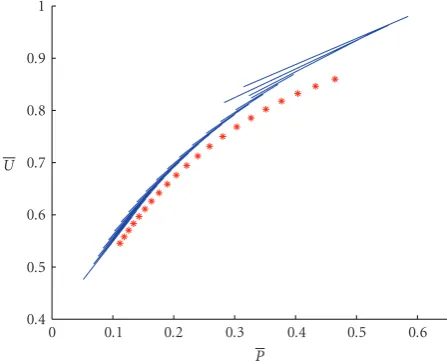
LetJadp = Uadp−λPadp denote the objective obtained using our ADP policy. Eachλ >0 obtains an ADP controller, a point (Padp,Uadp) in the (P, U) plane. Using the sameλ, we can compute the corresponding prescient bound giving the point (Ppre,Upre). (Every feasible controller must lie on or below the line, with slopeλ, that passes through (Ppre,Upre).) We carried out Monte Carlo simulation (100 realizations, each with 1000 time steps) for several values ofλ∈[0.5, 1.5], computingJadpas described inSection 5.2and our prescient upper bound as described above.
Figure 5shows our ADP controllers and the associated upper bounds. We can see that the ADP controllers are clearly feasible and perform very well depending onλ. For example, forλ =1,Jadp =0.47(Uadp =0.69,Padp = 0.22) andJpre = 0.5(Upre = 0.74,Ppre = 0.24), so we know that 0.47 ≤J ≤ 0.5. So in this example, forλ = 1,Jadpis not more than 0.03 suboptimal.
0.6 0.5 0.4 0.3 0.2 0.1 0
P
0.4 0.5 0.6 0.7 0.8 0.9 1
U
Figure5: ADP controllers (red), and prescient upper bound (blue).
6. Conclusion
In this paper we present a variation on a multiperiod stochas-tic network utility maximization problem as a constrained convex stochastic control problem. We show that judging flow utilities dynamically, that is, with a utility function and a smoothing time scale, is a good way to account for network applications with heterogenous rate demands.
For the case of a single flow, our numerically computed value functions obtain flow policies that optimally trad off average utility and average power. We show that simple power law functions are reasonable approximations of the optimal value functions and that these simple functions obtain near optimal performance.
For the case of multiple flows on a single link (where the value function is not practically computable using dynamic programming), we approximate the value function with a combination of the simple one-dimensional power law functions. Simulations, and comparison with upper bounds on the optimal value, show that the resulting ADP policy can obtain very good performance.
Acknowledgments
This material is based upon work supported by AFOSR Grant FA9550-09-0130 and by Army contract W911NF-07-1-0029. The authors thank Yang Wang and Dan O’Neill for helpful discussions.
References
[1] J. Hayes, “Adaptive feedback communications,”IEEE Transac-tions on Communication Technology, vol. 16, no. 1, pp. 29–34, 1968.
[2] J. Cavers, “Variable-rate transmission for Rayleigh fading channels,”IEEE Transactions on Communications, vol. 20, no. 1, pp. 15–22, 1972.
[4] W. T. Webb and R. Steele, “Variable rate QAM for mobile radio,”IEEE Transactions on Communications, vol. 43, no. 7, pp. 2223–2230, 1995.
[5] C. Soon-Ghee and A. J. Goldsmith, “Variable-rate
variable-power MQAM for fading channels,” IEEE Transactions on
Communications, vol. 45, no. 10, pp. 1218–1230, 1997. [6] F. P. Kelly, A. K. Maulloo, and D. Tan, “Rate control
for communication networks: shadow prices, proportional fairness and stability,” Journal of the Operational Research Society, vol. 49, no. 3, pp. 237–252, 1997.
[7] S. H. Low and D. E. Lapsley, “Optimization flow control—I: basic algorithm and convergence,”IEEE/ACM Transactions on Networking, vol. 7, no. 6, pp. 861–874, 1999.
[8] M. Chiang, S. H. Low, A. R. Calderbank, and J. C. Doyle, “Layering as optimization decomposition: a mathematical theory of network architectures,”Proceedings of the IEEE, vol. 95, no. 1, pp. 255–312, 2007.
[9] M. J. Neely, E. Modiano, and C.-P. Li, “Fairness and optimal stochastic control for heterogeneous networks,” IEEE/ACM Transactions on Networking, vol. 16, no. 2, pp. 396–409, 2008. [10] J. Chen, W. Xu, S. He, Y. Sun, P. Thulasiraman, and X.
Shen, “Utility-based asynchronous flow control algorithm for wireless sensor networks,”IEEE Journal on Selected Areas in Communications, vol. 28, no. 7, pp. 1116–1126, 2010. [11] D. O’Neill, E. Akuiyibo, S. Boyd, and A. J. Goldsmith,
“Optimizing adaptive modulation in wireless networks via multi-period network utility maximization,” inProceedings of the IEEE International Conference on Communications, 2010. [12] N. Trichakis, A. Zymnis, and S. Boyd, “Dynamic network
utility maximization with delivery contracts,” inProceedings of the IFAC World Congress, pp. 2907–2912, 2008.
[13] D. Bertsekas, Dynamic Programming and Optimal Control: Volume 1, Athena Scientific, 2005.
[14] D. Bertsekas, Dynamic Programming and Optimal Control: Volume 2, Athena Scientific, 2007.
[15] K. ˚Astr¨om,Introduction to Stochastic Control Theory, Dover, New York, NY, USA, 1970.
[16] P. Whittle,Optimization Over Time: Dynamic Programming and Stochastic Control, John Wiley & Sons, New York, NY, USA, 1982.
[17] D. Bertsekas and S. Shreve,Stochastic Optimal Control: The Discrete-Time Case, Athena Scientific, 1996.
[18] D. Bertsekas and J. Tsitsiklis, Neuro-Dynamic Programming, Athena Scientific, 1996.
[19] W. Powell,Approximate Dynamic Programming: Solving the Curses of Dimensionality, John Wiley & Sons, New York, NY, USA, 2007.
[20] D. B. Brown, J. E. Smith, and P. Sun, “Information relaxations and duality in stochastic dynamic programs,” Operations Research, vol. 58, no. 4, pp. 785–801, 2010.
[21] S. Boyd and L. Vandenberghe, Convex Optimization, Cam-bridge University Press, CamCam-bridge, UK, 2004.
[22] M. Puterman, Markov Decision Processes: Discrete Stochastic Dynamic Programming, John Wiley & Sons, New York, NY, USA, 1994.
[23] S. Ross, Introduction to Stochastic Dynamic Programming: Probability and Mathematical, Academic Press, 1983. [24] E. Denardo,Dynamic Programming: Models and Applications,
Prentice-Hall, New York, NY, USA, 1982.
[25] Y. Wang and S. Boyd, “Performance bounds for linear stochastic control,”Systems and Control Letters, vol. 58, no. 3, pp. 178–182, 2009.
[26] R. Bellman,Dynamic Programming, Courier Dover, New York, NY, USA, 1957.
[27] C. Derman, Finite State Markovian Decision Processes, Aca-demic Press, 1970.
[28] D. Blackwell, “Discrete dynamic programming,”The Annals of Mathematical Statistics, vol. 33, pp. 719–726, 1962.
[29] A. Arapostathis, V. Borkar, E. Fern´andez-Gaucherand, M. K. Ghosh, and S. I. Marcus, “Discrete-time controlled Markov processes with average cost criterion: a survey,”SIAM Journal on Control and Optimization, vol. 31, no. 2, pp. 282–344, 1993. [30] R. M. Corless, G. H. Gonnet, D. E. G. Hare, D. J. Jeffrey, and D. E. Knuth, “On the Lambert W function,”Advances in Computational Mathematics, vol. 5, no. 4, pp. 329–359, 1996. [31] A. Manne, “Linear programming and sequential decisions,”
Management Science, vol. 6, no. 3, pp. 259–267, 1960. [32] P. J. Schweitzer and A. Seidmann, “Generalized polynomial
approximations in Markovian decision processes,”Journal of Mathematical Analysis and Applications, vol. 110, no. 2, pp. 568–582, 1985.
[33] M. A. Trick and S. E. Zin, “Spline approximations to value functions: linear programming approach,” Macroeconomic Dynamics, vol. 1, no. 1, pp. 255–277, 1997.
[34] D. P. De Farias and B. Van Roy, “The linear programming approach to approximate dynamic programming,”Operations Research, vol. 51, no. 6, pp. 850–865, 2003.
[35] R. Madan, S. P. Boyd, and S. Lall, “Fast algorithms for resource allocation in wireless cellular networks,”IEEE/ACM Transactions on Networking, vol. 18, no. 3, pp. 973–984, 2010. [36] J. Birge and F. Louveaux,Introduction to Stochastic
Program-ming, Springer, New York, NY, USA, 1997.