ISSN(Online): 2319-8753 ISSN (Print): 2347-6710
I
nternational
J
ournal of
I
nnovative
R
esearch in
S
cience,
E
ngineering and
T
echnology
(An ISO 3297: 2007 Certified Organization)
Website: www.ijirset.com
Vol. 6, Issue 5, May 2017
A Study on Surface Roughness of Turning of
E –Glass FRP Composite
M.Kishore Raj 1, L.Praveen Kumar 1, J.Nagarajan 1, K.Ravina 1, K.Thamilarasan 2
UG Student, Dept. of Mechanical Engineering, New Prince Shri Bhavani College of Engg &Tech, Gowrivakkam,
Chennai, India1
Associate Professor, Dept. of Mechanical Engineering, New Prince Shri Bhavani College of Engg &Tech,
Gowrivakkam, Chennai, India2
ABSTRACT: The fiber reinforced polymer composites (FRP) are used in a variety of structures, ranging from
spacecraft to aircraft to buildings and bridges. Accordingly, the need for accurate machining of composites has increased. Superior specific strength and stiffness of fiber-reinforced composites compared to traditional metals and alloys high corrosion resistance and capability to withstand hostile environmental conditions and ability of tailoring additional properties has made advanced composites in general and fiber-reinforced polymer composites in particular indispensable for various industries. Machining of composite materials is difficult to carryout due to the anisotropic and non-homogeneous structure of composites and to the high abrasiveness of their reinforcing constituents. There has been a great interest for improving the machining of composite materials. Surface roughness (Ra), is an important parameter in the manufacturing engineering, for produced components. This paper describes a study of the influence of cutting force on surface roughness in turning of glass-fiber-reinforced plastics (GFRP). A plan of experiments was performed on controlled machining with cutting parameters prefixed in work piece. A statistical technique, using full factorial design has been employed to investigate the influence of cutting parameters on surface roughness in turning GFRPs rods using carbide cutting tools. The objective was to obtain the effect of the cutting parameters namely cutting velocity, feed rate and depth of cut on the surface roughness of GFRP work piece.
KEYWORDS: Glass fiber reinforced plastics; surface roughness; carbide tool; Tool dynamometer:
I. INTRODUCTION
ISSN(Online): 2319-8753 ISSN (Print): 2347-6710
I
nternational
J
ournal of
I
nnovative
R
esearch in
S
cience,
E
ngineering and
T
echnology
(An ISO 3297: 2007 Certified Organization)
Website: www.ijirset.com
Vol. 6, Issue 5, May 2017
II. EXPERIMENTAL PROCEDURE
In order to achieve the objective of this experimental work, mainly obtaining the influence of cutting parameters on surface roughness in turning process with carbide cutting tools, machining issues were effectuated with different cutting parameters.
The GFRP workpiece in this study is of cylindrical rods with a 45 ° fiber angle. The components of GFRP subjected to the present experiments are glass fiber and epoxy resin.
Fig. I shows the experimental apparatus using an Engine lathe (all geared). In order to measure the cutting force, the
tool holder is installed in a dynamometer, the cutting force signal being measured by a pick-up and passed to a voltmeter.
III. EXPERIMENTAL RESULTS AND DISCUSSION
3.1. Analysis of surface roughness
Surface Roughness vs Feed
0 2 4 6 8 10 12 14 16 18
0 100 200 300
Feed in mm/min
S
u
rf
a
c
e
R
o
u
g
h
n
e
s
s
i
n
µ
m
At V=11.8 doc =0.5 At V=19.22 doc=0.5 At V=28.84 doc=0.5
ISSN(Online): 2319-8753 ISSN (Print): 2347-6710
I
nternational
J
ournal of
I
nnovative
R
esearch in
S
cience,
E
ngineering and
T
echnology
(An ISO 3297: 2007 Certified Organization)
Website: www.ijirset.com
Vol. 6, Issue 5, May 2017
Surface Roughness vs Feed
0 2 4 6 8 10 12 14 16 18
0 100 200 300
Fe e d in mm/min
S
u
rf
a
c
e
R
o
u
g
h
n
e
s
s
i
n
µ
m
At V=11.9 doc=1 At V=19.2 doc=1 At V=28.8 doc=1
Fig.2.b. Surface roughness vs. feed at doc=1.0mm
surface roughness vs feed
0 5 10 15 20 25
0 100 200 300
Fee d in m m /m in
S
u
rf
a
c
e
r
o
u
g
h
n
e
s
s
i
n
µ
m
At v=11.88 doc=1.5
At v=19.22 doc=1.5
At v=28.84 doc=1.5
Fig.2.c. Surface roughness vs. feed at doc=1.5mm
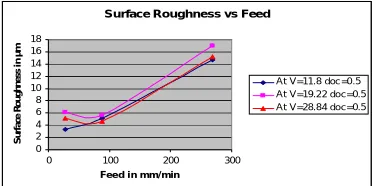
The Figures fig 2a, fig 2b and fig 2c shows the surface roughness of GFRP for various feed rates, with a fixed depth of cut of 0.5,1.0 and 1.5 mm respectively. Surface roughness increases with increase in feed rate in all the above cases. As the feed rate increases there is a gradually increase in surface roughness at lower speed and lower depth of cut, but there is a steep increase in surface roughness at lower speed and higher depth of cut. At lower depth of cut and lower speed, surface roughness increases gradually with the increase in feed rate. Whereas, there is a steep increase in surface roughness at lower speed and at higher depth of cut. It is found that the surface roughness is minimum at speed 11.88m/min, depth of cut is 1.0mm and feed rate of 27mm/min as shown in fig 2b. As there is an increase in the feed rate and depth of cut in the medium range, it has a deleterious effect on surface quality in GFRP machining, a further decrease in the feed rate and depth of cut or further increase in the feed rate and depth of cut is thus required for obtaining good surface quality.
The minimum surface roughness Ra is 2.75.
Ra Vs. DOC
0 5 10 15 20 25
0 0.5 1 1.5 2
DOC in m m
S
u
rf
a
c
e
R
o
u
g
h
n
e
s
s
i
n
µ
m
At V=11.88, F = 27
At V=11.88, F = 88 At V=11.88, F = 268
ISSN(Online): 2319-8753 ISSN (Print): 2347-6710
I
nternational
J
ournal of
I
nnovative
R
esearch in
S
cience,
E
ngineering and
T
echnology
(An ISO 3297: 2007 Certified Organization)
Website: www.ijirset.com
Vol. 6, Issue 5, May 2017
Ra Vs. DOC
0 2 4 6 8 10 12 14 16 18
0 1 2
DOC in mm
S
u
rf
a
c
e
R
o
u
g
h
n
e
s
s
i
n
µ
m
v=19.22, F=27
v=19.22, F=88
v=19.22, F=268
Fig.3.b. Surface roughness vs. doc at v=19.22
Ra Vs. DOC
0 2 4 6 8 10 12 14 16 18
0 0.5 1 1.5 2
DOC in m m
S
u
rf
a
c
e
R
o
u
g
h
n
e
s
s
i
n
µ
m
V=28.84, F=27
V=28.84, F=88
V=28.84, F=268
Fig.3.c. Surface roughness vs. doc at v=28.84
The Figures fig 3a, fig 3b and fig 3c show the relationship between the surface roughness and the depth of cut at constant cutting speed and the feed rate. High feed rate affects surface roughness largely, but depth of cut has less influence. This phenomenon is such that the plastics in GFRP are of good machinability, but the glass fiber itself is difficult to cut because of brittleness, this quality of the fibers influencing the machining properties of the composites.
Ra vs V
0 1 2 3 4 5 6 7
0 10 20 30 40
Speed in m/min
R
a
i
n
µ
m At F=27 doc=0.5
At F=27 doc=1.0 At F=27 doc=1.5
Fig.4.a. Surface roughness vs. cutting speed at F=27
Ra vs V
0 1 2 3 4 5 6 7
0 10 20 30 40
speed in m/min
R
a
i
n
µ
m At F=88 doc=0.5
At F=88 doc=1.0
At F=88 doc=1.5
ISSN(Online): 2319-8753 ISSN (Print): 2347-6710
I
nternational
J
ournal of
I
nnovative
R
esearch in
S
cience,
E
ngineering and
T
echnology
(An ISO 3297: 2007 Certified Organization)
Website: www.ijirset.com
Vol. 6, Issue 5, May 2017
Ra vs V
0 5 10 15 20 25
0 10 20 30 40
speed in m/min
s
u
rf
a
c
e
r
o
u
g
h
n
e
s
s
i
n
µ
m
At F=268 doc=0.5 At F=268 doc=1.0
At F=268 doc=1.5
Fig.4.c. Surface roughness vs. cutting speed at F=268
The Figures fig 4a, fig 4b and fig 4c have shown the change in surface roughness with cutting speed, at constant feed rate and depth of cut. It is noted that there is no much change in the surface roughness in relation to increases in the cutting speed: this phenomenon is therefore very different from that in ordinary metal cutting. The surface roughness according to the depth of cut and the cutting speed in GFRP cutting is affected significantly by the feed rate.
3.2.Analysis of cutting force
The Figures fig 5a, fig 5b and fig 5c have shown the relationship between the cutting force and the depth of cut at constant feed rate. The cutting force increases with increase in the depth of cut at higher and lower feed rate in all the above cases. But the cutting force It is also observed that the force increases as the depth of cut increases at lower feed rate. Therefore cutting force is found to be higher at low feed rate.
Cutting Force Vs. DOC
0 5 10 15 20 25 30 35 40 45
0 0.5 1 1.5 2
DOC in m m
F
o
rc
e
F
z
i
n
N
e
w
to
n
A t V=11.88, F=27"
A t V=11.88, F=88"
At V=11.88, F=268"
Fig.5.a. Cutting force vs. doc at V=11.88
Cutting Force Vs. DOC
0 5 10 15 20 25 30 35 40 45 50
0 0.5 1 1.5 2
DOC in mm
F
o
rc
e
F
z
i
n
N
e
w
to
n
V=28.84, F=27
V=28.84, F=88
V=28.84, F=268
ISSN(Online): 2319-8753 ISSN (Print): 2347-6710
I
nternational
J
ournal of
I
nnovative
R
esearch in
S
cience,
E
ngineering and
T
echnology
(An ISO 3297: 2007 Certified Organization)
Website: www.ijirset.com
Vol. 6, Issue 5, May 2017
Cutting Force Vs. DOC
0 5 10 15 20 25 30 35 40 45 50
0 0.5 1 1.5 2
DOC in mm
S
u
rf
a
c
e
R
o
u
g
h
n
e
s
s
i
n
µ
m
V=19.22, F=27
V=19.22, F=88
V=19.22, F=268
Fig.5.c.Cutting force vs. doc at V=28.84
IV. CONCLUSIONS
From the experimental results in the machining of GFRP, particular conclusions emerge, as follows:
1. Feed rate 27mm/min and depth of cut 1.0mm is found to be optimum for good surface quality.
2. Surface quality is improved with decrease in the feed rate.
3. At lower feed rate, lower depth of cut and lower cutting speed the cutting force is minimum.
4. For minimum surface roughness the optimum cutting force is 10.45N.
REFERENCES
[1] Chang.C (2006), Turning of glass-fiber reinforced plastics materials with chamfered main cutting edge carbide tools, Journal of Materials Processing Technology 180 (2006) 117-129.
[2] Eyup Bagic and Birhan Isik (2006), Investigation of surface roughness in turning unidirectional GFRP composites by using RS methodology and ANN, The International Journal of Advanced Manufacturing Technology, volume 31,Number 1-2/ November, 2006.
[3] Palanikumar K, Karunamoorthy L and Karthikeyan R (2006), Assessment of factors influencing surface roughness on the machining of glass fiber-reinforced polymer composites Materials and Design 27 (2006) 862-871.
[4] Palanikumar K, Karunamoorthy L and Manoharan N (2006),Mathematical Model to Predict the Surface Roughness on the Machining of Glass Fiber Reinforced Polymer Composites.
[5] Palanikumar K (2006),Cutting Parameters Optimization for Surface Roughness in machining of GFRP composites using Taguchi’s Method, Journal of Reinforced Plastics and Composites,11 2006; vol.25: pp. 1739-1751.
[6] Palanikumar K, Karunamoorthy L and Karthikeyan R (2006), Multiple Performance Optimization of Machining Parameters on the Machining of GFRP composites using Carbide (K10) Tool, Materials and Manufacturing Processes, Volume 21, Number 8/Nov-Dec 2006, pages 846-852. [7] Davim P.J and Mata.F (2005), New machinability study of glass fibre reinforced plastics using polycrystalline diamond and cemented carbide (K15) tools, Materials and Design (2005).
[8] Davim P. J, Mata.F (2005), Optimization of Surface roughness on turning fibre-reinforced plastics (FRP) with diamond cutting tools, The International Journal of Advanced Manufacturing Technology, volume 26,Number 4/ August, 2005.
[9] Davim P. J, Mata.F (2004), Influence of cutting parameters on Surface roughness in turning glass-fiber-reinforced plastics using statistical analysis, Industrial Lubrication and Tribology, volume 56,Number 5. 2004. pp.270-274.
[10] Sang-Ook. AN, Lee E.S and Noh.SL (1995), A study on the cutting characteristics glass fiber reinforced plastics with respect to tool materials and geometries, Journal of Materials Processing Technology 68 (1995) 60-67.
[11] Santhanakrishnan.G, Krishnamurthy.R and Malhotra.S.K (1989), High Speed Steel Tool Wear Studies in Machining of Glass-Fiber-Reinforced Plastics, wear, 132(1989)327-336.
[12] Santhanakrishnan.G, Krishnamurthy.R and Malhotra.S.K (1988), Machinability Characteristics of Fiber Reinforced Plastics Composites, Journal of Mechanical Working Technology, 17(1988)195-204.