ISSN(Online): 2319-8753 ISSN (Print): 2347-6710
International Journal of Innovative Research in Science,
Engineering and Technology
(A High Impact Factor & UGC Approved Journal) Website: www.ijirset.com
Vol. 6, Issue 8, August 2017
Abstract Review: Content Based Image
Retrieval Techniques
Dahale Sunil V1, Dr. S.B. Thorat2, Dr. P.K.Butey3
Research Scholar, Mahatma Gandhi Mission’s College of Computer Science. & IT,Nanded, (MS) India1
Director, SSBES Institute of Technology& Management, Nanded, (MS) India2
Head, Department Computer Science, Kamla Nehru Mahavidyalaya, Nagar, (MS) India3
ABSTRACT: In current technology the acquisition, transmission, storing, and manipulation are allowed on the large collections of images. With the increase in popularity of the network and development of multimedia technologies, users are not satisfied with the traditional information retrieval techniques. So nowadays, the content based image retrieval is becoming a source of exact and fast retrieval. Content Based Image Retrieval (CBIR) is a technique which uses visual features of image such as color, shape, texture, etc. to search user required image from large image database according to user's requests in the form of a query image. Images are retrieved on the basis of similarity in features where features of the query specification are compared with features from the image database to determine which images match similarly with given features. Feature extraction is a crucial part for any of such retrieval systems. So far, the only way of searching these collections was based on keyword indexing, or simply by browsing. Literature survey is most important for understanding and gaining much more knowledge about specific area of a subject. In this paper we survey some technical aspects of current content-based image retrieval systems and described the image segmentation in image processing and the features like neuro fuzzy technique, color histogram, texture, and shape for accurate and effective Content Based Image Retrieval System after doing the deep study of related works
KEYWORDS:Content-Based Image Retrieval (CBIR), Neuro Fuzzy, Color Histogram, HSV Color, fuzzy inference system.
I. INTRODUCTION
Internet and networking technologies are growing at rapid speed and become very popular concepts among the users worldwide. Internet is used various purposes like in business and in general communication. In the world of internet use of images is very important for communicating information effectively. This is one reason that digital images are used in internet for various purposes like advertising, crime prevention, medical diagnosis, architecture, fashion designing publishing etc. use the images for them is very essential.
We can retrieve the images from the database effectively if they are stored in systematic order. In early day’s retrieval of image from the database is done by comparing keywords manually. It is not working well if image database is large. The image database sizes are growing rapidly on the internet. So, the problem of storing database is becoming a big headache. To overcome such problem image are stored and classified in various formats like jpeg, mpeg, tiff etc.
In 1990’s the concept of Content-Based Image Retrieval (CBIR) has been developed and in 1992 the term CBIR is used by T. Kato, which is based on extracting the features from image like shape, color, and text automatically. This technique (CBIR) of retrieving images from large image database is called as content based image retrieval (CBIR). This technique is able to retrieve relevant images effectively. Various techniques are used to store and retrieving images from large image database.
ISSN(Online): 2319-8753 ISSN (Print): 2347-6710
International Journal of Innovative Research in Science,
Engineering and Technology
(A High Impact Factor & UGC Approved Journal) Website: www.ijirset.com
Vol. 6, Issue 8, August 2017
Block Diagram of CBIR
Figure 1Block Diagram of CBIR
II. RELATEDWORK
By MVHAMMAD HAMMAD ME MON et.al. [15] Present that present days data retrieval systems get additional attention because of the growing multimedia technologies use. This paper demonstrates an image retrieval system based on multiple regions that provide a client interface for helping to identify watershed regions-of-interest inside of an input image. The relationship between semantic ideas and visual elements is established through supervised Bayesian learning from positive bags. On standard datasets the proposed algorithm has been using and accomplishes great annotation performance [15].
By Pushpalatha S. Nikkam et.al.[16] present that CBIR is a procedure to found a desired image from a substantial database. A template for shape based hierarchical feature matching method for CBIR system. It uses a combination of global feature for shape based templates. In this work a novel learning technique is put forth which is based on hierarchal data decomposition. The proposed technique founds learning algorithm where feature extraction procedure is executed to detect edge, orientations and dataset images shape. The classification of dataset is taken care through support vector machine. Algorithm with the 99.09 % accuracy. The retrieval outcomes of proposed model are illustrated in terms of precision and recall, enhanced efficacy of retrieval is compared to other present models [16].
By CHAWKI Youness et.al.[17] present retrieval systems are typically based on the key words for image search, but in numerous case it cannot meet demands for various user with numerous view. A new CBIR method is presented, which is based on image frequency content. Indeed, we have used the 2-D ESPRIT technique to mine from image the frequency content for constructing the vector descriptor. This method is applied to the Coil_100 database and experimental outcomes present that this approach increases the image retrieval precision [17].
ISSN(Online): 2319-8753 ISSN (Print): 2347-6710
International Journal of Innovative Research in Science,
Engineering and Technology
(A High Impact Factor & UGC Approved Journal) Website: www.ijirset.com
Vol. 6, Issue 8, August 2017
III.FEATUREEXTRACTIONMETHODS
A. Text Feature
Naturally we found texture on nearly all the objects in the world. With the help of which, we can identify the object/image easily. One of the most common features used in CBIR for extraction of image is texture. Texture feature like shape or object are more precise for an image. Image is containing repetitive patterns called as texture [5]. One of the techniques used in CBIR to retrieve an image on the basis of texture is Co-occurrence matrix. Image is classification is done easily on the basis of texture feature [6]. On the basis of similarity of the texture feature, image is retrieved from the image database. Texture feature is used to analyses image in many areas like segmentation, classification and shape of CBIR. Two techniques are available for texture analysis namely spatial techniques and frequency-based techniques [7].Gabor filters and fractals can be used as an alternative method of texture analysis for image retrieval [8].
B. Color Feature
One of the most common features used in CBIR for extraction of image is color, due to its simplicity[5].An image is primarily composed of basic three colors i.e. Red, Green & Blue. Basic low level feature which is useful to recognize an image by human is color. Normally color image is represented in three dimensional color spaces [4]. Various methods are available to retrieve image from the image database basis of color attribute and similarity found in images [1]. Image retrieval based on color distribution is achieved by histogram computing [2]. Swain and Ballard described method for the color images in association with color histogram and to measure the similarity by means of color histogram intersection. But, the limitation of color histogram is that it only shows global color distributions and cannot reflect the spatial distributions of the image [3].
C. Shape Feature
If image is represented on the basis of shape have many advantages like similarity measurement, robustness, computation complexity etc. Shape represented in two ways one by, contour-based and second by region-based. Contour-based require extraction of boundary and Region-based methods; however, do not require boundary information [10][11]. In content based image retrieval shape is one of the basic attribute for retrieval of an image. Image is retrieved from image database by comparing shape of query image with every object in the database for which shape is stored [8]. Global and local features are two methods for extracting shape feature of an image. Nearly all the objects in the world are having a powerful property called shape. a shape is defined as geometrical information about image [9].
IV.METHODOLOGY
A. HSV Color Space
ISSN(Online): 2319-8753 ISSN (Print): 2347-6710
International Journal of Innovative Research in Science,
Engineering and Technology
(A High Impact Factor & UGC Approved Journal) Website: www.ijirset.com
Vol. 6, Issue 8, August 2017
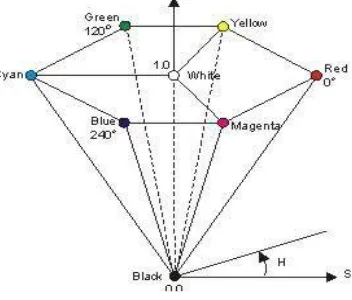
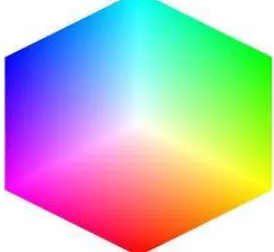
In this color space hue represents illumination and camera direction, saturation parameter represents (lightness) and value represents (brightness). So, this color space is best suited for CBIR [12]. HSV color space is more close to human perception about the color. It is much closer to RGB color space. HSV is developed by considering RGB color cube along the grey axis resulted in hexagonal palette. HSV color model is based on cylindrical coordinate system. This color model uses a Cartesian coordinate to represent cylindrical coordinate [13].
Figure 3Color Model Cylindrical Coordinate
HSL & HSV these two cylindrical coordinate represents the points in RGB color model. This color parameter HSV is used in various fields like image analysis, computer vision, image editing etc [14]. Saturation represents gray color in color space. The range of saturation is in between 0 to 1. Here 0 represents gray and 1 represents color. Value represents color brightness and varies with saturation. The range of value is in between 0 to 1. Here 0 represents total black.
Figure 4RGB Color Model
B. HSI Color Space
The HSI color space is very important and attractive color model for image processing applications because it represents color s similarly how the human eye senses colors. The HSI color model represents every color with three components: hue ( H ), saturation ( S ), intensity ( I ). The below figure illustrates how the HIS color space represents colors.
ISSN(Online): 2319-8753 ISSN (Print): 2347-6710
International Journal of Innovative Research in Science,
Engineering and Technology
(A High Impact Factor & UGC Approved Journal) Website: www.ijirset.com
Vol. 6, Issue 8, August 2017
C. NTSC Color Space
NTSC is named after the National Television System Committee [13].This color space is mainly used in television. It is having unique feature to keep gray color separate from color data due to this feature one same signal can be used for both color and black and white color television sets. Y, I & Q are three basic component of this color space. Here Y represents luminance, I represent hue and Q represents saturation. Among these three components I & Q stores color information whereas Y stores gray scale information [14]. Y, I & Q can be obtained by function rgb2ntsc which defines the NTSC components using
=
0.299 0.587 0.114
0.596 −0.274 −0.322
0.211 −0.523 0.312
D. YCbCr Color Space
This color space is mainly used in digital video. This color space is mainly having three components those are Y, Cb, & Cr. Component Y stores luminance information and rest of two components Cb, & Cr stores color information. Cb& Cr are nothing but blue difference and red difference from reference value. This color space is used to encode RGB information because YCbCr is not an absolute value [14][13]. We can convert image from RGB to YCbCr by function rgb2ycbcr.
= 16 128 128
+
65.481 128.533 24.966
−32.797 −74.203 112.000
112.000 −93.786 18.214
E. CMY and CMYK Color Space
This color space is mainly used for the purpose of printing. Cyan, Magenta &Yellow colours are the three main component of this color space. This color space produced color by light absorption and the three components used for this conversion are called as “subtractive primaries” [12]. This color space is device dependent and non-uniform to produce the best performance in printing. A fourth color is added to CMY i.e. Black to produce CMYK model [2].
V. APPLICATIONS OF CBIR
A. Crime Prevention
Crime Prevention For example Law enforcement agencies typically maintain large archives of visual evidence, including past suspects facial photographs, fingerprints, shoeprints Whenever a serious crime is committed, they can compare evidence from the scene of the crime for its similarity to records in their archives. This is an example of identify rather than similarity matching though since all such images vary over time. The CBIR is capable of searching an entire database to find the closest matching records.
B. Medical Diagnosis
The increasing reliance of modern medicine on diagnostic techniques such as radiology, histopathology etc. has resulted in an explosion in the number and importance of medical imaging. The prime requirement for medical imaging systems are to be able to display images relating to a named patient. Therefore there is increasing interest in the use of CBIR technique to aid diagnosis by identifying similar past cases.
C. Home Entertainment
Much home entertainment is image or video-based, including holiday snapshots, home videos and scenes from favorite TV programs or films. The CBIR technology could include management of family photo albums or clips from commercial films.
D. Education
ISSN(Online): 2319-8753 ISSN (Print): 2347-6710
International Journal of Innovative Research in Science,
Engineering and Technology
(A High Impact Factor & UGC Approved Journal) Website: www.ijirset.com
Vol. 6, Issue 8, August 2017
or traffic congestion for a course on urban planning, could reduce preparation time and lead to improved teaching quality. In some cases such videos might even replace a human tutor.
E. Advertising and Journalism
Both newspapers and stock agencies maintain archives of still photographs to illustrate articles or advertising copy. These archives can often be extremely large, and very expensive to maintain if detailed keyword indexing is provided. Broadcasting corporations faced with even bigger problem that they have to deal with millions of hours of archive videos footage. The CBIR technology provides efficient and effective retrieval of still images from photo libraries, eliminating or at least substantially reducing the need for manual keyword indexing.
F. Fashion Designing & Interior design
The designer has to work within externally imposed constraints, such as choice of materials. The ability to search a collection of fabrics to find a particular combination of color and texture is increasingly being recognized as a useful aid in the design process. There are general purpose CBIR packages for specific tasks such as color matching of items from electronic versions of mail order catalogues, and identifying textile samples bearing a desired pattern.
G. Architectural and engineering design
Architectural and engineering design share a number of common features like 2-dimentional and 3-dimentional models to represent objects. Due to this feature even a non-technical person will able to imagine a design. With such a ease of this feature designer can work very freely within the stipulated constraints and time as well as finance. And customer satisfaction achieved in well manner.
H. Web searching
An internet is growing with an emence speed day by day. Large amount of data uploaded and downloaded every day which is in the form of text, image & video etc. Finding a relevant data from such a large database is a difficult task. To find out relevant data from database search engines are developed such as text & image.
I. Military
As the recent advancement in the image technology has been made. This technology is used in development in designing military applications. With this application it will be easy to detect aircrafts from radar screen and identifying targets with the help of photographs taken from satellite. Cruise missile can also guide by such application.
VI. CONCLUSION
Content based image retrieval system is an emerging way of image retrieval from a large database. Although this area has been explored for decades, there is still a very large scope for achieving the accuracy of human visual perception in distinguishing images. The CBIR system can be improved by improving the indexing, retrieval design and feature extraction mechanism and to reduce the time better clustering approach with image decomposition and feature extraction can be used. To achieve more accurate and fast results better methods of image decomposition can be applied. Other techniques of clustering can be used with the system. At last in this paper we studied the basic Content based image retrieval system and the use as well as the evolution of wavelets in the field of CBIR systems.
REFERENCES
[1] Dr.Fuhui Long, Dr.Hongjiang Zhang and Prof. David Dagan Feng,FUNDAMENTALS OF CONTENT-BASED IMAGE RETRIEVAL. [2] Wei-Ta Chen, Wei-Chuan Liu, and Ming-Syan Chen, Fellow, Adaptive Color Feature Extraction Based on Image Color Distributions, IEEE.
In IEEE TRANSACTIONS ON IMAGE PROCESSING, VOL. 19, NO. 8, AUGUST 2010.
[3] You Fu-cheng, Zhang Cong in, The Technique of Color and Shape-based Multifeature Combination of TradeMark Image Retrieval, 978-1-4244-7874-3/10/$26.00 ©2010 IEEE.
[4] MaltiPuri in MaltiPuri, A Survey on Content Based Image Retrieval, International Journal of Computer Science & Engineering Technology (IJCSET).
[5] Tamer Mehyer, Jalal Omer Atoum, An enhancement on content based image retrieval using color and texture features. In Journal of Emerging trends in computing and information science vol 3, 4 april 2012).
[6] Hervé Le Borgne, Member, IEEE, Anne Guérin-Dugué, and Noel E. O’Connor, Member, IEEE,Learning Midlevel Image Features for Natural Scene and Texture Classification by, IEEE TRANSACTIONS ON CIRCUITS AND SYSTEMS FOR VIDEO TECHNOLOGY, VOL. 17, NO. 3, MARCH 2007.
ISSN(Online): 2319-8753 ISSN (Print): 2347-6710
International Journal of Innovative Research in Science,
Engineering and Technology
(A High Impact Factor & UGC Approved Journal) Website: www.ijirset.com
Vol. 6, Issue 8, August 2017
[8] Mrs.SarojShambharkar, Ms.Shubhangi C. Tirpude,Content Based Image Retrieval Using Texture and Color Extraction and Binary Tree Structure, International Journal of Computer Technology and Electronics Engineering (IJCTEE) National Conference on Emerging Trends in Computer Science & Information Technology (NCETCSIT-2011)
[9] Amit Jain, RamanathanMuthuganapathy, and KarthikRamani,Content-Based Image Retrieval Using Shape and Depth from an Engineering Database.
[10] Dengsheng Zhang and Guojun Lu in,Content-Based Shape Retrieval Using Different Shape Descriptors: A Comparative Study.
[11] K. NARESH BABU M.TECH (DECS) SAKE. POTHALAIAH M.E (ECE) Asst.Professor of ECE Dr.K ASHOK BABU Professor & HOD of (ECE), IMAGE RETIEVAL COLOR, SHAPE AND TEXTURE FEATURES USING CONTENT BASED,International Journal of Engineering Science and Technology Vol. 2(9), 2010, 4278-4287.
[12] Dr. Fuhui Long, Dr. Hongjiang& Prof. David Dagan Feng, in “Fundamentals of content based image retrieval”. [13] Rafael C. Gonzalez, Richard E. Woods & Steven L. Eddins,Digital image processing using Matlab.
[14] www.wikipedia.com.
[15] Mvhammadhammad me mon!, jian-ping li!, Imranmemon, Riazahmedshaikw and Farman alimangi,”Efficient Object Identification and Multiple Regions ofInterest using CBIR Based on Relative Locations andMatching Regions”, 2015 ieee, pp: 247-250.
[16] Pushpalatha S. Nikkam, Dr. Nagaratna P. Hegdeand Dr. B. Eswar Reddy,” Decomposition-Based ShapeTemplate Matching for CBIR System”, 2015 IEEE International Conference on Computational Intelligence andComputing Research.
[17] CHAWKI Youness, EL ASNAOUI Khalid, OUANAN Mohammed and AKSASSE Brahim,” CBIR using the 2-D ESPRIT Method: Application to Coil_100Database”, 2015 IEEE.