Seismic Analysis and Comparison of IS 1893
(Part-1) 2002 and 2016 of (G+4) Regular and
Irregular Building
Anoj Surwase1, Dr. Sanjay K. Kulkarni 2, Prof. Manoj Deosarkar3
P.G. Student, Department of Civil Engineering, D.Y. Patil School of Engineering &Technology, Lohegaon,
Maharashtra, India1.
Associate Professor, D.Y. Patil School of Engineering & Technology, Lohegaon, Maharashtra, India2
Assistant Professor, Department of Civil Engineering, D.Y. Patil School of Engineering & Technology,
Lohegaon, Maharashtra, India3
ABSTRACT:Considerable improvement in earthquake resistant design has been observed in recent past. As a result, Indian seismic code IS: 1893 has also been revised in year 2016, after a gap of 14 years. This paper presents the seismic load estimation for multistorey buildings as per IS: 1893-2002 and IS: 1893-2016 recommendations. The method of analysis and design of multi-storey (G+4) residential building located in zone III, IV. The scope behind presenting this project is to learn relevant Indian standard codes are used for design of various building element such as beam, column, slab, foundation and stair case using a software E-tab under the seismic load and wind load acting the structure. We have to find out the values in project base shear, time period, maximum story displacement.
KEYWORDS:ETAB, Equivalent Static Method, IS 1893 (Part-1) 2002 and 2016.
I.INTRODUCTION
The effective design and construction of an earthquake resistant structure have great importance have all the world. India shows that 54% of the land-living is unsafe to earthquake. This Project presents Seismic Analysis and Comparison of Is 1893 (Part-1) 2002 and 2016 of (G+4) Residential Building using ETAB software with auto lateral forces effect of an earthquake. This analysis of building is done by two different zones by manually as well as ETAB software. The base shear is depending upon the zone which is building is located. Concepts of the probability of evidence. The auto lateral force is considered by Indian Seismic Code IS 1893(Part 1) – 2002 and 2016.The Importance factor is change in latest version, due to this the base shear value is increased. The weight of the structure is same in zone III and IV.
Anirudh Gottala (2016) [1] - A multi-storied framed structure of (G+9) pattern is selected. Linear seismic analysis is done for the building by static method (Seismic Coefficient Method) and dynamic method (Response Spectrum Method) using STAAD-Pro as per the IS-1893-2002-Part- A comparison is done between the static and dynamic analysis, the results such as Bending moment, Nodal Displacements, Mode shapes are observed, compared and summarized for Beams, Columns and Structure as a whole during both the analysis.
Objectives and Limitation: -
In software to carry out the storey deflection, shear force and bending moment and compare the results by manual.
Compare the lateral forces in IS 1893 (Part1):2002 to IS 1893 (Part1):2016.
II.PROBLEM STATEMENT AND METHODOLOGY
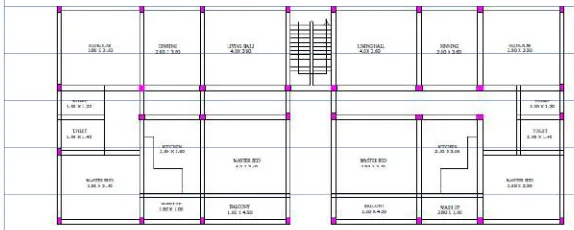
Design and analysis of (G+4) residential structure. The structure is situated in zone III and IV. The mud condition is medium, and R.C frames are infilled with brick masonry. Plan of Residential Building is follows.
Fig.1 Floor Plan for Symmetrical building
The Typical plan is same for zone III and IV.
Data
Live Load: 3.0 KN/m2
Thickness of slab: 125 mm
Beam Size: 230x300 mm
Column Size: 230x300 mm
Exterior Wall Thickness: 230 mm
Interior Wall Thickness: 100 mm
Earthquake Load: As Per IS: 1893-2002 (Part-1), IS 1893-2016 (Part 1).
Table 1. Importance Factor
Sr. No Structure I
1 Important service and community buildings or structures (for example critical governance buildings, schools), signature buildings, monument buildings, lifeline and emergency buildings (for example hospital buildings, telephone exchange buildings, television stations buildings,
radio station buildings; bus station buildings and metro rail buildings), railway stations, airports, food storage buildings (such as warehouses), fuel station buildings, electric power station buildings and fire station buildings), and large community hall buildings (for example cinema halls, shopping malls, assembly halls and subway stations) and power station.
2 Residential or commercial buildings (other than those listed in Sl. No.1 with occupancy more than 200 persons
1.2
3 All other buildings. 1.0
ETAB Modelling
Fig.2 Bending Moment Diagram in Zone III.
Above figure shows that the bending moment diagram in regular building in zone III.
Fig.3 Shear Force Diagram Zone III
Fig.4 Bending Moment Diagram Zone IV
Above figure shows that the bending moment diagram in regular building in zone IV.
Fig.5 Shear Force Diagram Zone IV
Above figure shows that the shear force diagram in regular building in zone IV.
Table.2 Base Shear in Regular Building (Zone III)
Floor Level
Equivalent Static Methods
IS 1893 (Part1)-2002 IS 1893 (Part1)- 2016 [4] 216 KN 260 KN
[3] 195 KN 234 KN
[2] 115 KN 138.24 KN
[1] 57 KN 68 KN
Above table shows that the base shear is calculated manually by IS 1893 (Part 1)-2002 and 2016. The base shear value in regular building in zone III.
Table.3 Base Shear in Regular Building (Zone IV)
Floor Level
Equivalent Static Methods
IS 1893 (Part1)-2002 IS 1893 (Part1)- 2016 [4] 324 KN 390 KN
[3] 293 KN 351 KN
[2] 175 KN 208 KN
[1] 85 KN 102 KN
[G] 28 KN 33 KN
Above table show that the maximum base shear in IS 1893 (Part-1)-2016 and 2002 is 260 KN and 216 KN. The base Shear in zone III and IV is gradually increases from ground to last fifth floor. The value of base shear is more in IS 1893 (Part-1)-2016. Importance Factor value for residential building is 1 is consider for IS 1893(Part-1)-2000 and in IS 1893 (Part-1)-2002 is 1.2.
Fig.6 Story Displacement
Above graph shows that the story displacement in two different zones. Zone IV having maximum story displacement. Y direction shows the value of displacement and X direction shows direction of displacement.
11.03
0.71 16.55
0.81 0
5 10 15 20
X direction Y direction
Max.Story Displacement
Fig.7 Time Period
Above graph shows that maximum and minimum time period for Regular building in zone III and zone IV. Time period of zone III and IV is 1.6 second and1.589 second.
Fig.8 Auto lateral Load
Above graph shows that the lateral forces find out in ETAB software. The maximum Lateral Forces in zone III and IV are 38.12 KN and 57.18 KN.
1.664 1.589
0 0.5 1 1.5 2
Zone III ZoneIV
T max Tmin
38.12 36.08
57.18
34.4
0 20 40 60 80
Ex Ey
AUTO LATERAL LOAD
Fig.9 Overturning Moment
Irregular Building
Building with simple consistent geometry and consistently dispersed mass stiffness and plan and elevation suffer much less damage as compared to irregular building. We consider geometry irregularity structure in this project.
Fig.10 Floor Plan for Irregular Structure
This is the plan for irregular building. This plan is same for both seismic zones which is III and IV.
1191.35 1787.03
0 500 1000 1500 2000
Moment
Overturning Moment
ETAB modelling
Fig.11 Bending Moment Diagram in Zone III
Above figure shows that the bending moment diagram in irregular building in zone III.
Above figure shows that the shear force diagram in irregular building in zone III.
Table.4 Base Shear in Irregular Building (Zone III)
Floor
Level Equivalent Static Methods
IS 1893 (Part1)-2002 IS 1893 (Part1)-2016
[4] 510 KN 611 KN
[3] 450 KN 540 KN
[2] 330 KN 396 KN
[1] 160 KN 191 KN
[G] 53 KN 63 KN
Above table shows that the maximum base shear in IS 1893 (Part-1)-2016 and 2002 is 611 KN and 510 KN.
Table.5 Base Shear in Irregular Building (Zone IV)
Floor
Level Equivalent Static Methods
IS 1893 (Part1)-2002 IS 1893 (Part1)-2016
[4] 763.3 KN 916.3 KN
[3] 673.5 KN 808.5 KN
[2] 493.9 KN 592.9 KN
[1] 237.97 KN 285.67 KN
[G] 78.57 KN 82.50 KN
Fig.13 Story Displacement
Above fig. shows that the maximum story displacement in two different zones. Zone IV having maximum story displacement in Y direction. In both zones Maximum displacement is more in Y direction.
Fig.14Time Period
Above graph shows that maximum and minimum time period for Irregular building in zone III and zone IV. Time period of zone III and IV is 1.085 second and1.589 second.
6.2
0.23 16.55
0.36 0
5 10 15 20
X direction Y direction
Max.Story Displacement
Zone III Zone IV
1.085
1.589
0 0.5 1 1.5 2
Zone III ZoneIV
Fig.15 Auto lateral Load
Above graph shows that the lateral forces for irregular building find out in ETAB software. The maximum Lateral Forces in zone III and IV are 37.07 KN and 55.61 KN.
Fig.16Overturning Moment
III. RESULT
The lateral forces are calculated manually using equivalent static methods recommended by IS: 1893-2016 (Part -1) is high as compared to IS: 1893-2002.
The lateral forces are more in IS 1893-2016 as compared to 2002 due to importance factor value change.
The Overturning moment both symmetric and unsymmetrical building is negative Y direction is maximum.
IV. CONCLUSION
The seismic design approach, in both the versions, is based on designing a strong and ductile structure. Unlike previous version of 2002, the latest 2016 version clearly reflects that design seismic force is much higher than what can be expected during strong shaking.
In IS:1893-2002 version, seismic coefficient method yields lower values of base shear relative to equivalent static method.
34.07 37.06
51.9 55.61
0 20 40 60
Ex Ey
AUTO LATERAL LOAD
Zone III Zone IV
979.92 1469
0 500 1000 1500 2000
Moment
Overturning Moment
Auto lateral forces in ETAB for Regular structure in X direction is more but in Irregular structure auto lateral forces in Y direction.
While calculating base shear manually and ETAB there is huge difference between them.
Story displacement is more for Symmetric in X direction but an unsymmetrical structure in Y direction.
Zone four have more values not only regular structure but also irregular structure.
REFERENCES
1.Anirudh Gottala, “Comparative study of static and dynamic seismic analysis of a multistorey building”, International Journal of Science Technology and Engineering.
2.Awkar J. C. and Lui E.M, “Seismic analysis and response of multi-storey semi rigid frames”, Journal of Engineering Structures, Volume 21, Issue 5, Page no: 425-442, 1997.
3. Mohit Sharma and Dr. Savita Maru “Dynamic Analysis of Multistoried Regular Building” International Journal of Mechanical and Civil Engineering, Volume 11, Issue 1 Jan. 2014.
4. Kulkarni J.G., Kore P. N., S. B. Tanawade, “Analysis of Multi-storey Building Frames Subjected to Gravity and Seismic Loads with Varying Inertia”, International Journal of Engineering and Innovative Technology (IJEIT), Volume 2, Issue 10, April 2013. 5. Sayed Mahmoud and Waleed Abdallah Saudi Arabia "Response Analysis of Multi-Story RC Buildings under Equivalent Static and Dynamic Loads according to Egyptian Code ", International Journal of Civil and Structural Engineering Research, Vol. 2, Issue 1, April 2014.
6. Mahesh N. Patil, Yogesh N. Sonawane, “Seismic Analysis of Multi-Storied Building”, International Journal of Engineering and Innovative Technology, ISSN: 2277-3754, Volume 4, Issue 9, March 2015, PP 123-129.
7. Balaji. U, “Design and Analysis of Multi-Storied Building under static and dynamic loading conditions using ETABS”, International Journal of Technical Research and Applications, ISSN: 2320-8163, Volume 4, Issue 4 (July-Aug, 2016), PP. 1-5. 8. B. Srikanth and V. Ramesh "Comparative Study of Seismic Response for Seismic Coefficient and Response Spectrum Methods", International Journal of Engineering Research and Applications, ISSN: 2248-9622, Vol. 3, Issue 5, Sep-Oct 2013.