ISSN(Online): 2320-9801
ISSN (Print) : 2320-9798
I
nternational
J
ournal of
I
nnovative
R
esearch in
C
omputer
and
C
ommunication
E
ngineering
(An ISO 3297: 2007 Certified Organization)
Vol. 3, Issue 9, September 2015
A Review on Plant Texture Analysis Using
Leaf Images
S.Abhirami, Dr.Antony Selvdoss Thanamani
Research Scholar, Dept. of Computer Science, NGM College, Pollachi, Tamil Nadu, India
Head and Associate Professor, Dept. of Computer Science, NGM College, Pollachi, Tamil Nadu, India
ABSTRACT: First, images of leaf are acquired with digital camera or scanners. Then the user can selects the base point of the leaf and a few reference points on the leaf blades or done this automatically. Then several morphological features are extracted. These features are used as inputs to the classifier system for discrimination as probabilistic neural network. The network was trained with leaves from different plant species. Then the recognition accuracy of the proposed method has been tested. The method works only for the plants with narrow sharp leaves which are more or less two dimensional in nature. This paper presented various effective algorithms used for plant classification using leaf images and review the main computational, morphological and image processing methods that have been used in recent years and we conclude with a discussion of ongoing work and outstanding problems in the area.
KEYWORDS: Plant Leaf Classification, PNN, PCA, Texture Analysis and Radial Basis Function, Moments Invariants, Neural Networks.
I. INTRODUCTION
Plant is one of the most important forms of life on earth. Plants maintain the balance of oxygen and carbon dioxide of earth’s atmosphere. The relations between plants and human beings are also very close. In addition, plants are important means of livelihood and production of human beings. Unfortunately, the overwhelming development of human civilization has disrupted this balance to a greater extent than we realize. It is one of our biggest responsibilities to save the plants from various threats, restore the diverseness of the plant community and put everything back to balance.
The first step of protecting plants is to automatically recognize or classify them means understand what they are and where they come from. But it is very difficult for ones to recognize a plant in hand correctly and immediately because there are so many kinds of plants unknown to us on earth. Allopathic medicine has a rich history with a number of ayurvedic [15] leaves which can’t be recognized by a human being. A computerized plant identification system can be very helpful in botanical garden or natural reserve park management, new plant species discovery, plant taxonomy, exotic plant detection, edible/poisonous plant identification and so on.
A computer based plant identification or classification system can use different characteristics of the flora, starting at very simple level such as: shape and colour of the leaf, flower and fruit type, branching style, root type, seasonality, outlook, to very complex such as cell and tissue structure, genetic structure. Presently the cell phones are capable of acquiring high quality images with their integrated digital camera, which makes the usability of such a system even wider. Plant leaves are two dimensional in nature and hold important features that can be useful for classification of various plant species. There are set of appropriate numerical attributes of features to be extracted from the object of interest for the purpose of classification. Research on the utilization of moments for object characterization in both in variant and noninvariant tasks has received considerable attention in recent years [8, 9]. The mathematical concept of moments has been around for many years and has been used in many diverse fields ranging from mechanics and statistics to pattern recognition and image understanding.
ISSN(Online): 2320-9801
ISSN (Print) : 2320-9798
I
nternational
J
ournal of
I
nnovative
R
esearch in
C
omputer
and
C
ommunication
E
ngineering
(An ISO 3297: 2007 Certified Organization)
Vol. 3, Issue 9, September 2015
plant species recognition systems which based solely on human expertise. Requirement of better plant species recognition system is in great demand and several researches have been made by some authors which are discussed in the next section.
Figure 1. System Flowchart
For the leaf contour classification, a scaled CCD code system is proposed to categorize the basic shape and margin type of a leaf by using the similar taxonomy principle adopted by the botanists. Then a trained neural network is employed to recognize the detailed tooth patterns. For the leaf vein recognition, the vein texture is extracted by employing an efficient combined thresholding and neural network approach so as to obtain more vein details of a leaf.
Plant leaves are approximately 2D in nature and the shape of plant leaf is one of the most important features for characterizing various plants species. Therefore, it is necessary for us to develop an automatic easy method that can correctly recognize leaf shapes of different species.
Peucker approximation algorithm is adopte to the original leaf shapes and a new shape representation is used to form the sequence of invariant attributes. This is shape polygon approximation. Then a modified dynamic programming (MDP) algorithm for shape matching is proposed for the plant leaf recognition. Finally, the superiority of proposed method is demonstrated by experiment. In this experiment, there are 50 leaf images randomly selected from our image database as the query images, and each query can retrieve the 20 most similar images from the database. For recognition of intact leaves, the recognition accuracy of the MDP is over 92%.
Gu et al. [5] used the result of segmentation of leaf’s skeleton based on the combination of wavelet transform (WT) and Gaussian interpolation. It is a a new approach for leaf recognition also using the classifiers, a nearest neighbour classifier (1NN), a k nearest neighbor classifier (k NN) and a radial basis probabilistic neural network (RBPNN) are used, based on runlength features (RLF) extracted from the skeleton to recognize the leaves. Finally, the effectiveness and efficiency of the proposed method is demonstrated by several experiments.
Wang et al. [6] extracted several geometric features like rectangularity, circularity, eccentricity and seven moment invariants for classification . Hu defines the following seven functions, computed form central moments through order three, that are invariant with respect to object scale, translation and rotation:
treated as a set of “points”. As a result there are more than 20 classes of plant leaves successfully classified. The average correct recognition rate is up to 92.2 percent.
ISSN(Online): 2320-9801
ISSN (Print) : 2320-9798
I
nternational
J
ournal of
I
nnovative
R
esearch in
C
omputer
and
C
ommunication
E
ngineering
(An ISO 3297: 2007 Certified Organization)
Vol. 3, Issue 9, September 2015
set of unique features with proper proposed method is responsible for plant identification. The experimental result shows that the RBPNN achieves higher recognition rate and efficiency than radial basis function neural network (RBFNN), BP neural network (BPNN).
Historically, Hu[8] published the first significant paper on the utilization of moment invariants for image analysis and object representation in 1961. Hu’s Uniqueness Theorem states that if f(x, y) is piecewise continuous and has nonzero values only in the finite part of the f(x, y) plane, then geometric moments of all orders exist. It can then be shown that the moment set
{mpq } is uniquely determined by f(x, y) and conversely f(x,y) is uniquely determined by {mpq } . Since an image
segment has finite area and, in the worst case, is piecewise continuous, a moment set can be computed and used to uniquely describe the information contained in the image segment. Using nonlinear combinations of geometric moments, Hu derived a set of invariant moments which has the desirable properties of being invariant under image translation, scaling, and rotation [1]. However, the reconstruction of the image from these moments is deemed to be quite difficult. T.H.Resis [9] stated that moment invariant for pattern recognition presented by HU is incorrect. The four moment absolute invariant under general linear transformation is in error. So he revised the fundamental theorem. Sidhartha Maître [10] consider the change of effect of contrast in an image and modified the seven moment invariant.given by HU which are independent of change of transformation, scale, rotation and contrast also. Similarly Jan Fusser [11] proposed a new set of moment invariants with respect to rotation, translation, and scaling suitable for recognition of objects having fold rotation symmetry.
Wu et al. [12] extracted 12 commonly used digital morphological features which were orthogonalized into 5 principal variables. They used 1800 leaves to classify 32 kinds of plants using probabilistic neural network (PNN) system. The major contribution of this work is a easy to implement method. First, images of leaf are acquired with digital camera or scanners. Then the system requires the user to select the base point of the leaf and a few reference points on the leaf blades, in which first we convert the RGB image [1] to binary.
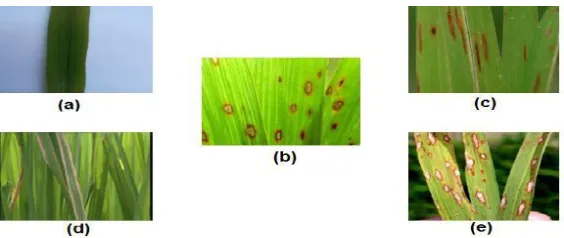
Brown spot
It is caused by the virus named as Cochliobolusmiyabeanus &Helminthosporium. Brown spot diseased leaf is shown in Fig 1(b). The main symptoms are
Initially appears as brownish spots on leaves.
Later, it becomes Oval shaped foliar spots with yellow halo.
The spots are brown, with greyish centers when fully developed.
Appear in leaf blade & sheath
ISSN(Online): 2320-9801
ISSN (Print) : 2320-9798
I
nternational
J
ournal of
I
nnovative
R
esearch in
C
omputer
and
C
ommunication
E
ngineering
(An ISO 3297: 2007 Certified Organization)
Vol. 3, Issue 9, September 2015
bacterial leaf blight,, rice blast respectively.
After preprocessing is complete as shown in Fig.2, obtain a set of basic geometric features such as Diameter, Physiological length, Physiological width, leaf area and leaf perimeter and after that 12 morphological features as smooth factor, aspect ratio, form factor, rectangularity, narrow factor, perimeter ratio of diameter, perimeter ratio of Physiological length, Physiological width and 5 vien features were extracted from the leaves. After that transform the
The leaf database based on digital morphological feature is proposed. They well explained the Algorithm of MMC, classification stage and the Data preprocessing for application of the MMC. In particular, by comparing with the nearest neighbour (1NN) and kNN classifiers, it can be found that the MMC classifier can not only save the storage space but also reduce the classification time. The proposed method is more robust than the one based on contour features since those significant curvature points are hard to find.
RGB image to binary
Gray=0.2051 *R+0.5342*G+0.1789*B
Where R,G,B corresponds to the colour of the pixel ,respectively. Intensity of R=1.09*luminosity-2.44(R=0.835,p<0.001)
Intensity of G=0.988*luminosity-4.41(R=0.948,p<0.01)
An uncomplicated and computationally effective technique for plant species recognition by means of leaf image is recommended by Hossain and Amin [14]. This technique executes only on the plants with wide flat leaves which are more or less two dimensional in general. This technique includes five major phases. In first phase, images of leaf are obtained with digital camera or scanners. Subsequently the user decides the base point of the leaf and small number of reference points on the leaf blades. In accordance with these points the leaf shape is obtained from the background and a binary image is generated. Following that the leaf is aligned horizontally by keeping its base point on the left of the image. Then eccentricity, area, perimeter, major axis, minor axis, equivalent diameter, convex area and extent are obtained as before done. A distinctive collection of features are obtained from the leaves by segmenting across the major axis and parallel to the minor axis. After that the feature points are normalized by considering the ratio of the slice lengths and leaf lengths (major axis). These features are provided as inputs to the probabilistic neural network [18].
A new technique for feature extraction from natural image like plant leaf is developed by Prasad et al. [16] for automated living plant species identification which would be helpful for botanical students to carry out their research for plant species identification. A novel multiresolution and multidirectional Curvelet transform is executed on sub segmented leaf images to obtain leaf information, precisely in order that the orientation of the object in the image does not taken into account and which also enhance the accuracy rate. These coefficients are given as the input to a trained SVM classifier to categorize the result.
bdul kadir [17] build a foliage plant identification systems for 60 kinds of leaves . It was dedicated to handle two or more plants that have similar/same shape but the color patterns on the leaves were different. In this case, Zernike moments were combined with other features: geometric features, color moments and graylevel cooccurrence matrix (GLCM). To implement the systems, two approaches have been
ISSN(Online): 2320-9801
ISSN (Print) : 2320-9798
I
nternational
J
ournal of
I
nnovative
R
esearch in
C
omputer
and
C
ommunication
E
ngineering
(An ISO 3297: 2007 Certified Organization)
Vol. 3, Issue 9, September 2015
results show that Zernike Moments have a prospect as features in leaf identification systems when they are combined with other features.
IV. CONCLUSION
In this paper we have discussed a number of plants identification systems with wide ranges of methods. It should be clear that no single method provides a solution for all problems, but appropriate methods must be chosen. There are many ways to recognize the plant species, but it usually time consuming. This is because it involves the expert, botanists to recognize the plant species. Therefore, it is very important to automatically recognize the plant species in order to manage them. This will increase an interest in studying plant taxonomy and ecology, lift biology educations standards and promote the use of information technology for the management of natural reserve parks and forest plantation. By doing this, the best approach for leaf features extraction and classification have to be analyze.
Plant species recognition system is commonly used in agriculture, ecology and environmental science. Comparing to other recognition system, plant species recognition system requires additional skilled understanding. Accordingly, the requirement of plant species recognition system using computer vision techniques is increasing rapidly for several applications. Although performance of the system is good enough, we believe that the performance still can be improved. Hence, other features will be researched in the future.
REFERENCES
1. R. C. Gonzalez, R. E. Woods, “Digital Image Processing”. Prentice Hall, 2004.
2. Z. Wang, Z. Chi, and D. Feng, “Shape based leaf image retrieval,” IEEE Proceedings Vision, Image and Signal Processing, vol. 150, no. 1, February 2003.
3. H. Fu, Z. Chi, D. Feng, and J. Song, “Machine learning techniques for ontologybased leaf classification,” IEEE 2004 8th International Conference on Control, Automation, Robotics and Vision, Kunming, China, 2004.
4. J. Du, D. Huang, X. Wang, and X. Gu, “Computeraided plant species identification (CAPSI) based on leaf shape matching technique,” Transactions of the Institute of Measurement and Control. 28, 3 (2006) pp. 275284.
5. X. Gu, J. Du, and X. Wang, “Leaf recognition based on the combination of wavelet transform and gaussian interpolation,” in Proceedings of International Conference on Intelligent Computing 2005, ser. LNCS 3644. Springer, 2005.