ISSN(Online): 2320-9801
ISSN (Print): 2320-9798
I
nternational
J
ournal of
I
nnovative
R
esearch in
C
omputer
and
C
ommunication
E
ngineering
(An ISO 3297: 2007 Certified Organization)
Vol. 3, Issue 6, June 2015
A Robust Multilevel Image Fusion Technique
using Spatial and Transform Domain Methods
Tejashri Polkamwar, Alpana Deshmukh
PG Student, Dept. of E&TC, G.H. Raisoni Institute of Engineering & Technology, Pune, Maharashtra, India
Assistant Professor, Dept. of E&TC, G.H. Raisoni Institute of Engineering & Technology, Pune, Maharashtra,India
ABSTRACT: Image fusion is widely used term in different applications namely satellite imaging, remote sensing, multifocus imaging medical imaging, robotic vision and military applications. In this paper, multi-level image fusion is implemented where fusion is performed in two stages. Firstly, Discrete Wavelet or Fast Discrete Curvelet transform is applied on both source images and secondly image fusion is carried out with a spatial domain method like Averaging. Further, comparative analysis of fused image obtained from both Discrete Wavelet and Fast Discrete Curvelet transform is done which proves effective image fusion using proposed Curvelet transform than Wavelet transform through enhanced visual quality of fused image and by analysis of seven quality metrics parameters. The proposed method is very innovative which can be applied to medical and multifocus imaging applications in real time.
KEYWORDS: Discrete Wavelet Transform, Fast Discrete Curvelet Transform, Image fusion, PSNR, RMSE, Entropy
I. INTRODUCTION
With technology rapidly advancing, different sensors are available in market which provides multimodal images with different physical characteristics, geometry, and time and frequency domain characteristics. It is difficult for a sensor to acquire all these characteristics in a single image. Hence the technical method to combine all these characteristics into a single image with rich information content is the concept of image fusion.
The image fusion algorithm based on Wavelet Transform which faster developed was a multiresolution analysis image fusion method in recent decade [1]. Wavelet Transform has good time frequency characteristics. It was applied successfully in image processing field [2]. Nevertheless, its excellent characteristic in one-dimension can’t be extended to two dimensions or multi-dimension simply. Separable wavelet which was spanning by one-dimensional wavelet has limited directivity [3].
Aiming at these limitation, E. J. Candes and D. L. Donoho put forward Curvelet Transform theory in 2000 [4]. Curvelet Transform consisted of special filtering process and multi-scale Ridgelet Transform. It could fit image properties well. However, Curvelet Transform had complicated digital realization, includes sub-band division, smoothing block, normalization, Ridgelet analysis and so on. Curvelet’s pyramid decomposition brought immense data redundancy [5]. Then E. J. Candes put forward Fast Curvelet Transform(FCT) that was the Second Generation Curvelet Transform which was more simple and easily understanding in 2005[7]. Its fast algorithm was easily understood. Li Huihui’s researched multi-focus image fusion based on the Second Generation Curvelet Transform [6]. The experiments show that the method could extract useful information from source images to fused images so that clear images are obtained.
II. RELATED WORK
ISSN(Online): 2320-9801
ISSN (Print): 2320-9798
I
nternational
J
ournal of
I
nnovative
R
esearch in
C
omputer
and
C
ommunication
E
ngineering
(An ISO 3297: 2007 Certified Organization)
Vol. 3, Issue 6, June 2015
methods include fusion methods such as averaging, Brovey method, principal component analysis (PCA) and intensity hue saturation IHS. The disadvantage of spatial domain methods is that they produce spatial distortion in the fused image. Spatial distortion can be handled precisely by frequency domain approaches on image fusion. Transform domain methods include Multiresolution Analysis (MRA), such as Pyramid transforms (Laplacian pyramid, gradient pyramid, etc.), Wavelet transforms (Discrete wavelet transform, Multiwavelet transform, Complex wavelet transform, etc.)) AndMultiscale transforms such as Ridgelet [7], Curvelet and Contourlet). These methods show a better performance in spatial and spectral quality of the fused image compared to other spatial methods of fusion.
Most of research work for Medical image fusion is done using spatial domain methods like Averaging, PCA, etc., multiresolution transforms like Laplacian pyramid transform, Discrete Wavelet transform and multiscale transforms like Curvelet transform are most commonly used for image fusion. The Laplacian pyramid method is used for fusion which causes blocking effects in fused image and also fails for spatial orientation during decomposition process [8, 9].The Discrete Wavelet transform proves to be better than pyramid transform due to better signal to noise ratio and straight edges are detected well as it operates on point singularity. But the discrete Wavelet transform has poor directionality and also fails to represent curvilinear structures [10]. Curvelet transform has advantages over wavelet transform in terms of high directionality, representing curve-like edges efficiently and reduces noise effect [11].
Literature survey of image fusion reveals, mostly image fusion is carried out only at single level, but this paper has implemented multilevel image fusion in which fusion undergoes through two levels. Also until now only one of fusion method, either transform domain methods or spatial domain methods are used in research work [12]. Recently, image fusion with single transform and spatial domain are used to improve fusion result [13, 14].
So here in this paper two transform domain methods like Wavelet and Curvelet transform are used along with a spatial domain method, averaging. The research paper covers a broad implementation of two different domain methods with comparative performance analysis. Further, comparative analysis of fused image obtained from both Discrete Wavelet and Fast Discrete Curvelet transform is done which proves effective image fusion using proposed Curvelet transform than Wavelet transform through enhanced visual quality of fused image and by analysis of 7 quality metrics parameters. The method is innovative which carries out complex fusion algorithms at 2-levels which can be used for medical and multi-focus image fusion. Firstly, transform domain methods are implemented which gives high quality spectral contents in fused image and then spatial domain method is used for high spatial resolution.
III.PROPOSED METHOD
A. Description of the Proposed Algorithm:
Aim of the proposed algorithm is to obtain the fused images by applying different fusion methods for further comparison and performance evaluation.The proposed algorithm can be implemented for fusion of Medical imaging and Multifocus imaging applications. Usually, medical images namely CT and MR are of main concern for medical diagnosis of brain, spine, and chest etc. related diseases. They help physicians for better diagnosis and based on it further planning of treatment is decided. The CT image contains only bone details where as MR image contains soft tissue details and both contain complementary information. Thus, the role of fusion comes into picture which combines both CT and MR images into a single fused image which contains bone as well as soft tissue details with accurate information.
The same proposed algorithm can be applied for multifocus images in which, both the images from same scene are captured with different focus namely left and right focus. The multifocus image fusion is mostly used in satellite imaging applications and digital camera applications etc. The section 2 shows experimental results obtained by applying proposed algorithm for medical imaging and multifocus imaging applications.
The proposed algorithm is consists of three main steps.
Step 1: Image Registration:
ISSN(Online): 2320-9801
ISSN (Print): 2320-9798
I
nternational
J
ournal of
I
nnovative
R
esearch in
C
omputer
and
C
ommunication
E
ngineering
(An ISO 3297: 2007 Certified Organization)
Vol. 3, Issue 6, June 2015
(b) Both the input images are registered and are made of same dimension, 512 x 512. The images of file format namely, .bmp, .jpg, .tif, .gif, .png etc. can be read.
Step 2: Fusion:
a) Discrete Wavelet Transform is applied on both the input images which undergoes column filtering and then row filtering. The wavelet coefficients from both the source images are obtained which preserves original contents from input images.
b) Similarly, Fast Discrete Curvelet transform is applied to both the input images and a simple reindexed data is obtained. The curvelet coefficients of both the source images which are obtained contain high directionality.
c) The image fusion rule of averaging based on spatial domain is applied on obtained wavelet and curvelet coefficients. Fusion is done by taking the average of pixels values from coefficients matrix obtained after DWT and FDCT applied on two input images, namely A(i1,i2) and B(i1,i2).
FAVG = (A(i1,i2)+B(i1,i2))/2
d) Apply Inverse 2D Discrete Wavelet transform (IDWT) and Fast Discrete Curvelet Transform (IFDCT) on both the concatenated images based on DWT and FDCT to reconstruct the resultant fused images and display the result.
Step 3: Calculating quality metrics parameters:
Comparative statistical analysis of fused images obtained from multilevel fusion process based on DWT and DFCT is done with 7 quality metrics parameters such as peak signal to noise ratio (PSNR), root mean square error (RMSE), structural similarity index (SSIM), image quality, average gradient, edge intensity and entropy.
B. Flow Diagram of the Proposed Method:
Fig. 1. Flow Diagram of Proposed Method
IV.SIMULATION RESULTS
The simulation studies involve the image fusion results along with the parameters values as shown in figures below. The proposed algorithm is implemented with MATLAB. Image fusion of the two input images is carried out using
DFCT DWT
Spatial Domain method Spatial domain
method
Fusion Fusion
IDWT IFDCT
Fused Image Fused Image
Input Image1 Input Image2
ISSN(Online): 2320-9801
ISSN (Print): 2320-9798
I
nternational
J
ournal of
I
nnovative
R
esearch in
C
omputer
and
C
ommunication
E
ngineering
(An ISO 3297: 2007 Certified Organization)
Vol. 3, Issue 6, June 2015
spatial domain and transform domain. Proposed algorithm is compared between seven quality metrics PSNR, RMSE, SSIM, image quality, average gradient, edge intensity and entropy as shown in table below.
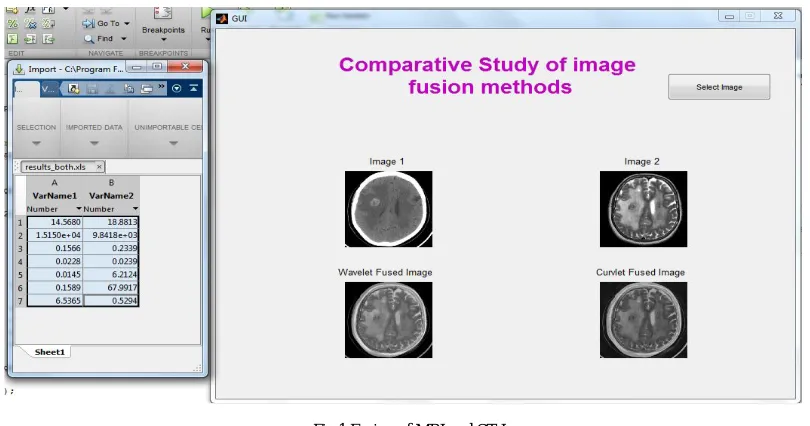
Figure 1 shows the wavelet and curvelet fused images of CT and MRI images (multimodal images) of brain along with quality metrics parameters in the order PSNR, RMSE, SSIM, image quality, average gradient, edge intensity and entropy.
Fig.1.Fusion of MRI and CT Image
Figure 2 shows the wavelet and curvelet fused images clock images (multifocus images) of along with quality metrics parameters in the order PSNR, RMSE, SSIM, image quality, average gradient, edge intensity and entropy.
ISSN(Online): 2320-9801
ISSN (Print): 2320-9798
I
nternational
J
ournal of
I
nnovative
R
esearch in
C
omputer
and
C
ommunication
E
ngineering
(An ISO 3297: 2007 Certified Organization)
Vol. 3, Issue 6, June 2015
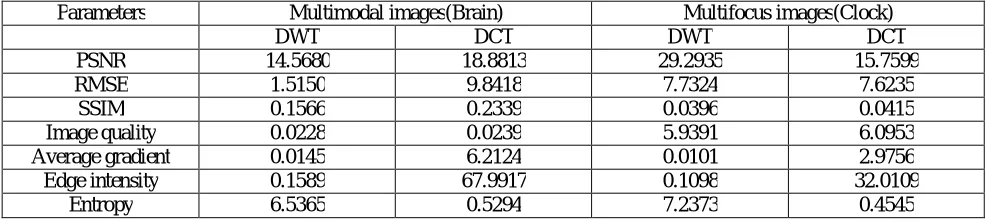
Table 1 shows the comparison between the evaluation parameters for wavelet and curvelet fused images of brain (multimodal image) and clock (multifocus image).The result analysis for the fusion techniques is given below.
TABLE 1: Evaluation of Parameters
Parameters Multimodal images(Brain) Multifocus images(Clock)
DWT DCT DWT DCT
PSNR 14.5680 18.8813 29.2935 15.7599
RMSE 1.5150 9.8418 7.7324 7.6235
SSIM 0.1566 0.2339 0.0396 0.0415
Image quality 0.0228 0.0239 5.9391 6.0953
Average gradient 0.0145 6.2124 0.0101 2.9756
Edge intensity 0.1589 67.9917 0.1098 32.0109
Entropy 6.5365 0.5294 7.2373 0.4545
PSNR is the ratio between maximum possible power of the signal to the power of the corrupting noise that creates distortion of image. Its value should be high. Root mean square error is a measure of image quality index. The large value of mean square means that image is a poor qualityThe SSIM compares local patterns of pixel intensities that have been normalized such as luminance and contrast. The SSIM index is a decimal value between 0 and 1. A value of 0 would mean zero correlation with the original image, and 1 means the exact same image. Image quality index indicates the fused image contains all the information from the source images. Its value should be high.Average Gradient shows the degree of clearness, which embeds the details and texture feature of the image. It uses the difference between adjacent pixels of x-direction and y-direction, to represent the change lying in the details of fused image. Greater the average gradient is, the more distinct the image shows.Edge intensity is a measure of important visual information with the edge that is present in each pixel of an image. Its valve should be high. Entropy is used to evaluate the information quantity contained in an image. The higher value of entropy implies that the fused image is better than the input images.
V. CONCLUSION AND FUTURE WORK
The proposed multilevel image fusion algorithm based on DWT and FDCT works efficiently for fusion of medical andmultifocus imaging. The comparison of DWT and FDCT is done by tabular representation which shows improved fusion quality by statistical analysis of 7 quality metrics parameters. The FDCT based multilevel image fusion works better than DWT based multilevel image fusion. The proposed algorithm and results obtained can be used by researchers or academicians for further research work like other fusion methods based on latest multiscale geometric analysis transform and some improvements in pre as well as post processing of image fusion.
REFERENCES
1. Li, H., Manjunath, B.S., Mitra, S.K., 1995. Multisensor image fusion using the Wavelet Transform. Graphical Models Image Process. 57 (5),235–245.
2. Li, S., Wang, Y., 2000. Multisensor image fusion using discrete multiWavelet Transform. In: Proc. 3rd Internat. Conf. on Visual Computing, pp. 93–103.
3. Li, H., Manjunath, B.S., Mitra, S.K., 1995. Multisensor image fusion using the Wavelet Transform. Graphical Models Image Process. 57 (5), 235–245.
4. E. J. Candes,D. L. Donoho. Curvelets:A surprisingly effective nonadaptive representation for objects with edges[J]. In:C. Rabut A. Cohen ,L. L. Schumaker. Curves and Surfaces. Nashville , TN: Vanderbilt University Press ,2000. 105-120.
5. E. J. Candes, D. L. Donoho. New tight frames of curvelets and optimal representations of objects with singularities[J]. Commun. On Pure and Appl. Math.2004, 57(2):219-266.
6. E. J. Candes , L. Demanet D. L. Donoho et al.. Fast Discrete Curvelet Transforms[R]. Applied and Computational Mathematics. California Institute of Technology , 2005.1.
7. LiHui-hu,iGuoLe,iLiuHang. Research on image fusion based on the second generation curvelet transform [J]. ActaOpticaSinica, 2006,26(5): 657 ~662.
8. E.J. Candes, “Ridgelets: Theory and Applications,” USA: Department of Statistics, Stanford University, 1998.
ISSN(Online): 2320-9801
ISSN (Print): 2320-9798
I
nternational
J
ournal of
I
nnovative
R
esearch in
C
omputer
and
C
ommunication
E
ngineering
(An ISO 3297: 2007 Certified Organization)
Vol. 3, Issue 6, June 2015
10. P. J. Burt, R. J. Kolczynski, “Enhanced image capture through fusion,” in Proc. 4th Internat. Conf. on Computer Vision, pp. 173–182, 1993
11. H. Li, B. S. Manjunath, and S. K. Mitra, “Multisensor image fusion using the wavelet transform,” Graphical Models and Image Processing, vol. 57, no. 3, pp. 235–245, 1995.
12. F. E. Ali, I. M. El-Dokany, A. A. Saad, and F. E. Abd El-Samie,” Fusion of MR and CT Images Using The Curvelet Transform” , 25th National Radio Science Conference (NRSC 2008), March 18‐20, 2008, Faculty of Engineering, Tanta Univ., Egypt.
13. Parmar, Kiran R., “Analysis of CT and MRI Image Fusion Using Wavelet Transform “, IEEE Xplore digital library in 2012 International Conference on Communication Systems and Network Technologies (CSNT).
14. R.J. Sapkal, S.M. Kulkarni, “Image Fusion based on Wavelet Transform for Medical Application”, International Journal of Engineering Research and Applications, Vol. 2, Issue 5, September- October 2012, pp.624-627.
BIOGRAPHY
Tejashri Polkamwarreceived Bachelor in Engineering degree from G.H. Raisoni Institute of Engineering &Technology, Pune, India in 2012. Currently she is pursuing Master’s degree in Engineering(VLSI and Embedded Systems) from the same college. Her area interests are Image Processing, Data Fusion, Embedded Systems, etc.