Robust Strategy on Coordinated
Scheduling of PHEV Integrated in a
Distributed System
A.Akshaya Preethi, S.Naveen*, G.Balachander*, N.Thamarai selvan*
Department of Electrical and Electronics Engineering, INFO Institute of Engineering, Coimbatore, India
ABSTRACT: Due to the wide depletion of the fossil fuels and to reduce the overall fuel consumption, it is envisioned that Plug-in Hybrid Electric Vehicle (PHEV) will be an environmental friendly solution to global researches. When compared to other approaches, an alternative solution to tackle the increase in peak load and power loss issues is done using the smart scheduling strategy. The main objective of this paper is the minimization of total operating cost of the system and its performance is tested in an IEEE 33 distribution system. In order to contribute this work closer to real life scenario, different types of PHEV’s with different All Electric Ranges (AER) and battery capacities is analysed. Finally, the test results is compared between Binary Particle Swarm Optimization (BPSO) algorithm and uncontrolled scheduling supports the efficiency of the smart scheduling scheme tested using MATLAB Software.
KEYWORDS: Plug-in Hybrid Electric Vehicles; Economic scheduling ; Particle Swarm Optimization (PSO) ; All Electric Range (AER).
I. INTRODUCTION
Increasing fuel prices, diminishing fossil fuel reserves, rising greenhouse gas emissions and political unrest have made plug-in (hybrid) vehicles an attractive alternative to traditional internal combustion engine vehicles (ICEV). The growth of PHEVs as a clean, safe and economical transportation option to ICEVs can be promoted by extending driving range, improving battery health and life, increasing electric grid reliability and promoting acceptance of PHEVs by the consumer. The degree of penetration of PHEVs as a transportation option depends on a variety of factors, including charging technology, communication security, Advanced Metering Infrastructure (AMI), incentives to customers, electricity pricing structures and standardization.The wide-spread adoption of electric vehicles will have many multi-faceted socio-economic impacts.
Among this increased system load, leading to stressed distribution systems and insufficient generation, power quality and reliability problems, degrading battery health, scheduling of vehicles as a potential power source in an ancillary market, costs incurred versus revenues earned by end user in offering such services, along-with the dependence on variable consumer behaviour have been considered as hurdles to PHEV implementation.
complete authority over their transportation availability and/or electricity usage. However, other objectives, such as system loss reduction, greenhouse emission reduction, battery lifetime extension, etc., can also be optimization factors.
II. PROBLEM DISCRIPTION
A.DISTRIBUTION LOAD FLOW:
Distribution system plays a significant position in the power system, since it is the main point of link between bulk power and the consumer. It have gained a overwhelming research interest in the academics as well as in industrial committee nearly from last three decades.
B. IEEE 33 BUS SYSTEM:
The IEEE 33 bus system is shown in the fig.1.Distribution Load flow is done by Backward and forward sweep Algorithm. The MATLAB Software tool is used for distribution network simulation and load flow calculation.
Figure 1: Single line diagram of IEEE-33 bus system
C. INFORMATION OF PHEV:
D.INITIAL AND DEPARTURE TIME OF SOC OF PHEVS:
The amount of energy stored in a battery is known as the State Of Charge (SOC). The estimation of the SOC cannot only prevent a battery over discharge and improving the battery life but also allows the application to make control over energy saving strategies. Thus the calculation of the initial and departure time of SOC of PHEV is given by,
(SOCa) = 1- (d/dr)
(SOCa) = (STD/dr) + 0.2
E. ALL ELECTRIC RANGES (AER):
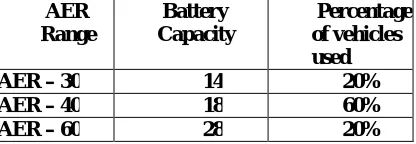
All-electric range (AER) is the driving range of a vehicle using only power from its electric battery pack to traverse a given driving cycle. In the case of a battery electric vehicle, it means the total range per charge. For a plug-in hybrid (PHEV), it means the range of the vehicle in charge-depleting mode. PHEVs can travel considerably further in charge-sustaining mode which uses both on-board fuel and the battery pack.
Table 1: AER Ranges with their Battery capacities
AER Range
Battery Capacity
Percentage of vehicles used
AER – 30 14 20%
AER – 40 18 60%
AER – 60 28 20%
F. DATA AND ANALYSIS:
The departure time is considered as the starting time of the initial trip and arrival time is the end of the last trip. By the above method the data are collected with their in time and out time of the PHEV vehicle.
G. CHARGING AND DISCHARGING COST :
Figure 2: Cost Minimization Chart
H.SCHEMATIC DIAGRAM :
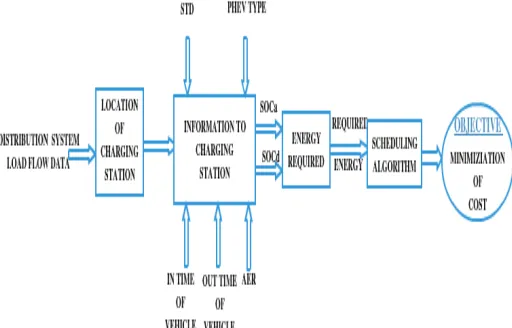
Here we undergo to find an optimal location for scheduling the PHEV, which is parked in the parking lot of the charging station. When the PHEV arrives the In time, Subsequent travel distance (STD),Battery Capacity ,AER and estimated parking time of the PHEV is noted. The energy required for the PHEV is calculated by the means of data collected from the owners of the PHEV. And then ,the optimal scheduling is performed by using BPSO Algorithm. The performance of the of the BPSO algorithm is tested using the IEEE 33 bus system. Finally the scheduling of the PHEV is performed as shown in figure3.
III. PROBLEM FORMULATION
At peak hours the controlled charging and discharging of PHEVs as well as the advantage of off-peak charging
benefits are as followed by decreasing in the operating cost of the system.
A. OBJECTIVE:
The main objective of the work is to minimize the total operational cost of the system which comprises of two parts:[6]
1. Charging and discharging cost
2. Battery Depreciation Cost.
which results in the total operation cost of the system and some of the factors which motivated us to do this project are as follows:[6]
1. To quantify and visualize the impact of the adoption of PHEVs on the electricity market.
2. To reduce the potential global warming which has been created around the globe with the anthropogenic
emission of greenhouse gases and the persistence of atmospheric carbon emission.
3. To reduce the fuel consumption and environmental pollution problem by introducing PHEVs.
B.CONSTRAINTS
The charging, discharging power and SOC of the PHEVs
should lie between their minimum to maximum limit or in their acceptable range to avoid the any uncertainties in the system. [3]
The charging power limit of the PHEV is given by,
0 < rPHEV k < p Rated
PHEVs battery SOC Limit
20% < SOC < 100%
C.MATHEMATICAL MODEL
The controlled charging and discharging of PHEVs as well as the advantage of off-peak charging benefits are as followed by decreasing in the operating cost of the system. The mathematical model calculation is given as follows
Minimum cost: Min(cost) Cost = Cost(chg) + Cost(Bdep)
Cost(chg) =
Cost(Bdep)=∑t=1(Cb,k Eb,k +CL).Edis,k / (Lc Eb,K DOD)
D.STATE OF CHARGE (SOC) EVALUATION
A Set of 10 vehicles with predefined arrival and departure time is considered
The initial SOC (SOCa) and the desired departure time SOC (SOCd) is calculated based on the first trip
distance (d) and the subsequent travel distance (STD) of the PHEVs.
The required SOC (SOCr) of PHEVs entering the car parks is determined by the charging coordinator using
the PHEVs (SOCd)
(SOCr) positive if (SOCd > SOCa)
(SOCr) zero if (SOCd = SOCa)
(SOCr) negative if (SOCd< SOCa)
E. Energy requirements of PHEVs:
The required to charge and schedule of battery is calculated using initial SOC. Then the SOC required for the PHEV battery is given as follows
+0.2
where, C = Battery capacity of the PHEV dR = All electric range of the PHEV.
IV. SMART SCHEDULING STRETEGIES
Algorithm Description:
The BPSO Start with initialization of particles and then successively updating velocity position, local best and gobal best solution with each iteration.[7]
Require: No. of Particles, MaxIter, InputFile 1: Read Input File
2: Initialize Particles 3: while (iter ≤ MaxIter) do 4: for all (Particles i) do
10: end if 11: end for
12: gBestiter = min ∀i (pBesti, gBestiter−1) 13: iter++
14: end while
V. RESULTS AND DISCUSSIONS
A.ENERGY REQUIRED
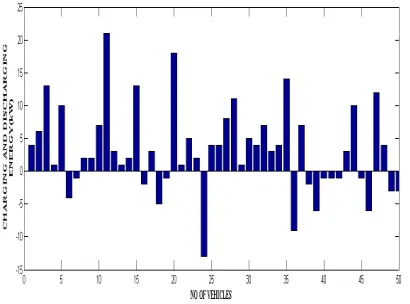
The energy which is required to charge the battery of the vehicles at the end of the trip is calculated and then the scheduling takes place for the initial value of SOC.
Figure 4 : Energy requirement chart
B.OPTIMAL BUS LOCATION:
To find out the optimal bus location we are applying Binary Particle Swarm Optimization (BPSO) Algorithm of the network, to minimize the power loss in the 33 bus system as shown Table 2.
Table 2: Optimal Bus Location of 33 bus system
Parameter Uncontrolled scheduling BPSO algorithm
Bus location 2 18 2 18
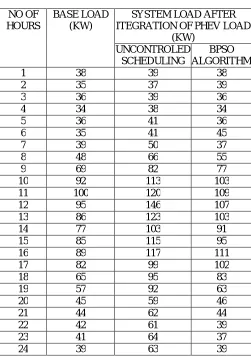
C.SYSTEM LOAD DATA:
Table 3 : load variation at optimal charging station location
NO OF HOURS
BASE LOAD (KW)
SYSTEM LOAD AFTER ITEGRATION OF PHEV LOAD
(KW) UNCONTROLED
SCHEDULING
BPSO ALGORITHM
1 38 39 38
2 35 37 39
3 36 39 36
4 34 38 34
5 36 41 36
6 35 41 45
7 39 50 37
8 48 66 55
9 69 82 77
10 92 113 103
11 100 120 109
12 95 146 107
13 86 123 103
14 77 103 91
15 85 115 95
16 89 117 111
17 82 99 102
18 65 95 83
19 57 92 63
20 45 59 46
21 44 62 44
22 42 61 39
23 41 64 37
24 39 63 39
D .TOTAL OPERATION COST
Parameter Uncontrolled scheduling BPSO algorithm
Cost($/day) 51.92 25.74
Cost($/day) 3.0641 3.0641
Total cost($/day) 54.9841 28.8041
VI. CONCLUSION
In this paper, the optimal scheduling of the PHEV is performed in IEEE 33 Bus using BPSO Algorithm. Finding an optimal location for the charging station and optimal scheduling of PHEV benefits of both gird operators and vehicle owners. The test results were analysed by varying the vehicles All Electric Ranges (AER) and battery capacities. It is evident from the result that the smart scheduling strategy using BPSO algorithm is better when compared to uncontrolled scheduling strategy, thus the objective of attaining minimum total operating cost of the system which comprises of charging and discharging cost as well as battery depreciation cost is achieved without isolating any constraints.
REFERENCES
[1] Zhaohao Ding, Ying Lu, Lizi Zhang,Wei-Jen Lee, and Dayu Chen “A Stochastic Resource Planning Scheme for PHEV Charging Station
Considering Energy Portfolio Optimization and Price-responsive Demand ”,IEEE Transactions on Industry Application,vol.54,pp.5590-5598,2018.
[2] Abdurrahman Arikan , Ruofan Jin, "Optimal Centralized Renewable Energy Transfer Scheduling for Electrical Vehicles “IEEE International
conference on smart grid communication,2015.[https://doi.org/10.1109/SmartGridComm.2015.7436308]
[3] Mohammad javad Mirzaei, Ahad Kazemi, Omid homaee,”Real World based approach for optimal management of electric vehicles in an
intelligent parking lot considering simultaneous satisfaction of vehicle owner and parking operator”, Energy (Volume 65 pages 572–579, 2014; doi:10.1016/j.energy.2013.11.045).
[4] Feiran Huang Wei-Jen Lee, "Design Optimization of PHEV Charging Station",IEE Industrial and commercial power system conference,2012.[
https://doi.org/10.1109/ICPS.2012.6229606]
[5] Hong.B, “plug-in hybrid electrical vechicles (PHEV),” IEEE Emerg.technol.portal,2012.
[6] Dr.S.Charles Raja, S.Suganya, J.Jeslin Drusila Nesamalar and A.Akshaya Preethi* “Economic scheduling of Plug-In Hybrid Electric Vehicle
considering various travel patterns”,National power engineeringconference,2018.[https://doi.org/10.1109/NPEC.2018.8476752]
[7] Arvind Kumar , Vikas Bhalla , Praveen Kumar “Unit Commitment in a Smart Grid with Plug-in Hybrid Electric Vehicles- A Cost-Emission
Optimization”, IEEE Transpontation Electrification conference, 2017. [https://doi.org/10.1109/ITEC-India.2017.8333714]
[8] Aiman H,El-Maleh,Ahmad T.Sheikh,Sadiq M. Sait,”Binary Particle Swarm optimization based state assignment for area minimization of
sequential circuits” ,Applied soft computing ,vol.13,pp.4832-4840,2013.
[9] Livani R. Jalilzadeh Hamidi “Myopic real-time decentralized charging management of Plug-in Hybrid Electric Vehicles”,Electrical power
system Reasearch,vol.143,pp.522-532,2017.
[10] Imran Rahman , Pandian M.Vasant , Balbir Singh MahinderSingh , M. Abdullah-Al-Wadud “Review of recent trends in optimization
techniques for Plug-in Hybrid, And Electric Vehicle charging infrastructures”,Renewable and suitainable energy Review,vol.58,pp.1039-1047,2016
[11] Nima Ghiasnezhad Omran a, Shaahin Filizadeh, "A semi-cooperative decentralized scheduling scheme for plug-in electric vehicle charging demand",International Journal of Electrical power and energy system,vol.88,pp.119-132,2017.
[12] Qiuminv Dong, Dusit Niyato, "The PHEV Charging Scheduling and Power Supply Optimization for Charging Stations,”IEE Transaction on
vehicular Technology,vol.65,pp.566-580,2016.
[13] Yoshito Nishita and Masafumi Iwata “Control Charge-Discharge Using EV and PHEV Batteries for Power Demand Reduction”,IEE
International Telecommunication Enwergy conference,2015.[ https://doi.org/10.1109/INTLEC.2015.7572445]
[14] Rahul Mehta, Dipti Srinivasan, Asiwin M “Smart Charging Strategies for optimal integration of plug-in Electric vehicle within Existing Distribution system infrastructure”, IEE Transaction on smart grid,vol.9,pp.299-312,2018.
[15] Maigha, Mariesa L.Crow,” Economic scheduling of Residential Plug-in Hybrid Electric Vechicle Charging, Energies , vol.7,