Journal of Industrial Engineering and Management Studies
Vol. 4, No. 1, 2017, pp. 69-89
DOI: 10.22116/JIEMS.2017.51964
www.jiems.icms.ac.ir
Integrated modeling and solving the resource allocation problem
and task scheduling in the cloud computing environment
Maryam Shams1,*, Ahmad Jafarzadeh Afshari1, Amir Khakbaz1
Abstract
Cloud computing is considered to be a new service provider technology for users and businesses. However, the cloud environment is facing a number of challenges. Resource allocation in a way that is optimum for users and cloud providers is difficult because of lack of data sharing between them. On the other hand, job scheduling is a basic issue and at the same time a big challenge in reaching high efficiency in the cloud computing environment. In this paper, “the cloud resources management problem” is investigated that includes allocation and scheduling of computing resources, such that providers achieve the high efficiency of resources and users receive their needed applications in an efficient manner and with minimum cost. For this purpose, a group technology based non-linear mathematical model is presented with an aim at minimization of load difference of servers, number of transfers between servers, number of active virtual machines, maximum construction time, the cost of performing jobs and active servers energy consumption. To solve the model, a meta-heuristic multi-objective hybrid Genetic and Particle Swarm Optimization algorithm is proposed for resource allocation and scheduling. In order to demonstrate the validity and efficiency of the algorithm, a number of problems with different dimensions are randomly created and accordingly the efficiency and convergence capability of the suggested algorithm is investigated. The results indicated that the proposed hybrid method has had an acceptable performance in generating high quality, diverse and sparse solutions.
Keywords: Cloud computing; Resource allocation; Task scheduling; Non-dominated sorting genetic algorithm; Particle swarm optimization.
Received: December 2016-15
Revised: April 2017-16
Accepted: May 2017-18
1. Introduction
Cloud computing is a model for providing easy access to a collection of changeable and configurable computing resources (like networks, servers, storage space, applications, and services) through a network based on the user demand and the access should rapidly be provided or freed with the least need to resource management or direct intervention of service provider. In the meantime, the issue of resource allocation in cloud computing is of great importance.
* Corresponding Author;[email protected]
A resource allocation system for cloud computing can be referred to any type of mechanism whose goal is to guarantee the provision of making requirements of applications.
The issue of resource allocation is a major challenge in cloudy environments and has a direct relationship with the amount of energy consumption, service providers’ profit, and users’ cost; hence, many works have been done to reduce the number of physical or virtual resources used, by applying virtualization methods and creation of load balance and integration of physical resources. Cloud resources can be physical or virtual and the cloud provider requests them from the cloud. Generally, real resources of a data center which are shared between several users should dynamically be allocated according to the user’s request or retaken. The resource allocation system should deal with unpredicted requests.
Having allocated the computational resources to users, there is a need to make decisions on the scheduling of jobs. The goal of scheduling is to determine a processing resource from a collection of the resources which are needed for processing of a job, such that more duties can be processed in less time. The scheduling system controls various duties in the cloud system to increase the rate of job accomplishment and productivity of resources and as a result, increase the computational power. Job scheduling is one of the important challenges of cloud computing systems. Owing to limitations and heterogeneity of resources, the issue of scheduling is among the NP-Complete issues (Garey, Johnson, 1979). An appropriate scheduling method is very effective on the increase of time of performing jobs and productivity of resources.
Many studies have been conducted on the issue of resource allocation and scheduling of jobs in the cloud computing environment (Daji et al., 2013). However, no deterministic mathematical model has been proposed on the integration of allocation and scheduling in the cloud computing environment. Allocation and scheduling of resources can seamlessly lead to the optimization of criteria and the main goals of users and service providers including transfer charges, servers load balance and management on machines. Thus, the issue needs further investigation.
In solving constrained optimization problems, there are two subjects of optimization and binding. Due to the complexity of the problem, a hybrid algorithm based on Non-dominated Sorting Genetic Algorithm (NSGA II) and Particle Swarm Optimization (PSO) has been proposed to solve it in an acceptable time. The goal of the algorithm is to use capabilities of the PSO algorithm due to its suitable rate of convergence to the optimum solution. In the first step, the proposed algorithm tries to use Genetic Algorithm capabilities to find the local optimal solution. In addition, we know that the penalty function method is the most common method for constrained optimization due to simplicity and ease of implementation. In the second step, using the co-evolutionary concept, the Co-evolutionary Particle Swarm Optimization approach (CPSO) is used to adapt the local optimal solutions to penalty factors to find the global optimal point out of local optimal solutions. In the next sections of this paper, after a brief overview of previous studies, the problem of resource allocation and scheduling using the concepts of group technology in the cloud computing environment is studied and a non-linear programming mathematical model is proposed for the problem. Then, the problem-solving method is considered and having explained the primary concepts and definitions, an efficient meta-algorithm is proposed combining Genetic Algorithm and PSO.
2. Literature review
depending on the type of industry. Here, some of the studies conducted in the literature are investigated.
In 2008, Jaeger et al., explored the nature and potential of cloud computing, the policy issues raised, and research questions related to cloud computing and policy. In 2013, Eguia et al. proposed a linear programming model for the display of the problem of cellular manufacturing and jobs scheduling of reconfigurable cellular manufacturing systems (RCMS) with an aim of minimizing reconfiguration and efficiency costs for the condition of lack of use of RCMS resources. Then, in order to solve greater examples of this problem and find a suitable schedule without the need to long computation times, they used an efficient Tabu Search (TS) algorithm. In 2014, Kim et al. proposed a multi-agent-based scheduling method for intercellular and intracellular scheduling problem of configuration of the system and flow of materials in a production line of hybrid cells and then presented a real-time heuristic scheduling method to solve the problem.
The problem of constrained resource allocation is also one of the problems with an important position in planning and project control. The desirability of scheduling of activities of a project depends not only on the project completion time but also other factors. Among these factors, the way of using resources can be mentioned. The non-deterministic nature of activities in a project causes deterministic models not to be responsible for many practical projects. Therefore, in 2015, Wang and Su proposed a dynamic hierarchical resource allocation algorithm for multiple nodes of big data environments that using the fuzzy allocation pattern, dynamically classified jobs and nodes in different levels according to the computational power and storage factors.
Since solving real world problems with deterministic methods has been inefficient due to their large size, heuristic methods have always been considered in this area. Among the methods presented in the literature, the following studies can be mentioned. The results of the studies show that the proposed heuristic methods are more efficient and present solutions which are closer to the optimum solution.
In 2011, Cagnina et al., introduced a PSO-based method called CPSO-Shake for the constrained optimization. Making relatively simple changes in the conventional PSO algorithm, the method can better maintain the diversity and explore the limited search spaces more. In 2014, Moazami et al., proposed a new and rapid method for load shedding scheduling in which active and reactive values of power flow were prioritized via a dynamic list and optimized using culture– particle swarm optimization–co-evolutionary algorithm and artificial neural network method. In 2014, M.A. Rodriguez and R. Buyya put forward a scheduling and resource allocation strategy for scientific workflows in infrastructure clouds as a (laaS) service. They presented a PSO based algorithm with an aim at minimizing the total cost of workflow considering deadline constraints.
As mentioned, there are many models for scheduling problems in the literature. Given the nature of scheduling problems and especially with regard to the concept of group technology, which is the topic of the present study, there is no willingness for mathematical modeling and achieving the optimal solution of this kind of problems. Appearance of objective functions and non-linear constraints in the problem, binary variables, numerous variables and limitations that itself increases the size of the problem and naturally makes it more complicated and other issues have caused mathematical models and their solution not is used frequently in the literature because a lot of time is needed to solve them and given the current methods, types of software and the problem volume, achieving the desirable solution is never assured and even if it is achievable it’s a very time-consuming job. As mentioned before, in this paper, a resource allocation and scheduling problem is modeled using the concept of group technology considering special assumptions.
in that their works are completed in the shortest possible time and the minimal cost which cloud service providers must receive. On the other hand, also the cloud service providers tend to maximize resource utilization and increase their profits, that these two are often in conflict with each other and does not match with the traditional methods of resource allocation and the available scheduling mechanisms. The examined problem of this study with considering to the specified requirements in the Service Level Agreement tries to find the best scheduling and resource allocation that be able to complete the works with maximum utilization of resources, at minimum cost, and in minimum time, by providing a deterministic integrated mathematical model. As yet, no deterministic mathematical model has been proposed on the integration of allocation and scheduling in the cloud computing environment.
In addition, given the difficulty of workshop flow and permutation workshop flow problems, deterministic approaches have less been considered to solve this type of problems. Few of these methods only investigated very small size problems. As a result, over the last fifty years, researchers have proposed many heuristic algorithms and methods to solve this type of problems of medium and large size. Thus, this study is looking for presenting a co-evolutionary mechanism based differential evolutionary method to solve this constrained optimization problem. At first, a penalty function is designed to manage constraints. Then, a co-evolutionary model is implemented to do a thorough search in the spaces of solutions and penalty factors. Given its co-evolutionary property, it seems it is significantly superior to the best existing methods.
3. Modeling the problem
In the upcoming problem, there are m virtual machines and n jobs in general. It should be noted that the m machines are settled in c cells or in other words, c servers and there is one or more of each one. Each job has a special process and the sequence of performing various operations to fulfill the job is definite. Furthermore, each job has a number of avocations or duties. Performing any task of each job has its special processing time on each machine. The hardware and software capacity of servers and virtual machines is known and each machine can only perform one operation or task at a time. It is assumed that in the case of starting an operation, its pause is not allowed. In this problem, the operation related to each job processing is scheduled on the virtual machines needed for processing in the cell where the machine is settled. The goal of solving this problem is to determine the sequence of jobs in each cell in such a way that goals of users as service providers are met, such that the following objective are optimized and the constraint in using the existing resources is observed.
1) Minimization of the intracellular movement in order to reduce communication costs
2) Equiponderating loads of servers and virtual machines for the purpose of increase of productivity of resources and the system
3) Minimization of the number of active machines to reduce intervention
4) Minimization of the construction time of cellular generation with the workflow structure in order to reduce servicing cycle
5) Minimization of the cost of performing task in order to increase users and service providers’ profit
6) Minimization of energy consumption of servers to optimize consumption
In real problems, instead of dealing with one criterion we deal with several of them. Therefore the problem is considered as a multi-objective one in this study.
Problem Formulation
All the constants and variables used in the model are listed for easy reference below:
𝐷𝑗∶ 𝑇ℎ𝑒 𝑛𝑢𝑚𝑏𝑒𝑟 𝑜𝑓 𝑑𝑒𝑚𝑎𝑛𝑑 𝑜𝑓 𝑗𝑜𝑏 𝑗
𝑇𝑝∶ 𝑇𝑜𝑡𝑎𝑙 𝑎𝑣𝑎𝑖𝑙𝑎𝑏𝑖𝑙𝑖𝑡𝑦 𝑡𝑖𝑚𝑒 𝑜𝑓 𝑝 − 𝑡𝑦𝑝𝑒 𝑣𝑖𝑟𝑡𝑢𝑎𝑙 𝑚𝑎𝑐ℎ𝑖𝑛𝑒 𝑎𝑐𝑟𝑜𝑠𝑠 𝑠𝑒𝑟𝑣𝑒𝑟𝑠 𝑎𝑖𝑗𝑝= {1 𝑖𝑓 𝑖
𝑡ℎ 𝑡𝑎𝑠𝑘 𝑖𝑛 𝑗𝑜𝑏 𝑗 𝑛𝑒𝑒𝑑𝑠 𝑓𝑜𝑟 𝑝 − 𝑡𝑦𝑝𝑒 𝑣𝑖𝑟𝑡𝑢𝑎𝑙 𝑚𝑎𝑐ℎ𝑖𝑛𝑒 0 𝑜𝑡ℎ𝑒𝑟𝑤𝑖𝑠𝑒 𝑇𝐸𝑗 ∶ 𝑇ℎ𝑒 𝑗𝑡ℎ 𝑗𝑜𝑏 𝑡𝑟𝑎𝑛𝑠𝑚𝑖𝑠𝑠𝑖𝑜𝑛 𝑡𝑖𝑚𝑒
𝑁𝑝𝑘 ∶ 𝑇ℎ𝑒 𝑚𝑎𝑥𝑖𝑚𝑢𝑚 𝑛𝑢𝑚𝑏𝑒𝑟 𝑜𝑓 𝑝 − 𝑡𝑦𝑝𝑒 𝑣𝑖𝑟𝑡𝑢𝑎𝑙 𝑚𝑎𝑐ℎ𝑖𝑛𝑒𝑠 𝑡ℎ𝑎𝑡 𝑐𝑎𝑛 𝑏𝑒 𝑜𝑛 𝑘𝑡ℎ 𝑠𝑒𝑟𝑣𝑒𝑟 (1 ≤ 𝑘 ≤ 𝑐)
𝑆𝐶𝑖𝑗 ∶ 𝑊𝑜𝑟𝑘𝑙𝑜𝑎𝑑 𝑠𝑖𝑧𝑒 𝑜𝑓 𝑡𝑎𝑠𝑘 𝑖 𝑖𝑛 𝑗𝑜𝑏 𝑗
𝑆𝐷𝑖𝑗∶ 𝐷𝑎𝑡𝑎 𝑠𝑖𝑧𝑒 𝑜𝑓 𝑡𝑎𝑠𝑘 𝑖 𝑖𝑛 𝑗𝑜𝑏 𝑗
𝐷𝑇𝐼𝑘 ∶ 𝑇ℎ𝑒 𝑑𝑎𝑡𝑎 − 𝑡𝑟𝑎𝑛𝑠𝑓𝑒𝑟 − 𝑖𝑛 𝑝𝑟𝑖𝑐𝑒 𝑜𝑓 𝑠𝑒𝑟𝑣𝑒𝑟 𝑘 ($/𝑀𝐵𝑠) 𝐷𝑇𝐼𝑘 ∶ 𝑇ℎ𝑒 𝑑𝑎𝑡𝑎 − 𝑡𝑟𝑎𝑛𝑠𝑓𝑒𝑟 − 𝑜𝑢𝑡 𝑝𝑟𝑖𝑐𝑒 𝑜𝑓 𝑠𝑒𝑟𝑣𝑒𝑟 𝑘 ($/𝑀𝐵𝑠)
𝐶𝑜𝑚𝑘 ∶
𝑇ℎ𝑒 𝑒𝑥𝑒𝑐𝑢𝑡𝑖𝑛𝑔 𝑝𝑟𝑖𝑐𝑒 𝑜𝑓 𝑠𝑒𝑟𝑣𝑒𝑟 𝑘, 𝑟𝑒𝑝𝑟𝑒𝑠𝑒𝑛𝑡𝑠 𝑡ℎ𝑒 𝑐𝑜𝑠𝑡 𝑝𝑒𝑟 𝑒𝑥𝑒𝑐𝑢𝑡𝑒𝑑 𝑚𝑖𝑙𝑙𝑖𝑜𝑛 𝑖𝑛𝑠𝑡𝑟𝑢𝑐𝑡𝑖𝑜𝑛𝑠 ($/ 𝑀𝐼𝑠)
𝑆𝑡𝑟𝑘 ∶ 𝑆𝑡𝑜𝑟𝑎𝑔𝑒 𝑝𝑟𝑖𝑐𝑒 𝑜𝑓 𝑠𝑒𝑟𝑣𝑒𝑟 𝑘 ($/𝑀𝐵𝑠)
𝐵𝑔𝑗∶ 𝑈𝑠𝑒𝑟 − 𝑑𝑒𝑓𝑖𝑛𝑒𝑑 𝑏𝑢𝑑𝑔𝑒𝑡 𝑜𝑓 𝑒𝑥𝑒𝑐𝑢𝑡𝑖𝑛𝑔 𝑗𝑜𝑏 𝑗
𝑐𝑝𝑢𝑖𝑗∶ 𝑇ℎ𝑒 𝑎𝑚𝑜𝑢𝑛𝑡 𝑜𝑓 𝑟𝑒𝑞𝑢𝑖𝑟𝑒𝑑 𝐶𝑃𝑈 𝑜𝑓 𝑒𝑥𝑒𝑐𝑢𝑡𝑖𝑛𝑔 𝑡ℎ𝑒 𝑖𝑡ℎ 𝑡𝑎𝑠𝑘 𝑖𝑛 𝑗𝑜𝑏 𝑗
𝑚𝑒𝑚𝑖𝑗 ∶ 𝑇ℎ𝑒 𝑎𝑚𝑜𝑢𝑛𝑡 𝑜𝑓 𝑟𝑒𝑞𝑢𝑖𝑟𝑒𝑑 𝑚𝑒𝑚𝑜𝑟𝑦 𝑜𝑓 𝑒𝑥𝑒𝑐𝑢𝑡𝑖𝑛𝑔 𝑡ℎ𝑒 𝑖𝑡ℎ 𝑡𝑎𝑠𝑘 𝑖𝑛 𝑗𝑜𝑏 𝑗
𝑠𝑡𝑜𝑖𝑗∶ 𝑇ℎ𝑒 𝑎𝑚𝑜𝑢𝑛𝑡 𝑜𝑓 𝑟𝑒𝑞𝑢𝑖𝑟𝑒𝑑 𝑠𝑡𝑜𝑟𝑎𝑔𝑒 𝑜𝑓 𝑒𝑥𝑒𝑐𝑢𝑡𝑖𝑛𝑔 𝑡ℎ𝑒 𝑖𝑡ℎ 𝑡𝑎𝑠𝑘 𝑖𝑛 𝑗𝑜𝑏 𝑗
𝐶𝑃𝑈𝑘 ∶ 𝑇ℎ𝑒 𝐶𝑃𝑈 𝑐𝑎𝑝𝑎𝑐𝑖𝑡𝑦 𝑜𝑓 𝑠𝑒𝑟𝑣𝑒𝑟 𝑘 𝑀𝐸𝑀𝑘 ∶ 𝑇ℎ𝑒 𝑚𝑒𝑚𝑜𝑟𝑦 𝑐𝑎𝑝𝑎𝑐𝑖𝑡𝑦 𝑜𝑓 𝑠𝑒𝑟𝑣𝑒𝑟 𝑘 𝑆𝑇𝑂𝑘∶ 𝑇ℎ𝑒 𝑠𝑡𝑜𝑟𝑎𝑔𝑒 𝑐𝑎𝑝𝑎𝑐𝑖𝑡𝑦 𝑜𝑓 𝑠𝑒𝑟𝑣𝑒𝑟 𝑘
𝐸𝑘,𝑚𝑎𝑥∶ 𝑇ℎ𝑒 𝑚𝑎𝑥𝑖𝑚𝑢𝑚 𝑝𝑜𝑤𝑒𝑟 𝑐𝑜𝑛𝑠𝑢𝑚𝑝𝑡𝑖𝑜𝑛 𝑜𝑓 𝑠𝑒𝑟𝑣𝑒𝑟 𝑘
𝐸𝑘,𝑖𝑑𝑙𝑒∶ 𝑡ℎ𝑒 𝑝𝑜𝑤𝑒𝑟 𝑐𝑜𝑛𝑠𝑢𝑚𝑝𝑡𝑖𝑜𝑛 𝑜𝑓 𝑠𝑒𝑟𝑣𝑒𝑟 𝑘 𝑤ℎ𝑒𝑛 𝑖𝑡 𝑖𝑠 𝑖𝑑𝑙𝑒 𝐸𝑘 ∶ 𝑇ℎ𝑒 𝑑𝑦𝑛𝑎𝑚𝑖𝑐 𝑝𝑜𝑤𝑒𝑟 𝑐𝑜𝑛𝑠𝑢𝑚𝑝𝑡𝑖𝑜𝑛 𝑜𝑓 𝑠𝑒𝑟𝑣𝑒𝑟 𝑘
𝐸𝑆𝑘 ∶ 𝑇ℎ𝑒 𝑠𝑡𝑎𝑟𝑡/𝑐𝑢𝑟𝑟𝑒𝑛𝑡 𝑝𝑜𝑤𝑒𝑟 𝑐𝑜𝑛𝑠𝑢𝑚𝑝𝑡𝑖𝑜𝑛 𝑜𝑓 𝑠𝑒𝑟𝑣𝑒𝑟 𝑘
𝑌𝑖𝑗𝑘= {1 𝑖𝑓 𝑖
𝑡ℎ 𝑡𝑎𝑠𝑘 𝑏𝑒𝑙𝑜𝑛𝑔𝑠 𝑡𝑜 𝑗𝑜𝑏 𝑗 𝑖𝑠 𝑒𝑥𝑒𝑐𝑢𝑡𝑒𝑑 𝑖𝑛 𝑠𝑒𝑟𝑣𝑒𝑟 𝑘 0 𝑜𝑡ℎ𝑒𝑟𝑤𝑖𝑠𝑒
𝑀𝑟𝑝𝑘= {1 𝑖𝑓 𝑟𝑡ℎ 𝑝 − 𝑡𝑦𝑝𝑒 𝑣𝑖𝑟𝑡𝑢𝑎𝑙 𝑚𝑎𝑐ℎ𝑖𝑛𝑒 𝑤ℎ𝑖𝑐ℎ 𝑎𝑠𝑠𝑖𝑔𝑛𝑒𝑑 𝑡𝑜 𝑠𝑒𝑟𝑣𝑒𝑟 𝑘 𝑖𝑠 𝑎𝑐𝑡𝑖𝑣𝑎𝑡𝑒𝑑 0 𝑜𝑡ℎ𝑒𝑟𝑤𝑖𝑠𝑒
𝑍𝑖𝑗𝑟𝑝𝑘= {
1 𝑖𝑓 𝑖𝑡ℎ 𝑡𝑎𝑠𝑘 𝑏𝑒𝑙𝑜𝑛𝑔𝑠 𝑡𝑜 𝑗𝑜𝑏 𝑗 𝑖𝑠 𝑎𝑠𝑠𝑖𝑔𝑛𝑒𝑑 𝑡𝑜 𝑟𝑡ℎ 𝑝 − 𝑡𝑦𝑝𝑒 𝑣𝑖𝑟𝑡𝑢𝑎𝑙 𝑚𝑎𝑐ℎ𝑖𝑛𝑒 𝑖𝑛 𝑠𝑒𝑟𝑣𝑒𝑟 𝑘 (1 ≤ 𝑟 ≤ 𝑁𝑝𝑘)
0 𝑜𝑡ℎ𝑒𝑟𝑤𝑖𝑠𝑒
𝑊𝑖𝑗𝑙ℎ= {1 𝑖𝑓 𝑖
𝑡ℎ 𝑡𝑎𝑠𝑘 𝑏𝑒𝑙𝑜𝑛𝑔𝑠 𝑡𝑜 𝑗𝑜𝑏 𝑗 𝑖𝑠 𝑑𝑜𝑛𝑒 𝑒𝑎𝑟𝑙𝑖𝑒𝑟 𝑡ℎ𝑎𝑛 𝑙𝑡ℎ 𝑡𝑎𝑠𝑘 𝑏𝑒𝑙𝑜𝑛𝑔𝑠 𝑡𝑜 𝑗𝑜𝑏 ℎ ( 1 ≤ 𝑙 ≤ 𝑠, 1 ≤ ℎ ≤ 𝑡)
0 𝑜𝑡ℎ𝑒𝑟𝑤𝑖𝑠𝑒
𝐻𝑖𝑗𝑙ℎ𝑟𝑝𝑘=
{
1 𝑖𝑓 𝑖𝑡ℎ 𝑡𝑎𝑠𝑘 𝑏𝑒𝑙𝑜𝑛𝑔𝑠 𝑡𝑜 𝑗𝑜𝑏 𝑗 𝑎𝑛𝑑 𝑙𝑡ℎ 𝑡𝑎𝑠𝑘 𝑏𝑒𝑙𝑜𝑛𝑔 𝑡𝑜 𝑗𝑜𝑏 ℎ 𝑎𝑟𝑒 𝑎𝑠𝑠𝑖𝑔𝑛𝑒𝑑 𝑡𝑜 𝑟𝑡ℎ 𝑝 − 𝑡𝑦𝑝𝑒 𝑣𝑖𝑟𝑡𝑢𝑎𝑙 𝑚𝑎𝑐ℎ𝑖𝑛𝑒 𝑖𝑛 𝑠𝑒𝑟𝑣𝑒𝑟 𝑘
0 𝑜𝑡ℎ𝑒𝑟𝑤𝑖𝑠𝑒
𝐴𝑐𝑡𝑘 = {1 𝑖𝑓 𝑠𝑒𝑟𝑣𝑒𝑟 𝑘 𝑖𝑠 𝑢𝑠𝑒𝑑 0 𝑜𝑡ℎ𝑒𝑟𝑤𝑖𝑠𝑒
𝑊𝑡𝑗𝑝𝑘 ∶ 𝑊𝑜𝑟𝑘𝑙𝑜𝑎𝑑 𝑜𝑓 𝑗𝑜𝑏 𝑗 𝑜𝑛 𝑝 − 𝑡𝑦𝑝𝑒 𝑣𝑖𝑟𝑡𝑢𝑎𝑙 𝑚𝑎𝑐ℎ𝑖𝑛𝑒 𝑜𝑛 𝑠𝑒𝑟𝑣𝑒𝑟 𝑘 𝐴𝑣𝑗𝑘 ∶ 𝑊𝑜𝑟𝑘𝑙𝑜𝑎𝑑 𝑎𝑣𝑒𝑟𝑎𝑔𝑒 𝑜𝑓 𝑗𝑜𝑏 𝑗 𝑜𝑛 𝑎𝑙𝑙 𝑣𝑖𝑟𝑡𝑢𝑎𝑙 𝑚𝑎𝑐ℎ𝑖𝑛𝑒𝑠 𝑜𝑛 𝑠𝑒𝑟𝑣𝑒𝑟 𝑘
𝑔𝑠𝑖𝑗∶ 𝐶𝑜𝑚𝑝𝑙𝑒𝑡𝑖𝑜𝑛 𝑡𝑖𝑚𝑒 𝑜𝑓 𝑡ℎ𝑒 𝑖𝑡ℎ 𝑡𝑎𝑠𝑘 𝑖𝑛 𝑗𝑜𝑏 𝑗
𝑔𝑡𝑗∶ 𝐶𝑜𝑚𝑝𝑙𝑒𝑡𝑖𝑜𝑛 𝑡𝑖𝑚𝑒 𝑜𝑓 𝑗𝑜𝑏 𝑗
𝑔 ∶ 𝑇𝑜𝑡𝑎𝑙 𝑐𝑜𝑚𝑝𝑙𝑒𝑡𝑖𝑜𝑛 𝑡𝑖𝑚𝑒 𝑜𝑓 𝑎𝑙𝑙 𝑗𝑜𝑏𝑠
𝑇𝑖(𝑖+1)𝑗∶ 𝑇𝑟𝑎𝑛𝑠𝑓𝑒𝑟𝑖𝑛𝑔 𝑡𝑖𝑚𝑒 𝑜𝑓 𝑡𝑤𝑜 𝑐𝑜𝑛𝑠𝑒𝑐𝑢𝑡𝑖𝑣𝑒 𝑡𝑎𝑠𝑘𝑠 𝑏𝑒𝑙𝑜𝑛𝑔𝑠 𝑡𝑜 𝑗𝑜𝑏 𝑗
The problem of this work can be expressed in the fallowing mathematical model. The goal of this optimization problem is to minimize the total operational cost of the system including power and executing costs andmaximize the efficiency of computing resources.
(1)
Min F = F1 , F2 , F3 , F4 , F5 , g
(2)
𝐹1 = ∑ ∑ ∑(𝑊𝑡𝑗𝑝𝑘− 𝐴𝑣𝑗𝑝𝑘)2 𝑐 𝑘=1 𝑚 𝑝=1 𝑡 𝑗=1 (3)
𝐹2 = ∑ ∑ ∑ 𝑌𝑖𝑗𝑘 (1 − 𝑌𝑖+1𝑗𝑘) 𝑐 𝑘=1 𝑡 𝑗=1 𝑠−1 𝑖=1 (4)
𝐹3 = ∑ ∑ ∑ 𝑀𝑟𝑝𝑘 𝑐 𝑘=1 𝑚 𝑝=1 𝑁𝑝𝑘 𝑟=1 (5)
𝐹4 = ∑ ∑ ∑ 𝐶𝑠𝑡𝑖𝑗𝑘. 𝑌𝑖𝑗𝑘 𝑐 𝑘=1 𝑡 𝑗=1 𝑠 𝑖=1 (6)
𝐹5 = ∑(𝐴𝑐𝑡𝑘. 𝐸𝑘,𝑖𝑑𝑙𝑒+ 𝐸𝑘∑ ∑ 𝑌𝑖𝑗𝑘 𝑡 𝑗=1 𝑠 𝑖=1 𝑐 𝑘=1 ) Subject to: (7) ∑ 𝑍𝑖𝑗𝑟𝑝𝑘 𝑵𝒑𝒌 𝒓=𝟏 = 𝑎𝑖𝑗𝑝 . 𝑌𝑖𝑗𝑘 ∀ 𝑖 , 𝑗 , 𝑝 , 𝑘 (8) 𝑀𝑟𝑝𝑘 ≤ ∑ ∑ 𝑍𝑖𝑗𝑟𝑝𝑘 𝑡 𝑗=1 𝑠 𝑖=1 ∀ 𝑟 , 𝑝 , 𝑘 (9) 𝑀𝑟𝑝𝑘 ≥ ∑ ∑ 𝑍𝑖𝑗𝑟𝑝𝑘 𝑡 𝑗=1 𝑠 𝑖=1 𝑠 × 𝑡 ∀ 𝑟 , 𝑝 , 𝑘 (10)
∑ ∑ ∑ 𝑍𝑖𝑗𝑟𝑝𝑘 = 1 𝑐 𝑘=1 𝑚 𝑝=1 𝑁𝑝𝑘 𝑟=1 ∀ 𝑖 , 𝑗 (11) ∑ ∑ ∑ ∑ 𝐷𝑗 . 𝑚𝑒𝑚𝑖𝑗 . 𝑍𝑖𝑗𝑟𝑝𝑘 𝑚 𝑝=1 𝑁𝑝𝑘 𝑟=1 ≤ 𝑀𝐸𝑀𝑘 𝑡 𝑗=1 𝑠 𝑖=1 ∀ 𝑘 (12) ∑ ∑ ∑ ∑ 𝐷𝑗 . 𝑐𝑝𝑢𝑖𝑗 . 𝑍𝑖𝑗𝑟𝑝𝑘 𝑚 𝑝=1 𝑁𝑝𝑘 𝑟=1 ≤ 𝐶𝑃𝑈𝑘 𝑡 𝑗=1 𝑠 𝑖=1 ∀ 𝑘 (13) ∑ ∑ ∑ ∑ 𝐷𝑗 . 𝑠𝑡𝑜𝑖𝑗 . 𝑍𝑖𝑗𝑟𝑝𝑘 𝑚 𝑝=1 𝑁𝑝𝑘 𝑟=1 ≤ 𝑆𝑇𝑂𝑘 𝑡 𝑗=1 𝑠 𝑖=1 ∀ 𝑘 (14) 𝑊𝑡𝑗𝑝𝑘 = ∑ ∑𝑁𝑝𝑘𝐷𝑗 . 𝑡𝑖𝑗𝑝 . 𝑍𝑖𝑗𝑟𝑝𝑘 𝑟=1 𝑠 𝑖=1 𝑇𝑝 ∀ 𝑗 , 𝑝 , 𝑘 (15) 𝐴𝑣𝑗𝑘 = ∑𝑚 𝑊𝑡𝑗𝑝𝑘 𝑝=1 ∑ ∑𝑚 𝑀𝑟𝑝𝑘 𝑝=1 𝑁𝑝𝑘 𝑟=1 ∀ 𝑗 , 𝑘 (16)
𝑇𝑖(𝑖+1)𝑗 = ∑ 𝑌𝑖𝑗𝑘 (1 − 𝑌𝑖+1𝑗𝑘) 𝑐
𝑘=1
(17)
𝑔𝑠𝑖+1𝑗− 𝑔𝑠𝑖𝑗 ≥ 𝑡𝑖𝑗𝑝 + 𝑇𝑖(𝑖+1)𝑗 ∀ 𝑖 , 𝑗 , 𝑝
(18)
𝑔𝑠𝑙ℎ − 𝑔𝑠𝑖𝑗 + 𝑀(1 − 𝑊𝑖𝑗𝑙ℎ) + 𝑀(1 − 𝐻𝑖𝑗𝑙ℎ𝑟𝑝𝑘) ≥ 𝑡𝑙ℎ𝑝 ∀ 𝑖 , 𝑗 , 𝑙 , ℎ , 𝑟 , 𝑝, 𝑘 & 𝑖 ≠ 𝑙 , 𝑗 ≠ ℎ
(19)
𝑔𝑠𝑖𝑗 − 𝑔𝑠𝑙ℎ + 𝑀 . 𝑊𝑖𝑗𝑙ℎ+ 𝑀(1 − 𝐻𝑖𝑗𝑙ℎ𝑟𝑝𝑘) ≥ 𝑡𝑖𝑗𝑝 ∀ 𝑖 , 𝑗 , 𝑙 , ℎ , 𝑟 , 𝑝 , 𝑘 & 𝑖 ≠ 𝑙 , 𝑗 ≠ ℎ
(20)
𝑊𝑖𝑗𝑙ℎ+ 𝑊𝑙ℎ𝑖𝑗 = 𝐻𝑖𝑗𝑙ℎ𝑟𝑝𝑘 ∀ 𝑖 , 𝑗 , 𝑙 , ℎ , 𝑟 , 𝑝, 𝑘 & 𝑖 ≠ 𝑙 , 𝑗 ≠ ℎ
(21)
𝑊𝑖𝑗𝑙ℎ+ 𝑊𝑙ℎ𝑢𝑣 ≤ 𝑊𝑖𝑗𝑢𝑣+ 1 ∀ 𝑖 , 𝑗 , 𝑙 , ℎ , 𝑢 , 𝑣 & 𝑖 ≠ 𝑙 ≠ 𝑢 , 𝑗 ≠ ℎ ≠ 𝑣
(22)
𝑔𝑠𝑖𝑗 ≥ 𝑡𝑖𝑗𝑝 ∀ 𝑖 , 𝑗, 𝑝
(23)
𝑔𝑡𝑗 ≥ 𝑔𝑠𝑖𝑗 ∀ 𝑖 , 𝑗
(24)
𝑔 ≥ 𝑔𝑡𝑗 ∀ 𝑗
(25)
𝐶𝑠𝑡𝑖𝑗𝑘 = 𝑐𝑝𝑢𝑖𝑗. 𝐶𝑜𝑚𝑘+ 𝑠𝑡𝑜𝑖𝑗. 𝑆𝑡𝑟𝑘+ 𝑚𝑒𝑚𝑖𝑗. (𝐷𝑇𝐼𝑘+ 𝐷𝑇𝑂𝑘) ∀ 𝑖 , 𝑗 , 𝑘
(26)
∑ ∑ 𝐶𝑠𝑡𝑖𝑗𝑘 𝑠
𝑖=1 𝑐
𝑘=1
. 𝑌𝑖𝑗𝑘 ≤ 𝐵𝑔𝑗 ∀ 𝑗
(27)
∑ ∑ 𝑌𝑖𝑗𝑘. 𝐸𝑘 𝑡
𝑗=1 𝑠
𝑖=1
≤ 𝐸𝑘,𝑚𝑎𝑥 . 𝐴𝑐𝑡𝑘− 𝐸𝑘,𝑖𝑑𝑙𝑒− 𝐸𝑆𝑘 ∀ 𝑘
(28)
∑ 𝐴𝑐𝑡𝑘 𝑐
𝑘=1
≥ ⌈∑ 𝐸𝑘,𝑖𝑑𝑙𝑒+ 𝐸𝑆𝑘 𝑐
𝑘=1
𝐸𝑘,𝑚𝑎𝑥 ⌉
(29)
𝑔𝑠𝑖𝑗 , 𝑔𝑡𝑗 , 𝑔 , 𝐶𝑠𝑡𝑖𝑗𝑘 ≥ 0
(30)
𝑌𝑖𝑗𝑘 , 𝑍𝑖𝑗𝑟𝑝𝑘 , 𝑊𝑖𝑗𝑠𝑡 , 𝐻𝑖𝑗𝑠𝑡𝑟𝑝𝑘 , 𝐴𝑐𝑡𝑘 , 𝑀𝑟𝑝𝑘 ∈ {0 , 1}
The objective function is composed of six terms that are shown in equations (2) to (6). The first term is related to load balance of servers. Using variance, the amount of load unbalance of the integrated load in servers can be calculated. The second term is related to the calculation of the number of transits between servers and in the case of the existence of a transfer, communication costs will increase. The third term is related to the calculation of the number of active virtual machines. The fourth term is related to the calculation of the cost of performing all duties of all jobs on all servers. It should be noted that the cost of calculation and storage is different on different servers depending on the capacity of each server and also network traffic etc. The fifth term calculates the energy consumption in the servers that are active. It is worth mentioning that the cost of power consumption of communication resources, coolers and air conditioning of modules (units) across servers and communication equipment/network is amortized in a data center and as a result, it is relatively independent of the user job volume. More exactly, these costs are not included in the cost and power equation of data center (Gudarzi et al., 2012) The last term, which is denoted by g in equation (1), is related to the maximum duration of time of performing jobs. Putting F1, F2, F3, F4, F5 and g in the objective function causes the values to be minimized.
Constraint (7) is related to the definition of variable Zijrpk and shows that task i of job j can be done on the machine No. r of type p in server k (Zijrpk=1), only if the task is performed in server k (Yijk=1) and also the machine of type p is needed (aijp=1). Constraints (8) and (9) ensure us that in the case of allocation of at least one job to each of the machines, the related machine will be considered as active. Constraint (10) guarantees that each task of each job is allocated to one machine of one type and on one server.
needed for processing). The numerator of the above equation determines the total processing time of all duties allocated to all the machines of type p in server k. Constraint (15) calculates the average processing time within server for job j on all machines in sever k. In other words, like equation (14), the equation calculates the efficiency of a server.
Constraint (16) calculates the transfer time for two consecutive duties i and i+1 of job j. Constraint (17) guarantees that each task is processed on the machine of type p in accordance with the defined operation (tasks) priority in processing. It means that the difference between the completion times of task i and i+1 of job j should at least be equal to the sum of the time span of processing and transfer of task i of job j. It means task i+1 cannot be completed before task i. Constraints (18) and (19) shows the sequence of performing jobs on a machine. It means if task i of job j and task l of job h are both accomplished on machine r of type p in server k, the completion time of each task will be in accordance with the priority of their entry to the machine. Constraint (20) shows that if duties i and l of jobs j and h are both accomplished on machine No. r of type p in server k (Hijlhrpk=1), one of the duties i or l of jobs j and h will be done before the other. In other words, we will have Wijlh=1 or Wlhij=1. Constraint (21) expresses the trinity relation in the priority of jobs done on a machine and shows that jobs related to a machine are done in a queue. Constraint (22) guarantees that the completion time of each task is at least equal to its accomplishment time. Constraint (23) shows the completion time of each task. It means the completion time of job j should at least be equal to the completion time of its task. Constraint (24) shows that the time span of construction is more than or equal to the completion time of each job.
Constraint (25) calculates the cost of doing a job. A general cloud service provider receives the cost of three cases: calculations, storage, and data transfer. The data transfer is from/to the internet, private or public IP addresses etc. and because of the negligible cost of data transfer between cloud servers, it can be ignored in the modeling of the cost equation and its cost is set to zero (Wang et al, 2013). Constraint (26) is defined for budget control and guarantees that the cost of performing all duties of all jobs doesn’t exceed the defined budget.
Each sever has an energy limit Ek,max that cannot be exceeded. Constraint (27) guarantees that the servicing or hosting of virtual machines is done according to the remaining capacity. A constant or idle energy plus the start/recent energy of server k determines recent energy consumption of the server. For the severs that meet the conditions Ek,max>Ek,current and Ek,current≠0, the total number of used servers is constrained by the inequality (28) (Ek,current=Ek,idle+ESk). Constraints (29) and (30) are obvious and introduce the type and range of variables.
4. The proposed algorithm
Due to the complexity of the problem, in this study, a hybrid meta-algorithm based on Non-dominated Sorting Genetic Algorithm (NSGA II) and co-evolutionary Particle Swarm Optimization (PSO) has been designed and implemented to solve it.
This stage operator is called congestion distance operator. Each point with more congestion distance covers a wider area and its elimination leads to losing solution diversity in a wide range of solutions.
Each particle in the PSO algorithm consists of three d-dimensional vectors where d is the dimension of the search space. For the ith particle, the three vectors are xi current position of the particle, vi the particle speed and xi, best is the best position the particle has experienced so far. xi is a set of coordinates that displays the current position of a particle. If the position is better than previous solutions, it is stored in xi,best. fiis the value of the objective function for xi and fi,best is the value of objective function for xi,best, both of which are regarded as constituent elements of a particle. In each iteration, a new xi and vi are obtained and the purpose of executing the algorithm is to improve xi,best with the probability of xi.
As we know, Genetic Algorithm and PSO algorithm has respectively been successful in solving many discrete and continuous optimization problems (Pandian and Vasant, 2010). Given the discrete nature of scheduling problems and also multi-objectivity of the mathematical model proposed for this study, NSGA II internally deals with solving the problem optimally. On the other hand, the binding part of the problem which is expressed by the concepts of penalty functions, an external PSO algorithm adjusts the penalty factors. The two algorithms interactively and in parallel are used to solve constrained multi-objective optimization problems in a co-evolutionary way. In the next section, the meta-algorithm will be described in detail.
4.1. Co-evolutionary mechanism
Given the simplicity of rule and ease of implementation, the penalty function method is regarded as the most common technique in the management of constraints for application uses. In fact, new methods have only been used normally for dealing with very special problems (and generally unreal). In this study, inequality constraints are only considered because penalty functions are not as appropriate for managing equality constraints as for hard constraints and there are other suitable methods for their management (Michalewicz, 1996).
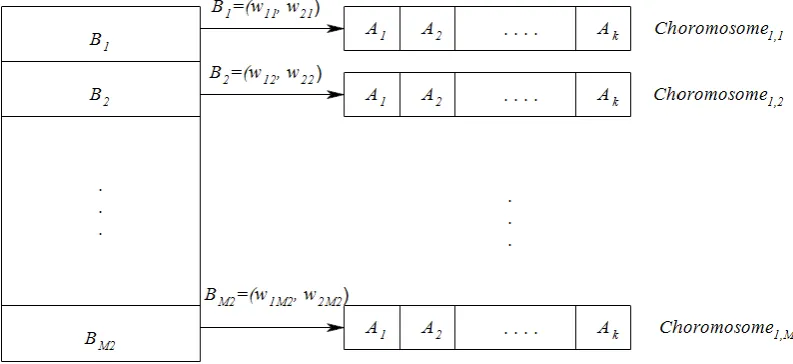
Since adjustment of penalty factors for the penalty function method is difficult, Michalewicz demonstrated that a self-adaptive plan is a hopeful management in co-evolutionary optimization. In his study, Coello also proposed the concept of co-evolutionary and combined it with a genetic algorithm to solve constrained optimization problems. He, Wang and Huang et al., respectively proposed a co-evolutionary PSO approach and a co-evolutionary mechanism based differential evolutionary method to solve constrained optimization problems. In the present research, some changes are made in the co-evolutionary process and Non-dominated Sorting Genetic Algorithm (NSGA II) and PSO are combined to solve multi-objective optimization problems. The proposed technique, using the concept of co-evolutionary concept, deals with the implementation of the idea that two (or more) populations are evolved simultaneously or interactively while the populations exchange the information in the process. As a result, by this combined optimization more worthy solutions that meet more constraints can be achieved.
Figure 1. Graphical illustration for the notion of co-evolution
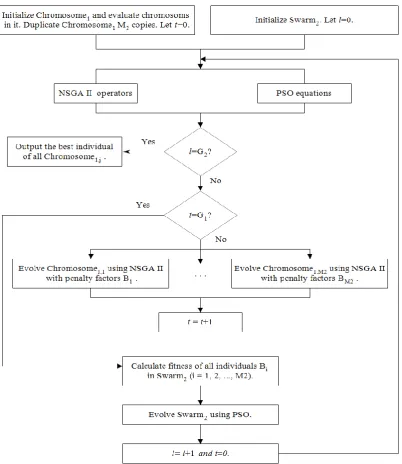
Two populations of Swarm and Chromosome are used in NSCGA-PSO. Population Swarm (designated by Swarm2) is used with size M2 for the adjustment of suitable penalty factors. In another section, the multiple population Chromosome (designated by Chromosome1,1, Chromosome1,2,….,Chromosome1,M2), each with size M1, are used in parallel to search for suitable decision solutions.
The problem that will be solved optimally is as follows:
Optimize fk(x). k = 1, … , m. Subject to:
gi(x) ≤ 0 i = 1, … , p.
gi(x) ≥ 0
When people are evaluated in Chromosome1, a special penalty function is designed in which not only the number of violated constraints but also the amount of violation by the constraints is important. Specifically, the ith Chromosome with regard to the kth objective function in Chromosome1,j in NSCGA-PSO is evaluated by the following formula:
(32) 𝐹𝑖(x) = 𝑓𝑖𝑘(𝑥) + (𝑠𝑢𝑚_𝑣𝑖𝑜𝑙 × 𝑤1+ 𝑛𝑢𝑚_𝑣𝑖𝑜𝑙 × 𝑤2) × 𝛽
Where fik(x) is the fitness value of the ith individual with regard to the kth objective, sum_viol is the sum of total values violated by the constraints and num_viol is the number of violations of the constraints which is initialized with zero. w1 and w2 are penalty factors corresponding to particle Bj in Swarm2. β is the effect coefficient of violation in order to increase its effect and prevent regeneration of infeasible solutions.
As we know, the amount of violation of inequality constraints is calculated as follows:
(32)
𝑉𝑔𝑖 = max {0, 1 − 𝑔𝑖(𝑥)
𝑔0𝑖 } ∀𝑔𝑖(𝑥) ≥ 0
(33)
𝑉𝑔𝑖 = max {0,𝑔𝑖(𝑥)
𝑔0𝑖 − 1} ∀𝑔𝑖(𝑥) ≤ 0
In this case, the value of sum_viol is calculated as follows:
(34)
𝑠𝑢𝑚_𝑣𝑖𝑜𝑙 = ∑ 𝑉𝑔𝑖 𝑁
𝑖=1
Where N is the number of inequality constraints (here it is assumed that all equality constraints are converted to inequality constraints).
Each individual Bj(1≤ j≤ M2) in Swarm2 displays a set of penalty factors (w1 and w2). The generated combined weights (that is penalty factors) are used in a definite number of generations (G1) for the evolution of Chromosome1. Having evolving each Chromosome1 corresponding to it, the jth individual Bj in Swarm2 is evaluated as described below:
1- If there is at least one feasible solution in Chromosome1,j, then individual Bj is called a valid individual, which is evaluated as follows:
(35)
𝑃(𝐵𝑗) = ∑ 𝑓𝑓𝑒𝑎𝑠𝑖𝑏𝑙𝑒
𝑛𝑢𝑚_𝑓𝑒𝑎𝑠𝑖𝑏𝑙𝑒− 𝑛𝑢𝑚_𝑓𝑒𝑎𝑠𝑖𝑏𝑙𝑒
Where ∑ 𝑓𝑓𝑒𝑎𝑠𝑖𝑏𝑙𝑒is the sum of values of the objective function of feasible solutions in Chromosome1,j and num_feasible shows the number of feasible solutions in Chromosome1,j. If infeasible solutions are not kept out of the calculation, the selection mechanism of genetic algorithm may cause the population to be affected by regions of the search space in which solutions with there are very low weight combinations (w1 and w2). Such solutions may have good fitness values but are infeasible as well. In fact, the use of β coefficient in equation (33) is to prevent the emergence of such problems. In addition, deduction from num_feasible in equation (35) is for preventing from the recession of Chromosome1,j in special regions that have very small number of feasible individuals with good objective values.
2- If there is no feasible solution in Chromosome1,j (the penalty can be considered very low), then Bj will be known as an invalid individual, which is evaluated as follows:
(36)
𝑃(𝐵𝑗) = max(𝑃𝑣𝑎𝑙𝑖𝑑) +
∑ 𝑠𝑢𝑚_𝑣𝑖𝑜𝑙
∑ 𝑛𝑢𝑚_𝑣𝑖𝑜𝑙+ ∑ 𝑛𝑢𝑚_𝑣𝑖𝑜𝑙
Where max(Pvalid) shows the maximum value of the objective function of all valid individuals in P2. ∑ 𝑠𝑢𝑚_𝑣𝑖𝑜𝑙, shows the sum of violations of constraints for all people in Chromosome1,j, and ∑ 𝑛𝑢𝑚_𝑣𝑖𝑜𝑙 counts the total number of violations of constraints for all people in Chromosome1,j.
Figure 2. Flow chart of NSCGA-PSO.
4.2. Design of Taguchi experiment
(37)
𝑆
𝑁 𝑟𝑎𝑡𝑖𝑜 = −10 log10
𝑠𝑢𝑚(𝑜𝑏𝑗𝑒𝑐𝑡𝑖𝑣𝑒 𝑓𝑢𝑛𝑐𝑡𝑖𝑜𝑛)2
𝑛
Where the objective function is the output value for each run of experiment and n is the number of repetition of the experiment. The quality of solutions generated by various algorithms is assessed using the following equation (Hamilton and Vairaktarakis, 2013):
(38)
𝑅𝑒𝑙𝑎𝑡𝑖𝑣𝑒 𝐷𝑒𝑣𝑖𝑎𝑡𝑖𝑜𝑛 𝐼𝑛𝑑𝑒𝑥 (𝑅𝐷𝐼) =𝑀𝑒𝑡ℎ𝑜𝑑𝑆𝑜𝑙 − 𝐵𝑒𝑠𝑡𝑆𝑜𝑙
𝑊𝑜𝑟𝑠𝑡𝑆𝑜𝑙 − 𝐵𝑒𝑠𝑡𝑆𝑜𝑙 100%
Where BestSol and WorstSol are respectively the best and the worst values of objection function by the tested method (values are shown by MethodSol).
Parameters of the proposed algorithm and their level are shown in table 1. The probability of mutation and crossover for each pair of chromosomes is normally considered between 0 and 1 and the effect rate of mutation (mutation intensity) is considered very small and from 0.001 to 0.1. Here, values related to levels of each of control factors are considered according to previous studies.
Table 1. Controllable factors and their levels for DOE. High Medium
Low
3 2
1 Parameters
20 15
10 Population size
0.9 0.8
0.75 Crossover percentage
0.4 0.3
0.2 Mutation percentage
0.05 0.02
0.01 Mutation rate
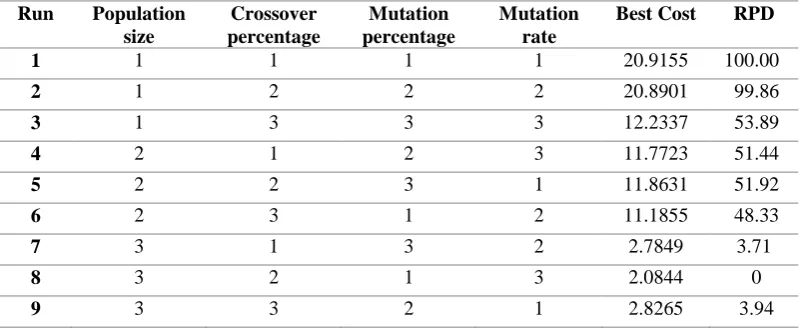
Having determined performance criteria, control factors, and their levels, Taguchi method can be used for the design of experiments. In this example, the MINITAB statistical software has been used to design the experiments. The experiments designed by Taguchi method and also the results of experiments for each one of response variables for a sample problem has been shown in table 2. Furthermore, according to equation (38), the best-calculated cost for each experiment has been normalized. The total number of designed experiments is equal to 9, each of which was repeated five times. All experiments were carried out using MATLAB software.
Table 2. The design of Experiments Using the Taguchi method and expected results. Run Population
size
Crossover percentage
Mutation percentage
Mutation rate
Best Cost RPD
1 1 1 1 1 20.9155 100.00
2 1 2 2 2 20.8901 99.86
3 1 3 3 3 12.2337 53.89
4 2 1 2 3 11.7723 51.44
5 2 2 3 1 11.8631 51.92
6 2 3 1 2 11.1855 48.33
7 3 1 3 2 2.7849 3.71
8 3 2 1 3 2.0844 0
9 3 3 2 1 2.8265 3.94
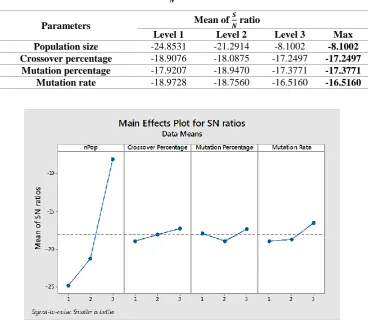
Table 3. The average of 𝑺
𝑵 ratio for expected Best Cost.
Mean of 𝑺
𝑵 ratio
Parameters
Max Level 3
Level 2 Level 1
-8.1002 -8.1002
-21.2914 -24.8531
Population size
-17.2497 -17.2497
-18.0875 -18.9076
Crossover percentage
-17.3771 -17.3771
-18.9470 -17.9207
Mutation percentage
-16.5160 -16.5160
-18.7560 -18.9728
Mutation rate
Figure 3. The average of 𝑺
𝑵 ratio plot at each level for the objective function values.
In figure 3, the first graph is related to the size of the population of Non-dominated Sorting Genetic Algorithm in which the third factor value of -8.10026 has the optimum condition out of three ratios, while the factor with value -24.8531 has the worst situation. Given the high slope of the diagram, it can be concluded that the variable of population size has the highest effect on the optimum value of objective function.
According to the results obtained from table 3, the optimum conditions for the adjustment of genetic algorithm parameters is when all variables are considered at level 3.
5. Calculation results
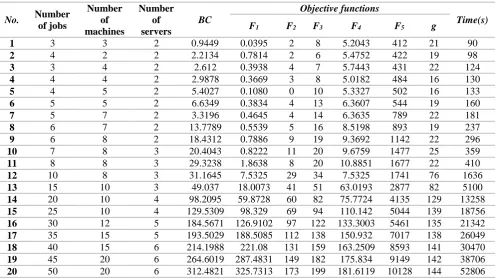
In this section, the proposed approach is executed on small and medium size problems. For each of the generated problems, each algorithm is run five times and the results are expressed as the average value of runs. The BC value in table 4 represents the fitness of the best individual in all chromosomes and particles, which has been obtained as a result of various iterations of the two algorithms. The assumptions considered for these problems are:
- The number of iterations for the external algorithm is considered as 30.
- Processing times for small and large problems are randomly generated respectively in the interval [1,5] and [1,10].
Table 4. Obtained Pareto front solutions for small and large problems.
No. Number
of jobs
Number of machines
Number of servers
BC
Objective functions
Time(s)
F1 F2 F3 F4 F5 g
1 3 3 2 0.9449 0.0395 2 8 5.2043 412 21 90
2 4 2 2 2.2134 0.7814 2 6 5.4752 422 19 98
3 3 4 2 2.612 0.3938 4 7 5.7443 431 22 124
4 4 4 2 2.9878 0.3669 3 8 5.0182 484 16 130
5 4 5 2 5.4027 0.1080 0 10 5.3327 502 16 133
6 5 5 2 6.6349 0.3834 4 13 6.3607 544 19 160
7 5 7 2 3.3196 0.4645 4 14 6.3635 789 22 181
8 6 7 2 13.7789 0.5539 5 16 8.5198 893 19 237
9 6 8 2 18.4312 0.7886 9 19 9.3692 1142 22 296
10 7 8 3 20.4043 0.8222 11 20 9.6759 1477 25 359
11 8 8 3 29.3238 1.8638 8 20 10.8851 1677 22 410
12 10 8 3 31.1645 7.5325 29 34 7.5325 1741 76 1636
13 15 10 3 49.037 18.0073 41 51 63.0193 2877 82 5100
14 20 10 4 98.2095 59.8728 60 82 75.7724 4135 129 13258
15 25 10 4 129.5309 98.329 69 94 110.142 5044 139 18756
16 30 12 5 184.5671 126.9102 97 122 133.3003 5461 135 21342 17 35 15 5 193.5029 188.5085 112 138 150.932 7017 138 26049 18 40 15 6 214.1988 221.08 131 159 163.2509 8593 141 30470 19 45 20 6 264.6019 287.4831 149 182 175.834 9149 142 38706 20 50 20 6 312.4821 325.7313 173 199 181.6119 10128 144 52806
The nature of the problem solving algorithms is to reach the best solution in an acceptable time. The two parameters, that is calculation time and the optimum value of solutions, are suggested as the main factors of comparison and conclusion. In the proposed mathematical model, weights of all objective functions are assumed equal. As we know, when cost functions become non-linear, calculations need more time than the linear case. The obtained results of the optimum Pareto solutions show that NSCGA-PSO algorithm has an acceptable performance when finding the optimum value of problems. Moreover, the time to reach the optimum solution corresponding to development and extension of problems has an intangible increase in comparison with the Lingo software. As a result, it increases considerably the speed of decision making for resource allocation and jobs scheduling in the cloud computing environment. The diagram of the changes of calculation time of sample solved problems is shown in figure 4.
Figure 4. The computing time changes plot.
0 10000 20000 30000 40000 50000 60000
0 5 10 15 20 25
C
om
put
ing
ti
m
Non-dominated Sorting Genetic Algorithm is one of the most powerful methods for multi-objective optimization, but optimization by this method is quite time consuming and costly. Combining this algorithm with the PSO algorithm in a co-evolutionary manner, as described in the previous section, is an attempt to for reducing the optimization time of the method. In PSO algorithm, members of population communicate with each other and reach the solution by the exchange of information, which results in a high convergence rate. In this way, the advantages of both NSGA and PSO are used and the optimization and convergence rate is increased significantly. In order to test the effect of different iterations (Max-iterations in the improvement step) on the final solution quality, the convergence curve of the best individual position cost is all chromosomes is drawn for different iterations.
Convergence curves of objective functions for populations with size 30 and 50 and number of iterations of 500 generations are respectively shown in figures 5 and 6. According to figure 5, optimization process continues to 100 generations, which leads to finding an individual with the cost value of -3. According to the figure, in generations No. 10, 20, 70, 100 and 470, local search by NSGA has led to a considerable mutation in the convergence process. In figure 6 with a number of generations of 50, the optimization process has continued to 170 generations, which has led to finding an individual with the cost value of -4. According to the figure, in generations with No. 5, 60 and 170, local search by NSGA has led to a considerable mutation in the convergence process. Thus, not changing the generations, the decision solution will approach the absolute optimal as much as possible. The results indicate that increasing the convergence rate of multi-objective optimization problems, NSCGA-PSO is capable of presenting an excellent solution.
Figure 5. Convergence curves with the population size of 30.
Figure 6. Convergence curves with the population size of 50.
0 50 100 150 200 250 300 350 400 450 500
-5 0 5 10 15 20
Iteration
B
es
t
C
os
t
0 50 100 150 200 250 300 350 400 450 500
-5 0 5 10 15 20
Iteration
B
es
t
C
os
The another criterion for comparing the results is the capability of the proposed algorithm to meet all constraints of the problem in this study. Recorded results of table 4 in the previous section indicate that except for the constraints of the sequence of doing jobs on a machine at a time in which there is deviation in some of the primary populations, the algorithm has had good performance in meeting nearly all constraints of problems of various sizes.
The last comparison criterion of the study is to show how much the proposed algorithm is able to regenerate the optimum Pareto deploy and that it is possible to identify and generate the highest size of the optimum deploy using a hybrid of two algorithms of NSGA and PSO. As mentioned in previous sections, instead of optimizing a single objective function, several objective functions should simultaneously be optimized in multi-objective problems. In such circumstances, instead of resulting in one single solution, the optimization output leads to a set of optimum solutions (Pareto optimum solutions) such that none of the Pareto deploy solutions is preferred to the others and depending on the situation, each one can be considered as the optimum choice.
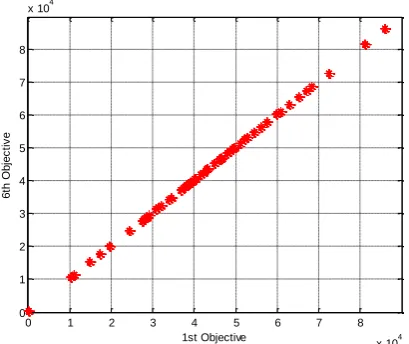
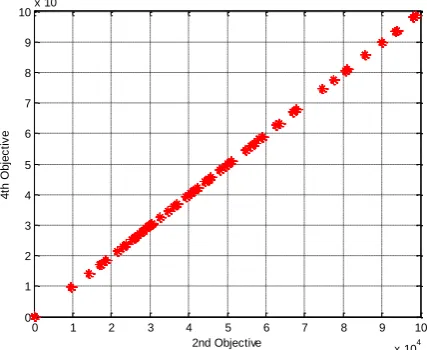
In figures 7 to 9, the Pareto deploy obtained by the algorithm for different objective functions are given in a pairwise manner. In the figures, the points designated by the red color are the same as the efficient or optimum Pareto points, which have been detected through domination calculations. As is seen, Pareto solutions are uniformly distributed across the search space and also different objective functions have a similar behavior in the direction of optimization. In this way, if the value of one function increases, so does the value of other functions. The lowest point on the Pareto curve is chosen as the most optimum solution. Selection of the optimum value of each function is accomplished while considering their importance for the system designer as well as the balance between the cost and the system efficiency.
Thus, given the obtained results, it seems that in the space of constrained optimization problems, NSCGA-PSO is an efficient method from the perspective of identification of the optimum Pareto deploy, meeting constraints as well as acceptable running time.
Figure 7. Comparing of the first and sixth objective functions in the range of obtained solutions from Pareto plot.
0 1 2 3 4 5 6 7 8
x 104 0
1 2 3 4 5 6 7 8
x 104
1st Objective
6
th
O
b
je
c
ti
v
Figure 8. Comparing of the third and fifth objective functions in the range of obtained solutions from Pareto plot.
Figure 9. Comparing of the second and forth objective functions in the range of obtained solutions from Pareto plot.
6. Conclusion
In this paper, a resource allocation and jobs scheduling problem in the cloud computing environment was first described in accordance with group technology concepts and the problem of basic cellular generation, which is an appealing issue in the literature, was taken into account. The problem is the allocation of resources and scheduling of a number of jobs (each containing a definite number of duties) in a cellular generation system as a one by one procedure. Presenting an integrated deterministic mathematical model, the problem under investigation tries to find the best scheduling and resource allocation so as to be able to fulfill duties with the highest degree of resource utilization, minimum cost as well as minimum time.
The criterion selected for the objective function is the popular criterion of the total completion time, which has been considered more by many researchers in the literature than any other criterion. Other optimization criteria of the study are a minimization of servers load difference, a number of intra-server movements, a number of active virtual machines, cost of doing jobs and energy consumption of servers. Given its complex nature, it is classified as an NP-Hard problem. In the beginning, a mathematical model was developed to solve the problem. Owing to the existence of many constraints and variables in the model, solving problems of higher size (more jobs and cells) necessitates spending much time. Thus, a hybrid Non-dominated Sorting Co-evolutionary Genetic Algorithm and Particle Swarm Optimization, namely NSCGA-PSO,
0 1 2 3 4 5 6 7 8
x 104 0
1 2 3 4 5 6 7 8x 10
4
3th Objective
5
th
O
b
je
c
ti
v
e
0 1 2 3 4 5 6 7 8 9 10
x 104 0
1 2 3 4 5 6 7 8 9 10x 10
4
2nd Objective
4
th
O
b
je
c
ti
v
was introduced to solve problems of higher size. The proposed NSCGA-PSO was presented to achieve an absolute solution with desirable quality. In this method, a penalty function for each constraint as a penalty factor for all constraint was considered. Then, an internal NSGA solved the problem for different penalty factors and obtained a locally optimal solution. At the same time, the external algorithm of PSO resulted in the global optimum solution by choosing the best penalty factor in a co-evolutionary way and in parallel. When the two algorithms were used to optimize objective of the problem considering the constraints, much more effective outcomes were obtained. The results obtained from solving small and medium size problems with NSCGA-PSO method were presented in the fifth section to demonstrate the proposed meta-algorithm efficiency.
In the end, analyzing the convergence of the proposed algorithm, meeting constraints and Pareto solutions archive, its effectiveness and optimum performance in expediting the achievement of the final desirable solution was proved. The results indicated that the proposed hybrid Non-dominated Co-evolutionary Genetic Algorithm and PSO have had an acceptable performance in generating high quality, diverse and sparse solutions.
Elimination of all restricting assumption of the problem which was mentioned in the third section of the paper can be regarded as appropriate areas for future studies. For example, the inclusion of stochastic or fuzzy processing times of each job which may have examples in the real world. Consideration of other objective functions with regard to the nature of each industry, considerations of preparation times and available times of machines, investigation of the problem in the dynamic mode, consideration of cut of jobs or use of other meta-heuristic methods to solve the problem is suggested for future research.
References
Abd-El-Wahed, W.F., Mousab, A.A. & El-Shorbagy, M.A., (2011). “Integrating particle swarm optimization with genetic algorithms for solving nonlinear optimization problems”, Journal of Computational and Applied Mathematics, Vol. 235, No. 5, pp 1446–1453.
Al-Aomar, R. and Al-Okaily, A., (2006). “A GA-based parameter design for single machine turning process with high-volume production”, Computers & Industrial Engineering, Vol 50, pp 317–337.
Cagnina, Leticia Cecilia; Esquivel, Susana Cecilia, Coello Coello, Carlos A., (2011). “Solving constrained optimization problems with a hybrid particle swarm optimization algorithm”, Engineering Optimization, Vol. 43, No. 8, pp 843-866.
Coello, C.A.C., (2000). “Use of a self-adaptive penalty approach for engineering optimization problems”, Computers in Industry, Vol. 41, pp 113–127.
Eguia, Ignacio, Racero, Jesus, Guerrero, Fernando, Sebastian Lozano, (2013). “Cell formation and scheduling of part families for reconfigurable cellular manufacturing systems using Tabu search, Simulation”, Transactions of the Society for Modeling and Simulation International, pp 1–17.
Emmons, Hamilton, Vairaktarakis, George, (2013). Flow Shop Scheduling: Theoretical Results, Algorithms, and Applications, Springer, New York.
Ergu, Daji, Kou, Gang, Peng, Yi, Shi, Yong and Shi, Yu, (2013). “The analytic hierarchy process: task scheduling and resource allocation in cloud computing environment”, The Journal of Supercomputing, Vol. 64, No. 3, pp 835-848.
He, Qie and Wang, Ling, (2007). “An effective co-evolutionary particle swarm optimization for constrained engineering design problems”, Engineering Applications of Artificial Intelligence, Vol. 20, pp 89–99.
Huang, Fu-zhuo, Wang, Ling and He, Qie, (2007). “An effective co-evolutionary differential evolution for constrained optimization”, Applied Mathematics and Computation, Vol. 186, pp 340–356.
Jaeger, Paul T., Lin, Jimmy, Grimes, Justin M., (2008). “Cloud Computing and Information Policy: Computing in a Policy Cloud?”, Journal of Information Technology & Politics , Vol. 5, No. 3, pp 269-283.
Javid, J., (2010). “Modeling supply chain management”, 2nd International Industrial Engineering
Conference. Tehran, Iran, 14-20.
Kim, Jungyun, Chung, Seong Youb, Yoon, Hyun Joong, (2014). “Multi-agent-based scheduling methods for hybrid cellular production lines in semiconductor industry”, Journal of Engineering Manufacture, Vol. 228, No. 12, pp 1701–1712.
Kim, S.J., Kim, K.S., Jang, H., (2003). “Optimization of manufacturing parameters for a brake lining using Taguchi method”, Journal of Materials Processing Technology, Vol. 136, pp 202–208.
Kolischa, R. and Padman, R., (2001). “An integrated survey of deterministic project scheduling”,
Omega, Vol. 29, pp 249–272.
Kuo, R.J. & Han, Y.S., (2011). “A hybrid of genetic algorithm and particle swarm optimization for solving bi-level linear programming problem – A case study on supply chain model”, Applied Mathematical Modelling, Vol. 35, No. 8, pp 3905–3917.
Moazzami, Majid, Khodabakhshian, Amin, Hooshmand, Rahmat-Allah, (2014). “A New Optimal Under-frequency Load-shedding Method Using Hybrid Culture–Particle Swarm Optimization–Co-evolutionary Algorithm and Artificial Neural Networks”, Electric Power Components and Systems, Taylor & Francis Group, Vol. 43, pp 69–82.
M. Garey and D. Johnson, (1979). Computers and intractability: a guide to the theory of NP-Completeness, 1st edition New York: WH Freeman and Company.
Mozdgir, Ashkan, Mahdavi, Iraj, Seyedi Badeleh, Iman, Solimanpur, Maghsud, (2013). “Using the Taguchi method to optimize the differential evolution algorithm parameters for minimizing the workload smoothness index in simple assembly line balancing”, Mathematical and Computer Modelling, Vol. 57, No. 1–2, pp 137–151.
Pandian M., Vasant, (2012). Meta-Heuristics Optimization Algorithms in Engineering, Business, Economics, and Finance, IGI Global, 1 edition, United States of America.
Rodriguez, M.A., Buyya, R., (2014). “Deadline Based Resource Provisioning and Scheduling Algorithm for Scientific Workflows on Clouds”, Cloud Computing, IEEE Transactions, Vol. 2, No. 2, pp 222 – 235.
Valdez, Fevrier, Melin, Patricia, Castillo, Oscar, (2011). “An improved evolutionary method with fuzzy logic for combining Particle Swarm Optimization and Genetic Algorithms”, Applied Soft Computing, Vol. 11, No. 2, pp 2625–2632.
Wang, Wei-Jen, Chang, Yue-Shan, Lo, Win-Tsung, Lee, Yi-Kang, (2013). “Adaptive scheduling for parallel tasks with QoS satisfaction for hybrid cloud environments”, The Journal of Supercomputing, Vol. 66, No. 2, pp 783-811.
Z. Michalewicz, (1996). Genetic Algorithms + Data Structures = Evolution Programs, 2nd edn., Springer-Verlag.