International Journal of Nanomedicine 2018:13 7019–7031
International Journal of Nanomedicine
Dove
press
submit your manuscript | www.dovepress.com 7019
O r I g I N a l r e s e a r c h
open access to scientific and medical research
Open access Full Text article
Injectable hydrogel composite containing modified
gold nanoparticles: implication in bone tissue
regeneration
Donghyun lee1
Dong Nyoung heo2
ha ram Nah3
sang Jin lee1
Wan-Kyu Ko4
Jae seo lee3
ho-Jin Moon1
Jae Beum Bang5
Yu-shik hwang6
rui l reis1,7
Il Keun Kwon1
1Department of Dental Materials, school of Dentistry, Kyung hee University, seoul 02447, republic of Korea; 2Department of engineering science and Mechanics, Pennsylvania state University, Pennsylvania 16802, Usa; 3Department of Detistry, graduate school, Kyung hee University, seoul 02447, republic of Korea; 4Department of Neurosurgery, cha Bundang Medical center, cha University, seongnam-si, gyeonggi-do 13496, republic of Korea; 5Department of Dental education, school of Dentistry, Kyung hee University, seoul 02447, republic of Korea; 6Department of Maxillofacial Biomedical engineering, school of Dentistry, Kyung hee University, seoul 02447, republic of Korea; 7The Discoveries centre for regenerative and Precision Medicine, headquarters at University of Minho, Barco, guimarães, Portugal
Background: For effective bone regeneration, it is necessary to implant a biocompatible scaffold that is capable of inducing cell growth and continuous osteogenic stimulation at the defected site. Here, we suggest an injectable hydrogel system using enzymatic cross-linkable gelatin (Gel) and functionalized gold nanoparticles (GNPs).
Methods: In this work, tyramine (Ty) was synthesized on the gelatin backbone (Gel-Ty) to enable a phenol crosslinking reaction with horseradish peroxidase (HRP). N-acetyl cysteine (NAC) was attached to the GNPs surface (G-NAC) for promoting osteo-differentiation. Results: The Gel-Ty hydrogels containing G-NAC (Gel-Ty/G-NAC) had suitable mechanical strength and biocompatibility to embed and support the growth of human adipose derived stem cells (hASCs) during a proliferation test for three days. In addition, G-NAC promoted osteo-differentiation both when it was included in Gel-Ty and when it was used directly in hASCs. The osteogenic effects were demonstrated by the alkaline phosphatase (ALP) activity test. Conclusion: These findings indicate that the phenol crosslinking reaction is suitable for injectable hydrogels for tissue regeneration and G-NAC stimulate bone regeneration. Based on our results, we suggest that Gel-Ty/G-NAC hydrogels can serve both as a biodegradable graft material for bone defect treatment and as a good template for tissue engineering applications such as drug delivery, cell delivery, and various tissue regeneration uses.
Keywords: nanomaterial, gelatin, enzymatic cross-linking, osteogenesis, N-acetyl cysteine
Introduction
Bone defects are caused by loss of a part of the bone due to trauma, osteomyelitis, or bone tumors. In order to treat bone defects, autologous, allogenic, and synthetic bone implants have been used in the clinical area. Nearly 2 million bone implants have been performed
in the USA over the past 16 years.1 Recently, there has been an increase in artificial bone
grafting because autologous bone grafting requires additional surgery for collecting bone
tissue at other sites to be used for implantation.1–4 However, there are some
disadvan-tages to artificial bone such as possible immune response, early absorption, and a lack
of osteogenic factors.5 To improve these problems, many studies have been performed
on growth factors, drugs, and proteins that induce effective bone regeneration.6–9
In general, nanomaterials have a size of less than 100 nm and are manufactured in various sizes, shapes, and crystal structures using materials such as silicon, carbon, silver, and graphene. Nanomaterials have attracted much attention in the fields of chemistry, physics, and biotechnology due to their ease of mass production and wide
range of applications.10,11 Among these materials, gold nanoparticles (GNPs) have better
biocompatibility and surface specificity than other nanomaterials. For these reasons,
correspondence: Il Keun Kwon Department of Dental Materials, school of Dentistry, Kyung hee University, 26, Kyungheedae-ro, Dongdaemun-gu, seoul 02447, republic of Korea
Tel +82 2 961 0350 Fax +82 2 961 9594 email [email protected]
Journal name: International Journal of Nanomedicine Article Designation: Original Research
Year: 2018 Volume: 13
Running head verso: Lee et al
Running head recto: Nanoparticle-hydrogel composite scaffold for bone regeneration DOI: 185715
International Journal of Nanomedicine downloaded from https://www.dovepress.com/ by 118.70.13.36 on 23-Aug-2020
For personal use only.
Dovepress
lee et al
GNPs have been widely applied in the fields of drug delivery,
diagnosis, and tissue regeneration.12–15 In particular, GNPs
are suitable for use as functional materials for bone regen-eration because of their excellent effects of promoting bone
differentiation of stem cells and osteoclast inhibition.12,16–19
In this study, N-acetyl cysteine (NAC) was grafted to GNPs by the surface specificity of GNPs for inducing a synergy effect for promoting bone regeneration.
NAC has been used clinically for kidney disease, hemor-rhagic cystitis, obstructive pulmonary disease, and especially
as a health supplement due to its antioxidant activity.20,21
Yamada et al have demonstrated that NAC enhances bone regeneration at a certain concentration by promoting osteogenesis-related gene expression such as osteopontin
and osteocalcin.22 In addition, adipogenic differentiation was
inhibited by intracellular antioxidant activity through NAC.23
NAC can be immobilized on GNP surfaces through covalent bonds by a reaction with the thiol group of NAC. After the NAC-grafted GNPs (G-NAC) were absorbed into the cell,
the NAC separated by intracellular glutathione.13 Based on
these theories, it is suggested that G-NAC was absorbed well into the cells by GNPs, and then GNPs and NAC will both express their activity in the cells.
Hydrogels are a type of material that imitate extracellular matrix in the body as they contain a lot of water due to the cross-linking of the hydrophilic polymer. Hydrogels contain water similar to the body environment and thus can provide an optimal environment for preserving the structure and
physiological activity of hydrophilic proteins.24 In addition,
it is possible to control the release of drugs, proteins, growth
factors, and other substances contained within hydrogels.25,26
An injectable hydrogel, which induces a cross-linking reac-tion after implantareac-tion in the defects, can be brought into close contact with the surrounding structure regardless of
the complexity of the shape of the defect.27,28
Biodegrad-able protein-based hydrogels, such as collagen, gelatin, silk fibroin, and chitosan, have been continuously studied for complete autologous tissue regeneration. Among these, gelatin is a material obtained from collagen, which is a fibrous
protein that constitutes a substantial part of living tissue.24
It has a lower molecular weight than collagen, excellent biodegradability, biocompatibility, and high commercial potential. Also, it has favorable properties for bioapplica-tion because it contains factors in collagen, such as the RGD
sequence, which positively affects cell adhesion.29 However,
formulation methods are still being researched as it is difficult to impart specific functions to the surface of gelatin such as what is done with other materials.
In this study, we designed G-NAC, a functional nanoparticle to promote bone formation, which was characterized chemi-cally and physichemi-cally. Subsequently, it was evaluated for cytotoxicity and promotion of bone differentiation in human adipose-derived stem cells (hASCs). The gelatin hydrogel was generated to induce tissue regeneration and allow G-NAC to continue to function (Figure 1). Gelatin with phenolic hydroxyl group was synthesized (Gel-Ty) by binding gelatin and tyramine (Ty) for hydrogel formation. Gel-Ty formed into a hydrogel by a reaction with horseradish peroxidase
(HRP) and hydrogen peroxide (H2O2). Biocompatibility
was assessed both with and without the Gel-Ty hydrogel
,6\QWKHVLVRIJROGQDQRSDUWLFOHV1DFHW\OF\VWHLQH*1$& ,,6\QWKHVLVRIJHODWLQW\UDPLQH*HO7\K\GURJHO
,,,+XPDQDGLSRVHGHULYHGVWHPFHOOVK$6&V
K$6&V *ROGQDQRSDUWLFOHV
*13V 1DFHW\OF\VWHLQH1$&
2
2 6+ 2
2
2
+2
2+ 2+
+2
1+
1+
1+
2 2 2
2+
1+
2+
+2
*1$& *HODWLQ
('&1+6 7\UDPLQH
*HO7\
KRUVHUDGLVKSHUR[LGDVH+53 +2
%RQHGHIHFW %RQHILOOLQJDQGERQH UHJHQHUDWLRQ *HO7\*1$&K$6&VFRPSOH[ **1$6&V
Figure 1 schematic diagram of the ggN-ascs injectable hydrogel production.
Abbreviation: ggN-ascs, gelatin–tyramine/gold-nanoparticles-N-acetyl cysteine/human adipose-derived stem cells complex hydrogel; h2O2, hydrogen peroxide; eDc,
1-ethyl-3-(3-dimethylaminopropyl)-carbodiimide hydrochloride; Nhs, N-hydroxysuccinimide.
International Journal of Nanomedicine downloaded from https://www.dovepress.com/ by 118.70.13.36 on 23-Aug-2020
Dovepress Nanoparticle-hydrogel composite scaffold for bone regeneration
via hASCs. In addition, GNPs were encapsulated in Gel-Ty hydrogel with hASCs to assess bioavailability.
Materials and methods
Materials
Gelatin type B, 2-morpholinoethanesulfonic acid (MES), sodium chloride, gold (III) chloride hydrate, sodium citrate, NAC and Ty were purchased from Sigma-Aldrich (St Louis, MO, USA). N-Hydroxysuccinimide (NHS) and 1-ethyl-3-(3-dimethylaminopropyl)-carbodiimide hydrochloride (EDC) were purchased from Tokyo Chemical Industry (Tokyo, Japan). Ty, HRP, and Alexa Fluor 488 Phalloidin were pur-chased from Invitrogen (Thermo Fisher Scientific, Waltham, MA, USA). Spectra/Por 4 dialysis tubing (3.5 and 10 kDa MWCO) was purchased from Spectrum Laboratories Inc (Rancho Dominguez, CA, USA). DMEM, FBS, antibiotic agents (penicillin/streptomycin, PS), TrypLE™ Express, PBS, and Dubecco’s phosphate buffered saline (DPBS) were purchased from Gibco (Thermo Fisher Scientific). Deionized-distilled water (DW) was produced by an ultrapure water system (Puris-Ro800; Bio Lab Tech., Republic of Korea).
equipment
Proton nuclear magnetic resonance (1H NMR) spectra were
recorded on a Bruker Avance 400 (Bruker Corporation, Billerica, MA, USA). The viscoelastic properties were measured by a rotating rheometer (AR-G2, TA Instruments, New Castle, DE, USA). The fluorescently labeled cells were observed by a confocal laser scanning microscopy (CLSM, Eclipse E600W, Nikon Corporation, Tokyo, Japan). ELISAs were performed using a Benchmark Plus microplate spec-trophotometer system (Bio-Rad Laboratories Inc, Hercules, CA, USA). Dynamic light scattering (DLS) was performed using an ELSZ-1000 (Photal, Otsuka Electronics, Osaka, Japan). Thermogravimetric analysis (TGA) was performed using an SDT Q600 (TA Instruments). Cell uptake of nano-particles analysis was observed using a DM2500 microscope with dark-field (DF) filter (Leica Microsystems, Wetzlar, Germany).
synthesis and preparation of gel-Ty/
g-Nac composite
synthesis and preparation of gNPs and g-Nac
The GNPs were produced using the citrate reduction of
HAuCl4 as previously described.30 Briefly, a 2% sodium
citrate solution was rapidly added in a 0.02% HAuCl4
solution at 100°C. The reaction temperature was maintained
for 15 minutes after the mixture turned to dark-purple and
then bench cooled to room temperature. The GNP solution
was filtrated using a 22 µm syringe filter (EMD Millipore,
Billerica, MA, USA). For attaching NAC on the GNPs
surface, 580 µM GNP solution was reacted with 29 mM
NAC solution and stirred for 48 hours at room temperature. The mixture was dialyzed for 5 days using a 3,500 Da dialysis membrane to remove unconjugated NAC.
synthesis and preparation of gel-Ty hydrogels
The MES buffer was prepared by blending 50 mM MES and 0.5 M sodium chloride in DW and then adjusting the
pH to 6.0. Gelatin type B was dissolved in 60°C MES
buffer at 2% concentration. After cooling, 25 mM NHS and 50 mM EDC were added at room temperature. After 1-hour reaction, Ty was added in half the amount of gelatin type B and was stirred for 24 hours at room temperature. The mixture was dialyzed for 7 days against DW using a 10 kDa dialysis tube and then the dialyzed solution was
lyo-philized. The synthesized Gel-Ty was analyzed by 1H-NMR.
The Gel-Ty hydrogels were formed by reaction with HRP
and H2O2. Briefly, 5 units of HRP and 25 µL of 50 mM
H2O2 were mixed in PBS in which lyophilized Gel-Ty was
dissolved at the required concentrations. The Gel-Ty solu-tion reacted into the form of a hydrogel within 1 minute. The hydrogels were prepared as a film with a thickness of 1 mm and shaped into an 8 mm diameter disk using a biopsy punch. These disks were used for rheometer and cell experiments. The viscoelastic properties of Gel-Ty hydrogels were mea-sured using a rotating rheometer. For rheological analysis, the samples were compressed to 5% strain at frequencies
from 0.1 to 100 Hz. The temperature was controlled at 25°C
during the viscoelastic measurement.
Preparation of gel-Ty/gNPs composite hydrogels
Solutions of 20, 100, and 200 µM GNPs and G-NAC
solutions were centrifuged at 13,000 rpm for 15 minutes to settle the particles. The supernatant-removed pellets were mixed in 7.5% Gel-Ty solution and then they were reacted
with HRP, H2O2, and hASCs. The Gel-Ty hydrogels formed
contained 10, 100, 200, and 400 µM GNPs, respectively.
These were used for in vitro experiments.
characterizations of g-Nac
The synthesized GNPs and G-NAC were characterized by DLS analysis to confirm the size of the nanoparticles at a
concentration of 200 µM at 25°C. Before ultraviolet-visible
(UV-vis) spectrum analysis, the concentration of the GNP solution was concentrated because the concentration of
International Journal of Nanomedicine downloaded from https://www.dovepress.com/ by 118.70.13.36 on 23-Aug-2020
Dovepress
lee et al
G-NAC solution was decreased when it was dialyzed during the production process. GNPs and G-NAC were centrifuged at 13,000 rpm for 15 minutes and then were lyophilized for TGA. TGA was performed under a high purity nitrogen flow of 100 mL/min. The temperature of the furnace was set to
increase at 10°C/min and up to a maximum of 800°C.
human adipose-derived stem cells (hascs)
culture
The hASCs (Cefobio, Seoul, Republic of Korea) were cultured in growth medium (GM) or osteodifferentiation
medium (OM) at 37°C in 5% CO2 incubator (Isotemp,
Thermo Fisher Scientific). The GM was composed of DMEM, 10% FBS, and 1% PS. The OM was composed of
GM, 10 mM β-glycerol phosphate disodium salt hydrate,
300 µM ascorbic acid, and 0.1 µM dexamethasone. In the
all cell experiments using hASCs, and the GM and OM were changed every 3 days.
Intercellular uptake analysis of gNPs
and g-Nac
The intercellular uptake of GNPs and G-NAC was determined
by DF assay.12 The hASCs were seeded in a confocal dish
(SPL, Pocheon, Republic of Korea) and treated with 20 µM
GNPs and G-NAC solutions. After 12 hours, these were fixed using 3.7% formaldehyde solution and were observed through a DM2500 microscope equipped with a DF filter. DF images were analyzed by ImageJ program.
Viability of hascs analysis
The viability of hASCs was evaluated using fluorescence staining and cell viability assay kit (EZ-Cytox, Dogne, Republic of Korea). For the evaluation of GNPs, NAC, and
G-NAC, hASCs were seeded at a density of 1×10⁴ cells
per well in GM. After 1 day, GM was changed to various GM containing various concentrations of GNPs, NAC, and G-NAC, respectively. These were then reacted by 1/10 diluted EZ-Cytox solution for 90 minutes, and the reacted solutions were measured using an ELISA reader operating at 450 nm wavelength. In the evaluation of Gel-Ty hydro-gels, two methods were used to confirm the surface and internal properties of hydrogels. First, for the evaluation on the hydrogel surface, a hydrogel prepared in the form of 8 mm diameter disk was placed on a 48-well cell culture plate, and drop seeding was carried out at a concentration
of 1×10⁴ cells per sample. Second, for hASCs-embedded
hydrogel preparation, two types of Gel-Ty solutions were prepared before the hydrogel cross-linking. The cross-linker
H2O2 was added to 10% Gel-Ty solution, and 2×10⁶ cells/mL
hASCs were dispersed in the other 10% Gel-Ty solution with HRP. These two solutions were then mixed and poured using a dual syringe. The cross-linked hydrogels were cut to disks and then they were moved to 48-well cell culture plate. All hydrogel samples were evaluated using a cell viability assay kit. In addition, the hASC cultured hydrogels were fixed using 3.7% formaldehyde solution and then were stained using Alexa Fluor 488 phalloidin and DAPI. The prepared samples were observed by CLSM.
alP activity
The hASCs were seeded in a 48-well cell culture plate at a
density of 2×10⁴ cells per well or sample. After 1 day, GM
was changed to either OM or OM containing GNPs, NAC, or G-NAC, respectively. The cells were then cultured for 5, 10, and 15 days. The osteodifferentiated hASCs were
washed with DPBS and lysed with 3× RIPA buffer at 4°C
for 1 hour. The lysed hASCs were centrifuged at 10,000 rpm for 10 minutes, and the supernatant was reacted with
p-nitrophenol phosphate (Sigma-Aldrich) in a 37°C incubator for 30 minutes. The level of p-nitrophenol production was measured using an ELISA reader at 405 nm wavelength.
statistical analysis
For hASC viability and ALP activity tests, a known quantity of hASCs was seeded in four wells per group. In addition, statistical analysis was performed using two-way ANOVA with Tukey’s multiple comparison post hoc tests. All values
are expressed as the mean ± SD, and all the experimental
groups are compared with each other. Significance was
defined as *P,0.05, **P,0.01, and ***P,0.001.
Results
characterization of gNPs and g-Nac
DLS analysis of GNPs at 580 µM concentration showed that
the particles had diameters mostly in the range of 28–32 nm.
The average diameter of particles was 35.83±0.9 nm,
and polydispersity (PDI) was measured as 0.3000±0.026
(Figure 2A). The GNP solution was prepared with G-NAC through reaction with NAC solution. The GNPs and G-NAC were measured using UV spectrophotometer. The measured maximum absorbance values were 522.5 and 527 nm for GNPs and G-NAC, respectively. Here, the graph of G-NAC is similar to the graph of GNPs, but it is confirmed that it has moved to the right of the graph of GNPs. The TGA graph showed the pyrolytic properties of GNPs, G-NAC, and NAC
when these were heated to 800°C (Figure 2C). The mass
International Journal of Nanomedicine downloaded from https://www.dovepress.com/ by 118.70.13.36 on 23-Aug-2020
Dovepress Nanoparticle-hydrogel composite scaffold for bone regeneration
%
:DYHOHQJWKQP $EVRUEDQFH 2' *1$& *13V&
7HPSHUDWXUH°& : HLJKW *1$& 1$& *13V$
'LDPHWHUQP 3', 'LDPHWHUQP ,QWHQVLW\Figure 2 Identification and quantification of GNPs and G-NAC.
Notes: Dls spectrum of gNPs (A), UV-vis spectrum of gNPs and g-Nac (B), and Tga curves of gNPs, Nac, and g-Nac (C). The weight is constant up to 800°c. Abbreviations: Dls, dynamic light scattering; g-Nac, gold nanoparticles-N-acetyl cysteine; gNPs, gold nanoparticles; Nac, N-acetyl cysteine; Tga, thermogravimetric analysis; UV-vis, ultraviolet visible.
reduction rates of GNPs, G-NAC, and NAC were 2.177%, 3.088%, and 82.58%, respectively.
Viability and osteodifferentiation of
hascs by Nac, gNPs, and g-Nac
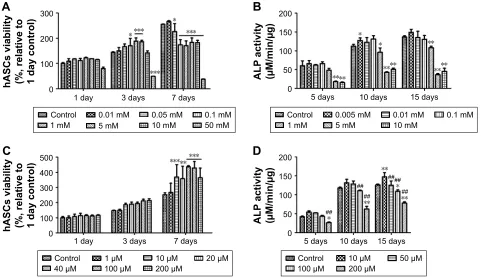
We confirmed how NAC and GNPs, independently, affect hASCs (Figure 3). In Figure 3A and C graphs, the group with no treatment of NAC or GNPs was set to control (100%), and the remaining groups were compared with the control group. NAC was evaluated in the range of 0.01–50 mM. The con-centration of 50 mM NAC was significantly lower (79.9%, 49.4%, and 37.8%) over all periods. All survival rates were
similar or slightly increased in all groups, except for 50 mM NAC. However, as the duration of drug treatment increased, the cell proliferation rate decreased at the groups treated with high concentrations of NAC. At 7 days, all NAC-treated groups, except the 0.01 mM NAC group (265.8%), were 22% lower than the control group (255.1%). On the contrary, all groups with added GNPs had a higher cell viability than the control group.
In the group treated with 40 µM GNPs for 7 days, the value of
viability was 1.73 times higher than the control group. ALP activity analysis was performed to confirm the bone differentiation effect of NAC and GNPs. It was performed within the noncytotoxic range, based on the viability analysis
GD\ K$6&VYLDELOLW\ UHODWLYHWR GD\FRQWURO
$
GD\V GD\V 0 &RQWURO 0 0 0 0 0K$6&VYLDELOLW\ UHODWLYHWR GD\FRQWURO
GD\ GD\V GD\V
&
P0 &RQWURO P0 P0 P0 P0 P0 $/3 DFWLYLW\ 0PLQJ%
GD\V GD\V GD\V
0 &RQWURO 0 0 0 $/3 DFWLYLW\ 0PLQJ
'
GD\V GD\V GD\V
&RQWURO
P0 P0 P0
P0 P0
P0 P0
Figure 3 evaluation of viability (A, C) and alP activity (B, D) of hascs at various concentrations of Nac (A, B) and gNPs (C, D). results are mean ± sD of triplicate experiments: *P,0.05, **P,0.01, and ***P,0.001 represent significant difference compared with control group, and ##P,0.01 represent significant difference compared with 10 µM group.
Abbreviations: gNPs, gold nanoparticles; hascs, human-derived stem cells; Nac, N-acetyl cysteine; alP, alkaline phosphatase.
International Journal of Nanomedicine downloaded from https://www.dovepress.com/ by 118.70.13.36 on 23-Aug-2020
Dovepress
lee et al
$/3
DFWLYLW\
0JPLQ
GD\V GD\V GD\V &RQWURO
*13V 1$&
*1$&
GD\ GD\V K$6&VYLDELOLW\ UHODWLYHWR GD\FRQWURO
GD\V &RQWURO
*13V 1$& *1$&
%
$
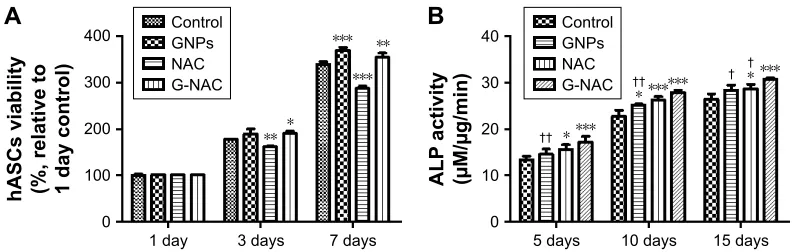
Figure 4 evaluation of viability (A) and alP activity (B) of hascs at 20 µM gNPs, 2.2 µM Nac, and 20 µM g-Nac. results are mean ± sD of triplicate experiments: *P,0.05, **P,0.01, and ***P,0.001 represent significant differences compared with control group, and †P,0.05 and ††P,0.01 represent significant differences compared with G-NAC
group.
Abbreviations: g-Nac, gold nanoparticles-N-acetyl cysteine; gNPs, gold nanoparticles; hascs, human-derived stem cells; Nac, N-acetyl cysteine.
results of hASCs. The ALP activity of 1 mM NAC was
measured to be 48.4, 96.1, and 108.4 µM/min/µg at 5, 10,
and 15 days, respectively. This was significantly lower than the control group (Figure 3B). In the ALP activity of GNPs,
10 µM GNPs was higher at all time periods. However, at
concentrations above 50 µM, the ALP activity tended to
decrease as the concentration of GNPs increased, unlike viability (Figure 3D). Thus, the concentration of GNPs was
further subdivided into 50 µM and the ALP activity was
found to be the highest in the 20 µM group (Figure S1).
Cell viability and ALP activity by G-NAC were assessed after treatment with the same concentrations as GNPs (Figure S2). During the viability of hASCs test, the values were significantly different from control (146.3%) when
40, 100, and 200 µM of G-NAC were treated for 3 days.
At 7 days, the hASCs viability was 1.65 times higher than
control in 100 µM G-NAC group. The ALP activity by
G-NAC was highest when treated with 10 µM, and the values
were higher than the 50, 100, and 200 µM G-NAC groups.
Based on the above results, a comparative evaluation of GNPs, NAC, and G-NAC for viability and ALP activity was performed. GNPs and G-NAC were treated at a concentration
of 20 µM and NAC at a concentration of 2.2 µM (Figure 4).
The NAC-treated group at 7 days showed 0.85-fold the con-trol group for viability, but the values of ALP activity were 1.17-, 1.16-, and 1.09-fold the control group at 5, 10, and 15 days, respectively. GNPs and G-NAC showed higher cell viability than the control group, but there was no significant difference between them. However, ALP activity showed a significant difference, by a maximum of 1.18 times and a minimum of 1.08 times higher than GNPs in G-NAC.
Intercellular uptake of gNPs and g-Nac
The hASCs were cultured in confocal dishes and then treated
with 20 µM of GNPs and G-NAC, respectively, to observe
the uptake of GNPs and G-NAC into the cells (Figure 5). The absorption of GNPs and G-NAC into the cells was observed in the bright field image (Figure 5A and C). In the DF image, however, only the absorbed particles were observed in white and there is little difference in absorbed amount. DF images were quantitatively compared using the ImageJ program, resulting in almost no difference between GNPs (2.38%) and G-NACs (2.27%) (Figure 5E).
Preparation and characterization of
gel-Ty hydrogel
In the 1H NMR analysis of synthesized Gel-Ty and gelatin,
the unique peaks were detected in Gel-Ty at 7.2 and 6.9 ppm (Figure 6A). The synthesized Gel-Ty was in a liquid state when it was dissolved in PBS, but retained a viscoelastic
solid form after HRP and H2O2 were added (Figure 6C). The
resulting Gel-Ty hydrogel was fixed at 5% stress at room tem-perature using a rheometer, and the modulus was measured by increasing the frequency from 0.1 to 40 Hz. The loss elastic
modulus (G″) of the 5%, 6.5%, and 8% Gel-Ty hydrogels was
4.32±0.86, 5.32±0.96, and 6.56±0.71, respectively. However,
the storage modulus (G′) greatly increased in proportion to
the increase of Gel-Ty concentration (Figure 6B).
Viability and alP activity of hascs on the
gel-Ty and gel-Ty/g-Nac hydrogels
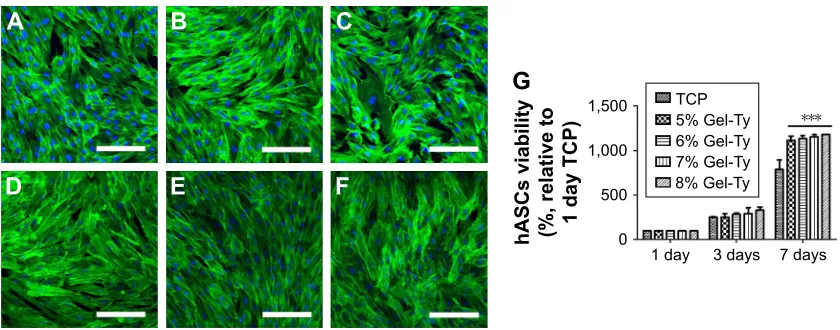
The hASC viability was evaluated in and out of the hydro-gel to determine the optimum concentration of Gel-Ty for loading G-NAC. Cells cultured on 5%–8% Gel-Ty surface were fluorescently stained and confirmed that they pro-liferated well in all groups using CLSM (Figure S3A–F). In addition, there was no significant difference at all con-centrations of Gel-Ty as shown in Figure S3G. However, at 7 days, the values of all hydrogel groups were 1.5 times higher than the hASCs cultured in the tissue culture plate
International Journal of Nanomedicine downloaded from https://www.dovepress.com/ by 118.70.13.36 on 23-Aug-2020
Dovepress Nanoparticle-hydrogel composite scaffold for bone regeneration
*13V%)
$
%
&
'
*13V')
*1$&%) *1$&')
(
*13V
8SWDNHUDWLR
*1$&
Figure 5 BF and DF images of hascs treated with 20 µM gNPs (A, B) and g-Nac (C, D) for 1 day. The DF images evaluated by ImageJ program (bright pixel/total pixel), and the results are mean ± sD of triplicate experiments (E). scale bars are 100 µm.
Abbreviations: BF, bright field; DF, dark field; G-NAC, gold nanoparticles-N-acetyl cysteine; gNPs, gold nanoparticles; hascs, human-derived stem cells.
Figure 6 characterization of gel-Ty hydrogels.
Notes: 1h NMr spectrum of the gelatin and gel-Ty (A). Image of 5% gel-Ty solution, and cross-linked gel-Ty hydrogel after addition of hrP and h
2O2 (B). Frequency
dependence of storage modulus (g′) and loss modulus (g″) for various concentrations of gel-Ty (C). results are means ± sD of triplicate experiments. Abbreviations: gel-Ty, gelatin–tyramine; 1h NMr, proton nuclear magnetic resonance; hrP, horseradish peroxidase; h
2O2, hydrogen peroxide; ppm, parts per million.
&KHPLFDOVKLIWSSP
*HODWLQ *HO7\
)UHTXHQF\+]
0RGXOXV3D
*′*HO7\ *′′*HO7\ *′*HO7\ *′′*HO7\ *′*HO7\ *′′*HO7\
%
$
%HIRUHFURVVOLQNLQJ $IWHUFURVVOLQNLQJ
&
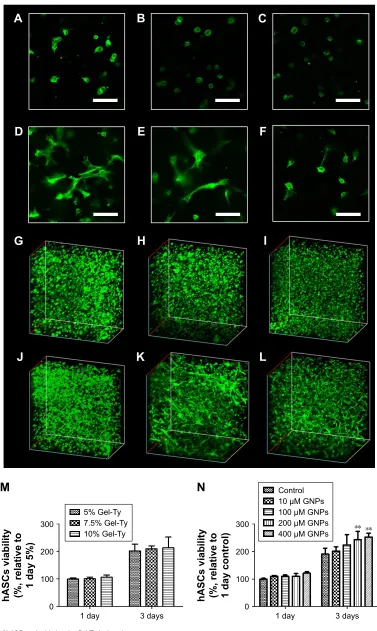
set as the control group. The number of living cells in the hydrogels was similar among the groups (Figure 7M), but the shape of 5% and 7.5% Gel-Ty hydrogels did not main-tain well after 3 days compared with 10% Gel-Ty groups (Figure 7A–L). To evaluate the applicability of GNPs to Gel-Ty hydrogels, cell viability was measured by prepar-ing 10% Gel-Ty complexes with various concentrations of GNPs (Figure 7N). As a result, it was confirmed that the cell viability was increased as the concentration of GNPs
increased. Particularly, at the concentration of 200 µM or
more, there was a significant difference compared with the control group.
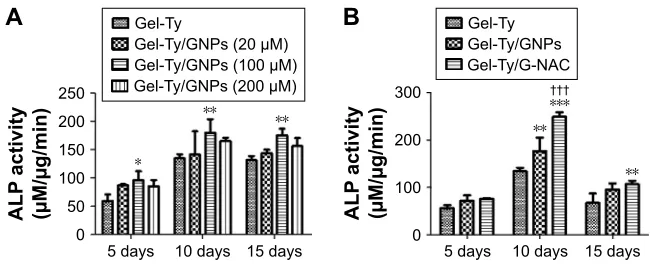
The ALP activity occurred at the Gel-Ty hydrogels containing various concentrations of GNPs (Figure 8A).
Samples containing 100 µM of GNPs showed the highest
values compared with the other groups at the 5, 10, and 15 days and at least 1.33 times and 1.62 times higher than the samples
without GNPs; 20 and 200 µM GNPs were all better than
con-trols, but they were lower than the samples containing 100 µM
GNPs. Based on these results, a comparative experiment was performed on the osteodifferentiation effects of Gel-Ty/GNPs
and Gel-Ty/G-NAC containing 100 µM of nanoparticles
(Figure 8B). Gel-Ty/G-NAC values were 1.85 times and 1.41 times higher than Gel-Ty and Gel-Ty/GNP, respectively.
International Journal of Nanomedicine downloaded from https://www.dovepress.com/ by 118.70.13.36 on 23-Aug-2020
Dovepress
lee et al
Figure 7 Viability of hascs embedded in the gel-Ty hydrogels.
Notes: The clsM images of 5% (A, D, G, J), 7.5% (B, E, H, K), and 10% gel-Ty hydrogel (C, F, I, L) after culture during 1 (A–C, G–I) and 3 days (D–F, J–L). F-actin of hascs is green, and scale bar is 100 µm. The viability of hascs embedded inside the gel-Ty (M) and gel-Ty/gNPs (N) hydrogels for 3 days. results are mean ± sD of triplicate experiments: **P,0.01 represent significant differences compared with control group.
Abbreviations: clsM, confocal laser scanning microscopy; gel-Ty, gelatin–tyramine; gel-Ty/gNPs, gelatin–tyramine/gold nanoparticles; hascs, human-derived stem cells.
$
%
&
'
(
)
*
+
,
-
.
/
GD\ GD\V
K$6&VYLDELOLW\ UHODWLYHWR GD\
*HO7\ *HO7\
*HO7\
GD\ GD\V
K$6&VYLDELOLW\ UHODWLYHWR GD\FRQWURO
&RQWURO 0*13V 0*13V 0*13V 0*13V
1
0
International Journal of Nanomedicine downloaded from https://www.dovepress.com/ by 118.70.13.36 on 23-Aug-2020
Dovepress Nanoparticle-hydrogel composite scaffold for bone regeneration
$/3
DFWLYLW\
0JPLQ
%
GD\V GD\V GD\V *HO7\
*HO7\*13V *HO7\*1$&
$
$/3
DFWLYLW\
0JPLQ
GD\V GD\V GD\V *HO7\
*HO7\*13V0 *HO7\*13V0 *HO7\*13V0
Figure 8 alP activity of hascs on the gel-Ty/gNPs (A) and gel-Ty/g-Nac (B).
Note: results are means ± sD of triplicate experiments: *P,0.05 and **P,0.01 represent significant difference compared with control group, ***P,0.001 represent significant difference compared with control group, and †††P,0.001 represent significant difference compared with Gel-Ty/GNPs group.
Abbreviations: gel-Ty/gNPs, gelatin–tyramine/gold nanoparticles; gel-Ty/g-Nac, gelatin–tyramine/gold nanoparticles-N-acetyl cysteine; hascs, human-derived stem cells.
Discussion
GNPs have been used in the biomedical field for a variety of applications such as drug delivery, diagnosis, anticancer,
and tissue regeneration.13,31 For bone regeneration, GNPs are
involved in the p38 mitogen-activated protein kinase signal-ing pathway when they are absorbed into mesenchymal stem cells (MSCs). This reaction induces osteoblast growth by activating osteoprogenitor factors and inhibiting adipogenic
factors in the nucleus.17 Based on this theory, we have found
positive results in several bone regeneration studies using
GNPs.16,32 In the previous study, we reported that GNPs of
30 and 50 nm diameter were effective in increasing osteo-differentiation through the expression of the Runx2 gene
as well as endocytosis.33 In addition, GNPs have different
properties for organ accumulation and toxicity by diameter, with 30 nm diameter GNPs causing a decrease in leukocyte and red blood cells in the blood and accumulating in the
spleen. This has been reported to be safer than other sizes.12,34
Therefore, we fabricated GNPs with a size of about 30 nm and
confirmed that 35.83±0.9 nm GNPs were fabricated through
DLS analysis. In the DLS results, the distribution range of 28–32 nm was the highest range and PDI was measured as 0.3, which proved that GNPs of the desired size were uniformly produced (Figure 2A).
GNPs are produced by citrate reduction method, which is the most common method, and it is still widely used because
it can be made simply by DW, HAuCl4, and sodium citrate.30
The GNPs thus fabricated have surface area properties that easily couple with hydrophobic groups, anionic groups,
and thiol groups.35 NAC, with a thiol group, easily bonds
with GNPs. Due to the localized surface plasmon resonance characteristic of the gold surface, the absorption and scattering wavelengths are different depending on the organic matter
when the organic material is bonded to the gold surface.36,37
UV-vis spectrum was measured using the properties of these GNPs, and the maximum absorption wavelength of G-NAC was shifted 4.5 nm compared with GNPs (Figure 2B). As a result, the binding of NAC was demonstrated.
The NAC-synthesized G-NAC was quantitated by TGA. The difference in mass reduction between GNPs and G-NAC was 0.911% and NAC was 82.58% when the NAC, GNPs, and
G-NACs were heated to 800°C. The difference in mass
reduc-tion rates between G-NAC and GNPs is due to pyrolysis of the
NAC bound to the GNPs surface.12 Thus, the mass difference
between GNPs and G-NAC corresponded to 17.42% of the NAC mass. The mass of the combined NAC was calculated to be 5.23% of the GNPs mass. Zhu et al demonstrated that the intracellular uptake of functionalized GNPs was influenced
by hydrophobicity and charge.38 Jiang et al reported that the
rate of cell uptake depended on the size of the nanoparticles.39
Therefore, in this study, DF microscope assay was performed to determine whether NAC attachment affects cell uptake. In Figure 5, there was no significant difference in the cellular uptake of GNPs and G-NAC, suggesting that GNPs might be useful for intracellular delivery of NAC. G-NAC, which is absorbed into the cells, can be separated to GNPs and NAC by
glutathione and, after cleavage, these act independently.13
The reactive oxygen species (ROS) refers to oxygen in a deformed and unstable state, such as superoxide ion and hydroxyl radical. Reduction of ROS in MSCs promotes osteogenesis by stimulating the Wnt and MAPK pathway while inhibiting adipogenesis through inhibiting CCAAT/
enhancer-binding proteins (CEBPs).23 We have applied
NAC, a widely used antioxidant, to GNPs to accelerate bone differentiation. When NAC was used alone, the hASCs displayed cytotoxicity at concentrations exceeding 10 mM, so experiments were conducted at concentrations lower than that (Figure 3A). Figures 3 and 4 show that GNPs and
International Journal of Nanomedicine downloaded from https://www.dovepress.com/ by 118.70.13.36 on 23-Aug-2020
Dovepress
lee et al
G-NAC promote osteodifferentiation of hASCs especially at
20 µM concentration. In addition, a small amount of NAC, as
much as adding 20 µM G-NAC, promoted
osteodifferentia-tion similar to the 20 µM GNPs, despite relatively low cell
viability. A comparative evaluation of the ALP activity of GNPs, NAC, and G-NAC demonstrated that NAC bound to GNPs works to synergistically improve bone regeneration as shown by the highest ALP value in G-NAC (Figure 4).
We conjugated the amino group of Ty to the carboxyl groups of gelatin to bind the phenol group for the cross-linking reaction to the gelatin. As a result, gelatin with a hydroxyl phenol group was synthesized and the peaks of the phenyl protons of Ty present in Gel-Ty were observed at 7.2 and
6.9 ppm (Figure 6A).40 The synthesized Gel-Ty is dissolved
in PBS. Subsequently, HRP and H2O2 are added to form a
hydrogel through dehydrogenation between phenol analogs (Figure 6C). HRP, an alpha-helical protein bound to a heme
group, acts as a catalyst for the radical generation of H2O2.
One H2O2 reacts with HRP to produce two phenolic radicals,
and these form hydrogels by causing cross-linking within
the Gel-Ty by phenol groups.41 The Gel-Ty hydrogel
cross-linking can be easily controlled depending on concentration and its stiffness was increased in proportion to concentration (Figure 6B). In addition, because the number of radicals
generated according to the concentration of H2O2 or HRP
varied, it can be used to control the mechanical strength or gelation time of the hydrogel. Thus, it has been used in many
studies.42–47 Biocompatibility was assessed by incubating cells
on the surface and inside of Gel-Ty hydrogel. Cell viability was not significantly different between hydrogels at all con-centrations. However, as the hydrogel intensity decreased in the low concentration of Gel-Ty, it was degraded in a short time (Figure 7J, K and L). Therefore, 10% Gel-Ty was selected as the hydrogel to apply G-NAC. The viability of hASCs inside the Gel-Ty hydrogel with various concentra-tions of GNPs was positively correlated with the number of GNPs, confirming the possibility of G-NAC loading (Figure 7N). Experiments in which GNPs are directly applied to hASCs were added to additional GNPs whenever media were replaced, but not when GNPs or G-NAC were contained in Gel-Ty hydrogels. Thus, hydrogel experiments with nano-particles proceeded with higher concentrations of nanopar-ticles than the studies using only nanoparnanopar-ticles (Figure 8). The bone differentiation effect of Gel-Ty containing various
concentrations of GNPs was highest at 100 µM (Figure 8A).
The GNPs and G-NAC were found to have the highest
bone mineralization promoting effect at 20 µM, while the
total amount of nanoparticles treated for 15 days was about
100 µM (Figures S1 and 4B). In addition, low ALP activity
was measured at higher or lower concentrations of GNPs, similar to experiments in which only nanoparticles were used. As a result, it was once again confirmed that there is a proper concentration for maximizing the bone differentiation promoting effect. It was proved that G-NAC preserves its excellent bone differentiation promoting effects even when applied to Gle-Ty through the comparative study of Gel-Ty
hydrogels containing 100 µM GNPs and G-NAC.
Conclusion
In summary, we conducted an evaluation of GNPs and NAC, which are substances capable of promoting osteodifferen-tiation. Based on these results, we designed and prepared G-NAC, and the biocompatibility and osteodifferentiation promoting effects of G-NAC were demonstrated by the viability and ALP activity of hASCs. In addition, Gel-Ty, which is a gelatin-based enzyme cross-linked hydrogel capable of positioning G-NAC in bone defects, was pre-pared for effective bone regeneration. The condition of Gel-Ty hydrogel suitable for tissue regeneration was also established by in vitro experiments. The applicability of hASCs encapsulation to hydrogels was confirmed through the biocompatibility test of Gel-Ty hydrogel containing GNPs. Evaluation of bone differentiation and regeneration ability of Ge-Ty/G-NAC hydrogel will be analyzed later through in vitro and in vivo experiments. These results demonstrate that the Gel-Ty/G-NAC complex can be used as an injectable hydrogel for bone regeneration. Our results suggest that it can be widely applied to the bone tissue engineering field.
Acknowledgments
This research was supported by the Bio & Medical Technology Development Program of the National Research Foundation (NRF) and funded by the Korean government (MSIP&MOHW) (No 2017M3A9E4048170).
Disclosure
The authors report no conflicts of interest in this work.
References
1. Kinaci A, Neuhaus V, Ring DC. Trends in bone graft use in the United States. Orthopedics. 2014;37(9):e783–e788.
2. Vaccaro AR, Chiba K, Heller JG, et al; North American Spine Society for Contemporary Concepts in Spine Care. Bone grafting alternatives in spinal surgery. Spine J. 2002;2(3):206–215.
3. Clavero J, Lundgren S. Ramus or chin grafts for maxillary sinus inlay and local onlay augmentation: comparison of donor site morbidity and complications. Clin Implant Dent Relat Res. 2003;5(3):154–160.
International Journal of Nanomedicine downloaded from https://www.dovepress.com/ by 118.70.13.36 on 23-Aug-2020
Dovepress Nanoparticle-hydrogel composite scaffold for bone regeneration
4. Marx RE, Morales MJ. Morbidity from bone harvest in major jaw recon-struction: a randomized trial comparing the lateral anterior and posterior approaches to the ilium. J Oral Maxillofac Surg. 1988;46(3):196–203. 5. Bauer TW, Muschler GF. Bone graft materials. An overview of the
basic science. Clin Orthop Relat Res. 2000;(371):10–27.
6. Jones JR. Reprint of: Review of bioactive glass: from Hench to hybrids.
Acta Biomater. 2015;23(Suppl):S53–S82.
7. García-Gareta E, Coathup MJ, Blunn GW. Osteoinduction of bone grafting materials for bone repair and regeneration. Bone. 2015;81:112–121. 8. Kleinschmidt K, Ploeger F, Nickel J, Glockenmeier J, Kunz P,
Richter W. Enhanced reconstruction of long bone architecture by a growth factor mutant combining positive features of GDF-5 and BMP-2.
Biomaterials. 2013;34(24):5926–5936.
9. Wang M, Deng Y, Zhou P, et al. In vitro culture and directed osteogenic differentiation of human pluripotent stem cells on peptides-decorated two-dimensional microenvironment. ACS Appl Mater Interfaces. 2015; 7(8):4560–4572.
10. Richards DA, Maruani A, Chudasama V. Antibody fragments as nano-particle targeting ligands: a step in the right direction. Chem Sci. 2017; 8(1):63–77.
11. Tverdokhlebov S, Bolbasov E, Shesterikov E. Scaffold materials based on fluorocarbon composites modified with RF magnetron sputtering. In: Osteogenesis. London, InTech; 2012:83–116.
12. Lee D, Heo DN, Kim HJ, et al. Inhibition of osteoclast differentiation and bone resorption by bisphosphonate-conjugated gold nanoparticles.
Sci Rep. 2016;6:27336.
13. Ghosh P, Han G, De M, Kim CK, Rotello VM. Gold nanoparticles in delivery applications. Adv Drug Deliv Rev. 2008;60(11):1307–1315. 14. Shukla R, Bansal V, Chaudhary M, Basu A, Bhonde RR, Sastry M.
Biocompatibility of gold nanoparticles and their endocytotic fate inside the cellular compartment: a microscopic overview. Langmuir. 2005; 21(23):10644–10654.
15. Shi X, Wang S, Sun H, Baker JR. Improved biocompatibility of surface functionalized dendrimer-entrapped gold nanoparticles. Soft Matter. 2007;3(1):71–74.
16. Lee D, Heo DN, Lee SJ, et al. Poly(lactide-co-glycolide) nanofibrous scaffolds chemically coated with gold-nanoparticles as osteoinductive agents for osteogenesis. Appl Surf Sci. 2018;432:300–307.
17. Yi C, Liu D, Fong CC, Zhang J, Yang M. Gold nanoparticles promote osteogenic differentiation of mesenchymal stem cells through p38 MAPK pathway. ACS Nano. 2010;4(11):6439–6448.
18. Zhou J, Zhang Y, Li L, Fu H, Yang W, Yan F. Human β-defensin 3-combined gold nanoparticles for enhancement of osteogenic dif-ferentiation of human periodontal ligament cells in inflammatory microenvironments. Int J Nanomedicine. 2018;13:555–567. 19. Heo DN, Ko W-K, Bae MS, et al. Enhanced bone regeneration with
a gold nanoparticle–hydrogel complex. J Mater Chem B. 2014;2(11): 1584–1593.
20. Wang N, Qian P, Kumar S, Yan TD, Phan K. The effect of N-acetylcysteine on the incidence of contrast-induced kidney injury: a systematic review and trial sequential analysis. Int J Cardiol. 2016;209:319–327. 21. Mokhtari V, Afsharian P, Shahhoseini M, Kalantar SM, Moini A. A review
on various uses of N-acetyl cysteine. Cell J. 2017;19(1):11–17. 22. Yamada M, Tsukimura N, Ikeda T, et al. N-acetyl cysteine as an
osteogenesis-enhancing molecule for bone regeneration. Biomaterials. 2013;34(26):6147–6156.
23. Atashi F, Modarressi A, Pepper MS. The role of reactive oxygen species in mesenchymal stem cell adipogenic and osteogenic differentiation: a review. Stem Cells Dev. 2015;24(10):1150–1163.
24. Lee KY, Mooney DJ. Hydrogels for tissue engineering. Chem Rev. 2001;101(7):1869–1880.
25. Park SH, Kwon JS, Lee BS, et al. BMP2-modified injectable hydrogel for osteogenic differentiation of human periodontal ligament stem cells.
Sci Rep. 2017;7(1):6603.
26. Mi L, Liu H, Gao Y, Miao H, Ruan J. Injectable nanoparticles/hydrogels composite as sustained release system with stromal cell-derived factor-1α for calvarial bone regeneration. Int J Biol Macromol. 2017;101: 341–347.
27. Vishnu Priya M, Sivshanmugam A, Boccaccini AR, et al. Injectable osteogenic and angiogenic nanocomposite hydrogels for irregular bone defects. Biomed Mater. 2016;11(3):035017.
28. Vo TN, Shah SR, Lu S, et al. Injectable dual-gelling cell-laden com-posite hydrogels for bone tissue engineering. Biomaterials. 2016;83: 1–11.
29. Koshy ST, Desai RM, Joly P, et al. Click-crosslinked injectable gelatin hydrogels. Adv Healthc Mater. 2016;5(5):541–547.
30. Daniel MC, Astruc D. Gold nanoparticles: Assembly, supramo-lecular chemistry, quantum-size-related properties, and applica-tions toward biology, catalysis, and nanotechnology. Chem Rev. 2004;104(1):293–346.
31. Yeh YC, Creran B, Rotello VM. Gold nanoparticles: preparation, prop-erties, and applications in bionanotechnology. Nanoscale. 2012;4(6): 1871–1880.
32. Heo DN, Ko WK, Lee HR, et al. Titanium dental implants surface-immobilized with gold nanoparticles as osteoinductive agents for rapid osseointegration. J Colloid Interface Sci. 2016;469:129–137. 33. Ko WK, Heo DN, Moon HJ, et al. The effect of gold nanoparticle size
on osteogenic differentiation of adipose-derived stem cells. J Colloid
Interface Sci. 2015;438:68–76.
34. Zhang XD, Wu D, Shen X, et al. Size-dependent in vivo toxicity of PEG-coated gold nanoparticles. Int J Nanomedicine. 2011;6:2071–2081. 35. Hermanson GT. Bioconjugate Techniques. London: Academic Press;
2013.
36. Pattnaik P. Surface plasmon resonance. Appl Biochem Biotechnol. 2005;126(2):79–92.
37. Jain PK, Qian W, El-Sayed MA. Ultrafast cooling of photoexcited electrons in gold nanoparticle-thiolated DNA conjugates involves the dissociation of the gold-thiol bond. J Am Chem Soc. 2006;128(7): 2426–2433.
38. Zhu ZJ, Ghosh PS, Miranda OR, Vachet RW, Rotello VM. Multiplexed screening of cellular uptake of gold nanoparticles using laser desorption/ ionization mass spectrometry. J Am Chem Soc. 2008;130(43): 14139–14143.
39. Jiang W, Kim BY, Rutka JT, Chan WC. Nanoparticle-mediated cellular response is size-dependent. Nat Nanotechnol. 2008;3(3):145–150. 40. Fan Z, Zhang Y, Fang S, Xu C, Li X. Bienzymatically crosslinked
gelatin/hyaluronic acid interpenetrating network hydrogels: preparation and characterization. RSC Adv. 2015;5(3):1929–1936.
41. Kurisawa M, Chung JE, Yang YY, Gao SJ, Uyama H. Injectable biode-gradable hydrogels composed of hyaluronic acid-tyramine conjugates for drug delivery and tissue engineering. Chem Commun (Camb). 2005;(34): 4312–4314.
42. Kobayashi S, Uyama H, Kimura S. Enzymatic polymerization. Chem
Rev. 2001;101(12):3793–3818.
43. Li Z, Qu T, Ding C, et al. Injectable gelatin derivative hydrogels with sustained vascular endothelial growth factor release for induced angio-genesis. Acta Biomater. 2015;13:88–100.
44. Arora A, Mahajan A, Katti DS. TGF-β1 presenting enzymatically cross-linked injectable hydrogels for improved chondrogenesis. Colloids Surf
B Biointerfaces. 2017;159:838–848.
45. Bystroňová J, Čigalková I, Wolfová L, Pravda M, Vrana NE, Velebný V. Creating a 3D microenvironment for monocyte cultivation: ECM-mimicking hydrogels based on gelatine and hyaluronic acid derivatives.
RSC Adv. 2018;8(14):7606–7614.
46. Vial S, Reis RL, Oliveira JM. Recent advances using gold nanoparticles as a promising multimodal tool for tissue engineering and regenerative medicine. Curr Opin Solid State Mater Sci. 2017;21(2):92–112. 47. Lee SJ, Lee HJ, Kim SY, et al. In situ gold nanoparticle growth on
polydopamine-coated 3D-printed scaffolds improves osteogenic dif-ferentiation for bone tissue engineering applications: in vitro and in vivo studies. Nanoscale. 2018;10(33):15447–15453.
International Journal of Nanomedicine downloaded from https://www.dovepress.com/ by 118.70.13.36 on 23-Aug-2020
Dovepress
lee et al
Supplementary materials
GD\V
$/3
DFWLYLW\
0PJPLQ
GD\V
&RQWURO 0 0 0 0 0
Figure S1 evaluation of alP activity of hascs at various concentrations of gNPs below 40 µM. results are mean ± sD of triplicate experiments: *P,0.05, **P,0.01, and ***P,0.001 represent significant difference compared with control group.
Abbreviations: gNPs, gold nanoparticles; hascs, human-derived stem cells.
GD\
K$6&VYLDELOLW\ UHODWLYHWR GD\FRQWURO
$
GD\V GD\V
&RQWURO 0 0 0 0 0 0
$/3
DFWLYLW\
0PLQJ
%
GD\V GD\V GD\V
&RQWURO 0 0 0 0
Figure S2 evaluation of viability (A) and alP activity (B) of hascs at various concentrations of g-Nac. results are mean ± sD of triplicate experiments: *P,0.05, **P,0.01, and ***P,0.001 represent significant differences compared with control group, and #P,0.05 and ##P,0.01 represent significant differences compared with 10 µM group.
Abbreviations: g-Nac, gold nanoparticles-N-acetyl cysteine; hascs, human-derived stem cells.
$
%
&
'
(
)
GD\
K$6&VYLDELOLW\ UHODWLYHWR GD\7&3
*
GD\V GD\V
7&3 *HO7\ *HO7\ *HO7\ *HO7\
Figure S3 Viability of hascs on the gel-Ty hydrogel surface. The clsM images of 5% (A, D), 7.5% (B, E), and 10% gel-Ty hydrogel (C, F) after culture during 1 (A–C) and 3 days (D–F). F-actin of hascs is green and the nucleus of hascs is blue. scale bar is 200 µm. Images collected at 200× magnification. The cell viability assay on the gel-Ty hydrogels for 7 days using eZ-cytox assay (G). results are mean ± sD of triplicate experiments: ***P,0.001 represent significant differences compared with tissue culture plate group.
Abbreviations: clsM, confocal laser scanning microscopy; gel-Ty, gelatin–tyramine; hascs, human-derived stem cells; TcP, tissue culture plate.
International Journal of Nanomedicine downloaded from https://www.dovepress.com/ by 118.70.13.36 on 23-Aug-2020
International Journal of Nanomedicine
Publish your work in this journal
Submit your manuscript here: http://www.dovepress.com/international-journal-of-nanomedicine-journal
The International Journal of Nanomedicine is an international, peer-reviewed journal focusing on the application of nanotechnology in diagnostics, therapeutics, and drug delivery systems throughout the biomedical field. This journal is indexed on PubMed Central, MedLine, CAS, SciSearch®, Current Contents®/Clinical Medicine,
Journal Citation Reports/Science Edition, EMBase, Scopus and the Elsevier Bibliographic databases. The manuscript management system is completely online and includes a very quick and fair peer-review system, which is all easy to use. Visit http://www.dovepress.com/ testimonials.php to read real quotes from published authors.
Dovepress
Dove
press
Nanoparticle-hydrogel composite scaffold for bone regeneration
International Journal of Nanomedicine downloaded from https://www.dovepress.com/ by 118.70.13.36 on 23-Aug-2020