1 Article
1
Bioleaching of chalcopyrite by pure and mixed cultures at low temperature
2
3
Tangjian Peng1, 2, Jingshu Wang1, Jie Miao1, Guohua Gu 1, 2, Guanzhou Qiu1, 2, Erdenechimeg Dolgor3,
4
Weimin Zeng 1, 2, 4*
5
6
1 School of Minerals Processing and Bioengineering, Central South University, Changsha 410083,
7
China; [email protected] (T.P.); [email protected] (J.W.);
8
[email protected] (J.M.)
9
2 Key Laboratory of Biometallurgy, Ministry of Education, Changsha 410083, China;
10
[email protected], (G.G.); [email protected] (G.Q.); [email protected] (W.Z.)
11
3 Department of Chemical and Biological Engineering, School of Engineering and Applied Science,
12
National University of Mongolia, Ulaanbaatar 46A/272, Mongolia; [email protected]
13
(E. D.)
14
4 CSIRO Process Science and Engineering, Clayton, Victoria 3168, Australia
15
* Correspondence: [email protected]; Tel.: +86 731 88877472
Abstract: Low-temperature biohydrometallurgy is implicated in metal recovery in alpine mining area,
43
but our knowledge on its mechanism has been limited. To this end, an Acidithiobacillus ferrivorans
44
strain and a mixed culture were used for chalcopyrite bioleaching at 6 °C. The passivation of the
45
mineral surface was analyzed using X-ray photoelectron spectroscopy (XPS), the microbial community
46
structure of the mixed culture-mediated system was tested using high-throughput sequencing
47
technology, and the extracellular polymeric substances (EPS) and ferric iron on the microbe-mineral
48
interface were measured. A higher copper extraction rate was achieved using the mixed culture but it
49
did not relieve the passivation of the mineral surface. Acidithiobacillus spp. and Sulfobacillus spp. were
50
the two major lineages in the mixed culture-mediated system. In the fast-leaching stage, more EPS and
51
ferric iron were extracted in the mixed culture-mediated system. In conclusion, Sulfobacillus spp. can
52
relieve the inhibition of organic components to Acidithiobacillus spp., maintaining the robustness of the
53
leaching system and more Fe(III) complexed by elevated EPS can enhance chalcopyrite bioleaching by
54
the mixed culture.
55
56
Keywords: Chalcopyrite bioleaching; low temperature; microbial community; passivation;
57
extracellular polymeric substances; ferric iron
1. Introduction
85
Bioleaching as a green biotechnology offers an alternative to traditional pyrometallurgical methods for
86
extraction of valuable metals from sulfide minerals [1,2]. Studies on bioleaching have been extensively
87
carried out using mesophilic, moderate thermophilic and extremely thermophilic acidophiles [3-6]. On
88
the contrary, bioleaching at low temperature was only discussed in several documents. It was reported
89
that the microbially mediated dissolution of sulfide minerals can happen at temperature as low as 0°C
90
[7]. It was also found that chalcopyrite leaching rate at 4 °C was higher using the cold-adapted
91
Acidithiobacillus ferrivorans than the mesophilic A. ferrooxidans [8].
92
93
One of the topics of interest is to obtain a mixed culture in bioleaching of sulfide minerals. It has been
94
shown that using a mixed culture achieves a higher metal extraction rate than using a pure culture
95
[9,10]. On mesophilic and/or moderate thermophilic conditions, A. ferrooxidans, A. thiooxidans,
96
Leptospirillum spp., Sulfobacillus spp., A. caldus and Ferroplasma spp. were frequently detected in
97
mixed cultures [11,12]. Nonetheless, it was observed that the copper recovery was comparable using
98
the cold-adapted A. ferrivorans strain SS3 and the T7 mixed culture [13]. Bacterial community analysis
99
revealed the mixed culture was dominated by A. ferrivorans [8,13]. Similar result was obtained by
100
Halinen et al. [14].
101
102
Bioleaching is a complex process, which involves a series of (bio)chemical reactions and most
103
reactions happen at the microbes-mineral interface [15]. Microorganisms in bioleaching cultures can
104
secrete extracellular polymeric substances (EPS) and form biofilm at the microbe-mineral interface.
105
Biofilm plays an essential role in the interfacial reactions, which has been the interest of research in
106
recent years [15-18]. It was inferred that EPS has two main functions: mediate bacterial attachment to
107
the mineral surface, and concentrate ferric ions, the major oxidant in chalcopyrite bioleaching [19,20].
108
To date, EPS formation at low–temperature bioleaching cultures has been described only in few studies.
109
It was observed that cell adhesion at 4 °C was correlated with polysaccharides production [21].
110
111
In the present work, an A. ferrivorans strain YL15 and a bacterial consortium were respectively used
112
for chalcopyrite bioleaching at low temperature. The microbial community structure in the leaching
113
system by the mixed culture was analyzed. The passivation of mineral surface and the accumulation of
114
EPS and ferric iron on the cell-mineral interface in the two systems were investigated. The data were
115
used to explain the enhancement of chalcopyrite bioleaching by the mixed culture at low temperature.
116
The study would provide new knowledge into the mechanisms of chalcopyrite bioleaching at low
117
temperature.
118
119
2. Materials and methods
120
2.1 Mineral
121
Chalcopyrite sample was obtained from Guangzhou in Guangdong province of China. XRD analysis
122
showed that the sample contains 97.83% chalcopyrite and 2.17%. The sample consists of 33.1% copper,
123
28.7% iron and 35.4% sulfur. Sample was ground and sieved to obtain fractional sizes ≤ 75 μm and
124
sterilized by UV irradiation for 24 h in an aseptic room.
2.2 Cultures
127
Acidithiobacillus ferrivorans strain YL15 was isolated from acidic water (acid mine drainage pond) of
128
Yulong copper mine in Tibet of China [22]. The strain was routinely cultivated in iron-free 9K medium
129
[23] with chalcopyrite at a pulp density of 3% as a sole energy source at 6°C. Besides the acidic mine
130
drainage pond sample, another 4 water samples were collected from different sites: an acidic tailing
131
pool, two tailing dumps and an effusion pool. Each sample (including the acidic mine drainage pond
132
sample) was firstly filtered through qualitative filter paper to remove solid particles and then filtered
133
through a 0.22 μm polyethersulfone membrane. After that, microbial cells were washed down and
134
collected by centrifugation at 10,000 x g for 10 min. The harvested cells were combined together and
135
then cultivated using chalcopyrite as a sole energy source at 6°C. The obtained mixed culture was used
136
as a seed in our lab for chalcopyrite bioleaching at low temperature.
137
138
2.3 Bioleaching experiments
139
Bioleaching of chalcopyrite was conducted in 500 mL shake flasks. Chalcopyrite at a pulp density of 3%
140
and iron-free 9K medium (250 mL) were added into each flask. The pure culture of strain YL15 or the
141
mixed culture was centrifuged at 10,000x g for 10 min at 4°C to harvest cells. The collected cells were
142
washed using aseptic acidified water (pH2.0) for twice and then resuspended with 10 mL 9K medium.
143
Cells were added to the flasks and adjusted to obtain an initial cell density of approximately 2×10⁷
144
cells/mL. The flasks were operated at 160 rpm and the temperature was 6°C. Bioleaching experiments
145
were carried out in two groups: M-15 and MHJ. Chalcopyrite-grown cells of strain YL15 and the mix
146
culture were inoculated to groups M-15 and MHJ, respectively. An abiotic control was also conducted.
147
All the bioleaching experiments were carried out in triplicate.
148
149
Samples were withdrawn at regular intervals to determine the oxidation reduction potential (ORP), pH
150
values and metal ion concentrations. Concentrations of iron and copper were measured using the
151
method as described previously [23]. The pH value was measured with pHS-3E acid meter (LEICI,
152
Shanghai) and ORP (Ag/AgCl) value was assayed against a platinum electrode.
153
154
2.4 X-ray photoelectron spectroscopy (XPS) analysis
155
Ore residues were withdrawn at different stages of bioleaching. Sample preparation and XPS analysis
156
has been described in a previous document [23]. In brief, ore samples before or after bioleaching were
157
filtered, washed and dried in vacuum. XPS spectra of the samples were recorded at constant pass
158
energy of 20 eV and 0.1 eV/step using Al Ka X-ray source. Binding energies were referred to the C 1s
159
level at 284.8 eV. Peaks of S 2p were fitted using Savitsky-Golay model and Smart method (in
160
Avantage 5.52) for line smoothing and for obtaining the background of spectra, respectively. The ratio
161
of each sulfur species was calculated based on the area of each peak [23].
162
163
2.5 Sequencing of prokaryotic 16S rRNA gene sequences
164
Bioleaching samples of group MHJ were withdrawn at different time points. Sessile cells were
165
detached from mineral surface by vigorous vortex for 10 min in the presence of 1 gram of glass beads.
166
The obtained samples contained both free and detached cells and were centrifuged at 2,500 x g for 5
167
min to remove the ore residues. The obtained supernatants were centrifuged at 10,000 x g, 4 °C for 10
min to collect total cells. Genomic DNA was extracted as previously described [24]. The integrity of
169
DNA was checked on an agarose gel by ethidium bromide staining. Concentration of DNA was
170
measured using a ND-1000 spectrophotometer (NanoDrop Technologies, USA).
171
172
Detailed procedures for amplification and sequencing of prokaryotic V4 hypervariable region of 16S
173
rRNA gene have been described in a previous document [25]. Briefly, sequences of V4 region of
174
prokaryotic 16S rRNA gene were amplified using the universal primers 515F and 806R [26] linked
175
with barcodes, adapter, a pad and a linker of two bases. The purified PCR products were employed for
176
library construction. The MiSeq 500 kit was used for sequencing (2 x 250 bp paired-ends) on the
177
MiSeq sequencing platform (Illumina, USA).
178
179
Raw sequences were split to samples based on their barcodes. The raw sequencing data was deposited
180
at Sequence Read Archive under the accession number SRP133342. After sequence trimming, reads
181
assembly and chimeras sequences checking, operational taxonomic unit (OTU) clustering was
182
performed using UPARSE at a 97% similarity level. Thereafter, taxonomic affiliation of each sequence
183
was analyzed using RDP Classifier against the SILVA 16S rRNA database at a 70% threshold [27].
184
185
2.6 Extraction of EPS and ferric iron on the mineral surface
186
The extraction of EPS from bioleaching system was performed as described in our previous study [28].
187
To confirm that cells were not damaged during extraction, concentration of glucose 6-phosphate
188
dehydrogenase (G6PDH) in the extracts was measured [28]. The low content of G6PDH indicated the
189
extracts were not contaminated by a significant amount of intracellular components. Contents of
190
polysaccharides, proteins and eDNAs of EPS were determined as previously reported [15]. The
191
EPS-bound iron on the mineral surface was extracted by ultrasonic for 30°C as described in a previous
192
report [29] and the extraction was performed on ice for 30 min. All experiments were performed in
193
triplicate. Statistical analysis was performed using the Student’s t-test in R (version 3.6.0,
194
https://www.r-project.org).
195
196
3 Results
197
3.1 Bioleaching of chalcopyrite by the pure and mixed cultures
198
An Acidithiobacillus ferrivorans strain YL15 (group M-15) and a mixed culture (group MHJ) were
199
used for bioleaching of chalcopyrite at 6 °C. As is shown in Figure 1a, pH increased to about 2.5 in the
200
first 4 days in group MHJ, this is due to that protons attacked chalcopyrite and the generation of
201
protons derived from microbial sulfur oxidation is less than the consumption of protons in this stage.
202
After day 12, as microbial sulfur oxidation accelerated, pH started to decrease and achieved ~2.0 on
203
day 24. ORP value in the first 12 days was low, but after that it rocketed up to ~600 mV (Figure 1b).
204
Trends in group M-15 was similar to group MHJ, and the main difference was that pH decreased
205
between days 16-28.
207
Figure 1. Variations of pH (a) and ORP (b) during chalcopyrite bioleaching.
208
As illuminated by the Nernst equation:
209
E = E0+RT F ln
[Fe3+]
[Fe2+] [1]
210
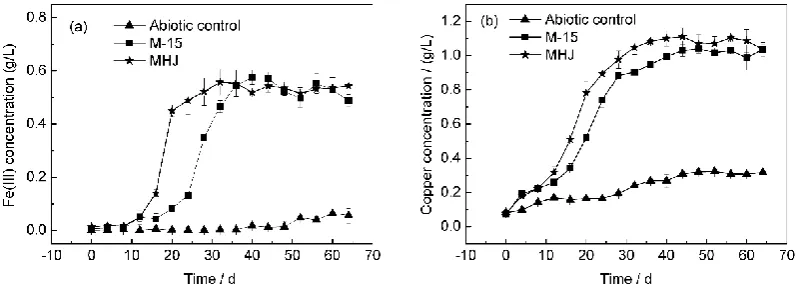
The value of ORP is mainly controlled by the ratio of Fe(III) to Fe(II). Variations of Fe(III) and Fe(II)
211
concentrations are shown in Figure 2a and Figure S1, respectively. The ratio of Fe(III) to Fe(II) was
212
low in the early stage. After that, as microbial oxidation of ferrous iron accelerated, concentration of
213
Fe(III) increased, accompanied with a decrease in the concentration of Fe(II). This was in accordance
214
with the low ORP value in the early stage and its rapid rise thereafter (Figure 1b). The copper
215
concentration in groups M-15 and MHJ was much higher than that in the abiotic control (Figure 2b),
216
suggesting that microorganisms greatly enhanced dissolution of chalcopyrite. Concentration of copper
217
increased significantly after day 12 and reached the highest value on days 44 and 48 in MHJ and M-15,
218
respectively. The highest copper concentration in group MHJ was significantly higher than in group
219
M-15 (p < 0.05).
220
221
Figure 2. Variations of copper (a) and ferric iron concentrations (b) during chalcopyrite bioleaching.
222
223
3.2 XPS analysis
224
As reported previously, the surface of chalcopyrite would be passivated by sulfur species during
225
bioleaching [30]. XPS is an appropriate tool to detect the intermediate sulfur species on the surface of
226
chalcopyrite [31]. The S 2p3/2 peaks of chalcopyrite sample before and after bioleaching (day 48 for
227
M-15 and day 40 for MHJ) were analyzed based on binding energy (BE) and full width at half
228
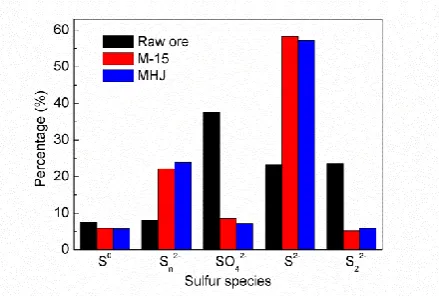
maximum (FWHM). The S 2pspectra of chalcopyrite surface before and after bioleaching were shown
in Figures. 3 and 4. The S 2p spectra for MHJ and M-15 were quite similar (Figure 4). Elemental sulfur
230
(S0), monosulfide (S2-), disulfide (S
22)-, polysulfide (Sn2-) and sulfate (SO42-) were detected on the
231
mineral surface. The content of each component during bioleaching was shown in Figure 5. The
232
content of S0 was low all the time, ranging from ~6.0% to ~7.5%. Ratios of S
n2- and S2- were higher
233
after bioleaching than in the raw mineral, e.g., percentage of Sn2- was < 10% in the beginning, but
234
increased to > 22.1% and 23.9% after bioleaching in M-15 and MHJ, respectively. On the contrary, the
235
contents of SO42- and S22- decreased after bioleaching. The ratio of SO42- was high (37.6%) before
236
bioleaching, but decreased to 8.5% and 7.2% in groups MHJ and M-15, respectively.
237
238
Figure 3. The S 2p spectra of chalcopyrite surface before bioleaching.
239
240
Figure 4. The S 2pspectra of chalcopyrite surface after bioleaching in M-15 (a) and MHJ (b).
241
242
Figure 5. Contents of sulfur species on the mineral surface detected by XPS before and after
243
bioleaching.
3.3 Microbial community dynamics of group MHJ
245
The microbial community of group MHJ was monitored using high-throughput sequencing of 16S
246
rRNA gene. Samples were withdrawn on days 20, 30 and 50 (designated as MHJ1, MHJ2 and MHJ3).
247
A total of 673,782 pair-end reads were obtained. Rarefaction curves of all samples based on sequencing
248
reads and number of OTUs reached plateaus, indicating that the sequencing depth was appropriate for
249
estimating the microbial diversity.
250
251
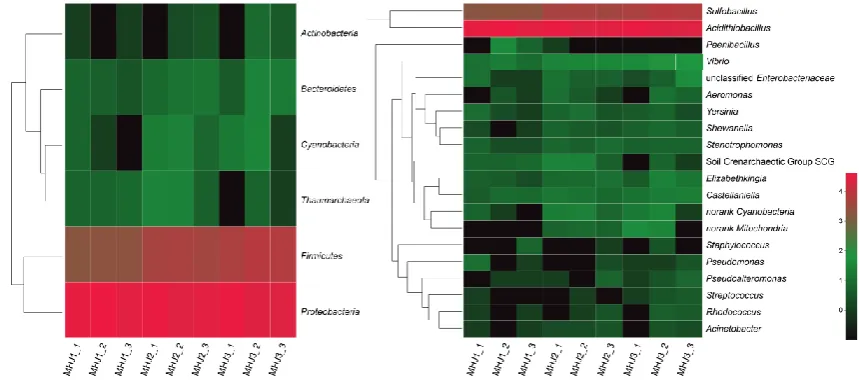
At phylum level, Proteobacteria was the dominate lineage and accounted for 81.5%-94.9% of the total
252
biomass, followed by Firmicutes (5.04%-18.39%), while the percentages of other phylum, e.g.,
253
Cyanobacteria, Thaumarchaeota and Bacteroidetes, were lower than 1% (Figure 6a). Down to the
254
genus level, a total of 27, 35 and 31 OTUswere detected for MHJ1, MHJ2 and MHJ3, respectively,
255
and 20 OTUs were shared by all samples. Acidithiobacillus dominated the microbial communities,
256
accounted for 94.8%, 87.0% and 81.1% in MHJ1, MHJ2 and MHJ3, respectively. Sequences of
257
Sulfobacillus (affiliated to Firmicutes) were detected at a considerable level and increased from 5.04%
258
on day 20 to > 10% on day 50 as bioleaching continued. Contents of other genera, for instance,
259
Stenotrophomonas spp., Pseudomonas spp. and Castellanilla spp., were < 0.1% (Figure 6b).
260
261
Figure 6. Heatmap of microbial communities on phylum and genus levels of MHJ. MHJ1_1, MHJ1_2
262
and MHJ1_3, MHJ2_1, MHJ2_2 and MHJ2_3, MHJ3_1, MHJ3_2 and MHJ3_3 were the triplicates of
263
sample MHJ1, MHJ2 and MHJ3, respectively.
264
265
3.4 Analysis of EPS components and ferric iron on the mineral surface
266
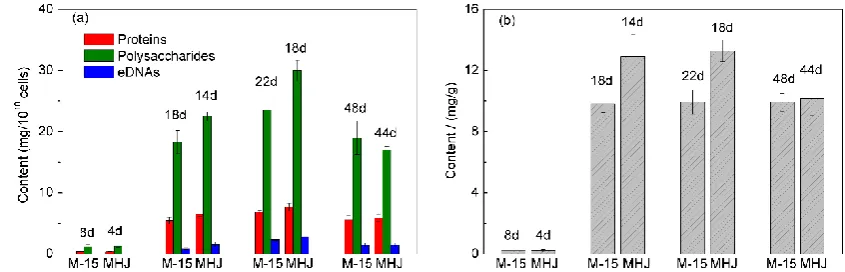
The contents of EPS components (proteins, polysaccharides and eDNAs) were analyzed in three stages:
267
adaptive stage, day 8 for M-15 and day 4 for MHJ, early fast-leaching stage, day 18 for M-15 and day
268
14 for MHJ, middle fast-leaching stage, day 22 for M-15 and day 18 for MHJ, and stationary stage, day
269
48 for M-15 and day 44 for MHJ. During the adaptive stage, the content of EPS was extremely low, the
270
amounts of proteins and polysaccharides were < 2 mg/1010 cells, and eDNAs were below detection
271
limit. During the fast-leaching stage, the content of EPS increased significantly, and all the three
272
components were higher in MHJ than in M-15 (p < 0.05). Especially for polysaccharides, the content in
273
MHJ was respectively 22.9% and 27.4% higher than in M-15. In the stationary stage, the amount of
EPS decreased compared with the middle fast-leaching stage, and the content in MHJ was slightly
275
lower than in M-15 (Figure 7a). The content of ferric iron on the mineral surface was higher in MHJ
276
than in M-15 in the fast-leaching stage (p < 0.05). For instance, the Fe(III) content in MHJ on day 18
277
was 25.3% more than in group M-15 on day 22. In the stationary stage, ferric iron on the mineral
278
surface was comparable in the two groups (Figure 7b).
279
280
Figure 7. Variations of EPS components and ferric iron on the mineral surface in groups M-15 and
281
MHJ during chalcopyrite bioleaching.
282
283
4 Discussion
284
A pure culture of A. ferrivorans strain YL15 and a mixed culture enriched from acid mine drainage in
285
Yulong copper mine were used in chalcopyrite bioleaching (M-15 and MHJ, respectively). The changes
286
of pH, ORP, iron and copper concentrations in both groups were similar. A higher copper extraction
287
rate was achieved in MHJ than in M-15, which is in accordance with previous results that mixed
288
cultures were more efficient in bioleaching of sulfide minerals than pure cultures [9]. To reveal the
289
enhancement mechanisms of mixed culture in bioleaching at low temperature, the microbial
290
community of group MHJ and the passivation substance of the mineral surface were tested, and a
291
comparison of the EPS components and ferric iron at the cell-mineral interface in groups MHJ and
292
M-15 was performed.
293
294
Previous work has emphasized the importance of interactions between physiologically distinct
295
acidophilic microorganisms (e.g., autotrophs and heterotrophs) in enhancing sulfide minerals
296
dissolution [32]. To conform this, first of all, the microbial community structure of the mixed culture
297
during bioleaching (MHJ) was monitored. The result revealed an extremely simple bacterial
298
community which consisted of two major lineages: Acidithiobacillus and Sulfobacillus. In order to find
299
out which species the two lineages belongs to, 16S rRNA gene of sample MHJ3 was amplified using
300
primers 27F and 1492R and the products were transformed to E. coli DH5α to build a clone library as
301
described in a previous document [33]. Ten clones were randomly selected, and the inserted fragments
302
were sequenced and aligned using BLAST. It is shown that 9 of the inserted fragments were 100%
303
identical to the 16S rRNA gene sequence of strain YL15 and the rest 1 fragment had a 98% identity to
304
an undescribed Sulfobacillus sp. The results unraveled that the Acidithiobacillus spp. should be A.
305
ferrivorans. The genus Sulfobacillus is commonly considered to be moderate thermophilic, although
306
some species can grow at temperatures < 20 °C [34]. However, in a previous report, a mixed culture
307
was enriched at 5°C with ferrous sulfate as a sole energy and sequences close to Sb. montserratensis
were detected at an abundance > 10% [35]. These results indicated that there would be novel
309
Sulfobacillus species existing in a low-temperature bioleaching culture.
310
311
Sulfobacillus can utilize many organic substances as its carbon source [34]. In group MHJ, the ratio of
312
Sulfobacillus increased as bioleaching progressed. This was due to that the accumulated organic
313
substances can promote the growth of Sulfobacillus. Sulfobacillus can alleviate the inhibition of organic
314
substances to the autotrophic Acidithiobacillus and therefore maintaining a more robust microbial
315
community than the pure-culture bioleaching system [36].
316
317
It was pointed out in a previous study that using mixed culture can reduce passivation of the mineral
318
surface and therefore enhance bioleaching performance [37]. Therefore, the passivation species on the
319
mineral surface in groups M-15 and MHJ were investigated using XPS. As discussed before, the main
320
component of passivation layer may be jarosite, elemental sulfur or polysulfide [31,38,39]. It was
321
shown that the content of elemental sulfur (S0) was low during bioleaching, indicating that it was not
322
the main component of passivation layer. The content of SO42- (jarosite) was high in the beginning, but
323
decreased significantly in the later stage, suggesting that it should not be the passivation substance. On
324
the contrary, the content of Sn2- (polysulfide) in the raw chalcopyrite was low, but increased greatly
325
after bioleaching. Therefore, polysulfide should be the major component of the passivation layer.
326
However, the S 2p spectra of ore residues in groups MHJ and M-15 were similar and the content of
327
polysulfide was comparable between the two groups (Figure 5). This indicated that the mixed culture
328
did not significantly alleviate the passivation of the mineral surface.
329
330
EPS function at the microbe-mineral interface in bioleaching. They are generated by microorganisms
331
and mediate the adsorption of microbes to the mineral surface [40]. Moreover, they can concentrate
332
metallic ions and provide a microenvironment, where the concentrations of metallic ions are higher
333
than in the bioleaching solution [20]. Herein, EPS in different stages of bioleaching in groups M-15 and
334
MHJ were extracted and the contents of the main components were analyzed. It is shown that the
335
contents of polysaccharides, proteins and eDNAs were higher in group MHJ than in M-15 in the
336
fast-leaching stage. Polysaccharides took up for the most part of EPS and change the most (Figure 7a).
337
Some of the compositions in polysaccharides, e.g., the uronic acids, can complex Fe(III) [40]. To this
338
end, the ferric iron on the mineral surface was extracted. The result showed that content of ferric iron
339
was higher in MHJ than M-15 (Figure 7b), which indicated that oxidation of chalcopyrite by ferric iron
340
would be faster in MHJ at the microbe-mineral interface. Therefore, it was hypothesized that more EPS
341
produced in the fast-leaching stage of group MHJ concentrated elevated content of ferric ions and
342
resulted in a higher reactional rate, thereby contributing to a higher copper extraction rate in group
343
MHJ than in group M-15. The study revealed the importance of EPS in bioleaching which was not
344
taken into consideration before when explaining why the mixed culture is more efficient than the pure
345
culture in bioleaching.
346
347
5 Conclusions
348
A pure culture of A. ferrivorans strain YL15 and a mixed culture were used in chalcopyrite bioleaching
349
at low temperature. Using the mixed culture resulted in a higher copper leaching rate than using the
pure culture. Microbial community structure analysis unveiled that the mixed culture mainly consisted
351
of Acidithiobacillus spp. and Sulfobacillus spp. The mixed culture did not significantly changed the
352
sulfur species profile on the mineral surface but may enhance chalcopyrite bioleaching via two
353
pathways: firstly, Sulfobacillus spp. can alleviate the toxicity of organic substances to Acidithiobacillus
354
spp. and thus sustain a vigorous leaching system; secondly, more EPS secreted by the mixed culture
355
can complex elevated content of ferric iron and accelerate the oxidation rate of chalcopyrite.
356
357
Supplementary Material: Figure S1 Variation of ferrous iron concentration during chalcopyrite
358
bioleaching.
359
360
Author Contributions: Conceptualization, W.Z. and E.D.; Formal analysis, T.P., J.W. and J.M.;
361
Funding acquisition, T.P., G.G., G.Q. and W.Z.; Investigation, J.W. and J.M.; Methodology, T.P.;
362
Project administration, G.G., G.Q. and W.Z.; Software, T.P. and J.W.; Supervision, G.G., E.D. and W.Z.;
363
Validation, W.Z.; Visualization, T.P., J.W. and J.M.; Writing—original draft, T.P. and E.D.;
364
Writing—review & editing, G.G., G.Q. and W.Z.
365
366
Funding: This work was funded by the National Natural Science Foundation of China, grant numbers
367
31900108, 31470230, 51374249 and 51604308, the Youth Talent Foundation of Hunan Province of
368
China, grant number 2017RS3003, Natural Science Foundation of Hunan Province of China, grant
369
number 2018JJ2486 and postdoctoral research funding plan in Hunan province (grant number 207159)
370
and Central South University (grant number 140050014).
371
372
Conflicts of Interest: The authors declare no conflict of interest.
373
374
References
375
1. Panda, S.; Akcil, A.; Pradhan, N.; Deveci, H. Current scenario of chalcopyrite bioleaching: A
376
review on the recent advances to its heap-leach technology. Bioresource Technol 2015, 196,
377
694-706.
378
2. Yin, S.; Wang, L.; Kabwe, E.; Chen, X.; Yan, R.; An, K.; Zhang, L.; Wu, A. Copper
379
bioleaching in china: Review and prospect. Minerals 2018, 8, 32.
380
3. Ai, C.; Yan, Z.; Chai, H.; Gu, T.; Wang, J.; Chai, L.; Qiu, G.; Zeng, W. Increased chalcopyrite
381
bioleaching capabilities of extremely thermoacidophilic metallosphaera sedula inocula by
382
mixotrophic propagation. J Ind Microbiol Biot 2019.
383
4. Li, Q.; Yang, B.; Zhu, J.; Jiang, H.; Li, J.; Zhang, R.; Sand, W. Comparative analysis of
384
attachment to chalcopyrite of three mesophilic iron and/or sulfur-oxidizing acidophiles.
385
Minerals 2018, 8, 406-418.
386
5. Acosta, M.; Galleguillos, P.; Ghorbani, Y.; Tapia, P.; Contador, Y.; Velásquez, A.; Espoz, C.;
387
Pinilla, C.; Demergasso, C. Variation in microbial community from predominantly mesophilic
388
to thermotolerant and moderately thermophilic species in an industrial copper heap
389
bioleaching operation. Hydrometallurgy 2014, 150, 281-289.
390
6. Gu, G.; Hu, K.; Zhang, X.; Xiong, X.; Yang, H. The stepwise dissolution of chalcopyrite
391
bioleached by leptospirillum ferriphilum. Electrochim Acta 2013, 103, 50-57.
7. Langdahl, B.R.; Ingvorsen, K. Temperature characteristics of bacterial iron solubilisation and
393
14c assimilation in naturally exposed sulfide ore material at citronen fjord, north greenland
394
(83on). FEMS Microbiol Ecol 1997, 23, 275-283.
395
8. Dopson, M.; Halinen, A.K.; Rahunen, N.; Ozkaya, B.; Sahinkaya, E.; Kaksonen, A.H.;
396
Lindstrom, E.B.; Puhakka, J.A. Mineral and iron oxidation at low temperatures by pure and
397
mixed cultures of acidophilic microorganisms. Biotechnol Bioeng 2007, 97, 1205-1215.
398
9. Akcil, A.; Ciftci, H.; Deveci, H. Role and contribution of pure and mixed cultures of
399
mesophiles in bioleaching of a pyritic chalcopyrite concentrate. Miner Eng 2007, 20, 310-318.
400
10. Liu, H.; Gu, G.H.; Xu, Y.B. Surface properties of pyrite in the course of bioleaching by pure
401
culture of acidithiobacillus ferrooxidans and a mixed culture of acidithiobacillus ferrooxidans
402
and acidithiobacillus thiooxidans. Hydrometallurgy 2011, 108, 143-148.
403
11. Peng, T.; Zhou, D.; Liu, Y.; Yu, R.; Qiu, G.; Zeng, W. Effects of ph value on the expression of
404
key iron/sulfur oxidation genes during bioleaching of chalcopyrite on thermophilic condition.
405
Ann Microbiol 2019, 69, 627–635.
406
12. Ma, L.; Wang, X.; Liu, X.; Wang, S.; Wang, H. Intensified bioleaching of chalcopyrite by
407
communities with enriched ferrous or sulfur oxidizers. Bioresource Technol 2018, 268,
408
415-423.
409
13. Liljeqvist, M.; Rzhepishevska, O.I.; Dopson, M. Gene identification and substrate regulation
410
provide insights into sulfur accumulation during bioleaching with the psychrotolerant
411
acidophile acidithiobacillus ferrivorans. Appl Environ Microb 2013, 79, 951-957.
412
14. Halinen, A.K.; Rahunen, N.; Kaksonen, A.H.; Puhakka, J.A. Heap bioleaching of a complex
413
sulfide ore: Part ii. Effect of temperature on base metal extraction and bacterial compositions.
414
Hydrometallurgy 2009, 98, 101-107.
415
15. Yu, R.; Hou, C.; Liu, A.; Peng, T.; Xia, M.; Wu, X.; Shen, L.; Liu, Y.; Li, J.; Yang, F., et al.
416
Extracellular DNA enhances the adsorption of sulfobacillus thermosulfidooxidans strain st on
417
chalcopyrite surface. Hydrometallurgy 2018, 176, 97-103.
418
16. Li, Q.; Sand, W. Mechanical and chemical studies on eps from sulfobacillus
419
thermosulfidooxidans: From planktonic to biofilm cells. Colloids and Surfaces B:
420
Biointerfaces 2017, 153, 34-40.
421
17. Zhang, R.; Neu, T.R.; Blanchard, V.; Vera, M.; Sand, W. Biofilm dynamics and eps production
422
of a thermoacidophilic bioleaching archaeon. New Biotechnol 2019, 51, 21-30.
423
18. Vardanyan, A.; Vardanyan, N.; Khachatryan, A.; Zhang, R.; Sand, W. Adhesion to mineral
424
surfaces by cells of leptospirillum, acidithiobacillus and sulfobacillus from armenian sulfide
425
ores. Minerals 2019, 9, 69-81.
426
19. Castro, C.; Zhang, R.; Liu, J.; Bellenberg, S.; Neu, T.R.; Donati, E.; Sand, W.; Vera, M.
427
Biofilm formation and interspecies interactions in mixed cultures of thermo-acidophilic
428
archaea acidianus spp. And sulfolobus metallicus. Res Microbiol 2016, 167, 604-612.
429
20. Li, Q.; Sand, W.; Zhang, R. Enhancement of biofilm formation on pyrite by sulfobacillus
430
thermosulfidooxidans. Minerals 2016, 6, 71.
431
21. Barahona, S.; Dorador, C.; Zhang, R.; Aguilar, P.; Sand, W.; Vera, M.; Remonsellez, F.
432
Isolation and characterization of a novel acidithiobacillus ferrivorans strain from the chilean
433
altiplano: Attachment and biofilm formation on pyrite at low temperature. Res Microbiol 2014,
165, 782-793.
435
22. Peng, T.; Ma, L.; Feng, X.; Tao, J.; Nan, M.; Liu, Y.; Li, J.; Shen, L.; Wu, X.; Yu, R. Genomic
436
and transcriptomic analyses reveal adaptation mechanisms of an acidithiobacillus ferrivorans
437
strain yl15 to alpine acid mine drainage. Plos One 2017, 12, e0178008.
438
23. Peng, T.; Chen, L.; Wang, J.; Miao, J.; Shen, L.; Yu, R.; Gu, G.; Qiu, G.; Zeng, W. Dissolution
439
and passivation of chalcopyrite during bioleaching by acidithiobacillus ferrivorans at low
440
temperature. Minerals 2019, 9, 332-341.
441
24. Wu, X.L.; Wu, X.Y.; Shen, L.; Li, J.; Yu, R.; Liu, Y.; Qiu, G.; Zeng, W. Whole genome
442
sequencing and comparative genomics analyses of pandoraea sp. Xy-2, a new species capable
443
of biodegrade tetracycline. Front Microbiol 2019, 10.
444
25. Xiao, Y.; Xu, Y.; Dong, W.; Liang, Y.; Fan, F.; Zhang, X.; Zhang, X.; Niu, J.; Ma, L.; She, S.,
445
et al. The complicated substrates enhance the microbial diversity and zinc leaching efficiency
446
in sphalerite bioleaching system. Appl Microbiol Biot 2015, 99, 10311-10322.
447
26. Rinke, C.; Lee, J.; Nath, N.; Goudeau, D.; Thompson, B.; Poulton, N.; Dmitrieff, E.;
448
Malmstrom, R.; Stepanauskas, R.; Woyke, T. Obtaining genomes from uncultivated
449
environmental microorganisms using facs–based single-cell genomics. Nat Protoc 2014, 9,
450
1038.
451
27. Leng, Y.; Yi, M.; Fan, J.; Bai, Y.; Ge, Q.; Yao, G. Effects of acute intra-abdominal
452
hypertension on multiple intestinal barrier functions in rats. Sci Rep-Uk 2016, 6, 22814.
453
28. Yu, R.; Liu, A.; Liu, Y.; Yu, Z.; Peng, T.; Wu, X.; Shen, L.; Liu, Y.; Li, J.; Liu, X., et al.
454
Evolution of sulfobacillus thermosulfidooxidans secreting alginate during bioleaching of
455
chalcopyrite concentrate. J Appl Microbiol 2017, 122, 1586-1594.
456
29. Peng, T.; Zhou, D.; Liu, X.D.; Yu, R.L.; Jiang, T.; Gu, G.H.; Chen, M.; Qiu, G.Z.; Zeng, W.M.
457
Enrichment of ferric iron on mineral surface during bioleaching of chalcopyrite. T Nonferr
458
Metal Soc 2016, 26, 544-550.
459
30. Zhao, H.; Zhang, Y.; Zhang, X.; Qian, L.; Sun, M.; Yang, Y.; Zhang, Y.; Wang, J.; Kim, H.;
460
Qiu, G. The dissolution and passivation mechanism of chalcopyrite in bioleaching: An
461
overview. Miner Eng 2019, 136, 140-154.
462
31. Sandström, Å.; Shchukarev, A.; Paul, J. Xps characterisation of chalcopyrite chemically and
463
bio-leached at high and low redox potential. Miner Eng 2005, 18, 505-515.
464
32. Okibe, N.; Johnson, D.B. Biooxidation of pyrite by defined mixed cultures of moderately
465
thermophilic acidophiles in ph-controlled bioreactors: Significance of microbial interactions.
466
Biotechnol Bioeng 2004, 87, 574-583.
467
33. Liu, X.; Chen, B.; Wen, J.; Ruan, R. Leptospirillum forms a minor portion of the population in
468
zijinshan commercial non-aeration copper bioleaching heap identified by 16s rrna clone
469
libraries and real-time pcr. Hydrometallurgy 2010, 104, 399-403.
470
34. Melamud, V.S.; Pivovarova, T.A.; Tourova, T.P.; Kolganova, T.V.; Osipov, G.A.; Lysenko,
471
A.M.; Kondrat'Eva, T.F.; Karavaiko, G.I. Sulfobacillus sibiricus sp. Nov., a new moderately
472
thermophilic bacterium. Microbiology+ 2003, 72, 605-612.
473
35. Escobar, B.; Buccicardi, S.; Morales, G.; Wiertz, J. Biooxidation of ferrous iron and sulphide
474
at low temperatures: Implications on acid mine drainage and bioleaching of sulphide minerals.
475
Hydrometallurgy 2010, 104, 454-458.
36. Johnson, D.B. Biodiversity and interactions of acidophiles: Key to understanding and
477
optimizing microbial processing of ores and concentrates. T Nonferr Metal Soc 2008, 18,
478
1367-1373.
479
37. Fu, B.; Zhou, H.; Zhang, R.; Qiu, G. Bioleaching of chalcopyrite by pure and mixed cultures
480
of acidithiobacillus spp. And leptospirillum ferriphilum. Int Biodeter Biodegr 2008, 62,
481
109-115.
482
38. Klauber, C.; Parker, A.; van Bronswijk, W.; Watling, H. Sulphur speciation of leached
483
chalcopyrite surfaces as determined by x-ray photoelectron spectroscopy. Int J Miner Process
484
2001, 62, 65-94.
485
39. Ghahremaninezhad, A.; Dixon, D.G.; Asselin, E. Electrochemical and xps analysis of
486
chalcopyrite (cufes2) dissolution in sulfuric acid solution. Electrochim Acta 2013, 87, 97-112.
487
40. Gehrke, T.; Telegdi, J.; Thierry, D.; Sand, W. Importance of extracellular polymeric substances
488
from thiobacillus ferrooxidans for bioleaching. Appl Environ Microb 1998, 64, 2743-2747.