Type of the Paper (Article.)
1
Comparative study into the environmental impact of
2
traditional clay bricks and mixed with a biological
3
ingredient using life cycle analysis
4
José Adolfo Lozano-Miralles 1, Manuel Jesús Hermoso-Orzáez 2 Carmen Martínez-García3 and
5
José Ignacio Rojas-Sola 2,*
6
1 University of Jaén, Spain; [email protected]
7
2 University of Jaén, Department of Engineering Graphics, Design and Projects, Spain; [email protected]
8
3 University of Jaén, Department of Engineering Chemical, Environmental and Materials, Spain;
9
10
* Correspondence: [email protected]; Tel.: +34-610-389-020
11
12
Abstract: The construction industry is responsible for 40 to 45% of primary energy consumption in
13
Europe alone. Therefore, it is essential to find new materials with a lower environmental impact in
14
order to attain sustainable housing. This study aims to determine and compare the environmental
15
impact of two clay samples forming a basis for the manufacture of traditional brick, a standard
16
material in building construction; traditional red clay brick and a brick based on clay mixed with a
17
biological ingredient. The samples of fired clay were manufactured at the laboratory scale, the
18
results being valid exclusively as indicators for the extrapolation of the analysis to other studies.
19
The results of the environmental impact of these formulations have been examined through an
20
evaluation of life-cycle analysis (LCA), observing that the incorporation of biological pore forming
21
agents led to a decrease of around 15 to 20% of all impact categories studied. Thus, the suitability of
22
using biological-based additives in clay bricks was confirmed both for their constructive
23
characteristics (lighter material) and increased energy efficiency (better thermal insulation)
24
considering the environmental point of view.
25
Keywords: Life-cycle analysis (LCA); sustainable materials; sustainability climate impact;
26
bioclimatic architecture; green buildings
27
28
1. Introduction
29
Building and road construction is responsible for almost half of the raw materials and energy
30
consumed throughout the planet [1]. Consequently, construction has a great impact on the depletion
31
of finite resources in addition to greenhouse gas emissions resulting from the combustion of fossil
32
fuels. In order to reduce the associated greenhouse gas emissions and resulting impact on the
33
climate, it is necessary to use environmentally sustainable building materials [2] [3].
34
35
Clay bricks have been widely used for thousands of years in the construction of houses, since it
36
is an economical product which uses cheap raw materials (clay, sand and water) and a simple
37
process of manufacture, firing. However, since their arrival in the 1980s and due to construction
38
systems based on exterior enclosures of concrete blocks, the market for clay-based bricks began to
39
decrease. Nevertheless, the producers found technological barriers due to the limitation as
40
insulating objects, in addition to which their weight limits their use to low height buildings [4] [5].
41
42
Nowadays, in the context of sustainable development and with thermal regulations, it is
43
necessary to develop new construction materials with high thermal and mechanical performance.
The incorporation of by-product or waste from different origins has been evaluated to improve these
45
properties. [6].
46
47
Historically, there are studies that apply LCA, to the materials used for the construction of
48
buildings since the 70s, especially in Germany [7-9]. Thus, life cycle analyses have been carried out
49
in residential sectors such as houses [10], or single-family homes [11], to establish strategies for
50
reducing gas emissions in residential sectors through new construction structures in hot and humid
51
conditions [12].
52
53
Following these guidelines, studies are being carried out in the United Kingdom applied to
54
LCA that demonstrate that materials of biological origin such as hemp, introduced in the
55
manufacture of construction materials, improve the environmental impact. Hemp is a natural
56
resource that has recently been used as a low environmental impact material in a series of composite
57
products and is increasingly used in buildings as an insulating element in exterior wall construction
58
[13-15].
59
60
In addition, it should be noted that the thermal decomposition, during the brick manufacturing
61
process, of the pore-forming agents (drying and firing stages), leads to an increase in the porosity of
62
the material [16] and, therefore, to an increase in insulating capacity [17-19].
63
64
Current environmental sustainability policies and associated concepts of bioclimatic
65
architecture, as well as social concern for general environmental aspects (global warming, increased
66
damage to the ozone layer and the accumulation of waste), have caused the construction industry to
67
be increasingly sensitive and obliged to consider new construction materials that reduce energy
68
consumption, innovating in the creation of products of a sustainable nature. In fact, in Europe, the
69
construction sector is responsible for 40-45% of primary energy consumption, which contributes to
70
significant emissions of greenhouse gases [20] [21].
71
72
73
In this line of research, similar studies have been carried out that applied the LCA technique to
74
the production of cellulose nanofibers as an organic biofuel additive against the use of plastic
75
materials, observing reductions in greenhouse gases by up to 75% and reducing production costs by
76
12%, as well as improving the energy efficiency of production between two and five times [22]. In
77
addition, the LCA model is currently being applied in numerous studies like that of Tsinghua
78
University to calculate fossil energy consumption in the life cycle and greenhouse gas emissions in
79
China [23]. Therefore, it is necessary to evaluate the environmental impact of construction materials
80
using the LCA technique. Many scientific studies that use the LCA methodology compare different
81
materials together, highlighting those with less impact on the environment [24, 25].
82
83
The objective of this research is to apply the LCA method to new samples of clay with the
84
incorporation of biomass, to determine new construction materials from the point of view of
85
sustainability. [26].
86
87
To this end, a comparative study has been carried out between a sample made exclusively with
88
100% clay (BYRC) and a mixture composed of 15% barley components (leftovers that remain after
89
the seed has been extracted from the cereal) and 85% of the base clay mixture (Brick with red clay
90
(BYRC)) called BB15 (Barley bagasse 15).
91
92
These materials have been selected due to their low cost, availability and close location to the
93
research centre. Also, in the firing process, the biological material degrades under the thermal effect,
94
producing pores that increase the sample's insulation capacity [27], enabling the improvement of the
95
thermal bridge and energy efficiency in the construction of sustainable housing. [28],
97
98
2. Materials and Methods
99
In this study, samples of ceramic material have been used, made with products and resources
100
from the nearby geographical area (Bailén, Jaén). The manufacturing process, including the
101
grinding, sieving, drying and firing of the materials has been carried out in a similar way to
102
industrial manufacturing so that the results can be extrapolated to greater production levels.
103
104
LCA is an adequate methodology to determine the environmental impact that occurs
105
throughout the life cycle of products, services or processes. It also allows the determination of the
106
impact of any of the phases independently from the rest.
107
108
2.1. Development of fired clay samples
109
The first sample is a reference sample without additives (BYRC). It contains 100% clay which
110
originated in Bailén (Jaén, Spain). Clay has been provided by a company in the sector. First, it will be
111
crushed to obtain a powder with particles of approximately 3 mm, to promote thermal conductivity
112
[29, 30].
113
114
For the second sample (BB15), 85% of the reference sample (BYRC) was separated, to which 15%
115
of barley bagasse was added as an additive and mixed in a laminator to improve the homogeneity,
116
obtaining a sample with a biological basis.
117
118
The bagasse, provided by the Heineken brewery (Jaén, Spain), located in Jaén’s capital, was
119
crushed and sieved to obtain a milling of less than 0.5 mm. The amount of incorporated additive was
120
chosen in line with previous studies [31].
121
122
The required amount of water was added to obtain the desired moisture and plasticity that are
123
necessary to avoid defects in the structure during the process. Subsequently, the samples were
124
modelled by an extrusion process in the form of tablets (175 x 79 x 17 mm), dried up to 105° C and
125
finally fired by increasing the temperature progressively during 11 hours until the maximum
126
temperature of 920° C, remaining for 1 h afterwards, according to the industrial recommendations of
127
the ceramic sector.
128
129
2.2. Life-cycle analysis (LCA)
130
The life cycle analysis was carried out using the ISO 14040 standards [32] defining the principles
131
and framework, and according to ISO 14044 [33] describing the different stages of the analysis. [34].
132
133
2.2.1. Definition of objective and scope
134
The evaluation of the life cycle was carried out following the process to obtain the clay
135
samples. To analyse and compare the environmental impact of the different formulations and
136
identify the unit of the process that presents the strongest environmental impact, in an ecological
137
design approach, as the main environmental benefit in construction is to reuse the bricks and recycle
138
the aggregates [35].
139
140
In order to build the inventory of production and establish the scope of the study, the functional
141
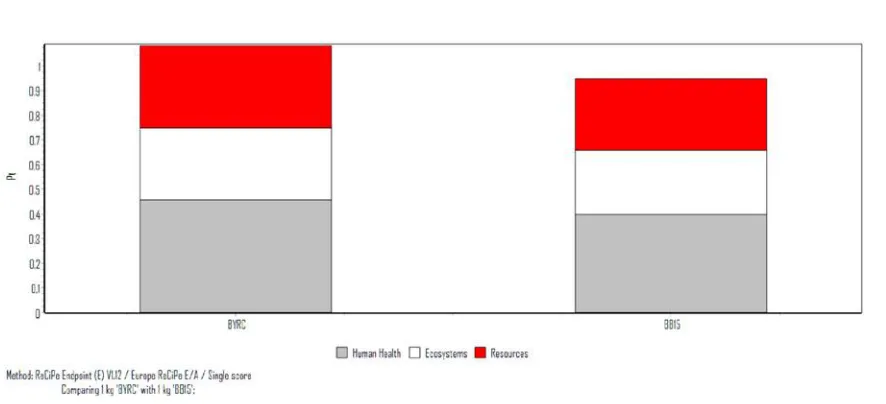
unit is defined as the production of 1kg of clay with a fixed thermal resistance.
The LCA methodology allows the determination of the environmental impact of the processes,
144
products or systems analysed in different ways. That is, you can analyse certain stages of the life
145
cycle, or analyse the entire cycle. The present investigation will focus only on the impact associated
146
with the production of these new samples, thus performing the analysis known as ‘Gate to Gate.’
147
148
The system studied uses raw materials from the laboratory (clay, sand, water and vegetable
149
matter) and takes into account the energy consumed in production (sieving, drying and firing), to
150
overcome the potential limitations, the initial hypotheses are defined as follows:
151
152
• The electricity used considers that the production mix corresponds to the Spanish energy
153
production system.
154
• The cleaning of the different devices used in the process is dismissed since it is not a
155
considerable percentage.
156
• The transport of material from the quarry, or from the factory to the laboratory, is not
157
considered as it is a gate to gate study.
158
159
The evaluation of the life cycle impact of the use of bagasse for brick construction was carried
160
out using the LCA SimaPro software 8.30 [36], which is widely used [37].
161
162
2.2.2. Life-cycle inventory
163
For the life cycle inventory, all inputs and outputs of the system were listed for the different
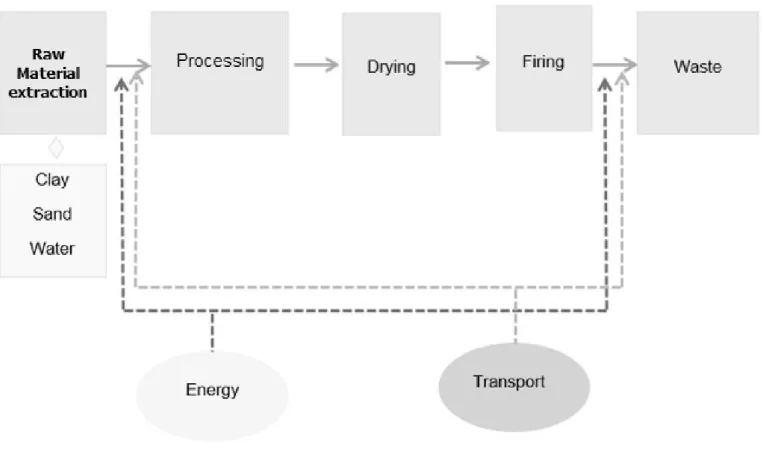
164
stages of the life cycle. Figure 1 shows a flow diagram of the different steps of the process with the
165
associated flows and Figure 2 shows the inputs, also called foreground data that have their own life
166
cycle. These environmental impacts (background data) are taken into account for the overall
167
evaluation of the life cycle of the product.
168
169
170
171
Figure 1.
Clay cycle.
172
174
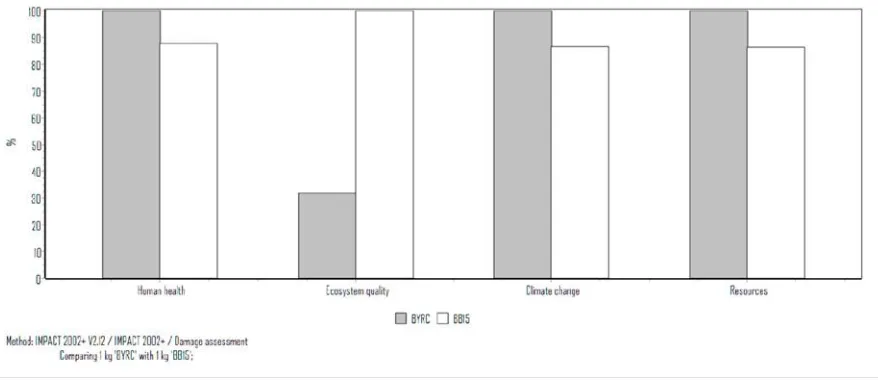
175
Figure 2. Barley cycle.
176
177
The inventory data was obtained directly from the experiments or through the use of data
178
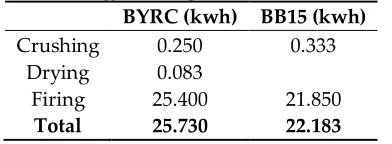
collected from industrial producer partners or from bibliographic references (Table 1). The
179
consumption data of the different processes are shown in Table 2.
180
181
Table 1. Inventory data
182
BYRC (kg) BYRC (%) BB15 (kg) BB15 (%)
Mix clay + sand 0.143 100 % 0.122 85 % Barley 0.021 15 % Water 0.317 100 % 0.317 100 %
183
Table 2.Total energy consumption data of the different processes
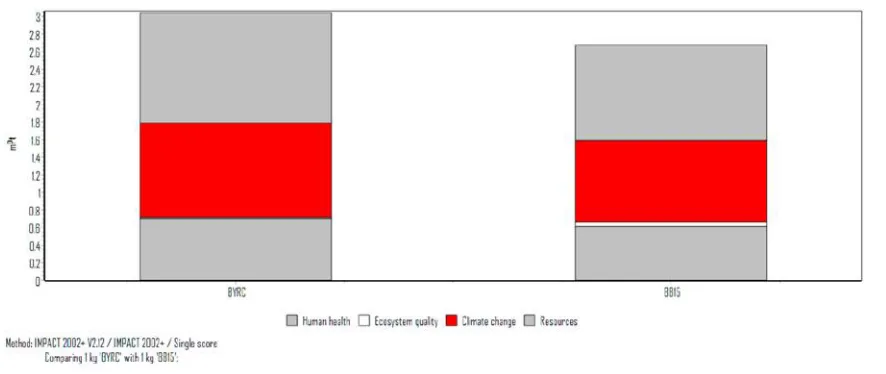
184
BYRC (kwh) BB15 (kwh)
Crushing 0.250 0.333 Drying 0.083
Firing 25.400 21.850
Total 25.730 22.183
185
Due to confidentiality issues, all process data provided by industries cannot be detailed in this
186
publication for either the clay mixture or for the vegetable pore forming agents.
187
188
2.2.3 Impact evaluation
189
190
With the data previously provided, an evaluation of the environmental impact of the samples is
191
carried out using the software Simapro 8.30. We will carry out a comparative study using two
192
methodologies to check for possible deviation in the results. The ReCiPe Endpoint v 1.12
193
methodology will be used first. This methodology evaluates the damage caused in four impact
194
categories, whose characteristics are described in Table 3. Impact 2002+ v2.12 will be the second
195
analysis methodology
200
Table 3. Indicators of impacts according to ReCiPe Endpoint v1.12
201
Impact category Category indicator Measurement units
Quality of the ecosystem FDP* FDP / m2 x year Human health DALY** People / year Natural resources Damage to resources MJ/Kg Abiotic resources *** Exhaustion Kg
* Fraction of potential disappearance of the ecosystem per m2 and year.
202
** Disability-adjusted life year: Reduction of years of life per person / year
203
*** Climatic, geological and geographical resources. Biodiversity.
204
205
206
3. Results and discussion
207
The objective is to compare the environmental impact of the two formulations developed. The
208
functional unit has been defined as well as the production of 1kg of the porous sample,
209
corresponding to that of the reference sample, without the vegetable agent.
210
211
3.1. Methodology ReCiPe Endpoint v1.12
212
213
Once the inventory data has been entered, the Simapro software and, using the first
214
methodology, the ReCiPe Endpoint v1.12, provides the results shown in Table 4, where the
215
contribution amounts provided by the different clay samples can be analysed in each impact
216
category. This data has been provided by the program, once the different amounts of raw materials
217
and processes have been introduced.
218
219
220
Table 4. Analysis of the energy and non-energy resources of the comparative cycle of clay samples as a
221
base.
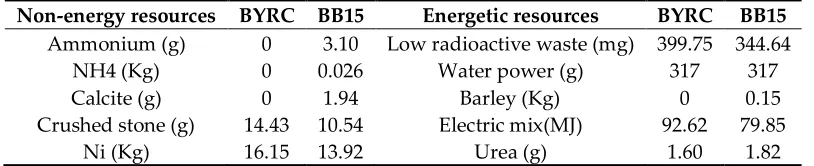
222
Non-energy resources BYRC BB15 Energetic resources BYRC BB15
Ammonium (g) 0 3.10 Low radioactive waste (mg) 399.75 344.64 NH4 (Kg) 0 0.026 Water power (g) 317 317 Calcite (g) 0 1.94 Barley (Kg) 0 0.15 Crushed stone (g) 14.43 10.54 Electric mix(MJ) 92.62 79.85
Ni (Kg) 16.15 13.92 Urea (g) 1.60 1.82
223
224
The general comparison of the scenarios represents the relative percentage in each impact
225
category. The most impressive scenario in the category represents 100% and the others are
226
calculated according to the latter. The comparison with the scenario of the BB15 sample, using the
227
ReCiPe Endpoint v1.12 method is presented in Figure 3, for the characterisation of the impact and in
228
Figure 4 for the characterisation of the damage.
229
230
231
The reference sample, without a pore-forming agent, shows the maximum impact in the 12
232
impact categories. Therefore, in the three categories of damage, human health, ecosystem and
233
resources, with a gap or difference from the other scenarios between 10% and 22%. In Figure 3, the
234
impacts of the two samples are compared showing that, in general, the base sample (BYRC)
235
produces a greater impact than the sample to which biological material has been added
236
(BB15). Likewise, the electricity consumption is higher in the base sample, so the aspects relating to
237
resources are affected in the final result.
239
240
Figure 3. Comparative impact of the samples analysed with the methodology ReCiPe Endpoint v 1.12.
241
242
243
In Figure 4, the impact of the samples to human health, ecosystem and resources can be
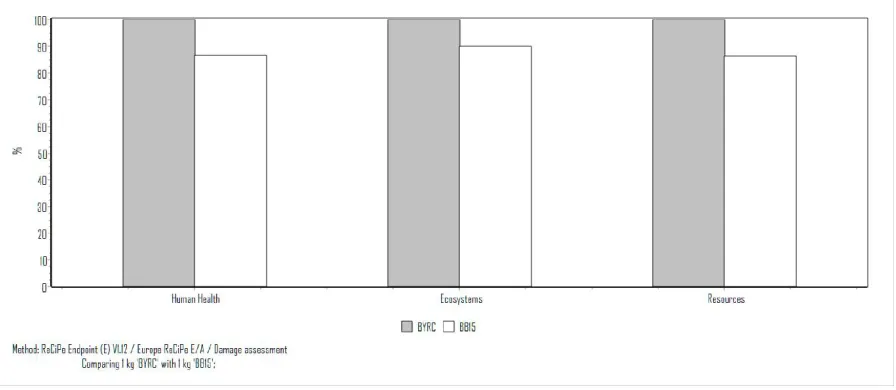
244
observed. In the base sample (BYRC) the impact is greatest, with human health and resources,
245
showing the greatest difference. This is motivated by the need for fewer raw materials in the
246
development of the samples. The third indicator of this ReCiPe Endpoint v 1.12 methodology
247
shows that the impact on the ecosystem is similar in the two samples.
248
249
250
251
252
Figure 4. Damage assessment of the samples with the methodology ReCiPe Endpoint v 1.12.
253
254
255
256
Performing an analysis of the samples using the single score, it is easy to determine the impact
257
percentages that each sample has on the three aspects to be considered with the ReCiPe Endpoint v
258
1.12 methodology. As can be seen in Figure 5, the base sample (BYRC) has the greatest impact.
265
266
267
Figure 5. Single score with the methodology ReCiPe Endpoint v 1.12.
268
269
270
Results in figures 6 to 8 show the quantities of the flows that produce the greatest impact;
271
resources, air emissions and impact on human health. The greatest impact is the emission of CO2
272
into the atmosphere, mainly due to the electrical energy consumed in the firing phase, followed by
273
the emissions of Methane, Sulfur Dioxide and Nitrogen Dioxide.
274
275
276
277
278
Figure 6. Weighting and quantity of resources with the methodology ReCiPe Endpoint v 1.12.
279
282
283
Figure 7. Weighting of emissions to the air with the methodology ReCiPe Endpoint v 1.12.
284
285
286
287
288
Figure 8. Impacts on the ecosystem with the methodology ReCiPe Endpoint v 1.12.
289
290
291
292
3.2. Methodology Impact 2002+ v2.12
293
294
The Impact 2002+ methodology provides us with additional information about factors that
295
influence climate change. The results obtained are analysed below.
296
297
Figure 9 shows that of the 15 indicators, 11 contribute the greatest impact and correspond to the
298
base sample (BYRC), the samples with biological material show a higher impact in only 4.
306
307
Figure 9. Comparative impact of the samples analysed with the methodology Impact 2002+ v2.12.
308
309
310
We can see in Figure 10, how the results are practically similar, with the addition of the
311
information provided by the methodology on climate change.
312
313
314
315
Figure 10. Evaluation of the damage of the samples with the methodology Impact 2002+ v2.12.
316
317
318
Figure 11 shows how the greatest impact occurs on resources, both for the extraction of raw
319
materials and for obtaining the raw materials necessary to produce the electrical energy needed in
320
the manufacturing processes of the new material.
324
Figure 11. Weighting and quantity of resources with the methodology Impact 2002+ v2.12
325
326
327
As a summary, in Figure 12, we note that a considerable improvement is achieved in the
328
reduction of impacts in all categories, the most considerable being that of resources.
329
330
331
332
Figure 12. Single score with the methodology Impact 2002+ v2.12.
333
334
335
5. Conclusions
336
337
In this investigation, the environmental impacts of two brick samples have been studied using
338
life cycle analysis, one with a traditional make-up and the other with a mixture of clay and a
339
biological agent. In addition, the results have been verified using two different methodologies.
340
341
For the biological sample, a vegetable additive, specifically barley bagasse, has been
342
incorporated into a traditional clay base, to check for improvement in the aspects of insulation,
343
weight and environmental contamination. The study focuses on the environmental impact of the
344
two formulations through a Life Cycle Analysis, using the ReCiPe Endpoint v 1.12 characterization
345
method and the Impact 2002+ methodology. It is observed that the incorporation of plant additives
Therefore, a clear improvement of the environmental impact is possible using a biological
348
vegetable and clay mixed brick. It shows a reduction in the impact generated by obtaining and
349
transforming the raw materials. In addition, this would be a very interesting innovation in the field
350
of new materials used in bioclimatic architecture. Even so, other aspects such as mechanical
351
resistance, bending resistance and thermal conductivity should be considered in future studies.
352
353
Thus, according to the results obtained and taking into account both general sustainable
354
development and regulations on energy efficiency [38, 39], it is deduced that it is necessary to
355
develop new materials using by-products or waste that facilitate their incorporation into the cycle of
356
industrial life, since it would constitute a reduction of emissions and a reduction in energy and
357
resource consumption.
358
359
360
Author Contributions: The following authors have contributed to this article “Conceptualization,
361
Lozano-Miralles. and Martinez-Garcia.; Methodology, Lozano-Miralles and Hermoso-Orzáez; Software,
362
Lozaro-Miralles and Martínez-Garcia.; Validation, Lozano-Miralles, Hermoso-Orzáez and Martínez-García;
363
Formal Analysis, Rojas-Sola.; Investigation, Lozano Miralles, and Hermoso-Orzáez.; Resources, Lozano
364
Miralles, Martinez-García, Hermoso-Orzáez and Rojas-Sola.; Data Curation, Lozano-Miralles and
365
Martinez-García; Writing-Original Draft Preparation, Lozano-Miralles-and Hermoso-Orzáez.; Writing-Review
366
& Editing, Hermoso-Orzáez and Rojas-Sola.; Visualization, Lozano-Miralles .; Supervision, Martinez-Garcia,
367
Hermoso-Orzáez and Rojas-Sola.; Project Administration, Lozano-Miralles and Hermoso-Orzáez.;
368
Funding: “This research received no external funding” This research did not receive any specific grant from
369
funding agencies in the public, commercial, or not-for-profit sectors.
370
371
Conflicts of Interest: Declare conflicts of interest or state “The authors declare no conflict of
372
interest.”373
374
References375
376
1. Edwards, B. Rough guide to sustainability. 3rd ed. RIBA Enterprises, London, 2010.
377
2. Pittau, F.; Krause, F.; Lumia, G.; Habert, G. Fast-growing bio-based materials as an opportunity for storing
378
carbon in exterior walls. Building and Environment 2018; 129, 117-129, DOI: 10.1016/j.buildenv.2017.12.006.
379
3. Dong, L.; Wang, Y.; Li, H.X.; Jiang, B.Y.; Al-Hussein, M. Carbon Reduction Measures-Based LCA of
380
Prefabricated Temporary Housing with Renewable Energy Systems. Sustainability.2018.10, 3. 718 DOI:
381
10.3390/su10030718
382
4. Kornmann M. Clay building materials: Manufacturing and properties, 2005.
383
5. Life Cycle Assessment of Completely Recyclable Concrete. De Schepper, M.; Van den Heede, P.; Van
384
Driessche, I.; De Belie, N. Materials. 2014.7, 8, 6010-6027, DOI: 10.3390/ma7086010
385
6. Bio-Inspired Sustainability Assessment for Building Product Development-Concept and Case Study.
386
Por:Horn, R.; Dahy, H.; Gantner, J.; Speck, O.; Leistner, P . Sustainability. 2018.10, 1, 130, DOI:
387
10.3390/su10010130
388
7. Dong, Y.H.; Ng, S.T. A life cycle assessment model for evaluating the environmental impacts of building
389
construction in Hong Kong. Building and Environment 2015, 89, 183-191, DOI:
390
10.1016/j.buildenv.2015.02.020.
391
8. Weibenberger, M.; Jenschb, W.; Lang, W. The convergence of life cycle assessment and nearly zero-energy
392
buildings: The case of Germany. Energy and Buildings 2014; 76:551–557. DOI: 10.1016/j.enbuild.2014.03.028.
393
9. Finnveden, G.; Hauschild, M.Z.; Ekvall, T.; Guinée, J.; Heijungs, R.; Hellweg, S. Recent developments in
394
life cycle assessment. Journal of Environmental Management 2009, 91, 1-21,
395
DOI: 10.1016/j.jenvman.2009.06.018.
396
10. Cuellar- Franca, R.M.; Azapagic, A. Enviromental impacts of the UK residential sector: Life cycle
397
11. Soust-Verdaguer, B.; Llatas, C.; Garcia-Martinez, A. Simplification in life cycle assessment of single-family
399
houses: A review of recent developments. Building and Environment 2016, 103, 215-227, DOI:
400
10.1016/j.buildenv.2016.04.014.
401
12. Balasbaneh, A.T.; Bin-Marsono, A.K. Strategies for reducing greenhouse gas emissions from residential
402
sector by proposing new building structures in hot and humid climatic conditions. Building and
403
Environment 2017; 124, 357-368, DOI: 10.1016/j.buildenv.2017.08.025.
404
13. Kenneth, I.P.; Miller, A. Life cycle greenhouse gas emissions of hemp–lime wall constructions in the UK.
405
Resources, Conservation and Recycling 2012, 69, 1-9, DOI: 10.1016/j.resconrec.2012.09.001.
406
14. Islam, H.; Jollands, M.; Setunge, S.; Ahmed, I.; Haque, N. Life cycle assessment and life cycle cost
407
implications of wall assemblages designs. Energy and Buildings 2014 84, 33-45, DOI:
408
10.1016/j.enbuild.2014.07.041.
409
15. Aouba, L.; Bories, C.; Coutand, M.; Perrin, B.; Lemercier, H. Properties of fired clay bricks with
410
incorporated biomasses: cases of olive stone flour and wheat straw residues. Construction and Building
411
Materials 2016,102, 7-13, DOI: 10.1016/j.conbuildmat.2015.10.040.
412
16. Russ, W.; Mörtel, H.; Meyer-Pittroff, R. Application of spent grains to increase porosity in bricks.
413
Construction and Building Materials 2005, 19, 117-126, DOI: 10.1016/j.conbuildmat.2004.05.014.
414
17. Barbieri, L.; Andreola, F.; Lancellotti, I.; Taurino, R. Management of agricultural biomass wastes:
415
preliminary study on characterization and valorisation in clay matrix bricks. Waste Management 2013, 33,
416
2307–2315, DOI: 10.1016/j.wasman.2013.03.014.
417
18. Bories, C.; Borredon ME, Vedrenne E, Vilarem G. Development of eco-friendly porous fired clay bricks
418
using pore-forming agents: a review. Journal of Environmental Management 2014, 143, 186-196. DOI:
419
10.1016/j.jenvman.2014.05.006.
420
19. Mohammed, M.S.; Ahmed A..I., Osman, R.M.; Khattab, I. Combinations of organic and inorganic wastes
421
for brick production. Polymer Composites 2014, 35 , 174–179, DOI: 10.1002/pc.22647.
422
20. United Nations Environment Programme (UNEP). Buildings and Climate Change: Status, Challenges and
423
Opportunities, 2006
424
21. Application of Eco-Design and Life Cycle Assessment Standards for Environmental Impact Reduction of
425
an Industrial Product. Navajas, A.; Uriarte, L. Gandia, L.M. Sustainability. 2017.1 9 10, 1724, DOI:
426
10.3390/su9101724
427
22. Moon, D.; Sagisaka, M.; Tahara,; Tsukahara, K. Progress towards Sustainable Production: Environmental,
428
Economic, and Social Assessments of the Cellulose Nanofiber Production Process. Sustainability 2017, 9,
429
2368. DOI: 10.3390/su9122368.
430
23. Peng, T.D.; Zhou, S.; Yuan, Z.Y.; Ou, X.M. Life Cycle Greenhouse Gas Analysis of Multiple Vehicle Fuel
431
Pathways in China. Sustainability 2017; 9, 2183. DOI: 10.3390/su9122183
432
24. Monteiro, H.; Freire, F. Life-cycle assessment of a house with alternative exterior walls: comparison of
433
three impact assessment methods. Energy and Buildings 2012 47, 572-583.
434
DOI: 10.1016/j.enbuild.2011.12.032.
435
25. Pargana, N.; Pinheiro, M.D.; Silvestre, J.D.; Brito, J. Comparative environmental life cycle assessment of
436
thermal insulation materials of buildings. Energy and Buildings 2014, 82, 466–481. DOI:
437
10.1016/j.enbuild.2014.05.057.
438
26. Insulation Cork Boards-Environmental Life Cycle Assessment of an Organic Construction Material.
439
Silvestre, J.D.; Pargana, N.; de Brito, J .; Pinheiro, M. D.; Durao, V. Materials. 2016, 9, 5, 394, DOI:
440
10.3390/ma9050394.
441
27. Fu, Y.C.; Zhu, H.Y.; Shen, J.Y. Thermal decomposition of dimethoxymethane and dimethyl carbonate
442
catalyzed by solid acids and bases. Thermochimica. Acta 2005; 434, 88-92. DOI: 10.1016/j.tca.2005.01.021.
443
28. Climate Change Mitigation Potential of Wood Use in Civil Engineering in Japan Based on Life-Cycle
444
Assessment. Kayo, C.; Noda, R. Sustainability.2018.10, 2. 561. DOI: 10.3390/su10020561
445
29. García-Ten, J.; Orts, M.J.; Saburit, A.; Silva, G. Thermal conductivity of traditional ceramics. Part I:
446
Influence of bulk density and firing temperature. Ceramics International 2010, 36 1951-1959. DOI:
447
10.1016/j.ceramint.2010.05.012.
448
30. García-Ten, J.; Orts, M.J.; Saburit, A.; Silva,G. Thermal conductivity of traditional ceramics: Part II:
449
31. Bories, C. Study of the characteristics of a bio-based pore-forming agent and mechanisms used to obtain a
452
micro-porous building brick with high thermal and mechanical properties. Toulouse, Institut National
453
Polytechnique, Sciences des Agroressources, 2015
454
32. British Standards Institution (BSI). ISO 14040:2006 Environmental management – life cycle assessment –
455
principles and framework. United Kingdom, 2006.
456
33. British Standards Institution (BSI). ISO 14044:2006 Environmental management – life cycle assessment –
457
requirements and guidelines. United Kingdom, 2006.
458
34. Study of the Technical Feasibility of Increasing the Amount of Recycled Concrete Waste Used in
459
Ready-Mix Concrete Production. Fraile-Garcia, E.; Ferreiro-Cabello, J .; Lopez-Ochoa,
460
L.M.; Lopez-Gonzalez, L.M. Materials. 2018.10, 7, 817, DOI: 10.3390/ma10070817
461
35. De Klijn-Chevalerias, M.; Javed, S. The Dutch approach for assessing and reducing environmental
462
impacts of building materials. Building and Environment 2017, 111, 147-159. DOI:
463
10.1016/j.buildenv.2016.11.003.
464
36. PRé Consultants. SimaPro LCA software Ver 7.2.3. Amersfoort, The Netherlands, 2010.
465
37. Pieragostini, C.; Mussati, M.C.; Aguirre, P. On process optimization considering LCA methodology.
466
Journal of Environmental Management 2012, 96, 43-54. DOI: 10.1016/j.jenvman.2011.10.014.
467
38. Reglamento de Instalaciones Térmicas en los Edificios y sus instrucciones complementarias (ITE).
468
Directiva 1751/1998, Madrid, 1998.
469
39. Código Técnico de la Edificación. Exigencias para los edificios establecidas en la Ley 38/1999 de 5 de
470
Noviembre de 1999, Madrid, 1999.