© 2014, IJCSMC All Rights Reserved 769
Available Online atwww.ijcsmc.com
International Journal of Computer Science and Mobile Computing
A Monthly Journal of Computer Science and Information Technology
ISSN 2320–088X
IJCSMC, Vol. 3, Issue. 8, August 2014, pg.769 – 773
RESEARCH ARTICLE
Predicting Web User's Behavior Patterns
Muhammad Ramzan Talib
1, Safi Ullah Hidayat
2, Muhammad Umer Sarwar
31,2,3 Department of Computer Science, Government College University, Faisalabad, Pakistan
Abstract:
Web user prediction is a process of predicting the future set of web pages that a web user can visit based
on the knowledge of formerly visited pages. Predict the behavior of a web user during internet surfing can
be implemented successfully in some important applications and these applications can have the
conventional tradeoffs betwixt the complexity modeling and accuracy prediction. Searching the
appropriate information on the internet is mostly a strenuous and annoying task for the web users. In this
context researcher are spending their efforts to introduce new and improved prediction methods to help
the web users in finding relevant information. In this paper an attempt has been made to review the
different patterns for predicting web user behavior that the researchers have suggested and derived after
the analysis of web log data.
Keywords: Web user behavior, Web search behavior, Web log data
Introduction:
Web user prediction involves in analyzing internet server logs that have detailed knowledge of
customer browsing activities. Over the past few years to inspect the web servers’ log several
© 2014, IJCSMC All Rights Reserved 770
Web mining is a significant approach to take out functional information from the web data and
identify the user behavior on a web page. With the help of extracted information researchers can
identify the patterns about network users’ behavior, traffic and interaction between web-pages
and web users. Additionally, these patterns are used to facilitate the strategies making in business
management such as internet site maintaining, directional marketing, page personalization and so
on. The web mining is classified into three types on the basis of data types: (1) web content
mining (2) web usage mining (3) web structure mining. Web content mining (WCM)
concentrates on the real information in the web pages such as graphics and text. Web usage
mining (WUM) analyzes web logs counting page references, timestamps and IP addresses and so
on. Web structure mining (WSM) analyzes the hyperlinks to discover web pages structure
knowledge [2]. Mining of interesting information from internet data has turn out to be more
famous and as a result of that internet mining is a large application of data mining you huge
internet data repositories [3]. Basic principle of web mining is to find out the useful knowledge
and information from those of network hyperlink structure, data used and page content. Web
mining used the technology of data mining, due to the web data heterogeneity and
semi-structured or semi-structured nature [4].
Methodology:
The process that we adopted in this study is based on the research skills of the authors. For
source selections certain limitations have been considered: studies incorporated in the selected
sources must be relevant to our topic and these sources must be available on web. The review
protocol is designed by using above mentioned keywords; web-users behavior, web search
behavior and web usage mining and web log data. The sources considered to conduct this review
includes: Springer, Elsevier Ltd, IEEE and JEDM. An additional step in the search process is
performed by searching the related work area of the selected papers to boost the review potency
by confirming that no helpful reference is fails to notice during the search process. Once the
sources had been defined, it was necessary to describe the process and the criteria for study
selection and evaluation. The inclusion and exclusion criterion for this study is strictly limited to
studies that contain content regarding the web-users predictions behaviors, web-users interests
© 2014, IJCSMC All Rights Reserved 771
Results and Discussion:
The most two most familiar models of web user prediction are: tree-based and sequence-based
models. The HPG (Hypertext Probability Grammar) with Markov chain statement is a type of
model which is sequence-based, that propose the next chain is predictable by the possibility of a
given production. Hypertext Probability Grammar with concept hierarchy is a model which is
tree-based proposes the mining efficacy control by the configuration of website. These studies
analyze the HPG and apply matrix technique of clustering to dig out the visual representation of
customer navigation behavior. The HPG shows a collection of sessions assemble by the web log
analyzing to supply a model that shows a hypertext probability system traversed by the customer.
It has been effectively used in different algorithms and actual applications including web usage
outline mining, Markov assumptions, web navigation guide, and others [1]. An approach for web
server’ log analysis is also proposed in [1]. The main objective of this approach is: rearrange the
web site into the hierarchical structure to increase query efficiency, incorporate the semantic
constraints with the hierarchical construction to allow the customer to use normal language as an
inquiry input to database and construct the customer profile matrix and compress the matrix into
clusters of customer who united the common characteristics. In [2] the two-step K-means cluster
algorithm proposed to web usage mining patterns with four attributes to dig out from the
collected information. The four attributes are: specifically relative entropy, category number,
page access times and element of categories are able to reflect consumers’ activities, preference and information scope which can exemplify users’ requirements in various aspects. But
conventionally, web usage mining (WUM) technologies always analyze information collected
from a single web site, when relate those approaches in to numerous web sites, the entire
consumer’s behaviors can be explained and the exposed pattern be capable of referred by on the
whole web sites. Therefore, web usage mining bears the challenges of information availability,
diversity of user’s behaviors, mining efficiency, evolving usage patterns and features selection.
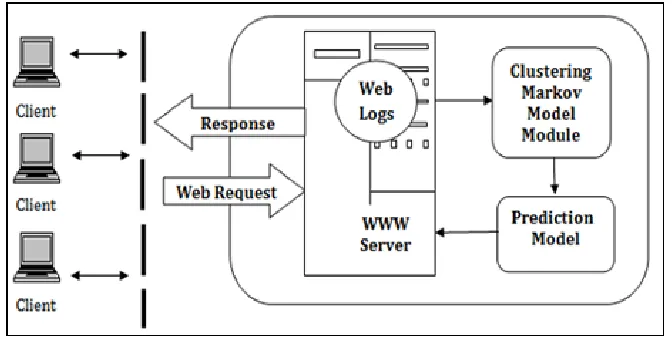
In [3] web page prediction representation was designed to give the respond of web user’s next
contact based on model of Markov and clustering via association rule with algorithm to provide a
© 2014, IJCSMC All Rights Reserved 772
Figure 1: General architecture of web system with web access prediction
Precisely predicting web customer access behavior can reduce the user perceived latency that is
crucial in the quickly growing World Wide Web. While traditional models of Markov have
helped to calculate user’s access behavior. These models have very serious boundaries. So the
novel clustering Markov model with algorithm accessible to analyze and evaluate for the
prediction of web access accurately which gives high accuracy.
In [5] analysis of users’ behavior on web 2.0 sites has been done by taking data from data three
social networking sites. In that analysis the creators of SNS are interviewed for the recognition of
Google analytics and daily data of these sites are collected. The purpose of recognition of Google
analytics was: Determine the vital measures and examine the relation between them, find out the
commonalities throughout these three case companies and give administrative implications
primarily based on statistical outcomes. The metrics that used in Google analytics were: Bounce
rate which is the percentage of a page visits, Visitor which is a user that visits the page or site, %
NV is a number of new visits by users who never visited the page or site before, ATOP is
average time on a page, PV is pages number divided on the basis of visits, ATOS, which is the
average time on site, Visitors is the quantity of time in which visitor has been on site.
Conclusion:
Web user prediction has become very significant in order to facilitate the web users to find
relevant information. Though, identifying different user’s behavior pattern by analyzing web log
© 2014, IJCSMC All Rights Reserved 773
References:
[1]. Christoph Hölscher, Gerhard Strube, Web search behavior of Internet experts and
newbies, Computer Networks, Volume 33, Issues 1–6, June 2000, Pages 337-346.
[2]. Hao Y., Bo Z., Yibo Z., Fang L. & Zhenming L. (2010) Web usage mining based on
WAN users’ behaviors 111 Project of Chinaunder Grant No. B08004 and the Fundamental Research Funds for the Central Universities (BUPT2009RC0123),IEEE.
[3]. Priyanka S. P. & Urmi D. A. (2013) Hybrid Technique for User’s Web Page Access Prediction based on Markov Model, IEEE – 31661.
[4]. Jia, L. (2013). Advanced Information Retrieval within Blogosphere and
Micro-Blogosphere (Doctoral dissertation, University of Illinois at Chicago).
[5]. Shwu-M. H. (2010) Analysis of User’s Behavior on Web 2.0 Social Network Sites: An