Type of the Paper (Article)
1
Security and Cryptographic Challenges for
2
Authentication based on Biometrics Data
3
Stefania Loredana Nita1, Marius Iulian Mihailescu 2,* and Valentin Corneliu Pau 3
4
1 University of Bucharest, Department of Computer Science; [email protected]
5
2 RCCL, Miami, Florida; [email protected]
6
3 The Academy of Romanian Scientists, Bucharest, Romania; [email protected]
7
* Correspondence: [email protected]; Tel.: +40740030310
8
9
Abstract: Authentication systems based on biometrics characteristics and data represents one of the
10
most important trend in the evolution of our world. In the near future, biometrics systems will be
11
everywhere in the society, such as government, education, smart cities, banks etc. Due to its
12
uniqueness characteristic, biometrics systems will become also vulnerable, privacy being one of the
13
most important challenge. The classic cryptographic primitives are not sufficient to assure a strong
14
level of secureness for privacy. The following work paper represents an effort to present the main
15
cryptographic techniques and algorithms that can give us the possibility to raise a certain level of
16
secureness for privacy. We will show their own challenges (strengths and weaknesses). We will
17
demonstrate how we can use the most common and well-known techniques and algorithms in order
18
to get a maximum efficiency and a high level in assuring the integrity of the biometrics data.
19
Keywords: classification, machine learning, chaos-based cryptography, Hadoop, data clustering,
20
biometrics.
21
22
1. Introduction
23
Biometric represents a science through which a system can identify in a unique way the
24
individual based on his physiological (face, fingerprint, iris, hand geometry, retina etc.) and
25
behavioral (voice, gait, signature, keystroke etc.) traits. Due to the rich of applications and systems
26
that occur at this moment on the market, the authentication technology is very widespread from
e-27
commerce applications, door access, and smart city technologies to Internet-of-Things technologies
28
and applications. Once these solutions where declared as providing better security in authentication,
29
automatically issues with privacy preserving and data integrity has been found didn’t stop to occur.
30
Indeed, biometrics systems become more convenient to be used as compared with different classic
31
authentication systems such as token based (e.g. ID cars) or knowledge based (e.g. passwords) [12].
32
A biometric-based authentication system is using two different operating modes: identification and
33
verification modes. These two different modes are very important as they represent security gaps,
34
which are exploited by unwanted users (e.g. hackers/crackers).
35
What is happening in identification mode?
36
In identification mode, the system has a clear goal to carry out the one-to-many comparison
37
meant to set up the individual identity. With other words, the user’s identity and the templates that
38
are stored in the database are compared and based on the result a decision will be made. The purpose
39
of the identification process is to answer to the question “Who am I?” If we are talking about the
40
implementation process, we can say that they are time consuming for deploying and needs a huge
41
amount of time for processing in order to find the proper match within the database [12].
42
What is happening in verification mode?
43
In verification mode, the system is carrying out the one-to-one comparison. This type o
44
comparison is used to set up the individual identity. The user is claiming that identity and the system
45
has the duty to verify if the claim is genuine or forged. The goal of the verification process is to answer
46
to the question “Am I who I say I am?” [12].
47
An interesting question raised by different professionals is “What measurements for the
48
biological characteristics is making them to be qualified as a biometric?” Most of the human
49
physiological and/or behavioral characteristics used in the system for authentication as long as they
50
are satisfying the following requirements:
51
- Performance: this requirement is quite important as the characteristic should be enough invariant.
52
The respect has to be assure for the matching criterion over a period.
53
- Distinctiveness: by choosing two persons should be sufficient different in terms of the
54
characteristic.
55
- Universality: the criteria consist in its unique characteristic that has to be for each person.
56
- Collectability: the requirement is a metric that is quantitatively measured.
57
When we are dealing with a real life biometric system, there is a number of issues that has to be
58
taken into consideration in order to take a complete advantage of the full system and to combat those
59
security issues that could occur on different section:
60
- Performance, the accuracy and speed, two main characteristics that refers to the achievable
61
recognition, are required to achieve the desired recognition accuracy and speed. Also,
62
operational and environmental factors are affecting the accuracy and speed;
63
- Acceptability, a factor that will indicates which people are willing to accept the use of a particular
64
biometric identity in terms of characteristic using in a daily lives;
65
- Circumvention reflects how easy is to fool a system using different methods meant to steal data
66
and to corrupt the integrity of the data.
67
As we will be able to see, the following content of the present work paper will cover the most
68
important aspects of security flaws that are raised by each of the components of the biometric system.
69
The work paper will show and demonstrate theoretical and practical two main benefits: (1) we will
70
demonstrate how we can protect the integrity of the biometric data using Machine Learning
71
Classification and what benefits we can obtain. Another benefit, and (2) applying chaos-based
72
cryptography over encrypted biometric encrypted data. The two main method for secure and
73
guarantee the integrity of the biometric encrypted data will be demonstrated in a professional system
74
architecture based on Hadoop and Data clustering.
75
The new challenges from the last two years represents a very important alarm signal for both,
76
academy and business environments. The security threats and gaps in assuring the privacy and
77
integrity found, represents one of the most important occasion from which we have to take the
78
maximum advantage in creating new theoretical and practical security frameworks.
79
Below we have underline the main new challenges that in our opinion will create new research
80
directions for security and cryptography field, such as:
81
- Using Machine Learning Classification over the encrypted biometric data;
82
- Encryption of biometric data using Chaos-based cryptography;
84
In order to be able to follow the ideas and to understand how they will be applied in a real
85
environment, we need to understand main four modules of the biometric system and their
86
vulnerabilities.
87
The mentioned challenges raised above will be treated and the issues solved using Chaos-based
88
cryptography and machine-learning classification applied in cluster environment using
89
authentication based biometrics.
90
2. Machine Learning Classification Over Biometric Encrypted Data
91
In this section, we present two machine-learning techniques applied on biometric encrypted data:
92
hyperplane decision and Naïve Bayes.
93
2.1. Preliminaries
94
2.1.1. Machine learning
95
“Machine learning is a field of computer science that gives the ability to learn without being explicitly
96
programmed” – Samuel Arthur [1].
97
The below techniques have been applied and implemented in a software solution in order to simulate the methods
98
on biometric data. The learning techniques implemented are described below. The solution software was
99
implemented in .NET Framework 4.5 using C# and Microsoft SQL Server 2016. Due to the status of the
100
software application, we cannot provide the source code in this work paper. For those who are interested about
101
the application they can visit the web page
https://www.researchgate.net/project/Biometrics-Analysis-102
Tool.
103
There are four types of learning techniques implemented are:
104
- Supervised learning is a type of inductive learning based on training sets, in which, the agent
105
receives a set of inputs and their corresponding outputs. The task of the agent is to learn the links
106
between every input and its corresponding output and to generate a template function that will
107
be able to solve problems for new inputs.
108
- Semi-supervised learning. In this type of learning, the agent receives an incomplete training set.
109
- Unsupervised learning is not using training sets, but the agent needs to discover on its own
110
different patterns in dataset.
111
- Reinforcement learning is a type of learning in which the training data is given as feedback for the
112
agent, such that if its output is “good” it receives a reward, otherwise it receives a punishment.
113
The target of the agent is to maximize its reward, providing better and better outputs. The
114
meaning of “good” output is different depending on the environment in which the agent is used
115
[4].
116
Classification represents a machine learning technique (included in supervised learning) in which the
117
inputs are divided into two or more classes. The input is a feature vector 𝑣 = (𝑣 , … , 𝑣 ) ∈ ℝ that
118
will be classified by applying a classification function 𝑓 : ℝ → {𝑥 , … , 𝑥 } on 𝑣, and the output is
119
𝑥 ∗= 𝑓 (𝑣), where 𝑐∗∈ {1, … , 𝑐}; 𝑥 ∗ is the class in which 𝑣 falls, based on model 𝑚.
120
In this case, the feature vector will represent all the biometric data over which the classification data
121
is applied.
122
𝑣 = (𝑣 , … , 𝑣 ) ∈ ℝ
123
𝑏𝑖𝑜𝑚𝑒𝑡𝑟𝑖𝑐 𝑣𝑒𝑐𝑡𝑜𝑟 = (𝑏 ) = (𝑏 , … . , 𝑏 )
124
𝑓 : ℝ ⟶ {𝑥 , … , 𝑥 } over 𝑏 and the output is 𝑥 ∗= 𝑓 (𝑣) where 𝑐∗∈ {1, … , 𝑐}
125
The 𝑥∗ represents the class in which 𝑏 falls, being based on model 𝑚.
126
Two important classification algorithms are Naïve Bayes and hyperplane decision-based classifier.
127
Naïve Bayes. The model 𝑚 of this classifier is based on probabilities: the probability that class 𝑥
128
occurs is {𝑝(𝑋 = 𝑥 )} and the probability that the element 𝑣 of 𝑣 occurs in the particular class
129
𝑥. The classification function is:
130
𝑥 ∗= max
∈{ ,…, }𝑝(𝑋 = 𝑥 |𝑉 = 𝑣)
131
= max
∈{ ,…, }𝑝(𝑋 = 𝑥 , 𝑉 = 𝑣 , … , 𝑉 = 𝑣 )
132
In order to obtain the second equality Bayes rules was applied.
133
In biometrics, the Naïve Bayes will help us to classify the biometric data and to obtain a faster time
134
for processing. The classification is done based on the biometric characteristics.
135
Hyperplane decision. The model 𝑚 contains 𝑐 vectors in ℝ (𝑚 = {𝑚 } ) and the classification
136
function is [2]:
137
𝑥 ∗ = max
∈{ ,…, }〈𝑚 , 𝑣〉,
138
where 〈𝑚 , 𝑣〉 represents the inner product between 𝑚 and𝑣 , in a hypothesis space 𝐻
139
having defined an inner product〈∙,∙〉.
140
In biometrics, the hyperplane decision will help us to identify and to classify in a much better way
141
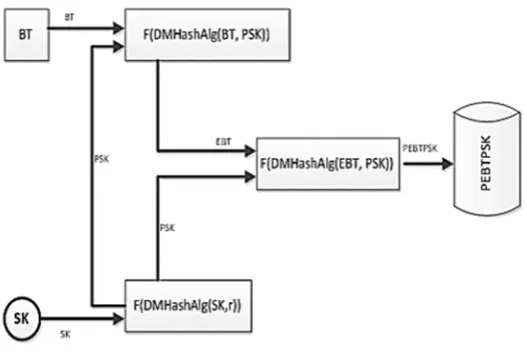
the biometrics 3D representations of face recognition.
142
143
2.1.2. Cryptography
144
Cryptosystem. It has more components: plaintext space 𝑃 , ciphertext space 𝐶 , key space 𝐾 , and
145
encryption functions 𝐸 = {𝐸 | 𝑘 ∈ 𝐾}, and decryption functions 𝐷 = {𝐷 |𝑘 ∈ 𝐾}:
146
∀𝑒 ∈ 𝐾 ∃𝑑 ∈ 𝐾 such that 𝐷 𝐸 (𝑚) = 𝑚, ∀𝑚 ∈ 𝑃
147
Encryption scheme. It represents a particularization of a cryptosystem. There are two types of
148
encryption schemes: symmetric key schemes (in which the same key is used for encryption and also
149
decryption) and public key encryption schemes (in which a public key is used to encrypt messages
150
and a private key is used to decrypt messages).
151
Homomorphic encryption. It is a special type of encryption which allows to apply functions over
152
encrypted message, resulting also an encrypted result, which, when decrypted it is the same as
153
applying the same function over unencrypted message. This is a powerful cryptographic technique,
154
because it increases the security of data, as the operations are applied on encrypted data, resulting
155
an encrypted output, which will be decrypted only the users that own the decryption key.
156
Unfortunately, at this moment a fully homomorphic encryption scheme (that allows to apply any
157
function on encrypted data) does not exist, because the existing computational capabilities are
158
overwhelm. An example of partial homomorphic encryption is RSA cryptosystem [3], where the
159
homomorphic operation is multiplication:
160
𝐸(𝑚 ) ∙ 𝐸(𝑚 ) = 𝑚 𝑚 mod 𝑛 = (𝑚 𝑚 ) mod 𝑛 = 𝐸(𝑚 ∙ 𝑚 ),
161
(2)
(3)
(4)
where the public key is modulus 𝑛 and the exponent is 𝑟, and encryption function is
162
𝐸(𝑚) = 𝑚 mod 𝑛
163
Applying in biometrics, the function has to be changed in order to allow the operations on
164
bits to be applied for each bit separately.
165
166
2.2. Techniques
167
In this section, we present the constructions of the above classification techniques proposed and
168
improved by the authors of [4], such that they could be applied on encrypted data. The authors of [4]
169
have shown that their methods are successfully applied on large real datasets, including in face
170
detection, which became widely used in biometric authentication.
171
2.2.1. Auxiliary algorithms
172
In [4] the cryptosystems that have been used are Quadratic Residuosity [5] (where 𝑃 = ℤ ) and
173
Paillier cryptosystem (where 𝑃 = ℤ and 𝑁 is modulus of Paillier) [6]. Further, notation (𝑏)
174
means the bit 𝑏 is encrypted with Quadratic Residuosity, (𝑚) means the integer 𝑚 is encrypted
175
with Paillier, 𝑆𝐾 and 𝑃𝐾 are secret and public key for Quadratic Residuosity and 𝑆𝐾 and
176
𝑃𝐾 are secret and public key for Paillier.
177
The entities implied in this sections are two parties A and B for building blocks and C (client) and S
178
(server) for classifiers.
179
Authors of [4] have defined some auxiliary operations: comparison with unencrypted inputs,
180
comparison with encrypted inputs, reversed comparison over encrypted data, negative integers
181
comparison and sign determination, which will be used in protocols defined below. The below
182
algorithm will demonstrate how the encryption over biometric data can work bit by bit.
183
Algorithm 1 – max over encrypted data [4]
Input A: 𝑘 integers encrypted using Paillier ((𝑎 ) , … , (𝑎 ) ), the length 𝑙 of 𝑎 (in
bits), 𝑃𝐾 and 𝑆𝐾
Input B: 𝑆𝐾 , 𝑃𝐾 , the length 𝑙 in bits
Output A: max 𝑎
A: generate random permutation 𝜋 over {1, … , 𝑘}
A: (𝑚𝑎𝑥) ∶= 𝑎 ( )
B: m := 1
for i = 2 to k do
𝑏 = max ≤ 𝑎 ( )
A: randomly generate integers 𝑟 , 𝑠 ∶= 0, 2 ∩ ℤ
A: (𝑚 ) ≔ (𝑚𝑎𝑥) ∙ (𝑟 ) ⊳ 𝑚 = 𝑚𝑎𝑥 + 𝑟 A: (𝑎 ) ≔ 𝑎 ( ) ∙ (𝑠 ) ⊳ 𝑎 = 𝑎 ( )+ 𝑠
A: send (𝑚 ) and (𝑎 ) to B
if 𝑏 is true then
B: 𝑚 ∶= 𝑖
B: (𝑣 ) ∶= 𝑅𝑒𝑓𝑟𝑒𝑠ℎ(𝑎 ) ⊳ 𝑣 = 𝑎
else
B: (𝑣 ) ∶= 𝑅𝑒𝑓𝑟𝑒𝑠ℎ(𝑚 ) ⊳ 𝑣 = 𝑚
endif
B: send (𝑣 ) to A
B: send (𝑏 )
A: (𝑚𝑎𝑥) ∶= (𝑣) ∙ (𝑔 ∙ (𝑏 ) ) ∙ ((𝑏 ) ) ⊳ 𝑚𝑎𝑥 = 𝑣 + (𝑏 − 1) ∙ 𝑟 −
𝑏 ∙ 𝑡
end for
B: send 𝑚 to A
A: output 𝜋 (𝑚)
Table 1 - max over encrypted data [4]
184
The next algorithm will show how to change an encryption scheme 𝐸 into and encryption scheme
185
𝐸 , both having the same plaintext size 𝑀 . The authors of [4] supposed that 𝐸 and 𝐸 are
186
additively homomorphic, and semantically secure. In the above algorithm (𝑐) means 𝑐 is
187
encrypted using encryption scheme 𝐸 , 𝑖 ∈ {1, 2}.
188
Algorithm 2 – Change encryption scheme [4]
Input A: (𝑐) , 𝑃𝐾 and 𝑃𝐾
Input B: 𝑆𝐾 , 𝑆𝐾
Output A: (𝑐)
A: pick 𝑟 ∈ 𝑀
A: send (𝑐′) ∶= (𝑐) ∙ (𝑟) to B
B: decrypt (𝑐′) and re-encrypt with 𝐸
B: send (𝑐′) to A
A: (𝑐) = (𝑐′) ∙ (𝑟)
A: output (𝑐)
Table 2 – changing encryption scheme [4]
189
Algorithm 3 – Private inner product [4]
Input A: 𝑎 = (𝑎 , … , 𝑎 ) ∈ ℤ , 𝑃𝐾
Input B: 𝑏 = (𝑏 , … , 𝑏 ) ∈ ℤ , 𝑆𝐾
Output A: (〈𝑎, 𝑏〉)
B: encrypt 𝑏
B: send (𝑏 ) to A
A: compute (𝑣) = ∏ (𝑏 ) 𝑚𝑜𝑑 𝑁 ⊳ 𝑣 = ∑ 𝑏 𝑎
A: re-randomize
A: output (𝑣)
Table 3 – Private inner product [4]
190
The authors of [4] proved that these algorithms are secured in honest but curious model.
191
2.2.2. Naïve Bayes
192
In order to apply Naïve Bayes on encrypted data, there are needed more transformations. In [4], it
193
was working with the logarithm of the probability distribution:
194
𝑥∗= max
= max
∈{ ,…, } log 𝑝(𝑋 = 𝑥 ) + log 𝑝(𝑉 = 𝑣 |𝐶 = 𝑐 )
196
The two types of auxiliary table were used:
197
- One table in which are stored values 𝑃(𝑖) = ⌈𝐾 log 𝑝(𝑋 = 𝑥 )⌉
198
- One table for every feature j and class 𝑖: 𝑇, (𝑞) ≈ 𝐾 log 𝑝 𝑌 = 𝑞 𝑉 = 𝑣 , ∀𝑞 ∈ 𝐷
199
where 𝐷 represent the domain of possible values of 𝑣, and 𝐾 ∈ ℕ is a constant.
200
Now to apply Naïve Bayes on encrypted data, the client needs to compute (𝑝 ) =
201
(𝑃 ) ∏ 𝑇, 𝑣 , and then uses Algorithm 1 to obtain max 𝑝.
202
2.2.3. Hyperplane decision
203
For hyperplane decision the things are quite simple, because the client will calculate
204
(〈𝑚 , 𝑣〉) , 𝑖 ∈ {𝑖, … , 𝑐}, using Algorithm 3 for inner product, and then Algorithm 1 is used to
205
compute max on encrypted inner product.
206
3. Data Clustering in Cloud Computing
207
3.1. Preliminaries
208
3.1.1. Fixed-width clustering algorithm
209
Clustering is a machine learning technique (included in unsupervised learning) in which a set of
210
objects is partitioned into groups called clusters. Different from classification, in clustering there are
211
no predefined clusters, thus the algorithm needs to find relationships or similarities between objects
212
[8].
213
Fixed-width clustering (FWC) algorithm is based on a distance measure. The steps of FWC are the
214
following:
215
1. From a given dataset 𝐷 with an established cluster width 𝑤 , generate a random set of 𝑚
216
clusters: 𝐶 , 𝑖 ∈ {1, … , 𝑚}.
217
2. Compute Euclidean distance between every point 𝑝 , 𝑗 = {1, … , 𝑛} and every cluster 𝐶 , using
218
the formula:
219
𝑑 𝑐 , 𝑝 = 𝑐 − 𝑝 + 𝑐 − 𝑝
220
3. If 𝑑 (𝑐 , 𝑝 ) ≤ 𝑤 , then 𝑝 belongs to 𝐶 cluster; adjust the centroid of 𝐶 by computing the
221
mean of the points that 𝐶 contains at this moment, using the formula (𝑛 is the number of points
222
in 𝐶):
223
𝑐𝑒𝑛𝑡𝑟𝑜𝑖𝑑(𝐶 ) = 𝑝 + ⋯ + 𝑝
𝑛 ,
𝑝 + ⋯ + 𝑝 𝑛
224
4. If 𝑑 (𝑐 , 𝑝 ) > 𝑤, then 𝑝 is the new centroid of 𝐶.
225
5. Reiterate steps 2, 3, 4 until the end of 𝐷.
226
(7)
(8)
3.1.2. MapReduce
227
MapReduce [7] is a programming model for large datasets processing, which works exclusively on
228
(𝑘𝑒𝑦, 𝑣𝑎𝑙𝑢𝑒) pairs. It consists in three steps: 𝑚𝑎𝑝, 𝑠ℎ𝑢𝑓𝑓𝑙𝑒, 𝑟𝑒𝑑𝑢𝑐𝑒, and the user needs to define 𝑚𝑎𝑝
229
and 𝑟𝑒𝑑𝑢𝑐𝑒 functions. The basic idea is that 𝑚𝑎𝑝 function takes as input a set of (𝑘𝑒𝑦, 𝑣𝑎𝑙𝑢𝑒) pairs
230
and outputs an intermediary set of (𝑘𝑒𝑦, 𝑣𝑎𝑙𝑢𝑒). These outputs are processed by 𝑠ℎ𝑢𝑓𝑓𝑙𝑒 function,
231
which groups all intermediary values corresponding to an intermediary key, and sends them to
232
𝑟𝑒𝑑𝑢𝑐𝑒 function. The 𝑟𝑒𝑑𝑢𝑐𝑒 function will try to join these values in order to decrease the number
233
of values. Usually just one value will result for the input key per 𝑟𝑒𝑑𝑢𝑐𝑒 invocation.
234
A well-known software framework is Hadoop MapReduce [8] that allows processing in parallel large
235
datasets (multi-terabytes of data). We will not give more details, for a comprehensive view please
236
read [8].
237
3.2. FWC algorithm with MapReduce
238
In [9] the authors propose a distributed version of FWC algorithm, using MapReduce on a large
239
number of virtual machines (VMs), as follows:
240
- Inputs: dataset D and the set of clusters 𝐶 , … , 𝐶
241
- Partitioning: the 𝑁 points of 𝐷 are allocated to the 𝑀 available VMs (if is not integer, then
242
the remaining points are allocated to the last VM).
243
- Map function. The input is dataset 𝐷 encrypted and kept into Hadoop Distributed File System
244
(HDFS) as (𝑘𝑒𝑦, 𝑣𝑎𝑙𝑢𝑒) pairs, where 𝑘𝑒𝑦 represents the position of 𝑣𝑎𝑙𝑢𝑒 in a data file and
245
𝑣𝑎𝑙𝑢𝑒 represents the encryption of numerical of the data point. The data files are global and sent
246
to all mappers. The 𝑚𝑎𝑝 function in proposed model computes the squared Euclidean distance
247
(in order to shun the square root):
248
𝐸 𝑑 𝑐 , 𝑝 = 𝐸(𝑐 ) − 𝐸(𝑝 ) + 𝐸(𝑐 ) − 𝐸(𝑝 )
249
The 𝑜𝑢𝑡𝑝𝑢𝑡 of map is a set of (𝑘𝑒𝑦, 𝑣𝑎𝑙𝑢𝑒) pairs, where 𝑘𝑒𝑦 is the position of 𝑣𝑎𝑙𝑢𝑒 into a
250
data file and 𝑣𝑎𝑙𝑢𝑒 is the distance 𝐸(𝑑 ) ≝ 𝐸 𝑑 𝑐 , 𝑝 . Note that 𝐸(𝑣) means value 𝑣 is
251
encrypted using function 𝐸.
252
- 𝑅𝑒𝑑𝑢𝑐𝑒 function. The output of a 𝑚𝑎𝑝 function becomes the input for a 𝑟𝑒𝑑𝑢𝑐𝑒 function. The
253
𝑟𝑒𝑑𝑢𝑐𝑒 function needs to find a minimum distance between every point 𝐸(𝑝 ) and every
254
centroid 𝐸(𝑐 ) and then to put data point 𝐸(𝑝 ) into corresponding cluster (the one that
255
corresponds to the minimum distance) [8].
256
Next, we present the pseudo-code algorithms for 𝑚𝑎𝑝 and 𝑟𝑒𝑑𝑢𝑐𝑒 functions as the authors provide
257
them in [9].
258
259
260
Algorithm 4 – Map function [9]
Input: encrypted dataset 𝐸(𝐷)
Output: < 𝑘𝑒𝑦, 𝑐𝑡𝑥𝑡(𝑣𝑎𝑙𝑢𝑒) >→< 𝑖𝑛𝑑𝑒𝑥, 𝑒𝑛𝑐𝑟𝑦𝑝𝑡𝑒𝑑 𝑑𝑖𝑠𝑡𝑎𝑛𝑐𝑒 𝐸 𝑑 >
Initialization: Choose a random set of clusters 𝑐 , … 𝑐 from a given dataset 𝐸(𝐷)
index = 0
for (𝑖=0 to 𝐷. 𝑙𝑒𝑛𝑔𝑡ℎ) do
for (𝑗=0 to 𝑐. 𝑙𝑒𝑛𝑔𝑡ℎ) do
𝐸 𝑑 = 𝑐𝑜𝑚𝑝𝑢𝑡𝑒𝐷𝑖𝑠𝑡(𝐸 𝑝 , 𝐸(𝑐 ))
𝑖𝑛𝑑𝑒𝑥 = 𝑖 + 𝑗
end
end
End
Take index as key
Construct value as an encrypted numerical value 𝐸 𝑑
Output < 𝑘𝑒𝑦, 𝑐𝑡𝑥𝑡(𝑣𝑎𝑙𝑢𝑒) > pair
Table 4 – 𝑚𝑎𝑝 function for distributed version for FWC
261
Algorithm 5 – Reduce function [9]
Input: < 𝑖𝑛𝑑𝑒𝑥, 𝑒𝑛𝑐𝑟𝑦𝑝𝑡𝑒𝑑 𝑑𝑖𝑠𝑡𝑎𝑛𝑐𝑒 𝐸 𝑑 >
Output: < 𝑐𝑡𝑥𝑡(𝑘𝑒𝑦), 𝑐𝑡𝑥𝑡(𝑣𝑎𝑙𝑢𝑒) >→< 𝐸(𝑐 ), 𝐸(𝑝 ) >
Initialization: 𝐸(𝑚𝑖𝑛𝐷𝑖𝑠)
for (𝑖=0 to 𝐷. 𝑙𝑒𝑛𝑔𝑡ℎ) do
𝐸(𝑚𝑖𝑛𝐷𝑖𝑠) = min (𝑑 , … , 𝑑 )
if 𝐸(𝑚𝑖𝑛𝐷𝑖𝑠) ≤ 𝑤 then
𝑎𝑠𝑠𝑖𝑔𝑛(𝐸 𝑝 , 𝐸(𝑐 ))
𝑢𝑝𝑑𝑎𝑡𝑒(𝐸(𝑐 ))
else
𝑐𝑟𝑒𝑎𝑡𝑒𝑁𝑒𝑤𝐶𝑙𝑢𝑠𝑡𝑒𝑟 𝐸 𝑝
end
end
Take 𝐸 𝑝 as key
Construct value as a numerical value 𝐸(𝑐 )
Output < 𝑐𝑡𝑥𝑡(𝑘𝑒𝑦), 𝑐𝑡𝑥𝑡(𝑣𝑎𝑙𝑢𝑒) > pair
Table 4 – reduce function for distributed version for FWC
262
We can easily see the potential of this approach of FWC algorithm in biometry. For example, it
263
could be used on large datasets of human face datasets in order to find different groups among the
264
subjects by analyzing the face images. An advantage of the proposed model in [9] is that
265
computations are made on encrypted data, assuring data privacy.
266
267
4. Our proposed solution
269
This section will describe the proposed solution, which has been implemented already practical, and
270
the results obtained where positive in encrypting data. The idea was developed and presented in
271
details in [10] and [11].
272
The below scheme can be adapted with success for all the mentioned algorithms mentioned above.
273
All the algorithms were been implemented with success in C, C++, Java, and C#. The source code will
274
be available at the link mentioned below.
275
The scheme has been created in a very flexible manner giving the possibility to be adapted
276
accordingly to any type of algorithms especially for those ones from machine learning field.
277
The algorithm has two components:
278
1 – The session key algorithm, and
279
2 – The scheme used for enrollment with data integrity checking and validating for the biometric
280
data.
281
In Figure 4 – 1, we can see that the permutation functions are applied on all the components that play
282
a role in the enrollment scheme. The permutation function will allow the original value to be
re-283
arranged in such a way that will be very difficult to understand something from permuted value. The
284
original values influence the encrypted system. The content of data could be protected using the
285
complex active action, which comes from the characteristic of the system mentioned above. The
286
behavior will result into a random series, which could be utilized to data encryption from secret
287
communication. Thus, an appropriate key controls encryption or decryption of data content. Machine
288
learning is also an appropriate choice for using a hash function due to one-way property. The model
289
described in Figure 4 - 2 stores the encrypted Biometric Template using Session Key. A session key is
290
the process that generates a random encoding and decoding key which ensures the privacy of a
291
session of communications. A similar example can be found in [5] and [6].
292
293
294
Fig. 4 – 1. Data integrity checking and validation for biometric data
295
As some notations for the scheme presented in Figure 4 – 1, the followings have to be considered:
296
• BT – biometric data
• SK – represents the session key, which is generated using a one of the algorithms, which were presented
298
in Chapter 2 and 3 and combined, with elements of machine learning described in Section 2.1.1. The BT
299
contains the biometric vector (𝑏 ) as we have discussed previous.
300
• PSK – represents the permuted session key, which is used to generate the extended version of permuted
301
transformation of the session, key (SK). F(SK) represents a function used for permutation which can be
302
used with any hash function generated based on the main ideas presented above.
303
• EBT – represents the biometric data, which are encrypted. In order to generate the biometric template
304
encrypted, the hash function construction is applied F(DMHashAlg(BT, PSK)). The hash function is
305
based on a simple XOR function and both functions F(DMHashAlg(SK,r)) and F(DMHashAlg(EBt,
306
PSL)) functions are used together beside the hash functions with the permutation of the bits SK, EBT
307
and ESK.
308
• PEBTPSK – the permuted biometric data and also the permuted session key (SK) will be used to
309
generate the final step in order to concatenate the biometric template F(DMHashAlg(EBT, PSL)). In
310
order to assure the decryption process, the biometric pattern is using the functions and session key,
311
which has been used to encrypt the template.
312
In the end, the presented idea represents a new scheme for assuring the data integrity of the biometric
313
data. The algorithm has been implemented with success and it was tested with positive results on a
314
set of 700 unique biometric data of 523 subjects.
315
To access the source code of the application, please, visit the following web address:
316
https://www.researchgate.net/project/Biometrics-Analysis-Tool.
317
5. Conclusions
318
Applying cryptographic mechanisms and machine learning over biometric data is not an easy task
319
to accomplish. This fact can be due to the high complexity of how the biometric data are scanned and
320
read from the user and transfer into the system. Every time that the evolution of technology is making
321
important advances the complexity of assuring the security and integrity of the data is becoming a
322
real pain for developers and designers of authentication systems on biometrics.
323
We have proven that applying machine learning techniques and cryptography mechanisms can be a
324
task that can be accomplished. The most important aspect on which we have focused in this work
325
paper is how the parameters can be represented and adapted within the algorithms and techniques
326
used in cryptography and machine-learning. The complexity of the algorithms and the time
327
processing can represented a problem but not so critical at this time for any of the system
328
configuration based on the highest requirements possible.
329
The algorithms presented in Chapter 3 and Chapter 4 where implemented with success and we have
330
obtained positive results.
331
All the results can be viewed at https://www.researchgate.net/project/Biometrics-Analysis-Tool. The
332
software used in analysis and simulation is presented at the mentioned web site. Due to copyrights, we didn’t
333
make the source code available at this moment.
334
References
335
1. Samuel AL: Some studies in machine learning using the game of checkers. IBM Journal of research and
336
development. 2000;44.1.2:206-226.
337
2. Nasrabadi NM: Pattern recognition and machine learning. Journal of electronic imaging. 2007; 16.4:
338
049901.
3. Rivest RL, Shamir A, Adleman L: A method for obtaining digital signatures and public-key
340
cryptosystems. Communications of the ACM. 1976;21(2):120-126.
341
4. Bost R, Popa RA, Tu S, Goldwasser S: Machine learning classification over encrypted data. In NDSS.
342
2015;4324:4325.
343
5. Goldwasser S, Micali S: Probabilistic encryption & how to play mental poker keeping secret all partial
344
information. In: Proceedings of the fourteenth annual ACM symposium on Theory of computing; May
345
1982: ACM; 1982. p. 365-377
346
6. Paillier P: Public-key cryptosystems based on composite degree residuosity classes. In: International
347
Conference on the Theory and Applications of Cryptographic Techniques, May 1999; Berlin,
348
Heidelberg: Springer; 1999. p. 223-238
349
7. Dean J, Ghemawat S: MapReduce: simplified data processing on large clusters. Communications of
350
the ACM. 2007; 51(1):107-113.
351
8. Taylor RC: An overview of the Hadoop/MapReduce/HBase framework and its current applications in
352
bioinformatics. In BMC bioinformatics. 2010:11(12):S1.
353
9. Alabdulatif A, Khalil I, Reynolds M, Kumarage H, Yi X: Privacy-preserving data clustering in cloud
354
computing based on fully homomorphic encryption. In PACIS 2017: Societal Transformation Through
355
IS/IT. Association for Information Systems (AIS). 2017:1-13.
356
10. Mihailescu Marius Iulian, Nita Stefania Loredana, Security of Biometrics Authentication Protocols. Theory
357
and Practice Applications, LAP LAMBERT Academic Publishing, ISBN-10: 3659777498, ISBN-13:
978-358
3659777493. Publishing Date: 11 September 2015, Language: English, 232 pages.
359
11. Mihailescu Marius Iulian, New Enrollment Scheme for Biometric Template using Hash Chaos-based
360
cryptography, Elsevier - Procedia Engineering, Volume 69, 2014, pages 1459-1468, ISSN: 1877-7058.
361
12. Mihailescu Marius Iulian, Racuciu Ciprian, Grecu Dan Laurentiu, Nita Stefania Loredana, A
Multi-362
Factor Authentication Scheme Including Biometric Characteristics as One Factor, 1st International
363
Conference Sea-Conf, pp.:348-353, Mircea cel Batran Naval Academy Scientific Bulletin, Volume XVIII,
364
Issue 1, ISSN: 2392-8956, ISSN-L: 1454-864X, CNCS Code: 884, 14-16 May 2015, Constanta, Romania.