CLUSTER BASED NEIGHBOR COVERAGE ROUTING
SCHEME FOR MANET
1DR.A.RAJARAM, 2SHAJAN JOSEPH
1
Associate Professor, Department of Electronics and Communication Engineering,
Karpagam College of Engineering, Coimbatore, India. 2
Research Scholar, Anna University, Chennai, India
E-mail: , [email protected], [email protected]
ABSTRACT
Mobile Ad hoc Network is the indivisible part of wireless network. In the past few years, the popularity of MANET grows unlimitedly. Due to the presence of mobility and infrastructure less topology, the vulnerability of ad hoc networks is introduced unconditionally. In this research work, it is developed that cross layer based multipath neighbor routing protocol to attain network connectivity and load balancing among the mobile nodes. In this phase, multipath routing is deployed to overtime the failures and breakages of links and paths. For reducing energy consumption, the energy consumption model has been proposed to keep maximum energy efficiency of mobile nodes. It is also calculated that the rebroadcast delay and rebroadcast probability of the proposed protocol. It uses the upstream coverage ratio of an RREQ packet received from the previous node to calculate the rebroadcast delay, and use the additional coverage ratio of the RREQ packet and the connectivity factor to calculate the rebroadcast probability in our protocol, which requires that each node needs its 1-hop neighbourhood information. By using the experimental result this work achieves more connectivity, lifetime and less overhead than the existing schemes NCPR and DPR and AODV.
Keywords: Multicast, Stability Ratio, Malicious Attackers, Detection Ratio, Delivery Ratio, Communication Overhead, End To End Delay, Threshold Value, Node Familiarity And Node Proposal.
1. INTRODUCTION
MANETs does not depend on pre-existing infrastructure or base stations. Network nodes in MANETs are free to move randomly. Therefore, the network topology of a MANET may change rapidly and unpredictably. All network activities, such as discovering the topology and delivering data packets, have to be executed by the nodes themselves, either individually or collectively. Depending on its application, the structure of a MANET may vary from a small, static network that is highly power-constrained to a large-scale, mobile, highly dynamic network. It is a group of autonomous mobile nodes or devices connected through wireless links without the support of a communications infrastructure. The topology of the network changes dynamically as nodes move and the nodes reorganize themselves to enable
communications with nodes beyond their
immediate wireless communications range by relaying messages for one another, i.e. multihop
Mobile Ad Hoc Network (MANET) is a self-configuring system of mobile routers linked by wireless links which consequently combine to form an arbitrary topology. Thus, the network's wireless topology may alter rapidly and unpredictably. However, due to the lack of any fixed infrastructure, it becomes complicated to exploit the present routing techniques for network services, and this provides some huge challenges in providing the security of the communication, which is not done effortlessly as the number of demands of network security conflict with the demands of mobile networks, largely due to the nature of the mobile devices .e.g. low power consumption, low processing load.
Mobile Ad Hoc networks are needed as mobile hosts need to communicate with each
with no fixed infrastructure and no
administrative help because
1. It may not be physically possible for the
2. It may not be practically economical to establish the infrastructure or
3. It may be because of the expediency of the
situation does not permit the installation of the infrastructure.
Examples of the use of the MANETs are:
• National security – for
communication in times of national
crisis, where the existing
communication infrastructure is non-operational due to a natural disaster or a global war.
• Law enforcement – for fast
establishment of communication in exhibitions, conferences, or sales presentations.
• Tactical operation – for fast
establishment of military
communication during the
deployment of forces in unknown and hostile terrain.
• Rescue mission – for communication
in areas without adequate wireless coverage.
2. RELATED WORK
In this paper [4], it was presented a mathematical framework for quantifying the overhead of proactive routing protocols in mobile ad hoc networks (MANETs).The focus is on situations where the nodes are randomly moving around but the wireless transmissions can be decoded reliably, when nodes are within communication range of each other. This paper analytically evaluated the inter-dependence between routing overhead and the stability of topologies, by characterizing the statistical distribution of topology evolutions. The stability of topology can be modelled as exponentially distributed with parameter computed from network configurations. This model gives good estimate of routing overhead and provides good insight on how nodal mobility affects the routing overhead.
In this paper [5], it was presented that put forth the problem of sending a broadcast message in a MANET. Broadcasting is a common operation in many applications, e.g., graph-related problems and distributed computing problems. It is also widely used to resolve many network layer problems. In a MANET in particular, due to host mobility, broadcasting is expected to be performed more frequently. Broadcasting may also be used in LAN
emulation or serve as a last resort to provide multicast services in networks whose topologies change rapidly. In this paper, assume that mobile hosts in the MANET share a single common channel with carrier sense multiple access(CSMA), but no collision detection (CD), capability. Synchronization in such a network with mobility is unlikely, and global network topology information is unavailable to facilitate the scheduling of a broadcast. So one straightforward and obvious solutionis broadcasting by flooding. Unfortunately, in this paper can observe that serious redundancy, contention, and collision could exist if flooding is done blindly. First, because the radio propagation is Omni-directional and aphysical location may be covered by the transmission ranges of several hosts, many rebroadcasts will be redundant. Second,
heavy contention could exist because
rebroadcasting hosts are probably close to each other. Third, collisions are more likely to occur because the RTS/CTS dialogue is inapplicable and the timing of rebroadcasts is highly correlated. Collectively, these problems are associated with flooding as the broadcast storm problem.
topologies sometimes consist of well-connected components joined by important links; identifying and increasing the reliability of these links is essential to provide both high reliability and efficiency. It isbuilt on prior analytic work to understand the effect of density on reliability in simple topologies, and confirm the effects of density and important links in simple topologies through simulation. The cost of RBP is small, and the net result is much greater efficiency when one considers net overhead to reach a targeted reliability. Timeliness is a natural side effect of our protocol, because a single flood will have a higher probability of achieving global coverage. RBP was motivated by our experiences implementing applications using diffusion. Broadcast loss forced application-specific changes to diffusion to get adequate query latency. RBP simplifies these applications by provided consistent, efficient flooding.
Broadcasting is a fundamental and effective data dissemination mechanism for route discovery, address resolution and many other network services in ad hoc networks. While data broadcasting has many advantages, it also causes some problems such as the broadcast storm problem, which is
characterized by redundant retransmission,
collision, and contention. This paper [7] proposes a probabilistic broadcasting based on coverage area and neighbor confirmation in mobile ad hoc networks. It uses the coverage area of a node to adjust the rebroadcast probability. If a mobile node is located in the area closer to sender, which means it has small additional coverage and rebroadcast from this node can reach less additional nodes, so its rebroadcast probability will be set lower. On the other hand, if a mobile node is located in the area far from sender, which means that the additional coverage from this node is large; its rebroadcast probability will be set higher. The coverage area can be estimated from the distance between sender and receiver and the distance can be estimated by signal strength or global positional system. This approach combines the advantages of probabilistic and area based approach. Simulation results show that our approach can improve the average performance of broadcasting in various network scenarios. Our approach is simple and can be easily implemented in MANET.
A Mobile Ad Hoc Network (MANET) is a network consisting of a collection of nodes capable of communicating with each other without aid from a network infrastructure. Each node participating in the network works both as host and a router and
must therefore is willing to forward packets for other nodes. For this purpose, a routing protocol is needed. The Dynamic Source Routing protocol [2], a simple as well as an efficient routing protocol is designed particularly for use in multi-hop wireless ad hoc networks, allows the network to be entirely self-organizing and self-configuring, without the requirement of any presented network infrastructure or the administration. All aspects of the protocol work entirely on- demand, permitting the routing packet overhead to scale automatically to only which needed to respond to various changes in the different routes currently in use. The DSR protocol permits various nodes to dynamically find out a source route across some multiple network hops to any destination in mobile ad hoc network. Each data packet which is sent carries in its header the complete as well as ordered list of different nodes through which the packet must pass, allowing the packet routing to be insignificantly loop-free and avoiding the requirement for all up-to-date routing information in the midway nodes through which the packet is forwarded. So by including this source route in the header of each data packet, some other nodes forwarding or overhearing any of these packets may also simply cache this routing information for the future use.
Our aim in this paper is to arrive at a cluster based Neighbor Coverage Routing Scheme which strikes a balance between overhead, network lifetime, energy efficiency and end to end delay.
3. IMPLEMENTATION OF OPTIMIZED
MULTICASTROUTINGSCHEME
The Cluster based Neighbor Coverage Routing Scheme consists of three phases i.e. cluster routing, cross layer design and energy consumption model.
3.1 Cluster Construction
In Cluser1, Cluster Head 1 chooses the multipath to Cluster Head 2. If the cluster nodes want to send a packet to another cluster in different region, it should get authentication from both cluster heads. If any failure occurs, the route control message is forwarded to both cluster regions. The failure means like node failure, path failure etc. To avoid this, the disjoint paths are chosen. Information is sent over multiple, strictly disjoint, paths. If different versions of information are received, the destination chooses the highest priority. So the
untrustworthy, since it is delivered a presumably incorrect message.
A cross layer based multipath neighbor routing
protocol is developed to attain network
connectivity. Here this protocol is deployed to overcome the link and path breakages. To decrease the energy consumption, the energy consumption model has been proposed. The experimental results shows more connectivity life time and less overhead. Cross layer design is said to be the violation of layered communication architecture in the protocol design with respect to the original architecture. This design emphasizes on the network performance by enabling the different layers of the communication stack to share state information or to coordinate their actions in order to jointly optimize network performance.
Distributed algorithms can exploit a cross-layer design to enable each node to perform fine-grained optimizations locally whenever it detects changes in network state. Mobility causes changes for the physical layer (for e.g. interference levels), the data link layer (for e.g. link schedules), the routing layer (for e.g. new neighbouring nodes), and the transport layer (for e.g. connection timeouts). As such, a cross-layer based design enhances the
capability of the node to manage its resources in the mobile environments Antenna arrays can also
enable the reception of multiple packets
simultaneously on the wireless channel and the data packets corresponding to several connections could also arrive simultaneously at a node. The cooperation of various layers such as routing, data link, and physical layer can ensure the forwarding of data for all the connections within time.
3.2. Cross layer framework
Cross layer design offers performance benefits for a particular system. In contrast, the architecture offers a model for sustained innovation in a system, so it offers long-term gains. The short-term performance gains of cross-layer design may be more significant for the network user to make efficient use of limited node resources.
The following issues raise the need for cross layer design:
• Due to multipath, the response of the
wireless channel varies over time and space which leads to short-term fading. These variations may be caused due to either motion of the wireless device or changes in the surrounding physical environment, and lead to errors at the receiving end. This causes bursts of errors
to occur during which packets cannot be successfully transmitted on the link. Furthermore, if very strong forward error correction codes at low error rates are employed to eliminate the burst errors then it reduces the spectral efficiency.
• There are also spatial and temporal
variations on a much greater timescale due to the small scale variations. Large-scale channel variation means that the average
channel response depends on user
locations and the level of interference on the channel. This channel variation occurs because of some users may essentially demand more channel access time than others based on their location and/or mobile velocity, even if their data rate requirement is the same as or less than other users. The improvement in the channel characteristics can be improved if the strict physical and MAC layer boundaries can be made soft with the help of cross layer design.
• In MANET traditional approach, each
layer of the IP protocol stack operates independently. The information is being shared between the adjacent layers only. Due to the dependencies between physical and upper layers, the traditional approach is not suitable for Mobile Ad hoc Networks. There is need to cross the normal layer boundaries to improve the performance of communication and hence
better than the application layer
performance. In Cross layer design, the data is shared between the different protocol layers dynamically.
• So that, the information can be exchanged
between any different layers of the TCP/IP protocol stack.
• In Wireless network, physical layer, Media
• The routing decision will change the contention level at the MAC layer and accordingly the physical layer parameters. Because of adaptation of layers end to-end performance can be optimized. Any design changes in the protocol stack when adding interaction between different layers may have effect on the whole system. So cross layer design use with caution.
3.3 Energy Consumption Model
In MANETs, the topology is dynamic not static. Due to the dynamic topology, node consumes more energy while roaming. For this, the topology control approach has been introduced. In this approach, have considered two cases,
i) Energy consumption of the node and
routes.
ii) Link stability and location stability.
Case i)
In first case, the dynamic and adaptive topology is proposed. It will adopt, according to the node moves with in the network. For this each node will keep on nearest level with in the cluster. The number of links connected to a node is kept low. The link with the low transmission power is also taken in to the consideration for the energy consumption of the route.
Case ii)
For link stability and location stability, each node carrying link with highest density and efficient transmission power with adaptable location. The location stability which implies node is on the stable state which is ready state to send the number of packets to the intended destination node with degrading the network performance. While implementing these two cases, the energy consumption of the whole network can be effectively reduced.
The energy model of proposed algorithm is given below. In this model energy consumption for transmitting Mbit is equal to:
Etr(M, d) = Eelec x M +
δ
amp x M x d2 - Ewast(Pdrop) M = bit contain some information like current energy level of the node, data label, node’s location and hop count.Eelec= Energy to be Transmitted and Received
electronic device module (75 nJ/bit).
δ
amp=Transmitter Amplifier (150 pJ/bit/m2) d = distance between the two nodes.
Ewast(Pdrop) = Energy wasted on packet dropping.
And the energy for receiving K bit is equal to: Err = Eelecx M
F. Packet format of CLMNRP
Source ID
Destination ID
Hop Count
Energy Status
Route Status
FCS
2 2 1 4 4
2
Fig 1.CLMNRP Packet format
In figure 1, the proposed packet format is shown. Here the source and destination node ID carries 2 bytes. The third field hop count determines the number of n does connected to the particular node in the cluster. It occupies 1 byte. The stability ratio of 4 bytes size indicates whether link, path and node stability factor are exceeded from threshold vector value. Both Energy and Route status are verified by cluster head. It occupies 4 bytes. The last filed FCS i.e. Frame Check Sequence which is for error correction and detection in the packet while transmission.
4.PERFORMANCE EVALUATION
The performance of the proposed approach is evaluated in this section. We have simulated our results using NS2.34 simulator. It is an object oriented discrete event simulator to identify the performance of proposed scheme. The Backend language of NS2.34 is C++ and front end is Tool command language (Tcl). NS2 is user friendly and easy to fabricate our own protocol. Tcl is a string-based command language. The language has only a few fundamental constructs and relatively little syntax, which makes it easy to learn. The syntax is meant to be simple. Tcl is designed to be a glue that
assembles software building blocks into
applications. Here we made the assumption that adopted for simulation is all nodes are moving dynamically including the direction and speed of nodes. Mobility scenario is generated by using random way point model with 300 nodes in an area of 1000 m × 1000 m. Our simulation settings and parameters are summarized in table 1.
Table1. Simulation And Settings Parameters Of CLMNRP
No. of Nodes 350
Area Size 1000 X 1000
Mac 802.11
Radio Range 250m
Simulation Time 50 sec
Packet Size 512 bytes
Mobility Model Random Way Point
Initial energy 75
Transmitted power 0.879
Received Power 0.08
Pause time 150 s
CS range 540m
D. Performance Metrics
We evaluate mainly the performance according to the following metrics.
MAC Collision Rate
The average number of packets (including RREQ, route reply (RREP), RERR, and CBR data packets) dropped resulting from the collisions at the MAC layer per second.
Normalized Routing Overhead
The ratio of the total packet size of control packets (include RREQ, RREP,RERR, and Hello) to the total packet size of data packets delivered to the destinations. For the control packets sent over multiple hops, each single hop iscounted as one transmission. To preserve fairness, use the size of RREQ packets instead of the number of RREQ packets, because the DPR and NCPR protocols include a neighbor list in the RREQ packet and itssize is bigger than that of the original AODV.
Packet Delivery Ratio
The ratio of the number of data packets successfully received by the CBR destinations to the number of data packets generated by the CBR sources.
Average End-To-End Delay
The average delay of successfully delivered CBR packets from source to destination node. It includes all possible delays from the CBR sources to destinations. The experiments are divided to three parts, and in each part evaluate the impact of one of the following parameters on the performance of routing protocols.
E. Results
We compared our proposed scheme with Dynamic Source Routing Protocol [] and NCPR [15]. The results are examined by using performance metrics end-to-end delay, packet delivery ratio, malicious node detection ratio, network lifetime, end to end delay and overhead.
From Fig.2, in X axis, No. of nodes can be varied as 50,100,….350. In Y axis packet delivery ratio is varied up to 100%. Compared to previous schemes namely NCPR and DPR, our proposed scheme CLMNRP achieves better delivery ratio.
[image:6.595.213.496.95.330.2].
Fig.2. Nodes Vs Packet Delivery Ratio
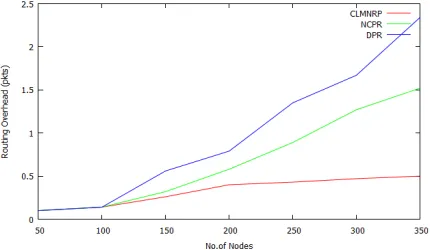
From Fig.3, in X axis, no.of.nodes can be varied as 50,100...350 and in Y axis routing overhead (packets) are varied as 0.5,1….2.5.Compared to previous schemes namely NCPR and DPR, our proposed scheme CLMNRP achieves less routing overhead.
Fig 3. No. Of Nodes Vs Routing Overhead
[image:6.595.307.522.440.565.2]Fig 4. No. Of CBR Connections Vs End To End Delay
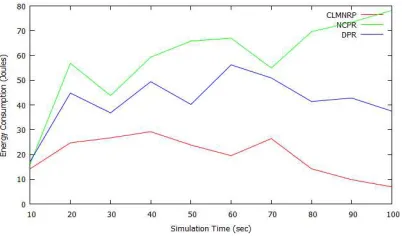
[image:7.595.90.291.345.463.2]In Fig.5, simulation time is varied as 10,20…100 in X axis and energy consumption is varied as 10,20…..80in Y axis. Compared to previous schemes namely NCPR and DPR, our proposed scheme CLMNRP consumes less energy.
Fig 5. Simulation Time Vs End To End Delay
4. CONCLUSION
In this research work, we proposed a cluster based neighbor coverage routing scheme based on neighbor coverage to reduce the routing overhead in MANETs. This neighbor coverage knowledge includes additional coverage ratio and connectivity factor. Here, multipath routing is deployed to overcome the failures of links and paths. For reducing the energy consumption, the energy consumption model has been proposed to attain maximum energy efficiency. The simulation results show that the proposed scheme has good performance and achieves more connectivity, lifetime and less overhead. Future studies can be extended to implement the authentication and security in the cluster routing scheme to make more integrity to the information which is carried out among the mobile nodes. We plan to choose the cryptographic schemes to make network more secure.
REFERENCES:
[1] C. Perkins, E. Belding-Royer, and S. Das,(2003)‘Ad Hoc On-Demand Distance
Vector (AODV) Routing’, IETF RFC 3561.
[2] D. Johnson, Y. Hu, and D. Maltz,(2007)‘The Dynamic Source RoutingProtocol for Mobile
Ad Hoc Networks (DSR) for IPv4’, IETF
RFC 4728, Vol. No.15, pp.No.153-181. [3] H. AlAamri, M. Abolhasan, and T. Wysocki,
(2009) ‘On OptimisingRoute Discovery in Absence of Previous Route Information
inMANETs”, Proceeding of IEEE Vehicular
Technology Conference. (VTC), pp.No.1-5. [4] X. Wu, H.R. Sadjadpour, and J.J.
Garcia-Luna-Aceves,(2007) ‘Routing Overhead as a
Function of Node Mobility:
ModelingFramework and Implications on
Proactive Routing,’Proceeding of IEEE
International Conference. Mobile Ad Hoc and Sensor Systems (MASS ’07).
[5] S.Y. Ni, Y.C. Tseng, Y.S. Chen, and J.P. Sheu,(1999) ‘The Broadcast Storm Problem
in a Mobile Ad Hoc Network,’ Proceeding of
ACM/IEEE Mobile Communication, pp.No.151-162.
[6] A. Mohammed, M. Ould-Khaoua, L.M.
Mackenzie, C. Perkins,and J.D.
Abdulai,(2009) ‘Probabilistic Counter-Based
Route Discoveryfor Mobile Ad Hoc
Networks,’ Proceeding of International
Conference. Wireless Communicationand Mobile Computing: Connecting the World Wirelessly (IWCMC ’09),pp.No.1335-1339. [7] J. Kim, Q. Zhang, and D.P. Agrawal, (2004 )
‘Probabilistic Broadcasting Based on
Coverage Area and Neighbor Confirmation in
MobileAd Hoc Networks,’ Proceeding of
IEEE GlobeCom.
[8] Z. Haas, J.Y. Halpern, and L. Li, (2002 )
‘Gossip-Based Ad Hoc Routing,’ Proceeding
of IEEE INFOCOM, Vol.No.21, pp.No.1707-1716.
[9] J. Chen, Y.Z. Lee, H. Zhou, M. Gerla, and Y. Shu,(2006) ‘Robust Ad Hoc Routing for
Lossy Wireless Environment,’ Proceedings of
IEEE Conference.Military Communication. (MILCOM ’06), pp.No.1-7.
[10] F. Stann, J. Heidemann, R. Shroff, and M.Z.
Murtaza,(2006) ‘RBP:Robust Broadcast
Propagation in Wireless Networks,’
Proceeding of International conference. Embedded Networked Sensor Systems (SenSys
[11] F. Xue and P.R. Kumar,(2004) ‘The Number of Neighbors Needed for Connectivity of
Wireless Networks,’ Wireless Networks,
Vol.No.10,pp.No. 169-181.
[12] X.M. Zhang, E.B. Wang, J.J. Xia, and D.K. Sung,(Sept.2011) ‘An Estimated Distance Based Routing Protocol for Mobile Ad Hoc
Networks,’, IEEE Transaction. Vehicular
Technology, Vol.No.60, pp.No.3473-3484.
[13] J.D. Abdulai, M.Ould-Khaoua, L.M.
Mackenzie, and A. Mohammed,(2008)
‘Neighbour Coverage: A Dynamic
Probabilistic RouteDiscovery for Mobile Ad
Hoc Networks,’ Proceedings of International
Symposium. Performance Evaluation of Computer and Telecommunication Systems,pp.No.165-172.
[14] P.Sinivasan & K.Kamalakkannan, “Signal Strength and Energy Aware Reliable Route
Discovery in MANET”, International Journal
of Communication Network Security ISSN: 2231 – 1882, Volume-1, Issue-4, 2012, pp.55-59.
[15] Tripti Nema, Akhilesh Waoo, P.S.Patheja & Dr.Sanjay Sharma, “ Energy Efficient Adaptive Routing Algorithm in MANET with
Sleep Mode”, International Journal of
Advanced Computer Research, Volume-2 Number-4 Issue-6, 2012, pp.431-435.
[16] S. Priyadsrini, T. M. Navamani, and Venkatesh Mahadevan, “An Efficient Route Discovery in Manets with Improved Route
Lifetime “, International Journal of
Information and Electronics Engineering, Vol. 2, No. 4, July 2012, pp.493-496.
[17] Wenjing Yang, Xinyu Yang and Shusen Yang, “Improving Route Stability in Mobile Ad hoc
Networks Based on Link Lifetime”, Journal