Performance Comparison between Conventional
and Self Tuning Fuzzy PI Controllers for
Interacting Multivariable Process
Angel Augustine
1, Neethu Mary
2, Jimisha K
3, Aruna B
4PG Scholar, Dept. of Control and Instrumentation, Vimal Jyothi Engineering College, Kannur, Kerala, India1,2,3,4
ABSTRACT-Conical tanks are used in many process industries as its shape contributes better drainage. The interactions between input-output variables are a common phenomenon. The implementation of control algorithms for this MIMO system is complicated,due to variation in process dynamics that occur due to nonlinear dynamic coupling.The control system present many challenging problem also due to uncertain and time varying parameters,constraints on manipulated variable,interaction between manipulated and controlled variable. The time domain analysis of interacting multivariable process is analyzed using PI controller.Then Self tuning fuzzy PI controller is applied to compare its performance.It is observed that Self tuning fuzzy PI controller perform better than conventional controller.
KEYWORDS: TCTILS,PI controller,fuzzy logic controller, Self-tuning fuzzy PI controllers. I. INTRODUCTION
Conical tank is a non-linear process because of its varying cross sectional area.For industries using nonlinear process,the design of controllers is a challenging task because the controller theory mainly deals with linear processes.The implementation of MIMO system is complicated,due to the variation in process dynamics[1].PI controller is used in many process industries due to its fast response and quick tuning[2][6][7].For controlling the level of tank in a multivariable process,model based controller can be used Internal Model Control (IMC) since it provide better closed loop performance and robustness compared to other[4][13].Also a decentralized IMC method is used for controlling the multi-input multi-output plants subject to multiple operating regimes [4].Because of the introduction of digital computers for process control,the applicability of adaptive control system has widened[3].The optimal control for Two Conical Tank Interacting Level System (TCTILS) is obtained by linear quadratic Gaussian control solution with optimal Kalman filter[5].
Several intelligent techniques like Genetic algorithm are used which is a global search technique for optimization process.It mimics the process of natural evaluation[7].As PI controller are time consuming and produce damped oscillation,neural network based controller are designed to overcome it[8].A centralized neuro controller realize a good dynamic behavior of TCTILS a perfect level tracking with lesser overshoot,lesser settling time,reduced interaction and good rejection of load disturbances[16].
MPC has become the leading form of advanced multivariable control in chemical process industry[11].To maintain performance of multiple linear MPC controller over a wide range of operating levels we can introduce a gain scheduling control strategy for MPC[12].Since MIMO system cause difficulties in feedback controller design a decentralized control can be used in industrial environment.It is used because of its simple structure,ease of implementation and maintain adequate performance[15].The fuzzy logic controller are widely used since it performs with zero overshoot,faster settling time,better set-point tracking and lesser error compared to conventional controllers[17].
In this paper, through simulation in Matlab by selecting appropriate fuzzy rules are designed to tune the parameters 𝑘𝑝 𝑎𝑛𝑑 𝑘𝑖of the PI controller. In this study, we propose two controllers conventional PI and Self Tuning
implementation,details of self-tuning fuzzy PI controller and implementation is included in section 4,section 5 deals with the simulation results and finally section 6 contain conclusion.
II. TWO CONICAL TANK INTERACTING LEVEL SYSTEM
Two Conical Tank Interacting Level System (TCTILS) is a class of two tank benchmark setup used by researchers. TCTILS is a nonlinear TITO system whose parameters vary with operating point. TCTILS has nonlinear dynamic interaction. The TCTILS as shown in Fig1 is based on the two tank benchmark setup that has been used by a number of researchers. The TCTILS is regarded as a setup for investigating, theoretically and experimentally, nonlinear multivariable feedback control schemes. TCTILSconsists oftwo identical conical tanks (TANK1 and TANK2), two independent pumps (PUMP1 and PUMP2) that deliver the liquid flows 𝐹𝐼𝑁1 and 𝐹𝐼𝑁2 to TANK1 and TANK2 through
the two control valves 𝐶𝑉1and 𝐶𝑉2 respectively. These two tanks are interconnected at the bottom through a manually
controlled valve, 𝑀𝑉12 with a valve co-efficient 𝛽12. 𝐹𝑂𝑈𝑇1 and 𝐹𝑂𝑈𝑇2 are the two output flows from TANK1 and
TANK2 through manual control valves 𝑀𝑉1 and𝑀𝑉2 with valve coefficients 𝛽1 and 𝛽2respectively. The 𝛽12, 𝛽1 and
𝛽2 are adjustable coefficients representing the resistance of the respective valves opening orifice.
Fig1.schematic of TCTILS
The valve coefficient 𝛽𝑖 may be evaluated using
𝛽𝑖= 𝑉𝑖𝑎𝑖 2𝑔 (1)
where Vi (i = 1, 2,12) are the cross sectional area of valves and ai is the discharge coefficient, which is assumed as unity. The operating parameters of TCTILS are presented in Table1. In TCTILS, level ℎ2 in TANK2 is considered as
measured variable and 𝐹𝐼𝑁1 is considered as manipulated variable.
The mathematical model of TCTILS is given by,
𝑑ℎ1
𝑑𝑡 =
𝐹
𝐼𝑁 1−𝛽 1 ℎ 1−𝑠𝑖𝑔𝑛 ℎ 1−ℎ 2 𝛽 12 √ℎ1−ℎ 2−ℎ 1𝑑𝐴 ℎ 1𝑑𝑡
1
3𝜋𝑅2 ℎ 1
2
𝐻 2
(2)
𝑑ℎ2
𝑑𝑡 =
𝐹
𝐼𝑁 2−𝛽 2 ℎ 2+𝑠𝑖𝑔𝑛 ℎ1−ℎ 2 𝛽 12 √ℎ 1−ℎ 2−ℎ 2𝑑𝐴 ℎ 2𝑑𝑡
1
3𝜋𝑅2 ℎ 2
2
𝐻 2
(3)
A (ℎ1) - Cross sectional area of TANK1 (𝑐𝑚2) at ℎ1 cm
A (ℎ2) - Cross sectional area of TANK2 (𝑐𝑚2) at ℎ2 cm
Parameter Description Value
R Top radius of conical 19.25 cm
H Maximum height of TANK1 &
TANK2
73 cm
𝐹𝐼𝑁1& 𝐹𝐼𝑁2 Maximum inflow to TANK1 &
TANK2 respectively
111.11 cm3/s
𝛽1 Valve co-efficient of MV1 35 cm2/s
𝛽12 Valve co-efficient of MV12 78.28 cm2/s
𝛽2 Valve co-efficient of MV2 19.69 cm2/s
A) TRANSFER FUNCTION OF TCTILS
The model of TANK1 can be represented as A(ℎ1)
𝑑ℎ1
𝑑𝑡 = 𝐹𝐼𝑁1− 𝛽1 ℎ1− ℎ2 (4)
Linearzingand applying partial differentiation and Laplace transform the above equation becomes,
𝜕ℎ1=
𝜕𝐹𝐼𝑁 1+2 ℎ 1𝑜 −ℎ 2𝑜𝛽 1 𝜕ℎ2
𝐴 ℎ1 𝑠+ 𝛽 1
2 ℎ 1𝑜 −ℎ 2𝑜
(5)
The model of TANK2 can be represented as
A(ℎ2)
𝑑ℎ2
𝑑𝑡 = 𝛽1 ℎ1− ℎ2 -𝛽2 ℎ2 (6)
Linearizing and applying partial differentiation and Laplace transform the above equation becomes,
[𝐴 ℎ2 𝑠 +
𝛽1
2 ℎ1𝑜−ℎ2𝑜+
𝛽2
2 ℎ2𝑜]𝜕ℎ2=
𝛽1
2 ℎ1𝑜−ℎ2𝑜𝜕ℎ1 (7)
Substitute (5) in (7) we get
[ 𝐴 ℎ2 𝑠 +
𝛽1
2 ℎ1𝑜−ℎ2𝑜+
𝛽2
2 ℎ2𝑜 ]𝜕ℎ2 =
𝛽1
2 ℎ1𝑜−ℎ2𝑜
𝜕𝐹𝐼𝑁 1+ 𝛽 1
2 ℎ 1𝑜 −ℎ 2𝑜𝜕ℎ2
𝐴 ℎ1 𝑠+ 𝛽 1
2 ℎ 1𝑜 −ℎ 2𝑜
(8)
Assuming different values for each terms we get the transfer function of TCTILS relating ℎ2 and 𝐹𝐼𝑁1 as
𝜕ℎ2
𝜕𝐹𝐼𝑁 1=
𝑅2
𝜏1𝜏2𝑠2+[𝜏1+𝜏2+𝐴(ℎ1)𝑅2]𝑠+1 (9)
Where 𝑐1= 1
2 ℎ1𝑜−ℎ2𝑜𝑐2=
1
2 ℎ2𝑜
𝑅1=
1 𝛽1𝐶1
𝑅2=
1 𝛽2𝐶2
𝜏1= 𝐴(ℎ1)𝑅1𝜏2= 𝐴(ℎ2)𝑅2
III. PI CONTROLLER
set-point.The PI controller tries to minimize the error by adjusting the process control input.PI is simple,robust and widely used in many control applications.
Mathematically
𝑚 𝑡 = 𝐾𝑝𝑒 𝑡 + 𝐾𝑝 1
𝑇 i 𝑒 𝑡 𝑑𝑡 (10)
In proportional controller the error value is multiplied by a proportional gain𝐾𝑝.It is also called adjustable
amplifier.It is responsible for the process stability. Integralerror is multiplied by 𝐾𝐼.In many systems integral
gainsare responsible for driving error to zero. But high value of gain results in oscillations and instability.Servo and Regulatory response of PI is observed.The gain values of PI is obtained as shown in the Table 2,
TABLE2.GAIN VALUES OF PI CONTROLLER
CONTROLLER 𝐾𝑃 𝐾𝐼
PI 0.5281 1.7907
IV. SELF TUNING FUZZY LOGIC CONTROLLER
The performance specifications of the systems such as rise time, overshoot, settling time and error steady state can be improved by tuning parameters kpandkiof the PI controller. By developing self tuning fuzzy controllers, these
parameters can be modified online, according to the changes in the process condition without much intervention of an operator.
LotfiZadeh, the father of fuzzy logic is extend two valued logic, defined by the binary pair {0,1}, to the whole continuous interval [0, 1]. Fuzzy controllers use heuristic information in developing design the control of nonlinear dynamic system. A fuzzy control system is shown in Fig. 2. FLS is consist fuzzifier, rules, inference engine and output processor (defuzzifier) and that are interconnected. The fuzzifier converts the crisp value into Fuzzy Sets. It is needed to activate rules that are in terms of linguistic variables. The rules are the heart of an FLS. The rules are expressed as a collection of IF-THEN statements. The IF-part of a rule represents antecedent and the THEN part represents consequent. The fuzzified inputs activate the inference engine and the rule base to produce a Fuzzy Set output. The commonly used inferential procedure is minimum and maximum implication method. Defuzzification is necessary to obtain the crisp number as the output.
Here we used self tuning fuzzy PI and PI controller, that is, the three parameters such as proportional gain (𝑘𝑝) and
integral gain (𝑘𝑖) of controllers are tuned by using fuzzy tuner. The co-efficient of the classical controllers cannot be
properly tuned for the TCTILSwith unpredictable parameter variation, hence tune automatically the controller parameters such as𝑘𝑝 and 𝑘𝑖 values by using self tuning fuzzy PI controller. The structure of the self tuning fuzzy PI
controlleris shown in Fig. 3.
The proposed controller structures consist of a simple upper level controller and a lower level classical controller. The upper level controller provides a mechanism to select the gain of a classical PI and the lower level deliver the solution to a particular situation. Here we use the control structure as a rule based Mamdani fuzzy controller. It is used in the upper level and conventional PI controller is selected for the lower level.
In fuzzy structure, there are two inputs to fuzzy inference: error 𝑒 𝑡 and change of error 𝑑𝑒 𝑡 and three outputs foreach PI controller parameters respectively kp 𝑎𝑛𝑑 ki. The steps for designing aimed controller for the spherical type
of storage vessel are as follows:
Fig. 2: A fuzzy control system
Fig. 3:The structure of the self-tuning fuzzy PI controller
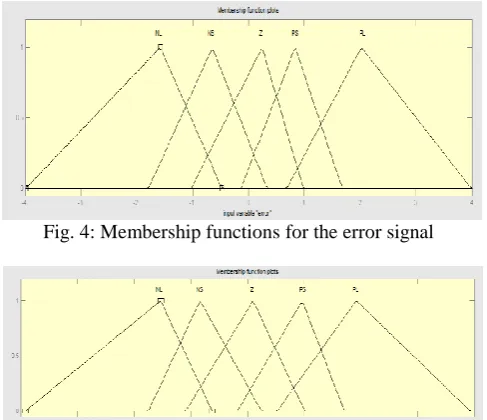
b) Then divide the universe of discourse into FSs. Fig. 4 and 5 show the input membership functions for the error signal and change of error signal respectively. Here the universe of discourse is divided as Negative Large (NL), Negative Small (NS), Zero (Z), Positive Small (PS) and Positive Large (PL). Fig. 6 to 7 shows the output membership function for the proportional and integral gains, whereas the universe of discourses is divided as Medium (M), Big (B) and Very Big (VB).
c) Write the rule base for the Self Tuning Fuzzy PI controller, based on experience and it is described in the below given Table 3&4 correspondingly.
d) Use the algorithm of the amied controller:Centroid defuzzification is the best technique to obtain the crisp output.
The degree of each membership function which was computed in the previous step of fuzzifications encountered by the subprogram called defuzzify and this after certain process it returns defuzzified output.
Fig. 4: Membership functions for the error signal
Fig. 6: Membership functions for the proportional gain
Fig. 7: Membership functions for the integral gain
TABLE 3: RULE BASE FOR THE PROPORTIONAL GAIN
e ∆e
NL NS Z PS PL
NL M S S S M
NS B M S M B
Z VB B M B VB
PS B M S M B
PL M S S S M
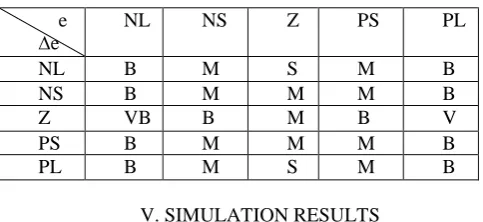
TABLE 4: RULE BASE FOR THE INTEGRAL GAIN
e ∆e
NL NS Z PS PL
NL B M S M B
NS B M M M B
Z VB B M B V
B
PS B M M M B
PL B M S M B
V. SIMULATION RESULTS
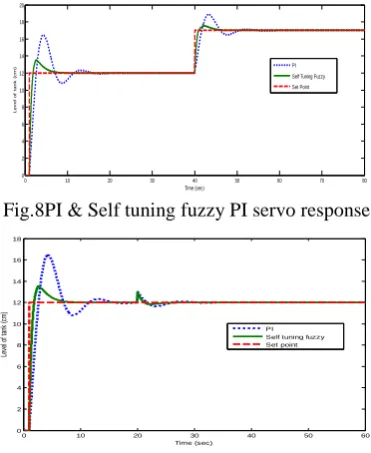
all the operating region. The performance indices in terms of ISE, IAE and ITAE for servo and regulatory response are also shown in Table 5&6.
Fig.8PI & Self tuning fuzzy PI servo response
Fig.9 PI & Self tuning fuzzy PI regulatory response
TABLE 5: PERFORMANCE COMPARISON (SERVO RESPONSE)
Controller ISE IAE ITAE
PI 142.3 36.93 589.8
Self-tuning fuzzy PI
35.7 10.82 152.1
TABLE 6: PERFORMANCE COMPARISON (REGULATORY RESPONSE)
Controller ISE IAE ITAE
PI 122 28.11 165.3
Self-tuning fuzzy PI
30.81 8.61 40.76
VI. CONCLUSION
Nonlinearity of the conical tank is observed and the model is implemented using SIMULINK.Level control of TANK2 is checked by both PI and Self tuning fuzzy PIcontroller.From the simulation results we can observe that both Self tuning fuzzy PI and PI provide fast response but Self tuning fuzzy PI control perform well with less number of oscillations when subject to change in level of conical tank and enhance performance of the system.
Self-tuning fuzzy PI controller gives better performance than conventional controller for both servo and regulatory problems in terms of integral time weighted absolute error,integral square error,and integral absolute error.Therefore we can conclude that Self tuning fuzzy PI controller is working properly for both servo and regulatory problems of two conical tank interacting level system.
0 10 20 30 40 50 60 70 80
0 2 4 6 8 10 12 14 16 18 20 Time (sec) L e v e l o f ta n k ( c m ) PI
Self Tuning Fuzzy Set Point
0 10 20 30 40 50 60
REFERENCES
[1]V.R.Ravi,T.Thyagarajan, “Application of Adaptive control technique to interacting nonlinear systems”,proceedings of ICETECT,2011.
[2]S.Saju,R.Revathi,K.ParkaviSuganya,“Modeling and control of liquid level interacting and non-interacting system”,international journal of advanced research in electrical,electronics and instrumentation engineering(vol.3,
Issue3),march2014.
[3]M.Kandasamy,K.Muthukumaran, “design of auto- tuning adaptive PID controller for two tank conical system”,ISSN No 2277-8179(vol.3,issue1)jan2014.
[4]D.Angeline,K.Vivetha,K.Gandhimathi,T.Praveena, “Model based controller design for conical tank system”,international journal of computer application 0975-8887(vol.85 no12),jan2014.
[5]S.K.Lakshmanaprabu,U.SaburaBanu,C.Bharanitharan, “Linear quadratic Gaussian control for two interacting conical tank process” International Journal of Computer Applications (0975 – 8887),CiQS-2014.
[6]S.Vadivazhagi,Dr.N.Jaya, “Modeling and simulation of interacting conical tank systems”IJIRSET(vol.3,issue6)june2014 [7]P.Aravind,M.Valluvan,S.Ranganathan,“Modeling and simulation of non-linear tank”,IJAREEIE(vol.2Issue2)feb2013.
[8]D.Mercy,S.M.Girirajkumar, “Tuning of controllers for non linear process using intelligent techniques”,IJAREEIE(vol.2,Issue9)sept2013. [9]Gunaselvi Manohar, V. Elakkiya, Pearley Stanley and R.Sudha, “Neural network based level control in two tank conical interacting system”IEEEconf978·1·4673-4603-0/12,
2013.
[10]D.Hariharan,S.Vijayachitra, “Modelling and real time control of two conical tank systems of non-interacting and interacting type”IJAREEIE(vol.2,issue11)nov2013.
[11]Sukanya R. Warier, SivanandamVenkatesh, “Design of Controllers based on MPC for a Conical Tank System”IEEEconf978-81-909042-2-3,march2012.
[12]V.R.Ravi,T.Thyagarajan, S.Yammunapriyadharshni, “Gain Scheduling Adaptive Model Predictive Controller for Two Conical Tank Interacting Level System”,IEEEICCCNT conf,july2012.
[13]S. Vadivazhagi, Dr. N. Jaya, “Design of Model based controller for Two Conical Tank Interacting Level systems”, IJMER(VOL.4,ISSUE6)/pp 65-71,june2014.
[14] Guan Tien Tan, Min-Sen Chiu,“A multiple-model approach to decentralized internal model control design”,Elsevier,Chemical Engineering Science 56 (2001) 6651–6660.
[15]V.R.RaviT.Thyagarajan,“A Decentralized PID Controller for Interacting Non Linear Systems”IEEEconf978-1-4244-7926-9/11.
[16]Y.R.Ravi,T.Thyagarajan,B.Puviyarasi,“Centralised Neuro Controller for Two Conical Tank Interacting Level System”,IEEE ICACCCT ISBN No. 978-1-4673-2048-1/12.