IOT Based Home Automation Using
Raspberry Pi
Pimpalgaonkar Rushikesh R.1, Rathod Nitin R.2, Kasle Anand A.3 ,Panchal S. D.4
UG Student, Dept. of E&TC, STC Faculty of Engineering, Latur, Maharashtra, India1
UG Student, Dept. of E&TC, STC Faculty of Engineering, Latur, Maharashtra, India2
UG Student, Dept. of E&TC, STC Faculty of Engineering, Latur, Maharashtra, India3
Head, Dept. of E&TC, STC Faculty of Engineering, Latur, Maharashtra, India4
ABSTRACT: The Internet of things is a technology of the future that has already started to touch our homes. Here we propose an IOT based home automation system using raspberry pi that automates home appliances and allows user to control them easily through internet from anywhere over the world. Our proposed system consists of a microcontroller based circuit that has lights and fan connected to it along with LCD display and Wifi connector interfaced with raspberry pi. Our system interacts with out online IOT system that IOT Gecko free web interface for controlling our home appliances with ease. After linking with IOT Gecko, the user is allowed to send load switching commands over IOT to our circuit. The circuit receives the commands over IOT by connecting to internet using wifi connector and then the raspberry processor processes these commands. After this the processor now processes these instructions to get user commands. It then displays these on an LCD display. Also it operates the loads (lights and fan) for switch them on/off according to desired user commands. Thus we automate home appliances over internet using raspberry pi.
KEYWORDS: Home Automation System, Internet of Things, Raspberry pi, Relay
I. INTRODUCTION
Home automation is the control of any or all electrical devices in our home or office. In today's era, technology can enhance human life. Technology is evolving decade by decade. Automation was a science fiction earlier but not today. By combining latest technology with home, we can build an awesome home. With the Raspberry Pi and Windows 10, we can build a home automation system that is capable of operating home devices automatically. Home Automation can be considered as an act of using electronic systems/devices and programming them to replace a number of human interactions for the control of basic home functions. This operates on the base of connecting sensors and devices to the IoT. For objects to considered IoT based, networks need to be converted to an IP-based network for proprietary protocols. The object being connected to the internet can represent itself digitally thereby being controlled from anywhere there is an internet connection. These objects have ability to transmit and receive data over a network without human-to human or human-to-computer interaction. This also means that more data can be gathered from these objects, even at a number of places with real-time information being presented from the objects.
II. INTERNET OF THINGS
The Internet of things (IoT) is the extension of Internet connectivity into physical devices and everyday objects. Embedded with electronics, Internet connectivity, and other forms of hardware (such as sensors), these devices can communicate and interact with others over the Internet, and they can be remotely monitored and controlled.
The definition of the Internet of things has evolved due to the convergence of multiple technologies, real-time analytics, machine learning, commodity sensors, and embedded systems.[5] Traditional fields of embedded systems, wireless sensor networks, control systems, automation (including home and building automation), and others all contribute to enabling the Internet of things. In the consumer market, IoT technology is most synonymous with products pertaining to the concept of the "smart home", covering devices and appliances (such as lighting fixtures, thermostats, home security systems and cameras, and other home appliances) that support one or more common ecosystems, and can be controlled via devices associated with that ecosystem, such as smartphones and smart speakers.The IoT concept has faced prominent criticism, especially in regards to privacy and security concerns related to these devices and their intention of pervasive presence.
Fig.1 Basic Model Of Iot
.The system can be use in several places like banks, hospital, labs and other sophisticated automated system, which dramatically reduced the hazards of unauthorized entry. The main reason to develop this system is to MIT and related market analysis publication. Integration with the internet implies that devices will use the IP address as a unique identifier. due to the limited address space of IPv4 (which allows for 4.3 billion unique addresses), objects in the IoT will have to use IPv6 to accommodate the extremely large address space required. Home automation is the control of any or all electrical devices in our home or office.There are many different types of home automation system available. These systems are typically designed and purchased for different purposes
III. RASPBERRY PI & RELAY
The Raspberry Pi is a small, cheap circuit board, called a microcontroller. It is basically a tiny computer on a single circuit board, and has been designed especially with hobbyists and students learning about electronics and programming in mind. It is very low powered compared to a regular computer, meaning that it can be left on all of the time without racking up your electricity bills too much, and it can easily be connected to a range of peripherals and other circuit boards.
The sending command to the raspberry pi is server side script running on our laptop or on a web server takes input commands from the user and correspondingly sends it to the client (Raspberry Pi). Here, we will be using commands to turn a light ON/OFF. When we pass the command to turn ON a light through the server side script, the information is relayed to the Raspberry Pi and it’s GPIO pin turns ON a relay. The system also sends status updates to the server on whether the light is ON/OFF.
the Raspberry Pi and it’s GPIO pin turns ON a relay. The system also sends status updates to the server on whether the light is ON/OFF.
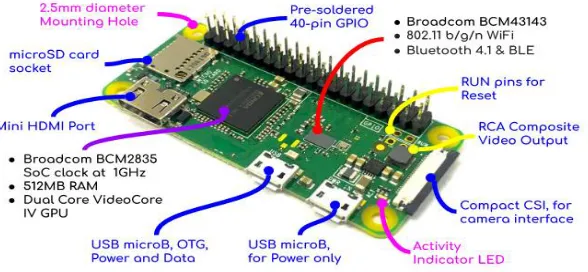
Fig 2 Model Of Raspberry Pi Zero
The Raspberry Pi is a series of small single-board computers developed in the United Kingdom by the Raspberry Pi Foundationto promote teaching of basic computer science in schools and in developing countries. The original model became far more popular than anticipated, selling outside its target market for uses such as robotics. It does not include peripherals (such as keyboards and mice) and cases. However, some accessories have been included in several official and unofficial bundles. The organisation behind the Raspberry Pi consists of two arms. The first two models were developed by the Raspberry Pi Foundation. After the Pi Model B was released, the Foundation set up Raspberry Pi Trading, with Eben Upton as CEO, to develop the third model, the B+. Raspberry Pi Trading is responsible for developing the technology while the Foundation is an educational charity to promote the teaching of basic computer science in schools and in developing countries.
Raspberry Pi Zero WH Features and Specs:
Processor: BCM 2835 SOC
Clock speed: 1GHz
RAM: 512MB
Built-in Wireless: BCM43143, WiFi + Bluetooth 4.1 + BLE (Bluetooth Low Energy), same as Raspberry Pi 3.
Memory: micro-SD
Display and Audio: mini-HDMI
USB Port: 1 x micro-B USB for data (with power too)
Power input: 1 x micro-B USB for power (no data)
Camera interface: CSI camera connector (needs adaptor cable, 0.5mm pitch to pitch CSI)
GPIO: Pre-soldered 40-pin GPIO connector, compatible with Raspberry Pi Zero v1.3 and Raspberry Pi 3.
Compatibility of GPIO: Compatible with existing HAT addons
3.2Relay
A relay is an electrically operated switch. Many relays use an electromagnet to mechanically operate a switch, but other operating principles are also used, such as solid-state relays. Relays are used where it is necessary to control a circuit by a separate low-power signal, or where several circuits must be controlled by one signal. The first relays were used in long distance telegraph circuits as amplifiers: they repeated the signal coming in from one circuit and re-transmitted it on another circuit. Relays were used extensively in telephone exchanges and early computers to perform logical operations A type of relay that can handle the high power required to directly control an electric motor or other loads is called a contactor. Solid-state relays control power circuits with no moving parts, instead using a semiconductor device to perform switching. Relays with calibrated operating characteristics and sometimes multiple operating coils are used to protect electrical circuits from overload or faults; in modern electric power systems these functions are performed by digital instruments still called "protective relays". Magnetic latching relays require one pulse of coil power to move their contacts in one direction, and another, redirected pulse to move them back. Repeated pulses from the same input have no effect. Magnetic latching relays are useful in applications where interrupted power should not affect the circuits that the relay is controlling.
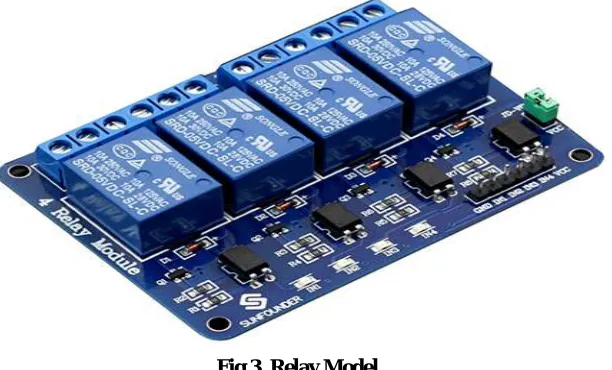
Fig 3 Relay Model
Magnetic latching relays can have either single or dual coils. On a single coil device, the relay will operate in one direction when power is applied with one polarity, and will reset when the polarity is reversed. On a dual coil device, when polarized voltage is applied to the reset coil the contacts will transition. AC controlled magnetic latch relays have single coils that employ steering diodes to differentiate between operate and reset commands. It was used in long distance telegraph circuits, repeating the signal coming in from one circuit and re-transmitting it to another.
IV. LITERATURE REVIEW
The Home automation system that uses Wi-Fi technology [1]. System consists of three main components; web server, which presents system core that controls, and monitors users’ home and hardware interface module(Arduino PCB (ready-made), Wi-Fi shield PCB, 3 input alarms PCB, and 3 output actuators PCB.), which provides appropriate interface to sensors and actuator of home automation system. The System is better from the scalability and flexibility point of view than the commercially available home automation systems. The User may use the same technology to login to the server web based application. .If server is connected to the internet, so remote users can access server web based application through the internet using compatible web browser.
An interface card has been realized to update signals between the actuator sensors and the raspberry pi card. Cloud-based home appliance monitoring and controlling System. Design and implement a home gateway to collect metadata from home appliances and send to the cloud-based data server to store on HDFS (Hadoop Distributed File System), process them using MapReduce and use to provide a monitoring function to Remote user [3].
It has been implemented with Raspberry Pi through reading the subject of E-mail and the algorithm. Raspberry Pi proves to be a powerful, economic and efficient platform for implementing the smart home automation [4].Raspberry pi based home automation is better than other home automation methods is several ways. For example, in home automation through DTMF (dual tone multi-frequency) [11], the call tariff is a huge disadvantage, which is not the case in their proposed method. Also, in Web server based home automation, the design of web server and the memory space required is ejected by this method, because it simply uses the already existing web server service provided by G-mail. LEDs were used to indicate the switching action. System is interactive, efficient and flexible.
Shih-Pang Tseng et al. [5] proposed Smart House Monitor & Manager (SHMM), based on the ZigBee, all sensors and actuators are connected by a ZigBee wireless network. They designed a simple smart socket, which can remote control via ZigBee. PC host is used as a data collector and the motion sensing, all sensing data are transferred to the VM in the cloud. The user can use the PC or Android phone to monitor or control through the Internet to power-saving of the house.
Arduino microcontroller to receive user commands to execute through an Ethernet shield. Our house network used together both wireless ZigBee and wired X10 technologies [6]. This system followed smart task scheduling with a heuristic for the Resource-constrained-scheduling problem (RCPSP). The mobile device can be either wired to the central controller through USB cable or communicates with it wirelessly, within the scope of the home. Arduino contains the web server application that communicates through the HTTP protocol with Web-based Android application. The system is highly flexible and scalable and expandable.
The home network which monitors the appliances and sensors and transmits data to the cloud-based data server which manages the information and provides services for users by transmitting data and receiving user commands from mobile application [7]. The proposed system has good modularity and configurability characteristics with very low power consumption in cost efficient way.
Application developed using the Android platform controlled and monitored from a remote location using the smart home app and an Arduino Ethernet based micro web-server [8]. The sensors and actuators/relays are directly interfaced to the main controller. Proposed design offers are the control of energy management systems such as lightings, heating, air conditioning, security, fire detection and intrusion detection with siren and email notifications. Embedded system Raspberry Pi to serve as a communication gateway between mobile devices and Konnex-Bus (KNX) home automation systems [9]. Store the information of all actors and sensors within a Smart Home, instead of using separate profiles. Ensures energy-consumption could be reduced, compared to a standard desktop computer. Dual tone multi frequency (DTMF) used in telephone lines [10].
V. PROJECT MODEL & DESIGN MODEL
Fig.4 Project Model
We will add the temperature and humidity sensor to get information about the room temperature and the humidity of that particular room. An Android device is the second major component used to access those things which are connected to 8 connected Relay channel. Android platform gives a good inbuilt architecture having Snapdragon or any smartphone processor with up to 2GB of RAM and a display panel to view the outputs. It is a way good stuff with which we can use to process the data connectivity between itself and the different devices.
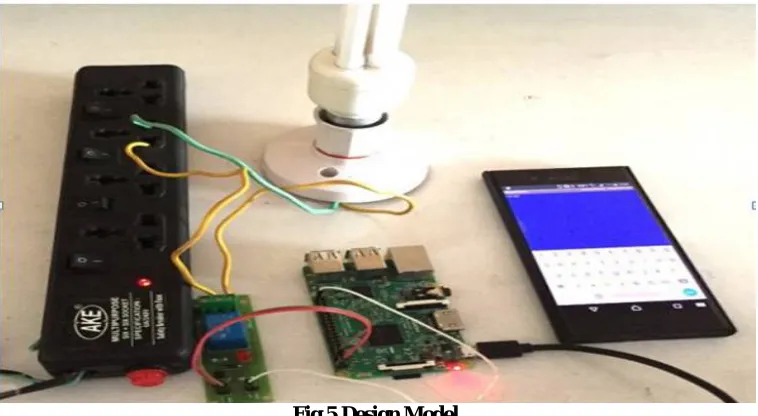
Fig 5 Design Model
It will be very simple Model to design.using available required material project model will design with help of required component. For showing concept of our project.
smart homes that will be in constant interaction with the grid in an effort for better energy management and full home automation to ensure comfort, security and privacy. that devices like Raspberry Pi can play very important role in designing smart home of the future at very low cost. An energy aware smart home can be developed using Raspberry Pi.
REFERENCES
[1] Ahmed ElShafee, Karim Alaa Hamed,” Design and Implementation of a WiFi Based Home Automation System”, International Journal of Computer, Electrical, Automation, Control and Information Engineering Vol: 6, No: 8, 2012.
[2] Hayet Lamine and Hafedh Abid , ”Remote control of a domestic equipment from an Android application based on Raspberry pi card”, IEEE transaction 15th international conference on Sciences and Techniques of Automatic control & computer engineering - STA'2014, Hammamet, Tunisia, December 21-23, 2014.
[3] YunCui, MyoungjinKim, YiGu, Jong-jinJung, and HankuLee, “Home Appliance Management System for Monitoring Digitized Devices Using Cloud Computing Technology in Ubiquitous Sensor Network Environment”,Hindawi Publishing Corporation International Journal of Distributed Sensor Networks Volume 2014, Article ID 174097
[4] Jain Sarthak,Vaibhav Anant and Goyal Lovely ,“Raspberry Pi based Interactive Home Automation System through E-mail.”,IEEE transaction,2014 International Conference on Reliability, Optimization and Information Technology ICROIT 2014, India, Feb 6- 8 2014.
[5] Shih-Pang Tseng, Bo-Rong Li, Jun-Long Pan, and Chia- International Journal of Computer Applications (0975 – 8887) National Seminar on Recent Trends in Data Mining (RTDM 2016) 10 Ju Lin,”An Application of Internet of Things with Motion Sensing on Smart House“, 978-1-4799-6284- 6/14 c ⃝2014 IEEE.
[6] Kim Baraka, Marc Ghobril, Sami Malek, Rouwaida Kanj, Ayman Kayssi “Low cost Arduino/Android-based Energy-Efficient Home Automation System with Smart Task Scheduling” , 2013 Fifth International Conference on Computational Intelligence, Communication Systems and Networks. [7] Kim Baraka, Marc Ghobril, Sami Malek, Rouwaida Kanj, Ayman Kayssi ,”Smart Power Management System For Home Appliances And Wellness Based On Wireless Sensors Network And Mobile Technology”, ,2015 XVIII AISEM Annual Conference, 978-1-4799- 8591-3/15©2015 IEEE
[8] Shiu Kumar,” UBIQUITOUS SMART HOME SYSTEM USING ANDROID APPLICATION “, International Journal of Computer Networks & Communications (IJCNC) Vol.6, No.1, January 2014.
[9] Jan Gebhardt, Michael Massoth, Stefan Weber and Torsten Wiens , “Ubiquitous Smart Home Controlling Raspberry Embedded System”, UBICOMM: The Eighth International Conference on Mobile Ubiquitous Computing, Systems, Services and Technologies, 2014.