Coiflet Wavelet Transform Image Compression
Based On JPEG Images
Er.Anjali Bakhshi1, Dr.Jagroop Singh2
M.Tech. Scholar, Department of Electronics & Communication Engg. DAVIET, Jalandhar, Punjab, India1
Associate Professor, Department of Electronics & Communication Engg. DAVIET, Jalandhar,Punjab, India2
ABSTRACT: Today, the uses of digital images are rapidly increasing on the internet. It is very difficult to store and transfer the huge information. So we need to compress the uncompressed media such as video, images and so on. The image compression is used in various modern applications as it reduces the memory required to store the information. The image compression reduces the number of bits required to represent an image thereby reducing the transmission cost and memory requirements. Compressed image is easy to transfer on limited bandwidth channel. In this paper, we implemented coif0, coif6, coif12 and coif18 wavelet transform in image compression. We compared the performances of different wavelet transform filters in terms of Mean Square Errors (MSE),Peak signal Noise Ratio(PSNR),Normalized Absolute Errors (NAE) and Compression Ratio(CR).
KEYWORDS: Coif, MSE, PSNR, NAEand CR.
I. INTRODUCTION
Image compression can be defined as a process by which the file size of media image is reduced with the help of encoding its data bits or picture information by more effective methods. The Result of this process is that the number of bits and bytes used to represent image information are reduced sufficiently. So due to adopting this process a smaller file size of the media Image is obtained to work with a high speed transmission of electronic media files or digital still images. Obviously these compressed media files needed smaller size in memory space for downloading and uploading the media files [9].
Compressing an image file is different than compressing raw binary data. Basic compression process can be used for compressing images but the result is not so good because the images have some unique features that can be used by encoders specially designed for them. The image compression algorithms try to delete redundant bits from the image file in a way that image can be again reconstructed. It means image compression algorithms try to utilize redundancies in the image information, they calculate which information to be kept in order to reconstruct the image and which to be trash away [9].Hence by trashing the redundant bits, image can be presented in smaller number of bits and is compressed.
II. COIFLET WAVELETS
Coif lets are discrete wavelets developed by Ronald Coifman. These wavelets are symmetric with wavelet function [8]. They have N/3 vanishing moments and scaling functions of N/3-1, which were employed in a great space of problems.
The Coif wavelet and the famous Daub wavelet are equally powerful in some aspects, but the Coif wavelet was developed having vanishing moments supporting both wavelet function φ(x) and scaling function ø(x). It has N/3 numbers of vanishing moments and N/3 – 1 numbers of scaling functions.
Here the Scaling and Wavelet functions are needed to be equalized with order of 1/2. The scaling function of coif shows interoperating qualities, which means that coif offers good estimation of the polynomial function at various levels of representations. Next, also the guts of symmetry in coif is well suited for signal waveforms calculations task because of the linear face of the transformation function, but along with that it is a less affordable when observing a typical frequency of concern; his digital version is applicable for real workouts. It is also employed in various situations with the aid of Sigmund and Calderon Operators .
Coif wavelet has 2N moments similar to 0 and the scaling function has 2N – 1 moment similar to 0. Here the wavelet & Scaling functions have an aid of height 6N-1. The Coif wavelet based functions are implemented alongside the discrete wavelet transformations technique. Coif would be extracted from a multi resolution computation for example the scaling function support an unfixed amount of vanishing moments.
III. ALGORITHM
Algorithm for Image Compression and decompression Process Wavelet Transform for Compression and Decompression Algorithm:
Step 1: Start the Image Compression Process.
Step 2: Fetch the Raw Image to be tested on.
Step 3: Transform the tricolour RGB image into greyscale image.
Step 4: Implement the wavelet Transformations using Coif0, Coif6, and Coif12 and Coif18 functions on the gray scale image.
Step 5: Implement the wavelet transform on first level decomposition and produce four sub bands such as LL, LH, HL and HH.
Step 6: Perform Decomposition for both vertical and horizontal direction.
Step 7: The steps are repeated on the sub image up to other decomposition level.
Step 8: Precise image reconstruction of the Raw Image is based on the wavelet decomposition.
Step 9: Halt
3.1 Compression Algorithm:
Step 1: Start the Image Compression Process.
Step 2: Fetch the Raw Image.
Step 3: Transform the tricolour RGB image into grayscale image.
Step 4: Implement the wavelet transformations using Coif0, Coif6, Coif12 and Coif18 filters on the gray scale image.
Step 6: Produce the compressed Image.
Step 7: Halt.
3.2 Decompression Algorithm:
Step 1: Fetch the transmitted Compressed Image.
Step2: Implement the Inverse wavelet transformation using Coif0, Coif6, Coif12 and Coif18 Inverse wavelet filters on the compressed image.
Step 3: Implement the inverse wavelet transformation to estimate the reconstruction of the raw image.
Step 4: Extract the reconstructed image and analyze the image quality parameters.
Step 5: Compute various image quality metrics such as MSE, PSNR, NAE, and CR for resulting image.
Step 6: Comparative Analysis the results based on different quality metrics.
Step 7: Repeat the process for others images and comparative analysis.
Step 8: End of the Algorithm.
IV. RESULT & DISCUSSION
In this research work, we have taken an image of couple.jpeg whose size is 512 x 512. The original image is compressed and decompressed with coif0.coif6, coif12 and coif18 wavelet transform.
Fig:-4.1 original couple image 512x512
Fig 4.3:-Image Compressed with Coiflets Wavelet image compression
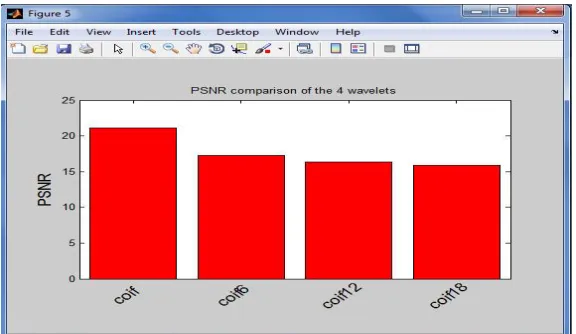
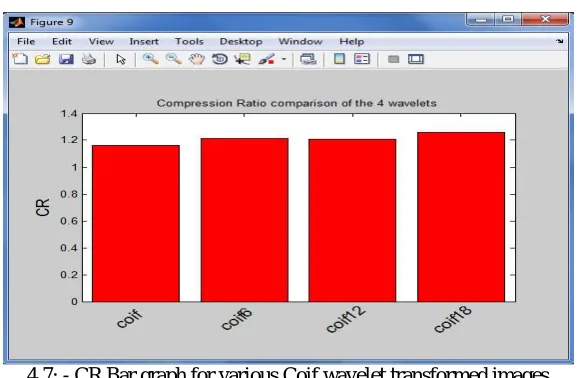
The wavelet transform based image compression in terms of quality metrics such as MSE,PSNR,NAE and CR using coif0,coif6,coif12 and coif18 wavelet transform. The fig. 4.4, fig.4.5, fig.4.6 and fig.4.7 show the plot the bar graph of MSE, PSNR, NAE and CR.
Fig 4.4: - MSE Bar graph for various Coif wavelet transformed images
4.6: - NAE Bar graph for various Coif wavelet transformed images
4.7: - CR Bar graph for various Coif wavelet transformed images
The results for the image compression using Quality Metrics likes MSE, PSNR, NAE and CR are shown below in Tabular form.
Table 4.1 Result analysis for image compression with Coiflets wavelet transforms.
Wavelet name MSE PSNR NAE CR
Coif0 504.4218 21.1029 0.4300 1.1594
Coif6 1.2132e+003 17.2915 0.7445 1.2138
Coif12 1.4998e+003 16.3704 0.8667 1.2060
V. CONCLUSION
In this research, we used DWT methods on an image compression. We find out quality metrics likes MSE,PSNR,NAE and CR .The quality metrics means check the quality of image, the more is effectiveness and robustness of the wavelet transform algorithm have been justified using a test image. We compared different wavelet transform fcoif0, coif6, coif12 and coif18. The coif0 is better than all other filter in terms of PSNR and MSE value.So,we conclude that coif0 wavelet filter is better for image compression because it is achieved better image quality among all wavelet filter and it also reducing the errors.
REFERENCES
[1] Monika Rathee, “Image compression Using Discrete Haar Wavelet Transforms”, International Journal of Engineering and Innovative
Technology, Volume 3, Issue 12, June 2014.
[2] B. B. S.Kumar and P.S Satyanarayan, “Compression and Denoising-Comparative Analysis from still image using Wavelet techniques”, ITSI
Transaction on Electrical and Electronics Engineering (ITSI-TEEE) ISSN (PRINT):2320-8945, Vol-1, 2013.
[3] Shuang Yang, Pan Gao, “Objective Image Quality Assessment based on Image Complexity and Color Similarity “Fourth World Congress on
Software Engineering, 2013.
[4] Kumar V.,V.Sunil.,Reddy,M.Indra Sena., “Image Compression Techiques byUsing Wavelet Transform”,Journal of information engineering
and applications,Vol 2,No 5.2012.
[5] M. Mozammel Hoque Chowdhury, “Image Compression Using Discrete Wavelet Transform”, International Journal of Computer Science
Issues, Vol. 9, Issue 4, July 2012.
[6] Niveditta Thakur, “A New Method for Color Image Quality Assessment”, International Journal of Computer Applications, Volume 15– No.2,
February 2011.
[7] Priyanka Singh, “JPEG Image Compression based on Biorthogonal, Coiflets and Daubechies Wavelet Families”, International Journal of
Computer Applications, Volume 13, January 2011.
[8] A.N. Skodras, “JPEG2000: The upcoming still image compression standard”, Electronics Laboratory, University of Patras, GR-26110 Patras,
Greece; 2001.
[9] Noor HudaJa’afar et.al “Distributed Arithmatic Architecture of Discrete Wavelet Transform (DWT) with Hybrid Method”, 2013.
[10] Rui ZHANG, Ting JIANG, Yao-yao YU, Hui GONG, Guang-jun DONG, “Fusion Image Quality Assessment Based on Quaternion”, IEEE
Institute of Surveying and Mapping, Information Engineering University Zhengzhou, China 2011.
[11] Ashraf, Robina. And Akbar, Muhammad, “Diagnostically Lossless Compression of Medical Images-2”, IEEE-2005, pp.227-230, 2005.
[12] Vinay U. Kale & Nikkoo N. Khalsa," Performance Evaluation of Various Wavelets for Image Compression of Natural and Artificial Images