Application of Advanced Optimization
Methods to Hybrid Microgrid Systems
S.Karishma1, Y.Nagaraja2
PG Student [Power systems], Dept. of EEE, Annamacharya Institute of Technology and Sciences, Kadapa,
Andhra Pradesh, India1
Assistant professor, Dept. of EEE, Annamacharya Institute of Technology and Sciences, Kadapa,
Andhra Pradesh, India 2
ABSTRACT: The main aim of this work is to control the Generated Power and Frequency Control in Hybrid Microgrid System using small signal Analysis. The frequency of a power system is dependent on real power balance. A change in real power demand at one point of network is reflected throughout the system by a change in frequency. The control of frequency and power generation is commonly referred as Load Frequency Control (LFC) which is a major function of AGC system. This work proposes optimum strategies for reducing system frequency deviation, caused by load fluctuation and renewable sources in a Hybrid microgrid system with attached storage. The Advanced Optimization Methods are applied to the hybrid Microgrid systems to stabilized the frequency. With the proposed GA, ISE, BFG Optimization Algorithms, the desired generation of power at both areas and frequency are controlled. Various test cases have been studied and results have been explored.
KEYWORDS: Photovoltaic system (PV), fuel cells (FC), wind turbine generators (WTGs), aqua electrolyzer (AE), battery energy storage system (BESS), flywheel energy storage system (FESS), small-signal stability, time domain simulations, integral square error (ISE), genetic algorithm (GA), bacteria foraging optimization (BFA).
I.INTRODUCTION
In electric power generation, system disturbances due to load fluctuations tend to variation in desired frequency value. Automatic Generation Control (AGC) or Load Frequency Control is a very important issue in power system operation and control for supplying sufficient and reliable electric power with good quality. An interconnected power system can be considered as being divided into control areas, which are connected by the tie lines. In each control area, all generators are assumed to form a coherent group. The power system is subjected to local variations of random magnitude and duration. For satisfactory operation of a power system the frequency should remain nearly constant. The frequency of a system depends on a active power balance. As frequency is a common factor throughout the system, a change in active power demand at one point is reflected throughout the system. Many investigations have been reported in the past pertaining to LFC of a multi area interconnected power system. In the literature, some control strategies have been proposed based on classical control theory. Due to unnecessary errors in the past, the conventional PI control scheme does not provide adequate control performance with the presence of non-linearity. This work develops optimum strategies to the AGC scheme with tuning a PID controller in order to reduce the overshoot of the conventional PI control and also to obtained the stabilized frequency.
Optimization methods justify the cost of investment of a Micro grid by enabling economic and reliable utilization of the resources. This work tries to bring the concept of Hybrid Renewable Energy Systems (HRES) and state of art application of optimization tools and techniques to microgrids, integrating renewable energies. With an extensive literature survey on HRES, a framework of diverse objectives has been outlined for which optimization approaches were applied to empower the microgrid. A review of modelling and applications of renewable energy generation and storage sources is also presented.
(CHP), photovoltaic (PV), wind turbine, or small-scale diesel generator. Distributed Generators are usually located near the loads, so that the line losses in a microgrid are relatively low. A microgrid can work with a host grid connection or in the islanded mode.
When grid connected, Distributed Generators supports the Main grid during the peak demand. When the disturbance occurs in the main grid, a microgrid can supply the load without the support of the main grid and also a microgrid can be reconnected when the fault in the main grid is removed. Furthermore, as in any technology, micro-grid technology faces many challenges. There are so many considerations should have to be taken into account, such as the control strategies which are based on the voltage, current, frequency, power, and network protection.
Microgrids are essentially modern, small-scale (electrical) power distribution systems. They afford numerous benefits, such as enhancing system reliability, reducing capital investment and carbon footprint, and diversifying energy sources. Microgrids contain several generators, whose sizes may range from several tens of kilowatts to a few megawatts. They are different from traditional centralized electricity networks, which transmit vast amounts of electrical energy across long distances at very high voltages. However, they are similar to utility scale power distribution grids, which generate, transmit and regulate electricity to the consumer locally. To improve the efficiency of microgrids and to reduce fossil fuel usage and pollution, renewable energy sources may be integrated with traditional microgrids. Renewable energy sources include photovoltaic power, hydro power and wind power. These are clean and abundantly available energy sources. A hybrid AC/DC microgrid is proposed in this work is to reduce the processes of multiple reverse conversions in an individual AC or DC grid and to facilitate the connection of various renewable AC and DC sources and loads to the power system. However the energy management, controlling, and also the operation of a hybrid micro grid are more complicated than those of an individual AC or DC grid. There are different operating modes of a hybrid AC/DC grid have been investigated. The controlling schemes for the coordination among the various converters have been proposed to control and make use of the maximum power from the renewable energy sources, and also to minimize the power transfer between the ac and dc networks, and also have to maintain the stable operation of both AC and DC grids under variable supply and demand conditions when the hybrid grid operates in both grid-tied and islanding modes. The advanced power electronic converters and also the control techniques are used to make a power grid much smarter.
This work proposes optimum strategies for reducing system frequency deviation, caused by load fluctuation and renewable sources in a Hybrid microgrid system with attached storage. Frequency deviations are associated with renewable energy sources because of their inherent variability. In this work, consider a microgrid where fossil fuel generators and renewable energy sources are combined with a reasonably sized, fast acting battery-based storage system. This work develops optimum strategies for frequency deviation reduction, despite the presence of significant (model) uncertainties. The advantages of our approach are illustrated by comparing system frequency deviation between the proposed system and the reference system which uses governors and conventional PID control to cope with load and renewable energy source transients.
The rest of this paper is organized as follows Section II briefly introduces the advanced optimization methods. Section III describes the small signal analysis in hybrid microgrid systems. Section IV explains the proposed hybrid microgrid system. Section V evaluates the performance of the proposed method based on simulated test cases in the MATLAB/Simpower Systems environment. Finally, the conclusion is drawn in Section VI.
II. ADVANCED OPTIMIZATION METHODS
Some of the well-known population-based optimization techniques developed during last three decades are: Genetic Algorithms (GA) which works on the principle of the Darwinian theory of the survival-of-the fittest and the theory of evolution of the living beings, Artificial Immune Algorithms (AIA) which works on the principle of immune system of the human being, Ant Colony Optimization (ACO) which works on the principle of foraging behavior of the ant for the food, Particle Swarm Optimization (PSO) which works on the principle of foraging behavior of the swarm of birds, Differential Evolution (DE) which is similar to GA with specialized crossover and selection method, Bacteria Foraging Optimization (BFG) which works on the principle of behavior of bacteria, Shuffled Frog Leaping (SFL) which works on the principle of communication among the frogs, Artificial Bee Colony (ABC) which works on the principle of foraging behavior of a honey bee.
Firstly, Integral Sqaure Error Technique is used, it is a basic technique which takes more time to stabilised the frequency and generation of power. Later Genetic Algorithm and Bacterial Foraging Optimization methods are used.
A. GENETIC ALGORITHM
Genetic Algorithm (GA) works on the Darvin’s theory of evolution and the survival-of-the fittest. Genetic algorithms guide the search through the solution space by using natural selection and genetic operators, such as crossover, mutation and the selection. GA encodes the decision variables or input parameters of the problem into solution strings of a finite length. While traditional optimization techniques work directly with the decision variables or input parameters, genetic algorithms usually work with the coding. Genetic algorithms start to search from a population of encoded solutions instead of from a single point in the solution space. The initial population of individuals is created at random. Genetic algorithms use genetic operators to create Global optimum solutions based on the solutions in the current population. The most popular genetic operators are selection, crossover and mutation. The newly generated individuals replace the old population, and the evolution process proceeds until certain termination criteria are satisfied.
B. INTEGRAL SQUARE ERROR
The Integral square error technique is used for the purpose of optimizing conventional controller gain value of the AGC system. A measure of system performance formed by integrating the square of the system error over a fixed interval of time. The integral of the squared system error is implemented in this modified PID controller.
C. BACTERIAL FORAGING OPTIMIZATION
Bacteria Foraging Optimization Algorithm (BFOA) is proposed by Kevin Passino (2002), is a new comer to the family of nature inspired optimization algorithms. Application of group foraging strategy of a swarm of E.coli bacteria in multi-optimal function optimization is the key idea of this new algorithm. Bacteria search for nutrients is a manner to maximize energy obtained per unit time. Individual bacterium also communicates with others by sending signals. A bacterium takes foraging decisions after considering two previous factors. The process, in which a bacterium moves by taking small steps while searching for nutrients, is called chemotaxis. The key idea of BFOA is mimicking chemotactic movement of virtual bacteria in the problem search space.
Since its initiation, BFOA has drawn the attention of researchers from various fields of knowledge especially due to its biological motivation and graceful structure. Researchers are trying to hybridize BFOA with different other algorithms in order to explore its local and global search properties separately. It has already been applied to many real world problems and proved its effectiveness over many variants of GA and PSO. Mathematical modeling, adaptation, and modification of the algorithm might be a major part of the research on BFOA in future.
III. SMALL SIGNAL ANALYSIS
Small Signal (or small disturbance) Stability is the ability of the power system to maintain synchronism under small disturbances such as small variations in loads and generations.
LOAD FREQUENCY CONTROL AREA
The frequency of a power system is dependent on real power balance. A change in real power demand at one point of network is reflected throughout the system by a change in frequency. The control of frequency and power generation is commonly referred as Load Frequency Control (LFC) which is a major function of AGC system.
Fig 1 Schematic block diagram of a synchronous generator with basic frequency control loops.
In Fig.1. The speed governorsenses the change in speed (frequency) via the primary and supplementary control loops. The hydraulic amplifierprovides the necessary mechanical forces to position the main valve against the high-steam (or hydro-) pressure, and the speed changerprovides a steady-state power output setting for the turbine.
The speed governor on each generating unit provides the primary speed control function, and all generating units contribute to the overall change in generation, irrespective of the location of the load change, using their speed governing. However, primary control action is not usually sufficient to restore the system frequency, especially in an interconnected power system and the supplementary control loop is required to adjust the load reference set point through the speed-changer motor. The supplementary loop performs a feedback via the frequency deviation and adds it to the primary control loop through a dynamic controller. The resulting signal (ΔPC) is used to regulate the system
frequency. In real-world power systems, the dynamic controller is usually a simple integral or proportional integral (PI) controller.
According to Fig.1 the frequency experiences a transient change (Δf) following a change in load (ΔPL). Thus, the feedback mechanism comes into play and generates an appropriate signal for the turbine to make generation (ΔPm) track the load and restore the system frequency.
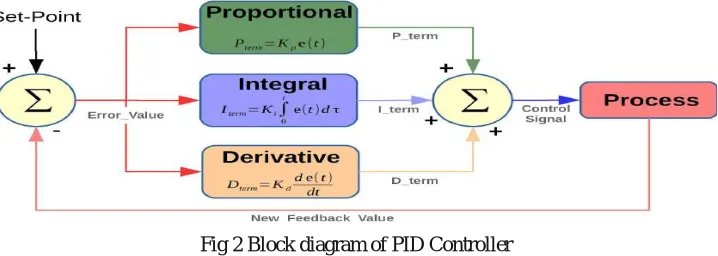
TUNING A PID CONTROLLER
A Proportional-Integral-Derivative Controller (PID Controller) is a control loop feedback mechanism. As the name suggests, PID consists of Proportional Integral Derivative which are varied to get optimal response. The entire idea of this controller revolves around manipulating the error. The error as is evident is the difference between the Process Variable and the Set point.
Fig 2 Block diagram of PID Controller
generate an offset. Ki will counteract the offset. Higher value of Ki implies that the set point will reach the Phase Value too fast. If this action is very fast, the process variable is prone to be unsteady. Kd keeps this under control.
Although many alternative optimal control techniques have been proposed, the PID controller continues to be the most popular controller used in industrial processes. The main advantage of this kind of controller is its simplicity. It is not easy to find another controller with such a simple structure that is effective, robust and comparable in its dynamic performance. A very important step in the use of PID controllers is the controller parameters tuning process. In a PID controller, each mode (proportional, integral and derivative mode) has a gain to be tuned, giving as a result three variables involved in the tuning process. ISE, GA, BFGA algorithm is used to select optimal control gains that dynamically minimize the total controller error.
IV. PROPOSED HYBRID MICROGRID SYSTEM
The proposed hybrid system configuration is shown in Fig 3. The hybrid power generation subsystem consists of three WTGs, a PV, two FCs, and a DEG. Aqua Electrolyzers (AE) absorbs a part of generated energy from PV or WTGS to generate the available hydrogen for Fuel Cells (FC). The Diesel-Engine Generator (DEG) is a Standby generator that may automatically startup to deliver power to the system only when the total power generated by the WTG, PV, and FC is insufficient even if the BESS/FESS may have enough stored energy
.
Fig.3. Configuration of the hybrid microgrid system.
V. SIMULATION VALIDATION
The different optimization methods are applied to the hybrid microgrid system to obtain stabilized frequency. The simulation results are performed using the powerful power system computer aided design (MATLAB/SIMULINK) software.
CASE 1
In this case, when the BFG Algorithm technique is applied to the Hybrid Microgrid System, it is observed that the
stabilized frequency is obtained with in time compared to other techniques and results are effective.
Fig.4. Desired frequency with BFG technique
CASE 2
In this case, by using the three techniques the change in generation power at area 1 are stabilized and also shown the comparison of the ISE, BFG, GA Techniques which are implemented for desired values.
`
Case 3
In this case, by using the three techniques the change in generation power at area 2 are stabilized and also shown the comparison of the ISE, BFG, GA Techniques which are implemented for desired values.
Fig.6. Desired generation of power at area 2 with ISE, GA, BFG technique
CASE 4
In this case, change in tie-line power is shown using BFGA,ISE,GA Techniques. Simulation is done in MATLAB 2015 and the results are analysed for different techniques.
CASE 5
In this case, when the GA Algorithm technique is applied to the Hybrid Microgrid System, it is observed that the stabilized frequency is obtained with in time compared to other techniques and results are effective.
Fig.8. Desired generation of power in hybrid system by using GA technique. CASE 6
In this case, when the ISE Algorithm technique is applied to the Hybrid Microgrid System, it is observed that the stabilized frequency is obtained with in time compared to other techniques and results are effective.
CASE 7
In this case, when the BFG Algorithm technique is applied to the Hybrid Microgrid System, it is observed that the stabilized frequency is obtained with in time compared to other techniques and results are effective.
Fig.10. Desired generation of power in hybrid system with BFG technique.
VI. CONCLUSION
This project has presented optimization algorithms, aimed to maintain an stabilized frequency to the hybrid microgrid systems with small signal analysis. The results obtained by the proposed algorithm proved that the deviations in the frequency for various constraints are within desired limits.
REFERENCES
1) . Kundur, “Power System Stability and Control”. New York, NY: McGraw-Hill, 1994.
2) T. K. Nagsarkar and M. S. Sukhija, “Power System analysis”, New Delhi: Oxford University Press, 2007. 3) CIGRE Task Force 38.02.08, “Long-Term Dynamics: Phase II”, CIGRE Technical Brochure No. 102, 1995.
4) A. Kurita, H. Okubo, K. Obi et al., “Multiple time-scale dynamic simulation”, IEEE Trans. Power Syst., vol. 8, pp. 216–223, 1993. 5) P. M. Anderson and A. A. Fouad, “Power System Control and Stability”. USA: IEEE Press, 2nd Edition, 2003.
6) NEMMCO, “Frequency and Time Deviation Monitoring in NEM”, vol. 2007, NEMMCO, 2007, http://www.nemmco.com.au/powersystemops/250– 0069.pdf.
7) C. Luo, H. Golestani Far, H. Banakar, et al., “ Estimation of wind penetration as limited by frequency deviation”, IEEE Trans. Energy Convers., vol. 22, no. 3, pp. 783–791, 2007.
8) N. Jaleeli, L. S. Vanslyck, “NERC’s new control performance standards”, IEEE Trans. Power Syst., vol. 14, no. 3, pp. 1092–1099, 1999.
9) M. Yao, R. R. Shoults, R. Kelm, “AGC logic based on NERC’s new control performance standard and disturbance control standard”, IEEE Trans. Power Syst., vol. 15, no. 2, pp. 852–857, 2000.
10) N. Hoonchareon, C. M. Ong, R. A. Kramer, “Feasibility of decomposing ACE1 to identify the impact of selected loads on CPS1 and CPS2”, IEEE Trans. Power Syst., vol. 17, no. 3, pp. 752–756, 2002.
11) D.P. Kothari, I.J. Nagrath, “Modern Power System Analysis”, McGraw-Hill, Singapore,2003.
12) I. P. Kumar and D. P. Kothari, “Recent philosophies of automatic generation control strategies in power systems”, IEEE Trans. Power. Syst., vol. 20, no. 1, pp. 346–357, 2005.
13) “Small-Signal Stability Analysis of an Autonomous Hybrid Renewable Energy Power Generation/Energy Storage System Part I: Time-Domain Simulations”- Dong-Jing Lee and Li Wang, Senior Member, IEEE.
14) P.M. Anderson, A.A. Fouad, “Power System Control and Stability”, Iowa State University Press, Ames, IA, 1977. 15) P. Kundur, “Power System Stability and Control”, McGraw-Hill, New York, 1994.
16) Allen J. Wood and Bruce F. Wollenberg, “Power Generation, Operation and Control”, Wiley India, New Delhi, 2009. 17) D.P. Kothari and J.S. Dhillon, “Power System Optimization”, Prentice Hall of India, New Delhi, 2004.
18) Jizhong Zhu, “Optimization of Power System Operation”, John Wiley and Sons, New Jersey, 2009.
19) P.W. Sauer, M.A. Pai, “Power System Dynamics and Stability”, Pearson Education Pte. Ltd., Singapore, 1998.