LDC Language Resource Database: Building a Bibliographic Database
Eleftheria Ahtaridis, Christopher Cieri, Denise DiPersio
Linguistic Data Consortium, University of Pennsylvania
3600 Market Street, Suite 810, Philadelphia, PA 19104 USA
{ilya, ccieri, dipersio}@ldc.upenn.edu
Abstract
The Linguistic Data Consortium (LDC) creates and provides language resources (LRs) including data, tools and specifications. In order to assess the impact of these LRs and to support both LR users and authors, LDC is collecting metadata about and URLs for research papers that introduce, describe, critique, extend or rely upon LDC LRs. Current collection efforts focus on papers published in journals and conference proceedings that are available online. To date, nearly 300, or over half of the LRs LDC distributes have been searched for extensively and almost 8000 research papers about these LRs have been documented. This paper discusses the issues with collecting references and includes preliminary analysis of those results. The remaining goals of the project are also outlined.
Keywords: bibliographies, digital libraries, metadata
1.
Background
The Linguistic Data Consortium (LDC) is an open,
not-for-profit consortium of universities, corporations,
and government research organizations that creates and
provides language resources (LRs) including data and
tools and specifications. LDC currently distributes over
500 LRs and adds approximately 30 new ones to its
Catalog1 each year. In addition to those in the catalog,
LDC develops and distributes LRs for sponsored projects
and common task evaluations. Including both types, LDC
has distributed over 84000 copies of more than 1300 titles
to 3100 organizations in 70 countries. LDC’s LRs are
used by researchers, technology developers, teachers and
others engaged in a variety of language-related and
human language technology tasks, including language
and speaker recognition, information retrieval and
extraction, machine translation, language learning and
natural language processing.
In order to inform the research communities it supports
about its resources and its work, LDC staff have written,
presented and published over 150 papers and book
chapters. Similarly, LDC members and data licensees
have produced thousands of papers describing their use of
these resources, the technologies they have created and
their research findings. Such papers also routinely report
any further conditioning of the data sets, derived LRs,
issues encountered and solutions adopted. Unfortunately,
there is no single repository where one can find all of the
1http://www.ldc.upenn.edu/Catalog/
academic papers associated with an LR and no standard
way to link LRs to each other or to associated papers. As a
result, each user must independently face the problem of
learning about an LR. This leads inevitably to duplication
of effort and accidental variation in researchers’
knowledge about LRs. Of course, the problem of access to
information about LRs has been long acknowledged. Bird
and Simons (2000) recognized the need to catalog
“advice” when they were planning the Open Language
Archives Community (OLAC), which includes hundreds
of academic papers. However, there are currently no links
between papers and LRs in OLAC-related or any of the
other LR metadata repositories known to the authors. This
paper describes LDC efforts to address these and related
problems.
2.
Motivation
In 2009, LDC began to collect research papers that
introduce, describe, extend or rely upon LRs in the LDC
Catalog (Cieri, 2009). The motivation was many-fold: (1)
to assess the academic impact of LRs, (2) to support the
claim that papers about LRs are also LRs, (3) to support
LRs users by allowing them to easily find all papers
related to an LR, (4) to support LR authors by promoting
their efforts and allowing them to track all relevant
feedback, and (5) to help LR authors assess their impact
on research. Without wishing to enter the debate about
citation metrics, the impact of an LR is some function of
the number of others using it and the nature of those uses.
Collecting metadata about all papers mentioning an LR is
hosts such metadata may enhance the use of the LR and of
course, the content of such papers is useful for subsequent
users of the LR and for providing feedback to the creator.
The goal then is to create a database which would
eventually be integrated into the LDC Catalog with
bidirectional links between the LRs and papers
mentioning them. Since LDC supports many research
communities, we expect this bibliography to be accessed
by a range of individuals with varied interests in the data.
The database would serve multiple user types: end users
of LDC’s data, LR creators and paper authors. Someone
searching for a particular LR could readily identify
research that cites the LR and answers questions including
the motivation for why the LR was created, how it was
developed and used, and any known limitations of the LR
or subsequent enhancements developed. Additionally,
paper authors could gain greater exposure for their
research by adding citations of their work to the database.
3. Methodology
3.1 Selection
At the commencement of the project, LDC assembled a
small revolving team of student research assistants to
begin building the database. The students came from
diverse academic backgrounds at both the undergraduate
and graduate levels. All had some experience with
web-based social science research. Research assistants
were provided with basic background on LDC and some
training on how to search for an LR and which papers to
include. Research assistants began populating the
database with papers describing the earliest LDC LRs
published. Not surprisingly, searches of older benchmark
corpora, such as TIMIT (Garofolo et al, 1993a) resulted in hundreds of papers that required several months to read,
evaluate and add to the bibliography. To understand the
variation in the impact of LRs, to give the team a sense of
accomplishment, and to avoid duplication of effort, the
team was divided into two and half were directed to begin
working on the most recent published LRs. After a few
months, the selection strategy was modified again to
identify representative major LR types – broadcast news
speech and transcripts, conversational telephone speech
and transcripts, multilingual collections supporting
language identification, multi-speaker collections
supporting speaker recognition, treebanks, news text,
lexicons, translations and multiple translation corpora –
which were then selected from across the entire LDC
catalog. As a result, the range of LR types currently in the
bibliography is nearly representative of that in the LDC
Catalog.
The database includes scholarly papers with various
relationships to the LR cited: those that introduce a new
LR, those that describe an existing LR, those that extend
an LR, and those that rely upon an LR. The last category,
papers that relied upon an LR, constitutes the bulk of the
papers archived to date. Those papers that only mentioned
an LR in passing and did not work significantly with it
were not included.
3.2 Search Process
Searching began with EBSCO MegaFILE® 1, a journal
archive available to LDC through the University of
Pennsylvania Library. EBSCO MegaFILE was selected
since it provides comprehensive, multi-disciplinary
coverage of scholarly journal articles. Research assistants
searched in EBSCO MegaFILE for each LR’s title,
including variants, and LDC catalog number (e.g.,
LDC93S1). The yield from that search was low; only
about 300 journal articles, or less than one paper for each
LR in the catalog. Moreover, EBSCO MegaFILE does not
return results from conference proceedings where many
of the papers dealing with LDC LRs appear. To locate
conference papers and additional journals not covered in
EBSCO, the search next turned to the web.
The team used two journal search engines, CiteSeerX®2
and Google Scholar®3 for the next phase of the search.
CiteSeerX was chosen for its focus on scholarly articles in
computer science. Google Scholar was utilized for its
extensive indexing of journals and conference
proceedings from many scholarly publishers. Google
Scholar consistently yielded the most potential results and
was the main search engine used; CiteSeerX yielded
more ‘on-target’ results that contained less article
repetition. That is, CiteSeerX provided greater precision
while Google Scholar provided greater recall.
1http://search.ebscohost.com/ 2http://citeseerx.ist.psu.edu/
3.3 Format
As papers were located, they were formatted and stored
using EndNote® 1 bibliographic software. EndNote was
chosen since it allows multiple users to collect and
organize references as well as to create a searchable
bibliography. Work began with a free web version of
EndNote; an upgraded licensed version was later acquired
for better data management. In particular, the licensed
version has enhanced search and reporting features and
allows for an unlimited number of references. At
minimum, each bibliographic record includes: Author(s),
Title, Year (of Publication or Conference), Journal Name
or Conference Name, Abstract, URL, and LR(s) used.
The LR used is indicated in the ‘Notes’ field in each
EndNote record. A small number of records contain
additional information fields including digital object
identifier (DOI).
4.
Problems encountered
The most common problem encountered was uncertainty
about which LR was actually being used in the research
the papers described. This uncertainty was due primarily
to missing or inadequate citations of the LR. For example,
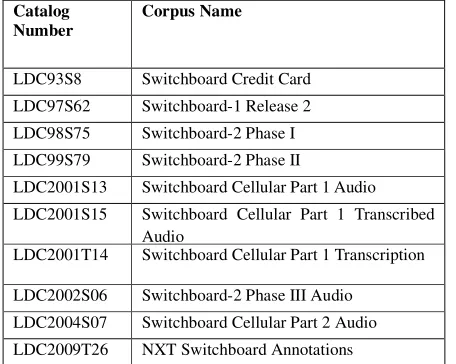
consider an article that mentions using a Switchboard corpus, but does not specify which. As shown in Table 1,
the LDC Catalog has ten corpora with Switchboard in the
name including the original, Switchboard-1 Release 2 (Godfrey & Holliman, 1997), cellular versions, and
transcripts.
Catalog Number
Corpus Name
LDC93S8 Switchboard Credit Card
LDC97S62 Switchboard-1 Release 2
LDC98S75 Switchboard-2 Phase I
LDC99S79 Switchboard-2 Phase II
LDC2001S13 Switchboard Cellular Part 1 Audio
LDC2001S15 Switchboard Cellular Part 1 Transcribed Audio
LDC2001T14 Switchboard Cellular Part 1 Transcription
LDC2002S06 Switchboard-2 Phase III Audio LDC2004S07 Switchboard Cellular Part 2 Audio LDC2009T26 NXT Switchboard Annotations
Table 1: LDC’s Switchboard corpora
1http://www.endnote.com/
In such a case, the team reviewed LDC’s licensing records for the primary article author. If the author’s organization
had licensed only one Switchboard data set, this would strongly suggest the corpus intended by the reference. The
team also checked the date of publication of the paper
against the release date of the given LR. In the example
above, if the article pre-dated the release of all
Switchboard corpora but one, this would conclusively indicate the LR cited.
The team encountered many articles for which they could
not determine the specific LR used. In those cases, the LR
identified in the database is the project ‘family’ name; so
in the current example, just Switchboard. This issue unfortunately affects some of the most-cited resources in
LDC's corpus catalog including the English Penn
Treebanks (Marcus, Santorini, & Marcinkiewicz, 1995
and Marcus et al., 1999).2 A related problem was that
papers often referred to the LR by the data source and not
its official name. For instance, many papers referenced a
Wall Street Journal (WSJ) corpus; WSJ data is included in
several LDC LRs, including CSR-I (Garofolo et al., 1993b), BLLIP (Charniak et al., 2000), Penn Treebank and TIPSTER (Harman & Liberman, 1993). Roughly 10% of papers read lack a reference to the specific LR
used.
It is also interesting to note that most papers failed to cite
LRs in the ‘references’ section. That is, the LR referenced
in the paper was often not treated in the same manner as
other research papers. Unfortunately, citations of corpora
and other data sets have not yet taken hold in most
research communities using LRs. LDC provides citation
guidelines for each LR in its Corpus Catalog. The
guidelines include the LR author, year of publication, LR
name, and Linguistic Data Consortium as the LR
publisher.
A related issue is that many papers make no mention of
LDC, either in the reference section or in the paper itself.
For instance, a Google Scholar search for the LDC LR,
WSJCAM0 Cambridge Read News (Robinson, et al.,
2
LDC distributes two versions of the Penn Treebank:
1995), returns 208 possible results. A search of both
“WSJCAM0” and “LDC” yields forty three possible
results, and for “WSJCAM0” and “Linguistic Data
Consortium” yields just twenty one possible hits. This
means that searchers could not simply include LDC in
search terms to limit results and focus on those that were
likely to be on target. To better understand the issue,
consider that a Google Scholar search for LDC LR
“Switchboard” returns over 55,000 possible hits since the
term “switchboard” is used in many disciplines. Results
cannot be limited by restricting the search for those
articles that also mentioned LDC since this could exclude
many potential articles. Instead, searchers must resort to
less effective tactics to focus on relevant papers, such as
restricting the subject area search or publication date of
the article.
Searches often returned several URLs for a given paper.
When possible, the URL chosen was that of a database
such as the ACL Anthology, which provides access to the
full text of the paper. Linking to personal web pages was
avoided since those pages are less likely to be maintained
over time. Another challenge was finding full-text URLs
for some articles. Google Scholar’s search results are
often linked to ‘reader-pays’ journal article archives such
as ACM Digital Library1, IEEE Xplore® 2 , and
SpringerLink 3 Those sites generally require a
subscription or fee for full article access although some
information about the article including a summary may be
provided at no cost. In such cases, the team first attempted
to locate a freely-available version of the paper. If a
no-cost version could not be found, articles that could be
viewed with the journal subscription services provided by
the library of the University of Pennsylvania, LDC’s host
institution, were included. If the team could not access
the full text of the paper, they included the paper in the
bibliography only if they could determine from any
summary or other information provided that the research
used a given LR.
1http://dl.acm.org/
2http://ieeexplore.ieee.org/Xplore/guesthome.jsp
3http://www.springerlink.com/
5.
Progress to date
Currently, the papers database contains almost 8000
references which represent an in-depth search of
approximately 55% of the LRs in the catalog.
Specifically, this includes LDC catalog years 1993
through 1995 and 2008 and 2009, as well as LRs
representative of each type LDC distributes (broadcast,
lexicons, treebanks, etc.). A small number of corpora not
targeted in those years and genres are also archived in the
database since a search for one particular LR often
returned hits for other LRs that were either used as part of
the same research project or that had similar names.
The papers database focuses on published LRs in LDC’s
Catalog. Although searches often returned papers
describing unpublished LRs, those were excluded from
the bibliography unless they also involved significant
work with a published LR. Unpublished LRs were not
searched for specifically since the yield of papers is
expected to be lower and concentrated in evaluation
workshop proceedings (which are also less likely to be
published). As unpublished LRs constitute over half of
LDC’s LRs, it is expected that LDC’s research impact is
larger than that captured by the current project.
6.
Current Analysis
As almost 300 LRs, over half of LRs in LDC’s catalog,
have been searched for extensively, some preliminary
analysis on results is now possible. The licensed version
of EndNote allows for searching within a field and across
fields, so the number of times an LR was cited can be
counted. One question was whether those LRs that are
licensed most frequently are also those that are referenced
most frequently in academic papers. To investigate this
relationship, the number of licenses for a given LR was
compared to the number of times that LR was cited in a
research paper.
Table 2 plots the number of licenses4 for a given LR along
the X axis against the number of times that LR was
referenced in a research paper along the Y axis. As
4
expected, the more times an LR has been licensed, the
more that LR is used, so there is a positive relationship
between the two variables (correlation coefficient .633).
Of those LRs searched for extensively, an average of 38
papers per LR have been located with a range of 0 to 692
papers per LR.
Table 2: License count versus paper counts for LRs
To further investigate the relationship between resources
and research, the number of papers for LDC’s most
licensed LRs, the “Top Ten”1 , were examined. Table 3
shows (1) the number of licenses for and (2) papers about
LDC’s most licensed LRs.
Table 3: License and paper counts for LDC’s Top Ten
LRs
A few trends emerge – as before, the more times an LR
has been licensed, the more likely it is to be used in
research. For certain LRs that have been licensed
frequently yet do not appear very often in scholarly
literature, such as Web 1T 5-gram (Brants & Franz,
2006), and YOHO Speaker Verification (Campell &
Higgins, 1994), a few explanations are possible. One
1
http://www.ldc.upenn.edu/Catalog/topten.jsp
possible explanation is that these LRs were simply not
mentioned by the paper author. In the case of an LR such
as Web 1T 5-gram, it may also be that since this LR is
fairly new compared to the other Top Ten LRs2, research
use of this LR is still in its infancy.
On the other hand, an LR such as Message Understanding
Conference (MUC) 7 (Chinchor, 2001) has been
referenced more than it has been licensed. This data, as
well as other benchmark databases such as TIMIT,
pre-date the establishment of LDC, and thus, there are
more organizations with access to this data than LDC’s
license count captures.
7. Future Work
The papers database currently resides on LDC’s network.
Remaining steps include (1) completing the initial
bibliographic search for all LDC LRs, (2) extending
OLAC or a similar metadata repository to include links
among LRs, (3) converting the EndNote database into a
web searchable form integrated with the LDC Catalog so
that searches for LRs reveal all related papers and
vice-versa, (4) permitting paper authors to add their own
citations to the database after validation and, finally, (5)
further promoting the resource.
The LDC papers database, while still in-progress, has
begun to address the motivations behind its creation. Just
over half of LDC’s LRs have been searched for and
almost 8000 unique research papers have been located.
These papers span two decades of research and have been
presented at scores of academic conferences or published
in various scholarly journals. The papers database has
confirmed that those LRs that are licensed the most
frequently by a research community are those that are also
utilized most frequently for research.
Once the papers database has integrated into LDC’s
catalog, it will be utilized by LR users to locate all
research related to an LR and by LR authors to help
promote their LR and track usage. The facility with which
researchers can exploit an LR and build upon prior work
will increase, thereby lowering barriers to
language-related education, research and technology
development.
2
8.
References
Bird, Steven & Gary Simons (2000). A Survey of the State of the Art in Digital Language Documentation
and Description,
http://www.language-archives.org/documents/surve y.html, Draft: 5
Brants, Thorsten & Alex Franz (2006). Web 1T 5-gram Version 1 (LDC2006T13). Linguistic Data Consortium, Philadelphia, PA.
Campbell, Joseph & Alan Higgins (1994). YOHO Speaker Verification (LDC94S16). Linguistic Data Consortium, Philadelphia, PA.
Charniak, Eugene et al. (2000). BLLIP 1987-89 WSJ Corpus Release 1 (LDC2000T43). Linguistic Data Consortium, Philadelphia, PA.
Chinchor, Nancy (2001). Message Understanding Conference (MUC) 7 (LDC2001T02). Linguistic Data Consortium, Philadelphia, PA.
Cieri, Christopher (2009). A Road Map for Interoperable Language Resource Metadata. SILT-FlareNet Workshop.Waltham, MA.
Garofolo, John S., et al. (1993a). TIMIT Acoustic-Phonetic Continuous Speech Corpus (LDC93S1).
Linguistic Data Consortium, Philadelphia, PA. Garofolo, John S., et al. (1993b). CSR-I (WSJ0)
Complete (LDC93S6A). Linguistic Data Consortium, Philadelphia, PA.
Godfrey, John J. & Edward Holliman. (1997). Switchboard-1 Release 2 (LDC97S62). Linguistic Data Consortium, Philadelphia, PA.
Harman, Donna & Mark Liberman (1993). TIPSTER Complete (LDC93T3A). Linguistic Data Consortium, Philadelphia, PA.
Mitchell, Marcus, Beatrice Santorini, & Mary Ann Marcinkiewicz (1995). Treebank-2 (LDC95T7). Linguistic Data Consortium, Philadelphia, PA. Mitchell, Marcus, et al. (1999). Treebank-3 (LDC99T42).
Linguistic Data Consortium, Philadelphia, PA. Robinson, Tony et al. (1995). WSJCAM0 Cambridge