CSEIT17252 | Received : 26 August 2017 | Accepted : 06 Sep 2017 | September-October-2017 [(2)4: 67-72]
International Journal of Scientific Research in Computer Science, Engineering and Information Technology © 2017 IJSRCSEIT | Volume 2 | Issue 5 | ISSN : 2456-3307
67
Dynamic Job Ordering and Slot Configurations for Mapreduce
Workloads Using Heuristic Algorithm
M. Praveen Kumar
1, S. P. Santhoshkumar
2, S. Syed Shajahaan
31Assistant Professor, Department of Information Technology, Rathinam Technical Campus, Coimbatore, Tamil Nadu, India 2Assistant Professor, Department of Computer Science and Engineering, Rathinam Technical Campus, Coimbatore, Tamil Nadu,
India
3Head of the Department, Department of Information Technology, Rathinam Technical Campus, Coimbatore, Tamil Nadu, India
ABSTRACT
MapReduce is a popular parallel computing paradigm for large-scale data processing in clusters and data centers. A MapReduce workload generally contains a set of jobs, each of which consists of multiple map tasks followed by multiple reduce tasks. Due to 1) that map tasks can only run in map slots and reduce tasks can only run in reduce slots, and 2) the general execution constraints that map tasks are executed before reduce tasks, different job execution orders and map/reduce slot configurations for a MapReduce workload have significantly different performance and system utilization. This paper proposes two classes of algorithms to minimize the makespan and the total completion time for an offline MapReduce workload. Our first class of algorithms focuses on the job ordering optimization for a MapReduce workload under a given map/reduce slot configuration. In contrast, our second class of algorithms considers the scenario that we can perform optimization for map/reduce slot configuration for a MapReduce workload. We perform simulations as well as experiments on Amazon EC2 and show that our proposed algorithms produce results that are up to 15 _ 80 percent better than currently unoptimized Hadoop, leading to significant reductions in running time in practice.
Keywords: MapReduce, Hadoop, Flow-Shops, Scheduling Algorithm, Job Ordering.
I.
INTRODUCTION
MAPREDUCE is a widely used computing model for large scale data processing in cloud computing. A MapReduce job consists of a set of map and reduces tasks, where reduce tasks are performed after the map tasks. Hadoop [2], an open source implementation of MapReduce, has been deployed in large clusters containing thousands of machines by companies such as Amazon and Facebook. In that cluster and data center environments, MapReduce and Hadoop are used to support batch processing for jobs submitted from multiple users (i.e., MapReduce workloads). Despite many research efforts devoted to improving the performance of a single MapReduce job (e.g., [3], [11]), there is relatively little attention paid to the system performance of MapReduce workloads. Therefore, this paper tries to improve the performance of MapReduce
dependent jobs finish the computation subject to the input-output data dependency. In contrast, for independent jobs, there is an overlap computation between two jobs, i.e., when the current job completes its map-phase computation and starts its reduce-phase computation, the next job can begin to perform its mapphase computation.
II.
MOTIVATION
In this section, we show the importance and challenge of job ordering optimization as well as map/reduce slot configuration optimization by giving motivating examples experimentally.
2.1 Motivation for Job Ordering Optimization
To motivate the importance of job ordering
optimization for MapReduce workloads on
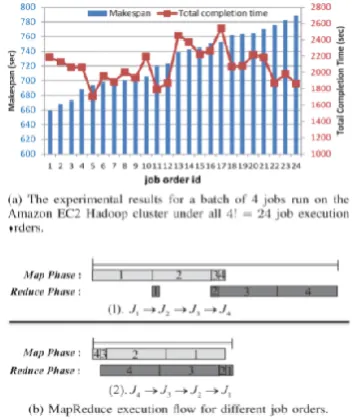
performance, we ran a Testbed workload consisting of four jobs (J1 J4) from Table 2 of Section 7.1 in an Amazon EC2 Hadoop cluster configured with map slots of 57 and reduce slots of 19. We do so by comparing the performance of all possible job submission orders.
2.2 Motivation for Slot Configuration Optimization
To motivate the importance of optimization on map/reduce slot configuration, we perform a simulation experiment with a Testbed MapReduce workload consisting of four jobs, assuming that a cluster consisting of 10 slave nodes each configured with eight
slots, i.e., the total number of map slots plus reduce slots for the cluster is 80, as shown in Fig. 2. Our experiments are three folds. First, we examine the influence of slot configuration to the overall performance by running jobs in all possible map/reduce slot configurations in practice (i.e., configure map slots from 1 to 7 per slave node), under an arbitrary job submission order. The experimental results are given in Fig. 2a. It can be noted that the maximum performance difference between the worst-case map/reduce slot configuration (e.g., 10=70) and the optimal one (e.g., 60=20) is huge, up to 399%. Second, we consider the influence of job orderings on the performance by running jobs with all possible job orders, under an optimal map/reduce slot configuration (e.g., 60/20). Fig. 2 b shows that the performance difference of the worst-case job submission order and the optimal one can be large up to 33%, depending on the workload characteristic. Third, we evaluate and compare the optimal (minimum) makespan as well as its corresponding optimal map/reduce slot configuration for all possible job submission orders. Fig. 2c illustrates the optimal map/reduce slot configuration (i.e., blue and green bar) as well as its corresponding optimal makespan (i.e., red curve) for all 4! ¼ 24 possible job submission orders, sorted by makespan in non-decreasing order. The results show that there are varied optimal configurations of map/reduce slots for different job submission orders. Moreover, it’s worth noting that the maximum performance difference between the worst-case job order and the optimal job order each under its corresponding optimal map/reduce slot configuration, is 28:7%. In summary, the above motivating example poses three key challenging issues: (1). Different map/reduce slot configurations will have different performance under a given job order (2). Even under the optimal map/ reduce slot configuration, different job submission orders will result in varied performance (3). The optimal configurations of map/reduce slots, as well as its corresponding optimal makespan, are different under different job submission orders.
III.
RELATED WORKS
3.1 Job Ordering Optimization
The batch job ordering problem has been extensively studied in the high-performance computing literature [25]. Minimizing the makespan has been shown to be NP-hard [25], and a number of approximation and heuristic algorithms (e.g., [14], [34]) have been proposed. In addition, there has been work on bi-criteria optimization which aims to minimize makespan and total completion time simultaneously, such as [13]. The previous works all focused on the single-stage parallelism, where each job only has a single stage. In contrast, MapReduce is an interleaved parallel and sequential computation model [23] which is related to the two-stage hybrid flow shop (2HFS) problem [17]. Minimizing the makespan for 2HFS is strongly NP-hard when at least one stage contains multiple processors [16]. There has been a large body of approximation and heuristic algorithms (e.g., [6], [24]) proposed for 2HFS. Additionally, there has been work (e.g., [31]) targeted at the bi-criteria optimization of both makespan and total completion time. The main difference between MapReduce and traditional 2HFS is that MapReduce jobs can run multiple map and reduce tasks concurrently in each phase, whereas 2HFS allows at most one task to be processed at a time. In this way, MapReduce is more similar to the two-stage hybrid flow shop with multiprocessor tasks (2HFSMT) [28], [29] problem, which allows a task at each stage can be processed on multiple processors simultaneously. However, there is a requirement in 2HFSMT that a task at each stage can be scheduled only when the number of processors it requires is satisfied; otherwise, the task needs to wait [28]. In contrast, the number of running map/reduce tasks for a MapReduce job can be dynamically scaled up and down as idle map/ reduce slots become available. In summary, MapReduce is a new computation model that is similar to but different from other models mentioned above. The works that are most related to ours are [26], [41]. In [26], Moseley et al. present an offline 12approximation algorithm for minimizing the total flow time of the jobs; this is the sum of the differences between the finishing and arrival times of all the jobs. Verma et al. [41] propose two algorithms for makespan optimization. One is a greedy algorithm job ordering method based on Johnson’s Rule. Another is a heuristic algorithm called Balanced Pool. They discuss and evaluate the algorithms experimentally. We follow their job ordering approach (i.e., the MK_JR algorithm in our paper). But our main
contributions go beyond it in a number of significant aspects. First, we prove a 1 þ d upper bound on the approximation ratio of our MK_JR algorithm. Second, we give the relationship between upper-bound
makespan, lower-bound makespan, and the
corresponding job orders.
3.2 MapReduce Job Optimization
There is a large body of research work that focuses on the optimization for MapReduce jobs. One optimization policy focuses on the architectural design and optimization issues. Jiang et al. [21] proposed a set of general low-level optimizations including improving I/O speed, utilizing indexes, using fingerprinting for faster key comparisons, and block size tuning. Rasmussen et al. [33] presented an I/O-efficient MapReduce system called Themis that improves the performance of MapReduce by minimizing the number of I/O operations. Likewise, Sailfish [32] improves MapReduce’s performance through more efficient disk I/O. It mitigates partitioning skew in MapReduce by choosing the number of reduce tasks and intermediate data partitioning dynamically at runtime, using an index constructed from intermediate data. There are also methods that reduce I/O cost in MapReduce by using indexing structures (e.g., Hadoop++ [12]), column-oriented storage (e.g., [15]). Polo et al. [30] proposed a scheduling technique and implemented a prototype called Adaptive Scheduler that can adaptively manage the workload performance with the awareness of hardware heterogeneity, distributed storage to meet user’s deadline requirement. Wolf et al. [42] propose a flexible scheduling allocation scheme called FLEX, which can optimize any of a variety of standard scheduling theory metrics, such as response time, stretch, and makespan. Tang et al. [35], [37] proposed a dynamic slot allocation system called Dynamic MR to improve the performance for the slot-based Hadoop MRv1, by allowing map (or reduce) tasks can be run on map slots and reduce slots.
Adjusting Hadoop configuration is another
parameter configurations optimization, on the cloud platform, to meet desired requirements on execution time and cost for a given workload, based on a careful mix of job profiling, estimation using black-box and white-box models and simulation. In contrast, Agarwal et al. [7] present a system RoPE that can re-optimize data parallel jobs by adapting execution plans based on estimates of code and data properties. Another optimization policy is to share work and eliminate redundant data access and computation. Agrawal et al. [8] provide a method to maximize scan sharing by grouping MapReduce jobs into batches so that sequential scans of large files are shared among many simultaneous jobs as possible. MR Share [27] is a sharing framework that provides three possible work-sharing opportunities, including scan work-sharing, mapped outputs sharing, and Map function sharing across multiple MapReduce jobs, to avoid performing redundant work and thereby save processing time. There is also an optimization policy of pipelining. MapReduce Online [10] is such a modified MapReduce system to support online aggregation for MapReduce jobs that run continuously by pipelining data within a job and between jobs. In contrast, we improve the performance for a MapReduce workload by maximizing the cluster utilization as much as possible, through optimizing the map/reduce slot configuration and the job submission order. All these studies are complementary to our study and our approach can be incorporated into these modified MapReduce frameworks (e.g., MRShare [27], MapReduce Online [10]) for further performance improvement.
IV.
SYSTEM ANALYSIS
4.1 Existing System
A MapReduce job consists of a set of map and reduce tasks, where reduce tasks are performed after the map tasks. Hadoop, an open source implementation of MapReduce, has been deployed in large clusters containing thousands of machines by companies such as Amazon and Facebook. In those cluster and data center environments, MapReduce and Hadoop are used to support batch processing for jobs submitted from multiple users (i.e., MapReduce workloads). Despite many research efforts devoted to improve the performance of a single MapReduce job, there is relatively little attention paid to the system performance of MapReduce workloads. Therefore, this
paper tries to improve the performance of MapReduce workloads.
Disadvantages of Existing System:
1. The previous works all focused on the single-stage parallelism, where each job only has a single stage. 2. Slow performance of the Map Reducer workloads
4.2 Proposed System
In this paper, we target at one subset of production MapReduce workloads that consist of a set of independent jobs (e.g., each of jobs processes distinct data sets with no dependency between each other) with different approaches. For dependent jobs (i.e., MapReduce workflow), one MapReduce can only start only when its previous dependent jobs finish the computation subject to the input-output data dependency. In contrast, for independent jobs, there is an overlap computation between two jobs, i.e., when the current job completes its map-phase computation and starts its reduce-phase computation, the next job can begin to perform its map-phase computation in a pipeline processing mode by possessing the released map slots from its previous job.
Advantages of Proposed System: 1.
2. We propose a bi-criteria heuristic algorithm to optimize makespan and total completion time simultaneously. 3.
4. Propose slot configuration algorithms for makespan and total completion time. We also show that there is a proportional feature for them, which is very important and can be used to address the time efficiency problem of proposed enumeration algorithms for a large size of total slots.
4.3 Algorithm
function Kernighan-Lin(G(V,E)):
determine a balanced initial partition of the nodes into sets A and B
do
compute D values for all a in A and b in B let gv, av, and bv be empty lists
for (n := 1 to |V|/2)
remove a and b from further consideration in this pass
add g to gv, a to av, and b to bv
update D values for the elements of A = A \ a and B = B \ b
end for
find k which maximizes g_max, the sum of gv[1],...,gv[k]
if (g_max > 0)then
Exchange av[1],av[2],...,av[k] with bv[1],bv[2],...,bv[k]
until (g_max <= 0) return G(V,E)
V.
YSTEM ARCHITECTURE
5.1 Modules
1.
Job Ordering Optimization Module2.
Slot Configuration Optimization ModuleModule Description:
1. Job Ordering Optimization:
This module we can significantly improve the total completion time of MapReduce. For Map Reducer workloads we use the job ordering optimization algorithms MK_JR and MK_TCT_JR.
2. Slot Configuration Optimization:
The slot configuration can have a significant impact on performance for MapReduce workloads. We propose several enumeration algorithms for map/reduce slot configuration optimization with regard to the makespan and total completion time of a MapReduce workload.
VI.
APPLICATIONS
1. Social Media: The Large data is generated from the social media platforms such as YouTube, Facebook, Twitter, LinkedIn, and Flickr. The amount of DATA being uploaded to the internet is rapidly increasing, with Facebook users uploading over 2.5 billion new Data every month. It can be used to improve applications performance by greatly reducing the file size and network bandwidth required to display your application. 2. Business Applications: online shopping application where the every item has data is shown. Company’s data and scan copies of various documents. 3. Satellite images: This includes weather data or the data that the government captures in its satellite surveillance imagery. 4. Photographs and video: This includes security, surveillance, and traffic video.
VII.
CONCLUSION
This paper focuses on the job ordering and map/reduce slot configuration issues for MapReduce production workloads that run periodically in a data warehouse, where the average execution time of map/reduce tasks for a MapReduce job can be profiled from the history run, under the FIFO scheduling in a Hadoop cluster. Two performance metrics are considered, i.e., makespan and total completion time. We first focus on the makespan. We propose job ordering optimization
algorithm and map/reduce slot configuration
optimization algorithm. We observe that the total completion time can be poor subject to getting the optimal makespan, therefore, we further propose a new greedy job ordering algorithm and a map/reduce slot configuration algorithm to minimize the makespan and total completion time together. The theoretical analysis is also given for our proposed heuristic algorithms, including approximation ratio, upper and lower bounds on makespan. Finally, we conduct extensive experiments to validate the effectiveness of our proposed algorithms and their theoretical results.
VIII.
ACKNOWLEDGEMENT
Mr. M. Praveenkumar is currently working as an Assistant Professor in Information Technology at Rathinam Technical Campus, Tamilnadu, India. He received a Master of Engineering from Anna University of Technology, Coimbatore, India.
Assistant Professor in Computer Science and Engineering at Rathinam Technical Campus, Tamilnadu, India. He received a Master of Engineering from Anna University of Technology, Coimbatore, India.
Mr. S. Syed Sajahaan is currently working as Head of the Department in Computer Science Engineering and information Technology at Rathinam Technical Campus, Tamilnadu, India. He received a Master of Engineering from Anna University of Technology, Coimbatore, India.
IX.
REFERENCES
[1]. http://hadoop.apache.org/docs/r1.2.1/fairschedule r.html
[2]. http://hadoop.apache.org/docs/r2.3.0/hadoop-yarn/hadoop yarnsite/CapacityScheduler.html [3]. Ching-Chi Lin, Pangfeng Liu, and Jan-JanWu.
Energy-aware virtual machine dynamic provision and scheduling for cloud,. In Cloud Computing(CLOUD), 2011 IEEE Inter national Conference on, pages 736–737, july 2011. [4]. Anton Beloglazov and Rajkumar Buyya. Energy
efficient allocation of virtual machines in cloud data centers, In 10th IEEE/ACM International Conference on Cluster, Cloud and Grid Computing, pages 577–578, 2010.
[5]. YibinWei,Ling Tian , Research on cloud design resources scheduling based on Genetic Algorithm, 2012 International Conference on systems and informatics(ICSAI 2012)
[6]. Chen, K. ; Powers, J. ; Guo, S. ; Tian, F. CRESP: Towards Optimal Resource Provisioning for MapReduce Computing in PublicClouds , IEEETransactions on Parallel and Distributed Systems ,Volume: 25 , Issue: 6 Publication Year: 2014 , Page(s): 1403–1412.
[7]. Xiaohong Zhang ; Yuhong Feng ; Shengzhong Feng ;Jianping Fan ; Zhong Ming An effective data locality aware task scheduling method for MapReduce framework in heterogeneous environments, 2011 International Conference on Cloud and Service Computing (CSC)Year: 2011 , Page(s):235-242
[8]. Sewoog Kim ; Dongwoo Kang ; Jongmoo Choi ; Junmo Kim Burstiness-aware I/O scheduler for MapReduce framework on virtualized environments , 2014 International Conference on
Big Data and Smart Computing (BIGCOMP) Publication Year: 2014 , Page(s): 305–308. [9]. Hammoud, M. ; Rehman, M.S. ; Sakr, M.F.
Center-of Gravity Reduce Task Scheduling to Lower MapReduce Network Traffic , 2012 IEEE 5th International Conference on Cloud Computing (CLOUD) Publication Year: 2012 , Page(s): 49–58.
[10]. . olo, . Carrera, . ecerra, . orres, . yguad e, M. teinder, and . Whalley. Performance-driven task co-scheduling for MapReduce environments. In 12th IEEE/IFIP
Network Operations and Management
Symposium. ACM, 2010.
[11]. L. Phan, Z. Zhang, B. Loo, and I. Lee. Real-time MapReduce Scheduling. Tech. Report No. MS-CIS-10-32, UPenn, 2010.
[12]. B. Palanisamy, A. Singh, L. Liu, and B. Jain. Purlieus: localityaware resource allocation for MapReduce in a cloud. In Proceedings of 2011 International Conference for High Performance Computing, Networking, Storage and Analysis (SC), 2011.