DOI : https://doi.org/10.32628/CSEIT1953155
An Efficient Method for License Plate Detection and Recognition using OCR
Aswathy Mani*1, Nisy John Panicker2
*1PG Scholar, CSE Department, College of Engineering, Munnar, Kerala, India 2Assistant Professor, CSE Department, College of Engineering, Munnar, Kerala, India ABSTRACT
This paper presents an efficient method for license plate detection and recognition that will aid in the development of an intelligent transport system. To significantly accelerate license plate localization a simple image pre-processing method is first used without reducing detection performance compared with that obtained using original image. Line density filter approach is used to extract the license plate regions, there by significantly reducing area to be analysed for license plate localization. In license plate recognition, the characters are recognized from these detected license plates by using optical character recognition and the owner details are displayed. The aim of this paper is to serve the purpose of accurately localizing vehicle license plates from complex scenes in real time that would help motor vehicle department in various ways.
Keywords : License Plate Detection, License Plate Recognition, Line Density Filter, Optical Character Recognition, Pre-Processing.
I. INTRODUCTION
Intelligent transport systems plays an important role in supporting smart cities because of their promising applications in various areas, such as electronic troll collection, high way surveillance, urban logistics and traffic management. One of the key components of intelligent transport systems is vehicle license plate recognition, which enables the identification of each vehicle by recognizing the characters on its license plate through various image processing and computer vision techniques. License plate recognition (LPR) is a technology converts images to text. While the idea may seem simple, the behind scenes complexity that goes on it quite amazing [1].
Vehicle license plate recognition typically consists of license plate detection (LPD), character segmentation and recognition. LPD is a fundamental component of vehicle license plate recognition; as such, its performance, in terms of both detection accuracy and
runtime efficiency, largely determines the overall system and thus influences the support provided for intelligent systems in smart cities. The importance of LPD is well known in computer vision community. A number of LPD methods have been proposed over past decades, some of them have demonstrated success in certain specific tasks. However, most of the previous methods work well only under certain predefined conditions. Some common restrictions include fixed illumination, license plate with blur or distortion from view point changes, relatively simple backgrounds and the presence of only a single license plate in an image. More recent approaches increased the computational complexity due to the restrictions on license plate. However, these approaches still have difficulty in extracting license plates from complex scenes. LPR is an application in the study of image processing and pattern recognition [1].
Researchers have developed a lot of LPR methods. The first step in license plate detection is to detect the license plate itself. Plate localization is way to locate the position of car license plate. By using histogram it is simply detect the license plate.
The second step is to recognize the characters from license plate using optical character recognition. OCR is that the recognition of written communication characters-by-character, analysis of the text in image and so translation of the character text image into character codes, such as ASCII, commonly used in processing or further analysis.
This paper is organized as follows: section 2 briefly reviews the relevant literature on vehicle license plate detection and recognition. Section 3 introduces an efficient approach for vehicle license plate recognition in detail. Result and discussion are presented in section 4. Finally section 5 concludes the paper.
II. RELATED WORK
The various LPD methods are reviewed in this section as it is the first step in a license plate recognition system along with a few LPR methods. Vehicle license plates are characterized by abundant edge information and many methods exploits edge information for license plate detection.
Zheng used the magnitude of the vertical gradients to detect candidate license plate regions. These candidate regions were then evaluated based on three geometrical features: the ratio of width and height, the size and the orientation. Rotation free character recognition was applied onto these candidate regions [2]. Bai et al. Used a hybrid license plate extraction algorithm based on the edge statistics and morphology for monitoring the high way ticketing systems. They used the conventional morphology filter which was very time consuming as its template
usually contains several pixels, which increases the computational cost. Thus, this filter may not be appropriate for applications that require real time processing [3]. Zeng used a license plate extraction method, that searches for a license plate in a convolution output image using a rectangular shit window size, although this method was sensitive to window size, only a single license plate can be detected in any given image [4].
Hsieh et al. Used morphology based method that was significantly reduced the number of candidates extracted from the cluttered images. The differences between a 7*1 open operator and a 7*1 close operator was used to locate the license plate [5]. H.H.Wu et al. Used a morphology gradient method for extracting license plate candidates was introduced that achieves an impressive average extraction ration of 96.6% . However, the morphology technique was time consuming and was not suitable for license plate detection against complex backgrounds [6]. Ying-Nong chen et al. Used a single feature map and a fully connected MLP were trained by examples to classify the possible candidates. To identify the regions of faces or license plates pyramid based localization methods were applied. In addition, geometrical rules filtered out false alarms in license plate detection [7].
W. Zou et al. Used a automatic figure ground segmentation approach by transferring segmentation masks of glocally similar exemplars into query image.
Firstly, object oriented descriptor (OOD) was proposed as high level image representation which implicitly encoded geometric information and highlights objects in an image [8]. W. Zou et al. Used a novel unsupervised algorithm to detect salient regions and to segment out foreground objects from background [9].
the improved computational efficiency was achieved at the cost of reduced edge information [10]. Anagnostopoulos et al. Used sliding concentric windows as a new image segmentation technique for license plate detection. By using different backgrounds and ambient illumination several type natural gray level images of vehicle was tested. According to the experimental setup angle of view and distance from vehicle is varied [11].
C. E. Anagnostopoulos et al. [12] Use license plate recognition algorithm in images or videos consist of license plate region is extracted as a first step then character segmentation, finally the characters are correctly recognized. This task was quite challenging due to the diversity of plate formats and the non uniform outdoor illumination conditions during image acquisition. M. M. Cheng et al. [13] used global contrast differences and spatial weighted coherence scores.
G. Hsu et al. [14] Divides the applications of vehicle license plate recognition into three types and used a solution with three parameter such as access control (AC), law enforcement (LE), and road patrol (RP). Li et al. [15] constructed a conditional field model to find the license plate. Lin , Hang, Huang [16] Got inspired from the observation that license plates were very salient to human visual perception and hence used a novel license plate detection algorithm based on image saliency. W. Zhou et al. [17] used a novel scheme to automatically locate license plates by principal visual word (PVW), discovery and local feature matching.
III. EFFICIENT APPROACH FOR DETECTION AND RECOGNITION
This section presents an efficient approach for license plate detection and recognition. Caltech license plate dataset used this approach that substantially out
performs state-of-art methods in terms of both accuracy and efficiency [1].
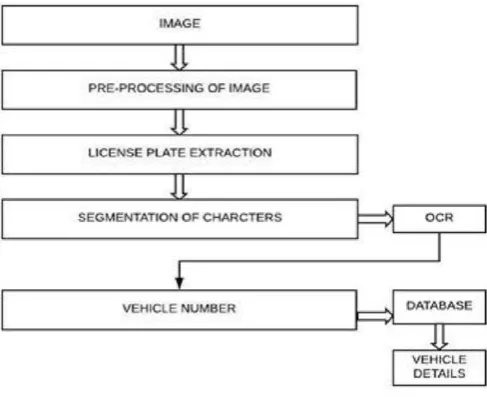
In this method the first part is license plate detection, which consists of image pre-processing, candidate extraction and license plate verification. The original colour image is downscaled and converted into gray scale image by the pre-processing procedure. Then a set of candidate regions extracted via edge density detection, adaptive thresholding for the detected edges and line density filtering. Finally, the license plate is located by verifying each of the candidate regions. The second part is license plate recognition which involves recognizing the characters from the license plate and identifying the vehicle details from the database [1]. Fig.1. Shows the framework of the proposed license plate detection and recognition system.
Fig. 1. Proposed license plate detection and recognition
A. License Plate Detection
license plate in an image. To address this issue, one suggestion is to downscale the input image or license plate detection. Unfortunately, the downscaling operation may result in a loss of information and lead to decrease in license plate detection performance; for this reason, most previously developed methods do not perform image downscaling as part of the license plate detection task. Thus, a fundamental problem to be addressed is how to balance detection accuracy and runtime efficiency for license plate detection [1].
In this paper, image downscaling method for license plate detection substantially reduces the image size without incurring an obvious decrease in performance compared with that achieved when using the original image. This method is based on the following observations. First, the area of license plate is obviously greater than its heights. Second, license plate characters are printed in uniform direction [1]. The first step in the detection process is preprocessing. The original image is converted into gray scale image. Which gray scale image is converted into an histogram image. In an image processing context, the histogram of an image normally refers to a histogram of pixel intensity values. The histogram will illustrate 256 numbers for a 8 bit gray scale image it consist of 256 different possible intensities and showing the distribution of pixels amongst those gray scale values. The next step is image enhancement. Image enhancement is the process of adjusting digital images so that the results are more suitable for display or for further analysis. After that the enhanced image is filtered in order to remove the noise, making it easier to identify the key features. Then edge detection is performed by using Robert operator. Edge detection is identifying edges in an image which are used as a fundamental asset in image analysis. In order to perform the next step binarization different morphological process like erosion, closing and binary open is performed. Finally by using line density filter the corresponding license plate detected
B. License Plate Recognition
The second step is license plate recognition that recognize the characters from license plate. OCR is the recognition of written text characters-by-characters. It includes study of the text in image and then translate the character text into character codes, such as ASCII, that are commonly used in processing or further analysis.
Any OCR system goes through numerous phases including: data acquisition, pre-processing, feature extraction, classification and post-processing where the most crucial aspect is the pre-processing which is necessary to modify the data either to correct fault in the data acquisition process due to limitations of the capturing device sensor, or to prepare the data for subsequent activities later in the description or classification stage. Data pre-processing describes any sort of process performed on information to arrange it for one or more process procedure. Hence, preprocessing is that the preliminary step that transforms info into format which will be additional simply and efficiently processed. Therefore, the main task in preprocessing the captured data is to decrease the variation that causes a reduction in the recognition rate and increases the complexities, as for example, The success of efficient character recognition systems the preprocessing of input stroke of characters is important. Thus, pre-processing is a vital stage before feature extraction since it controls the quality of the results or the consecutive stages. The stages in a very pattern recognition system square measure in a pipeline fashion which means that each stage depends on the success of the previous stage in order to supply optimal/valid results [18].
text in the image. That will help for further analysis of image.
IV. EXPERIMENTAL RESULT
Our efficient approach is implemented in MatlabR2014a. The approach is evaluated on the widely used Caltech vehicle dataset. It includes 96 vehicle images. For the recognition part a dummy database is created regarding vehicle details. To implement this project in day to day life we have to collect the original information from RTO. Fig.2.depicts the various steps involved in this approach.
(a)
(b)
(c)
(d)
(f)
(g)
(h)
(i)
(j)
(k)
This paper presents an efficient method for license plate detection using line density filter and recognition [7] using OCR. The proposed approach consists of image preprocessing techniques, candidate extraction, license plate detection and license plate recognition.
V. CONCLUSION AND FUTURE WORK
VI.FUTURE WORK
When addressing difficult scenes, still there are certain limitations regarding the propose approach and other state-of-art methods. Example: reflective glare on license plates. To address such difficult case it would be interesting to exploit the MSER or Hough transform approach. In addition machine learning technique can be used as a future work
VII. REFERENCES
[2]. Shen-Zheng Wang and Hsi-Jian Lee, "Detection and recognition of license plate characters with different appearances," Proceedings of the 2003 IEEE International Conference on Intelligent Transportation Systems, Shanghai, China, 2003, pp. 979-984 vol.2.
[3]. Bai Hongliang and Liu Changping, "A hybrid license plate extraction method based on edge statistics and morphology," Proceedings of the 17th International Conference on Pattern Recognition, 2004. ICPR 2004., Cambridge, 2004, pp. 831-834 Vol.2.
[4]. D. Zheng, Y. Zhao and J. Wang, “An efficient
method of license plae location,” Pattern
Recognit. Lett., vol.26, no.15, pp.2431-2438, (2005)..
[5]. Jun-Wei Hsieh, Shih-Hao Yu and Yung-Sheng Chen, "Morphology-based license plate detection from complex scenes," Object recognition supported by user interaction for service robots, Quebec City, Quebec, Canada, 2002, pp. 176-179 vol.3. This paper presents an efficient method for license plate detection using line density filter and recognition 7using OCR. The proposed approach consists of image
preprocessing techniques, candidate extraction, license plate detection and license plate recognition. 824-827. Ying-Nong Chen, Chin-Chuan Han, Cheng-Tzu Wang, Bor-Shenn Jeng and Kuo-Chin Fan, "The Application of a Convolution Neural Network on Face and License Plate Detection,"
[6]. Hsien-Huang P. Wu, Hung-Hsiang Chen, Ruei-Jan Wu and Day-Fann Shen, "License Plate Extraction in Low Resolution Video," 18th International Conference on Pattern Recognition (ICPR'06), Hong Kong, 2006, pp. Pattern Recognition (ICPR'06), Hong Kong, 2006, pp. 552-555.
[7]. W. Zou, C. Bai, K. Kpalma and J. Ronsin, "Online Glocal Transfer for Automatic Figure-Ground Segmentation," in IEEE Transactions on Image Processing, vol. 23, no. 5, pp. 2109-2121, May 2014.
[8]. W. Zou, Z. Liu, K. Kpalma, J. Ronsin, Y. Zhao and N. Komodakis, "Unsupervised Joint Salient Region Detection and Object Segmentation," in IEEE Transactions on Image Processing, vol. 24, no. 11, pp. 3858-3873, Nov. 2015.
[9]. A. M. Al-Ghaili, S. Mashohor, A. R. Ramli and A. Ismail, "Vertical-Edge-Based Car-License-Plate Detection Method," in IEEE Transactions on Vehicular Technology, vol. 62, no. 1, pp. 26-38, Jan. 2013.
[10]. C. N. E. Anagnostopoulos, I. E. Anagnostopoulos, V. Loumos and E. Kayafas, "A License Plate-Recognition Algorithm for Intelligent Transportation System Applications," in IEEE Transactions on Intelligent Transportation Systems, vol. 7, no. 3, pp. 377-392, Sept. 2006.
[12]. M. Cheng, G. Zhang, N. J. Mitra, X. Huang and S. Hu, "Global contrast based salient region detection," CVPR 2011, Colorado Springs, CO, USA, 2011, pp. 409-416.
[13]. G. Hsu, J. Chen and Y. Chung, "Application-Oriented License Plate Recognition," in IEEE Transactions on Vehicular Technology, vol. 62, no. 2, pp. 552-561, Feb. 2013.
[14]. B. Li, B. Tian, Y. Li and D. Wen, "Component-Based License Plate Detection Using Conditional Random Field Model," in IEEE Transactions on Intelligent Transportation Systems, vol. 14, no. 4, pp. 1690-1699, Dec. 2013.
[15]. K. Lin, H. Tang and T. S. Huang, "Robust license plate detection using image saliency," 2010 IEEE International Conference on Image Processing, Hong Kong, 2010, pp. 3945-3948. [16]. W. Zhou, H. Li, Y. Lu and Q. Tian, "Principal
Visual Word Discovery for Automatic License Plate Detection," in IEEE Transactions on Image Processing, vol. 21, no. 9, pp. 4269-4279, Sept. 2012
[17]. Yasser Alginahi”Preprocessing Techniques in Character Recognition”
Cite this article as :
Aswathy Mani, Nisy John Panicker, "An Efficient Method for License Plate Detection and Recognition using OCR", International Journal of Scientific Research in Computer Science, Engineering and Information Technology (IJSRCSEIT), ISSN : 2456-3307, Volume 5 Issue 3, pp. 540-547, May-June 2019.
Available at doi :
https://doi.org/10.32628/CSEIT1953155