Unsupervised Word Segmentation Without Dictionary
Jason S. ChangDepartment of Computer Science National Tsing Hua University
101, Kuangfu Road, Hsinchu, 300, Taiwan, ROC [email protected]
Tracy Lin
Department of Communication Engineering National Chiao Tung University
1001, Ta Hsueh Road, Hsinchu, 300, Taiwan, ROC
This prototype system demonstrates a novel method of word segmentation based on
corpus statistics. Since the central technique we used is unsupervised training based on a
large corpus, we refer to this approach as unsupervised word segmentation.
The unsupervised approach is general in scope and can be applied to both Mandarin Chinese and
Taiwanese. In this prototype, we illustrate its use in word segmentation of Taiwanese Bible
written in Hanzi and Romanized characters. Basically, it involves:
z Computing mutual information, MI, between Hanzi and Romanized characters A and B. If A and B have a relatively high MI, we lean toward treating AB as a word.
z Using a greedy method to form words of 2 to 4 characters in the input sentences.
z Building an N-gram model from the results of first-round word segmentation
z Segmenting words based on the N-gram model
z Iterating between the above two steps: building N-gram and word segmentation
Computing mutual information. Using mutual information is motivated by the observation of
previous work by Hank and Church (1990) and Sproat and Shih (1990). If A and B have a relatively high MI that is over a certain threshold, we prefer to identify AB as a word over those having lower MI values. In the experiment with Taiwanese Bible, the system identified Hanzi and
Romanized syllables. Out of those, we obtained pairs of consecutive single or double Hanzi
characters and Romanized syllables. So those pairs are commonly known as character bigrams,
trigrams, and fourgrams. We differed from the common N-gram calculation and treated those as
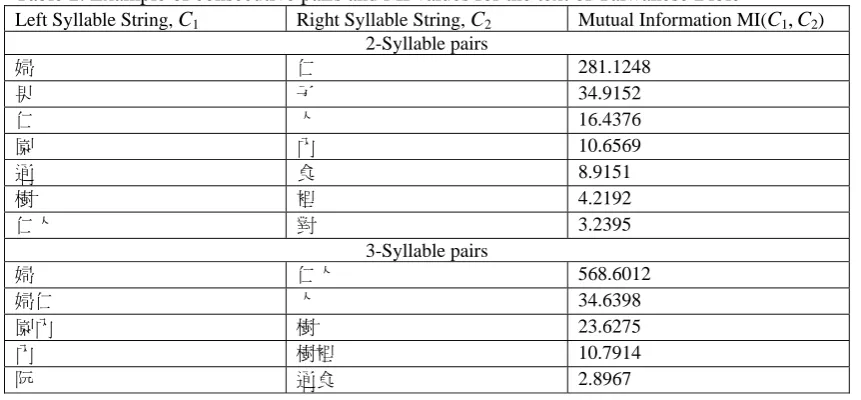
pairs of character sequence in order to apply mutual information statistics. Table 1 shows some
up the table storing MI statistics and obtained the information shown in Table2. First, we formed
words of two characters. Based on the information in Table 2, the system formed the words, 婦
仁, 果子, 通食, 園內, 樹裡. Notice that 仁人 is not selected because of confliction with
previous decision about the word 婦仁. Subsequently, we tried to extend the two-syllable words
chosen. A word is extended to three or four syllables if the MI is increased and in the corpus over
τ % of instances the two-character words can be extended that way. Currently, we set τ = 60.
Admittedly, there is limitation to what distributional regularity based on MI can be exploited for
word segmentation and there were still many errors in the first-round word segmentation results.
For instance, for the input, “我祈禱耶和華講:『主耶和華啊 … ,” the system produced the
segmentation of “我 / 祈禱 / 耶和華 / 講 / : / 『 / 主耶 / 和華 / 啊 /.” The first instance
of 耶和華 was segmented correctly, while the second instance of 耶和華 was over-segmented
because of the frequent character 主 before it. That problem can be partially alleviated by an
Expectation Maximization Algorithm of learning an N-gram model of word segmentation.
Building an N-gram model.
Currently, we used the unigram model where the probability of each word was estimated based
on the Good-Turing smoothing technique. First we tally the total number of words N and count R of each word W. Let N r be the number of distinct words have count r. Also, let N 0 be the number
of distinct syllable strings that never appear as a word. Godd-Turing smoothing stipulates that we
calculate r’ as an adjustment for r as follows: r0 = N1 / N 0
ri = (i+1) Ni+1 / N i
After the adjustment step, we obtained the probability for the unigram model as follows:
P( W ) = r’ / N where r’ is the smoothed count of W
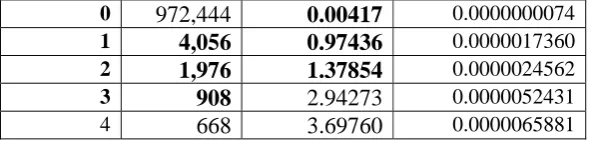
For instance, we had the counts after the first-round MI-based segmentation as showed in Table
3.
Table 3. Good-Turing estimates for unigrams: Adjusted frequencies and probabilities
r Nr r* PGT(
0 972,444 0.00417 0.0000000074
1 4,056 0.97436 0.0000017360
2 1,976 1.37854 0.0000024562
3 908 2.94273 0.0000052431
4 668 3.69760 0.0000065881
主, 耶和華 0.0018672506 0.0099990557 - 0.0000186707
主耶, 和華 0.0004775030 0.0007714881 - 0.0000003684
主耶和, 華 0.0000000074 0.0007198180 - 0.0000000000053
主, 耶和, 華 0.0018672506 0.0000017360 0.0007198180 0.0000000000023
Iterating between building N-gram and word segmentation. The improved word segmentation
obviously will bring about a better N-gram model for segmentation. Subsequently the improved
N-gram will help to produce segmentation results of higher accuracy. The process of
improvement usually converges quickly after a couple of iterations.
segmentation. The prototype illustrates:
z It is possible to achieve high-precision word segmentation for a sufficiently large corpus without a dictionary, rivaling human annotation.
z The heuristic MI-based approach by Sproat can be extended effective to handle word longer than two characters
z A more theorectically sound approach based on N-gram model and unsupervised learning based on EM-like algorithm can bring about higher performance than the heuristic approach based on mutual information.
z Unsupervised, self-organized word segmentation can provide an objective view of word segmentation. This should be considered as a quantitative, corpus-dependent method when setting up a segmentation standard or benchmark for word segmentation.
High-precision segmentation of Hanzi text can be achieved by unsupervised training on a
reasonably sized corpus. Unsupervised word segmentation represents an innovative way to
acquire lexical units in a large corpus based on lexical distributional regularity. Word
segmentation algorithm is standard Viterbi algorithm and is independent of N-gram trained on the
corpus, making it easy to change domains. The approach is useful in an indefinite number of
areas, and lends itself to customization for a particular user or task. For example, the results can
be used to prepare a concordance, as the first steps in many natural language processing systems
such as machine translation, information retrieval, or text-to-speech system. Finally, the model
explored here can be a basis for self-organized word segmentation and alignment of bilingual
Chinese-English corpus.
Acknowledgements
We acknowledge the support for this study through grants from Ministry of Education, Taiwan (MOE EX-91-E-FA06-4-4).
References
Church, K and P. Hank, "Word Association Norms, Mutual Information, and Lexicography," Computational Linguistics, 16:1, 1990, pp. 22-29.
Sproat, Chinese Word Segmentation, First International Conference on Language Resources & Evaluation: Proceedings, 1998, pp. 417— 420.
Richard Sproat, Chilin Shih, 1990, A statistical method for finding word boundaries in Chinese text. Computer Processing of Chinese & Oriental Languages, 4(4): 336-351.