O R I G I N A L R E S E A R C H
Analysis of two pheromone-responsive conjugative
multiresistance plasmids carrying the novel mobile
optrA
locus from
Enterococcus faecalis
This article was published in the following Dove Press journal: Infection and Drug Resistance
Yanhong Shang1,2,* Dexi Li2,*
Xinxin Shan2 Stefan Schwarz3 Su-Mei Zhang2 Yu-Xia Chen2 Wuqing Ouyang1 Xiang-Dang Du2
1Department of Basic Veterinary
Medicine, College of Veterinary Medicine, Northwest A&F University, Shaanxi 712100, People’s Republic of China; 2Department of Basic Veterinary
Medicine, College of Animal Science and Veterinary Medicine, Henan Agricultural University, Zhengzhou 450046, People’s Republic of China;3Institute of Microbiology and Epizootics, Centre for Infection Medicine, Department of Veterinary Medicine, Freie Universität Berlin, Berlin, Germany
*These authors contributed equally to this work
Background:The acquiredoptrAgene, which encodes a ribosomal protection protein of the
ABC-F family, can confer cross-resistance to linezolid and florfenicol, posing a serious therapeutic challenge to both human and veterinary medicine.
Purpose: The objective of this study was to investigate the twoEnterococcus faecalis(E.
faecalis) plasmids for their fine structure, their transferability and the presence of mobile antimicrobial resistance loci.
Methods:To elucidate theirfine structure, the two plasmids were completely sequenced and
the sequences analysed. Besides conjugation experiments, inverse PCR assays were con-ducted to see whether minicircles are produced from the mobile antimicrobial resistance loci.
Results:Two pheromone-responsive conjugativeoptrA-carrying plasmids fromE. faecalis,
pE211 and pE508 were identified, which can transfer with frequencies of 2.6 ×10⁻²and 3.7 ×10⁻²(transconjugant per donor), respectively. In both plasmids, optrAwas located on the novel mobileoptrAlocus with different sizes (12,834 bp in pE211 and 7,561 bp in pE508, respectively),flanked by two copies of IS1216genes in the same orientation. Inverse PCR revealed that circular forms can be generated, consisting ofoptrAand one copy of IS1216, indicating they are all active. The 77,562 bp plasmid pE211 also carried Tn558and a mobile
bcrABDR locus, and the 84,468 bp plasmid pE508 also harbored the genesfexA,tet(L),tet
(O/W/32/O) and a mobileaac(A)-aph(D) locus.
Conclusion: The presence of mobile genetic elements in these plasmids renders them
flexible and these elements will aid to the persistence and dissemination of these plasmids among enterococci and potentially also other gram-positive bacteria.
Keywords:enterococci, resistance, IS1216, conjugation, mobile genetic elements
Introduction
Linezolid and florfenicol are both important antimicrobial agents. Linezolid is approved in human medicine and usually used as a last resort antimicrobial agent to treat infections caused by methicillin-resistant Staphylococcus aureus (MRSA) and vancomycin-resistant enterococci (VRE).1Florfenicol is approved exclusively for food-producing animals, where it is mainly used for the control of respiratory tract infections.2However, the acquired cross-resistance to linezolid andflorfenicol has emerged during the past decade.3–5
Currently, at least three different groups of acquired resistance genes which confer cross-resistance to linezolid andflorfenicol have been identified. These includecfr, optrA
andpoxtA.3–5Among them, theoptrAgene encodes a ribosomal protection protein of the Correspondence: Xiang-Dang Du
Department of Basic Veterinary Medicine, College of Animal Science and Veterinary Medicine, Henau Agricultural University, No. 15 Longzihu, Zhengzhou 450046, People’s Republic of China
Tel +86 371 55369208 Email [email protected]
Wuqing Ouyang
Department of Basic Veterinary Medicine, College of Veterinary Medicine, Northwest A&F Universtiy, No. 3 Taicheng Road, Shaanxi 712100, People’s Republic of China
Tel +86 029 87091201 Email [email protected]
Infection and Drug Resistance
Dove
press
open access to scientific and medical research
Open Access Full Text Article
Infection and Drug Resistance downloaded from https://www.dovepress.com/ by 118.70.13.36 on 22-Aug-2020
ABC-F family.6It wasfirst found inEnterococcus faecalisand
Enterococcus faecium,4but has also been detected meanwhile in various Gram-positive bacteria.7,8
In this study, two pheromone-responsive conjugative plas-mids harboringoptrAalong with other resistance genes were analyzed to elucidate the basis for co-selection and dissemina-tion. Furthermore, two novel mobileoptrAloci in these plas-mids were identified.
Materials and methods
Bacterial strains and antimicrobial
susceptibility testing
Two optrA-positive E. faecalis strains (E211–ST59 and
E508–ST256) were identified from fecal samples of swine in Henan Province, China during a routine survey in 2015. Antimicrobial susceptibility testing was per-formed by broth microdilution according to the recom-mendations given in document M100 (28th ed.) of the Clinical and Laboratory Standards Institute (CLSI).9 S.
aureusATCC 29213 served as the quality control strain.
PCR analysis
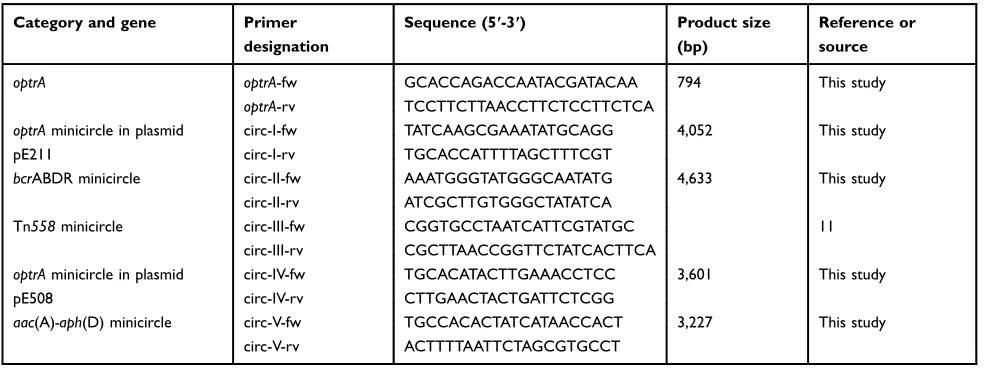
The presence of theoptrAgene was detected by PCR using the primers listed inTable 1. TheoptrA-carrying plasmid pE349 was used as the positive control.4The presence of the circular intermediate was detected by inverse PCR using the primers listed in Table 1. All the PCR products were subjected to Sanger sequencing.
Transfer experiments
To investigate the transferability of theoptrAgene, these two
E. faecalisstrains were used in conjugation experiments with
E. faecalis JH2-2 (rifampicin resistant) as the recipient.10 Transfer frequency is expressed as transconjugant per donor. Colonies that grew on the selective plates supplemented with 50 mg/L rifampin and 10 mg/Lflorfenicol after incubation for 16–24 h at 37°C were further confirmed by antimicrobial susceptibility testing and multilocus sequence typing (MLST) following harmonized protocols (http://www.mlst.net/).
Sequencing and analysis
Whole genome DNA of two optrA-positive transconju-gants E211-T1 and E508-T1 was sequenced by the PacBio RS and Illumina MiSeq platforms. The sequences from PacBio sequencing reads were de-novo assembled and corrected by Illumina MiSeq with pilon. Glimmer 3.02 was used to predict open reading frames (ORFs) and the software blast was used to annotate those ORFs. The sequences determined had been deposited in GenBank under accession numbers MK425644 (pE211) and MK425645 (pE508), respectively.
Results and discussion
The
optrA
gene in
E. faecalis
is transferable
The conjugation experiments indicated that these twoE.faecalis strains (E211–ST59 and E508–ST256) could
transferflorfenicol resistance to the recipient E. faecalis
JH2-2 (ST8) at high transfer frequencies, of 2.6×10⁻²
for E. faecalis E211 and 3.7×10⁻² for E. faecalis E508
(transconjugant per donor), respectively. Two transcon-jugants which were confirmed to share the same back-ground with the recipient (ST8), designated E211-T1 and E508-T1, respectively, were selected for further
Table 1PCR primers used in this study
Category and gene Primer
designation
Sequence (5ʹ-3ʹ) Product size (bp)
Reference or source
optrA optrA-fw GCACCAGACCAATACGATACAA 794 This study
optrA-rv TCCTTCTTAACCTTCTCCTTCTCA
optrAminicircle in plasmid pE211
circ-I-fw TATCAAGCGAAATATGCAGG 4,052 This study
circ-I-rv TGCACCATTTTAGCTTTCGT
bcrABDR minicircle circ-II-fw AAATGGGTATGGGCAATATG 4,633 This study
circ-II-rv ATCGCTTGTGGGCTATATCA
Tn558minicircle circ-III-fw CGGTGCCTAATCATTCGTATGC 11
circ-III-rv CGCTTAACCGGTTCTATCACTTCA
optrAminicircle in plasmid pE508
circ-IV-fw TGCACATACTTGAAACCTCC 3,601 This study
circ-IV-rv CTTGAACTACTGATTCTCGG
aac(A)-aph(D) minicircle circ-V-fw TGCCACACTATCATAACCACT 3,227 This study
circ-V-rv ACTTTTAATTCTAGCGTGCCT
Infection and Drug Resistance downloaded from https://www.dovepress.com/ by 118.70.13.36 on 22-Aug-2020
studies. Sequencing and sequence analysis identified two conjugative optrA-carrying plasmids, designated pE211 and pE508, which were derived from E211-T1 and E508-T1, respectively. The conjugative transfer region in both plasmids pE211 and pE508 displayed the great-est similarity with that in plasmid pTW9, which has key conjugative properties of pheromone-responsive plas-mids, such as aggregation substance (As). In combina-tion with with their high transfer frequencies, these two plasmids (pE211 and pE508) can be classified as pher-omone-responsive conjugative plasmids. MICs of the
two E. faecalis strains, their transconjugants and the
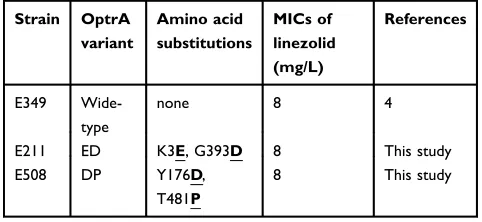
recipient strain are shown in Table 2. After transfer, the transconjugants displayed elevated MICs to the respective antimicrobial agents, including florfenicol, linezolid and bacitracin in E211-T1, and florfenicol, linezolid, gentamicin and tetracycline in E508-T1. As shown in Table 3, although there are few amino acid substitutions, the linezolid resistance that the OptrA variants in E. faecalis E211 or E508 confer remains the same with the OptrA prototype inE. faecalis E349.4
Both plasmids pE211 and pE508 have a
novel mobile
optrA
locus
The IS1216-flankedoptrAlocus in plasmid pE211 consisted of the transcriptional regulator genearaC, theoptrAgene and
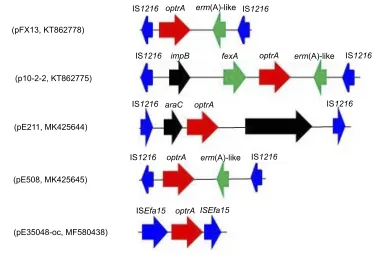
a restriction endonuclease gene (MGE1 inFigure 1A, 12,834 bp), while that in plasmid pE508 carried theoptrAgene and a truncatederm(A)-like gene (MGE3 inFigure 1B, 7,561 bp). In both plasmids,optrAwasflanked by two copies of IS1216
genes located in the same orientation, forming a novel locus, which was different from that described in previous studies (Figure 2).11,12In both cases, the two IS1216elements can recombine and“loop out”a circular intermediate, which can then integrate either into plasmids or in the chromosomal DNA by recombination with another IS1216copy. Via this way, theoptrAgene can move between different chromoso-mal and plasmidic locations. Iffinally integrated into a con-jugative plasmid or ICE, it can move with this element across strain, species or even genus boundaries. To investigate whether circular intermediates were present, inverse PCR assays using the primers listed inTable 1were conducted and the results showed that circular intermediates of different sizes (4,052 bp in plasmid pE211 and 3,601 bp in plasmid pE508) were formed in these strains. Sequence analysis of these circular intermediates confirmed that they contained one copy of the IS1216element and the sequence that was formerly located between the two IS1216elements, includ-ingoptrA.
The IS1216-like elements have also been reported to be associated with the vancomycin resistance VanA gene cluster in E. faecium,13 the multidrug resistance genes poxtA, optrA and cfr in enterococci and staphylococci,5,11,14 the macrolide-lincosamide-strepto-gramin B resistance geneserm(B) and erm(T) in enter-ococci and streptococci,15,16 and the tetracycline resistance gene tet(S) in Streptococcus infantis.17 These observations, along with multiple MGEs (MGE1-MGE4) associating with IS1216 elements found in this study, suggest that the IS1216-like ele-ments could play an important role in dissemination of the respective antimicrobial resistance genes among various Gram-positive organisms.
Table 2The antimicrobial susceptibilities of the wild-type strains, transconjugants, and recipient strains in this study
Strains MICs(mg/L)a
FFC LZD BAC GEN TET
E211 128 8 128 >128 128
E211-T1b 128 8 128 8 1
E508 128 8 4 >128 128
E508-T1b 128 8 2 >128 64
JH2-2 4 2 2 8 1
Notes:a
FFC,florfenicol; LZD, linezolid; TET, tetracycline; GEN, gentamicin; BAC, bacitracin.b
The transconjugants E211-T1 and E508-T1 were derived from matings betweenE. faecalisstrains E211/E508 and JH2-2, respectively.
Table 3Comparison the difference of OptrA variants and MICs
with wide-type strain
Strain OptrA variant
Amino acid substitutions
MICs of linezolid (mg/L)
References
E349 Wide-type
none 8 4
E211 ED K3E, G393D 8 This study
E508 DP Y176D,
T481P
8 This study
Infection and Drug Resistance downloaded from https://www.dovepress.com/ by 118.70.13.36 on 22-Aug-2020
MGE2 MGE3
MGE4 Tn
558
MGEI
77000
A
B
80000
IS1216 IS1216
IS1216
IS1216
IS1216 IS256
optrA
tet(O/W/32/O) tet(L)
repA
fexA
traB parA repA traC
seaI prgB
chap
aac(A)-aph(D) 72000
8000
16000
24000
32000
40000 48000
64000
6000 7000
ISenfal
pE211,
77, 562bp pE508,
84, 468bp ISenfal
traA
repA res
Is1216
Is1216
Is1216 fexA
tnpC
araC asal
chap
ssb
tnpB tnpA
optrA bcrABDR
70000
63000
56000
49000
42000 35000
Transposition
Antimicrobial resistance
Other function
Hypothetical protein
Transposition
Antimicrobial resistance
Other function
Hypothetical protein 28000
21000 14000
Figure 1The structure of two pheromone-responsive conjugative multiresistant plasmids carrying a mobileoptrAlocus fromE. faecalisin this study (A) The structure of the plasmid pE211. The positions of two mobile elements (MGE1 and MGE2), and Tn558were indicated in bold vertical lines and arrows outside the plasmid, (B) The structure of the plasmid pE508. The positions of two mobile elements (MGE3 and MGE4) were indicated in bold vertical lines and arrows outside the plasmid. The circles display (from the outside to inside): (i) the size scale in bp; (ii) the positions of predicted coding sequences transcribed in the clockwise orientation; (iii) the positions of predicted coding sequences transcribed in the counterclockwise orientation; (iv) the GC content plotted against 50%, with orange indicating >50% and purple indicating <50%; and (v) GC skew [(G-C)/(G+C)] in a 10,000 bp window. Genes are colour-coded, depending on functional annotations: blue, transposition; red, antimicrobial resistance; green, other function; gray, hypothetical protein.
(pFX13, KT862778)
(p10-2-2, KT862775)
(pE211, MK425644)
(pE508, MK425645)
(pE35048-oc, MF580438)
IS1216
IS1216
IS1216
IS1216
ISEfa15 optrA optrA
optrA
optrA
fexA optrA erm(A)-like
erm(A)-like
erm(A)-like
IS1216
IS1216
IS1216
IS1216
araC impB
ISEfa15
Figure 2The environment of theoptrAgene in different plasmids.
Infection and Drug Resistance downloaded from https://www.dovepress.com/ by 118.70.13.36 on 22-Aug-2020
T able 4 Coding sequences of the plasmid pE211 CDS no . CDS Nucleotide position (5 ʹ → 3 ʹ ) Pr otein length (aa) Database match (Size and accession no .) aa identify (%) 1 repA 1 – 1008 335 replication initiator pr otein A, Enter ococcus faecal is (335aa, WP_002382056.1) 99.7% (334/335) 2 orf 1358 – 2305 315 A TPase, Enterococcus faecalis (315aa, WP_025192929.1) 99.7% (314/315) 3 orf 4303 – 4971 222 CPBP family intramembrane metallopr otease, Enterococcus faecalis (222aa, WP_002403283.1) 99.5% (221/222) 4 orf 6038 – 6658 206 resolvase , N-terminal domain pr otein, Enterococcus faecalis (211aa, EFU10278.1) 97.6% (206/211) 5I S 1216 6830 – 7516 232 IS 6 -lik e element IS 1216 family transposase, Enterococcus faecium (232aa, WP_014748744.1) 100.0% (232/232) 6 fe xA 8026 – 9453 475aa chloramphenicol/ fl orfenicol ef fl ux MFS transporter F exA, Enterococcus faecalis (475aa, WP_078122474.1) 100.0% (475/475) 7 orf138 9631 – 10,047 138 putative o xidore ductase, Staph ylococcus sapr oph yticus (138aa, A VE17237.1) 100.0% (138/138) 8 tnpC 10,330 – 10,695 121 T ransposase C , Staph ylococcus aureus (121aa, YP_007878373.1) 100.0% (121/121) 9 tnpB 10,697 – 12,616 639 T ransposase B, Staph ylococcus cohnii (639aa, AEP69225.1) 100.0% (639/639) 10 tnpA 12,613 – 13,698 361 T ransposase A, Staph ylococcus epidermidis (361aa, AJW29167.1) 100.0% (361/361) 11 orf 15,103 – 15,726 207 resolvase helix-turn-helix pr otein, Enterococcus faecium (207aa, ADO66759.1) 100.0% (207/207) 12 IS 1216E 17,617 – 18,297 226 IS 6 -lik e element IS 1216 family transposase, Enterococcus faecium (226aa, YP_006937527.1) 100.0% (226/226) 13 ar aC 18,886 – 20,040 384 AraC family transcriptional regulator , Enter ococcus faec alis (384aa, AMM74624.1) 100.0% (383/384) 14 optrA 20,371 – 22,338 655 A B C-F ty p e ri b o so m al p rot e ct ion p ro te in O p tr A , En te roc oc cus fa ec al is (6 55a a, WP _ 078122 475. 1) 99.7% (653/655) 15 orf 23,967 – 28,367 1466 restriction endonuclease, Enter ococcaceae bacterium (1466aa, QBA9 9712.1) 100.0% (1466/1466) 16 IS 1216E 29,642 – 30,322 226 IS 6 -lik e element IS 1216 family transposase, Enterococcus faecium (226aa, YP_006937527.1) 100.0% (226/226) 17 hp 30,735 – 31,376 213 Hypothetical pr otein, Enterococcus faecalis (213aa, AEF32577.1) 100.0% (213/213) 18 hp 31,758 – 33,086 442 Hypothetical pr otein, Enterococcus faecalis (442aa, AEF32578.1) 99.8% (441/442) 19 orf 33,195 – 34,076 293 DNA nuclease, Enterococcus faecalis (293aa, AEF32579.1) 100.0% (293/293) 20 hp 34,048 – 34,491 147 Hypothetical pr otein, Enterococcus faecalis (147aa, AEF32580.1) 100.0% (147/147) 21 hp 34,705 – 35,541 278 Hypothetical pr otein, Enterococcus faecalis (278aa, WP_127341853.1) 99.6% (277/278) 22 ssb 36,916 – 37,392 158 Single-strand binding pr otein, Enter ococcus faec alis (158aa, NP_816947.1) 100.0% (158/158) 23 hp 37,532 – 38,872 446 Hypothetical pr otein, Enterococcus faecalis (446aa, WP_080008653.1) 99.6% (444/446) 24 hp 38,863 – 39,639 258 Hypothetical pr otein, Enterococcus faecalis (258aa, YP_004032980.1) 100.0% (258/258) 25 orf 47,434 – 49,998 846 T ype VI secretion pr otein, Enter ococcus faecali s (846aa, OIU90382.1) 99.8% (844/846) 26 orf 51,750 – 52,784 344 Conjugal transfer pr otein, Enterococcus faecalis (344aa, WP_002387763.1) 100.0% (344/344) 27 chap 54,111 – 55,382 423 CHAP domain-containing pr otein, Enterococcus faecalis (423aa, WP_010711028.1) 100.0% (423/423) 28 hp 56,288 – 57,166 292 Hypothetical pr otein, Enterococcus faecalis (292aa, NP_816968.1) 100.0% (292/292) 29 asa1 58,328 – 62,218 1296 aggre gation substance, Enter ococcaceae bacterium (1296aa, QBA99 726.1) 100.0% (1296/1296) 30 orf 63,454 – 66,174 906 LPXTG-motif cell wall anchor domain pr otein, Enter ococcus faecalis (906aa, EFM78589.1) 100.0% (906/906) 31 tr aA 68,199 – 69,158 319 Conjugal transfer pr otein T raA, Enterococcus faecalis (319aa, NP_816935.1) 100.0% (319/319) 32 IS Enf a1 69,902 – 70,582 226 IS Enf a1 family transposase, Staphy lococcus aureus (226aa, WP_000191454.1) 100.0% (226/226) 33 bcrD 70,779 – 71,609 276 Undecapr eny l-diphosphatase , Enterococcus faecalis (276aa, A O X48039.1) 100.0% (276/276) 34 bcrB 71,609 – 72,310 249 bacitracin ABC transporte r permease, Enter ococcus faecali s (249aa, WP_129343483.1) 100.0% (249/249) 35 bcrA 72,351 – 73,268 305 b aci tr aci n A B C tr an sp or te r, A TP -b in d in g p ro te in B cr A , Ente ro co cc us fae cal is (305a a, A Q L 5 5357. 1) 100.0% (305/305) 36 bcrR 73,451 – 74,065 204 XRE family transcriptional regulator , Enter ococcus faec alis (204aa, AXG90118.1) 100.0% (204/204) 37 IS Enf a1 74,621 – 75,301 226 IS Enf a1 family transposase, Staphy lococcus aureus (226aa, WP_000191454.1) 100.0% (226/226) Abbre viations: hp , h ypothetical pr otein; aa, amino acids.
Infection and Drug Resistance downloaded from https://www.dovepress.com/ by 118.70.13.36 on 22-Aug-2020
T able 5 Coding sequences of plasmid pE508 CDS no . CDS Nucleotide position (5 ʹ → 3 ʹ ) Pr otein length (aa) Database match (Siz e and accession no .) aa identify (%) 1 hp 140 – 1600 486 Hypothetical pr otein, Enter ococcus faecali s (486aa, WP_126254905.1) 100.0%(486/486) 2 hp 3025 – 3753 242 Hypothetical pr otein, Enter ococcus faecali s (242aa, WP_126266300.1) 100.0% (242/242) 3 orf 10,688 – 11,188 166 DnaJ domain-containing pr otein, partial, Enterococcus faecalis (173aa, EOH11044.1) 95.4% (165/173) 4 orf 12,574 – 13,359 261 ArsR family transcriptional regulator , Enter ococcus faec alis (261aa, WP_002387611.1) 100.0% (261/261) 5 hp 14,217 – 16,430 737 h ypothetical pr otein, Enterococcus faecalis (737aa, ETJ10394.1) 99.3% (732/737) 6 hp 16,417 – 18,579 720 h ypothetical pr otein, Enterococcus faecalis (720aa, WP_087548822.1) 100.0% (720/720) 7 orf 19,135 – 21,627 830 type VI secretion pr otein, Enter ococcus faecali s (846aa, OIU90382.1) 98.1% (830/846) 8 orf 23,001 – 24,035 344 conjugal transfer pr otein, Enter ococcus faecali s (344aa, WP_010774162.1) 99.7% (343/344) 9 hp 24,742 – 25,359 205 Hypothetical pr otein, Enter ococcus faecali s (205aa, WP_033786897.1) 99.5% (204/205) 10 chap 25,362 – 26,633 423 CHAP domain pr otein, Enter ococcus faecal is (423aa, EFU06796.1) 100.0% (423/423) 11 hp 27,539 – 28,417 292 Hypothetical pr otein, Enter ococcus faecali s (292aa, WP_002405612.1) 100.0% (292/292) 12 prgB 29,580 – 33,497 1305 L P X T G ce ll w al la n ch o r d o m ai n -c o n ta in in g p ro te in , Ent erococc us fa ec alis (1 3 0 5 aa ,W P _ 0 1 0 8 1 9 0 5 8 .1 ) 99.6% (1300/1305) 13 seal 34,280 – 37,003 907 Surface exclusion pr otein, Enter ococcaceae bacterium (907aa, QBA99747.1) 100.0% (907/907) 14 tr aC 39,968 – 41,557 529 T raC pr otein, Enterococcus faecalis (529aa, EOK37046.1) 99.4% (526/529) 15 tr aB 41,607 – 42,764 385 T raB/GumN family pr otein, Enter ococcus faecalis (385aa, WP_010717212.1) 100.0% (385/385) 16 repA2 42,934 – 43,944 336 replication initiator pr otein A, Enterococcus faecalis (336aa, WP_010774283.1) 100.0% (336/336) 17 parA 44,553 – 45,335 260 ParA family pr otein, Enter ococcus faecalis (260aa, WP_010783395.1) 100.0% (260/260) 18 orf 46,984 – 48,300 438 Y-family DNA polymerase, Enterococcus faecalis (438aa, WP_126262290.1) 100.0% (438/438) 19 hp 48,617 – 50,647 669 Hypothetical pr otein, Enter ococcus faecali s (669aa, WP_010829996.1) 99.2% (664/669) 20 IS 1216 52,601 – 53,287 228 IS 1216 family transposase, Enterococcus faecalis (228aa, WP_080114306.1) 100.0% (228/228) 21 IS 256 53,912 – 55,084 390 IS 256 transposase, Staphy lococcus aureus (390aa, C AL22896.1) 99.7% (389/390) 22 aac (A) -aph (D) 55,214 – 56,653 479 bifunctional aminoglycoside N-acetyltransferase/aminoglycoside phosphotransferase , Staph ylococcus cohnii plasmid (479aa, YP_009090128.1) 100.0% (479/479) 23 IS 1216 57,683 – 58,369 228 IS 1216 family transposase, Enterococcus faecalis (228aa, WP_080114306.1) 100.0% (228/228) 24 fe xA 60,449 – 61,876 475 Florfenicol/chloramphenicol exporter , Staphy lococcus lentus (475aa, WP_032495681.1) 99.8% (474/475) 25 hp 63,385 – 63,990 201 Hypothetical pr otein, Enter ococcus faecali s (201aa, O XC92628.1) 100.0% (201/201) 26 hp 65,562 – 66,395 277 GIY -YIG nuclease family pr otein, Lactococcus lactis (277aa, WP_060416607.1) 99.6% (276/277) 27 repA 68,095 – 69,273 392 Replication initiator pr otein, Enterococcaceae bacterium (392aa, QBA99761.1) 100.0% (392/392) 28 IS 1216 70,722 – 71,408 228 IS 1216 family transposase, Enterococcus faecalis (228aa, WP_080114306.1) 100.0% (228/228) 29 tet (L) 71,967 – 73,343 458 tetracycline ef fl ux MFS transporter T et(L), Streptococcus uberis (458aa, WP_037627686.1) 99.8% (457/458) 30 tet (O/W/32/ O) 74,006 – 75,925 639 tetracycline resistance ribosomal pr otection pr otein, Streptococcus suis (639aa, RRN51891.1) 100.0% (639/639) 31 IS 1216 76,939 – 77,619 228 IS 6 -lik e element IS 1216 family transposase, Enterococcus faecalis (228aa, WP_080114306.1) 100.0% (228/228) 32 optrA 78,123 – 80,090 655 ABC-F type ribosomal pr otection pr otein OptrA, Lactobacillales (655aa, WP_099809080.1) 99.8% (654/655) 33 erm (A)-lik e 81,507 – 82,238 242 23S rRNA (adenine(2058)-N(6))-meth yltransferase Erm(A), Lactobacillus salivarius (242aa, WP_086201761.1) 100.0% (242/242) 34 IS 1216 83,691 – 84,377 228 IS 6 -lik e element IS 1216 family transposase, Enterococcus faecalis (228aa, WP_080114306.1) 100.0% (228/228) Abbre viations: hp , h ypothetical pr otein; aa, amino acids.
Infection and Drug Resistance downloaded from https://www.dovepress.com/ by 118.70.13.36 on 22-Aug-2020
The analysis of the genetic context of
optrA
in plasmids pE211 and pE508
As shown inFigure 1AandTable 4, the 77,562 bp plasmid pE211 harbored the phenicol/oxazolidinone resistance
gene optrA, the TN558- associated phenicol resistance
gene fexA, and the mobile bacitracin resistance operon
bcrABDR (Mobile Genetic Element, MGE2, 5,527 bp). The fexA-carrying transposon Tn558has previously been described on plasmids in Staphylococcus lentus,
Staphylococcus cohnii, and Enterococcus spp.11,18,19
Here, it is present on plasmid pE211 in E. faecalis. The MGE2 consisting of the bcrABDR operon confers resis-tance to bacitracin. Thebcrlocus wasflanked by ISEnfa1
elements as previously described in E. faecalis or
Clostridium perfringens.20,21 Here, it is present on the plasmid pE211 inE. faecalis.
As shown inFigure 1BandTable 5, the 84,468 bp plasmid pE508 harbored the phenicol/oxazolidinone resistance gene
optrA, the phenicol resistance genefexA, the mobile bifunc-tional aminoglycoside resistance gene aac(A)-aph(D) locus (MGE4, 5,891 bp), and the tetracycline resistance genes tet
(L) andtet(O/W/32/O). The aminoglycoside resistance gene
aac(A)-aph(D) is usually located on the transposon Tn4001
from staphylococci, Tn5281from enterococci or Tn3706from streptococci. Together with other resistance genes, it can also be located on the transposons Tn924, Tn5384or Tn5385from
E. faecalis.22In this study, to the best of our knowledge, it was for the first time seen thataac(A)-aph(D) isflanked by two copies of IS1216elements located in the same orientation on the plasmid pE508 fromE. faecalis.
The presence of the circular intermediates in MGE2 and MGE4 were detected by inverse PCR (Table 2) and further sequence analysis indicated that both MGEs are active. However, the Tn558locus is apparently not active as no circular intermediates were detectable.
Conclusion
Two pheromone-responsive conjugative multiresistance plasmids carrying the novel optrA locus from E. faecalis
were identified, with one plasmid (pE211) harbouring a mobile bcrABDR locus, and the other (pE508) a mobile
aac(A)-aph(D) locus. All these mobile locus were active due to the presence of the minicircles. The presence of MGEs in these plasmids renders them flexible and these elements will aid to the persistence and dissemination of these plasmids among enterococci and potentially also other Gram-positive bacteria.
Acknowledgments
We thank Don B. Clewell (University of Michigan) for providing E. faecalis reference strain JH2-2. This work was supported by grants from the National Natural Science Foundation of China (No. U1604103, U1704108 and 31472239), the Program for Innovative Research Team (in Science and Technology) in University of Henan Province (No. 18IRTSTHN020) and the German Federal Ministry of Education and Research (BMBF) under pro-ject number 01KI1727D as part of the Research Network Zoonotic Infectious Diseases.
Disclosure
The authors report no conflicts of interest in this work.
References
1. Hashemian SMR, Farhadi T, Ganjparvar M. Linezolid: a review of its properties, function, and use in critical care.Drug Des Devel Ther.
2018;12:1759–1767. doi:10.2147/DDDT.S164515
2. El Garch F, de Jong A, Simjee S, et al. Monitoring of antimicrobial susceptibility of respiratory tract pathogens isolated from diseased cattle and pigs across Europe, 2009-2012: VetPath results. Vet Microbiol.2016;194:11–22. doi:10.1016/j.vetmic.2016.04.009 3. Schwarz S, Werckenthin C, Kehrenberg C. Identification of a
plas-mid-borne chloramphenicol-florfenicol resistance gene in Staphylococcus sciuri. Antimicrob Agents Chemother.
2000;44:2530–2533. doi:10.1128/aac.44.9.2530-2533.2000 4. Wang Y, Lv Y, Cai J, et al. A novel gene, optrA, that confers
transferable resistance to oxazolidinones and phenicols and its pre-sence inEnterococcus faecalisandEnterococcus faeciumof human and animal origin. J Antimicrob Chemother. 2015;70:2182–2190. doi:10.1093/jac/dkv116
5. Antonelli A, D’Andrea MM, Brenciani A, et al. Characterization of poxtA, a novel phenicol-oxazolidinone-tetracycline resistance gene from an MRSA of clinical origin. J Antimicrob Chemother.
2018;73:1763–1769. doi:10.1093/jac/dky088
6. Sharkey LK, Edwards TA, O’Neill AJ. ABC-F proteins mediate antibiotic resistance through ribosomal protection. MBio. 2016;7: e01975. doi:10.1128/mBio.01975-15
7. Fan R, Li D, Feßler AT, Wu C, Schwarz S, Wang Y. Distribution of optrAandcfrinflorfenicol-resistantStaphylococcus sciuriof pig origin. Vet Microbiol.2017;210:43–48. doi:10.1016/j.vetmic.2017.07.030 8. Huang J, Chen L, Wu Z, Wang L. Retrospective analysis of genome
sequences revealed the wide dissemination ofoptrAin Gram-positive bacteria.J Antimicrob Chemother.2017;72:614–616. doi:10.1093/jac/ dkw488
9. CLSI. Performance Standards for Antimicrobial Susceptibility Testing. 28th ed. CLSI Supplement M100. Wayne, PA: Clinical and Laboratory Standards Institute; 2018.
10. Huys G, D’Haene K, Collard JM, et al. Prevalence and molecular characterization of tetracycline resistance in Enterococcus isolates from food.Appl Environ Microb.2004;70:1555–1562. doi:10.1128/ AEM.70.3.1555-1562.2004
11. He T, Shen Y, Schwarz S, et al. Genetic environment of the transferable oxazolidinone/phenicol resistance gene optrA in Enterococcus faecalis isolates of human and animal origin. J Antimicrob Chemother. 2016;71:1466–1473. doi:10.1093/jac/ dkw016
Infection and Drug Resistance downloaded from https://www.dovepress.com/ by 118.70.13.36 on 22-Aug-2020
12. Morroni G, Brenciani A, Antonelli A, et al. Characterization of a multiresistance plasmid carrying theoptrA andcfrresistance genes from an Enterococcus faecium clinical isolate. Front Microbiol.
2018;9:2189. doi:10.3389/fmicb.2018.02189
13. Darini AL, Palepou MF, Woodford N. Effects of the movement of insertion sequences on the structure ofVanAglycopeptide resistance elements in Enterococcus faecium. Antimicrob Agents Chemother.
2000;44:1362–1364. doi:10.1128/aac.44.5.1362-1364.2000
14. Liu Y, Wang Y, Schwarz S, et al. Transferable multiresistance plasmids carryingcfrinEnterococcus spp. from swine and farm environment. Antimicrob Agents Chemother. 2013;57:42–48. doi:10.1128/ AAC.01605-12
15. Raze D, Dardenne O, Hallut S, Martinez-Bueno M, Coyette J, Ghuysen JM. The gene encoding the low-affinity penicillin-binding protein 3r inEnterococcus hiraeS185R is borne on a plasmid carry-ing other antibiotic resistance determinants. Antimicrob Agents Chemother.1998;42:534–539.
16. Tsai JC, Hsueh PR, Chen HJ, Tseng S-P, Chen P-Y, Teng L-J. The erm(T) gene is flanked by IS1216V in inducible erythromycin-resistant Streptococcus gallolyticus subsp. pasteurianus. Antimicrob Agents Chemother. 2005;49:4347–4350. doi:10.1128/ AAC.49.10.4347-4350.2005
17. Ciric L, Brouwer MS, Mullany P, Roberts AP. Minocycline resistance in an oralStreptococcus infantis isolate is encoded by tet(S) on a novel small, low copy number plasmid. FEMS Microbiol Lett.
2014;353:106–115. doi:10.1111/1574-6968.12410
18. Kehrenberg C, Schwarz S. Florfenicol-chloramphenicol exporter genefexAis part of the novel transposon Tn558.Antimicrob Agents Chemother.2005;49:813–815. doi:10.1128/AAC.49.2.813-815.2005 19. Wang Y, Zhang W, Wang J, et al. Distribution of the multidrug
resistance gene cfr in Staphylococcus species isolates from swine farms in China.Antimicrob Agents Chemother.2012;56:1485–1490. doi:10.1128/AAC.05827-11
20. Wang XM, Li XS, Wang YB, et al. Characterization of a multidrug resistance plasmid fromEnterococcus faeciumthat harbours a mobi-lized bcrABDR locus. J Antimicrob Chemother. 2015;70:609–611. doi:10.1093/jac/dku416
21. Charlebois A, Jalbert LA, Harel J, Masson L, Archambault M, Tse H. Characterization of genes encoding for acquired bacitracin resistance in Clostridium perfringens.PLoS One.2012;7:e44449. doi:10.1371/journal. pone.0044449
22. Hegstad K, Mikalsen T, Coque TM, Werner G, Sundsfjord A. Mobile genetic elements and their contribution to the emergence of antimi-crobial resistant Enterococcus faecalis and Enterococcus faecium. Clin Microbiol Infect. 2010;16:541–554. doi:10.1111/j.1469-0691.2010.03226.x
Infection and Drug Resistance
Dove
press
Publish your work in this journal
Infection and Drug Resistance is an international, peer-reviewed open-access journal that focuses on the optimal treatment of infection (bacterial, fungal and viral) and the development and institution of preventive strategies to minimize the development and spread of resis-tance. The journal is specifically concerned with the epidemiology of
antibiotic resistance and the mechanisms of resistance development and diffusion in both hospitals and the community. The manuscript manage-ment system is completely online and includes a very quick and fair peer-review system, which is all easy to use. Visit http://www.dovepress.com/ testimonials.php to read real quotes from published authors.
Submit your manuscript here:https://www.dovepress.com/infection-and-drug-resistance-journal
Infection and Drug Resistance downloaded from https://www.dovepress.com/ by 118.70.13.36 on 22-Aug-2020