DEVELOPMENT OF SMART ACCESS AND TRACKING OF INFORMATION RESOURCES (SMART LIBRARY) SYSTEM USING RADIO FREQUENCY
IDENTIFICATION (RFID) TECHNOLOGY
HASMA KHAIRUL NISAK BINTI HARUN
DEVELOPMENT OF SMART ACCESS AND TRACKING OF INFORMATION RESOURCES (SMART LIBRARY) SYSTEM
USING RADIO FREQUENCY IDENTIFICATION (RFID) TECHNOLOGY
HASMA KHAIRUL NISAK BINTI HARUN
A project report submitted in partial fulfilment of the requirements for the award of the degree of
Master of Science (Computer Science - Real Time Software Engineering)
Center of Advanced Software Engineering (CASE) Faculty of Computer Science and Information System
Universiti Teknologi Malaysia
iii
DEDICATION
iv
ACKNOWLEDGEMENTS
Special thanks to my academic mentor, Mr. Azri Azmi for his encouragement, guidance and suggestions for improvement in completing my project and dissertation. Thanks to all the lecturers in the CASE for transferring vast knowledge and best education, hence upgrading my technical capabilities in the field.
Recognition is also given to my industrial mentor, Dr. Wan Sazaley Wan Ismail for the highest management support and professional expertise in ensuring the project is a success as well as monitoring it to be aligned with the organisation's objectives and concerns.
Deepest and never ending appreciations are contributed to my parents for giving me a strong upbringing and a world of opportunities, and also to my family for their constant motivational advices and amazing companions.
v
ABSTRACT
vi
ABSTRAK
vii
TABLE OF CONTENTS
CHAPTER TITLE PAGE
DECLARATION ii
DEDICATION iii
ACKNOWLEDGEMENTS iv
ABSTRACT v
ABSTRAK vi
TABLE OF CONTENTS vii
LIST OF TABLES xi
LIST OF FIGURES xii
LIST OF SYMBOLS xiv
LIST OF APPENDICES xv
1 INTRODUCTION 1
1.1 Overview 1
1.2 Company Background 4
1.3 Company Structure 5
1.4 Core Functions and Businesses 5
1.4.1 Electronics and Intelligent System Development
Programme (EISDP) 6
1.4.2 Industrial Automation and Robotics Programme (IARP) 6 1.4.3 National CAD/CAM Programme (NCCP) 7
1.5 Background of the Problem 7
1.6 Importance of the Project 10
1.7 Chapter Summary 11
2 PROJECT OVERVIEW 12
viii
2.2 Project Visions 13
2.3 Project Scopes 14
2.4 Project Deliverables 15
2.5 Project Schedule 15
2.6 Chapter Summary 15
3 LITERATURE REVIEW 16
3.1 Introduction 16
3.2 Background Study of Existing System 17 3.3 Overview of Existing Library Management System 19 3.3.1 Basic Components in Existing System 20
3.3.2 System Modules 21
3.3.3 Cataloguing 22
3.3.4 Circulation 23
3.3.5 Acquisitions 23
3.3.6 Administration 24
3.3.7 Reports 24
3.3.8 Online Patron Access Catalogue (OPAC) 25 3.3.9 Problems in Existing System 25
3.4 Proposed Solution 26
3.5 Background of RFID Technology 28
3.5.1 Introduction 28
3.5.2 What is RFID? 31
3.5.3 Components of RFID 36
3.5.4 Standards on RFID 41
3.5.5 Industry Examples 43
3.6 Study on RFID Technology in Library 47 3.6.1 Benefits of Using the RFID in the Library 50 3.6.2 Comparison of AIDC Technology in Library 53 3.6.3 RFID Frequencies in Library 54 3.6.4 How RFID Implemented in Smart Library System 68 3.6.5 Study on Similar Applications in Market 70
3.7 Results of Investigation 73
ix
3.9 Software Development Process 75
3.9.1 Waterfall Model 76
3.9.2 Spiral Model 80
3.9.3 The Rational Unified Process (RUP) Model 83 3.9.4 AMTC Software Development Process 86
3.10 Documentation Standards 88
3.10.1 DOD-STD-2167A 88
3.10.2 ISO 9001:2000 89
3.11 Software Techniques 91
3.12 Software Tools 92
3.12.1 Visual Modelling Tools 92
3.12.2 Programming Language Tools 94
3.12.3 Reporting Tools 99
3.13 Chapter Summary 101
4 METHODOLOGY 102
4.1 Introduction 102
4.2 Software Development Process Model Selection 103
4.3 Software Techniques 104
4.4 Software Tools 106
4.5 Software Documentation 108
4.5.1 DOD-STD-2167A 108
4.5.2 ISO 9001:2000 108
4.5.3 Project Documentation 109
4.6 Problem Solving Methodology 110
4.7 Chapter Summary 111
5 PROJECT DISCUSSION 112
5.1 System Analysis 112
5.2 System Design 118
5.2.1 Preliminary Design 119
5.2.2 Detailed Design 123
5.2.3 Web Application Modelling 124
x
5.3 System Implementation 126
5.4 Chapter Summary 129
6 CONCLUSION 131
6.1 Achievements 131
6.2 Constraints and Challenges 132
6.3 Future Works 133
6.4 Chapter Summary 134
7 REFERENCES 135
xi
LIST OF TABLES
TABLE NO. TITLE PAGE
xii
LIST OF FIGURES
FIGURE NO. TITLE PAGE
1.1 SIRIM Berhad Organisation Structure 5 3.1 Library Management System 19 3.2 Library Management System Modules 22 3.3 Smart Library System Overview 27 3.4 Components of RFID System 37
3.5 HF Tag 60
3.6 UHF Tag 61
3.7 RFID Components in Smart Library System 68 3.8 Elements of Methodology 74
3.9 Waterfall Model 76
3.10 Spiral Model 80
3.11 RUP Model 84
xiii
LIST OF ABBREVIATIONS
AMTC - Advanced Manufacturing Technology Centre DoD - Department of Defense of the United States DOD-STD-2167A - Defense System Software Development, 1988 EPC - Electronic Product Code
Gen2 - Generation Class 2
HF - High Frequency
ISO - International Standards Organisation OOAD - Object-Oriented Analysis and Design RFID - Radio Frequency Identification SDD - Software Design Document
SRS - Software Requirements Specification STD - Software Test Description
STR - Software Test Report UHF - UltraHigh Frequency
xiv
LIST OF SYMBOLS
cm - Centimetre
ft - Feet
GHz - Gigahertz KHz - Kilohertz
m - Metre
mm - Millimetre
xv
LIST OF APPENDICES
APPENDIX TITLE PAGE
A Project Schedule (Gantt Chart) For Development 140 of Smart Access And Tracking of Information
Resources (Smart Library) System Using RFID Technology
B Software Requirements Specification (SRS) 144
C Software Design Document (SDD) 210
D Software Test Description (STD) 247
1
CHAPTER 1
INTRODUCTION
1.1 Overview
As a large organisation with multi-disciplinary units, SIRIM Berhad plays a vital role in ensuring its services offered with the best quality and exceeds the customers' satisfaction. In responding to these diverse customers' and business clients' requests, the organisation constantly look forward in improving its services especially when there is inefficient process identified within the operating departments. Efficient mechanisms need to be introduced as part of cutting cost of operations and bringing added value to the organisation in the long term.
2
Mechanism in identifying and tracking of Department's materials and patrons currently uses older Automated Identification and Data Capturing (AIDC) technology namely barcodes. The advent of AIDC technology specifically the Radio Frequency Identification, also known as RFID, promotes better mechanism of tracking and security not only in services sector, but also in manufacturing, logistics, access control, document management and many other sectors. Being a technology frontier, the organisation intends to take a new leap and exploit this breakthrough technology to be applied to its business activities and thereafter, commercialise the local solution to the public. As a consequence, introducing the RFID technology in the SIRIM Berhad technical library environment not only promotes innovation, but also enhancing the Department's business to be more flexible and secured in the administration process. It also improves employee productivity through better utilisation of their time.
In summary, this thesis outlines the development of Smart Access and Tracking of Information Resources System (also known as Smart Library) using RFID Technology to improve the access of information resources and tracking process with the aim of broadening sharing of knowledge. In this project, Smart Library System consists of basic operations namely cataloguing, circulation, acquisition and reporting are developed with improved tracking capability via RFID technology to identify and monitor movement of library patrons and circulated materials to the rightful access.
The thesis is organised into six chapters with the first chapter introduces the overview of the thesis, company background, project background and importance of project to the targeted organisation.
3
The third chapter addresses the literature review focusing on the study of the existing system and a brief overview of the proposed system. The background of RFID technology and its characteristics are also reviewed and comparisons between this technology and barcodes are listed. On top of that, similar applications offered in the market are surveyed for comparison. Software methodology and its constituents are elaborated in comprehensive manner to ensure a sound selection of the project methodology being made. By the end of the chapter, a summary of all findings are presented.
The fourth chapter emphasises on project methodology covering discussion on software development methodology, software techniques, methods, software and hardware requirements and problem solving issues.
The fifth chapter contains most of the software development work performed to achieve the outcomes. As a result, technical documentations are produced as project artefacts. The chapter ends with summarised development efforts and outputs.
4
1.2 Company Background
SIRIM Berhad is a wholly-owned company of the Malaysian Government under the Minister of Finance Incorporated. Registered on 15 November 1995 and in full operation as a corporate entity on 1 September 1996, and since then, it has successfully delivered its role as the national agency for industrial development. SIRIM Berhad continues to enhance its role by becoming a strategic partner to the industry through Research, Technology Transfer, Technology Incubation and Skill Development. Besides aiming to promote the development of new sources for Small Medium Enterprises (SMEs) in the quest for growth in the manufacturing, technology and services sectors, SIRIM Berhad continues to set the foundations for the second phase towards Vision 2020 and to become a key player in the broadening of Malaysia's knowledge-based economy.
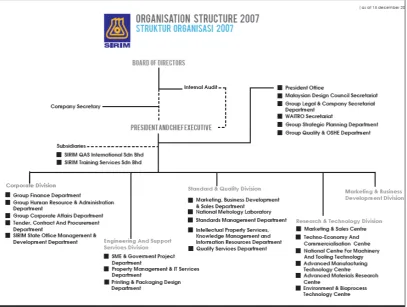
SIRIM Berhad is organised into four Divisions namely; Group Corporate Division, Support Services Division, Standards and Quality Division and Research and Technology Division. Activities undertaken by the Standards and Quality Division and Research and Technology Division are supported by the Support Services Division and also the Group Corporate Division.
5
1.3 Company Structure
The company structure is illustrated in Figure 1.1, each division is broken down into departments or centres which focus on specific functions and core businesses.
Figure 1.1: SIRIM Berhad Organisation Structure
1.4 Core Functions and Businesses
6
technology focus area specifically related to Research and Development (R&D), product development, design and prototyping, consultancy and advisory, technical support, technology transfer and dissemination through technical trainings. Its office is located in Bukit Jalil, Kuala Lumpur and it offers a variety of services to the industries through its three programmes:
1.4.1 Electronics and Intelligent System Development Programme (EISDP)
Electronics and Intelligent System Development Programme (EISDP) specialises in the design and development of hardware and software for electronics and ICT application systems. The programme assists local industries in enhancing their competitiveness through the application of the latest electronics and information technology. EISDP also promotes R&D activities on electronics and ICT-based products, processes and system design for the industries. The core expertise lies in the areas of RFID and signal processing, control and instrumentation, electronics identifications, communications and intelligent systems development.
1.4.2 Industrial Automation and Robotics Programme (IARP)
7
1.4.3 National CAD/CAM Programme (NCCP)
National CAD/CAM Programme (NCCP) established in 1995 by the Malaysian Government with the aim to assist industries and organisations improve their quality, productivity and competitiveness through the application of CAD/CAM/CAE and related technologies. NCCP offers R&D, consultancy and trainings in CAD/CAM modelling, rapid prototyping, reverse engineering and manufacturing systems.
1.5 Background of the Problem
SIRIM Berhad remains focused on its core business of Quality and Technology through its own main portfolios, Research and Technology and Standards and Quality. Enhancing the competitiveness of industries and protection of the consumers as well as the environment has been the mainstay of SIRIM Berhad's endeavours in the implementation of its standardisation and quality programmes.
With wide ranges of products and services in Standards and Quality business, the Intellectual Property Services, Knowledge Management and Information Resources Department (hereafter will be referred as User Department) provides technical information and intellectual property (IP) services for researchers, inventors, industries, IP practitioners and other professionals and business circles through various means. Among the User Department's services are as follows:
a) Library Membership Schemes b) Electronic Information Retrieval
8
d) Comprehensive and updated collection of Malaysian and foreign Standards
e) Trade-related information f) Patents and technical journals
As a large organisation with multi-disciplinary units, being responsive to the internal employees' and business clients' requests necessitates the User Department to manage the technical information resources in efficient manner so as to maintain wealth of knowledge for the company researchers and personnel, yet create lasting relationships with the customers and industry partners. The strategy of separating people from repetitive manual tasks is common in almost all industries to promote productivity. This same trend has been seen within libraries as the organisation seeks to find ways to shift the focus of their staff away from manual labour and towards value-adding self-circulation and inventory monitoring.
The business of running a library in SIRIM Berhad includes boosting staff effectiveness, minimizing recurrent maintenance costs as well as maximizing technology benefits. These present desires to improve customer service and add real value to the customer's visits by maximising the use of professional skills and experience. Inability to locate information leads to poor customer service levels. Delay in tracking information resources, other than causing operation delay, also result in unproductive work, which can cost the organisation. This project thus recommends using Radio Frequency Identification (RFID) technology in tracking of library technical resources and inventory in SIRIM Berhad, simultaneously replacing the existing Library Management System to be more scalable and integrated.
9
whilst adding security against theft. RFID reduces lost books and creates savings in time spent searching for books shelved in incorrect locations.
Using RFID tags in libraries has become common nowadays. The high circulation rates make the math simple: introducing self-service for borrowers increases the efficiency significantly enough to pay back for investment in this emerging technology.
In summary, this thesis outlines the software development project for Smart Access and Tracking of Information Resources System using RFID Technology for the purpose of managing the SIRIM Berhad technical information resources with the common library processes such as administration, cataloguing, circulation and acquisition, which are regarded as valuable business to the User Department. In this project, enhancement includes tagging and tracking process to control library inventory using Radio Frequency Identification (RFID) technology.
10
1.6 Importance of the Project
Although the RFID technology has been in use for the many years in the world, however in recent times, the benefits of RFID has been realised by the organisations throughout the world. The list of benefits and features afforded by an RFID system are quite impressive. They can include applications that remove human intervention completely, allowing for the changing of data in the field, operation where line of sight is not possible, and acquiring of information from multiple items at high speed, and the ability to identify items nested inside of packaging without opening the packaging. Due to this, the project will benefit the User Department by eventually replacing an existing Library Management System in terms of the added functionalities as well as incorporating advanced features such as RFID technology.
Radio Frequency Identification (RFID) provides for 'sightless' or no line of sight identification of items. It includes the ability to facilitate circulation, re-shelving, and theft detection, and it has several other important advantages. It can either replace or supplement existing library barcodes. When the costs of labour is taken into consideration for tasks such as check-out, check-in, inventory holds, lists and mis-shelved items, RFID can prove to be very efficient when compared to traditional barcodes.
11
Among Research and Development areas and initiatives of the AMTC are focused around researching, developing and implementing RFID technology and solutions in improving security and efficiency in manufacturing, government and service industries. Therefore, the project will bring values to the SIRIM Berhad in general, to hold its reputation as a technology frontier.
RFID is a form of automated data collection and it can offer unique solutions if implemented successfully. Coupled with an application, and at the same time fully utilises its incredible power, a solution can be designed that provides numerous benefits to the company; cost reduction, increased accuracy, improved workforce efficiency, streamlining business process, and improving the company's ability to execute. In the days of running supply chains leaner and at the same time more responsive, RFID in many cases provides the needed functionality to support these elusive goals.
Looking at the capacity building perspective, it is justifiable that the project will benefit the organisation to nurture local expertise in developing RFID solutions and offering seamlessly integrated and innovative local product. In the long-run, this way could alleviate dependency on imported RFID solutions and allow the country to own home-grown product and technology experts.
1.7 Chapter Summary
135
REFERENCES
Banks, J., Hanny, D., Pachano, M.A. and Thompson, L.G. (2007). RFID Applied, Wiley: United States, 127.
Baumeister, H., Koch, N. and Mandel L. (1999). Towards a UML Extension for Hypermedia Design. Proceedings UML '99, France. 1723, 614-629.Springer-Verlag.
Boehm, B.W. (1988). A Spiral Model of Software Development and Enhancement. IEEE Software. 21(5), 61-72. IEEE Computer Society Press.
Boggs W. and Boggs M. (2002). UML with Rational Rose 2002. United States: Sybex.
Booch G., Jacobson I., and Rumbaugh J. (1999), Unified Modeling Language User Guide. United States:Addison-Wesley.
Boss, Richard (2004). RFID Technology in Libraries. ALA Technical Notes. Retrieved May 14th, 2004, from
http://www.ala.org/ala/pla/plapubs/technotes/rfidtechnology.cfm
Buschmann, F., Meunier, R., Rohnert, H., Sommerlad, P. and Stal, M. (1996). Pattern-Oriented Software Architecture: A System of Patterns. England: Wiley.
Carp, Douglas, Leslie D. and Lichtenberg. J. (2004). Tiny Trackers: Use of RFID by Libraries and Booksellers. Newsletter on Intellectual Freedom.53(5):169,206-215. Cockburn A. (2000). Selecting a Project's Methodology. IEEE Software. 17 (4), 64 -
136
Collins, J. (2006). Reading books Reduces Out-Of-Stocks. RFID Journal. Retrieved September 28, 2008, from http://www.rfidjournal.com/article/articleview/2696
Conallen J. (1999). Building Web Applications with UML. Addison-Wesley.
Coyle, K. (2005). Management of RFID in Libraries. The Journal of Academic Librarianship. 31(5), 486-489. The Journal of Academic Librarianship.
Derakhshan, R., Orlowska, M.E. and Li, X. (2007). RFID Data Management: Challenges and Opportunities. RFID, 2007 IEEE International Conference. 26-28 March 2007. Texas USA, 175-182.
Dressen, D. (2004). Considerations for RFID Technology Selection. Atmel Applications Journal. 3, 18. Corporate Communication: Atmel Corporation.
Dustin, A. (2003). Effective Software Testing. United States: Addison-Wesley.
Erwin, Emmit and Christian Kern. (2005). Radio Frequency Identification in Libraries. Australasian Public Libraries and Information Services. 18(1), 20-28 Australasian Public Libraries and Information Services.
Finkenzeller, K. (2004). RFID Handbook. United States: John Wiley and Sons.
Gershenfeld, N., Krikorian, R. and Cohen, D. (2004). The Internet of Things. Scientific American Journal. 291(4), 76–78. Scientific American.
Gilbert, A. (2004). RFID: Coming to a Library Near You. CNET News.com. Retrieved September 30, 2008, from http://www.news.com.com/RFID/2100-1012_3-5411657.html.
137
Hennicker R. and Koch N. (2001). Systematic Design of Web Applications with UML. United States: IGI Publishing.
IDTechEx. (2005). Active RFID: A Profitable Business. IDTechEx.com. Retrieved August 29th, 2008, from http://www.idtechex.com/products/articles/0000396.asp.
IEE. (2005). Radio Frequency Identification Device Technology (RFID) Fact File. The Institution of Electrical Engineers. 1-10. Institution of Electrical Engineers.
Intel (2007). Intel® UHF RFID Transceiver R1000. intel.com .Retrieved September 15, 2008, from http://www.intel.com/products/embedded/rfid/r1000.htm
International Standards (2000). ISO 9001:2000: Quality Management Systems - Requirements. Switzerland: International Standards Organisation.
International Standards (2001). ISO/IEC 15693 Part 1: Physical characteristics., Part 2: Air interface and initialization, Part 3: Anti-collision and transmission protocol.
International Standards (2004). ISO/IEC 18000-3:2004. Switzerland: International Standards Organisation/International Electrotechnical Commission.
Kruchten P. (2002). Tutorial: Introduction to the Rational Unified Process. Proceedings of the 24th International Conference. 23 May 2005. IEEE. 703.
Lahari, S. (2006). RFID Sourcebook. RFID Journal. 1, 9-10. IBM Press.
Larman, C. (2001). Applying UML and Patterns. (2nd ed.). United States: Prentice Hall.
138
Overgaard G. and Palmkvist K. (2005). Use Cases - Patterns and Blueprints. United States: Addison-Wesley.
Paret, D. (2005). RFID and Contactless Smart Card Applications. United States: John Wiley & Sons.
Raghu D., Harrop P. (2008). Complete RFID Analysis and Forecasts. RFID Forecasts, Players & Opportunities 2005-2015. IDTechEx.com. 20-30. IDTechEx.
Rational Software (2001). Rational Unified Process. Rational Software. 2-12. Corporation.
RFID Journal (2003). ISO Moves on RFID Standards. RFID Journal. 297(1), 1. RFID Journal.
RFID Journal (2006). A summary of RFID standards. RFID Journal. 1335, 129 RFID Journal.
Roberti, M. (2006). How World Kitchen Got It Right, RFID Journal, July. 18-25. RFID Journal.
Rook, P. (1986), Controlling software projects. Software Engineering Journal. 1(1), 7-16. Michael Faraday House.
Rosenberg, D. and Scott, K. (1999). Use Case Driven Object Modelling with UML. United States: Addison-Wesley.
Royce, W. (1970). Managing the Development of Large Software Systems. Proceedings of IEEE WESCON. 1-9. IEEE Computer Society Press.