555-233-001
Comcode 108671413 Issue 2
June 2000
Release 2.0
Copyright and legal notices
Copyright Copyright © 2000 by Lucent Technologies. All rights reserved.
Notice Every effort was made to ensure that the information in this book was com-plete and accurate at the time of printing. However, information is subject to change.
Your Responsibility for Your System’s Security
Toll fraud is the unauthorized use of your telecommunications system by an unauthorized party, for example, persons other than your company’s employ-ees, agents, subcontractors, or persons working on your company’s behalf. Note that there may be a risk of toll fraud associated with your telecommuni-cations system and, if toll fraud occurs, it can result in substantial additional charges for your telecommunications services.
accessed through or connected to it. Lucent Technologies will not be respon-sible for any charges that result from such unauthorized use.
Lucent
Technologies Fraud Intervention
If you suspect that you are being victimized by toll fraud and you need techni-cal support or assistance, techni-call Technitechni-cal Service Center Toll Fraud Interven-tion Hotline at 1 800 643-2353.
Trademarks AUDIX, CALLMASTER, CentreVu, CONVERSANT, DEFINITY, Magic On Hold, PassageWay, and TransTalk are registered trademarks and DEFINITY ONE, Guide Builder, INTUITY, and SNAP Connection are trademarks of Lucent Technologies, Inc.
Microsoft and Windows are registered trademarks and Windows NT is a trademark of Microsoft Corporation.
Macintosh is a registered trademark of Apple Computer, Inc. Pentium is trademark of Intel Corporation.
UNIX is a registered trademark of X/Open Company, Ltd. FastCall is a registered trademark of Aurora Systems, Inc. Commence is a trademark of Commence Corporation.
Octel is a registered trademark of Octel Communications Corporation. PhoneLine is a registered trademark of CCOM Information Systems.
Ascend and Pipeline are registered trademarks of Ascend Communications, Inc.
This material is protected by the copyright laws of the United States and other countries. It may not be reproduced, distributed, or altered in any fashion by any entity (either internal or external to Lucent Technologies), except in accordance with applicable agreements, contracts or licensing, without the express written consent of the BCS Product Publications organization and the business management owner of the material.
This document was prepared by the Product Publications department of the Business Communications Systems division of Lucent Technologies. Offices are located in Denver CO, Columbus OH, Middletown NJ, and Basking Ridge NJ, USA.
Ordering Information
Call: Lucent Technologies BCS Publications Center
Voice 1 800 457-1235International Voice 317 322-6791 Fax 1 800 457-1764International Fax 317 322-6699
Write: Lucent Technologies BCS Publications Center 2855 North Franklin Road
Order: Document No. 555-233-001 Comcode 108671413 Issue 2, June 2000
For additional documents, refer to the section in “About This Document” enti-tled “How to Order Documentation.”
You can be placed on a standing order list for this and other documents you may need. Standing order will enable you to automatically receive updated versions of individual documents or document sets, billed to account informa-tion that you provide. For more informainforma-tion on standing orders, or to be put on a list to receive future issues of this document, contact the Lucent Technolo-gies Publications Center.
Warrranty The CD software and documentation are not warranted and are provided by Lucent Technologies as is.
Disclaimer Intellectual property related to this product and registered to AT&T Corpora-tion has been transferred to Lucent Technologies Incorporated.
Contents
Copyright and legal notices
iii
Copyright. . . iii
Notice . . . iii
Your Responsibility for Your System’s Security . . . iii
Lucent Technologies Fraud Intervention . . . iv
Trademarks . . . iv
Ordering Information . . . v
Call: . . . v
Write:. . . v
Order: . . . vi
Warrranty. . . vi
Disclaimer . . . vi
Heritage . . . .vii
. . . .vii
About This Document
xix
Purpose . . . .xixIntended audiences . . . . xix
Conventions used in this document . . . . xxi
Security . . . xxii
Trademarks . . . xxii
How to order documentation . . . xxiv
How to comment on this document . . . xxv
1 Introduction
1-1
2 Desktop/Console Solutions
2-1
Telephones for the global marketplace . . . 2-1 Digital DCP telephones . . . 2-3 6400-Series digital telephones . . . 2-4 6400-Series telephones . . . 2-5 7400-Series digital telephones . . . 2-8 8400-Series digital telephones . . . 2-9 9400-Series digital telephones . . . 2-13 7300/ATL-Series hybrid telephones . . . 2-14 Analog (single-line) telephones . . . 2-14 6200-Series analog telephones . . . 2-15 8100-Series analog telephones . . . 2-16 9100-Series analog telephones . . . 2-17 2500-Series analog telephones . . . 2-19 Attendant Consoles . . . . 2-20 DEFINITY Attendant Console . . . 2-20 DEFINITY PC Console . . . 2-21
3 Adjuncts
3-1
Alerts and sensors . . . 3-5 External speakerphones . . . 3-5 Security devices . . . 3-6 Call Accounting Systems . . . 3-7
4 I
NTUITY
AUDIX Messaging
4-1
FAX Messaging . . . 4-21 Automated Attendant . . . 4-22 Bulletin Board . . . 4-23
5 Call Center
5-1
6 Wireless Solutions
6-1
Medium-Range mobility . . . 6-2 Long-Range mobility . . . 6-4 DEFINITY Wireless Business System PWT . . . 6-6 Application starter package . . . 6-7
7 Computer Telephony Integration
7-1
Server-Based solutions . . . 7-1 Third-Party applications . . . 7-3 DEFINITY IP Softphone . . . 7-5
8 Telecommuting/Virtual Office
8-1
DEFINITY ONE features for telecommuting . . . 8-1 Remote Call Coverage/
Call Forwarding Off-Net/Coverage of Calls Redirected Off-Net . . . 8-2 Extended User Administration of Redirected
9 System Administration
9-1
10 Networking
10-1
Uniform Dial Plan . . . . 10-1 Distributed Communication System —
ISDN . . . 10-19 Centralized Attendant Service . . . 10-20 Main/Satellite/Tributary. . . 10-21 Electronic Tandem Network . . . 10-22 Starter application package . . . 10-23
Appendix A: Features
A-1
Automatic routing features . . . A-2 Basic features . . . A-3 Call Center features . . . .A-12 Private networking features . . . .A-14 Trunk group features . . . .A-17
About This Document
Purpose
This document provides a high-level overview of the features, components, and capabilities of the DEFINITY ONE™ Communications System (DEFINITY ONE). For information on how to install, administer, or maintain DEFINITY ONE, see the DEFINITY ONE Documents Main Menu on this CD.
This document is intended to provide an understanding of:
• DEFINITY ONE components
• DEFINITY ONE features
• Additional solutions to further tailor DEFINITY ONE to future needs
Intended audiences
This overview provides information for the following audiences:
• Customer end users and system administrators
How to use this document
This document provides a basic understanding of the components, features, and capabilities of DEFINITY ONE, and the starter packages. The information is useful in identifying applications to increase employee productivity and effectiveness.
Overview chapters are:
• Chapter 1, Introduction: provides an overview of DEFINITY ONE, including
features, hardware and software.
• Chapter 2, Desktop/Console Solutions: describes the telephones and consoles
available with DEFINITY ONE.
• Chapter 3, Adjuncts: describes the adjuncts available with DEFINITY ONE.
• Chapter 4, INTUITY AUDIX Messaging: describes the Lucent AUDIX
application and features on DEFINITY ONE, and provides a high-level overview of application capabilities and functionality.
• Chapter 5, Call Center: describes advanced call-handling applications and call
center management capabilities.
• Chapter 6, Wireless Solutions: describes applications that enable employees to
stay in touch with co-workers and clients from both on-site and off-site locations.
• Chapter 7, Computer Telephony Integration: describes the applications that
• Chapter 8, Telecommuting/Virtual Office: describes applications that enable employees to work effectively off-site.
• Chapter 9, System Administration: describes applications to help manage
DEFINITY ONE, including the DEFINITY Site Administration (DSA) tool.
• Chapter 10, Networking: describes connection applications for various voice and
data networks.
• Appendix A, Features: lists the features of DEFINITY ONE.
Conventions used in this document
The following conventions are used in this document:
• The term system is used to represent DEFINITY ONE.
• The term switch is used to represent other telecommunications switching products.
Security
DEFINITY ONE security is extremely important to Lucent Technologies. See the
Trademarks
This document contains references to the following Lucent Technologies trademarked products:
• AUDIX®
• CallVisor®
• DEFINITY®
• DEFINITY ONE™ Communications System • INTUITY®
• CentreVu® • BCMS Vu® • PassageWay®
• CALLMASTER®
• Magic On Hold® • CONVERSANT®
The following products are trademarked by their appropriate vendor:
• Netscape Navigator® is a registered trademark of Netscape Communications Corporation.
• pcAnywhere® is a registered trademark of Dynamic Microprocessor Associates. • Windows NT™ is a trademark, and Windows® is a registered trademark, of
Microsoft® Corporation.
• Paradyne™ is a trademark of Paradyne Corporation.
• U.S. Robotics® is a registered trademark of U.S. Robotics Corporation. • Pentium™ is trademark of Intel Corporation.
• Macintosh® is a registered trademark of Apple Computer, Inc. • UNIX® is a registered trademark of X/Open Company, Ltd. • FastCall® is a registered trademark of Aurora Systems, Inc. • Commence™ is a trademark of Commence Corporation.
• Octel® is a registered trademark of Octel Communications Corporation. • PhoneLine® is a registered trademark of CCOM Information Systems.
• Ascend® and Pipeline® are registered trademarks of Ascend Communications, Inc.
• Informix® is a registered trademark of Informix Software, Inc. • Intuition® is a registered trademark of Answersoft, Inc. • FastCall® is a registered trademark of Aurora Systems, Inc.
How to order documentation
This document order number is 555-233-001, Issue 2. The comcode is 108671413. To order this document, contact:
Lucent Technologies BCS Publications Center 2855 North Franklin Road
Indianapolis, IN 46219-1385 U.S.A.
Voice: 1 800 457-1235 Fax: 1 800 457-1764
International Voice: 317 322-6791 International Fax: 317 322-6699
Web Site: www.lucent.com/enterprise/documentation
The documentation library CD is part of the standard customer documentation package. If additional copies of the CD are needed, contact the Publications Center and use order number 555-233-001, Issue 2, comcode 108671413.
How to comment on this document
Lucent Technologies welcomes feedback. Please complete and return the reader comment form at the back of the document.
If the reader comment form is missing for DEFINITY ONE Communications System Release 2.0 Overview, (555-233-001), Issue 2, fax your comments to
1
Introduction
The DEFINITY ONECommunications System (DEFINITY ONE) Release 2.0 provides Lucent customers an integrated set of applications that are administered through an easy-to-use interface. DEFINITY ONE offers sophisticated business features and functionality, such as voice mail, call center, and networking. The system is applicable to a single site or a network within large business satellite offices or worldwide branch offices.
Release 2.0 includes DEFINITY Release 8.2, INTUITY AUDIX Release 4.4, and DEFINITY Site
Administration (DSA) Release 1.0, loaded on a single NT-based platform. Application integration results in easy administration on the Windows NT 4.0 operating system. In addition, outside adjuncts and associated connectivity and maintenance costs are eliminated and functionality is consolidated into a single cabinet. This creates a cost-effective platform.
The Application Starter Packages offer an array of prepackaged advanced applications that effectively help manage time and communication processes. DEFINITY ONE starter packages include:
• Automatic Call Distribution (ACD)
• Networking
• Virtual Office
DEFINITY ONE Communications System
DEFINITY ONE with DEFINITY Release 8.2 software allows full functionality, including support for the 6200-, 6400-, 7400-, and 8400-series telephones and terminals. The following features are offered:
• DEFINITY station and trunk circuit packs, such as C-LAN and IP trunk
• Asynchronous Transfer Mode (ATM) and features, such as telecommuting
• Integrated Services Digital Network-Primary Rate Interface (ISDN-PRI) access and Distributed Communications System (DCS) and QSIG private networking
See Appendix A, Features for a complete list of DEFINITY ONE features.
What’s new in release 2.0
Gateway (DLG) feature allows the Windows local area network (LAN) interface to be administered within the DEFINITY application. Upgrade procedures are
supported via an installation wizard in the same manner as a new load within Release 1.0.
Improvements include:
• Processor Ethernet Access
This enhancement to the DEFINITY software frees up hardware slots which were occupied by a C-LAN board in earlier releases.
• DEFINITY LAN Gateway
The Adjunct-Switch Application Interface (ASAI) application in DEFINITY can be accessed via either processor ethernet or a C-LAN board without an external gateway board (TN801).
• Support of BCMS Vu Release 2, Version 2.0 in an external server (not TN795 co-resident). The connection to DEFINITY ONE is via the LAN only.
• Separate Telnet Ports for Direct Access to DEFINITY and AUDIX
In Release 8.2, Lucent Services logins are the same as for Release 7.2, but now favor the use of separate Telnet ports for direct access.
• New Commands
installconfig automatically determines whether a reboot is required. In addition,
the new stop command is introduced as an alternate spelling of the shutdown command.
• Backup/Restore and Download Pages
The Backup/Restore feature is enhanced to support multiple backup schedules and to include files for Integrated SSP Announcements (ISSPA). Release 7.1 commands autobackup and cancelbackup were modified for use in Release 8.2, replacing backupsource and backupparams. Schedbackup is a new command. The download pages are enhanced to download additional applications and applications in additional languages.
• Integrated SSP Announcements (ISSPA) (Feature will be available in a subsequent release.)
Announcements are supported on the CWY1 module of the processor board without a separate TN750C. This capability is equivalent to one TN750C and announcements are stored on the DEFINITY ONE hard drive. This enables backup similar to other DEFINITY translations. Other benefits include ISSPA support of one hour of announcement storage and elimination of the slot needed for the announcement board.
• Upgrade Support
AUDIX
AUDIX provides a messaging communications solution for unified voice, fax, and e-mail messaging. Accessing voice e-mail, fax, e-e-mail, and file attachments via phone, PC, laptop, and wireless saves the user valuable time. This release of AUDIX includes several enhancements in media, access, and connectivity that offer the first truly “universal” messaging product. AUDIX provides voice, fax, and text messaging together with text-to-speech, and Message Manager functionality on a single processor. The new processor board provides DSP resources for messaging, and support for TCP/IP.
DEFINITY Site Administration (DSA)
Call Center
Call Center functionality in DEFINITY ONE consists of the following:
• DEFINITY Basic, Deluxe or Elite Call Center software
• Basic Call Management System (BCMS) monitoring and reporting
• Access to BCMS through DSA using terminal emulation (only one BCMS monitoring/reporting session may be active at one time)
• Scheduled printing of historical reports is not supported
• BCMS Vu support via the LAN (TN795 processor)
• Call Management System (CMS) support via the C-LAN board
• TSAPI support via the C-LAN board or the LAN (TN795 processor)
• Passageway Direct Connect support
Web browser access
Call Accounting
Call Accounting controls communications costs with accurate reporting on calls processed and effective cost-allocation methods. Call Accounting stores call records from phone extensions and assigns costs to the calls. The system also creates ad-hoc reports to manipulate call data and charge-back call expenses to clients or
departments. Detection of toll fraud and maintenance of call records also are features of call accounting. Station Message Detail Recording (SMDR) records are written in real time to a file on the local hard disk. Because of ethernet connectivity, this information is easily accessed from anywhere on the LAN or WAN.
Starter packages
DEFINITY ONE Starter Packages are designed to introduce simple, cost effective advanced applications that allow businesses to start small and grow. Starter Package capacity can increase with business expansion.
The following Starter Packages are available:
• Automatic Call Distribution (ACD)
The ACD Package can establish a call center operation with as few as six agents. It includes the following features:
~ Basic Call Management System (BCMS) provides reports on the status of agents, splits, trunks, and incoming calls.
The package can be upgraded to support up to 50 agents.
• Virtual Office
The Virtual Office Starter Package provides voice and data access for off-site workers and telecommuters. This allows workers to remotely access a business LAN or Internet. Users also can receive calls using the same number.
• Wireless
The Wireless Starter Package enhances mobility within business locations, enabling employees to receive important calls away from their desks. It is available in single- and multi-zone packages for 1 to 25 users. The Wireless Starter Package provides convenient business calling features using compact handsets.
Packages are available for DEFINITY Wireless Business Systems and the TransTalk 9000 systems.
• Networking
System administration
DEFINITY ONE offers the DEFINITY Site Administration (DSA) Release 1.0 package.
MasterDirectory and PhoneLine
The MasterDirectory and PhoneLine Starter Package includes software for collecting, modifying, and synchronizing directory information from a variety of sources. Sources include private branch exchanges (PBXs), telecom databases, and corporate databases. Current directory information in networked, stand-alone, and mobile-computing environments is accessed online. In addition, information in corporate directories is distributed to users throughout the organization.
AMIS Analog Networking
AMIS Networking involves:
• Establishing machine names
• Administration of dial strings for all AMIS nodes
• Administration of address ranges
• Testing with other vendors (this requires test mailboxes with password access)
• Post implementation support for five consecutive business days, with the understanding that the translations have not been changed or modified by the customer
Customers implementing AMIS or TCP/IP networking should consider using the Node Implementation and Testing Offer which includes administration and testing of end points. Ask your service representative for details.
Note: Customers who currently have DCP networking installed will need to purchase an Interchange to facilitate the TCP/IP-DCP conversion.
Hardware
DEFINITY ONE’s major component is a new processor board, the TN795. This circuit pack contains:
• Windows NT 4.0 operating system with on-board Pentium processor chip
• Motorola processor running application firmware
• NT to firmware interface
• Tone clock functionality equivalent to a TN2182 circuit pack
• AUDIX software with virtual AUDIX ports
Compact modular cabinet
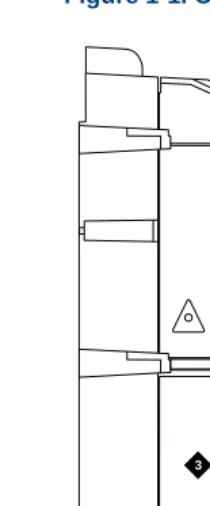
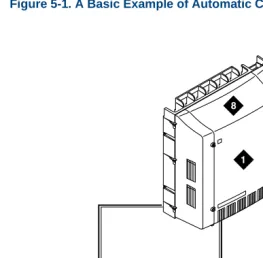
Figure 1-1. Compact Modular Cabinet
Slots 1 and 2 are reserved for the TN795 circuit pack. Slot 3 is recommended for the TN744D circuit pack, but any other slot is acceptable.
scdmlft2 KLC 091399
5 10
1 2 3 4 6 2 1 3 4 EM XFR ON AUTO OFF PCMCIA MAJOR ALARM MINOR ALARM CLOCK OK REMOVE SHUTDOWN T N 7 9 5 T N 7 4 4 D
1. Slots 1 - 5 2. Slots 6 - 10 3. 650 Power Supply
Software
DEFINITY ONE systems use DEFINITY Release 8.2 software. For more
information, see DEFINITY Enterprise Communications System Release 8.2 Feature Description.
In addition to the basic software, optional packages (see Starter application package
on page 8-6) are designed to enhance system capabilities. The basic software is
required for the optional packages. See your account representative for more information.
Reliability
DEFINITY ONE provides a common communications solution featuring business communication, multimedia messaging, call accounting, and system management applications. The system is small in footprint and line size and the single-cabinet platform allows applications to work together, eliminating cost and complexity.
DEFINITY ONE provides:
• System survival of minor power surges (including lightning-induced surges up to 2,500 peak volts) without service interruption
• System operation in less-than-ideal locations of above-average temperatures and humidity
• Automatic restoration of the last saved version following a power outage
• Remote diagnostics capability, enabling rapid troubleshooting and maintenance
• Scheduled centralized backups of critical system information at remote sites. In an emergency, multiple copies of translations, AUDIX subscriber information, and the Windows NT registry files are available. Saved information can be quickly restored.
• Self-diagnostics and self-correction of system errors, automatically calls the Lucent Technical Assistance Center for remote diagnostics support
• Automatic standard maintenance routines
Incomparable service
2
Desktop/Console Solutions
The communications needs of people in your company vary widely. Some may require only basic telephone service. Others may need effective messaging services or high-speed data communications and access to a variety of host and personal computers.
DEFINITY ONE brings voice communications, data communications, and messaging together on the desktop, which enables you to customize the types of service for various users.
Note: Some applications and products are unavailable in some countries. Please check with your local distributor for further information about the features and applications available to you.
Telephones for the global marketplace
Telephones fall into two basic families — Digital Communications Protocol (DCP) and analog. These terms describe how each type of telephone communicates with your DEFINITY ONE system. These families of telephones are designed to accommodate the types of communications various users require. All telephones have touch-tone dialing and the message-waiting lamp for notification of messages.
The following DEFINITY telephones are supported:
• 6400-Series digital telephones
• 7400-Series digital telephones
• 8400-Series digital telephones
• 9400-Series digital telephones (available in select European countries only)
• 6200-Series analog telephones
• 8100-Series analog telephones
• 9100-Series analog telephones
Digital DCP telephones
Digital telephones using the DCP use digital transmission for integrated voice, data, and control signals. Transmission is over a connection consisting of one or two pair of wires. Each connection supports one signalling channel and two information (voice and data) channels.
DCP telephones are useful for people who receive a high volume of calls, require access to multiple applications or databases, use switch features heavily, or require messaging services. DCP telephones can be used to expand the capabilities of personal computers.
DCP telephones provide the full range of DEFINITY ONE features on your desktop. In addition to multiline and multifunction capabilities, they provide access to integrated voice and data applications and messaging services.
Some models include display screens. DCP telephones can save money by reducing the number of lines, modems, and ports that would normally be needed for analog facilities.
The following DCP telephones are available for sale:
• 6400-Series digital telephones
6400-Series digital telephones
The 6400-Series digital telephones are versatile 2-wire DCP telephones that support all of the key/hybrid features of DEFINITY ONE. These telephones have a new, global design and include the following additional features:
• Date and time display
• Feature button that allows switchhook control of a headset
• Conference, Transfer, Hold, and Last Number Dialed fixed feature buttons
• Group Listen capability. This allows you to use your handset or headset while others in the room listen via a speakerphone. This 2-way handset, 1-way speaker mode allows you to serve as a spokesperson for a group.
• Station User Administration capability allows you to program certain features on the telephone yourself.
• Whisper Page. This allows an assistant to announce a second call to a company official during an active call on the official’s telephone. The announcement is heard only by the official.
• Auto Call Times. This allows each call to be timed automatically upon answer. The elapsed call displays on the telephone. The timer is stopped automatically when a call is ended or placed on hold.
6400-Series telephones
DEFINITY ONE supports the following 6400-Series telephones:
• 6402 telephone
The 6402 telephone is a digital, single-line DCP telephone without a display that can be wall mounted. This cost-effective, entry-level telephone is designed for users with basic call handling requirements. The 6402 is ideal for areas where there is minimum use, such as reception areas, copy rooms, file rooms, or warehouse locations. This telephone has a Feature button for accessing up to 12 system features and a built-in, 1-way (listen-only) speakerphone that facilitates off-hook dialing and listening to voice mail or broadcast messages.
• 6402D telephone
The 6402D telephone is a digital, single-line DCP telephone with a 2-line by 16- character display. This telephone has a Feature button for accessing up to 12 system features. The 6402D has a 1-way (listen-only) speakerphone and can be wall mounted. There are no soft keys associated with the display.
• 6408+ telephone
• 6408D+ telephone
The 6408D+ telephone is a digital, multiline DCP telephone that has eight call appearance/feature buttons and a 2-line by 24-character display. This telephone is designed for users who need multiple line appearances and extensive features. The 6408D+ has 12 additional features that are accessible via the 2-line by 24-character display and are selected by the four display-associated soft keys. The 6408D+ has a built-in 2-way speakerphone and can be wall mounted.
• 6416D+ telephone
The 6416D+ telephone is a digital, multiline DCP telephone that has 16 call appearance/feature buttons and a 2-line by 24-character display. This telephone is designed for users with call coverage responsibilities who need multiple line appearances and extensive features. The 6416D+ has 12 additional features that are accessible via the 2-line by 24-character display and are selected by the four display-associated soft keys. A 24-button expansion module can be added to provide 24 additional auxiliary buttons. (The 24-button expansion module requires power from the station or the closet.) The 6416D+ has a built-in 2-way speakerphone and can be wall mounted when not used with the 24-button expansion module.
• 6416D+M telephone
The 6416D+M has 12 additional features that are accessible via the 2-line by 24-character display and are selected by the four display-associated soft keys.
A 24-button expansion module can be added to provide 24 additional auxiliary buttons. (The 24-button expansion module requires power from the station or the closet.)The 6416D+M allows you to install a 100A Tip/Ring module, providing a connection between the telephone and such analog adjuncts as modems, fax machines, analog conference-quality speakerphones, answering machines, and TDD machines commonly used by the hearing impaired. The 6416D+M has a built-in 2-way speakerphone and can be wall mounted. The 6416D+M also has a built-in headset jack.
• 6424D+ telephone
The 6424D+ telephone is a digital, multiline DCP telephone that has 24 call appearance/feature buttons and a 2-line by 24-character display. This telephone is designed for the busy executive or executive assistant who requires extensive call handling and call coverage flexibility. The 6424D+ has 12 additional features that are accessible via the 2-line by 24-character display and are selected by the four display-associated soft keys. The 6424D+ has a built-in 2-way speakerphone and can be wall mounted. A 24-button expansion module can be added to provide 24 additional auxiliary buttons. (The 24-button expansion module requires power from the station or the closet.)
• 6424D+M telephone
This telephone is designed for the busy executive or executive assistant who requires extensive call handling and call coverage flexibility. The 6424D+M has 12 additional features that are accessible via the 2-line by 24-character display and are selected by the four display-associated soft keys. The 6424D+M allows you to install a 100A Tip/Ring module, providing a connection between the telephone and such analog adjuncts as modems, fax machines, analog conference-quality speakerphones, answering machines, and TDD machines commonly used by the hearing impaired. The 6424D+M has a built-in 2-way speakerphone and can be wall mounted. A 24-button expansion module can be added to provide 24 additional auxiliary buttons. (The 24-button expansion module requires power from the station or the closet.) The 6424D+M also has a built-in headset jack.
Requirements
The 6400-Series telephones are compatible with the following 2-wire DCP circuit packs:
• TN 2181 (16-port circuit pack)
• TN 2224 (24-port circuit pack)
• TN 2214 (international 24-port circuit pack)
7400-Series digital telephones
8400-Series digital telephones
The 8400-Series telephones are versatile 2-wire/4-wire DCP telephones that offer flexibility and cost savings and support most of the key/hybrid features of
DEFINITY ONE. (Table 2-1 on page 2-11 shows the differences between the 8400-Series telephones and 6400-8400-Series telephones.) These telephones detect
automatically whether they are plugged into a 2-wire or 4-wire digital line circuit card.
Note: The 8400-Series telephones are not offered with new DEFINITY systems sales. However, you can still purchase these telephones from Lucent.
DEFINITY ONE supports the following 8400-Series telephones:
• 8403 telephone
The 8403 is a 3-line telephone without a display that can be wall mounted. This telephone has a built-in, 1-way (listen-only) speakerphone and three
programmable buttons.
• 8405B telephone
The 8405B is a 5-line telephone without a display and can be wall mounted. The 8405B has a built-in 1-way speaker and programmable keys.
• 8405D+ telephone
• 8410B telephone
The 8410B is a 10-line telephone without a display that can be wall mounted. The 8410B has a built-in 2-way speakerphone and programmable keys.
• 8410D telephone
The 8410D is a 10-line telephone with a 2-line, 24-character display. The 8410D has 12 additional features that are accessible via the 2-line by 24-character display and are selected by the four display-associated soft keys. This telephone can be wall mounted.
• 8411D telephone
The 8411D is a 10-line telephone with a 2-line, 24-character display. This telephone is an enhanced version of the 8410D telephone that has a built-in RJ11C jack, which provides an interface to analog telephone devices (such as a telecopier or a modem) and an RS232 data interface for PassageWay Direct Connection. The 8411D has a built-in 2-way speakerphone and programmable keys. The 8411D has 12 additional features that are accessible via the 2-line by 24-character display and are selected by the four display-associated soft keys. This telephone cannot be wall mounted.
• 8434DX telephone
Table 2-1. Differences between the 6400-Series telephones and 8400-Series telephones
Feature 6400-Series
telephones
8400-Series telephones
Whisper Page Yes Yes
Group Page Yes Yes
Bridged Appearance Yes Yes
Personal CO Line Appearance
Yes Yes
Directed Call Pick-up Yes Yes
Group Listening Yes No
Station User Administration
Yes No
Time/Day Default Yes No
Adjustable Display Yes No
Pull-out Tray Yes No
Headset without handset offhook
Requirements
The 8400-Series telephones are compatible with all 2-wire and 4-wire DCP circuit packs.
Dual-Purpose NEXT button
Yes No
Auxiliary Jack No Yes
Tip/Ring Interface 6416D+M and 6424D+M only
Yes (8411)
2- and 4- wire 2-wire only Yes
RS-232 CTI Interface No Yes (8411)
AD Labeling Yes Yes
Active Dialing Yes Yes
Context-Sensitive Help Yes Yes
Automatic Timer Yes No
Table 2-1. Differences between the 6400-Series telephones and 8400-Series telephones
Feature 6400-Series
telephones
9400-Series digital telephones
The 9400-Series telephones (used only in selected European countries) are digital telephones. The 9403 and 9434 telephones operate in both 2-wire and 4-wire configurations. The 9410 telephone operates only in the 2-wire DCP configuration.
Note: These telephones are not currently sold as new.
DEFINITY ONE supports the following 9400-Series telephones:
• 9403 telephone
The 9403 telephone is a 3-line digital telephone without a display and can be wall mounted. This telephone has a built-in, 1-way (listen-only) speakerphone and three programmable buttons. The 9403 operates in both 2-wire and 4-wire configurations.
• 9410 telephone
The 9410 telephone is a digital, multiline telephone that has 10 call
appearance/feature buttons and a 2-line by 24-character display. The 9410 has a built-in 2-way speakerphone and can be wall mounted. This telephone operates only in the 2-wire DCP configuration.
• 9434 telephone
The 9434 telephone is a digital, multiline telephone that has 34 call
Requirements
The 9400-Series telephones are compatible with all 2-wire circuit packs. The connection is made via a 2-wire, 16-port or 24-port DCP interface card.
7300/ATL-Series hybrid telephones
The 7300/ATL-Series telephones are multiline, hybrid telephones. Although these telephones are supported, they cannot access the latest set of DEFINITY features. These telephones are not currently sold as new.
Analog (single-line) telephones
Single-line telephones are an economical choice for users who do not handle many calls and do not use modems and fax machines extensively.
All signals between analog telephones and the DEFINITY system are analog over a pair of wires. Only one incoming call can ring at a time, but the telephone can actually handle two calls — one active and one on hold.
Depending on the particular telephone, you can alternate between two calls or set up a three-way conference using the switchhook or flash button. You can access DEFINITY ONE voice features by either entering access codes from your touch-tone keypad or pressing feature buttons.
The following analog telephones are available:
• 6200-Series analog telephones
• 8100-Series analog telephones
• 9100-Series analog telephones
6200-Series analog telephones
The 6200-Series telephones are single-line, analog telephones.
There are three 6200 telephones available:
• 6210 telephone
The 6210 telephone is a single-line analog telephone that can be wall mounted. This telephone has a built-in Data jack that allows a user to bridge a fax machine, modem, or laptop computer onto the single analog line.
• 6218 telephone
The 6218 telephone is a single-line analog telephone that can be wall mounted. This telephone has a built-in Data jack that allows a user to bridge a fax machine, modem, or laptop computer onto the single analog line. The 6218 also has 8 speed dial buttons and a 2-way speakerphone. The 6218 telephone is available in the U.S. only.
• 6220 telephone
8100-Series analog telephones
The 8100-Series telephones are single-line analog telephones that require one tip-and-ring pair for operation. These telephones are not currently sold as new.
DEFINITY ONE supports the following 8100-Series telephones:
• 8101M telephone
The 8101M telephone is a single-line analog telephone that contains a Message light, selectable personalized ringing pattern, and a Data jack. This telephone allows users to access system features with the Flash button.
• 8101 telephone
The 8101 telephone is a single-line analog telephone that contains a Message light, selectable personalized ringing pattern, and a Data jack. This telephone allows users to access system features with the Flash button. The 8101 provides the added features of automatic redial, (with a Redial button) and a Hold button.
• 8102M telephone
The 8102M telephone is a single-line analog telephone that contains 12 programmable dialing buttons, automatic redial, selectable personalized ringing pattern, a Message light, a Hold button, a Data jack, and an Adjunct jack. This telephone allows users to access system features with the Flash button.
• 8110M telephone
The 8110M telephone is a single-line analog telephone that contains 12
9100-Series analog telephones
The 9100-Series telephones are cost-effective analog telephones (sold outside North America only). These telephones are not currently sold as new.
DEFINITY ONE supports the following 9100-Series telephones:
• 9101 telephone
The 9101 telephone has the following features:
~ Standard alphanumeric dial pad
~ Convenient pulse or push-button tone dialing
~ A fully modular connection that provides maximum ease of installation
~ Telephone-line powered, unaffected by power interruption
~ Easily installed on desk or table
~ User-selectable ringer volume and pitch control
~ Flashing ringer light that indicates an incoming call
~ Flashing Message light
~ Flash button for accessing system features such as Hold and Transfer
• 9103 telephone
The 9103 telephone has the following features:
~ Convenient pulse or push-button tone dialing
~ A fully modular connection that provides maximum ease of installation
~ Easily installed on desk or table
~ User-selectable ringer volume and pitch control
~ Flashing ringer light that indicates an incoming call
~ Flashing Message light
~ Flash button for accessing system features such as Hold and Transfer
~ Three memory-dialing buttons
~ Ability for you to program ten memory-dialing numbers on the numeric dial pad keys (0 and 1 through 9)
~ On-hook dialing with 1-way speaker
~ Last Number Redial feature
~ Save feature, which enables you to save a number in memory for a temporary period of time
• 9110 telephone
The 9110 telephone has the following features:
~ Convenient pulse or push-button tone dialing
~ Easily installed on desk or table
~ Hands-free 2-way speakerphone
~ Ten memory-dialing buttons to which you can program 20 memory-dialing numbers
~ Flashing Message light
~ Flash button for accessing system features such as Hold and Transfer
~ Last Number Redial feature
~ Save feature, which enables you to save a number in memory for a temporary period of time
~ Mute button
~ Speaker volume control
~ User-selectable ringer volume and pitch control
~ User-adjustable speakerphone volume control
2500-Series analog telephones
There are three models of 2500-Series single-line analog telephones. These telephones are not currently sold as new.
• 2500 MMGM telephone, which is a basic, desktop telephone
• 2500 YMGM telephone, which is a desktop telephone that has a Hold button, a Mute button, a Flash button, and a Redial button
Attendant Consoles
To increase the effectiveness of attendants handling calls, DEFINITY ONE offers the following tools:
• DEFINITY 302C Attendant Console (requires connectivity to a 2-wire circuit pack)
• The DEFINITY 302B Attendant Console requires connectivity to a 4-wire circuit pack. The DEFINITY 302B Attendant Console is not currently sold as new.
• DEFINITY PC Console Release 2.0 or later
DEFINITY Attendant Console
DEFINITY PC Console
The DEFINITY PC Console is a software application that enables call attendants to handle incoming calls efficiently using a personal computer. Using the familiar Microsoft Windows interface, attendants can easily track how long callers have been on hold and for whom they are waiting. Attendants can monitor up to six calls at once. They need not fumble with pen and paper when handling calls, as they can make notes on their computers about what each caller needs. Having the call-processing software on the same computer with spreadsheet, word-call-processing, or other software enables attendants to stay productive between calls.
Your company directory is displayed on screen with busy extensions shaded. A variety of search functions are available, so attendants can find names and extensions easily. Online telephone identification enables attendants to identify employees quickly. Calls are transferred with the press of a button. Online help makes it easy for attendants to remind themselves how to use the system.
Requirements
The following requirements must be met for the PC Console to function properly:
• An IBM-compatible personal computer with:
~ A Pentium-based, 100-Megahertz or higher processor
~ A minimum of 16 megabytes (MB) of random-access memory (RAM) ~ A minimum of 4 MB of read-only memory (ROM)
~ A 3.5-inch diskette drive ~ An available COM port
~ Sufficient hard disk space. The space required to support PC Console depends on the number of users you are supporting, the amount of information stored for each person, and whether you will include each person’s photograph in PC Console.
• Any of the following operating systems: ~ Microsoft Windows 3.1 or later (R2.0 only)
~ Microsoft Windows for Workgroups 3.11 or later (R2.0 only)
~ Microsoft Windows 95
~ Microsoft Windows NT
~ Windows 98 (R3.0 only)
• A 2- or 4-wire DCP telephone with a PassageWay® adapter, an 8411 telephone, a CALLMASTER® IV, a CALLMASTER VI, a 6424D+M telephone, or a 6416D+M telephone.
3
Adjuncts
DEFINITY ONE provides the following equipment to supplement the services and features of your system and telephones:
• Power systems
• On hold and delayed announcement systems
• Headsets
• Audio and visual paging
• Alerts and sensors
• Speakerphones
• Security devices
Power Systems
Lucent Technologies offers the following solutions to provide power for equipment and protection from power disturbances or disasters:
• Uninterruptible Power Systems (UPS)
A UPS safeguards your DEFINITY ONE and associated applications from utility power irregularities. During a power failure, the UPS battery activates and supplies power for a limited amount of time.
• Surge Protectors
Surge protectors help protect PCs, fax machines, and other equipment from electrical surge damage. Alternating Current (AC) Protectors prevent voltage surges from entering the system via the AC utility line. Line Protectors prevent voltage surges from entering the system via incoming central office lines or via wiring for phones that extend to or from another building.
• Terminal Power Supplies
On hold and delayed announcement systems
Lucent offers the following external announcement systems for DEFINITY ONE:
• Magic On Hold Express Systems
Magic On Hold Express systems provide businesses with fully customized, professionally produced announcements for customer-specific “on hold” environments. The announcements are delivered to your company from the production studio. Production options include legally licensed background music and/or customized information messages that play when a caller is placed on hold or in queue.
• Magic On Hold Systems
Magic On Hold systems provide businesses up to 3 minutes of continuous radio programming for customer-specific requirements. Production options include legally licensed background music and/or customized information messages that play when a caller is placed on hold or in queue.
• Professional Announcement Recordings
• Delay Announcement Systems
Delay announcement systems serve announce only, information announcement, in-queue announcement, and broadcast messaging for businesses with automatic messaging applications. These systems occupy callers during the call process.
Headsets
Headsets help increase productivity in telephone-intensive work assignments. Headsets are proven to reduce neck strain and muscle tension when telephones are used at least 3 hours per day. Lucent provides a complete product line for Call Center, traditional business office, computer telephony, and mobile applications.
Audio and visual paging
Lucent’s overhead voice paging equipment allows telephone users to make announcements by speaking into a telephone handset. DEFINITY ONE supports as many as 9 paging zones, and 1 zone can be set up to activate every zone at the same time. A zone is the location of the loudspeakers: for example, conference rooms, warehouses, or storerooms.
Visual paging includes indoor LED message display signboards, wireless keyboards for sign programming, connector kits for integrating with the PagePac Plus
Alerts and sensors
Lucent provides a complete product line of alerts and sensors for your business. With alert devices, you can select the type of sound for incoming calls. For example, bell, horn, or chime sounds, or use visual signals such as flashing lights to indicate a ringing call, a voice mailbox message, or a voice paging message.
Sensors detect and analyze central office ringing signals to determine if the signal is a standard voice, data, or fax call. Once it determines the type of signal, the sensor device routes the call to the appropriate end point.
External speakerphones
Security devices
Lucent provides the following security devices:
• Access Security Gateway (ASG)
The Access Security Gateway (ASG) is a built-in authentication feature that offers a more secure alternative to static login passwords for remote access to DEFINITY ONE. Using an encryption algorithm, the Access Security Gateway uses session-based challenge and response technology to limit access to the DEFINITY ONE system’s remote maintenance and administration port, system administration terminal, and NET CON channels. See DEFINITY ONE
Communications System Release 2.0 Installation and Upgrades (555-233-109) for information on how to administer this feature.
• Remote Port Security Device
The RPSD works with all data communications protocols and can be used in the following applications:
~ Protecting organizations with remote and home offices that communicate over the public telephone network via dial-up lines
~ Safeguarding companies that administer their communication and voice processing systems remotely from a centralized site, helping to ensure that critical network routing information, traffic data, and PBX feature translations are not compromised
~ Controlling dial-up access by a supplier that provides remote maintenance services ensuring that only the service provider has access to the maintenance ports.
Call Accounting Systems
Note: Call Accounting Systems (CAS) do not run co-resident on the DEFINITY ONE platform. They are supported ONLY if they can interface to the DEFINITY ONE system for CDR records.
• DEFINITY Network Telemanagement (DNT)
DEFINITY Network Telemanagement is a state-of-the-art, multi-user
telemanagement system. Designed in the industrial-strength, on-line, dynamic server-based Informix NT, this application is unmatched in its performance and speed.
DEFINITY Network Telemanagement provides a full 32-bit seamless application for client/server environments that use local area networks (LANs) and wide area networks (WANs). DEFINITY Network Telemanagement is ODBC-compliant and uses MAPI/TAPI conventions. DEFINITY Network Telemanagement is a fully distributed network-based product.
DEFINITY Network Telemanagement can support as many simultaneous users as required and is offered in various modules that include call management (call accounting), asset management (inventory control), and service management (work/service orders).
• Call Accounting System for Windows (CFW)
You can generate reports that identify:
~ Most frequently dialed numbers
~ Most expensive calls
~ Longest duration calls
In addition, you can search the accounting data for a variety of information, including dialed numbers, partial numbers, dates, times, call types, departments, and calling extensions.
You can define up to 5 levels of reporting hierarchy for assignment of costs. The system archives your data for one accounting period. A flexible markup
capability allows service businesses to adjust call pricing for each client.
CFW can generate 20 standard historical or real-time reports from as many as 100 locations and 10,000 stations. An individual system is capable of polling different types of call detail storage units or other CFW systems. The remote systems forward call records and alarms as they are generated.
A traffic engineering option allows you to monitor trunk usage, calling patterns, incoming traffic, and outgoing calls by area code. This allows you to analyze trends summarizing how your equipment is being used.
• Call Accounting System XP (CAS XP)
Call Accounting System XP has equivalent functionality to the call accounting portion of DEFINITY Network Telemanagement. Call Accounting System XP is a LAN/WAN-based application that supports customers with multi-user
requirements. It is offered at a base size of 50 stations, but can be upgraded to 10,000 stations. As an option, you can purchase an Internet module that provides employee Internet usage reports.
4
I
NTUITY
AUDIX Messaging
Fewer than 30 percent of person-to-person business calls reach the intended party on the first attempt. This makes day-to-day business communications frustrating and can impact productivity. Integration of communications with the Lucent Technologies’ INTUITY AUDIXmessaging system helps ensure that calls are not lost.
In addition to call-answer capability, AUDIX provides new opportunities through multimedia messaging. A multimedia message can include text, voice, and fax components. Multimedia messaging allows users to mail a single message to persons on a mailing list, send a message with multiple components to other subscribers, or categorize and store messages for later reference.
This section provides a high-level overview of AUDIX and describes its application and features within DEFINITY ONE. This section includes:
• Application overview
• Additional sources of information
• Accessing AUDIX administration
Application overview of AUDIX
AUDIX is a multimedia messaging application on the DEFINITY ONE platform that allows users to integrate voice, text, fax messages, and binary files into a single message.
For example, a sales manager who wants to inform a distributed sales force of a new compensation plan can send a message with both voice and text. The voice
component might be, “This message is going to all members of the Northeast Sales region. Congratulations on your excellent results last year. As of January 1st, the compensation plan for new product sales will be changed. Please print the attached text message for detailed information.” The text message could be created in Message Manager and specify the plan details.
Additional sources of information
The following additional information for administering AUDIX is available:
• AUDIX System Administration documentation on the DEFINITY ONE documentation CD
• The Message Manager Installation chapter in DEFINITY ONE™
Communications System Release 2.0 Installation and Upgrades (555-233-109) • AUDIX help topics in the DEFINITY Site Administration (DSA) online help
• Command Line Administration Quick Reference on the DEFINITY ONE documentation CD
The DEFINITY ONE documentation CD contains the following information:
• Messaging Solutions Quick Reference Guide
• AUDIX Wallet Card
• Message Manager Quick Reference Guide
Accessing AUDIX Administration
AUDIX Administration tools can be accessed one of two ways:
• Through the DEFINITY Site Administration (DSA) application
• Dialing directly to the AUDIX application using Telnet or a terminal emulator that uses Telnet
Using DEFINITY Site Administration (DSA)
To establish a connection for AUDIX administration:
1. On DSA window browser, click Tasks tab, then click Add System.
2. Click Add Voice Mail System.
Note: Your telecommunications manager can assign a name or you can choose a name. The name will appear in the Tree tab.
4. Indicate the connection method:
~ Modem or data module
~ Direct serial port connection
~ LAN connection
5. When prompted by the Add Voice Mail System Wizard, provide additional information about the connection.
6. Indicate automatic or manual DSA login to AUDIX each time you login.
7. If DSA automatically logs in, enter the AUDIX login and password information.
Review and test the DSA connection
To review and test the DSA connection:
1. Review the Voice Mail System Summary and make any needed corrections.
2. Click Test to try the connection.
If the connection works, DSA displays the login prompt or the AUDIX Command Prompt screen. If the connection does not work, DSA displays an error dialog box with troubleshooting information.
4. Click the Tree tab and confirm that it displays in the tree.
To later change the voice mail system or connection information, right-click
Voice Mail System in the DSA Tree tab and choose properties.
Add as many systems as desired to DSA. If connecting to systems directly using serial ports, you can connect as many switches or AUDIX systems that have ports. If connecting to systems over a network, you can connect to as many systems as needed.
To connect to AUDIX administration:
1. On the DSA browser pane of the DSA window, click the Tree tab.
2. Right-click the AUDIX system you want to administer.
3. In the pull-down menu, select 4410 Emulation or 513 Emulation.
4. At the login: prompt enter login/user name.
5. At the password: prompt, enter your password.
6. At the TERM: prompt, click F7 (Continue).
The system displays the AUDIX Command Prompt screen.
7. For more information see the following documentation on the DEFINITY ONE documentation CD.
~ AUDIX System Administration
~ Command Line Administration Quick Reference
Using Telnet to access AUDIX Administration
To access AUDIX via Telnet or another terminal emulator:
1. Set up a connection to local Telnet or other terminal emulator using the following information:
~ Local machine name for host name
~ Specified port number for port
~ VT100 for Term type
2. Once the connection is established, enter login/user name at the Telnet login:
prompt.
3. Enter a password at the password: prompt.
4. At the TERM prompt: enter a terminal type, such as vt100, 4410, or 514.
The system displays the AUDIX Command Prompt screen.
Features of AUDIX
The following AUDIX features allow users to send, receive, and organize voice, text, and fax messages:
• Voice Messaging
• Voice Mailbox
• Transmission Control Protocol/Internet Protocol (TCP/IP)
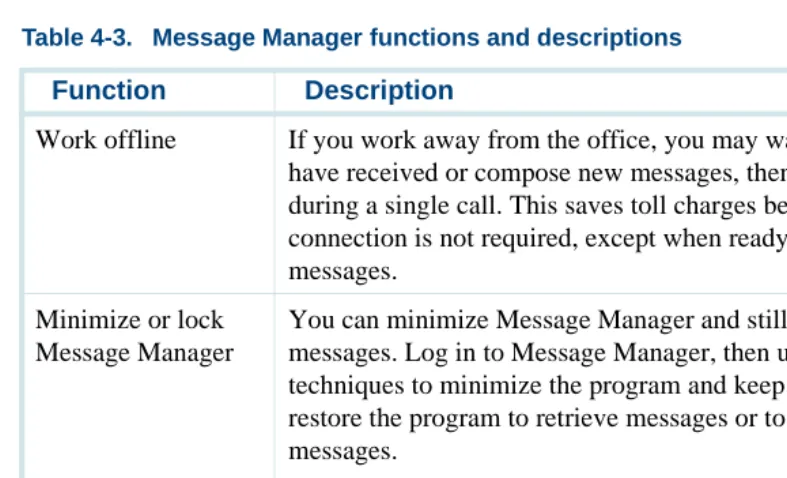
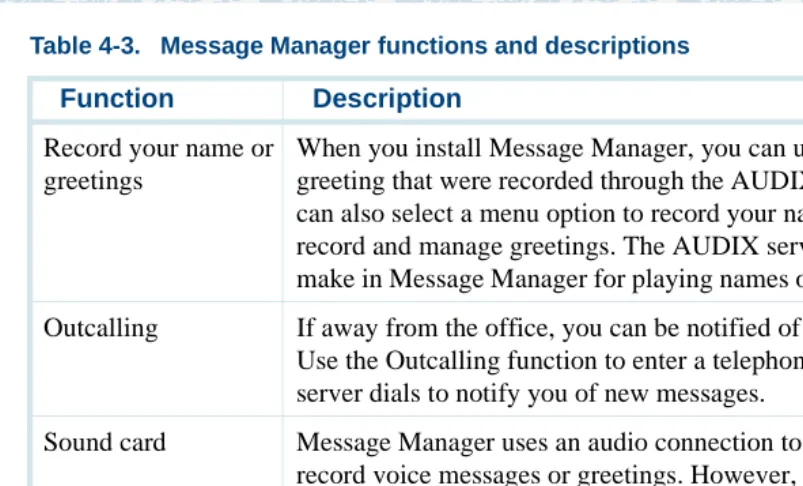
• Message Manager
• Fax Messaging
• Automated Attendant
• Bulletin Board
Voice Messaging
Users and callers instruct the AUDIX Voice Messaging feature by pressing touch-tone keys in response to detailed voice prompts.
Nuances and inflection are integral parts of person-to-person communication. The AUDIX software uses a high-quality voice-encoding algorithm known as Code-Excited Linear Prediction (CELP) to capture the nuances and subtle inflections of the human voice.
Voice Messaging is similar to an electronic mail system in that messages can be sent to other individuals or groups without directly calling the recipient. The message is stored in the recipient’s AUDIX mailbox. Recipients can access stored messages at their convenience.
Voice Messaging enables a user to:
• Send messages to other AUDIX and Message Manager users
• Listen to messages received from other AUDIX and Message Manager users
• Forward messages received with comments attached
• Reply to messages received from other AUDIX and Message Manager users
In addition to basic capabilities, the Outcalling function of AUDIX Voice Messaging allows the feature to:
• Automatically place a call from AUDIX to a user when messages are waiting
• Specify the number to be called by AUDIX when messages are waiting (may be an office, home, car, or pager)
Call Answer Call Answer answers a call and records a message when the user is unavailable. This function enables the Voice Messaging feature to:
• Answer incoming calls
• Create personal greetings for incoming calls
• Disable call answer so that a caller hears a greeting, but cannot leave a message
• Customize a set of standard greetings
• Record up to 9 different personal greetings using the Multiple Personal Greeting function
• Play a single greeting for all calls, or assign various personal greetings to play in response to different types of calls, for example, internal and external, busy and no answer, or out-of-hours
Voice Messaging languages
Multilingual support Optional multilingual functions allow callers to interact with the AUDIX application using different languages. For example, callers can follow voice prompts in
languages that may or may not match the language of the people they are calling. An administrator can install up to 9 languages on the AUDIX application and operate them simultaneously.
Users also can record personal greetings in two different languages. Prompts are delivered in the selected languages.
Customized announcements
Announcements comprise sets of spoken instructions or voice prompts in the AUDIX Voice Messaging application. For example: “To access your mailbox, press star R.”
Voice mailbox
A mailbox is a storage area on a computer disk for messages, personal greetings, and mailing lists. Lucent AUDIX users acquire a mailbox when they are administered on the application. Each user accesses this mailbox with a private password.
Callers can leave messages in a user’s mailbox, but cannot perform other operations related to the user’s mailbox. After a user logs in, the feature voices the name of the user and reports the number of new messages received. Each message consists of a message header and a message body.
The user can save, delete, reply to, or forward messages. There are three categories of incoming messages: New, Unopened, and Old. Table 4-1 on page 4-11 describes each category.
The system administrator can set the order in which these categories are played to the user.
Outgoing mailbox The outgoing section of a mailbox stores messages that users create, send, or forward. In most cases, messages remain in the outgoing section until delivered.
Table 4-2 on page 4-12 describes the outgoing mailbox categories listed in default
order. The AUDIX administrator can change this order. Table 4-1. Incoming mailbox categories
Category Description
New A message and header that a user has not listened to. The Message Waiting Indicator (MWI) on the user’s telephone turns on when a new message is present and turns off after the user has listened to it.
Unopened A message with a header that has been listened to, but not the message itself. The MWI does not stay on for this type of message.
Table 4-2. Outgoing mailbox categories
Category Description
Filed Messages that users create and save in the outgoing section of a mailbox. Users can later access these messages to modify, address and send again, or delete.
Undelivered Messages that have not been sent or messages scheduled for delivery at a future time or date. Users can review, change, or cancel messages and their addresses at any time before delivery.
Nondelivered Messages that AUDIX could not deliver. The application attempts to deliver a message 10 times (or the administered number of times), then places the message in this category. This usually indicates that the intended recipient’s incoming mailbox is full, that the recipient’s application cannot recognize or accept a message component (for example, is not fax-enabled), or that there were transmission problems (for example, with an AMIS analog line).
TCP/IP
AUDIX Transmission Control Program/Internet Protocol (TCP/IP) provides the ability to exchange messages with subscribers on other AUDIX systems. The remote system can be next to or geographically distant from the local DEFINITY ONE system.
AUDIX TCP/IP uses the proprietary AUDIX digital protocol to exchange messages, user profiles, and message-status information with other machines.
Nondeliverable Messages defined as “nondeliverable” can be rescheduled for delivery with a new address, or altered to allow forwarding, if needed.
Delivered Message headers that identify messages delivered but not yet listened to or that identify messages containing nondeliverable components. The latter type of message header is an Incomplete Delivery header. For example, if a message contains more than the four components allowable (that is, a voice, fax, text, and file attachment), the additional components are not delivered, and the message header indicates that a component was not delivered.
Accessed Message headers that identify messages that have been listened to. A message is considered accessed even if only the header has been listened to.
Table 4-2. Outgoing mailbox categories
Category Description
The digital protocol uses a digital file format, similar to a data-file transfer between two computer systems, to transmit the information. Digitally transmitted messages are communicated quickly and with excellent sound quality.
TCP/IP allows you to exchange voice, fax, text messages, and attached files from other AUDIX systems. This enables a user to:
• Address messages by name only, known as name addressing. This function applies only to administered remote recipients. Administered refers to remote use