CONSTRUCTIVIST MODEL TO ENCOUNTER LANGUAGE
MISCONCEPTIONS, PRIOR KNOWLEDGE
OVERGENERALIZATIONS AND VISUALIZATION ERRORS IN
ELECTROCHEMISTRY
MUZAMMILA AKRAM
CONSTRUCTIVIST MODEL TO ENCOUNTER LANGUAGE MISCONCEPTIONS, PRIOR KNOWLEDGE OVERGENERALIZATIONS AND VISUALIZATION
ERRORS IN ELECTROCHEMISTRY
MUZAMMILA AKRAM
A thesis submitted in fulfilment of the requirements for the award of the degree of Doctor of Philosophy (Chemistry Education)
Faculty of Education Universiti Teknologi Malaysia
iii
DEDICATION
iv
ACKNOWLEDGEMENT
The completion of my research work is one of the blessings of Almighty Allah who is the most beneficent, the most merciful and bestowed me power to complete it. My humblest and sincerest feelings for the last prophet of Allah, Hazrat Muhammad (PBUH), who will remain forever a source of guidance and beacon of knowledge for the mankind.
I feel honor to pay my regards and sincerest gratitude to my supervisor Dr. Johari Bin Surif for his guidance, valuable suggestions and humble supervision. I would like to acknowledge Prof. Dr. Yusof Arshad for providing me support and guidance. I wish to acknowledge all my research participants especially Syed Muhammad Zafar Iqbal. I feel great pleasure in expressing my deep sense of obligation to my uncle, Asad Ali Ahmad and my brother, Kamran Akram. Doctoral studies require a significant time commitment and unfailing dedication. Over the past four years, my family and friends have been supportive and understanding of the implications of my undertaking. I wish to pay my deepest gratitude to my mother, my children and especially my husband Murad Ali for his cordial co-operation. May God bless them with eternal happiness.
v
ABSTRACT
vi
ABSTRAK
Masalah kesalahfahaman telah menjadi semakin kritikal apabila pelajar perlu memperoleh konsep sains dalam bahasa kedua. Selain itu, kesalahfahaman pelajar ini berbeza-beza mengikut wilayah, budaya, jantina atau umur. Untuk menghadapi kesalahfahaman pelajar ini, adalah penting untuk mengenal pasti sebab-sebab berlakunya situasi ini. Oleh itu, kajian ini adalah untuk mengenal pasti kesalahfahaman dalam bidang elektrokimia serta sebab-sebab kesalahfahaman ini berlaku dalam kalangan pelajar sains yang menggunakan bahasa kedua di peringkat kelas menengah di Pakistan. Penyelidik telah membuktikan bahawa elektrokimia dianggap sebagai topik yang sukar bagi pelajar untuk mempelajarinya. Kajian ini membangunkan model konstruktivis untuk menghadapi kesalahfahaman bahasa, pengetahuan umum yang keterlaluan dan kesilapan visualisasi selepas mengenal pasti kesalahfahaman elektrokimia. Ia telah dijalankan dalam dua fasa. Semasa fasa-I, teori „grounded‟ telah
vii
TABLE OF CONTENTS
CHAPTER TITLE PAGE
DECLARATION ii
DEDICATION iii
ACKNOWLEDGEMENT iv
ABSTRACT v
ABSTRAK vi
TABLE OF CONTENTS vii
LIST OF TABLES xv
LIST OF FIGURES xvii
LIST OF ABBREVIATIONS xix
LIST OF APPENDICES xx
1 INTRODUCTION 1
1.1 Introduction 1
1.2 Background of the Study 6
1.2.1 Misconceptions 6
1.2.2 Reasons behind Misconceptions (Language Misunderstandings, Prior Knowledge Overgeneralizations and Visualization Error) 7
1.2.3 Use of Second Language and Misconceptions 9
1.2.4 Need of New Constructivist Model with Context to Pakistan 12
1.3 Statement of the Problem 16
1.4 Objectives of the Study 18
1.5 Proposed Research Questions 19
viii
1.6.1 Piaget Constructivist Approach 20 1.6.2 Vygotsky Constructivist Approach 20
1.7 Significance of the Study 23
1.8 Delimitations of the Study 26
1.9 Definitions of Terms 27
1.9.1 Concept 27
1.9.2 Conceptual Difficulty 27
1.9.3 Misconception 28
1.9.4 Constructivism 28
1.9.5 Electrochemistry 28
1.9.5.1 Electrochemical Cells 29
1.9.5.2 Electrolysis 29
1.9.5.3 Electrodes 29
1.9.5.4 Redox: Oxidation and Reduction Reaction 30
1.9.6 Discrepant Question 30
1.9.7 Student 31
1.9.8 Teachers 31
1.9.9 Language 31
1.10 Summary 32
2 LITERATURE REVIEW 33
2.1 Introduction 33
2.2 Difficulties in Teaching and Understanding
Electrochemistry 33
2.3 Identification of Misconceptions and its Reasons 36 2.3.1 Misconceptions regarding with Language 37 2.3.2 Misconceptions regarding with Prior Knowledge
Overgeneralizations 38
2.3.3 Misconceptions regarding with Visualization 40 2.4 Key Misconceptions in Topic of Electrochemistry 41
2.4.1 Oxidation and Reduction 42
2.4.2 Electric Current in Electrolytes 43
2.4.3 Electric Charge 44
ix
2.4.5 Electrolytic Cell 45
2.5 Constructivist Models and Misconceptions 46
2.5.1 Conceptual Change Model 47
2.5.2 Driver Teaching Model 48
2.5.3 Needham Five Phase Model 49
2.5.4 The 5E Instructional Model 51
2.5.5 Osborne Generative Model 53
2.5.6 Summary of Current Models with Justification of
New Constructivist Model 55
2.6 Constructivism 57
2.6.1 The Constructivist Learning Approaches 58 2.6.2 The Constructivist Classroom 61
2.6.3 The Constructivist Teacher 62
2.6.4 Studies Related to Constructivist Teaching
Strategies 63
2.7 Summary 69
3 RESEARCH METHODOLOGY 71
3.1 Introduction 71
3.2 Research Design of Present Study 71
3.3 Research Instruments of Phase-I 73
3.3.1 TME 73
3.3.2 Diagnostic Test Interview 74
3.3.3 Think Aloud Protocol 75
3.3.4 Concept Mapping 75
3.3.5 Discussion by Panel of Teachers 75 3.4 Procedures of Phase-I for Conducting Grounded Theory 76
3.4.1 The Research Sites 77
3.4.2 Gaining Access and Making Rapport 77 3.4.3 Initial Purposive Sampling (before Theoretical
Sampling) 78
3.5 Data Collecting and Analyzing Activities of Phase- I 78 3.5.1 First Stage Data Collecting and Analyzing
x
3.5.2 Second Stage Data Collecting and Analyzing
Activities 81
3.5.3 Third Stage Data Collecting and Analyzing Activities 83
3.6 Validation Strategies of Phase-I 85
3.6.1 Data Collection Triangulation 85
3.6.2 Researcher Expertise 86
3.6.3 Evaluation Criteria 86
3.6.4 Quality Checks during Data Collection of Phase-I 87
3.6.5 Quality Checks during Data Analysis of Phase-I 87
3.7 Summary of Phase-I 87
3.8 Research Design of Phase-II of the Study 88
3.9 Research Instruments of Phase-II 89
3.9.1 Observation Checklist 89
3.9.2 Students‟ Interview 90
3.10 Data Collection for Phase-II 90
3.11 Data Analysis for Phase-II 91
3.12 Research Ethics 92
3.13 Summary 92
4 RESULT AND DISCUSSION 94
4.1 Introduction 94
4.2 Electrochemistry Misconceptions among Second Language Science Students of Pakistan 94
4.2.1 Oxidation and Reduction 95
4.2.1.1 Item 1 of Oxidation Reduction 95
4.2.1.2 Item 2 of Oxidation Reduction 97
4.2.1.3 Item 3 of Oxidation Reduction 99
4.2.2 Electric Current in Electrolytes 100
4.2.2.1 Item 4 of Electric Current in Electrolytes 100
4.2.2.2 Item 5 of Electric Current in Electrolyte 103
4.2.2.3 Item 6 of Electric Current in Electrolytes 105
4.2.3 Electric Charge 106
xi
4.2.3.2 Item 8 of Electric Charge 108
4.2.3.3 Item 9 of Electric Charge 109
4.2.4 Galvanic Cell 111
4.2.4.1 Item 10 of Galvanic Cell 111
4.2.4.2 Item 11 of Galvanic Cell 114
4.2.4.3 Item 12 of Galvanic Cell 115
4.2.4.4 Item 13 of Galvanic Cell 117
4.2.4.5 Item 14 of Galvanic Cell 119
4.2.4.6 Item 15 of Galvanic Cell 120
4.2.4.7 Item 16 of Galvanic Cell 122
4.2.4.8 Item 17 of Galvanic Cell 124
4.2.4.9 Item 18 of Galvanic Cell 125
4.2.5 Electrolytic Cell 127
4.2.5.1 Item 19 of Electrolytic Cell 128
4.2.5.2 Item 20 of Electrolytic Cell 130
4.2.5.3 Item 21 of Electrolytic Cell 132
4.2.5.4 Item 22 of Electrolytic Cell 133
4.2.5.5 Item 23 of Electrolytic Cell 134
4.2.5.6 Item 24 of Electrolytic Cell 136
4.3 Summary of Results Regarding with Identification of the Presence of Electrochemistry Misconceptions Secondary school students of Pakistan 138
4.3.1 Some Previously Reported Misconceptions that were unreported by Majority of Second Language Science Students 138
4.3.2 Some New Misconceptions that were Previously Unreported 139
4.3.2.1 Oxidation & Reduction 139
4.3.2.2 Electric Current in Electrolytes 139
4.3.2.3 Electric Charge 140
4.3.2.4 Galvanic Cells 140
4.3.2.5 Electrolytic Cells 141
xii
4.4.1 Language Misunderstanding 143
4.4.1.1 Misunderstanding of General Vocabulary 143 4.3.1.2 Misunderstanding of Terms 144
4.4.2 Overgeneralization of Prior Knowledge due to Abstract Natured Concepts 145
4.4.3 Visualization Error 149
4.5 Panel of Teachers Discussion 151
4.5.1 The Diagnosis Phase 151
4.5.2 The Connection Phase 152
4.5.3 The Prescription Phase 153
4.5.4 The Treatment Phase 155
4.5.5 Follow up Phase 156
4.5.6 Reflection Phase 157
4.6 Summary of Phase-I Result 158
5 CONSTRUCTIVIST MODEL TO ENCOUNTER MISCONCEPTIONS (CEM2) 159
5.1 Introduction 159
5.2 Constructivist Model to Encounter Misconceptions (CEM2) 159
5.3 Phases of CEM2 Model 163
5.3.1 Diagnosis Phase 163
5.3.2 Connection Phase 165
5.3.3 Prescription Phase 166
5.3.4 Treatment Phase 168
5.3.4.1 Double Triangular-ZPD Chemistry Education Metaphor 169
5.3.4.2 Techniques of Treatment Phase 171
5.3.4.3 Language Scaffolding Techniques 171
5.3.4.4 Task Based Inquiry 172
5.3.4.5 Use of Computer Animation 173
xiii
5.3.4.7 Use of Visualization Dual-Coding
Theory (DCT) 175
5.3.5 Follow up Phase 177
5.3.5.1 Self-Assessment 178
5.3.5.2 Peer Assessment 179
5.3.6 Reflection Phase 180
5.4 Modelling Mechanism behind CEM2 Model 182
5.5 Sample Lesson Plan of CEM2 model 185
5.5.1 The Diagnosis Phase 186
5.5.2 The Connection Phase 186
5.5.3 The Prescription Phase 187
5.5.4 The Treatment Phase 188
5.5.5 The Follow up Phase 189
5.5.6 The Reflection Phase 189
5.6 Phase-II Result and Discussion 190
5.6.1 Observation of CEM2 Model-Trained Teachers 190
5.6.1.1 Narrative Summary Example 191
5.6.2 Students‟ Interview 193
5.6.2.1 Microscopic level of Representation of knowledge 193
5.6.2.2 DCT of Visualization 194
5.6.2.3 Contextual Communication 195
5.6.2.4 Task Based Inquiry 196
5.6.2.5 Discrepant Questions 197
5.7 Summary 198
6 CONCLUSIONS, IMPLICATIONS AND SUGGESTIONS 199
6.1 Introduction 199
6.2 Conclusions 199
6.3 Conclusions Regarding with Identification of the Presence of the Electrochemistry Misconceptions 200 6.4 Conclusions Regarding with Reasons behind the Electrochemistry Misconceptions 201
xiv
6.4.2 Overgeneralization of Prior Knowledge due to
Abstract Natured Concepts 202
6.4.3 Visualization Error 203
6.5 Conclusions Regarding with Development of a Constructivist Model to Encounter Misconceptions (CEM2) 203
6.6 Conclusion Regarding with Effect of CEM2 Model 206
6.7 Implications of the Present Research 208
6.7.1 Implications in Diagnosing the Misconceptions 208
6.7.2 Implications to the Teaching & Learning Chemistry 209
6.7.3 Implications to the Curriculum 211
6.7.4 Implications to the Assessment 212
6.7.5 Implications to the Reflection 213
6.7.6 Implications to the Teachers Training 213
6.7.7 Implications to the Constructivist Theories 215
6.8 Suggestions 216
6.9 Summary 218
REFERENCES 220
xv
LIST OF TABLES
TABLE NO TITLE PAGE
3.1 Sample Questions used for Diagnostic Test Interview 74
3.2 Sample Questions for Teacher Group Discussion 76
3.3 Illustration of the Open, Axial, Selective Coding and
Conditional Matrix 79
3.4 Level of Second Language Science Students‟
Misconceptions in Electrochemistry 80
3.5 Sample of Memo showing Axial Coding 82
3.6 Sample of Memo showing relationship between
Initial Open coding, Axial Coding and Selective Coding 83
3.7 Sample Questions Focused during Observation 89
3.8 Sample Questions asked during Students‟ Interview 90
4.1 Item 1 of Oxidation & Reduction 96
4.2 Item 2 of Oxidation & Reduction 97
4.3 Item 3 of Oxidation & Reduction 99
4.4 Item 4 of Electric Current in Electrolytes 101
4.5 Item 5 of Electric Current in Electrolytes 103
4.6 Item 6 of Electric Current in Electrolytes 105
4.7 Item 7 of Electric Charge 107
4.8 Item 8 of Electric Charge 108
4.9 Item 9 of Electric Charge 110
4.10 Item 10 of Galvanic Cell 112
4.11 Item 11 of Galvanic Cell 114
4.12 Item 12 of Galvanic Cell 116
4.13 Item 13 of Galvanic Cell 117
xvi
4.15 Item 15 of Galvanic Cell 121
4.16 Item 16 of Galvanic Cell 122
4.17 Item 17 of Galvanic Cell 124
4.18 Item 18 of Galvanic Cell 126
4.19 Item 19 of Electrolytic Cell 128
4.20 Item 20 of Electrolytic Cell 130
4.21 Item 21 of Electrolytic Cell 132
4.22 Item 22 of Electrolytic Cell 133
4.23 Item 23 of Electrolytic Cell 135
4.24 Electrolytic Cell 136
4.25 Rating the sources based on Student‟s Responses 142 4.26 Language Misunderstanding (Misunderstanding of
general vocabulary) 144
4.27 Language Misunderstanding (Misunderstanding of Terms) 145 4.28 Prior Knowledge Overgeneralization due to Abstract
Natured Concepts 147
xvii
LIST OF FIGURES
FIGURE NO TITLE PAGE
1.1 Students Result in SSC (Secondary School Certificate) Examinations in the subject of Chemistry for
Class IX (2009-2013) 4
1.2 Conceptual Framework of the Study 23
2.1 Needham‟s Five Phase Constructivist Model 50
2.2 5E‟s Instructional Model 52
2.3 Osborne Generative Model 54
2.4 Chemical Triangle 68
3.1 Research Process of Phase–I and Phase–II of Present Study 72
4.1 An Electrolytic Cell 136
5.1 Constructivist Model to Encounter Misconceptions (CEM2) 162
5.2 Diagnosis Phase of CEM2 model 164
5.3 Connection Phase of CEM2 model 166
5.4 Prescription Phase of CEM2 model 167
5.5 Double Triangular-ZPD Chemistry Education Metaphor
of Treatment Phase 170
5.6 A Simple Electrolytic Cell 172
5.7 A Lemon battery (Galvanic cell) 172
5.8 Comparison between Textbook diagram and Animated
Diagram of an Electrolytic Cell 173
5.9 Comparison between Textbook diagram and Animated
Diagram of a Galvanic Cell 173
5.10 Difference between a Conductor and an Electrolyte 174 5.11 Co-construction of Visualizable Model of Galvanic Cell
xviii
5.12 Follow up Phase of CEM2 model 178
5.13 Sample of T Chart showing Differentiation between
Electrochemical Cells 180
5.14 Reflection Phase of CEM2 model 180
5.15 Flow Chart of Constructivist Model to Encounter
Misconceptions (CEM2) 182
5.16 Students Made Initial Model of Galvanic Cell 183
5.17 Students Made Target Model of Galvanic Cell 184
5.18 Modelling Mechanism behind CEM2 Model 184
5.19 Initial Model of Galvanic Cell during Lesson 187
5.20 Visualizable Models Showing Scientific Concepts of
Galvanic Cell 190
5.21 Animated Diagram of a Galvanic Cell 194
5.22 Animated Diagram of a Galvanic cell Showing
Mechanism at Electrodes 194
xix
LIST OF ABBREVIATIONS
TME - In this study, TME stands for Test designed to identify the Misconceptions in Electrochemistry
CEM2 - Constructivist Model to Encounter Misconceptions
IX CLASS - In this study, it means ninth Class of Government Secondary Schools
DCT - Dual Coding Theory of Visualization PKO - Prior Knowledge Overgeneralization
VE - Visualization Error
LM - Language Misconceptions
xx
LIST OF APPENDICES
APPENDIX TITLE PAGE
A Consent Letter for TME 231
B Test designed to identify Misconceptions in
Electrochemistry (TME) 232
C Sample Questions used for Diagnostic Test
Interview (Phase-I) 235
D Thick Aloud Protocol Sheet (Phase I) 236
E Students Concept Mapping of Galvanic Cell
during Phase-I 237
F Panel of Eminent Chemistry Teachers Participated
in the Group Discussion 238
G List of Chemistry Teachers of Secondary classes
participated in Group Discussion 239
H Sample Questions for Teacher Group Discussion 240 I Time Table for Data Collection and Data Analysis
Activities (Phase I) 241
J Permission Letter 242
K1 Focus of Observation (Phase II) 243
K2 Observation Checklist (Phase II) 244
L Sample Questions asked during Students‟
Interview (Phase-II) 245
M Sample of Students Solved Transcript of TME
showing New Electrochemistry Misconception 246 N Sample of student‟ Transcript of Diagnostic
xxi
O Expert Review & Subject Matter Experts Evidence
for Validation (TME) 251
P Chapter 7 Worksheet 1 252
Q Chapter 7 Worksheet 2 253
R Task Based Inquiry (Electrolytic Cell in
Cooperative Groups) 256
S Task Based Inquiry (Lemon battery developed with
the use of low cost materials) 257
T Use of Dual Coding Theory of Visualization
during Phase-II 258
U Sample of Students‟ solved Transcript of T
Chart (Phase-II) 259
V Sample of Solved Worksheets using Bilingual
Education Techniques (Phase-II) 260
W Concept Mapping during Phase-II Showing Initial
Model and Target Model of Galvanic Cell 261
CHAPTER 1
INTRODUCTION
1.1 Introduction
The relevance of science as a solid rock for the technological progression of any nation cannot be underestimated. Every citizen needs a basic knowledge of science and technology to function productively and intelligently in this era. Chemistry is the field of science filled with interesting phenomena tempting for understanding and explaining every occurrence in the natural and manufactured world. Its study has incredible importance to humanity for its ability to explain natural phenomena and everyday happenings. It plays central role in current technological development of the world. Its knowledge is important in the manufacturing of fertilizer, food storage and processing, management of natural resources, provision of health facilities as well as favorable living environment. The science of chemistry creates a natural link between home and school. It provides the means through which children understand the world around them and explore the wider implications of science (Bomide, 1985).
2
chemistry. Nevertheless, it requires a comprehensive effort to assess conceptual knowledge of chemistry that school students learn in secondary schools (Ogude, 1994; Ozkaya, 2002). Concept formation and learning attitude towards chemistry at secondary school depends upon various factors. Many research studies have indicated that concept formation in chemistry is a big challenge at all levels of schooling for many students and even for teachers (Dawson, 1978; Taber, 2002).
Concepts are thoughts or notions formed in the mind as the product of careful mental activity. Concepts formed when the ideas or thoughts are developed based on common properties of objects or events by the process of abstraction. These are powerful building blocks for learning. These concepts play significant role in the teaching of chemistry and for further learning (Taber, 2002). When concepts become difficult for students or forms misconceptions, they tend to shy away from questions set on these concepts during any examination leading to poor performance. Difficulties ascended when students‟ ideas or thoughts became different from the definitions accepted by experts. These incorrect ideas referred as misconceptions or alternative conceptions (Griffiths, 1994; Nakhleh, 1992). Several studies in the chemistry education literature dealt with the misconceptions of basic concepts of chemistry at schools. Duit (2007) conducted a study on students‟ misconceptions in science and found that instruction often failed to engage those ideas that students carry to the classroom. Student‟s misconceptions in chemistry created a major problem of concern to science educators, teachers and students (Ozmen, 2004). Electrochemistry regarded as one of the most difficult chemistry concepts in which both pre-service teachers and students have learning difficulties (Nakhleh, 1992; Ogude, 1994; Ozkaya, 2002).
3
For the current study, topic of electrochemistry was selected for a number of reasons as cited by Akram (2014). For example, electrochemistry considered as a difficult topic for students to learn and for teachers to teach. A survey conducted to rate the most difficult chemistry topics at schools and the top three were chemical equilibrium, the mole and oxidation-reduction reactions (Finley, Stewart and Yarroch, 1982). Principles of electrochemistry had general applications used in routine e.g. electroplating established based on the principle of electrolytic cell. Students should acquaint such knowledge (Ahtee, Asunta and Palm, 2002). Moreover, the topic of electrolysis was common in physics and chemistry. Sometimes, it promoted confusion and students did not freely assimilate their knowledge across physics and chemistry (Taber, 1998).
Garnett and Treagust (1992b) investigated high school students understanding of electrochemistry in terms of electrochemical cells and identified students‟ misconceptions. In 1997, Sanger and Greenbowe replicated the study of Garnett and Treagust (1992b) with college chemistry students and found similar findings with them as students had misconceptions in galvanic, electrolytic and concentration cells. Obomanu (2012) also identified the conceptual difficulties and misconceptions of Nigerian secondary school students in electrolysis through concept inventory. Moreover, Sanger and Greenbowe (1997a) emphasized that identifying misconceptions was important to help learners understand this topic meaningfully. The misconceptions of students may change with the change in variables like gender, age, culture, religion and geographical region (Losh, 2003).
4
Figure 1.1 Students Result in SSC (Secondary School Certificate) Examinations in the subject of Chemistry for Class IX (2009-2013), Adapted from Akram (2014).
Akram (2014) described the factors that have contributed to this problem. These factors included poor methods of instruction, instruction in second language, laboratory inadequacy, poor science background and passive role of students etc. Usually students had problems in understanding the complex and abstract natured phenomena of chemistry like oxidation and reduction reactions and electrolysis (Ahtee, Asunta and Palm, 2002). Misconceptions in electrochemistry were common and students had difficulty to understand (Obomanu, 2012). Researchers had made many attempts in many advanced countries to assist students learning by identifying the misconceptions experienced by students and possible solutions to overcome this problem (Sanger and Greenbowe, 1997a and 1997b; Niaz and Chacon, 2003; Ozmen, 2004; Ozkaya et al., 2006). Some studies also suggested ways of remedying conceptual difficulties about electrochemistry in the literature. These studies used one conceptual change method as a basic technique that is computer animations (Yang andre and Greenbowe, 2003) or computer-assisted learning (Talib, Matthews and Secombe, 2005) or conceptual change instruction (Huddle, White and Rogers, 2000). However, in Pakistan and in many other developing countries, very little research work has been done in identifying the misconceptions of their own students particularly in the abstract natured chemistry concepts. Most Pakistani Schools are not well equipped to use computer-assisted learning as a single solution for encountering the misconceptions (Akram, 2014).
5
language of all the students of Pakistan. When they tried to understand the concepts, they translated it into Urdu that might develop misconceptions (Halai, 2007). Both Garnett and Treagust (1992a) and Ogude and Bradley (1998) found that inappropriate language in explaining the electrochemical concept might cause misconceptions. Various research studies indicated that students who study main courses in a foreign language had difficulty connecting new and old information meaningfully. Pollnick and Rutherford, (1993) exposed that learning in chemistry through the medium of second language developed problems for students. Johnstone and Selepeng (2001) conducted an experimental research and concluded that students who were learning science in a second language lost at least 20 percent of their capacity of understanding and reasoning.
Thus, the problem became more critical when second language was used in communicating the scientific concepts. Cassels and Johnstone (1980) exposed that the non-technical words associated with science were a cause of misunderstanding for students. Words, which were understandable in normal English usage, changed their meaning (sometimes quite slightly) when used in science situation. Akram (2014) reported that language misunderstanding found to be an important factor that caused conceptual difficulties among secondary school students of Pakistan. Hence, there was a great need to help secondary school students who were learning chemistry in their second or sometimes third language to overcome their misconceptions of electrochemistry. The present study intended not only to diagnose misconceptions but also tried to identify the reasons behind these misconceptions. Moreover, this investigation also shed light on how students develop misconceptions. This study anticipated making logical connection between knowledge in a second language instructed to students and the students developed misconception as a result.
6
constructivist model for second language science students to encounter electrochemistry misconceptions after diagnosing the misconceptions and its reasons.
1.2 Background of the Study
The background of the study comprised of the concept of misconceptions, reasons behind misconceptions, use of second language and misconceptions and need of new constructivist model with context to Pakistan. All these headings explained in the following.
1.2.1 Misconceptions
Skelly and Hall (1993) defined a misconception as a mental representation of a concept that did not match to a proper scientific theory. They divided misconception into two categories: experiential and instructional. Experiential misconception referred to as alternative, intuitive or native conceptions. In experiential misconception, a concept tried to be understood to some extent, through everyday experience and interaction with the phenomena involved. Meanwhile instructional misconception defined as misconceptions related to these more abstract phenomena resulted from some instructional experience. Students‟ misconceptions in science found a major problem of concern to science educators, teachers and students. The researchers and teachers were interested to know the nature of misconceptions, the source of these misconceptions and the effects of instruction on elimination of misconceptions (Ozmen, 2004). During concept formation, the students tried to connect new knowledge into their existing schema. If they held misconceptions, these misconceptions obstructed their subsequent learning. The prior misconception developed further misconceptions (Nakhleh, 1992).
7
chemistry, caused more confusion. Students did not freely assimilate their knowledge across physics and chemistry (Taber, 1998). The workshop, Integrated Physics and Chemistry Modeling Workshop, was conducted at Arizona State University (ASU) in June 2001. This workshop was carried out to identify the key misconceptions in chemistry and physics. The key misconceptions in electrochemistry were selected from catalog recommended by eminent participants of workshop. The electrochemistry key misconceptions were used in TME (Test designed to measure misconceptions in electrochemistry) for identifying the presence of misconceptions among second language science students of Pakistan for present study.
Science student often held misconceptions and it became difficult for the teachers to reorganize their thinking. Misconceptions became resistant to instruction because learning involved radically reorganizing students‟ knowledge. It was not easy to reorganize students‟ existing ideas towards scientific ideas. Barke (2009) suggested that every science teacher should know his own students‟ misconception. Students‟ misconceptions were deeply rooted and extremely complex by a number of sources. Likewise, the students‟ misconceptions often vary by geographical region, culture, religious background, gender and age (Losh, 2003). In order to diffuse student‟s misconceptions, it is essential to identify the reasons behind these misconceptions.
1.2.2 Reasons behind Misconceptions (Language Misunderstandings, Prior Knowledge Overgeneralizations and Visualization Error)
8
Ozkaya, Uce & Sahin (2003) gave the reasons of considering the electrochemistry as a difficult subject. They argued that the particles and their movement could not be seen with the eye and thus teaching of the abstract natured electrochemistry topic was challenging. They also recommended further research to improve instruction to encounter this problem. Students faced difficulties in understanding the abstract chemical processes especially at microscopic and symbolic levels. Sometimes, they overgeneralized prior knowledge in constructing the new concepts due to abstract natured chemistry topics (Garnett & Treagust, 1992; Lee & Arshad, 2009; Lin, 2002; Sanger & Greenbowe 1997a; Sanger & Greenbowe 1997b).
Some researchers identified the main reasons of misconceptions as inconsistent terminology during instruction and in textbooks that leads to generalizations or overgeneralizations by students (Abimbola, 1988; Ogude & Bradley, 1994). Ozkaya (2002) investigated conceptual understanding and difficulties in acquiring scientific concepts of electrochemistry. He recognized this problem due to inadequate explanations of the electrochemistry concepts in the textbook. Students who learn electrochemistry from most high school textbooks had conceptual difficulties on this topic (Birss and Truax, 1990). Textbooks and its diagrams provided visual representation to the students. Improper labelling of textbooks diagrams developed visualization misunderstandings. Vavra (2011) described the term visualization used to name a representation, refer to the process of creating a graphical representation or as a synonym for visual imagery. Students visualized the (-) sign as electrons in electrolyte. Improper visual presentation in the textbooks originated some electrochemistry misconceptions (Garnett & Treagust, 1992a, 1992b; Ozkaya, 2003).
9
teachers failed to provide accurate information to their students and they presented the concepts poorly. Teachers could also be a source of misconceptions because most students regarded their teachers as experts and considered their words correct (Ogude, 1994; Ozkaya, 2002).
Terms with multiple meanings caused general confusion to students in abstract natured chemistry concepts. For example, “Electrolysis definition interpreted by students as breaking apart chemically of substances due to electricity”, this misinterpretation could develop alternative concepts about electrolysis (Schmidt, 1997). Many school-made misconceptions developed because there were problems with the specific terminology and the scientific language. For example, students could not differentiate properly between substances, particles and chemical symbols (Barke, 2009).
1.2.3 Use of Second Language and Misconceptions
Research in science education indicated misconception contribution on students learning outcomes. Misconceptions should not be considered a simple problem and could not be taken for granted. The problem of misconception became worse when science students had to acquire scientific concepts in second language. Kocakulah, (2005) conducted a study that described the effect of teaching mathematics and science in a second language. He found that teaching sciences and mathematics through a medium of second language posed conceptual and linguistic problems among students.
10
Comins (1993) discussed the different causes of misconceptions and exposed that usually students focused on the superficial sources of knowledge. Language misunderstanding considered as one of the basic factor that developed the misconceptions. Words in everyday usage had specific uses in sciences that students could not understand due to superficial thinking. Mowshowitz, (2013) discussed the problems of terminology that caused language misconceptions in science education. For example, confusion of the words that had different ordinary meanings and the technical meanings used in sciences. Some scientific terms had technical meanings that were very different from their common sense meanings. For example, the word spontaneous in chemistry did not mean, very quick. It meant without net input of energy. Using words that had technical meanings and not realizing it. For example, if the house burnt down, the house would destroy (in the English sense). However, the atoms were in the house had not been altered. Sometimes, students got confused in using similar but not identical terms. For example, a reasonable, nonscientific interpretation of a supernova was a bigger nova.
Bird and Welford (1995) also showed that there was significant difference between British school learners and second language learners. The second language students‟ performances in science examinations were poor comparatively. Poor knowledge of grammar rules and complex content related vocabulary developed problems for second language learners to read and understand the text. Whereas, first language learners had inherent knowledge of learning their language at an early stage, did not show these problems (Johnstone and Selepeng, 2001).
11
Pakistan considered as a linguistically diverse country and approximately 57 languages were reported to speak throughout the four major provinces of country (Khan, 2002). Whereas, Urdu is the national language of country and it is the primary language. Less than 10 percent of the populations speak Urdu others preferred to speak their native mother languages (Laporte, 1998). English considered as the preferred language of education. In English medium science and mathematics classrooms, the learning process became more complex. It was due to the socio-cultural tools that students used often included their first language, which was different from their language of instruction. For example, students moved from the language of instruction to their own language during learning the science and mathematics. Students‟ concentration divided into two levels. They had to understand the language involved at first level and then they had to understand the scientific concepts involved at second level. Science students needed to understand the language of instruction before they made sense of the scientific concepts encoded in that language. The students used Urdu in thinking during learning process. This attempt of interpreting the language of instruction (second language) into students‟ first language developed misconceptions in multilingual classrooms of Pakistan (Halai, 2007).
12
Teachers should use a multidisciplinary approach that integrated technology with effective teaching and learning practice. Ordinary instructional methods like lectures, labs or simply reading texts, were not found successful for challenging secondary school students misconceptions in electrochemistry (Akram, 2014). Various teaching models agreed that students became active in construction of knowledge by asking questions, experimenting and communicating with their classmates. Before proceeding further, it would be important to have a general view of the various constructivist models that help teachers in developing concept formation. A comprehensive analysis of existing constructivist models and how these models helped in developing the new constructivist model with context to Pakistan was described in the following.
1.2.4 Need of New Constructivist Model with Context to Pakistan
During the 1980‟s and 90‟s a constructivist model of learning appeared to be the dominant theme in science education. Research into students‟ misconceptions was very extensive. However, Millar (1989) recognized that a model of learning was not the same as a model for teaching and that how constructivist models of learning might be translated into specific teaching approaches was far from clear. Richardson (2003) argued the important unresolved issue related to the difficulty in translating a theory of learning into a theory of teaching. This issue demanded more researches focused on students learning using constructivist instruction.
13
Current constructivist instructional models embedded in a Piagetian-focus (1970) that seeks to resolve student misconceptions properly. Models that were more progressive also included the Vygotskian notion of scaffolded learning through the principle of zone of proximal development (1978). Collectively, the work of Piaget and Vygotsky provided an appropriate foundation for differentiating instruction and learning (Tomlinson 2003). Researchers identified many significant understandings in helping to improve student learning. However, teachers often find it difficult to assimilate solid research findings into a coherent structure for classroom teaching and learning (Marshall, 2009). Most of the secondary school students are in concrete level, therefore, the teachers tried to link between concept and concrete experiences for probing misconceptions (Abraham, Williamson and Westbrook, 1994). The correction of misconceptions required direct experience. The new constructivist model proposed task based inquiry to develop link between concept and concrete experiences to encounter misconceptions.
14
Driver teaching model (1985) was based on constructivism, which gave students opportunity to make their own conceptions about a particular topic. Constructivist views of learning in science suggested that learners could only make sense of new situations in terms of their existing understanding. Learners used prior knowledge to interpret observations. Learners developed their concepts by adding to or modifying their existing ideas (Driver, 1985; Osborne, 1983). Osborne generative model (1983) gave premise that learners‟ prior knowledge might or might not be compatible with the new concept. The implications of such a view demanded teachers to find out the learners‟ ideas in order to consider these in their teaching. Teachers then needed to provide experiences that challenge the learners‟ existing understanding in order to help them restructure their ideas. Guidance was available on the ideas that learners held and on the range of methods, which researchers used to elicit the learners‟ ideas (Driver, 1985). However, the guidance available to teachers on how to promote restructuring of the learners‟ ideas was much more limited (Claxton, 1986; Trumper, 1990). The new proposed model would help to use identified misconceptions for restructuring the students‟ alternative ideas. Transformation of the identified misconceptions into anticipated questions and discrepant questions would help second language science students to assimilate and accommodate the new appropriate concepts. When students internalized new words in the presence of another knowledgeable person then they found themselves in the zone of proximal development (ZPD). It referred to the place for learning located somewhere between the student‟s present and latent understanding (Vygotsky, 1978). Students could understand the concepts consciously only when concepts were explained in a related context. The technical aspects of electrochemistry demanded the support of more knowledgeable person. The new proposed model would help second language science students to internalize the meaning of new words using language scaffolding with context in the presence of more knowledgeable peer or teacher.
15
assess their understanding of a concept. Keogh and Naylor (1993) mentioned a significant issue about how to make constructivism applicable to class, especially with 30 or even 40 or more students. Moreover, how the learner‟s ideas could be considered in planning suitable restructuring activities was a matter of concern (Keogh and Naylor, 1993; Claxton, 1986; Trumper, 1990). In principle, the suggestion that teachers should plan activities based on what the learners already know and understand looked like an obvious way to proceed. The problem arose with the sheer practicality of attempting to do that with a class of 40 or more learners. Even if the teacher has adequate information about the learners‟ initial ideas, attempting to respond to their individual ideas could become a difficult exercise in classroom management (Keogh and Naylor, 1993). The new proposed constructivist model would help teachers to experience considering students‟ ideas in manageable ways in a large class. It would facilitate teachers to make sense of how to work with a whole class.
A critical look at the status of science education in Pakistan revealed a dismaying situation, which was reflected in students‟ low achievement in core science subjects such as chemistry, biology, mathematics and physics, particularly at secondary level (Ali, 2013). The National Education Policies in Pakistan have considered quality science education in particular as a means to achieving radical social development (Government of Pakistan, 2009). The ultimate learning outcomes intended in the National Curriculum required from teachers to adopt a comprehensive vision of pedagogies and engage in practices premised on constructivist philosophy of learning that emphasized centrality of students in the learning process. How this happened in reality? Ali (2013) experienced alludes to a wide gulf that existed between the ideal goals and what actually happened in most of chemistry classrooms in Pakistan. Haider (2014) described the current situation of secondary schools in Pakistan i.e. teacher was active while students were just passive listeners in classrooms. The large size of the class created a distance between teacher and student. Ali (2013) concluded that social, contextual and cultural factors combined to affect students‟ ability to engage in science learning and their achievement in Pakistan.
16
English is the second language or sometimes third language for all the students of Pakistan. When science students tried to understand the meanings of scientific concepts in a second language, they translated it into Urdu that developed misconceptions (Halai, 2007). The use of a second language as a language medium of instruction developed learning difficulties arising out of language barrier in Pakistan (Aziz et al., 2014). Moreover, Akram (2014) investigated language misunderstanding as an important factor of developing electrochemistry misconceptions among secondary school students of Pakistan. The high demands of conceptual learning required constructivist based teaching models to be implemented in science classes at Pakistan to letting go of transmission-oriented practices (Ali, 2013). The context of Pakistan with second language, large class size and passive role of learners demanded to improve the current constructivist models. Viewed against this background, the new constructivist model was needed to be developed for second language science students of Pakistan by using constructivist strategies in a manageable way in a large class to encounter misconceptions.
1.3 Statement of the Problem
17
electrolysis was common in physics and chemistry. Sometimes, it promoted confusion and students did not freely assimilate their knowledge across physics and chemistry. Student misconceptions were deeply rooted and extremely complex by a number of sources. Likewise, the student misconceptions often vary by geographical region, culture, religious background, gender and age (Losh, 2003). Barke (2009) suggested that every science teacher should know his own students‟ misconception. Wescott (2005) suggested that instructors should recognize the misconceptions of their own students as a first step in helping students confronting misconceptions.
18
Although misconceptions in chemistry education had been established, yet their role during the learning process was poorly examined. How students develop misconceptions was still to be investigated (Hamza & Wickman, 2007). Further research was needed with context to use of second language for improving teaching and learning activities in electrochemistry by removing students‟ misconceptions. Clement (2008) examined the role of discrepant questioning in modification of cognitive conflict and accommodation. However, some issues needed to be investigated. For example, how to use identified misconceptions as anticipated and discrepant questions, how to develop disequilibrium state among second language science students for assimilation and accommodation. Constructivist theories recommended teachers to encourage their students in realizing their cognitive conflicts to change their misconceptions (Duit, 1991). Students could understand the concepts consciously only when concepts were explained in a related context. The technical aspects of electrochemistry demanded the support of more knowledgeable person. A comprehensive effort should be made to combine harmoniously the different teaching techniques used in various constructivist models for implementing manageably in large class with context to second language.
For this reason, it was aimed to encounter the students‟ electrochemistry misconceptions after identifying its reasons and develop a designed teaching sequence in the form of a new constructivist model. Moreover, the present study intended to make a logical connection between knowledge presented to students in a second language and their developed misconceptions as a result. Therefore, the present study was designed to develop a constructivist model to encounter the language misunderstandings, prior knowledge overgeneralizations and visualization errors for second language science students of secondary class in Pakistan.
1.4 Objectives of the Study
i. To identify the presence of electrochemistry misconceptions among second language science students of secondary class in Pakistan.
ii. To investigate the reasons behind the electrochemistry misconceptions among second language science students of secondary class in Pakistan.
19
knowledge overgeneralizations and visualization errors for second language science students of secondary class.
iv. To study the process of new proposed constructivist model to encounter electrochemistry misconceptions of second language science students in secondary class.
1.5 Proposed Research Questions
So present study was designed to seek the answers to the following questions
i. What electrochemistry misconceptions were identified among second language science students of secondary class in Pakistan?
ii. What were the reasons investigated behind the electrochemistry misconceptions among second language science students of secondary class in Pakistan?
iii. Was a new proposed constructivist model encountered language misunderstandings, prior knowledge overgeneralizations and visualization errors of second language science students of secondary class?
iv. How did new proposed constructivist model encounter electrochemistry misconceptions of second language science students in secondary class?
1.6 Conceptual Framework of the Study
20
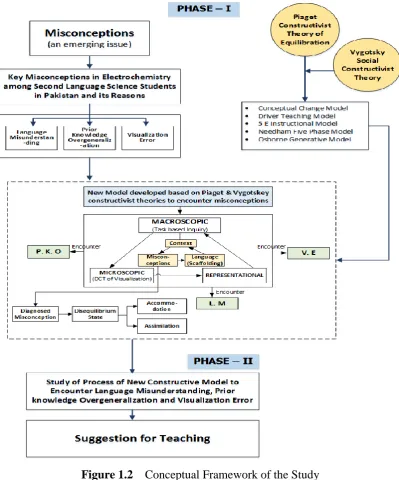
perception provided a strong base in developing the new instructional model. The conceptual framework of the study was illustrated in Figure 1.2, which represented the use of constructivist approaches in developing an instructional model for meeting the misconceptions in the difficult topic of electrochemistry. The theoretical foundation of new model was consisted on two validated and reliable constructivist approaches of Piaget theory of equilibration and Vygotsky social constructivism.
1.6.1 Piaget Constructivist Approach
Piaget (1950) considered three important processes in cognitive development: assimilation, accommodation and equilibration. If learner used existing concepts to deal with new phenomena, this referred to assimilation. When existing concepts of learner were inadequate to grasp new phenomena, then he tried to restructure his central concepts. This status referred as accommodation. Equilibrium, determined the child‟s transition from one stage of development to the next. At the beginning, the learner used his logical structure that work well but toward the end of the stage, he became dissatisfied with his structure. This dissatisfaction developed disequilibrium state and it was essential for a new equilibrium. According to Piaget, equilibrium encompassed both assimilation and accommodation. Posner (1982) defined conceptual change in terms of assimilation and accommodation. Moreover, he stressed that there must be dissatisfaction with existing conceptions for conceptual change.
The theoretical underpinning of the new model was based on the process of equilibration of Piaget, with the modification of use of identified misconception. Here, identified misconceptions helped to produce disequilibrium state that lead to assimilation and accommodation.
1.6.2 Vygotsky Constructivist Approach
21
language was a mean of expressing thoughts that had already developed (Gredler, 1997). For Vygotsky, language role was central to the development of thought. He considered words as the means through which thinking developed. It was important to go beyond direct experience in teaching scientific concepts and to mediate experience with words (Howe, 1993). Vygotsky focused on process of conceptual development rather than product. His interest was how the students perform during different task situations.
Vygotsky (1962) believed that learning process occurred when students internalized the meanings of new words and after that; they became able to use them. When students internalized new words in the presence of another knowledgeable person then they found themselves in the zone of proximal development (ZPD). It referred to the place for learning located somewhere between the student‟s present and latent understanding (Vygotsky, 1978). Students could understand the concepts consciously only when concepts were explained in a related context using language (Vygotsky, 1978). The new model was based on theoretical underpinning of Vygotsky work. It believed that students could understand the scientific concept when it was explained in a related context. Moreover, the technical aspects of electrochemistry demanded the support of more knowledgeable person. The new proposed model would help second language science students to internalize the meaning of new words with ZPD and contextual communication.
Constructivist perspectives on learning had given rise to a number of instructional models e.g. Conceptual Change model, Driver teaching model, 5E Instructional model, Needham‟s Five-Phase Constructivist Model, Osborne Generative Model. Theses constructivist models facilitated the present study in developing a modified constructivist instructional model for confrontation of misconceptions with context to Pakistan. The context of Pakistan with second language, large class size and passive role of learners demanded to improve the current constructivist models.
22
approaches provided the theoretical foundation of new model. The new model developed the Double Triangular-ZPD chemistry education metaphor (Figure 1.2) for the current study. Double Triangular-ZPD chemistry education metaphor hybridized the triangle of macroscopic, microscopic, representational, with another triangle of misconceptions, context and language with the idea of ZPD. This metaphor believed that language scaffolding with three level of representation helped to encounter all the misconceptions identified due to language misunderstandings (L.M), prior knowledge overgeneralizations (P.K.O) and visualization errors (V.E). Moreover, a teacher might develop dissatisfaction among student‟s existing cognitive structure during instruction with context of identified misconceptions. It might help students to accommodate and assimilate the new appropriate concept in their minds instead of misconception. The detail of this metaphor was given with the explanation of new model in chapter 5.
23
Figure 1.2 Conceptual Framework of the Study
1.7 Significance of the Study
24
concerning many aspects of chemical phenomena were prevalent among students (Cole and Todd, 2003; Hamza and Wickman, 2007). Concepts construction process of student could be diverted by misconceptions. For that, it was so important for teachers to know their students misconception. Barke (2009) suggested that every science teacher should know their students‟ misconception for his or her lessons.
Moreover, how students develop misconceptions and how they justify their non-scientific concepts or alternative conceptions were questions that still needed to be investigated (Hamza & Wickman, 2007). Schmidt (1997) raised the question for further researches that need to be investigated. The concerned question was, whether there were other concepts and terms that originated misconceptions in the complex concepts such as electrochemistry among students. How students develop misconceptions in using second language as medium of instruction, was a question of new dimension that could not be considered till now. The question, how students‟ misconception could be encountered with context of using second language and saturated classes were not given due consideration (Akram, 2014). Furthermore, Morris (2008) emphasized on exploring the best possible sources behind students‟ diagnosed misconceptions in electrochemistry for further research. Clement (2008) examined the role of discrepant questioning in modification of model element. However, the questions further needed to investigate i.e., how anticipated and discrepant questions helped to assimilate and accommodate the new appropriate concept in students‟ minds and how diagnosed misconceptions could be used as anticipated and discrepant questions.
25
Common assessment applied on these concepts could not explore misconceptions because students had never been assessed on their concept and scientific process understanding. There were several studies conducted to determine misconceptions about electrochemistry in the literature (e.g. Schmidt, 2007; Sanger and Greenbowe, 1997; Garnett and Treagust, 1992; Ozkaya, 2002; Hamza and Wickman, 2007). It was a need in teaching to focus on the topics in which students held misconceptions and that influenced their performance for future learning. There should be undertaken studies to find out learning obstacles and then to overcome these. Student-centered learning environments were enriched by effective methods and techniques, which are needed in order to help the students understand the challenging concepts. Some studies suggested ways of remedying electrochemistry misconceptions in the literature. These studies used different conceptual change method and techniques such as conceptual change instruction (e.g. Huddle, White and Rogers, 2000; Sanger and Greenbowe, 1997), cooperative learning strategies (Acar and Tarhan, 2007), conceptual change text (Yuruk, 2007) and jigsaw puzzle techniques (Doymus et al., 2010).
All of them pointed out that their conceptual change methods and techniques were effective in remedying students‟ misconceptions. However, they also reported that the techniques they used, could not completely overcome the student's electrochemistry misconceptions. In fact, this might stem from structure of conceptual change method or technique they used. That is, using just one teaching method to accomplish conceptual change might in fact result in some disadvantages (Ceyhun and Karagolge, 2005; Doymus, 2010). For example, students soon became bored with continued reading of conceptual change texts or use of jigsaw puzzle techniques (Doymus, 2010). To prevent such problems, using two or more methods or techniques or strategies, based on the constructivist theories, might help students to develop a better conceptual understanding.
26
the second language. Misconceptions were encountered in content of electrochemistry with context to present Pakistani situations (rote learning, saturated classes, misunderstanding of language and passive role of students). Diagnosed misconceptions were used to develop disequilibrium state among student‟s existing cognitive structure. Transformation of the diagnosed misconceptions into anticipated and discrepant questions helped students to assimilate and accommodate the new appropriate concept in their minds. Construction of knowledge was encouraged to attain through social negotiation keeping in view that there was no competition among students for recognition. After the concept formation, the concepts in the mind of learners were given a chance to reflect their knowledge through activities (quiz, presentations and discussions on thoughts and ideas). It will also provide feedback for teacher and learner. This model helped students to continually assess their understanding of a concept with the use of follow up and reflection activities.
It was hoped that this study grasped attention to the literature in the areas of learning, specifically, constructivism, challenging misconceptions, cognitive development and concept formation in second language. This study provided guidelines for teachers, at all levels, in diagnosing and encountering their own students‟ misconceptions. This study aimed to communicate the outcomes of research to teachers, textbook authors, college and university professors and teacher educators who involved in the preparation of science teachers. The favorable attitude towards self-construction of knowledge would be developed through this study. The outcomes of this study would steer the rudder towards amenable planning on the part of science teachers, science students, curriculum experts and policy makers. Moreover, the present study had the implications to various disciplines like teaching and learning of chemistry, curriculum development, students‟ assessment, reflection and modification in constructivist theories.
1.8 Delimitations of the Study
27
was also delimited to the topic, Electrochemistry, selected from the syllabus prescribed by the Punjab Text Book Board of Education for secondary class.
1.9 Definitions of Terms
The various terms used in this research study, were defined as following.
1.9.1 Concept
Concepts can be considered as ideas, objects or events that help us understand the world around us (Eggen and Kauchak, 2004). Concepts formed when the ideas or thoughts are developed based on common properties of objects or events by the process of abstraction (American Heritage Dictionary, 2002). Concepts are constructed as abstract objects. Concepts are created (named) to describe, explain and capture reality as it is known and understood. In this study, concept means ideas, thoughts or understanding of secondary school students about the abstract natured topic of electrochemistry.
1.9.2 Conceptual Difficulty
28
1.9.3 Misconception
Misconceptions referred as students‟ mistaken answers to a particular situation or student‟s ideas, which cause mistaken answers about a particular situation or student‟s beliefs about how the world works different than that of the scientists (Dykstra, Boyle and Monarch, 1992). Misconceptions, on the other hand can be described as ideas that provide an incorrect understanding of such ideas, objects or events that are constructed based on a person's experience (Martin et al., 2002). The researchers used many labels for misconception such as “alternative frameworks”, “alternative conceptions”, “intuitive beliefs,” and “native conceptions”. In this study, the term misconceptions mean the incorrect understanding of electrochemistry concept that did not match to its proper scientific concept.
1.9.4 Constructivism
Learning that "is a process of constructing meaning; it is how people make sense of their experience" (Merriam, Caffarella, & Baumgartner, 2007). Historically, the term constructivism considered as a theory of learning. Whereas, during past few decades, constructivism started considering as a theory of teaching too with learning process. As a theory of learning, constructivism meant for knowledge construction. Phillips (2000), however, suggested that constructivism was not a theory of learning but a model of knowing. Elizabeth Murphy (1997) appealed that, concrete activities and use of real-world settings were the subjects associated with constructivist learning and teaching. In this study, the term constructivism considered as theory of teaching and learning process both. The present study used Piaget and Vygotsky constructivist theories.
1.9.5 Electrochemistry
29
and chemical change. It is the study of chemical reactions, which produce electricity and how to use electricity to produce chemical reactions.
1.9.5.1 Electrochemical Cells
An electrochemical cell is a device that produces an electric current from energy released by a spontaneous or non-spontaneous redox reaction. It has two basic types, voltaic cell and electrolytic cell. The galvanic cell or voltaic cell, named after Luigi Galvani and Alessandro Volta, both scientists who conducted several experiments on chemical reactions and electric current during the late 18th century. The galvanic cell is an electrochemical cell in which a spontaneous chemical reaction takes place and generates electric current. The electrolytic cell is the type of electrochemical cell in which a non-spontaneous chemical reaction takes place when electric current is passed through the solution (Tariq and Chatha, 2012). In this study, electrochemical cells mean both galvanic cell and electrolytic cells.
1.9.5.2 Electrolysis
Electrolysis is the process of electrically inducing chemical changes in a conducting melt or solution e.g. splitting an ionic compound into the metal and non-metal (Tariq and Chatha, 2012). In this study, electrolysis means decomposition of an ionic compound in aqueous solution or in fused state by passing electric current.
1.9.5.3 Electrodes
30
1.9.5.4 Redox: Oxidation and Reduction Reaction
“Redox” is a combination of “reduction” and “oxidation”. The word oxidation originally implied reaction with oxygen to form an oxide. Later, the term was expanded to encompass oxygen-like substances that accomplished parallel chemical reactions. Ultimately, the meaning was generalized to include all processes involving loss of electrons. The word reduction originally referred to the loss in weight upon heating a metallic ore such as a metal oxide to extract the metal. In other words ore was "reduced" to metal. Antoine Lavoisier (1743–1794) showed that this loss of weight was due to the loss of oxygen as a gas. Later, scientists realized that the metal atom gains electrons in this process. The meaning of reduction then generalized to include all processes involving gain of electrons. Redox reactions include all chemical reactions in which atoms have their oxidation state changed; in general, redox reactions involve the transfer of electrons between species (Prescott, 2001).
In this study, the term redox means reduction and oxidation. Oxidation means a chemical reaction in which oxygen is added or hydrogen is removed or electrons are lost. Reduction is a chemical reaction in which oxygen is removed, hydrogen is added or electrons are absorbed.
1.9.6 Discrepant Question
31
1.9.7 Student
A student (also pupil) has its dictionary meaning as a learner or who attends an educational institution. In this study, students mean secondary school students studying chemistry in government schools in a second language. The present study dealt with the topic of electrochemistry that is present in IX class. Hence, all those second language science students were selected for phase-I who have studied this topic.
1.9.8 Teachers
The term teacher possessed its dictionary meaning and referred as a person who teaches or instructs or communicate. Someone whose job is to teach in a school or college or any educational institution. In this study, teachers mean chemistry teachers (both male and female) who were teaching electrochemistry to IX class in government secondary schools.
1.9.9 Language