Appearance Model with Occlusion Detection
B. K. Shreyamsha Kumar
, M.N.S. Swamy
, M. Omair Ahmad
c
Springer Science+Business Media, LLC, part of Springer Nature 2018.
This is Author’s Post-print that is published in Springer’s Multimedia Tools and Applications
and is available at https://link.springer.com(DOI:10.1007/s11042-018-6453-z). Permission to
make digital or hard copies of all or part of this work for research or classroom use is granted without fee provided that copies are not made or distributed for profit or commercial advantage and that copies bear this notice and the full citation on the first page. Systematic or multiple reproduction, distribution to multiple locations via electronic or other means, duplication of any material in this paper for commercial purposes, or modification of the content of the paper are prohibited and require prior specific permission and/or a fee.
Cite this article as:
B.K. Shreyamsha Kumar, M.N.S. Swamy and M. Omair Ahmad, “Visual Tracking using Struc-tural Local DCT Sparse Appearance Model with Occlusion Detection”, Multimedia Tools and
Appl., Vol. 78, Issue 6, pp. 7243-7266, 2019, DOI:10.1007/s11042-018-6453-z
Bibtex:
@article{LDSAMOD2019,
title = Visual Tracking using Structural Local DCT Sparse Appearance Model with Occlusion Detection,
author ={Shreyamsha Kumar, B. K. and Swamy, M. N. S. and Omair Ahmad, M.},
journal ={Multimedia Tools and Appl.},
pages ={7243–7266}, volume ={78}, number ={6}, month ={Mar}, year ={2019}, DOI ={10.1007/s11042-018-6453-z} }
08-Aug-2018
Abstract In this paper, a structural local DCT sparse appearance model with occlusion
de-tection is proposed for visual tracking in a particle filter framework. The energy compaction property of the 2D-DCT is exploited to reduce the size of the dictionary as well as that of the
candidate samples so that the computational cost ofl1-minimization can be lowered. Further,
a holistic image reconstruction procedure is proposed for robust occlusion detection and used for appearance model update, thus avoiding the degradation of the appearance model in the presence of occlusion/outliers. Also, a patch occlusion ratio is introduced in the confidence score computation to enhance the tracking performance. Quantitative and qualitative perfor-mance evaluations on two popular benchmark datasets demonstrate that the proposed tracking algorithm generally outperforms several state-of-the-art methods.
Keywords Visual Tracking · Local DCT Sparse Appearance Model · Holistic Image
Reconstruction·Reconstruction Error·Occlusion Map ·Observation Model Update.
1 Introduction
In the last two decades, visual object tracking has seen a flurry of research due to its wide range of real-life applications including vehicle navigation, robotics, human behavior analysis, action recognition, human computer interaction, video indexing and retrieval, medical imaging,
security and surveillance [45]. In spite of this, it still remains a challenging problem due to the
following reasons: (1) complexity in target searching, (2) intrinsic (e.g., pose changes, shape deformation) and extrinsic (e.g., varying viewpoints, rotation and scaling due to camera mo-tion, illumination changes, occlusions, cluttered and moving backgrounds) object appearance
variations [39,44]. In order to carefully handle these appearance variations, a good appearance
model that adapts to intrinsic appearance variations and be robust to extrinsic appearance variations is needed.
M. Omair Ahmad [email protected]
Department of Electrical and Computer Engineering, Concordia University, Montreal, Quebec H3G 1M8 Canada
In general, there are three main components in visual tracking, namely, (1) an observation model, used to represent the tracked object and finds whether an observed image patch be-longs to the object class or not, (2) a dynamic model, which describes the states of an object
over time and predicts its likely state (e.g., Kalman filter [6], and particle filter [21]), and (3)
an observation model update to adapt the appearance variations of the object. The proposed method contributes to all these three components and are as follows: (1) a new observation model based on 2D discrete cosine transform (DCT) features, (2) a modification of the observa-tion likelihood of each particle to improve the tracking performance, and (3) reconstrucobserva-tion of the holistic image and its application to occlusion detection for the observation model update. In the literature, the tracking algorithms are categorized as belonging to either generative or discriminative approaches based on the representation scheme used to model the appear-ance of the object. Discriminative methods extract information from both the target and the
background to differentiate the target from the background (e.g., using boosting algorithms [2],
semi-supervised learning [12] and support vector machines [41]). On the other hand, generative
methods extract information only from the target region to model the object appearance and search for a region that is most similar to the target model. These methods are based on
tem-plates [3,6,24,26], or local patches/fragments [1,17,31], or subspace models [29,32,33,35] or
local subspace models [28]. Since the generative methods consider information from the target
region alone for object appearance, they are not efficient in cluttered environments, but they achieve higher generalization with limited data. In contrast, the discriminative methods per-form better if the training set is large due to its capability of differentiating the target from the background. The advantages of these individual methods are exploited by collaborating both
generative and discriminative methods for object appearance model in [48,55].
Recently, Henriqueset al.[15] have proposed a high speed tracking algorithm based on
ker-nelized correlation filter (KCF), which exploits the properties of circulant data in the Fourier
domain to diagonalize the elements of the circulant data. Further, Danelljanet al.[8] proposed
a spatially regularized discriminative correlation filter (SRDCF) for tracking by introducing a spatial regularization in the learning process to penalize the correlation filter coefficients
de-pending on their spatial location. Wanget al.[42] have proposed a deep learning tracker (DLT)
by training a stacked denoising autoencoder network to learn generic image features from a large image dataset in an unsupervised fashion and then using those features for online
track-ing. Liet al.[19] proposed a tracking algorithm using four-layer convolutional neural network
(CNN) to distinguish the target from its surroundings. In addition to that, they proposed a truncated structural loss function to maintain as many training samples as possible and reduce
the risk of tracking error accumulation. Note that both the methods of [42] and [19] update the
appearance models by fine-tunning the CNNs online. In [50], the interdependencies between the
particles are exploited to jointly learn the particle representations for visual tracking. In [49],
a circulant sparse tracker, which exploits the circulant structure of the target templates for visual tracking by efficiently solving the optimization problem in the Fourier domain, has been
proposed. Zhang et al.[51] have proposed a correlation particle filter for visual tracking by
exploiting the advantages of individual filters to handle the problems of occlusions, large-scale
variations and high computational complexity. In [52,53], by exploiting the interdependencies
between different features, the authors have proposed a tracker in which the correlation filters
are learned jointly. Further, Ou et al. [26] have proposed a visual tracking algorithm based
on online representative sample selection scheme via non-negative least square to construct the templates, and then predict the optimal candidate using a score function. In deep relative
tracking [10], robust visual features and an effective nonlinear ranking function are learned
Experiments conducted on two popular benchmark datasets with comparison to the state-of-the-art tracking methods bear out the competency and effectiveness of the proposed method for visual tracking.
The rest of this paper is organized as follows. Section 2 gives the background information
and reviews the related work available in the literature on visual tracking. Section3describes
the object representation using structural local 2D-DCT sparse appearance model. The holistic
image reconstruction from an overlapped local patches is explained in Section4followed by the
proposed tracking algorithm in Section5. Experimental results for the two popular benchmark
datasets are demonstrated and discussed in Section6followed by a conclusion in Section7.
2 Background and Related Work
The success of sparse representation in vision applications, such as image denoising [9], image
classification [46] and face recognition [43] has motivated Meiet al.to propose al1tracker [24].
In l1 tracker, a set of target templates and trivial templates are used to model the object
appearance. The target location is determined by solving onel1-minimization for each particle
sample. Further, the minimum error bounded efficientl1 tracker with occlusion detection [25]
and the accelerated proximal gradient algorithm (L1APG) [3] were proposed to improve the
l1 tracker in terms of both the speed and accuracy. As most of these methods use holistic
representation, they fail/drift during occlusions. Adam et al.[1] proposed a tracking method
based on fragments, where each fragment is tracked by measuring the local regional similarity. Finally, the target location is found by using the vote maps of the tracked fragments. Jia
et al. [17] proposed a visual tracking algorithm based on an adaptive structural local sparse appearance (ASLA) model by exploiting both the partial and the spatial information of the
target. Similar to ASLA, Daiet al.[7] proposed a part-based sparsity model for visual tracking
but with non-overlapped patches to model the object appearance. Then the target template set for each patch is updated dynamically. Further, a tracking algorithm based on support
vector machine (SVM) is proposed by exploiting the aligned structural local sparse features [41].
Concurrently, a robust local sparse tracker with global consistency constraint is proposed in [47]
to alleviate the problem of drifting when the target patch is similar to that of the background. Wanget al.[37] proposed a weighted local cosine similarity (WLCS) to measure the similarity between the target and the candidates, and then developed a tracking algorithm based on the
local model. In [38], an inverse sparse tracking algorithm is proposed by employing a locally
the algorithm employs a local template update scheme, the unoccluded local parts are updated while the occluded ones are discarded during heavy occlusion.
In the literature, only a few attempts have been made to exploit the properties of DCT for
visual tracking [5,20,22] in spite of its success in a wide range of vision applications such as
image retrieval [14], image fusion [30], face recognition [13,34], video object segmentation [4]
and video caption localization [54]. In both [22] and [5], the features extracted from the DCT
coefficients are used to find the target location by measuring the similarity between the target
and candidates, but there is no update of appearance model in [22]. At the same time, Liet
al.[20] proposed a compact 3D-DCT based object representation and its incremental learning
for robust visual tracking (IL3DDCT). The likelihood is evaluated using a signal reconstruction-based similarity measure. In contrast to these methods, which use only DCT for the appearance model, the proposed method exploits both the sparse representation and 2D-DCT to model the appearance of the object. Further, the proposed method uses the local appearance model in contrast to the holistic templates used in the above methods. Also, a robust occlusion detection and an observation model update is proposed to reduce the effects of occlusion/outliers on the tracking algorithm.
3 Structural Local 2D-DCT Sparse Appearance Model
The robustness and effectiveness of local representations, when the objects undergo pose change,
deformation and partial occlusion [1,7,17], has motivated us to propose a structural local
2D-DCT sparse appearance model for visual tracking. The proposed algorithm has some similarity
to ASLA [17] in the use of local sparse representation, but differs in the domain in which
sparse representation is applied. ASLA directly uses the pixel intensities in the local patches for object appearance model, whereas the proposed method uses the DCT coefficients of those pixel intensities in the local patches. Further, the proposed method reconstructs an image from the overlapped patches and sparse codes to detect the occlusions. Even though ASLA can handle partial occlusions due to local representations, ASLA does not have any mechanism for occlusion detection. Also, the proposed method differs from ASLA in terms of the appear-ance model update. Most of the methods in the literature use pixel intensities in the holistic
templates [3,24] or in the local patches [7,17,47] for object appearance modeling using sparse
representation. But the proposed method explores it in the transform domain (2D-DCT). It is well known that a fraction of the 2D-DCT coefficients are sufficient to represent an image
with less visual distortion due to the energy compaction property of the 2D-DCT [27]. In this
paper, the energy compaction property of the 2D-DCT is exploited by reducing the number of elements/coefficients in the candidate samples and the dictionary to lower the computational
cost ofl1-minimization. Most of the local appearance models use the patch reconstruction error
to detect the occlusion [7,47]. In contrast, the proposed method uses the holistic
reconstruc-tion error to detect the occlusion. The holistic reconstrucreconstruc-tion error is obtained from the holistic image reconstructed from the overlapped local patches and the sparse codes.
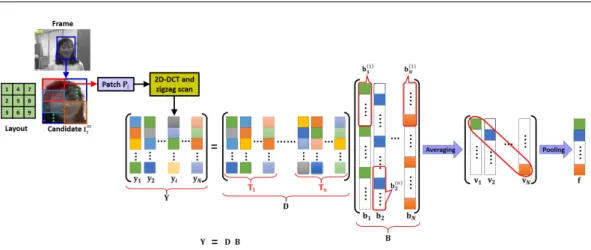
For a given target candidate, the overlapped local patches Pi inside the target region are
extracted with a spatial layout as shown in Fig.1. Then, 2D-DCT of these patches are computed
followed by zigzag scanning, whose order is akin to the one defined in [27]. This gives a matrix
Y=[y1,y2, ...,yN] ∈Rd×N for a given candidate, where N denotes the number of local patches
extracted within the target region and d is the number of pixels in a patch. As each fixed
part of the target object is represented by one local patch, the complete holistic structure
of a target candidate can be represented by all these N local patches with a fixed spatial
Fig. 1 Structural local 2D-DCT sparse appearance model: illustration of a local patchPiextraction followed
by 2D-DCT, zigzag scanning, averaging of sparse coefficients obtained vial1-normalization and alignment
pooling of features. 2D-DCT of each local patch (where the first patch is denoted in red, second one in blue,
and the last one in brown rectangle) is sparsely represented by the patch dictionaryD(in 2D-DCT domain)
with a sparse vector. These sparse coefficients are averaged and pooled to represent a target object.
T=[T1,T2, ...,Tn]to create a dictionaryD=[d1,d2, ...,d(n×N)] ∈Rd×(n×N), wherenis the number
of target templates. Here, the local patches of the target templates are used as the dictionary atoms to encode the local patches inside the candidate regions, where all these local patches are in 2D-DCT domain. As these local patches are obtained across many templates, the resultant dictionary captures the generality of the different templates and hence, it is able to represent
various forms of target parts [17,31].
In sparse representation, only a few basis elements of the dictionary with different coeffi-cients are sufficient to represent a local patch inside the target region and this is achieved by solving the following minimization problem:
min
bi
kyi−Dbik22+λkbik1, s.t.bi 0, (1)
whereyi ∈Rd×1represents the 2D-DCT of thei-th local patch,bi ∈R(n×N)×1is the sparse code of
that local patch, and the constraintbi 0 indicates that all the elements ofbiare non-negative.
Now, the sparse codes of the given target candidate is given by B = [b1,b2, ...,bN]. Further,
the sparse coefficients of each local patch bi are divided into several segments depending on
the template that each element of the vector belongs to, i.e., b>
i = [b (1)> i ,b (2)> i ,,b (n)> i ], where
b(ik) ∈RN×1 indicates the k-th segment of the sparse coefficient vectorb
i corresponding to the
templateTk in the given target template setT. From these segmented sparse coefficientsb
(k)
i ,
a normalized feature vectorvi ∈RN×1 for thei-th local patch is obtained as
vi= 1 G n Õ k=1 b(ik), i=1,2, ...,N, (2)
whereGis a normalization term, which makes all the contributions from the templates sum to
unity. Thus, for a given candidate, all the normalized feature vectors of the local patches within
a candidate region form a square matrixV=[v1,v2, ...,vN] ∈RN×N. Since a single local patch
captures only some local appearance of the object, the whole object modeling requires pooling of information from these normalized feature vectors. Here, alignment pooling is chosen due
to its capability of using full structural information contained in the dictionary and precisely
locating the target object [17]. Even though each local patch at a given position of the candidate
is represented by patches at different positions of the templates, the local appearance of a patch with some appearance variation in a candidate is correctly represented by the patches at the
same positions of the templates. That is, the top left corner patch of the object in Fig.1 can
be represented precisely by the top left corner patches of the templates. This is achieved by
considering only the diagonal elements of the square matrix V as the pooled feature vector
f ∈RN×1, given by
f =diag(V) (3)
This feature vector f not only captures the target structure with a fixed spatial relationship
but also reflects the similarity between the candidate and the target template.
4 Holistic Image Reconstruction from an Overlapped Local Patches
In the proposed method, the overlapped local patches are used for the object representation rather than holistic templates due to their robustness to pose change, deformation and
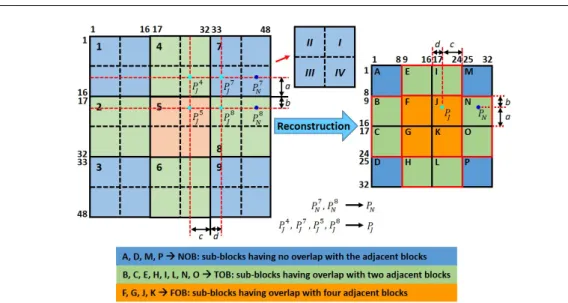
occlu-sion. The overlapped local patches of size 16×16 with an overlap of 8 pixels are extracted from
an image of size 32×32 as per the layout shown in Fig.1. Now, the extracted local patches
are concatenated as per their spatial relationship to obtain a overall block of size 48×48 (as
shown in left part of Fig. 2). For clarity, the original image of size 32×32 is assumed to be
divided into a sub-blocks of size 8×8 as shown in right part of Fig. 2. Now, the first 16×16
patch extracted from the top-left corner of the image, denoted as block1in left part of Fig.2,
is comprised of four 8×8 sub-blocks denoted as sub-blockA, B, EandFin right part of Fig.
2. Similarly, the second block, denoted as block2, is comprised of four 8×8 sub-blocks B, C,
FandG, and so on. Please note that some of the nomenclature/symbols used in this section
may have different meaning outside this section.
To understand the reconstruction procedure, the 8×8 sub-blocks in Fig. 2are divided into
three groups depending on the number of overlaps they have with the neighboring 16×16
blocks. The first group consisting of four sub-blocks (A, D, M andP) has no overlaps with
16×16 blocks, and are denoted as no overlapping blocks (NOB) (blue color blocks in the right
part of Fig.2). The second group consisting of 8 sub-blocks (B, C, E, H, I, L, NandO) has
an overlap with two 16×16 adjacent blocks, and are denoted as two overlapping blocks (TOB)
(green color blocks in the reconstructed image of Fig. 2). Similarly, the last group consisting
of four sub-blocks (F, G, JandK) has an overlap with four 16×16 adjacent blocks, and are
denoted as four overlapping blocks (FOB) (orange color blocks in the reconstructed image of
Fig.2). Since the NOB group has no overlaps, the pixels in the sub-blocksA, D, MandPof
the reconstructed image are copied directly from theII-quadrant of block1, III-quadrant of
block3,I-quadrant of block 7 andIV-quadrant of block 9, respectively. However, the TOB
group has two overlapping blocks and hence the pixels in the sub-blocks B, C, E, H, I,
L, N andO of the reconstructed image are computed from the corresponding two 16×16
overlapping blocks. For example, the sub-blockNis reconstructed fromIV-quadrant of block
7, I-quadrant of block8. Therefore, all the pixels in theIV-quadrant of block 7(denoted as
P7N) andI-quadrant of block8(denoted asP8N) are used to find the pixel values in sub-block
N(denoted asPN) by PN = aP 7 N+bP 8 N a+b , (4)
Fig. 2 Holistic image reconstruction from overlapped local patches.
where aand bare the distances as shown in Fig.2. Similarly, all the pixels in the sub-blocks
F, G, JandK belonging to FOB group are computed from the pixels of the corresponding
four 16×16 overlapping blocks using
PJ = c c+d aP4J+bP5J a+b ! + d c+d aP7J+bP8J a+b ! , (5)
wherea,b,canddare the distances as shown in Fig.2,P4J,P5J,P7J andP8J are the pixel values
from the blocks4, 5, 7and8, respectively, andPJ is the reconstructed pixel belonging to block
J. The reconstructed holistic imageIr of theJogging-2 andWomansequences is shown in Fig.
3to illustrate the effectiveness of the proposed image reconstruction without introducing any
errors/artifacts during transition from one patch to another.
5 Proposed Tracking Algorithm
In the proposed framework, motion of the target is estimated using a Markov model with hidden
state variables [16]. Let xt represent a state variable describing the affine motion parameters
of a target at time t. Given a set of observed images It = {I1, ...,It} at time t, the posterior
probabilityp(xt|It)can be estimated recursively by the Bayesian theorem,
p(xt|It) ∝p(It|xt)
∫
p(xt|xt−1)p(xt−1|It−1)dxt−1 (6)
where p(It|xt)represents the observation model, andp(xt|xt−1)represents the dynamic model.
In this work, an affine transformation with six parameters is adopted to model the target
statext =(xt,yt, θt,st, αt, φt), wherext,yt, θt,st, αt, φt denote horizontal and vertical translations,
rotation angle, scale, aspect ratio and skew direction at timet, respectively. The dynamic model
p(xt|xt−1) describes the temporal correlation of states between two consecutive frames and is
p(xt|xt−1)=N (xt;xt−1,Σ), where Σ denotes a diagonal covariance matrix, whose elements are
the variances of the affine parameters. These affine parameters are used to crop a sub-image
from the current frame and then normalized to the size w×h. The dynamic model randomly
selectsMsamples of the state variablextgiven the statext−1att−1, which are used to generate
candidate samples Im
t , where m = 1,2, ...,M. Among these M states, the optimal state of the
tracked targetxt at timetis determined by solving the following MAP estimation:
ˆ xt =arg max xm t p(Imt |x m t )p(x m t |xt−1), m=1,2, ...,M (7)
wherexmt denotes them-th sample of the statext andImt indicates an image sample observed
byxm
t .
In the proposed method, the 2D-DCT of the overlapped local patches inside the target region are used to model the object appearance. These overlapped local patches can be represented by a very few low-frequency 2D-DCT coefficients, which can preserve the image information
in a patch very well due to the energy compaction property of the 2D-DCT. Hence, only r
lower frequency 2D-DCT coefficients are considered out ofd coefficients in all the patches of
the candidates and the dictionary while solving the l1-minimization problem in Eq. (1). The
confidence scoresCmfor all the candidates are computed from the sparse codes using Eqs. (2),
(3) as [17] Cm= N Õ i=1 fim (8)
In visual tracking based on particle filter framework, the confidence of the each particle is given by its observation likelihood, defined as
p(Imt |x
m t ) ∝C
m
(9)
Finally, the optimal state of the target is estimated using Eq. (7). Further, the observation
models are adapted to handle the appearance change of the target by incrementally updating the template set and dictionary, as discussed in the next subsection.
Algorithm 1Proposed Tracking Algorithm
Input: Target object is labeled in the first frame and its initial state isx0, number of templatesn, number
of local patchesN
1: Collect a set ofntemplates,T=[T1,T2, ...,Tn], using kd-tree to model the object appearance.
2: From every template inT, extract theN overlapped local patchesPi, compute the 2D-DCT followed by
zigzag scanning to create a dictionaryD.
3: fort>ndo
4: SampleMcandidate states{x1t,xt2, ...,xtM}fromxt−1.
5: For every candidate statextm, extract the corresponding image sampleImt and its local patch matrix
in 2D-DCT domainYm
t as explained in section3.
6: For all the candidate samples Im
t , compute sparse codes bi for each local patch vector yi in the
candidate sample matrixYm
t using Eq. (1) by considering onlyr number of DCT coefficients in both
candidates and the dictionary.
7: Compute the pooled feature vectorfmand the confidence scoreCmfor all the candidates using Eqs.
(2), (3) and (15), respectively.
8: Find the optimal state of the tracked target ˆxt using the Eqs. (9) and (7).
9: Update the template setTand dictionaryDas described in section5.1for every 5 frames.
10: end for
tionaryD and the tracked candidate matrix ˆYto compute the sparse codes ˆB using Eq. (1). The local appearance of a patch in a target candidate is correctly represented by the patches at the same positions of the templates. Hence, the sparse codes corresponding to the respec-tive patches are only used to compute the overlapped local patches. These overlapped patches
are used to reconstruct the holistic image Ir as described in section 4 and then the holistic
reconstruction errorE=ˆI−Ir is computed, where ˆIis the target image of the tracking result.
Further, the holistic reconstruction errorEis used to generate a binary occlusion mapO1using
Eq. (10) indicating one for occluded pixels and zero for non-occluded pixels.
O1= (
1, if|E| ≥OT hr
0, otherwise, (10)
where OT hr is a precomputed threshold that decides whether the pixel is occluded or not. In
order to computeOT hr, it is assumed that all the elements of the reconstruction error E will
be in the ”normal range” and follow the Gaussian distribution in the absence of occlusion. But
during occlusions, the occluded elements of the reconstruction errorEwill probably exceed the
”normal range”. Therefore, by knowing the ”normal range” of the reconstruction error in the
initial frames (from 1 ton) of the respective sequence, the value of theOT hr is computed as
OT hr = c1 n n Õ f=1 std(Ef) (11)
Here, each target template in a template setTis used as the candidate sample and the remaining
n−1 templates are used as the dictionary in a round-robin fashion to computeOT hr. In general,
the occlusion is a large connected region as opposed to the random noises or object appearance variations, whose region is very small. Hence, the occlusion map is updated to retain only the large connected region by applying a morphological operations and a connected component analysis.
In order to increase the robustness of the occlusion detection method, it is proposed to identify the patch of the tracked candidate with no contribution from the respective patches
of the dictionary D using the pooled feature vector ˆf. If there is no contribution from the
respective patches of the dictionary D, the respective element of the pooled feature vector ˆf
will be zero. That is, ˆfi=0 indicates that there is no contribution from thei-th patch of all the
templates in representing thei-th patch of the tracked candidate, and this happens when the
i-th patch is occluded fully. Then, a binary occlusion mapO2 is generated by indicating one in
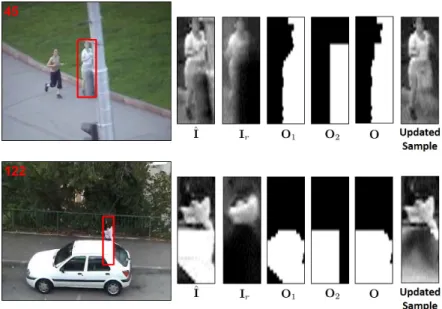
Fig. 3 Some representative cases ofJogging-2 and Womansequences to illustrate the effectiveness of the
proposed holistic image reconstruction, the robust occlusion map generation (O1,O2,O), and the updated
sample.
Now, the two occlusion maps O1 andO2 are combined to generate a final occlusion map
Oby performing a logical-OR operation. This makes the occlusion map more robust, so that
the chances of appearance model deterioration due to occlusion could be reduced. Fig.3shows
the occlusion mapsO1,O2andOforJogging-2 (#45) andWoman(#122) sequences. Further,
a occlusion ratio τ is computed as the ratio of the number of ones inOto the total number
of elements in O. This occlusion ratio τ indicates the amount of occlusion in the tracked
candidate. The occlusion ratio τ decides whether the update of the observation model with
the tracked sample is full or partial or not, with the help of two thresholds τ1 andτ2. In the
absence of occlusion (when τ < τ1), the tracked sample is used directly for the model update
(full update). During partial occlusion (when τ1 < τ < τ2), the occluded pixels in the tracked
sample are replaced with the corresponding pixels from the previously updated meanµto get
a updated sample. This updated sample is free from occlusion and is used in a model update.
During severe occlusion (when τ > τ2), the tracked sample is not used for model update.
Fig. 3 shows the updated tracked sample, which is free from occlusion, for Jogging-2 (#45)
andWoman (#122) sequences. It is observed from Fig. 3 that the combined occlusion map
O is more robust than the individual ones O1 and O2, and make the updated sample free
from occlusion with the proposed appearance model update. The updated tracked samples,
which are free from occlusion, are cumulated for an incremental subspace learning [29]. This
incremental learning not only adapts to the target appearance variation but also preserves the common visual information in the collected observations. The proposed method uses trivial
templates along with PCA basis vectorsUto estimate the targetp, as given by
p=Uq+e=[U I] q e (12)
where Iis the identity matrix representing trivial templates, q denotes the coefficients of the
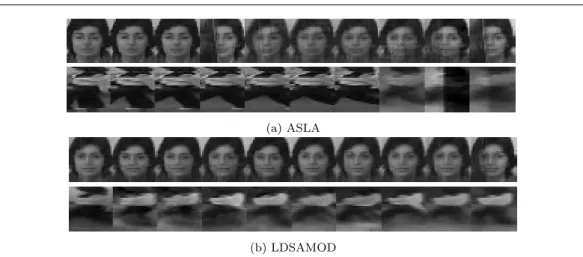
(b) LDSAMOD
Fig. 4 Some representative cases ofFaceocc1 (#700) andWoman (#180) to illustrate the effectiveness of the proposed observation model update compared to that of ASLA.
ASLA, which uses the latest tracked sample as p, the proposed method choses the updated
tracked sample with highest confidence score among the cumulated samples as p, which is
free from occlusion. Note that when τ > τ2, the tracked sample with severe occlusion is not
cumulated and hence its chances of considering as p is zero. Since the error is arbitrary and
sparse, Eq. (12) is solved byl1-minimization, and an image ˆpis reconstructed from the PCA
basis vectorsUalong with its coefficientsq. This ensures the reconstructed image is free from
corruption and outliers, as the coefficients of trivial templates (due to noise or outlier) are
excluded for image reconstruction. The reconstructed image ˆpis then used for updating both
the template and the corresponding dictionary atoms inDas discussed in the next paragraph.
It is known that the sparse codes ˆB of the tracked candidate represent the contributions
from all the patches of all the templates. Also, the local appearance of a patch with some appearance variation in the tracked candidate is correctly represented by the patches at the
same positions of the templates. Hence, the contribution ˆhk of each template in representing
the tracking result ˆI is computed by considering only the contributions from the respective
patches of the template using Eq. (13).
ˆ hk = N Õ i=1 ˆ B(N[k−1]+i,i), k=1,2, ...,n, (13)
While cumulating the tracked samples, the respective confidence ˆCand the template
contribu-tion scores ˆhk are also cumulated. From the cumulated confidence scores, the highest confidence
score is found and its corresponding updated tracked sample is used aspin Eq. (12). Further,
from the cumulated template contribution scores, the location ˆkof the template to be replaced
is found using the Eq. (14).
ˆ k =arg min k Õ t∈[t−4:t] hk(t) (14)
With this replacement strategy, the template, which is contributing least to the representation
of the previous 5 tracking results, is replaced with the reconstructed image ˆp. This is done
with an assumption that the template with the least contribution score may have an old appearance of the object, which may be outdated, and hence cannot contribute significantly in
dictionary atoms are also updated. To illustrate the effectiveness of the proposed observation model update, the template dictionary for the proposed method and ASLA is shown in Fig.
4. From Fig. 4, it is observed that the template set of ASLA gets corrupted over the time,
but this is not so with the proposed method. Unlike [24], which considers only the current
tracking result (may be severely occluded) to find the template contribution score, the proposed
method considers previous 5 tracking results (which are not severely occluded withτ < τ2) to
find the average template contribution score. As [24] directly uses the occluded/corrupted
tracking result for the model update, there are chances of observation model degradation.
However, in the proposed method, ˆpused for the model update is free from the occlusion and
outliers/corruptions, as they are removed before and after an incremental subspace learning. In the proposed method, instead of using the sum of pooled features to find the confidence
scoreCm by giving equal weights to each patch (as in ASLA), it is proposed to compute the
confidence score Cm using weighted sum of the pooled features. This is done by assigning
different weights to each patch depending on its patch occlusion ratioτpi. Now the confidence
scoreCmis rewritten as Cm= N Õ i=1 τpifim (15)
whereτpi is the ratio of occluded pixels to that of total pixels in a patch.
6 Experimental Results
The proposed algorithm is implemented in MATLAB and its performance is evaluated using
50 and 60 challenging sequences available in the OTB-50 [44] and VOT2016 [18] datasets,
respectively. These sequences cover most of the real-life challenging situations in object tracking, such as motion blur due to fast movement, pose variation, complex background, varying lighting conditions, low contrast, scale change, heavy occlusion, in-plane and out-of-plane rotation. In
the proposed method, each image observation is resized to 32×32 pixels and then local patches
of size 16×16 are extracted with an overlap of 8 pixels. Therefore, each target region is cut
into N = 9 overlapping patches. In the proposed method, SPAMS package [23] is used for
l1-minimization and the regularization constant λ is set to 0.01. 10 eigenvectors are used in
an incremental subspace learning and the observation model is updated for every 5 frames. Considering the trade-off between effectiveness in tracking and computational efficiency, 600
particles are sampled using a particle filter. The constant c1 used to compute thresholdOT hr
in (11) is set to 4. The occlusion ratio thresholdsτ1 andτ2 are set to 0.1 and 0.65, respectively.
In the initial 10 frames, kd-tree is used to obtain the tracking results, and from these tracking
resultsn=10 target templates are extracted for the generation of the dictionaryD. The number
of DCT coefficients considered in each patch,r, is set to 64 while computing the confidence score
Cm for all the candidates, except during occlusions whenτ > τ2, it is set to 256. By reducing
the size of the dictionary as well as that of the candidate samples, the proposed method has achieved a speed of 2.18 fps (including the time required for the computation of the 2D-DCT and the proposed occlusion detection) as compared with 1.86 fps required by ASLA. This is a 17.2% increase in the speed compared to that of ASLA in spite of having to compute the 2D-DCT coefficients and the occlusion detection.
The performance of the proposed method is evaluated against several recent state-of-the-art algorithms based on the pstate-of-the-article filter framework for a fair comparison. The considered
algorithms are IVT [29], L1 accelerated proximal gradient (L1APG) [3], ASLA [17], sparse
are employed to evaluate the tracker in a given frame. Based on these basic metrics, the OTB-50 and VOT2016 methodologies derive other performance measures to analyze the tracking performance.
In OTB-50, the performance of a tracker for a given sequence is evaluated using thesuccess
rate and the precision score. The former is the ratio of successful frames whose OR is larger
than a given threshold to the total frames in a sequence, whereas the later is the percentage of frames whose CLE is less than a given threshold distance of the ground truth. By using multiple
thresholds, two curves are obtained showing how the threshold value affects the success rate
and the precision score, and are called as success plot and precision plot, respectively, for a
given sequence. Further, thesesuccess andprecision curvesare averaged over all the sequences
to obtain the overallsuccess andprecision plots, respectively. In order to quantify the overall
performance of a tracker, the area under curve (AUC) of thesuccess plotor theprecision score
for the threshold of 20 pixels, is employed [44].
In VOT2016, the performance of a tracker is analyzed using the accuracy (A) and robust-ness (R). The accuracy is the average overlap between the predicted and ground truth bounding boxes during successful tracking periods. On the other hand, the robustness measures the num-ber of times the tracker fails to track. In VOT2016, whenever a tracker predicts a bounding box with zero overlap with the ground truth, a failure is detected and the tracker is re-initialized. All the trackers are evaluated 15 times on each sequence and then per-frame accuracy is obtained as an average over these runs. Averaging per-frame accuracies gives per-sequence accuracy,
while per-sequence robustness is computed by averaging failure rates over different runs [18].
6.2 Performance Evaluation on OTB-50
The performance of the proposed method is evaluated on the OTB-50 benchmark [44] consisting
of 50 sequences with fully annotated attributes and compared with the state-of-the-art tracking algorithms using one-pass evaluation (OPE). The one-pass evaluation (OPE) uses the ground truth object location in the first frame and evaluates the tracker based on the average precision
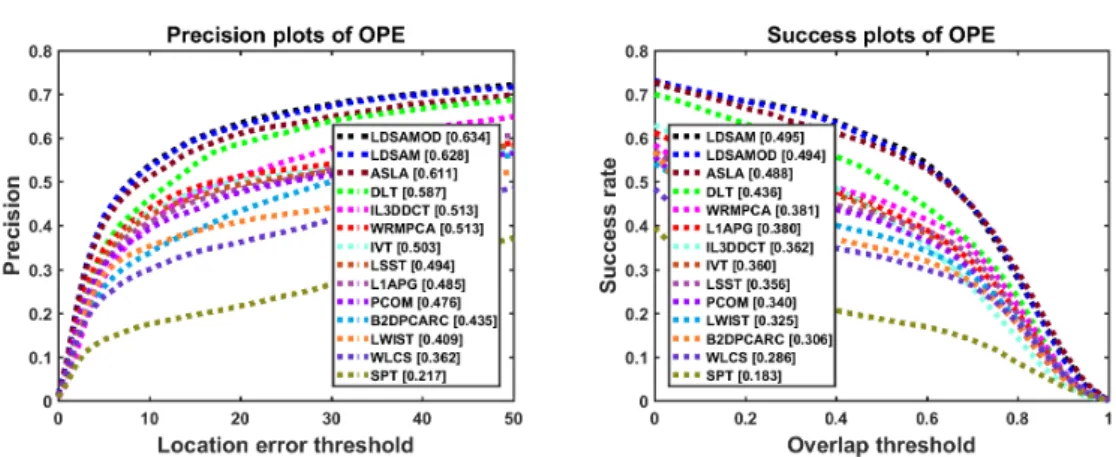
score or success rate. Theprecisionandsuccess plots of OPE for the various trackers averaging
over the OTB-50 benchmark sequences are shown in Fig. 5. In precision plot, the precision
score for the threshold of 20 pixels is used to rank the tracker. Whereas insuccess plot, AUC is
used to rank the overall performance of the tracker. Both theprecision score and AUC values
have been shown along with the tracker name in the respective plots of Fig.5. From Fig.5,
it is observed that the proposed method (LDSAMOD) outperforms the state-of-the-trackers ASLA, DLT, IL3DDCT, WRMPCA, IVT, LSST, L1APG and PCOM by 3.6%, 8%, 23.6%,
Fig. 5 Overall performance evaluation of the proposed method usingsuccessandprecision plotsof OPE.
Fig. 6 Performance evaluation of the proposed method using success and precision plots of OPE for se-quences having occlusion. The values appearing in the title denotes the number of sese-quences associated with the respective attribute.
23.6%, 26%, 28.3%, 30.7% and 33.2%, respectively, in terms ofprecision score. A similar trend
in performance is also observed insuccess scores. Overall, LDSAMOD and its previous version
(LDSAM) [31] provide the best performance to that of the other methods in terms ofprecision
andsuccess score. The proposed method, LDSAMOD, is an improvement of LDSAM [31] with
a robust occlusion detection, which is used to update the appearance model as well as to find the confidence score. Further, the OPE performance comparison of the proposed method for
sequences having occlusion against the other trackers is shown in Fig.6. From the Fig.6, it is
observed that the proposed method outperforms the state-of-the-trackers DLT, ASLA, L1APG, IVT, WRMPCA, IL3DDCT, PCOM and LSST by 5.2%, 12.9%, 23.6%, 31%, 31.6%, 32.4%,
36% and 46.2%, respectively, in terms ofprecision score. This trend in performance holds true
forsuccess scorealso. For sequences having occlusion, it is observed that the proposed method and its previous version have shown better performance than that of the other trackers, both
attributes in an equal or weighted manner, whereas pooled corresponds to the per-frame
aver-aging of the super-sequence obtained by concatenating all of the sequences [18]. The best three
results are shown in(red, bold),(violet, underline)and(blue, italic)fonts for better
compar-ison of the proposed tracker with the other state-of-the-art trackers. Note that as the trackers with statistically equivalent results are merged while ranking, the different trackers may have
same A-Rank and R-Rank [18]. From Table1, it is observed that the proposed method stands
first in all the challenging sequences in terms of overlap, except for occlusion where it stood
second, and illumination change, where it stood third. Also, it is observed in Table2 that the
proposed method ranks first in all the challenging sequences in terms of failures, except for motion change, where it stood second, and illumination change, where it stood fourth. Further, the overall performance of the proposed method is superior to that of other methods in terms of mean, weighted mean and pooled averaging of overlap and failures.
6.4 Qualitative Evaluation
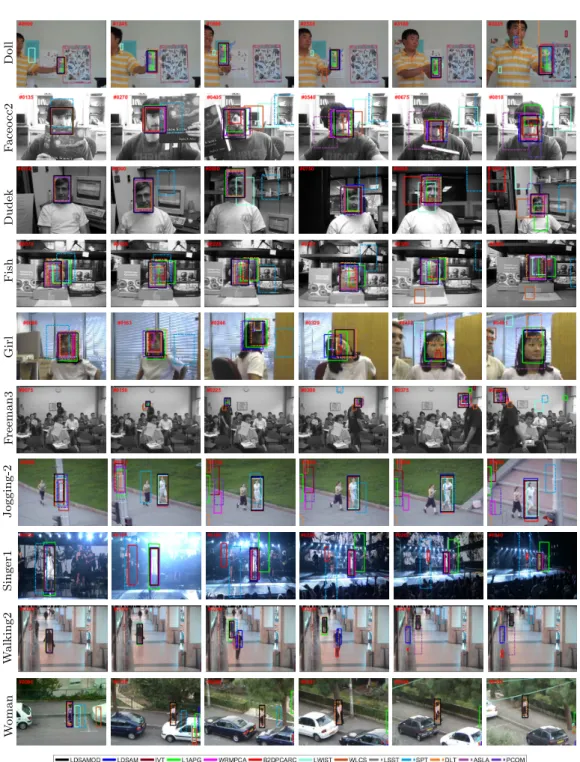
For qualitative evaluation of the trackers, some tracking results on a subset of the OTB-50
benchmark sequences are shown in Fig.7. In Fig.7, the tracking results of all the trackers on
the six exemplar image frames are shown for each selected sequence and these six frames are selected at regular intervals without any bias. The proposed LDSAMOD tracker successfully
tracks the target in the all the frames of the Doll, Faceocc2, Dudek, Fish, Girl, Freeman3,
Jogging-2, Singer1, Walking2 and Woman sequences, which contain most of the real-time
challenges such as pose change, partial occlusion, illumination change, scale change and out-of-plane rotation. This indicates the strong capabilities of the proposed method in handling these challenges. The proposed tracker has slightly drifted away in middle few frames (#163
to #412) of the Girl sequence and then starts tracking afterwards. It is also observed that
the previous version of the proposed method, LDSAM, performs better in all the sequences
exceptWalking2 andWoman sequences, where the sequence undergoes severe occlusion along
with scale and appearance change, in spite of using local appearance model. Similarly, even
with local appearance model, ASLA fails to track the object inFaceocc2,Jogging-2,Walking2
and Woman, where the sequence undergoes partial/severe occlusion. These failures in both
ASLA/LDSAM is because of the appearance model update with the imprecise tracked samples
without removing the occlusion. IVT tracks the object in most of the sequences except Doll,
Girl, Freeman3, Jogging-2 andWoman sequences, where as L1APG tracks the object
com-pletely inGirlandWalking2 sequences and drifts away inFaceocc2,DudekandFishsequences
T able 1 Accuracy Ran k and Av erage Ov erlap C omparison of the Prop osed Metho d with tha t of the Compared T rac k ers. (red, b old) , (violet, underline) and (blue, italic) indicate First, Second and Third Rankings, resp ecti v ely . Accuracy lab el camera motion lab el empt y lab el illum. c hange lab el motion c hange lab el o cclusion lab el size c hange Mean W eigh ted mean P o oled T rac k ers A-Rank Ov erlap A-Rank Ov erlap A-Rank Ov erlap A-Rank Ov erlap A-Rank Ov erlap A-Rank Ov erlap A-Rank Ov erlap A-Rank Ov erlap A-Rank Ov erlap IVT 1.00 0.41 1.00 0.48 6.00 0.50 1.00 0.36 1.00 0.33 1.00 0.37 1.83 0.41 1.83 0.41 1.00 0.42 L1APG 1.00 0.43 1.00 0.50 10.00 0.45 1.00 0.37 1.00 0.35 5.00 0.33 3.17 0.40 3.17 0.41 1.00 0.42 ASLA 1.00 0.44 1.00 0.49 1.00 0.61 1.00 0.38 1.00 0.36 1.00 0.41 1.00 0.45 1.00 0.44 1.00 0.44 WRMPCA 1.00 0.40 1.00 0.49 5.00 0.52 1.00 0.37 1.00 0.31 1.00 0.37 1.67 0.41 1.67 0.41 1.00 0.42 B2DPCAR C 1.00 0.42 1.00 0.47 3.00 0.54 1.00 0.36 1.00 0.35 1.00 0.37 1.33 0.42 1.33 0.41 1.00 0.42 SPT 12.00 0.31 11.00 0.36 9.00 0.45 7.00 0.27 3.00 0.29 6.00 0.31 8.00 0.33 8.00 0.32 11.00 0.32 WLCS 1.00 0.41 1.00 0.50 1.00 0.63 1.00 0.34 1.00 0.33 1.00 0.40 1.00 0.43 1.00 0.42 1.00 0.43 L WIST 1.00 0.42 1.00 0.49 1.00 0.65 1.00 0.34 1.00 0.34 1.00 0.41 1.00 0.44 1.00 0.42 1.00 0.43 PCOM 1.00 0.41 1.00 0.48 3.00 0.57 1.00 0.36 1.00 0.36 1.00 0.41 1.33 0.43 1.33 0.42 1.00 0.43 DL T 1.00 0.44 1.00 0.50 1.00 0.58 1.00 0.39 1.00 0.38 1.00 0.42 1.00 0.45 1.00 0.44 1.00 0.45 LSST 1.00 0.40 1.00 0.44 2.00 0.55 1.00 0.32 1.00 0.34 1.00 0.37 1.17 0.40 1.17 0.39 1.00 0.40 LDSAM 6.00 0.33 12.00 0.36 13.00 0.31 5.00 0.28 1.00 0.31 11.00 0.25 8.00 0.31 8.00 0.31 11.00 0.33 LDSAMOD 1.00 0.45 1.00 0.51 1.00 0.61 1.00 0.39 1.00 0.36 1.00 0.42 1.00 0.46 1.00 0.45 1.00 0.46 T able 2 Robustness Rank and Av erage F ailures Comparison o f the Prop osed Metho d with that of the Co mpared T rac k ers. (red, b old) , (violet, underline) and (blue, italic) indicate First, Sec o nd and Third Rankings, resp e ctiv ely . Robustness lab el camera motion lab el empt y lab el illum. c hange lab el motion c hange lab el o cclusion lab el size c hange Mean W eigh ted mean P o oled T rac k ers R-Rank F ailures R-Rank F ailures R-Rank F ailures R-Rank F ailures R-Rank F ailures R-Rank F ailures R-Rank F ailures R-Rank F ailures R-Rank F ailures IVT 4.00 114.67 5.00 59.40 1.00 9.47 3.00 101.87 4.00 40.00 4.00 52.47 3.50 62.98 3.50 78.10 4.00 264.47 L1APG 4.00 140.80 1.00 49.13 4.00 11.60 5.00 99.13 2.00 38.60 4.00 54.27 3.33 65.59 3.33 82.89 4.00 267.27 ASLA 1.00 92.80 3.00 45.80 1.00 7.73 3.00 79.27 2.00 33.93 2.00 40.20 2.00 49.96 2.00 61.84 2.00 208.27 WRMPCA 4.00 106.60 3.00 52.47 2.00 10.47 3.00 91.93 4.00 38.20 2.00 48.33 3.00 58.00 3.00 71.51 4.00 242.60 B2DPCAR C 6.00 126.93 6.00 62.20 4.00 10.67 5.00 100.67 7.00 43.93 8.00 59.20 6.00 67.27 6.00 83.66 7.00 278.73 SPT 12.00 183.27 12.00 107.27 10.00 12.33 12.00 135.27 4.00 54.07 12.00 72.60 10.33 94.13 10.33 120.29 13.00 414.47 WLCS 6.00 164.73 11.00 89.53 1.00 9.13 9.00 124.13 4.00 46.67 8.00 60.87 6.50 82.51 6.50 105.86 11.00 355.27 L WIST 6.00 131.27 9.00 81.13 1.00 8.53 5.00 115.13 4.00 43.07 5.00 55.27 5.00 72.40 5.00 91.28 8.00 307.53 PCOM 6.00 127.00 5.00 57.67 1.00 8.87 4.00 102.33 4.00 41.20 4.00 53.73 4.00 65.13 4.00 81.61 5.00 273.93 DL T 1.00 94.73 1.00 42.20 1.00 10.07 1.00 66.53 2.00 35.40 2.00 43.33 1.33 48.71 1.33 60.06 1.00 201.47 LSST 6.00 135.60 9.00 77.87 4.00 11.40 5.00 115.20 4.00 45.60 9.00 61.47 6.17 74.52 6.17 93.11 9.00 315.20 LDSAM 11.00 167.13 11.00 114.20 1.00 10.00 11.00 131.40 4.00 51.67 12.00 76.60 8.33 91.83 8.33 117.10 11.00 396.53 LDSAMOD 1.00 90.80 1.00 40.53 1.00 9.13 1.00 73.73 1.00 28.27 1.00 34.53 1.00 46.17 1.00 57.60 1.00 192.47
In this paper, a generative tracking algorithm using a structural local DCT sparse appearance model with occlusion detection has been proposed. The energy compaction property of the 2D-DCT has been exploited to reduce the size of the dictionary and the candidate samples, which in
turn, lowers the computational cost ofl1-minimization. Also, it has been proposed to reconstruct
the holistic image from the overlapped local patches obtained from the patch dictionary and the sparse codes. Further, a robust occlusion map generation has been proposed using the reconstructed image and the tracked candidate. Also, it has been proposed to find the threshold for occlusion detection automatically for each sequence. In addition, the highest confident occlusion-free sample among the cumulated samples has been used to reconstruct the image for the template update. Further, it has been proposed to compute the patch occlusion ratio, and has been used in the confidence score computation by weighting the pooled features. Finally, the tracking result has been obtained by the MAP estimation. Extensive experiments have been conducted on the two popular tracking benchmark datasets, OTB-50 and VOT2016, to analyze the performance of the proposed method. The quantitative and qualitative performance of the proposed method has been compared with that of several recent state-of-the-art algorithms using these benchmark datasets, and it has been shown that the proposed method is competitive for most of the challenging sequences.
Acknowledgment
This work was supported by the Natural Sciences and Engineering Research Council (NSERC)
of Canada, the Regroupement Strat´egique en Microsyst`emes du Qu´ebec (ReSMiQ), and
Min-ist`ere de l’ ´Education, de l’Enseignement Sup´erieur et de la Recherche (MEESR) du Qu´ebec.
The authors would like to thank the authors of [3,17,20,29,36–40,42] who made their codes
available for comparison with the proposed method.
References
1. Adam, A., Rivlin, E., Shimshoni, I.: Robust fragments-based tracking using the integral histogram. In: Proc. of the IEEE Conf. on Comput. Vision and Pattern Recogn. (CVPR), pp. 798–805 (2006) 2. Babenko, B., Yang, M.H., Belongie, S.: Visual tracking with online multiple instance learning. In: Proc.
of the IEEE Conf. on Comput. Vision and Pattern Recogn. (CVPR), pp. 983–990 (2009)
3. Bao, C., Wu, Y., Ling, H., Ji, H.: Real time robust L1 tracker using accelerated proximal gradient approach. In: Proc. of the IEEE Conf. on Comput. Vision and Pattern Recogn. (CVPR), pp. 1830–1837 (2012)
Doll F aceo cc2 Dudek Fish Girl F reem a n3 Jogging-2 Singer1 W alking2 W oman
Fig. 7 Examples of tracking results of the compared methods on the ten OTB-50 benchmark sequences.
4. Chen, D., Liu, Q., Sun, M., Yang, J.: Mining appearance models directly from compressed video. IEEE
13. Hafed, Z.M., Levine, M.D.: Face recognition using the discrete cosine transform. Int. J. Comput. Vision
43(3), 167–188 (2001)
14. He, D., Gu, Z., Cercone, N.: Efficient image retrieval in DCT domain by hypothesis testing. In: Proc. of the IEEE Int. Conf. on Image Processing (ICIP), pp. 225–228 (2009)
15. Henriques, J.F., Caseiro, R., Martins, P., Batista, J.: High-speed tracking with kernelized correlation
filters. IEEE Trans. on Pattern Anal. and Mach. Intell. (PAMI)37(3), 583–596 (2015)
16. Isard, M., Blake, A.: Condensation: Conditional density propagation for visual tracking. Int. J. Comput.
Vision29(1), 5–28 (1998)
17. Jia, X., Lu, H., Yang, M.H.: Visual tracking via adaptive structural local sparse appearance model. In: Proc. of the IEEE Conf. on Comput. Vision and Pattern Recogn. (CVPR), pp. 1822–1829 (2012) 18. Kristan, M., Leonardis, A., Matas, J., Felsberg, M., Pflugfelder, R.: The visual object tracking VOT2016
challenge results. In: Proc. of European Conf. on Comput. Vision (ECCV), pp. 1–45 (2016)
19. Li, H., Li, Y., Porikli, F.: Deeptrack: Learning discriminative feature representations online for robust
visual tracking. IEEE Trans. on Image Processing25(4), 1834–1848 (2016)
20. Li, X., Dick, A., Shen, C., Hengel, A., Wang, H.: Incremental learning of 3D-DCT compact representations
for robust visual tracking. IEEE Trans. on Pattern Anal. and Mach. Intell. (PAMI)35(4), 863–881 (2013)
21. Li, Y., Ai, H., Yamashita, T., Lao, S., Kawade, M.: Tracking in low frame rate video: A cascade particle filter with discriminative observers of different life spans. IEEE Trans. on Pattern Anal. and Mach. Intell.
(PAMI)30(10), 1728–1740 (2008)
22. Lin, C., Pun, C.M.: Tracking object using particle filter and DCT features. In: Proc. of Int. Conf. on Advances in Comput. Science and Engineering, pp. 167–169 (2013)
23. Mairal, J., Bach, F., Ponce, J., Sapiro, G.: Online learning for matrix factorization and sparse coding. J.
Mach. Learn. Res.11, 19–60 (2010)
24. Mei, X., Ling, H.: Robust visual tracking using L1 minimization. In: Proc. of the IEEE Int. Conf. on Comput. Vision (ICCV), pp. 1436–1443 (2009)
25. Mei, X., Ling, H., Wu, Y., Blasch, E., Bai, L.: Minimum error bounded efficient L1 tracker with occlusion detection. In: Proc. of the IEEE Conf. on Comput. Vision and Pattern Recogn. (CVPR), pp. 1257–1264 (2011)
26. Ou, W., Yuan, D., Liu, Q., Cao, Y.: Object tracking based on online representative sample selection via
non-negative least square. Multimedia Tools and Appl.77(9), 10,569–10,587 (2018)
27. Pennerbaker, W., Mithchell, J.: JPEG: Still image data compression standard. Springer Science &
Business Media (1992)
28. Qu, P.: Visual tracking with fragments-based PCA sparse representation. Int. J. of Signal Processing,
Image Processing and Pattern Recogn.7(2), 23–34 (2014)
29. Ross, D.A., Lim, J., Lin, R.S., Yang, M.H.: Incremental learning for robust visual tracking. Int. J.
Comput. Vision77, 125–141 (2008)
30. Shreyamsha Kumar, B.K., Swamy, M.N.S., Omair Ahmad, M.: Multiresolution DCT decomposition for multifocus image fusion. In: Proc. of the IEEE Canadian Conf. on Electrical and Comput. Engineering (CCECE), pp. 1–4 (2013). DOI 10.1109/CCECE.2013.6567721
31. Shreyamsha Kumar, B.K., Swamy, M.N.S., Omair Ahmad, M.: Structural local DCT sparse appearance model for visual tracking. In: Proc. of the IEEE Int. Symp. on Circuits and Systems (ISCAS), pp. 1194–1197 (2015). DOI 10.1109/ISCAS.2015.7168853
32. Shreyamsha Kumar, B.K., Swamy, M.N.S., Omair Ahmad, M.: Visual tracking via bilateral 2DPCA and robust coding. In: Proc. of the IEEE Canadian Conf. on Electrical and Comput. Engineering (CCECE), pp. 1–4 (2016). DOI 10.1109/CCECE.2016.7726647
33. Shreyamsha Kumar, B.K., Swamy, M.N.S., Omair Ahmad, M.: Weighted residual minimization in PCA subspace for visual tracking. In: Proc. of the IEEE Int. Symp. on Circuits and Systems (ISCAS), pp. 986–989 (2016). DOI 10.1109/ISCAS.2016.7527408
34. Uzair, M., Mahmood, A., Mian, A.S.: Hyperspectral face recognition using 3D-DCT and partial least squares. In: Proc. of British Machine Vision Conference (BMVC), pp. 1–10 (2013)
35. Wang, D., Lu, H.: Object tracking via 2DPCA andl1-regularization. Signal Processing Letters19(11),
711–714 (2012)
36. Wang, D., Lu, H., Bo, C.: Fast and robust object tracking via probability continuous outlier model. IEEE
Trans. on Image Processing24(12), 5166–5176 (2015)
37. Wang, D., Lu, H., Bo, C.: Visual tracking via weighted local cosine similarity. IEEE Trans. on Cybernetics
45(9), 1838–1850 (2015)
38. Wang, D., Lu, H., Xiao, Z., Yang, M.H.: Inverse sparse tracker with a locally weighted distance metric.
IEEE Trans. on Image Processing24(9), 2646–2657 (2015)
39. Wang, D., Lu, H., Yang, M.H.: Online object tracking with sparse prototypes. IEEE Trans. on Image
Processing22(1), 314–325 (2013)
40. Wang, D., Lu, H., Yang, M.H.: Robust visual tracking via least soft-threshold squares. IEEE Trans. on
Circuits and Systems for Video Technology26(9), 1709–1721 (2016)
41. Wang, F., Zhang, J., Guo, Q., Liu, P., Tu, D.: Robust visual tracking via discriminative structural sparse feature. In: Proc. of the Chinese Conf. on Image and Graphics Technologies, pp. 438–446 (2015) 42. Wang, N., Yeung, D.Y.: Learning a deep compact image representation for visual tracking. In: Proc. of
Advances in Neural Information Processing Systems (NIPS), pp. 809–817 (2013)
43. Wright, J., Yang, A., Ganesh, A., Sastry, S., Ma, Y.: Robust face recognition via sparse representation.
IEEE Trans. on Pattern Anal. and Mach. Intell. (PAMI)31(2), 210–227 (2009)
44. Wu, Y., Lim, J., Yang, M.H.: Online object tracking: A benchmark. In: Proc. of the IEEE Conf. on Comput. Vision and Pattern Recogn. (CVPR), pp. 2411–2418 (2013)
45. Yang, H., Shao, L., Zheng, F., Wang, L., Song, Z.: Recent advances and trends in visual tracking: A
review. Neurocomputing74(18), 3823–3831 (2011)
46. Yang, J., Yu, K., Gong, Y., Huang, T.: Linear spatial pyramid matching using sparse coding for image classification. In: Proc. of the IEEE Conf. on Comput. Vision and Pattern Recogn. (CVPR), pp. 1794– 1801 (2009)
47. You, X., Li, X., He, Z., Zhang, X.: A robust local sparse tracker with global consistency constraint. Signal
Processing111, 308–318 (2015)
48. Zhang, H., Tao, F., Yang, G.: Robust visual tracking based on structured sparse representation model.
Multimedia Tools and Appl.74(3), 1021–1043 (2015)
49. Zhang, T., Bibi, A., Ghanem, B.: In defense of sparse tracking: Circulant sparse tracker. In: Proc. of the IEEE Conf. on Comput. Vision and Pattern Recogn. (CVPR), pp. 3880–3888 (2016)
50. Zhang, T., Ghanem, B., Liu, S., Ahuja, N.: Robust visual tracking via multi-task sparse learning. In: Proc. of the IEEE Conf. on Comput. Vision and Pattern Recogn. (CVPR), pp. 2042–2049 (2012) 51. Zhang, T., Liu, S., Xu, C., Liu, B., Yang, M.H.: Correlation particle filter for visual tracking. IEEE
Trans. on Image Processing27(6), 2676–2687 (2018)
52. Zhang, T., Xu, C., Yang, M.H.: Multi-task correlation particle filter for robust object tracking. In: Proc. of the IEEE Conf. on Comput. Vision and Pattern Recogn. (CVPR), pp. 4819–4827 (2017)
53. Zhang, T., Xu, C., Yang, M.H.: Learning multi-task correlation particle filters for visual tracking. IEEE Trans. on Pattern Anal. and Mach. Intell. (PAMI) pp. 1–14 (2018)
54. Zhong, Y., Zhang, H., Jain, A.K.: Automatic caption localization in compressed video. IEEE Trans. on
Pattern Anal. and Mach. Intell. (PAMI)22(4), 385–392 (2000)
55. Zhuang, B., Wang, L., Lu, H.: Visual tracking via shallow and deep collaborative model. Neurocomputing
B. K. Shreyamsha Kumarreceived B.E. degree in electronics and communication engineering from Ban-galore University, India, in 2000, and the M.Tech degree in Industrial Electronics from National Institute of Technology Karnataka, Surathkal, India, in 2004. He is currently pursuing Ph.D. degree in electrical and computer engineering with Concordia University, Montreal, QC, Canada. He has been a Research Associate with the Signal Processing Group, Concordia University, since Sept 2012. Before joining Concordia, he was with Central Research Laboratory (A Corporate Research Facility of Bharat Electronics, India) as a Member (Research Staff) from Oct 2004 to Aug 2012. He is a recipient of R&D Excellence Award conferred by Bharat Electronics. His research interests include visual tracking, computer vision, image fusion, image denoising, image encryption and document image processing. He has served as a reviewer for several peer-reviewed journals and major conferences.
M.N.S. Swamyreceived the B.Sc. (Hons.) degree in mathematics from Mysore University, India, in 1954, the Diploma degree in electrical communication engineering from the Indian Institute of Science, Bangalore, in 1957 and the M.Sc. and Ph.D. degrees in electrical engineering from the University of Saskatchewan, Saskatoon, Canada, in 1960 and 1963, respectively. He was conferred in 2009 the title of Honorary Professor at National Chiao Tong University in Taiwan. He is presently a Research Professor and the Director of the Center for Signal Processing and Communications in the Department of Electrical and Computer Engineering at Concordia University, Montreal, QC, Canada, where he served as the Chair of the Department of Electrical Engineering from 1970 to 1977, and Dean of Engineering and Computer Science from 1977 to 1993. During that time, he developed the Faculty into a research-oriented one from what was primarily an undergraduate Faculty. Since July 2001, he holds the Concordia Chair (Tier I) in Signal Processing. He has also taught in the Electrical Engineering Department of the Technical University of Nova Scotia, Halifax, and the University of Calgary, Calgary, as well as in the Department of Mathematics at the University of Saskatchewan. He has published extensively in the areas of number theory, circuits, systems and signal processing, and holds five patents. He is the coauthor of nine books and three book chapters. He was a founding member of Micronet from its inception in 1990 as a Canadian Network of Centers of Excellence until its expiration in 2004, and also its coordinator for Concordia University. Dr. Swamy is a Fellow of the Institute of Electrical and Elec-tronics Engineers, Fellow of the Institute of Electrical Engineers (United Kingdom), the Engineering Institute of Canada, the Institution of Engineers (India), and the Institution of Electronic and Telecommunication En-gineers (India). He was inducted in 2009 to the Provosts Circle of Distinction for career achievements. He has served the IEEE in various capacities such as the President-Elect in 2003, President in 2004, Past-President in 2005, Vice President (Publications) during 20012002, Vice-President in 1976, Editor-in-Chief of the IEEE TRANSACTIONS ON CIRCUITS AND SYSTEMS I from June 1999 to December 2001, Associate Editor of the IEEE TRANSACTIONS ON CIRCUITS AND SYSTEMS during June 1985 to May 1987, Program Chair for the 1973 IEEE CAS Symposium, General Chair for the 1984 IEEE CAS Symposium, Vice-Chair for the 1999 IEEE Circuits and Systems (CAS) Symposium, and a member of the Board of Governors of the CAS Society. He is the recipient of many IEEE-CAS Society awards, including the Education Award in 2000, Golden Jubilee Medal in 2000, and the 1986 Guillemin-Cauer Best Paper Award. He is the Editor-in-Chief of the journal Circuits, Systems and Signal Processing (CSSP) since 1999. Recently CSSP has instituted a best paper award in his name.
M. Omair Ahmadreceived the B.Eng. degree from Sir George Williams University, Montreal, QC, Canada, and the Ph.D. degree from Concordia University, Montreal, QC, Canada, both in electrical engineering. From 1978 to 1979, he was a Faculty Member with the New York University College, Buffalo, NY, USA. In Septem-ber 1979, he joined the Faculty of Concordia University as an Assistant Professor of computer science. He joined the Department of Electrical and Computer Engineering, Concordia University, where he was the Chair with the department from June 2002 to May 2005 and is currently a Professor. He holds the Concordia University Research Chair (Tier I) in Multimedia Signal Processing. He has published extensively in the area of signal processing and holds four patents. His current research interests include the areas of multidimen-sional filter design, speech, image and video processing, non-linear signal processing, communication DSP, artificial neural networks, and VLSI circuits for signal processing. He was a Founding Researcher at Micronet from its inception in 1990 as a Canadian Network of Centers of Excellence until its expiration in 2004. Pre-viously, he was an Examiner of the order of Engineers of Quebec. Dr. Ahmad was an Associate Editor of the IEEE TRANSACTIONS ON CIRCUITS AND SYSTEMS PART I: FUNDAMENTAL THEORY AND APPLICATIONS from June 1999 to December 2001. He was the Local Arrangements Chairman of the 1984 IEEE International Symposium on Circuits and Systems. In 1988, he was a member of the Admission and Advancement Committee of the IEEE. He has served as the Program Co-Chair for the 1995 IEEE Interna-tional Conference on Neural Networks and Signal Processing, the 2003 IEEE InternaInterna-tional Conference on Neural Networks and Signal Processing, and the 2004 IEEE International Midwest Symposium on Circuits and Systems. He was a General Co-Chair for the 2008 IEEE International Conference on Neural Networks and Signal Processing. He is the Chair of the Montreal Chapter IEEE Circuits and Systems Society. He is a recipient of numerous honors and awards, including the Wighton Fellowship from the Sandford Fleming Foundation, an induction to Provosts Circle of Distinction for Career Achievements, and the Award of Excel-lence in Doctoral Supervision from the Faculty of Engineering and Computer Science of Concordia University. Dr. Ahmad is a Fellow of the Institute of Electrical and Electronics Engineers.