R E V I E W
Open Access
From monocausality to systems thinking: a
complementary and alternative conceptual
approach for better understanding the
development and prevention of sports
injury
Adam Hulme
*and Caroline F. Finch
Abstract
The science of sports injury control, including both its cause and prevention, has largely been informed by a biomedical and mechanistic model of health. Traditional scientific practice in sports injury research has routinely involved collapsing the broader socioecological landscape down in order to analyse individual-level determinants of injury - whether biomechanical and/or behavioural. This approach has made key gains for sports injury
prevention research and should be further encouraged and allowed to evolve naturally. However, the public health, Applied Human Factors and Ergonomics, and injury epidemiological literature more broadly, has accepted the value of a socioecological paradigm for better understanding disease and injury processes, and sports injury research will fall further behind unless it does the same. A complementary and alternative conceptual approach towards injury control known as systems thinking that builds on socioecological science, both methodologically and analytically, is readily available and fast developing in other research areas. This review outlines the historical progression of causal concepts in the field of epidemiology over the course of the modern scientific era. From here, causal concepts in injury epidemiology, and models of aetiology as found in the context of sports injury research are presented. The paper finishes by proposing a new research agenda that considers the potential for a systems thinking approach to further enhance sports injury aetiological understanding. A complementary systems paradigm, however, will require that sports injury epidemiologists bring their knowledge and skillsets forwards in an attempt to use, adapt, and even refine existing systems-based approaches. Alongside the natural development of conventional scientific methodologies and analyses in sports injury research, progressing forwards to a systems paradigm is now required.
Keywords:Sports injury epidemiology, Socioecological frameworks, Systems thinking, Agent-Based Modelling, Applied Human Factors and Ergonomics
Review
There is an Arabian proverb of which most are familiar. It speaks of a camel whose owner had overloaded it be-yond what was a manageable weight; so much so, that it took only but a single piece of additional straw to bring the animal to its knees. The idiom,‘the straw that broke the camel’s back’, now extends to scenarios where a
certain number of precipitating factors combine to pro-duce an undesirable outcome. In most instances, how-ever, it is only the final event that is most noticeable to the person involved, and is routinely considered as the
‘unique cause’ of the effect in question (Rothman and Greenland 2005). The tendency for human beings to process events in this way, to otherwise implicate mono-causality into their daily thinking, is simply a matter of habituation. Conversely, when deliberating over causality on a deeper level, or when attempting to formulate new scientific theories, one has to advance rudimentary
* Correspondence:[email protected]
Australian Centre for Research into Injury in Sports and its Prevention (ACRISP), Federation University Australia, SMB Campus, PO Box 663, Ballarat, Victoria 3353, Australia
conceptions of causality to that of complexity and multi-factorialism (Rothman and Greenland 2005).
In the broader field of epidemiology, the science of causality, including ways in which to illustrate it, has been discussed at length (e.g. Greenland et al. 1999; Parascandola and Weed 2001; Broadbent 2013). Indeed, epidemiologists are not only motivated by the task of distinguishing simple correlation from actual causation, but also by the underlying and often times elusive and complex nature underpinning causal relationships (Glass et al. 2013). In other words, epidemiologists strive to identify both the risk factors for, and the causal mecha-nisms behind, the health effect in question. Closer to home, in the sports injury literature, there have been a number of examples that discuss or illustrate causality from a general prevention perspective (Meeuwisse 1994a, b; Gissane et al. 2001; Bahr and Holme 2003; Bahr and Krosshaug 2005; McIntosh 2005). Notwith-standing these examples, causal theory in sports injury epidemiology has entered into a period of inertia despite the availability of alternative conceptual causal ap-proaches. Sports injury prevention research will not be able to make significant gains unless a number of im-portant issues pertaining to causality are addressed.
The first section of this narrative review discusses the historical progression of causal concepts in the field of epidemiology more generally. This section, albeit sum-marised to include only a few noteworthy contributions, provides insight into why and how casual theory has evolved over time. From here, causal concepts in the broader field of injury epidemiology, and models of aeti-ology as found in the context of sports injury research are presented. The paper finishes with an overview of how a systems thinking approach has the potential to further enhance sports injury aetiological understanding.
The roots of causal concepts in the modern scientific era
In 1880, at the Tenth International Congress of Medi-cine in Berlin, the German physician Robert Koch made a significant contribution to the field of microbiology and disease causality. Reflecting upon his research into the origin of Tuberculosis, Koch outlined three illustri-ous causal postulates (Rivers 1937): (i) that the parasite occurs in every case of the disease in question; (ii) that it occurs in no other disease as a fortuitous and non-pathogenic parasite, and; (iii) that after being fully isolated from the body and repeatedly grown in pure culture, it can cause the disease again. At the time, Koch’s postulates were designed to definitively establish whether a causal relationship existed between a single infectious agent and particular disease. Ironically, how-ever, it was the limitations associated with these postu-lates that contributed to advancing aetiological
understanding in this area (Fredricks and Relman 1996). Certainly, for some pathogenic bacterial species, the pos-tulates were highly applicable. Yet, for other organisms, a clear violation of one or more of the postulates was found (Fredricks and Relman 1996).
The discovery of viruses in the early Twentieth cen-tury prompted a revision to Koch’s postulates. Rivers (1937) recognised that the monocausal exposure-disease framework was flawed, and warned of its continued ap-plication. Twenty years later, Huebner’s (1957) refine-ments to causal theory included, for the first time, the importance of epidemiological approaches alongside mere laboratory-based research. With the passing of yet another decade, the Five Realities of acute respiratory disease were formulated and supported the now ac-cepted multicausal paradigm through recognising the importance of the individual’s biological constitution, and the influence of seasonal variation on the pathogen-icity of certain agents (Evans 1967).
The further discovery of hundreds of new viruses transformed disease causality into a complex concept that included demographical, geographical and social layers. Accordingly, the historical progression of the sci-ence of infectious disease causality has been condensed into three distinct stages (Evans 1976): (i) the nature of
the agent as a key focus (e.g. Koch’s postulates and
monocausality); (ii) consideration to the environment in which the disease occurred (e.g. refinements from Huebner and Rivers) (Huebner 1957; Rivers 1937); and (iii), recognition of how the characteristics of thehost in-fluences the pathophysiology of disease (e.g. Evan’s Five Realities) (Evans 1967).
The evolution of causal thinking in epidemiology
on earlier work by distinguished philosophers of science (Mackie 1965; Lyon 1967).
Causal concepts in injury epidemiology
Whether it be improvised footwear to protect against the elements, or engineered clothing and equipment worn during warfare, injury prevention interventions have continued to evolve since the earliest known re-cords (Rivara 2001). Aside from a number of early les-sons, it took until the mid-late Twentieth century before the true application of epidemiological techniques for better understanding injury control were applied (Rivara 2001). If it were not for the causal concepts that has pre-viously been established in the infectious and chronic disease literature, injury epidemiology might have set out on an altogether different trajectory (Robertson 2007). Notable early concepts that were applied to injury control included the Domino Theory of Accident Causation (Heinrich 1931), De Dehaven’s (1942) bio-mechanical theories of energy exchange and force distri-bution, and the self-involved experiments of Stapp (1957). A number of influential visionaries prophetically elaborated on these robust theoretical foundations, and so injury control was established as a legitimate scientific discipline.
In his paper ‘The Epidemiology of Accidents’, Gordon (1949) illustrated a similar pattern of mortality between an outbreak of typhoid fever amongst a troupe of circus performers and that of a nightclub fire. The analogy of these two distinct scenarios, aside from the literal graph-ical representation of the sharp and initial aggregation of cases, was reflected in his commentary (Gordon 1949; p.515):
“Specifically directed prevention based on an
understanding of cause has long guided the attack on
communicable and other diseases…the biologic
principles that govern disease as a community problem are interpreted as holding equally well for injuries. A pattern for epidemiologic analysis is presented [Agent, Host, and Environment], as a means
for a better understanding of accidents”.
Gordon (1949) believed that, like disease, injuries were caused by particular epidemiologic episodes, such as sea-sonal change, demographic characteristics and an indi-vidual’s susceptibility. Just over a decade later, an experimental psychologist proposed that injuries were caused by the transfer of energy (Gibson 1961). The the-ory of energy exposures exceeding an organism’s physio-logical injury threshold remains foundational to the science of injury control.
A breakthrough in injury research arrived with the re-lease of ‘Accident Research: Methods and Approaches’
(Haddon et al. 1964). Haddon et al. (1964) had produced the ultimate anthological resource which established in-jury research as an important scientific discipline (Li and Baker 2014). The theories and methods presented in their definitive text were the catalyst for many more im-portant publications that followed, including numerous reports by the US-based National Research Council and the National Highway Traffic Safety Administration (Rivara 2001). Like Gordon (1949) before him, one of the greatest contributions to injury research by Haddon (1970, 1980) was his recognition of the Agent, Host and Environment triad. Haddon’s (1970, 1980) efforts to co-ordinate three distinct injury prevention phases (i.e. pre-event, pre-event, post-event) with the Epidemiological Triad resulted in the now famous Haddon Matrix for injury prevention interventions. The Haddon Matrix is widely used to conceptualise the candidate risk factors, tempor-ality, and the mechanisms of injury, and has been applied in a number of different injury contexts (Scott-Parker and Morang MacKay 2015). The addition of a third dimension to Haddon’s Matrix by Runyan (1998) introduced value criteria to enhance the efficacy and ef-fectiveness of injury prevention interventions. Runyan’s (1998) suggested criteria included: (i) effectiveness; (ii) cost; (iii) freedom; (iv) equity; (v) stigmatization; (vi) preferences, and; (vii) feasibility.
Causal concepts in sports injury epidemiology
Contemporary models of sports injury aetiology have broadly visualised how a multitude of risk factors pre-dispose and subsequently leave athletes susceptible to sustaining injury. These models have developed incre-mentally over time, being grounded in the broader causal concepts that have been outlined thus far.
(2001), alongside later suggestions (Bahr and Holme 2003; Bahr and Krosshaug 2005). The updated model ef-fectively advanced the initial linear paradigm of injury causality to a dynamic model in which a given athlete’s susceptibility to injury could continually change accord-ing to many adaptations or maladaptations that occur with continued sports participation (Meeuwisse et al. 2007) (Fig. 1).
A biomechanical perspective on sports injury causality illustrated a number of considerations that added com-plexity to sports injury causality (McIntosh 2005). McIntosh (2005) drew upon his own research, and ratio-nalised that the use of protective headgear might not affect sports injury risk, for better or worse, if that par-ticular intervention were to modify the behaviour and attitudes of its user. The model visualised how personal-ity, level of competitiveness and exposure to coaching practices interplay with environmental and biomechan-ical properties to influence injury risk. Ultimately, McIntosh (2005) explained how injury prevention pro-grams might not work to their full capacity if physical loads are reduced through intervention, yet an increase in kinetic energy exchange and higher forces are encour-aged through the actions and desires of coaches and ath-letes. Hagel and Meeuwisse (2004) similarly dedicated an
earlier paper to the notion of risk compensation in the sports injury context. They argued that, despite the best intentions of researchers’ to introduce sports injury countermeasures, interventions might not always have the desired effect. Their conclusion emphasised the im-portance of conducting injury prevention studies for de-termining whether countermeasures are efficacious through evaluating their net benefit (Hagel and Meeuwisse 2004).
Proposing a complementary research agenda for sports injury aetiological research
Existing sports injury prevention frameworks have been valuable for outlining and facilitating the overall research process. For instance, stage two associated with both the Sequence of Prevention model (van Mechelen et al. 1992) and the Translating Research into Injury Preven-tion Practice (TRIPP) framework (Finch 2006) specifies that the implementation and evaluation of injury preven-tion intervenpreven-tions cannot occur until risk factors and mechanisms of injury have been firmly established. Ac-cordingly, aetiological research requires a multidisciplin-ary approach, including not only biomechanical and clinical studies, but also investigations with a focus on behavioural and motivational factors (Finch 2006).
Despite this, very few original studies in the uninten-tional injury and sports injury literature have used be-havioural and social science theories in order to facilitate the uptake and maintenance of injury prevention inter-ventions (Trifiletti et al. 2005; McGlashan and Finch 2010). This is concerning given that injury research, whether focused on aetiology or prevention, has to occa-sionally reach above and beyond not only the biomedical and clinical sciences, but also the behavioural and mo-tivational levels to truly make a difference (Allegrante et al. 2010). In other words, incorporating injury determi-nants as they relate to policy development and legisla-tion are also crucial for prevenlegisla-tion purposes, yet they too have only featured on a very limited basis in sports injury research.
In one of very few examples, Cameron et al. (1994) ex-plained that before regulations specified that bicycle hel-met use was mandatory, the overall uptake of this injury prevention intervention was less than adequate. If people do not know, appreciate, or consider that particular in-jury countermeasures are necessary for enhancing their personal safety, there will be little incentive to use them. Accordingly, to increase the effectiveness of an interven-tion to reduce severe eye injuries amongst squash players, Eime et al. (2005) collaborated with the Victor-ian Squash Federation, leading eyewear manufacturing companies and sports venue managers. This was along-side behavioural and motivational strategies to ensure both the uptake and efficacy of the program was suc-cessful (Eime et al. 2004).
More recently, Finch and Donaldson (2010) developed a novel extension to the RE-AIM (Reach; Effectiveness; Adoption; Implementation; Maintenance) framework, through the Sports Settings Matrix to identify the mul-tiple levels of the sports delivery setting (e.g. national level through to a club, team and individual level that impact on injury prevention). The authors’stressed that the attitudes and knowledge towards injury prevention interventions need addressing, but equally, the setting, culture, and infrastructural support networks in which programs are to be delivered are also essential consider-ations for the success of initiatives. For injury prevention interventions to have the best chance of working, practice-based research that aims to measure the con-textual determinants of program effectiveness is required to translate efficacy into effectiveness; but alone, this is not enough. Even prior to implementation, it is impera-tive to reconcile differing perceptions of injury causation (Hanson et al. 2012).
The current state of sports injury aetiological research Contemporary models of sports injury aetiology have been influenced by a doctrine of scientific objectivity and engineered under a biomedical construct. This
means that injury mechanisms have primarily been understood from a biophysiological and biomechanical perspective. Despite being useful for calibrating research priorities and enhancing injury prevention efforts, such models have always directed attention to the individual athlete (i.e. age, gender, strength, neuromuscular control, equipment, training surface etc.) (Meeuwisse 1994a; Gissane et al. 2001; McIntosh 2005; Meeuwisse et al. 2007). This promotes a view that the science of sports injury control is best characterised by reducing the in-jury mechanism down to a level that only educational, behavioural and medically-oriented interventions can address. If not called into question, a biomedical and ob-jectivist epistemic tradition will continue to lead sports injury researchers to believe that athletes are‘free’agents who can always ‘choose’ their own behaviours. What is now required is the introduction of a complementary and alternative conceptual approach for better under-standing the development and prevention of sports in-jury. Revisiting the ten ecological principles (Haddon 1970) and re-examining the Injury Iceberg (Hanson et al. 2005) represents the first step in being able to show that it is possible to preserve the traditional approach in sports injury research, yet simultaneously, extend the horizon beyond it.
Forwards to a systems paradigm
Over the latter half of the Twentieth century, the field of public health blossomed into a multidisciplinary science (Rogers 1960). The limitations associated with routinely targeting interventions at individual-level, health-related determinants were recognised (Rose 1985; Graham 2004). The controversial ‘The role of medicine. Dream,
Mirage or nemesis’claimed that the primary reasons for
improvements in health-related outcomes in the developed world, at least post Eighteenth century, were nutritional, environmental and behaviourally-related (McKeown 1979). With increasing awareness that the process of scientific reductionism was not the sole an-swer to many public health issues, early government pol-icies (Lalonde 1974), associated literature (Blum 1974; Dever 1976), and pivotal comprehensive global agendas by the World Health Organisation (1986) recalibrated focus upstream to a political and societal-level (Graham 2004). Around the same time, calls for a greater em-phasis to be placed on social science theory (Cassel 1964, 1976) and social reformation strategies to address socioeconomic inequalities (Wing 1984, 1988) started to catalyse some of the more recognised ecological models of health (e.g. Dahlgren and Whitehead 1991; Green and Kreuter 1999; VanLeeuwen et al. 1999).
pathophysiology could best be investigated and under-stood. One school of scientists preferred to reduce disease down to a molecular level and study its pathogenic mechanisms, especially given technological advances in the fields of biology and genetics (Van-denbroucke 1988). Van(Van-denbroucke (1988) drew a comparison between the Nineteenth century’s miasmic theory and the modern day environmentalist move-ment striving for social change. Conversely, another school of scientists believed that historical, social, and geographical factors had been, and still were, equally responsible for the aetiology of many diseases along-side the specific-agent position (Loomis and Wing 1990). Loomis and Wing (1990) identified the similar-ity between Vandenbroucke’s (1988) molecularised epidemiology and the previous century’s germ theory.
In ‘The Limits of Epidemiology’, Wing (1994) claimed
that the field of epidemiology was vulnerable to being labelled as a‘basic science’ if practitioners were to con-tinue viewing exposure-disease relationships as self-contained, homogenous and universal phenomena. In other words, generalised assumptions and inferences de-rived via experimental and observational study designs need to reflect the social, political, and economic dimen-sions to which exposure(s) are influenced (Wing 1994). Consequently, in a series of papers, Susser and Susser (1996a, b) and Susser (1998) argued that the field of epi-demiology required a theoretical shift to encourage the emergence of a new scientific paradigm titled ‘ eco-epi-demiology’. The brilliance of this work, though, was not necessarily with a proposed eco-epidemiological para-digm, but the ability to outwardly project into the future (Susser and Susser 1996b; p.676):
“…one must also take heed of another emergent
paradigm. Information systems combined with systems analyses might well lead into a systems paradigm, with its own attractions for mathematically minded
epidemiologists…”.
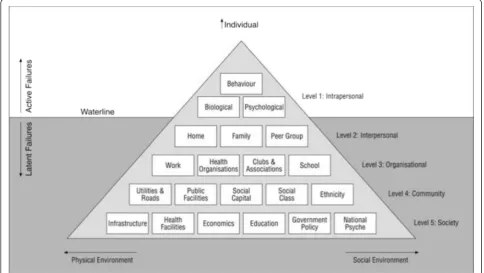
With recognition for Haddon’s (1970) early concept of ecological injury prevention, and Green and Kreuter’s (1999) ecological approach in the context of health pro-motion, Hanson et al. (2005) presented their metaphor-ical iceberg of injury prevention for the application of community safety interventions. The model visualised that above the water’s surface and within the iceberg’s tip lies a single level containing: (i) intrapersonal factors (e.g. behaviour, biology, psychology). But below the waterline in the socioecological depths were an add-itional four levels. These were: (ii) interpersonal (e.g. home, family); (iii) organisational (e.g. occupation, heath organisations); (iv) community (e.g. social class, public facilities), and; (v) society (e.g. infrastructure,
government policy). Both Haddon (1970) and Hanson et al. (2005) identified that the aetiology and prevention of injury, like disease, is grounded in an intrinsically eco-logical concept, and the individual is merely the salient
‘tip’of the iceberg (Fig. 2).
In the case of the Injury Iceberg, a socioecological per-spective towards injury control has many benefits, and draws attention to: (i) the importance of ergonomic and environmental design; (ii) the sustainability and alloca-tion of resources (e.g. personnel availability to financial budgeting); (iii) the value of community engagement and empowerment, and; (iv) how multiple countermeasures and interventions at different levels can maximise the ability to attenuate risk and prevent injury (Hanson et al. 2005; Allegrante et al. 2010). On the other hand, socioecological models are, first and foremost, only conceptual frameworks in which to challenge the bio-medical paradigm of individualism which originated out of the ‘medical model’ of both disease and injury (Eime et al. 2004, 2005). For instance, any given socioecological model does not identify discrete fac-tors, nor does it attempt to substantiate the strength and temporality of causal effects across its entire framework. In a similar manner, Hill’s (1965) consid-erations for causation and Rothman’s (1976; 2005) model, despite having had a positive impact on con-temporary epidemiological issues (e.g. Potischman and Weed 1999; Grant 2009; Ronksley et al. 2011), have also been regarded as ‘heuristics’ that are limited in their scope and application (Koopman and Lynch 1999; Phillips and Goodman 2004, 2006; Marshall and Galea 2014). Notwithstanding the promising evolution of multicausal theory in epidemiology, many import-ant public health issues stand resilient in spite of the best intentions to design and implement suitable in-terventions (Marshall and Galea 2014). Another con-ceptual approach known as ‘systems thinking’, which builds on the strong theoretical foundation that is of-fered by socioecological models, has potential and should be considered for better understanding the de-velopment and prevention of sports injury.
Thinking in‘systems’
and systems thinking approaches are conceptually syn-onymous, but particular systems thinking techniques offer methodological and analytical rigour to an already primed ecological framework. A succinct definition of systems thinking has been provided by Trochim et al. (2006; p.593):
“Systems thinking is a general conceptual orientation
concerned with the interrelationships between parts and their relationships to a functioning whole, often understood within the context of an even greater whole. It is ancient in origin and familiar to us all, but
it is also something very modern”.
System thinking theory and principles
A number of systems thinking principles are well recog-nised (Sterman 2006; Diez Roux 2007; Dekker 2011): (i) complexity in the system arises from multiple webs, rela-tionships, and interactions between a large number of heterogeneous factors; (ii) the knowledge associated with a given actor, agent or factor in the system is limited and localised to its respective sub-system or level; (iii) history plays an important role in the system, and past events explain present and future behaviour; (iv) interactions in the system can include non-linear self-reinforcing and self-correcting feedback loops (i.e. reciprocity), which might produce an emergent effect (i.e. small initial
events can reverberate exponentially and produce a dis-proportionately larger consequence in time, otherwise known as ‘sensitivity on initial conditions’); (v) complex systems are homeostatic: they persist, adapt, and are continually in flux to enable reconfiguration in response to internal or external influence and change; (vi) systems are counterintuitive, and aetiological processes can be vastly distant in time and space, and; (vii) systems can be resistant to obvious solutions (i.e. seemingly reason-able strategies can actually worsen the issue). The corol-lary of these characteristics is that adverse events, including injury, are emergent properties that arise from the many decisions, actions and interactions between ac-tors and agents across the entire system.
Principles in practice
upstream influences across the broader social structure (i.e. the behaviour of powerful corporate entities, tax sys-tems, and political processes) (Hernán 2015). This point is no better illustrated than by current models of sports injury aetiology which have primarily been concerned with the individual athlete and their immediate environ-ment. The revised model of athletic injury aetiology (Meeuwisse et al. 2007), for example, represents a sound attempt at advancing the initial static and linear para-digm, but systemic and interpersonal determinants are not featured. According to systems theory, any given sys-tem is characterised by continual adaptation and change involving multiple sub-systems. These sub-systems are further comprised of many interconnected compo-nents that are fundamentally different, including non-biological elements (e.g. amenities, products), along with individuals, communities, organisations, regula-tory agencies and political bodies. Ultimately, injury is the result of the many complex interrelated processes that need to be understood, and not the events and conditions in the system per se that produce emer-gent behaviour (Leveson 2011).
The application of system-based principles also have a number of analytical implications in terms of conventional epidemiological approaches. For example, given that it is necessary to study a system as a whole instead of isolating relationships between individual factors, the underlying assumptions that are commonly used in traditional statis-tical modelling are divorced from systems theory (Ip et al. 2013). This does not mean that systems thinking dismisses or acts as a substitute for scientific reductionism or linear modelling. Rather, system-driven approaches are viewed as supplementary to reductionist approaches, and can even include data derived via traditional statistical methods (Trochim et al. 2006). In response to the promul-gation of an ecological understanding of health-related processes, more sophisticated analytical techniques are available, such as multilevel analyses and random effects models (Luke and Stamatakis 2012; Galea and Ahern 2006). Despite being able to adjust for potential confound-ing, a fundamental limitation associated with all regression-based analyses lies with their inability to account for system-wide phenomena, such as self-reinforcing and self-correcting feedback mechanisms or causal effects that are time-distant from the outcome (i.e. the use of longitudinal snapshot data at predefined inter-vals) (Galea et al. 2010). Illustrative models such as Di-rected Acyclic Graphs and Structural Equation Modelling (e.g. path analysis) are used for different ends, and have even featured in sports injury research (e.g. Shrier and Platt 2008). However, these types of diagraphs are mostly concerned with the visualisation of traditional statistical-related subject matter at a single level (e.g. adjusted effect estimates and directed dependencies) (Pearl 1995;
Greenland et al. 1999; Shipley 2002; Greenland 2003; Olobatuyi 2006; VanderWeele and Robins 2007). Effect-ively, a systems approach attempts to understand the underlying processes along with theoverall functioningof a system in relation to its principles, rather than to iden-tify individual causal effects between isolated parameter estimates (Diez Roux 2007).
A brief overview of available system-based methods Although not formally recognised as such in the literature, there are two main systems-related fields. At one end of the systems thinking continuum lies computational system sci-ence methods which includes three prominent techniques: Agent Based Modelling (ABM), System Dynamics, and Network Analysis (Bonabeau 2002; Trochim et al. 2006; Marshall and Galea 2014). Both ABM and System Dynam-ics are computer-based simulations that have the ability to produce emergent behaviour after equations and rules have been assigned to individual elements in the system (Resni-cow and Page 2008; Galea et al. 2010; Luke and Stamatakis 2012) (i.e. predict the potential spread of global infectious pandemics and patterns of climate change). These methods, however, have also had epidemiological applications to chronic disease (Ness et al. 2007), Human Immunodefi-ciency Virus transmission and prevention (Aral et al. 2010; Marshall et al. 2012), substance-abuse (Moore et al. 2009; Gordon et al. 2006), physical inactivity (Yang et al. 2011), and dietary practices (Auchincloss et al. 2013). In terms of injury, System Dynamic modelling has been discussed as a way to strengthen the understanding of upstream activities in order to identify key political leverage points for injury prevention purposes (Ferencik and Minyard 2011).
2013), outdoor activity (Salmon et al. 2014), and road safety (Scott-Parker et al. 2015) systems. The successful operationalisation of AHFE systems-based methods demonstrates that these approaches are viable, practical, and highly versatile.
A case in point from the sports injury literature
The potential value of systems thinking principles can be illustrated in the context of sports injury by using the activity of distance running as an example. This particu-lar exercise modality, whether for recreational or com-petitive ends, has been chosen given its popularity, accessibility, and the plethora of health-related benefits associated with it. The term ‘the distance running sys-tem’will exemplify this scenario based on research from another context (Scott-Parker et al. 2015).
The distance running system in which a runner resides is comprised of many levels, including but not limited to: (i) equipment and the physical training environment; (ii) the runner themselves; (iii) wider social networks in-cluding other runners; (iv) occupational habits and life-style practices; (v) fitness trainers and coaches; (vi) running and fitness clubs and associated policies; (vii) community healthcare services; (viii) athletics associa-tions and official governing bodies, and; (ix) the wider political and regulatory environment. Certain outputs in the distance running system, such as injury, result from the synergistic interaction between its many various het-erogeneous elements. Consistent with contemporary models of sports injury aetiology (Meeuwisse et al. 2007), the most utilised epidemiological approach has been to collapse the distance running system down, and reduce injury mechanisms to the biomechanical and be-havioural levels only (van Gent et al. 2007; Nielsen et al. 2012; Saragiotto et al. 2014). From there, it has been possible to examine particular causal effects of interest (e.g. Boldt et al. 2013; Bredeweg et al. 2013; Rodrigues et al. 2013; Nielsen et al. 2014), such as isolating the associ-ation between isokinetic strength variables and injury using traditional statistical modelling (e.g. Messier et al. 1995). On the other hand, reassembling the distance running system after identifying statistically significant variables (on the tacit assumption that the whole cannot be greater or less than the sum of its parts), now re-quires supplementation with a systems approach. This will involve traversing‘up and out’of the system to also identify and examine the contribution of indirect influ-ences and systemic processes as they relate to running injury development. This includes, for example, the mar-keting, distribution and uptake of running footwear, the design of built environments, social expectations and norms, emerging technologies and the role of ‘e-health’, athletic policies, and the influence of private industry and healthcare services.
In reconciling systems concepts with epidemiology, Pearce and Merletti (2006) argue that the health of a population can be viewed as a complex adaptive system. By definition, this premise can be extended to athletic populations, including distance runners. But as Diez Roux (2007) has reasonably asked, what would a systems perspective actually look likein practice? The answer to this question is dependent on which systems-related field and method is adopted. Computational system sci-ence techniques and AHFE methods both show great promise for a variety of topics, but the former are inher-ently quantitative and the latter qualitative. It can be said with certainty, however, that both ends of the systems thinking continuum necessitate a team of multidisciplin-ary practitioners, each with unique skillsets and know-ledge regarding how to operationalise a particular methodology (Ferencik and Minyard 2011). In order to answer questions about complex causal phenomena, epi-demiologists are encouraged to find the‘middle ground’ between traditional epidemiological inquiry, and the ab-stract mental models found in the social sciences (Marshall and Galea 2014; Hernán 2015). Even though systems thinking is an appropriate starting point in which to reconcile data with theory, it still remains to be widely accepted across a number of scientific disciplines. This is because system-based methods are still in a stage of maturation and refinement. Currently, it is not pos-sible to produce a numerically precise systems-based model that simultaneously preserves the face validity underpinning the nature of reality (Ip et al. 2013). This delicate balance between statistical precision and eco-logical realism, however, might be viewed as a welcome trade-off for sports injury prevention research. There-fore, we contend that the future study of causality in sports injury research lies with a mutually inclusive an-swer: continue to utilise traditional epidemiological ap-proaches, but also embrace the possibilities associated with a systems thinking approach.
Conclusion
prevention interventions. However, rapid developments in the broader field of public health and Applied Human Factors and Ergonomics, are fast moving beyond the socioecological era. In fact, recognition for the potential of systems thinking methodologies and analyses has already gained traction in other injury contexts. The ad-vancement of sports injury prevention research will re-quire that epidemiologists bring their knowledge and skillsets forwards in an attempt to use, adapt, and even refine existing systems-based approaches. Alongside the natural development of conventional scientific method-ologies and analyses in sports injury research, moving forwards to a complementary systems paradigm is now required.
Abbreviations
ABM:Agent Based Modelling; AHFE: Applied Human Factors and Ergonomics; RE-AIM: Reach, Effectiveness, Adoption, Implementation, Maintenance.
Competing interests
The authors declare that they have no competing interests
Authors’contributions
Both authors read and approved the final manuscript. AH led the development of the manuscript and initiated the idea. CFF contributed further ideas and had editorial input into the manuscript
Authors’information
AH undertook this work as part of his PhD studies under the supervision of CFF. AH is supported by a Federation University Australia PhD scholarship. CFF is the Director of the Australian Centre for Research into Injury in Sport and its Prevention (ACRISP). ACRISP is one of nine research centres worldwide to be selected by the International Olympic Committee (IOC) as a member of the IOC Medical Research Network. CFF is supported by a National Health and Medical Research Council (of Australia) Principal Research Fellowship (ID: 1058737).
Acknowledgements
Dr Rasmus Nielsen, Professor Andrew McIntosh and Professor Paul Salmon provided feedback on sections in a draft version of this manuscript.
Received: 7 September 2015 Accepted: 3 December 2015
References
Ackoff RL. Towards a system of systems concepts. Manag Sci. 1971;17:661–71. Allegrante JP, Hanson DW, Sleet DA, Marks R. Ecological approaches to the
prevention of unintentional injuries. Ital J Public Health. 2010;7:24–31. Aral SO, Leichliter JS, Blanchard JF. Overview: the role of emergent properties of
complex systems in the epidemiology and prevention of sexually transmitted infections including HIV infection. Sex Transm Infect. 2010;86 Suppl 3:1–3.
Auchincloss AH, Riolo RL, Brown DG, Cook J, Roux Diez AV. An agent-based model of income inequalities in diet in the context of residential segregation. Am J Prev Med. 2013;40:303–11.
Bahr R, Holme I. Risk factors for sports injuries - a methodological approach. Br J Sports Med. 2003;37:384–92.
Bahr R, Krosshaug T. Understanding injury mechanisms: a key component of preventing injuries in sport. Br J Sports Med. 2005;39:324–9.
Baum F. The new public health. Sydney: Oxford University Press; 2011. Bertalanffy L. General system theory: foundations, development, application. New
York: Brazilier; 1969.
Blum HL. Planning for health: developmental application of social change theory. New York: Human Sciences Press; 1974.
Boldt AR, Willson JD, Barrios JA, Kernozek TW. Effects of medially wedged foot orthoses on knee and hip joint running mechanics in females with and without Patellofemoral Pain Syndrome. J Appl Biomech. 2013;29:68–77. Bonabeau E. Agent-based modeling: methods and techniques for stimulating
human systems. Proc Natl Acad Sci U S A. 2002;99:7280–7.
Bredeweg SW, Kluitenberg B, Bessem B, Buist I. Differences in kinetic variables between injured and noninjured novice runners: a prospective cohort study. J Sci Med Sport. 2013;16:205–10.
Broadbent A. The philosophy of epidemiology. Palgrave Macmillan: Basingstoke; 2013.
Cameron MH, Vulcan AP, Finch CF, Newstead SV. Mandatory bicycle helmet use following a decade of helmet promotion in Victoria, Australia–an evaluation. Accid Anal Prev. 1994;26:325–37.
Cassel J. Social science theory as a source of hypotheses in epidemiological research. Am J Public Health Nations Health. 1964;54:1482–8. Cassel J. The contribution of the social environement to host resistance.
Am J Epidemiol. 1976;104:107–23.
Checkland P. Systems thinking, systems practice. New York: John Wiley & Sons; 1981.
Dahlgren G, Whitehead M. Policies and strategies to promote equity in health. Institute for Future Studies: Stockholm; 1991.
De Haven H. Mechanical analysis of survival in falls from heights of fifty to one hundred and fifty feet. War Med. 1942;2:586–96.
Dekker S. Drift into failure. Surrey: Ashgate Publishing Limited; 2011. Dever AGE. An epidemiological model for health policy analysis. Soc Indic Res.
1976;2:453–66.
Diez Roux AV. Intergrating social and biologic factors in health research: a systems view. Ann Epidemiol. 2007;17:569–74.
Eime R, Owen N, Finch CF. Protective eyewear promotion: Applying principles of behaviour change in the design of a squash injury prevention programme. Sports Med. 2004;34:629–38.
Eime R, Finch C, Wolfe R, Owen N, McCarty C. The effectiveness of a squash eyewear promotion strategy. Br J Sports Med. 2005;39:681–5.
Evans AS. Clinical syndromes in adults caused by respiratory infection. Med Clin North Am. 1967;51:803–18.
Evans AS. Causation and disease: the Henle-Koch postulates revisited. Yale J Biol Med. 1976;49:175–95.
Ferencik R, Minyard K. Systems thinking and injury prevention: an innovative model for informing state and local policies. West J Emerg Med. 2011;12:273–4. Finch CF. A new framework for research leading to sports injury prevention. J Sci
Med Sport. 2006;9:3–9.
Finch CF, Donaldson A. A sports setting matrix for understanding the
implementation context for community sport. Br J Sports Med. 2010;44:973–8. Fredricks DN, Relman DA. Sequence-based identification of microbial pathogens:
a reconsideration of Koch’s postulates. Clin Microbiol Rev. 1996;9:18–33. Galea S, Ahern J. Invited commentary: considerations about specificity of
associations, causal pathways, and heterogeneity in multilevel thinking. Am J Epidemiol. 2006;163:1079–82.
Galea S, Riddle M, Kaplan GA. Causal thinking and complex system approaches in epidemiology. Int J Epidemiol. 2010;39:97–106.
Gibson JJ. The contribution of experimental psychology to the formulation of the problem of safety: a brief for basic research. In: Jacobs HH, editor. Behavioral approaches to accident research. New York: Association for the Aid of Crippled Children; 1961. p. 77–89.
Gissane C, White J, Kerr K, Jennings D. An operational model to investigate contact sports injuries. Med Sci Sports Exerc. 2001;33:1999–2003.
Glass TA, Goodman SN, Hernán MA, Samet JM. Causal inference in public health. Annu Rev Public Health. 2013;34:61–75.
Goode N, Salmon PM, Lenné MG, Hillard P. Systems thinking applied to safety during manual handling tasks in the transport and storage industry. Accid Anal Prev. 2014;68:181–91.
Gordon JE. The epidemiology of accidents. Am J Public Health Nations Health. 1949;39:504–15.
Gordon DM, Mezic J, Gruenwald PJ. Agent-based modelling of drinking behavior: a preliminary model and potential applications to theory and practice. Am J Public Health. 2006;96:2055–60.
Graham H. Social determinants and the unequal distribution: clarifying policy understandings. Milbank Q. 2004;82:101–24.
Green LW, Kreuter MW. Health promotion planning: an educational and ecological approach. 3rd ed. California: Mayfield Publishing Company; 1999. Greenland S. Quantifying biases in causal models: classical confounding vs
collider-stratification bias. Epidemiology. 2003;14:300–6.
Greenland S, Pearl J, Robins JM. Causal diagrams for epidemiologic research. Epidemiology. 1999;10:37–48.
Haddon W. On the escape of tigers, an ecological note. Am J Public Health. 1970; 60:2229–34.
Haddon W. Advances in the epidemiology of injuries as a basis for public policy. Public Health Rep. 1980;95:411–21.
Haddon W, Suchman E, Klein D. Accident research: methods and approaches. New York: Harper & Row; 1964.
Hagel B, Meeuwisse W. Risk compensation: a“side effect”of sport injury prevention. Clin J Sport Med. 2004;14:193–6.
Hanson D, Hanson J, Vardon P, McFarlane K, Lloyd J, Muller R, et al. The injury iceberg: an ecological approach to planning sustainable community safety interventions. Health Promot J Austr. 2005;16:5–10.
Hanson DW, Finch CF, Allegrante JP, Sleet D. Closing the gap between injury prevention research and community safety promotion practice: revisiting the public health model. Public Health Rep. 2012;127:147–55.
Heinrich HW. Industrial accident prevention: a scientific approach. New York: McGraw-Hill; 1931.
Hernán MA. Invited commentary: agent-based models for causal
inference—reweighting data and theory in epidemiology. Am J Epidemiol. 2015;181:103–5.
Hill AB. The environment and disease: association or causation? Proc R Soc Med. 1965;58:295–300.
Huebner RJ. Criteria for etiologic association of prevalent viruses with prevalent diseases; the virologist’s dilemma. Ann N Y Acad Sci. 1957;67:430–8. Ip EH, Rahmandad H, Shoham DA, Hammond R, Huang TK, Wang Y, et al.
Reconciling statistical and systems science approaches to public health. Health Educ Behav. 2013;40:123–31.
Jenkins DP, Salmon PM, Stanton NA, Walker GH. A systemic approach to accident analysis: a case study of the Stockwell shooting. Ergonomics. 2010;53:1–17.
Koopman JS, Lynch JW. Individual causal models and population system models in epidemiology. Am J Public Health. 1999;89:1170–4.
Krieger N. Epidemiology and the web of causation: has anyone seen the spider? Soc Sci Med. 1994;39:887–903.
Lalonde M. A new perspectice on the health of Canadians: a working document. http://www.phac-aspc.gc.ca/ph-sp/pube-pubf/perintrod-eng.php (1974). Accessed 24 Aug 2015.
Leveson NG. A new accident model for enginnering safer systems. Saf Sci. 2004; 42:237–70.
Leveson NG. Applying systems thinking to analyze and learn from events. Saf Sci. 2011;49:55–64.
Li G, Baker SP. Preface. In: Li G, Baker SB, editors. Injury research: theories, methods and approaches. New York: Springer; 2014. p. ix–x.
Loomis D, Wing S. Is molecular epidemiology a germ theory for the end of the twentieth century? Int J Epidemiol. 1990;19:1–3.
Luke DA, Stamatakis KA. Systems science methods in public health. Annu Rev Public Health. 2012;33:357–76.
Lyon A. Causality. Br J Philos Sci. 1967;18:1–20.
Mackie JL. Causes and conditions. Am Philos Q. 1965;2:245–64.
MacMahon B, Pugh TF, Ipsen J. Epidemiologic methods. Boston: Little Brown and Co; 1960.
Marshall BDL, Galea S. Formalizing the role of agent-based modeling in causal inference and epidemiology. Am J Epidemiol. 2014;181:92–9.
Marshall BDL, Paczkowski, MN, Seemann L, Tempalski B, Pouget RR, et al. A complex systems approach to evaluate HIV prevention in metropolitan areas: preliminary implications for combination intervention strategies. Plos One. 2012; doi:10.1371/journal.pone.0044833.
McGlashan AJ, Finch CF. The extent to which behavioural and social sciences theories and models are used in sport injury prevention research. Sports Med. 2010;40:841–58.
McIntosh A. Risk compensation, motivation, injuries, and biomechanics in competitive sport. Br J Sports Med. 2005;39:2–3.
McKeown T. The role of medicine. Dream, mirage or nemesis? Oxford: Basil Blackwell; 1979.
Meeuwisse WH. Assessing causation in sport injury: a multifactorial model. Clin J Sport Med. 1994a;4:166–70.
Meeuwisse WH. Athletic injury etiology: distinguishing between interaction and confounding. Clin J Sport Med. 1994b;4:171–5.
Meeuwisse WH, Tyreman H, Hagel B, Emery C. A dynamic model of etiology in sport injury: the recursive nature of risk and causation. Clin J Sport Med. 2007;17:215–9.
Messier SP, Edwards DG, Martin DF, Lowery RB, Cannon DW, James MK, et al. Etiology of iliotibial band friction syndrome in distance runners. Med Sci Sports Exerc. 1995;27:951–60.
Moore D, Dray A, Green R, Hudson SL, Jenkinson R, Siokou C, et al. Extending drug ethno-epidemiology using agent-based modelling. Addiction. 2009;104: 1991–7.
Ness RB, Koopman JS, Robert MS. Causal system modeling in chronic disease epidemiology: a proposal. Ann Epidemiol. 2007;17:564–8.
Nielsen RO, Buist I, Sørensen H, Lind M, Rasmussen S. Training errors and running related injuries: a systematic review. Int J Sports Phys Ther. 2012;7:58–74. Nielsen RO, Buist I, Parner ET, Nohr EA, Sorensen H, Lind M. Foot pronation is not
associated with increased injury risk in novice runners wearing a neutral shoe: a 1-year prospective cohort study. Br J Sports Med. 2014;48:440–7. Olobatuyi ME. A user’s guide to path analysis. Oxford: University Press of America;
2006.
Parascandola M, Weed DL. Causation in epidemiology. J Epidemiol Community Health. 2001;55:905–12.
Pearce N, Merletti F. Complexity, simplicity, and epidemiology. Int J Epidemiol. 2006;35:515–9.
Pearl J. Causal diagrams for empirical research. Biometrika. 1995;82:669–88. Phillips CV, Goodman KJ. The missed lessons of Sir Austin Bradford Hill. Epidemiol
Perspect Innov. 2004;1:1–5.
Phillips CV, Goodman KJ. Causal criteria and counterfactuals; nothing more (or less) than scientific common sense. Emerg Themes Epidemiol. 2006. doi:10. 1186/1742-7622-3-5.
Potischman N, Weed DL. Causal criteria in nutritional epidemiology. Am J Clin Nutr. 1999;69 Suppl 6:309–14.
Rasmussen J. Risk management in a dynamic society: a modelling problem. Saf Sci. 1997;27:183–213.
Read G, Salmon PM, Lenne MG. Sounding the warning bells: the need for a systems approach to rail level crossing safety. Appl Ergon.
2013;44:765–74.
Reason J. Managing the risks of organisational accidents. Vermont: Ashgate Publishing Ltd; 1997.
Resnicow K, Page SE. Embracing chaos and complexity: a quantum change for public health. Am J Public Health. 2008;98:1382–9.
Rivara FP. An overview of injury research. In: Rivara FP, Cummings P, Koepsell TD, Grossman DC, Maier RV, editors. Injury control: a guide to research and evaluation. New York: Cambridge University Press; 2001. p. 1–14. Rivers T. Viruses and Koch’s postulates. J Bacteriol. 1937;33:1–12.
Robertson LS. Injury epidemiology. 3rd ed. New York: Oxford University Press; 2007.
Rodrigues P, TenBroek T, Hamill J. Runners with anterior knee pain use a greater percentage of their available pronation range of motion. J Appl Biomech. 2013;29:141–6.
Rogers ES. Human ecology and health: an introduction for administrators. New York: Macmillan; 1960.
Ronksley PE, Brien SE, Turner BJ, Mukamal KJ, Ghali WA. Association of alcohol consumption with selected cardiovascular disease outcomes: a systematic review and meta-anlysis. Br Med J. 2011. doi:10.1136/bmj.d671. Rose G. Sick individuals and sick populations. Int J Epidemiol. 1985;14:32–8. Rothman KJ. Causes. Am J Epidemiol. 1976;104:587–92.
Rothman KJ, Greenland S. Causation and causal inference in epidemiology. Am J Public Health. 2005;95 Suppl 1:144–50.
Runyan CW. Using the Haddon matrix: introducing the third dimension. Inj Prev. 1998;4:302–7.
Salmon PM, Williamson A, Lenné M, Mitsopoulos-Rubens E, Rudin-Brown CM. Systems-based accident analysis in the led outdoor activity domain: application and evaluation of a risk management framework. Ergonomics. 2010;53:927–39.
Salmon PM, Cornelissen M, Trotter MJ. Systems-based accident analysis methods: a comparison of Accimap, HFACS, and STAMP. Saf Sci. 2012;50:1158–70.
Saragiotto BT, Yamato TP, Hespanhol LC, Rainbow MJ, Davis IS, Lopes AD. What are the main risk factors for running related injuries? Sports Med. 2014;44: 1153–63.
Scott-Parker B, Morang MacKay J. Research and practice in a multidimensional world: a commentary on the contribution of the third dimension of the Haddon matrix to injury prevention. Inj Prev. 2015;21:131–2.
Scott-Parker B, Goode N, Salmon P. The driver, the road, the rules…and the rest? A systems-based approach to young driver road safety. Accid Anal Prev. 2015;74:297–305.
Senge PM. The fifth discipline: the art and practice of the learning organisation. New York: Doubleday; 1990.
Shipley B. Cause and correlation in biology. United Kingdom: Cambridge University Press; 2002.
Shrier I, Platt RW. Reducing bias through directed acyclic graphs. BMC Med Res Methodol. 2008. doi:10.1186/1471-2288-8-70.
Stapp JP. Human tolerance to deceleration. Am J Surg. 1957;93:734–40. Sterman JD. Learning from evidence in a complex world. Am J Public Health.
2006;96:505–14.
Susser M. Does risk factor epidemiology put epidemiology at risk? Peering into the future. J Epidemiol Community Health. 1998;52:608–11.
Susser M, Susser E. Choosing a future for epidemiology: I. Eras and paradigms. Am J Public Health. 1996a;86:668–73.
Susser M, Susser E. Choosing a future for epidemiology: II. From black box to Chinese boxes and eco-epidemiology. Am J Public Health. 1996b;86:674–7. Trifiletti LB, Gielen AC, Sleet DA, Hopkins K. Behavioral and social sciences
theories and models: are they used in unintentional injury prevention research? Health Educ Res. 2005;20:398–07.
Trochim WM, Cabera DA, Milstein B, Gallagher RS, Leischow SL. Practical challenges of systems thinking and modeling in public health. Am J Public Health. 2006;96:538–46.
van Gent RN, Siem D, van Middelkoop M, van Os AG, Bierma-Zeinstra SMA, Koes BW. Incidence and determinants of lower extremity running injuries in long distance runners: a systematic review. Br J Sports Med. 2007;41:469–80. van Mechelen W, Hlobil H, Kemper HCG. Incidence, severity, aetiology and
prevention of sports injuries: a review of concepts. Sports Med. 1992;14:82–99. Vandenbroucke JP. Is‘The Causes of Cancer’a miasma theory for the end of the
twentieth century? Int J Epidemiol. 1988;17:708–9.
VanderWeele TJ, Robins JM. Directed acyclic graphs, sufficient causes, and the properties of conditioning on a common effect. Am J Epidemiol. 2007;166: 1096–104.
VanLeeuwen JA, Waltner-Toews D, Abernathy T, Smit B. Evolving models of human health toward an ecosystem context. Ecosyst Health. 1999;5:204–19. Wing S. The role of medicine in the decline of hypertension-related mortality. Int
J Health Serv. 1984;14:649–66.
Wing S. Social inequalities in the decline of coronary mortality. Am J Public Health. 1988;78:1415–6.
Wing S. The limits of epidemiology. Med Global Surv. 1994;1:74–86. World Health Organisation. The Ottawa Charter for health promotion: first
international conference on health promotion, Ottawa, 21 November 1986. http://www.who.int/healthpromotion/conferences/previous/ottawa/en/. Accessed 23 Nov 2015.
Yang Y, Diez Roux AV, Auchincloss AH, Rodriguez DA, Brown DG. A spatial agent-based model for the simulation of adults’daily walking within a city. Am J Prev Med. 2011;40:353–61.
Submit your manuscript to a
journal and benefi t from:
7 Convenient online submission
7 Rigorous peer review
7 Immediate publication on acceptance
7 Open access: articles freely available online 7 High visibility within the fi eld
7 Retaining the copyright to your article