UNIVERSITY OF TAMPERE
STUDENTS’ PARTICIPATION IN LOCAL LANGUAGE LEARNING
THROUGH THE JIGSAW-BASED COOPERATIVE LEARNING
METHOD
Faculty of Education
ANNISA ARIS TANTYA and SITI SARAYULIS
March 2017
University of Tampere Faculty of Education
ANNISA ARIS TANTYA and SITI SARAYULIS: Students’ Participation in Local Language Learning through the Jigsaw-Based Cooperative Learning Method
Master’s thesis in Education, 57 pages, 14 pages of appendices March 2017
The purpose of the study was to investigate students’ participation in local language learning through the jigsaw based cooperative learning method.
The research was carried out in the elementary school of Sukma Bangsa Lhokseumawe with the fifth grade students of local language learning. Observing 25 students’ activities, interactions (teacher-student, student-student), and learning journals, which were written by students based on their experience, were the main sources in gathering the data. The results revealed that applying the jigsaw based cooperative learning method produced significant development in students’ learning activities. Based on the observations, it could be seen that the teacher successfully implemented the jigsaw method. There were better progressions day by day in students’ personal and social skills; working cooperatively, mastering the materials, acquiring knowledge, giving opinions, knowing each other, respecting each other, helping each other, and encouraging each other.
In summary, students’ participation is enhanced by using the jigsaw method; jigsaw method characterized by constructing different groups, giving different subtopic in the group, requiring the students to separate from home group into the expert group. After that, the student in expert group should return to the home group and teach their peers in the home group. A better atmosphere in the classroom is successfully created. Notwithstanding, the challenges cannot be denied. Based on the learning journals, students being fussy, bossy, impatient, unconvinced by others' explanations about the essence of learning materials, and time constraints became the main problems, which disturbed the implementation of the jigsaw method. In spite of it all, the teacher as facilitator succeeded in managing the obstacles that appeared during applying the jigsaw method by introducing students to jigsaw method procedures, giving intervention to avoid unexpected events, and confirming the explanation at the end of the learning process, and hence the learning purpose could be achieved.
Key words: jigsaw, cooperative learning, local language, Acehnese, student participation, students’ personal and social skills, elementary school.
ACKNOWLEDGEMENT
All praise to ALLAH SWT, God Almighty, and Merciful, who has given the writers full strength to complete the thesis entitled "Students’ Participation in Local Language Learning through Jigsaw-Based Cooperative Learning Method”. Peace upon the prophet Muhammad SAW who has brought the Islamic norms and values from darkness to the brightness of the entire world. We would like to express our special thanks to our family, especially for our beloved parents (Hasyim Syahbana and Laily Fadhlun; H. Hasanuddin H. Usman and Hj. Ainol Mardhiah H. Yusuf) who inspire and for being a source of motivation
Additionally, we would like to express our special thanks of gratitude and appreciation to the following scholarship sponsorship, Mr. Surya Paloh, Prof. Komaruddin Hidayat, and Ms. Lestari L. Moerdijat. We also would like to thank to Mr. Ahmad Baedowi as the director of education Sukma Bangsa and our local tutors helped in completing the thesis, Ms. Evi Siregar, Mr. Fuad Fachruddin, P.hD., Mr. Samsir Alam, M.Ed., Prof. Khoiruddin Bashori, Ms. Titik Farwati, Ms. Poppy S. Winanti P.hD, Prof. Drs. H. Ratno Lukito, M.A., D.C.L., Mr. Dr. Samsu Rizal Panggabean, and Ms. Satia Prihatni Zen, MA for their advices, information, knowledge, and support during this course.
Furthermore, our great appreciation for our supervisor, Prof. Eero Ropo, Ph.D and Pekka Räihä Ph.D for their guidance, advice, and assistance during our research. We are also thanks to Julie Rajala, Niina Nyyssölä, and Markus Huhtamäkiwho supported us in writing thesis process.
The last but not least, a special thanks goes to Birlander members who shared many ideas and helped us at any stage in the research.
CONTENTS
1. INTRODUCTION ... 1
1.1 BACKGROUND OF THE STUDY ... 1
1.2 RESEARCH QUESTIONS ... 4
2. JIGSAW BASED COOPERATIVE LEARNING ENHANCES STUDENTS’ PARTICIPATION IN LOCAL LANGUAGE LEARNING ... 5
2.1 COOPERATIVE LEARNING ... 5
2.2 JIGSAW AS A COOPERATIVE LEARNING METHOD ... 7
2.2.1 A concept of the jigsaw method... 7
2.2.2 The jigsaw method procedures ... 9
2.2.3 The advantages of the jigsaw method ... 10
2.3 STUDENTS’ PARTICIPATION IN THE LEARNING PROCESS ... 12
2.3.1 The importance of participation in the learning process ... 12
2.3.2 Factors influencing the students’ participation in the process of learning ... 13
2.4 LANGUAGE ACQUISITION ... 16
2.4.1 The local languages in Aceh ... 17
2.4.2 The importance of the local language ... 18
2.4.3 Students’ participation in learning local language using cooperative learning method ... 19
3. METHODOLOGY... 21
3.1 RESEARCH DESIGN ... 21
3.2 PRELIMINARY RESEACH ... 21
3.3 THE OBJECT OF THE RESEARCH ... 22
3.5 DATA ANALYSIS ... 24
3.6 ETHICAL CONSIDERATIONS ... 26
4. FINDINGS AND DISCUSSION ... 27
4.1 TEACHER-STUDENT ACTIVITIES DURING THE APPLICATION OF JIGSAW-BASED COOPERATIVE LEARNING METHOD ... 27
4.1.1 The jigsaw steps in the learning process ... 28
4.1.2 Students’ participation during the application of the jigsaw method ... 30
4.1.3 Summary of progression in implementing the jigsaw method during the courses ... 41
4.2 STUDENTS’ PERSPECTIVES TOWARDS THE JIGSAW METHOD... 42
4.3 SUMMARY OF THE FACED CHALLENGES AND THE SOLUTIONS ... 48
5. CONCLUSIONS, IMPLICATIONS, AND SUGGESTIONS FOR FURTHER RESEARCH ... 49
5.1 CONCLUSIONS ... 49
5.2 IMPLICATIONS ... 50
5.3 LIMITATIONS OF THE RESEARCH ... 51
5.4 SUGGESTIONS FOR FURTHER RESEARCH ... 51
LIST OF TABLES
TABLE 1. The Local Languages in Aceh... 17
TABLE 2.The Comparisons of Cooperative Language Learning and Traditional Language Teaching ... 20
TABLE 3. The Research Instrument and Data Collection ... 24
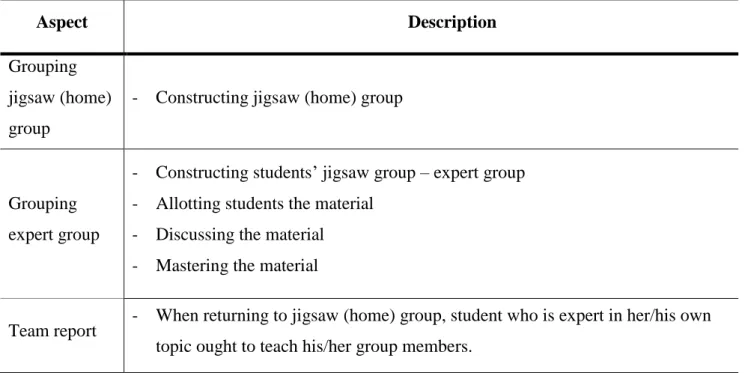
TABLE 4.The Main Aspect of the Implementation of the Jigsaw Method ... 29
TABLE 5. The Evaluation Stage of the Implementation of the Jigsaw Method ... 30
LIST OF FIGURES
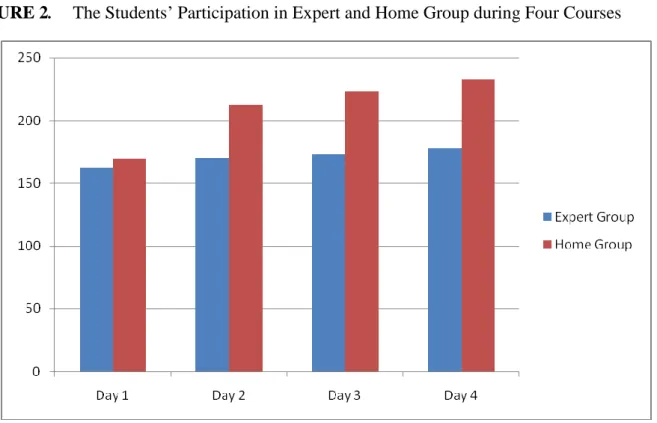
FIGURE 1. The Procedure of the Jigsaw Method ... 9 FIGURE 2.The Students’ Participation in Expert and Home Group during Four Courses ... 40
1
1. INTRODUCTION
1.1 BACKGROUND OF THE STUDY
Language is the most important skill in order to conduct better communication with others. Language has a pivotal role in human’s life and it is developed through interaction with others. It starts from infancy. A mother often talks to her child even while she is pregnant. In addition, when the child is born, the mother communicates with the child by using language. The first language that children obtain is called mother tongue or mother language (Buhmann & Trudell, 2008). Mother language that parents acquaint their children with is usually a local language of their region.
Learning local languages is one of the manifestations to entrench students’ appreciation for regional culture. According to Wildan (2010), the function of local language is as a medium of instruction in family and society. Tsui and Tollefson in Desai (2013) said that utilizing language and culture as the medium of instruction is the greatest tool in retaining and regenerating it. Following this, according to Vygotsky’s theory in Oakley (2004), culture has a crucial role in constructing knowledge. Constructing knowledge by culture could be learnt through songs, languages, and plays. Vygotsky also describes that culture might influence broader understanding for children in some contexts (Miller, 2011).
In Indonesia, there are many languages, which are typical of the provinces. One of the local languages in Indonesia is Acehnese, and mostly people in Aceh use Acehnese. Akbar et al. in Zulfadli (2014) revealed that Acehnese is a mother tongue of about 71% of the population in Aceh. In line with Yusuf (2009), about 2.5 million people in Aceh speak Acehnese language. In Aceh, there are different dialects of the Acehnese languages based on the districts where Acehnese people live, namely Aceh Utara dialect , Pidie dialect, Aceh Barat dialect, and Aceh Besar dialect. In addition, there are also two minority languages in Aceh; Jamee and Gayo. Every district has a different dialect that is unique to the area. For example, “what” in Aceh Utara dialect and Pidie dialect is “peu (/p∂/)”. However, the pronunciation of both is different. The accent of “peu (/p∂/)” in Aceh Utara dialect is “pu (/pu/)” and Pidie dialect is “peu (/p∂/)”. Moreover, using Indonesian in
2 daily conversations, which is occurred in local communities nowadays, challenges parents to make their children use Acehnese to communicate.
However, nowadays the existence of local language in Aceh is diminishing. Acehnese people, especially the younger generations prefer to use Indonesian in their daily life, specifically in urban areas such as Banda Aceh (Alamsyah et al. in Pillai &Yusuf, 2012).Based on language mapping in the province of Aceh, local languages in Aceh are beginning to extinct, particularly the Devayan language in Banyak Island (Santoso, 2017). It is also possibly happened in other regions in Aceh, if Acehnese people do not conserve their local languages from now on. The domination of Indonesian language in daily life is one of factors that reduce the use of Acehnese language.
Families with Acehnese monocultural backgrounds do not let their children speak Acehnese. Additionally, parents hesitate to teach children to speak the local language, because they assume that their children will have difficulties to understand the learning content in schools, which is delivered in Indonesian.
Additionally, based on pre-observations in the local language classes in the Elementary School of Sukma Bangsa Lhokseumawe, students only sit, listen, and do the tasks which were given by the teacher. From fifty students at the fifth grade, only 36% of the students (18 students) actively participated in learning the local language.
Based on pre-interview with some parents in elementary school of Sukma Bangsa, they said that they accustomed their children to speak Indonesian as a language of instruction since their children were babies. They prefer to accustom their children to speak Indonesian in order to avoid children use a kind of impolite words in Acehnese. For instance, ‘you’ in Acehnese language has three varieties “droeneuh”, “gata”, and “kah”. The first two words are the polite words in Acehnese and are used when speaking with someone who is older than speakers are. Otherwise, “Kah” is an impolite word or a little bit rough word, which is usually used by people with their fellow friends or younger than they are.
Additionally, the teachers in elementary school who teach Acehnese language were not originally from a local language education. They can only speak Acehnese in daily life. Moreover, there is no obligation in curriculum to determine Acehnese subject as a compulsory subject. In other words, implementation of Acehnese as a subject is optional.
3 Commonly, using a traditional method is also a reason that affects students’ refusal to give their attention to this subject. This fact creates a passive and an uninteresting classroom condition. Consequently, the learning process turns into an activity that reduces students’ motivation to learn Acehnese language. Lack of motivation to participate in the local language learning creates an unsupported environment. Students hesitate to participate actively during local language learning processes. However, if students participate actively in each learning activity, they will share some new information, learn better, and gain a better understanding (Wade in Abdullah et al., 2012). In line with Petress in Al-Kandari (2012) who said that, students give their best performance when they are actively involved in learning activities.
Furthermore, Slavin and Sahran in Sonwane (2011) stated that teaching method is one of the challenging topics of educational area. Therefore, an innovative and a creative teaching method are needed, in order to attract students’ enthusiasm to be actively involved in the learning process. A cooperative learning is one way to create student-centred learning and encourage students’ involvement in learning processes. One method, which is included in cooperative leaning, is the jigsaw method. Mengduo and Xiaoling (2010) found that students’ enthusiasm and participation could be promoted through a jigsaw method. It was a useful technique for students who are learning in language class. The jigsaw method is considered effective in increasing student’s confidence to speak. When students work together in a group discussion, they present better involvement, express a complex level of discussion, reduce the interruption when someone speaks, and offer important contributions. (Webb & Farivar in Gillies, 2006).
Based on Kazdan in Souvignier and Kronenberg (2007), using a cooperative method enhances social interactions among students in elementary school. When students are given a chance to construct thoughtful ideas by working with others, they develop an understanding of a purpose of groups and help others by giving information. According to Payne and Whittaker in Mohammadjani and Tonkaboni (2015), involving students through study in groups and discussions is important to give students opportunities for actively participating in the learning process. This treatment proved that cooperative learning acquaints learners to be an emphatic person by working with others and help each other. Classmates are often more sensitive than teachers of what other students cannot understand, able to converge the students’ attention to the problem, and provide clarification in their way (Gillies, 2006). As a result, student-centred classes can be created through students’ participate actively and work cooperatively.
4 Participation in the classroom does not only mean answering questions and making comments, but also asking more questions, and specifically responding to other students’ talk in class (McPherson, 2007). Establishing active participation in each course is not a simple task for every teacher. The behaviour and traits created by teachers and classmates influence students’ learning (Bolkan & Goodboy, 2009; Mustapha, 2010). Teachers should consider many things to create an active class and attract students to contribute actively in the classroom.
Therefore, we decided to use jigsaw method in order to explore more whether this method will involve students in learning the local language. We proposed that the teacher uses the jigsaw method to create a better atmosphere in the classroom. Additionally, the teacher can recognize the challenges in implementing jigsaw method and their solutions through this research.
In the next chapter, we discuss the theory and previous studies about the jigsaw method as one of cooperative learning methods, students’ participation, and language acquisition. Then, chapter three explains the method that we used for gathering and analyzing the data in this study. Furthermore, chapter four will discuss the results that we found in this study. Finally, in the last chapter, we present the conclusions and the implications of this study.
1.2 RESEARCH QUESTIONS
1.2.1 How does the jigsaw method work in order to enhance students’ participation in local language learning in the fifth grade?
1.2.2 What are the challenges in implementing jigsaw method, and does the teacher solve the challenges?
5
2. JIGSAW BASED COOPERATIVE
LEARNING ENHANCES STUDENTS’
PARTICIPATION IN LOCAL LANGUAGE
LEARNING
This chapter will discuss theories and previous studies that were chosen for the study. The discussion will focus on a cooperative learning in general, jigsaw method in particular, students’ participations in the learning process, and language acquisition in education. Additionally, the concepts, procedures, and advantages of the jigsaw will be explained in this chapter.
2.1 COOPERATIVE LEARNING
At the beginning of the twentieth century, the Johns Hopkins University began to focus on a cooperative learning, concerning small group learning and helping each other to achieve group aims (O’Leary & Griggs, 2010; Karacop & Doymus, 2013). This method is characterized by students working in 4-5 member groups, in which the members gain the acknowledgement based on the learning of the entire members (Slavin, 2008). An arrangement of cooperative learning encourages demonstrative teaching in elementary and secondary schools. Learning processes will be more interactive when cooperative learning is applied in a classroom. According to Steven and Slavin in Souvignier and Kronenberger (2007), cooperative learning is possible and efficient to use from the first day of school. According to Fawcet and Garton (2005), cooperative learning shows advancements, not only in students’ achievements, but also in students’ social interactions in elementary school.
Cooperative learning adjusts students to understand and share information with others in order to gain a good achievement. A research by Johns Hopkins University proves that cooperative learning encouraged students' achievements, if students are committed to learning objectives. The appreciation, which is achieved by groups, was not based on a single group product. However, it was because of the individual learning of all group members (Slavin, 2008). Based on Adams
6 (2013), students work better in gaining knowledge and social ability by associating cooperation and individual liability. Cooperative learning helps students to conduct their social skill, they rehearse to respect others opinions and express their opinions. Indirectly it will embed students’ responsibility in terms of tasks and obligations in groups. In line with the researches above, Hossain et al. (2014) revealed when working in small groups, students acquire a better academic achievement, regardless of ability levels, learning styles, ethnics, and gender. The cooperative learning itself helps increase students’ performances, communication skills, and values.
Slavin in Dollard and Mahoney (2010) stated that the purpose of cooperative learning is to utilize students’ passion, action, and inspiration independently. Studying in groups encourages students become more autonomous to figure out a material that they want to accomplish. Learning is not only getting the information from teachers or parents, but students can also learn from their colleagues. They find the problem and try to solve it together in groups. According to Grineski in O’Leary and Griggs (2010) through a cooperative learning, all students engaged in the learning process such as thinking, learning, and enjoying progress with colleagues. Cooperative learning is applied in order to construct a meaningful learning and gain a better thinking skill (Leng et al., 2013). The research found when students work cooperatively, they can build a better understanding and good achievements. In reference to this finding, we agree that cooperative learning will help students to participate actively and involve themselves independently in the classroom.
In order to engage students in learning, five elements must be presented in a cooperative classroom (Johnson &Johnson in Tran, 2016). According to Roger and Johnson in Rusman (2013), the elements of cooperative learning are positive interdependence, individual and group accountability, interpersonal and small group skills, face-to-face interaction, and group processing. According to Gillies et al. (2008), in conducting positive interdependence, every student should contribute actively in the group to achieve the learning group goal, such as mastering the essence of material, interrupting politely, giving opinion, and following teacher’s instruction. According to Sahin (2011), individual and group accountability is related to students’ self-awareness to take a responsibility in order to accomplish group achievements, which rely on all members of groups, such as to complete a task on time, write a result, pay attention and make eye contact with others, and initiate to talk. According to Jolliffe (2007), interpersonal and small group skills did not come naturally to students’ way of thinking, but through interacting with others (nurture). Students learn how to communicate, respect each other, resolve problem, and motivate the groups from teammates. When doing face-to-face interaction, every member in the group should support and encourage each other to achieve learning goals in completing a task (Ashman & Gillies, 2003). Additionally, Sahin (2011) said that a group processing is a reflection of a group process, which is
7 done by every member, such as reflecting on group sessions and presenting the results. Based on the five basic elements of cooperative learning, researchers agree that these elements is as a guideline in gaining the data when doing observation during courses.
2.2 JIGSAW AS A COOPERATIVE LEARNING METHOD
Hossain in Azmin (2016) stated that there are several types of cooperative learning methods; those were included the Student Teams-Achievement Division (STAD), Teams-Games-Tournaments (TGT), Cooperative Integrated Reading and Composition (CIRC), Team Accelerated Instruction (TAI), and the jigsaw method.
2.2.1 A concept of the jigsaw method
Forming a jigsaw method in a classroom avoids problems that occur in the learning process. This method is proven diminishing a competition and increasing cooperation (Doymus et al., 2010). In order to minimize the competition, according to Aronson (as cited in Souvignier & Kronenberger, 2007), the jigsaw method provides a cooperative learning environment, which fosters learner activities, joint acquisitions of contents and mutual explanations. Aronson and colleagues firstly applied the jigsaw classroom in 1971 in Austin, Texas. They invented the jigsaw method to reduce a racialism problem (segregation). By applying this method, they tried to merge white youngsters, African-American youngsters, and Hispanic youngsters in one class (Aronson, 2000).
As mentioned by Richards and Rodgers (2000), groups in cooperative learning are permitted to equal and unequal ability. By applying the jigsaw method, it is expected that students’ social skills will improve despite of their different ethnics, languages, and abilities. In forming cooperative learning groups, heterogeneous abilities in one group will conduct an equal understanding about materials. The jigsaw method constrains students to discuss and share basic information that they had before. At the end of the learning, a teacher has an important role to polish students’ achievements in order to enrich the knowledge towards the content of the material. In line with Kelly (2005), diverse ability groups make more comprehensive group conditions and produce the broadest perspectives and thoughts. Each group member who has unequal ability in learning will get advantages. According to Felder and Brent (2007), studying with heterogeneous abilities in one group will benefit each individual. Those who have a weak ability in learning can learn from students with a high ability while those who have a strong ability in learning will acquire the lesson content because they teach and guide others. Huang et al. (2014) revealed that forming cooperative
8 learning groups by mixing students with have high and low abilities is proven advancing effectiveness of learning and encouraging students’ social skills. Heterogeneous group members conduct a deeper and a better learning process. Studying with different students creates new ideas and understandings. These findings are in line with the research findings of Rasuli et al. (2011); Mohammadjani and Tonkaboni (2015).
Therefore, when forming the home groups, the teacher plays a role to distribute and choose each member of the groups to avoid social discrepancy. If the teacher lets students choose their members, they will most probably choose the same gender or the same ability for their own group. This causes unfairness to other students who have low ability in learning.
When creating home groups, teachers distinguish some factors related to the gender and culture (Sahin, 2011). However, some researchers did not find differences in achievement between male and female when forming jigsaw method (Njoroge & Githua, 2013; Peklaj, 2003; Petersen et al., 1991). In a cooperative condition, there was an equalizing effect; over time, there were no significance differences between female and male group members in achievement, verbal participation, perceived leadership, and status. The results are consistent with a proposition that group composition in terms of sex is not a significant influence on outcomes of cooperative efforts (Petersen, 1991). Contrary to previous studies, our study does not intend to explore students’ achievements after learning with jigsaw method. This study does not see the different genders when forming the groups, but distinguishes the members according to their abilities in local language learning. The groups will consist of students with mixed abilities according to their skills in the local language subject.
9 2.2.2 The jigsaw method procedures
According to Azmin (2015):
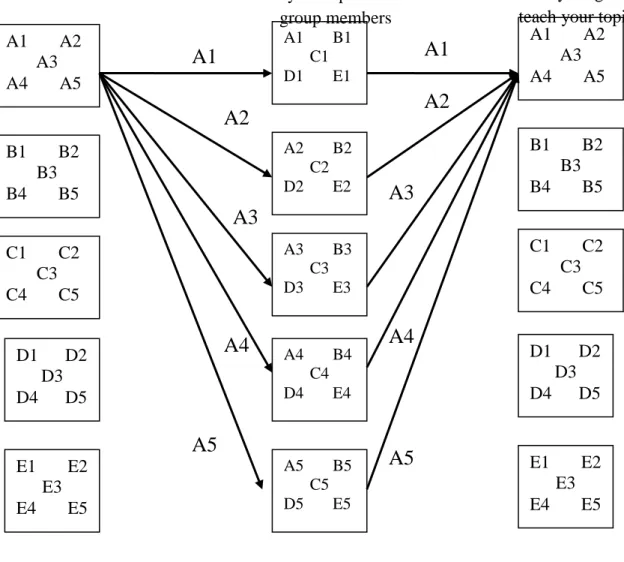
The procedures of applying jigsaw are; the teacher introduces a topic and subtopics. Then, students are divided into ‘home’ groups, where they are each given a different subtopic in the group. The next step requires the students to separate from their ‘home’ groups into the ‘expert’ groups where these students focus on one subtopic, researching and discussing it. Therefore, the students become experts on the subtopic that they have been assigned. Following their discussion, the students from all of the ‘expert’ groups must return to the ‘home’ groups and teach their peers based on their findings and discussions. In the end, all members of the ‘home’ groups will have learnt from each expert group discussion and will have the beneficial from each other. (p. 92)
FIGURE 1.The Procedure of the Jigsaw Method
A1 A2 A3 A4 A5 B1 B2 B3 B4 B5 C1 C2 C3 C4 C5 D1 D2 D3 D4 D5 E1 E2 E3 E4 E5 A1 B1 C1 D1 E1 A2 B2 C2 D2 E2 A3 B3 C3 D3 E3 A4 B4 C4 D4 E4 A5 B5 C5 D5 E5
A1
A2
A3
A1 A2 A3 A4 A5 B1 B2 B3 B4 B5 C1 C2 C3 C4 C5 D1 D2 D3 D4 D5 E1 E2 E3 E4 E5A4
A5
A1
A2
A3
A4
A5
Original groupReturn to your group and teach your topic Master your topic with other
10 The procedures of applying the jigsaw method are seen in graph 1. Through this method, learners have a same opportunity to participate in learning activities and a same responsibility in accomplishing assignments. The jigsaw method accustoms the learners to collaborate and cooperate with others. Additionally, this method can successfully reduce students’ reluctance to participate actively in the classroom activities and automatically conducts student-centred classes. However, teachers’ role as facilitator is undeniable when applying the jigsaw method. The teacher should help the students in gaining an essence of materials and control the learning process in order to achieve the learning goals by becoming involved in each student’s activity. According to Holliday (as cited in Mengduo and Xiaoling, 2010):
The group’s work in the expert groups and the home groups need to be assessed to ensure that everyone participated. This assessment evaluates the cooperation of the students while working in these small groups. The assessment takes the form of self-evaluation and teacher evaluation. Evaluation forms need to be created to evaluate the cooperation of the students while working in-group. (p.119)
2.2.3 The advantages of the jigsaw method
The jigsaw method emphasizes cooperative learning by providing students with an opportunity to help and encourage each other to increase a comprehension of materials. In line with Vygotsky’s theories, which focused on utilizing an environment into learning processes, includes people, cultures, and experiences in order to enhance students’ cognitive development. Students acquire the knowledge through an interaction with people around them and then they internalize the knowledge individually. According to Vygotsky in Doolittle (1997), internalization covers filtering new knowledge based on previous knowledge, and then incorporates it into students’ way of thinking. The learning process itself is a process of gaining the essence of the materials, which need students’ way of thinking to make it. Vygotsky in Oakley (2004) also said that a social interaction between children and adults around them is one way to build a complex thinking. An outcome of their learning process is a result from their interaction with others, parents, peers, and teachers.
In the jigsaw method, every student works in-group to achieve a group goal. They are more actively involved in gaining and mastering a learning content (Doymus et al., 2010). Therefore, students may not be only as passive receivers, who sit, listen, and accept the information from a teacher in learning processes without making any effort to be an active learner. The teacher is only as a facilitator who guides them, if they were stuck in the learning process. Teachers should give the students an opportunity to participate and facilitate them using a precise guidance in order to achieve learning goals in an active class.
11 In order to achieve better group aims, the teachers arranged students with various levels of abilities into one group. Thus, expert students can help others in understanding a material. Vygotsky in Oakley (2004) said that a support and a guidance by experienced others is needed to increase students’ achievement. The experienced others, which is called scaffold, provides a crucial role in increasing students’ level of capability. It will help students move from their actual level to their potential level.
The previous study by Azmin (2016) proved that the jigsaw method is successful promoting students’ performance rather than traditional method. The study also produces positive views from students after using the jigsaw method in the classroom. In line with Dollar and Mahoney (2010), applying the jigsaw method admits students in having a big opportunity to participate. Maceiras et al. (2011) in their study showed that students gained a deeper understanding and more participating in a group discussion rather than only listened to teachers’ explanations. Students are also enjoying the learning activity and feeling more helpful during learning with the jigsaw method. Even though, some of students were still doubt about the accuracy of the information from their teammates. Therefore, at the end of the courses, the teacher as a facilitator gives a completion of a whole material. Not only expert teammates, but also the teacher becomes scaffoldings in this activity to help students in gaining a better knowledge. According to Marhamah and Mulyadi (2013):
The jigsaw method also provides a way to help students become active in the classroom. When students are worried or sometimes even afraid to participate, they will miss the information, which is needed to understand the material. However, in the jigsaw method, students allow to work with one another and the knowledge. By involving students actively in the learning activities will increase their listening, speaking, cooperating, reflecting, and problem-solving skills. (p.711)
Additionally, Mengduo and Xiaoling (2010) found that the jigsaw method increases learners’ motivation, activeness, and interest in learning English effectively. This finding is in line with Yoruk (2016); Yapici (2016), which found benefits of applying the jigsaw method are not only increasing students’ achievement but also gaining a better motivation, enthusiasm, and activeness.
12
2.3 STUDENTS’ PARTICIPATION IN THE LEARNING PROCESS
Every student has to do well and take an active role in his or her learning process. It can be done through student’s participation by seeking the information independently, analyzing the information, and asking questions if they get difficulties in the learning process. When students speak in class, teachers consider that students are ready to ask a question, answer the question, give comments, and play a part in a class discussion. However, when students do not speak and participate in these ways, teachers consider that the students are lazy, unprepared, passive, or/and uninvolved students (Vandrick, 2000). There are many reasons why students do not speak out in the classroom. Therefore, when determining the technique and the method of teaching, teachers need to consider whether the method is an appropriate method to be applied and encourages confidence levels for students to speak more or not. This part will talk about the importance of the participation in the learning process, the factors which influence participation, and how to increase students’ participation in the discussion process.
2.3.1 The importance of participation in the learning process
Participation is an important element to learn. Based on social constructivism, learning occurs when students are actively engaged in the learning process and work in collaboration with other students to accomplish the group aims (Alanazy in Leng et al., 2013). According to Cohen in Tayebinik and Puteh (2013) students should be actively engaged in the learning process in order to enhance the quality of teaching. It has been proved that students learn better and get more information when they actively participate. Classroom participation can increase students’ motivation to take responsibility in learning, encourage students’ readiness in class, increase students’ confidence level in communicating with others, and create critical thinking.
The national Oracy project recognized that one way of improving learning could be through participation and discussion with others. When learners discuss with others, it can help learners in understanding, and then learners can appreciate new meaning and understanding by stating it into words. Through group discussion, every learner can assess the new knowledge and consider it in a different situation as they argue with others. Verbalizing all of the thinking provides a basic idea for learners to think deeply in their own thoughts, as Vygotsky said that thinking is an internal personal discussion. (Kelly, 2005) However, when the participation does not occur in a class, it will affect the students’ motivation to learn and students’ general attitudes towards the course. (Cieniewicz in Thien, 2008)
13 Lave and Wenger in Yun and Kim (2014) believe that learning should be established in social participation and interaction, which would play roles in developing learners’ ability in learning. The Russian constructivist psychologist, Lev Vygotsky, in Jordan et al. (2008) emphasizes that learners’ reasoning and understanding can be awoken with a social participation. He also claims that thinking and meaning are constructed through language. Individuals’ ideas are shared with others through a language. This participation in language is internalized as an individual thought. Therefore, a social communication develops into internalized thinking (Vygotsky in Oakley, 2004).
Vygotsky socio-constructivism theory was used as a basis for obtaining a concept of students’ participation in a local language through the jigsaw method in elementary school at the fifth grade. The theory was useful in evaluating the working of the jigsaw method during the learning activities observation and students’ opinions that were expressed in the learning journal.
2.3.2 Factors influencing the students’ participation in the process of learning
During the learning process, there are many factors influencing the students’ hesitation to speak out. According to Vandrick (2000), some of the reasons are related to students’ personal characteristics, classroom dynamics, and students’ background. Additionally, Abdullah (2012) states some factors that influence students’ participation are; the personality of the students, the skills of the instructor, the perception of classmates, and the size of classroom.
Students’ Personality
The personality of students is one of the supporting factors causing students to be engaged actively during the learning process. Students who have low motivation tend to be shy to speak and give opinions in class activities. Students can also become passive in the learning process because of self-limitations (Mustapha, 2010). The first of the self-limitations is cannot focus during the lecture or learning time (Abdullah, 2012). Students who cannot focus during the learning process tend to have difficulties in performing. When the teacher is delivering the material, students prefer to do something else that is unrelated to the class activities. Fear of offense and failing to show their intelligence also happen as a trigger to do not actively interact in the learning process (Mustapha, 2010). Students feel that they will act in the wrong way and make silly mistakes, even though they have a good understanding of the material. They think that is better for them to stay calm and keep the answer to themselves. Another typical of the factor above is fear that the lecturers will criticize their answers and confusion is occurring among students (Abdullah, 2012). Students are reluctant to give opinions or comments in the learning process, because the teacher will criticize the opinion.
14 When the teacher asks students to confirm the idea advocated by students, students tend to be confused and lose the idea. The next factor is low levels of self-confidence (Rocca, 2010). The level of students’ self-confidence will affect their courage to speak in front of a class. A student who feels capable enough and trust with her/his skills will be brave in expressing their capability, whereas students with low level of self-confidence tend to be shy and hesitate to perform. Another factor is
lack of preparation (Tesfaye, 2015). One factor which characterizes students’ readiness to study is when students give responses and are motivated to be involved in the classroom. A final factor is that students’ moods and emotional states influence their motivation to participate in the learning process. This situation can be seen when students showed their positive emotions in the classroom, for instance interacting well with fellow students and the teacher.
On the other hand, better participation can be shown if a student has a high self-efficacy. Self-efficacy is related to displaying more curiosity and discovering the inner urge. Thus, if self-Self-efficacy is high, it will enhance students’ confidence levels and they will become more active and speak more in the classroom. They will show a greater interest to learn and know more by asking questions, giving opinions, and discussing the topics in the classroom.
Classroom Dynamics
According to Vandrick (2000), classroom dynamics is characterised by students’ full participation and happens when all students are actively involved in the learning process. A teacher who is able to conduct a well-managed classroom dynamic will be able to create a good interaction between students and the teacher, and among students. Providing opportunities to all students to speak up in learning is a supporting factor that enables students to be engaged actively. A teacher is not supposed to pay attention to some certain dominant students. Lack of opportunity to give questions or comments causes students to be reluctant to participate. Therefore, a teacher needs to give an equal chance to each student to contribute in the learning process.
Students’ Background
According to Tesfaye (2015), students’ academic backgrounds influence levels of participation during class activities. Based on a situation in a classroom, students with Acehnese as the first language show a better involvement in Acehnese subject rather than students with Indonesian as the first language. In line with Vandrick’s findings (2000), the reason that influences students to hesitate to participate in a class, which has a certain language as the medium of instruction, is that the language is not their first language. Naturally, students who are not able to speak Acehnese as
15 their first language will be nervous to speak out. Even though they believe that their opinions are correct, some students will be silent and act as receivers in the group process.
The Power and Skills of Teachers
The power and skills of teachers become an important factor to attract students’ participation in the learning process. According to Rocca (2010), teachers give a contribution to increase students’ levels of participation. Students also believe that teachers influence their involvement in a classroom based on the way the teacher communicates with them (Fritshner in Rocca, 2010).
A teacher has to lead his/her learners to encourage learners’ performances and qualities of learning. During the learning process, teachers are able to use their power in delivering the material. She/he ought to have teaching ability in line with her/his competency, proficiency, and experience. A good skill in delivering materials that is shown by a teacher makes students believe in the teacher’s quality. Students will trust and appreciate, and even obey anything the teacher says. When students and teachers have a good relationship, students will be more comfortable to share, communicate, and participate during the learning process.
In enhancing students’ willingness to participate, the teacher has to appreciate a student who gained a good result by giving a reward. A teacher may give applause to her/his students in order to increase students’ motivation to be involved in the learning activities. Teachers need to give students an opportunity to express their thoughts to conduct a good interaction during the learning process.
Essentially, having powers in teaching is really needed. A teacher who uses these powers during the learning process is a creative and critical teacher. Therefore, the skills and power of teachers will influence students’ involvement during the courses. A teacher, who manages when and how the power can be applied effectively, is a teacher who can educate and teach the students to reach a better achievement and participation.
The Personality of Classmates
However, not only teachers, but also classmates also have a crucial factor to influence the level of students’ participation. Students prefer to participate in-group or in the classroom if they are in a group which has the same thought with them. Positive traits, such as giving applause, support, and encouragement, which are shown by peers, will be helpful to promote students’ engagement during the learning process. When their classmates give the encouragement, students will feel more relax in sharing their ideas (Mustapha, 2010). A good relationship among students will result in better
16 atmosphere when sharing with others during class activities. Whereas, students who tend to silent and have low social relationship with classmates will be more passive in the learning process. Environmental Factor
The environmental factor such as the size of classroom also affects students’ motivation to engage during the learning process. According to Abdullah et al. (2012), the size and seating positions in the classroom affect increasing students’ involvement during the learning process. Students are interested in studying in a room equipped with an air condition, pictures on the wall, and a wide room. Additionally, based on Rocca (2010) the seating arrangements also influence students’ participation. Seating positions in a wider and more comfortable room will encourage passive students to become active during the learning process.
2.4 LANGUAGE ACQUISITION
Language has a pivotal role in human’s life. Language is developed through interaction with other people. According to Chomsky, language exists innately. Someone is able to be familiar with language because he or she has the capacity of it. On the other hand, Skinner stated that children learn language when hearing it is spoken (Jordan, Carlile & Stack, 2008). According to Bransford et al. (2000):
...young children have rich opportunities for learning because they can use context to figure out what someone must mean by various sentence structures and words. Unless she was being tested by tricky experimenters, for example, the child discussed above could determine the general meanings of “apple,” “eat,” and “throw.” Similarly, if a mother says “Get your shirt” while pointing to the only loose object (a shirt) on the rug, the child begins to understand the meaning of “get” and “shirt.” (p.94)
In their daily life, children did not think intricately. They think what they saw and they speak what they heard. Mc Namara in Bransford et al. (2000) stated that child’s habit in comprehending others speaking uses meaning as an indication to language rather than uses language as an indication to meaning.
Environment influences children in learning language. For instance, an Acehnese child who lives in Aceh uses Acehnese as her/his first language (L1) and Indonesian as the second language (L2). She or he acquires Acehnese from parent in home and Indonesian from schools. According to Jordan, Carlile, and Stack (2008) the home is the place that facilitates children providing a rich linguistic environment and promotes their improvement of a verbal communication. Parents play
17 roles in their children language development. Language is also gained from school environments. Students acquire language when a teacher is explaining materials, discussing and peer talking that involving the whole class or small groups, reading, writing, listening to the teacher or each other (Cohen et al. 2004).
2.4.1 The local languages in Aceh
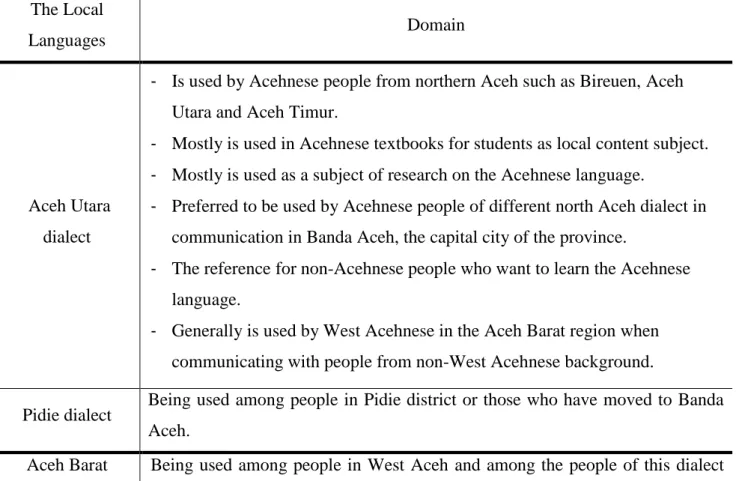
There are differences among local languages in Aceh, which is why Acehnese people did not use the same language in each region. The local languages used in the Province of Aceh are Aceh Utara dialect, Pidie dialect, Aceh Barat dialect, Aceh Besar dialect, Jamee, and Gayo. (Zulfadli, 2014). Aceh Utara dialect is used for Acehnese people from northern Aceh. The dialect is the easiest dialect that is usually used by people who want to learn the Acehnese language. Pidie dialect is used among people who stay in Pidie. Aceh Barat dialect is used among Acehnese people who stay in Western Aceh. Aceh Besar dialect is mostly used in Greater Aceh and around Banda Aceh. Jamee is used in southern Aceh and Gayo is used in central Aceh. The differences among dialects in the Province of Aceh can be seen in the table 1 below.
TABLE 1. The Local Languages in Aceh (Zulfadli, 2014) The Local
Languages Domain
Aceh Utara dialect
- Is used by Acehnese people from northern Aceh such as Bireuen, Aceh Utara and Aceh Timur.
- Mostly is used in Acehnese textbooks for students as local content subject.
- Mostly is used as a subject of research on the Acehnese language.
- Preferred to be used by Acehnese people of different north Aceh dialect in communication in Banda Aceh, the capital city of the province.
- The reference for non-Acehnese people who want to learn the Acehnese language.
- Generally is used by West Acehnese in the Aceh Barat region when communicating with people from non-West Acehnese background.
Pidie dialect Being used among people in Pidie district or those who have moved to Banda Aceh.
18 The Local
Languages Domain
dialect who live in Banda Aceh. Aceh Besar
dialect
Being used among people in Greater Aceh and around Banda Aceh outskirts where the Aceh Besar community lives.
Jamee Mostly is used in Aceh Selatan areas and within the community, family members of Jamee origin who have moved to Banda Aceh.
Gayo language
Is used among people of Gayo in Aceh Tengah, or students of Gayo language background who live in Banda Aceh. It is also used as a language of oral cultural expression and written works in Aceh Tengah.
2.4.2 The importance of the local language
Even though every region in Aceh has various local languages, however according to Congress Aceh Civilization (2015), students only need to learn the certain language in their region. Students are unnecessary to speak all languages fluently. On the other hand, parents tend to accustom their children to speak Indonesian rather than Acehnese. This tendency affects the first language acquisition. (Muhammad, 2013). The environment exposed too much with Indonesian language (friends, teachers, school, books, movies, and so on). Therefore, the children think that Indonesian is simpler than Acehnese, which is why they are faster and easier to speak Indonesian rather than Acehnese. L2 is more dominant than L1. The fact is Indonesian as a medium of instruction in Aceh is causing that some parents not to accustom their children to speak Acehnese more. Commonly, parents, who live in city, using Indonesian as a medium of instruction when talking to their children and using Acehnese with their spouse.
The significant role who should establish heritage language is parents. Guardado in Park (2013) said parents should support children’s heritage of language and culture maintenance, because they have the pivotal role. It can be done through using the first language in daily conversations, discussion about one topic, or sharing each other to acquire new information clearly. Li in Alhussein and Milian (2013) said that increasing new vocabulary and expressing children’s opinion could be clearly done through using the first language when talking. Portes and Hao also said in Park (2013) that using heritage language during interaction with their children in home environment can create big possibility to next generations in preserving children heritage language. The cultural identity cannot to be instantly created; it needs school, community, and family who conserve it. This in line with Park (2013) state that through schools, families, parents, and ethnic
19 communities are the cultural identity can be protected and expanded, it cannot be automatically established. Especially, mothers are the people, who often stay beside their children, have important part in accustoming students in language practice.
Horbatsch (2008) stated that mothers are the main point in children’s first language learning, who more participated, involved, and committed rather than fathers. Using the first language at home proved that literacy development in school could be increased. Additionally, their academic development has positive influence. Shin (as cited in Al Hussein & Millian, 2000) resulted children’s literacy development in school can be developed through practicing the first language at home, and it can also promote on students’ academic growth.
2.4.3 Students’ participation in learning local language using cooperative learning method
Learner autonomy in language learning is needed. It can be started by giving the chance for students to be actively participating. Teachers should also create a meaningful and pleasant class to attract students’ attention in the language learning process. Yildirim (2012) said that an autonomous learning environment could be created through giving small responsibilities to students and increasing level of responsibility slowly. Additionally, guidance and encouragement are needed in language learning, and teachers require creating valuable, attractive, and fun ways in delivering material during the language learning process.
Besides, supportive environment, which children can be experienced language learning, is necessary. Huttenloncer in Bransford et al. (2000) said that language should be practiced perpetually and active process and not only passively listened or observed by watching television. Additionally, Mc Groarty as cited in Chern (2002) said, “Academic and language learning require that students have opportunities to comprehend what they hear and read as well as express themselves in meaningful tasks” (p. 153). Giving the learners a meaningful role by using cooperative learning method in local language will be more helpful accustoming them increasing their capability in order to acquire the language rather than using traditional method. Teachers are as facilitator instead of the main speaker in the learning process. They have to guide students to be independence learners. Table 2 showed some differences between cooperative language learning and traditional language teaching. Based on Johnson & Johnson (1991); Nunan (1989) as cited in Zhang (2010) most interactions in the learning process during cooperative learning are characterized with communicative language teaching. Both of the researchers give highlight to the interaction and communication between students and students-teachers.
20
TABLE 2.The Comparisons of Cooperative Language Learning and Traditional Language Teaching (Johnson & Johson; Nunan in Zhang, 2010. p.82)
Traditional Language Teaching Cooperative Language Learning
Independence None or negative Positive
Learner roles Passive receiver and performer Active participator, autonomous learners
Teacher roles
The centre of the classroom, Controller of teaching pace and direction, judge of students’ right or wrong, the major source of assistance, feedback, reinforcement and support.
Organizer and counsellor of group work, facilitator of the communication tasks, intervener to teach collaborative skills.
Types of activities
Knowledge recall and review, phrasal or sentence pattern practice, role play, translation, listening etc.
Any instructional activity, mainly group work to engage learners in
communication, involving processes like information sharing, negotiation of meaning and interaction.
Interaction
Some talking among students, mainly teacher-student
interaction
Intense interaction among students, a few teacher-student interaction
Materials Complete set of materials for each student.
Materials are arranged according to purpose of lesson. Usually one group shares a complete set of materials. Room arrangement Separate desks or students
placed in pairs. Collaborative small groups Student
expectations
Take a major part in evaluating own progress and the quality of own efforts toward learning. Be a winner or loser.
All members in some way contribute to success of group. The one who makes progress is the winner.
Teacher-student
21
3. METHODOLOGY
As mentioned before, the research questions of the research are 1) how does the jigsaw-based cooperative learning method work in order to enhance students’ participation in local language learning in the fifth grade?; and 2) what are the challenges in implementing the jigsaw method, and does the teacher solve the challenges? In order to answer the research questions, in this chapter the methods, which have been chosen for the study, is introduced. We also describe the way to analyze the data. This section discusses the research design, data gathering, data analysis, and ethical consideration based on the study.
3.1 RESEARCH DESIGN
In order to achieve the research purpose, we used a qualitative analysis. This focused on a singular case of phenomenon to gain better understanding of the process. According to (Merriam, 2009) a case study is an intensive, delineate, and analyze of a single phenomenon, the social unit, or an entity entirely and descriptively. It allowed having more description and explanation about what was happened on the student’ activities and students’ participation during the learning process, which were gathered through observations. In addition, we used learning journal to analyze learning opinion on the jigsaw method. We observed the participants in one class of fifth grade during the class activities and gave three open-ended questions as a learning journal in the last of two class activities. To compile the results of the learning journal, we also did the interview for seeking the deeper information about the use of the jigsaw method in order to enhance students’ participation.
3.2 PRELIMINARY RESEACH
Before we decided to choose the fifth grade as the objects of research, firstly we did a trial in the lower grade to see what students’ mother tongue is actually used. We collected students’ basic data from the school and the local language teacher. We found that 90% of the first, the second, and the third grade students were Acehnese. In the beginning, we thought it would be more challenging to
22 apply the jigsaw in the lower grade that has Acehnese as their mother tongue. However, when we asked what actually their mother tongue in their environment is, almost all of them said that Indonesian is their mother tongue. This was not our main problem actually to choose them become our participants. We need students who use Acehnese as their mother tongue. As a result, we could not do the research in these classes. Thus, we changed our subject of research into higher grade. We chose the fifth grade, which is consisted of two classes; Malahayati and Malikussaleh class. There are 25 students in each class. We decided Malahayati class as the piloting class and Malikussaleh class as the subject of research. We did the piloting in Malahayati class in order to make changes our instrument more understandable based on students’ perception. Additionally, the purpose of piloting is to acquire the precise final results and answer the research questions.
Before applying the jigsaw method in the classroom, we share the exact procedures of the jigsaw method with the teacher. Additionally we arranged an observation form as our guideline in observing students’ activities and learning journals in order to examine students’ perception towards the jigsaw method during classes.
After doing the piloting, we found that there were some changing in main focuses of observation forms and the question of learning journals. Based on our reflection and evaluation, we also considered to observe not only students’ activities, but also teacher's activities when using the jigsaw method in the classroom. We evaluated the observation form to the teacher and students according to the exact procedures of the jigsaw method and the basic of cooperative learning. Finally, we communicated with the headmaster to do the real research in the local language class at Malikussaleh class.
3.3 THE OBJECT OF THE RESEARCH
The objects of the research were 25 students at fifth grade in the elementary school of Sukma Bangsa Lhokseumawe, which is consisted of 16 girls and 9 boys.
3.4 DATA GATHERING
The preliminary data of the students was gained from students’ personal data, which is documented by schools’ administrations. The data showed that even though almost 90% students are Acehnese, but they are not capable enough of speaking Acehnese.
23 Based on preliminary observations in Malahayati class, we found that 17 students of 25 students participated actively in learning Acehnese. Whereas, in Malikussaleh class, there are only 15 students of 25 students participated actively in learning Acehnese. Because of the passive students occurred more in Malikussaleh class, we decided this class as the object of our study. We also expect that the implementation of the jigsaw method can also apply in Malahayati class.
In gathering the data, the researchers acted only as observers. The participants’ perspective (emic) is the way the researchers gather the data (Merriam, 2009). In gathering the data, the information integrated from multiple sources, namely observation, learning journal, and interview. For enhancing the accuracy of the research among the different sources, the triangulation was made. As stated by Creswell (2012), “triangulation is a process of corroborating evidence from different individuals (e.g., a principal and a student), types of data (e.g., observational field notes and interviews), or methods of data collection (e.g., documents and interviews) in descriptions and themes in qualitative research.” By doing this way, it encourages us developing a report that is both credible and accurate. (p.259)
The data collection tools were observation forms and learning journal. The observation focused on students’ interaction (teacher – students, students- students) in local language learning by using the jigsaw method. School policies determine local language class; it is 35 minutes/hour every week. The observation held in the learning process for four courses from September to October 2016. We arranged a guideline in order to specify the context of observation. In addition, we used the video and audio recorder to help us in gathering the data.
Learning journal was used as the media for student to write their experience after learning local language by using the jigsaw method. The learning journals were given to students every two meeting. For the first learning journal, researchers asked students to answer three open-ended questions:
1. How do you like studying in local language during these weeks?
2. What are the benefits or ease that you got when studying in local language learning?
3. What were the challenges or problems that you had when studying local language learning? For the second learning journal, the students only wrote their experience after studying by using jigsaw method freely. However, in the second learning journal, the researchers did not obtain enough data to answer the research question.
The last stage gathering the data was interview. Based on students’ learning experience that students wrote in the learning journal, we interviewed 25 students to collect more information to answer the research questions. We did not have specific guideline during interview. In other words, interview as the way to make students’ writing in learning journal properly.
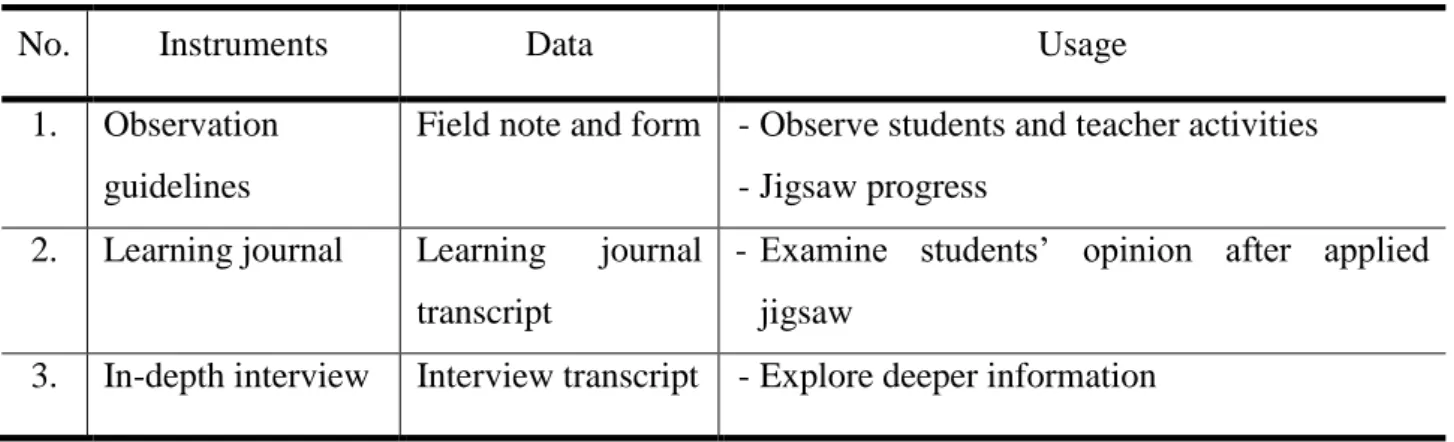
24 Below is the research instruments and data collection techniques used in the research.
TABLE 3. The Research Instrument and Data Collection
No. Instruments Data Usage
1. Observation guidelines
Field note and form - Observe students and teacher activities - Jigsaw progress
2. Learning journal Learning journal transcript
- Examine students’ opinion after applied jigsaw
3. In-depth interview Interview transcript - Explore deeper information
3.5 DATA ANALYSIS
We observed the learning process in the local language class for four times. The local language class is once in a week for 35 minutes/course. To ensure that teachers did the learning process based on jigsaw method rules, we also made the observation form for the teacher. In the first class, the teacher was still awkward in applying jigsaw method. Within 35 minutes, the teacher still could not manage time well, thus in the first day she spent almost 60 minutes for applying this method. In the second day, the teacher changed the way in managing the time. She managed the timeline in order to make the learning process manageable. The jigsaw method could complete for more than 35 minutes, the class was more manageable than the first course. In the third and the fourth meeting, the teacher and students were already familiar with this method. Thus, she could manage the class well and the jigsaw method worked properly in 35 minutes. We observed the teacher and students’ activities during applying the jigsaw method and found that students’ participation was enhanced by using the jigsaw method in local language learning. Students, who previously did not involve in studying local language, became active students. They were more initiating to talk, courageous in presenting the result, talkative with others in giving opinion, encouraging each other, helping each other in understanding, and working together to achieve the group goal. Obstacles that hindered the implementation of the jigsaw method were also occurred. Based on the learning journal, conflict in the group was happened in the learning process, which was affected by some students who were stubborn, fussy, too fast explaining, impatient, and uncooperative (disturbing others). These factors became an obstacle, which also challenged every student in their team to do their best to solve the problems.
Answering the first research question, we used observation as our instrument. We did the observation by using observation form that already piloted before. In every course, we did the
25 observation during the learning process. There are five basic elements of cooperative learning which used as reference to conduct observation form in our research; 1) positive independence, 2) face to face interaction, 3) individual accountability and personal responsibility, 4) social skill, and 5) group processing (Johnson, 1991). According to our piloting, we found only three basic elements that were included in our observation. The first basic was cooperative work; some activities were associated with sharing resources, encouraging each other’s effort to achieve, reflecting on the group session, and discussing the hand out were the main domain to be observed. The second was respecting each other; some activities were associated with interrupting politely, paying attention and making eye contact, following teacher’s instruction, and the last was individual accountability; some activities were related to write the result, master the essence of the material, stay in the group, complete the task on time, resolve the problem constructively, initiate to talk, present the result, and give opinion.
The solution for answering the second research question during four courses, we offered learning journal for all students in the fifth grade in every two classes. The students should fill the learning journal based on their experience when applying the jigsaw method in the learning process. Additionally, we also explored more information from them by interview. Later on, we examined whether the students become interested in studying Acehnese subject based on advantages or disadvantages of applying the jigsaw method in the learning process.
We analyzed observation results, students’ opinion in the learning journal, and the students’ interview result section by section after applying the jigsaw method in the classroom. After that, we coded and categorized the data based on our finding. Based on (Merriam, 2009) the researchers in qualitative research build toward theory from observations and intuitive understandings gathered from the field research. Information or data, which was collected through interviews, observations, or documents, was merged and classified into larger themes as the researcher decided before doing the research from the particular to the general.
26
3.6 ETHICAL CONSIDERATIONS
The participants in this research were the fifth grade students in elementary of Sukma Bangsa Lhokseumawe. We chose them as participants deliberately. Because of the students are still underage, we needed an approval from their parents. Therefore, we decided to make the permission letter and gave it to their parents. They were informed that their children’ activities, an interview session and learning journal, would be entirely confidential. The parent only should give a signature on the permission letter and gave it back to us. In gathering the data, we would respect for children dignity, being objective in writing the data, avoiding harm, and respecting students’ privacy. We were also consistent to avoid plagiarism when writing the result.