Exploring Mass Message Customization
Kaustubh NandeAcademic Associate, Communication Area Indian Institute of Management, Ahmedabad
Gujarat, India E-mail:
iii To
TABLE OF CONTENTS Sr. No PAGE 1 ABSTRACT v 2 INTRODUCTION 1 3 THE INTENT 3 4 CURRENT SITUATION 5
5 MASS MESSAGE CUSTOMIZATION 9
6 LIMITATIONS AND FUTURE RESEARCH 12
7 CONCLUSION 13
v
ABSTRACT
The paper begins with the exploratory concept of ‘mass customization’ and then moves on to discuss the possibility of applying it in business communication. Further, it gives a brief framework within which to fit this concept. The author then argues the relevance of the concept in today’s workplace. However, this paper does not discuss the details of the ‘process of mass message customization.’ It just hints to possible areas for further research and exploration.
Key words: Mass Messages, Customization, Business
INTRODUCTION
In today’s era of experience economy, one needs to constantly modify one’s own processes and assumptions on which one thinks and delivers messages (Pine and Gilmore, 1999). Business communication is no exception and it is even more prone to rapid change in the workplace. Today, the ‘public’ of an organization is vital for the organization’s survival and growth. Moreover, with rapid increase in communication technology, it is not just necessary to deliver a share of the organization’s profits to the public, but also to meet its rising demands and expectations. Today, business communicators and the organizations alike need to be personalized, flexible and responsive to achieve their full potential. The globally interconnected markets offer enterprises, which manage to build individual and enduring relationships with their customers and achieve strategic advantages in the face of increasing competition. Therefore, the highest directive for any modern enterprise must be to ensure consistent orientation, always and everywhere (Schenk. & Eggebert, 2003).
Modern multimedia applications such as the Internet are spreading throughout the world and gaining popularity. These can be used to enhance the power of mass customization. This, however, gives rise to additional
2
challenges: the interconnectivity between worldwide electronic data interchange and the actual production and transportation of parts and goods (Caddy, Helou & Callen, (Ed), 2003).
THE INTENT
In this paper, I will focus on the main challenges business communicators are most likely to face in the future i.e. of addressing and responding to mass public on behalf of an organization. I will further try to illustrate how the concept of Mass Message Customization (MMC) will facilitate us in understanding this phenomenon. My focus is specifically on the concept of mass message customization and how it can be applied in the near future to solve many demanding communication problems.
I start with the existing concept of “mass customization”. The mass customization paradigm is based on flexibility and quick responsiveness in developing, producing, marketing and delivering products that can satisfy as wide a range of customers as possible, without substantially increasing the costs (Pine, 1993). Taking this paradigm and applying it to business communication, we would be able to come up with some framework that can be applied in the context of an organization’s public. The public of an organization is broadly divided into I) External public: that which reinforces perceived image of your organization to the external world
• Consumers
4 • Community • Media • Government • Financial Institutions • General Public
II) Internal public: that which works at creating and enhancing that image.
• Investors
• Employees
• Suppliers
• Distributors/Dealers/Retailers
CURRENT SITUATION
According to a survey, 33 percent of the respondents said that CEOs, who augment their communications with a discussion of mission and values, can differentiate themselves in the market. Twenty-five percent of respondents believed the same result could be achieved by including new developments in products and services (Gaines & Leslie, 2000). The current communication pattern between the vision makers and the mission achievers in an organization seems to be highly skewed.
The technological revolution has transformed the traditional one-way medium of memos and newsletters into a two-way communication channel of e-mail and on-line bulletin boards. If harnessed properly, electronic networking has great potential, but it has also fast-forwarded many expectations, which reinforces the need to clarify, who tells whom what, how and how often. (Banksten, 1999).
In a recent report, Burson-Marsteller calculated that 48 percent of a company's reputation is attributed to its CEO--up from 40 percent in 1997. For business influentials--investors, regulators, analysts, journalists, and other executives to form positive perceptions of a company, corporate communicators must clearly convey information about their CEO's reputation. (Gaines, Leslie & Cakim, 2003).
6 Figure 1
The reality is that companies need to coordinate the messages they emit to different stakeholders, audiences, and perhaps even more importantly, concentrate on the way in which they listen to those audiences. The more the company can build the diverse stakeholder groups into its own discussions about policy, products and practices, and the more it can make those discussions cross-functional, the better it should be able to manage its stakeholder relations.
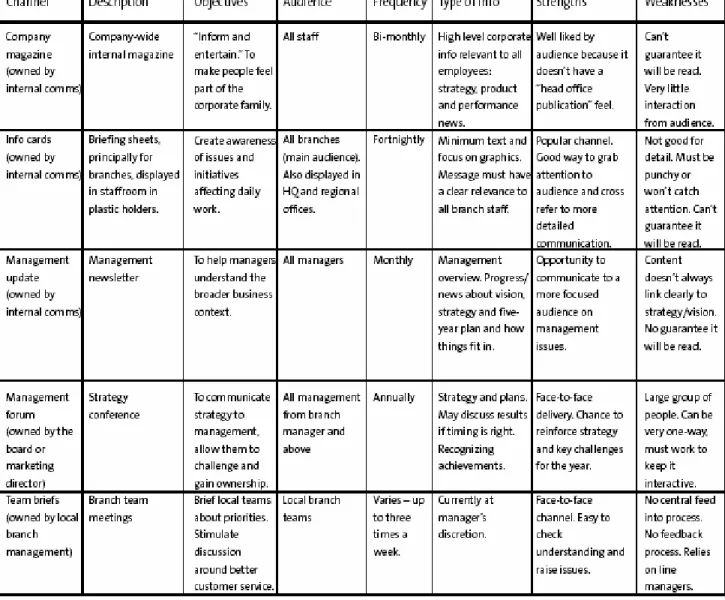
The table below presents a sample matrix 'Channel Guide' to test the effectiveness of communication channels employed by an organization in order to create an integrated communication strategy. It is interesting to study that all of these elements, if expanded to external communication might be successfully applied by using the concept of “mass message customization”.
Figure 2: Sample Matrix Channel Guide
The current picture however, is typically one, where communication with different stakeholders is ‘owned’ by different functions. HR or operations may own communication with the employees; marketing owns communication with the customers; public affairs communicates with the press, politicians and public interest groups; the chairman/CEO owns communication with the investment community; and so on. Responsibility for
8
employee communication has been batted back and forth between HR and public relations for two decades or more; with HR currently back in the ascendant. In short, it is increasingly hard for organizations to speak one language, let alone with one voice. (Clutterbuck, 2001)
MASS MESSAGE CUSTOMIZATION Approach
It is debatable whether all the elements of the “mass message customization” process can be really customized. Organizations may find that one component or element of the process is more customizable than others. (Caddy, Helou & Callen, 2003). Therefore the value of the message depends on its content and meaning. Moreover, the time required for the message to be delivered, read and understood by the receiver plays an important part in effective communication. Achieving higher customer and public satisfaction should be the main aim of the message strategy.
In the organizational context we can borrow and combine elements from mainly two mass communication models.
i) Leagan’s model (one of the exchange models): It says that there is a communicator, who transmits a message through a channel giving it appropriate treatment and delivers it to the audience. And of course, response is an important part of this process. (McQuail & Windahl, 1993).
ii) The other is Frank Dance’s helical model of communication, which describes communication as a helix with no perceptual beginning and no perceptual end. (Equivalent of the Indian concept of Anadi-Anant). (Kumar, 2002).
10
Combining and adapting the main elements of the two models to an organization specific scenario,
I suggest the following process flow of communication in a customized mass message scenario.
Figure 3: The MMC framework
These form the broad building blocks with which most of the internal and external communication could be dealt by applying the process of mass message customization.
Basic Strategy
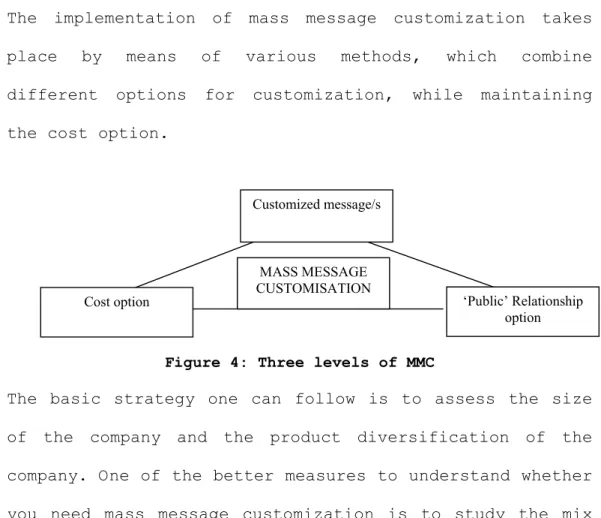
The implementation of mass message customization takes place by means of various methods, which combine different options for customization, while maintaining the cost option.
Figure 4: Three levels of MMC
The basic strategy one can follow is to assess the size of the company and the product diversification of the company. One of the better measures to understand whether you need mass message customization is to study the mix
MASS MESSAGE CUSTOMISATION ‘Public’ Relationship option Cost option Customized message/s
Communication Strategy – the Customer - the Products/Services – the Message -Image perception - Response
of product diversification, distribution of customers and the per annum advertising spending of the company.
Try to identify the Unique Selling Proposition behind the company image or a product image. In most cases, the first-mover advantage is lost as soon as competition moves in. And as it happens, the pioneer often loses steam. Moreover, competition saves the cost of developing a new market and avoids repeating the mistakes the trailblazer may have committed. Nonetheless, if a company keeps reinventing itself and plans its moves in advance, the rewards are visible (Vishwajeet, 2002).
Identifying key issues for individual and long term customer relationships is also an important factor. Listen to your customers and use existing customer database to its optimum. The customer model suggests listening and getting feedback from your existing customers. Integrate this new information to create new customer base and then implement these changes in the distribution and customer relationship management. (Shackmann & Link, 2003).
12
LIMITATIONS AND FUTURE RESEARCH
This paper does not deal in detail about the process of mass message customization. Rather, it hints at the possibilities and problems associated with the concept. There are some limitations of the process regarding its operationalisation in the real work place. Some important ones are listed below
1. Inputs related to the message.
2. The treatment of the message in terms of throughput of the system.
3. The Quality of specificity in terms of the specific image being / wanting to be created.
4. Having an insight into consequences of the message in terms of the individual entity and the organizations a whole.
5. The flexibility of the process in terms of response and alteration to the messages/s.
6. Frequency/Repetitively with which the similar process can be carried out in a similar manner.
7. Accessibility of Knowledge/information to others both internal and external public.
All these issues are highly context specific. Nevertheless, these help one in understanding and analyzing the process of mass message customization.
CONCLUSION
The concept of mass message customization holds a promising picture for the future. But at the same time the concept needs to be tested in theory and practice in the real workplace. In today’s workplace new information and communication technologies are the major drivers of change. Including them and factoring for their capabilities early enough would definitely give organizations a leading edge in their businesses.
14
REFERENCES
[1] Ayers, J. ( 2003). Do you really know what to do with your customer data?. Harvard Management Update. Vol. 8, Issue 6.
[2] Audit the impact of your messages. (2003). Strategic
Communication Management, Vol. 7 Issue 3, p1
[3] Bankston, & Karen. (May 1999). Talking the talk. Credit Union Management, Vol. 22, Issue 5.
[4] Caddy, I., Helou, M., & Callen, J. (2003). From Mass Production to Mass Customization: Impact of Integrated Supply chains. New York: Springer.
[5] Clutterbuck, D. (2001). The communicating company.
Journal of Communication Management, Vol. 6 Issue 1, p70.
[6] Gaines, R., Leslie, D., & Cakim.(2003). More than a suit. Across the Boar. Vol. 39 Issue 4, p33.
[7] Gaines, R., & Leslie. (2000). CEO reputation: the new factor in shareholder value. Directorship, Vol. 26 Issue 5, p4.
[8] Kumar, K. (2002). Introduction to Mass Communication in India. New Delhi: Jaico Publishing.
[9] McQuail, D. & Windahl, S. (1993). Communication models for the study of mass communication. London/New York: Longman.
[10] Pine, J. and Gilmore, J. (1999). 'The Experience Economy: work is theatre & every business a stage; goods and services are no longer enough. Harvard Business School Press, Boston. MA.
[11] Pine, B.J. II,. (1993). Mass customizing products and services. Planning Review, Vol. 21 No. 4.
[12] Shackmann, & Link. (2003). Intermediaries for the Provision of Mass Customized Digital Goods in Electronic Commerce. Moving into mass customization. New York: Springer.
[13] Schenk, M. & Eggebert. (2003). Mass Customization Facing Logistics Challenges. Moving into mass customization. New York: Springer.