1
The role of emotions in e-learning in psychotherapy: a
mixed methods study
by
Chris Blackmore
A thesis submitted in partial fulfilment of the requirements for the
degree of Doctor of Philosophy
The University of Sheffield
Faculty of Social Sciences
The Information School
2
Contents
List of Figures ... 6 List of Tables ... 6 Acknowledgements ... 7 Abstract... 9 1 INTRODUCTION ... 10 1.1 Research questions ... 10 1.2 Background ... 10 1.2.1 Collaborative learning ... 23 1.2.2 Student activity ... 24 1.2.3 Student satisfaction ... 26 1.2.4 Module mark ... 27 1.3 Correlations ... 271.3.1 Collaborative learning and student activity ... 27
1.3.2 Collaborative learning and student satisfaction ... 28
1.3.3 Collaborative learning and student mark ... 28
1.3.4 Student activity and student satisfaction ... 29
1.3.5 Student activity and student mark ... 29
1.3.6 Student satisfaction and student mark ... 29
1.4 Conclusion ... 29
2 LITERATURE REVIEW ... 31
2.1 Search strategy ... 31
2.1.1 “Low-hanging fruit” and other searches ... 32
2.1.2 Controlled systematic searching ... 33
2.1.3 Excluded materials ... 35
2.2 Narrative summary - role of emotions in learning ... 35
2.2.1 The nature of emotions ... 35
2.2.2 Emotions online ... 38
2.2.3 Ontology (being online) ... 41
2.2.4 Affordances ... 43
2.2.5 Neurobiology ... 44
2.2.6 Emotions in learning and teaching ... 46
2.2.7 Collaborative learning ... 56
2.2.8 Transformative learning ... 58
2.2.9 Learning outcomes in psychotherapy education ... 58
3
2.4 Conclusion ... 64
3 METHODOLOGY ... 65
3.1 Theoretical framework ... 65
3.1.1 Paradigms ... 65
3.1.2 Ontology (methodological considerations) ... 66
3.1.3 Epistemology ... 67 3.1.4 Ethnography ... 68 3.1.5 Mixed Methods ... 70 3.1.6 Qualitative analysis ... 72 3.2 Research Design ... 74 3.2.1 Ethical approval ... 74 3.2.2 Participants ... 75 3.2.3 Reporting ... 76
3.2.4 Study 1 - Mental health/well-being measures ... 78
3.2.4.1 Sampling ... 78
3.2.4.2 Data collection ... 80
3.2.4.3 Analysis ... 81
3.2.4.4 Limitations ... 81
3.2.5 Study 2 - The Linguistic Inquiry and Word Count (LIWC) ... 83
3.2.5.1 Sampling ... 84
3.2.5.2 Data collection ... 88
3.2.5.3 Analysis ... 88
3.2.5.4 Limitations ... 88
3.2.6 Study 3 - Qualitative interviews ... 89
3.2.6.1 Sampling ... 89 3.2.6.2 Data collection ... 93 3.2.6.3 Analysis ... 94 3.2.6.4 Limitations ... 98 3.2.7 Integration ... 99 3.2.8 Validation criteria... 100 3.3 Reflective statement ... 107 3.4 Summary ... 122 4 FINDINGS ... 123
4.1 Study 1 - Analysis of student data from well-being/mental health measures ... 123
4.1.1 Changes in Well-being ... 123
4
4.1.3 Well-being and module mark ... 130
4.1.4 Well-being and weekly activity... 130
4.1.5 Well-being and student satisfaction ... 131
4.1.6 Relationships between all measures ... 131
4.1.7 Summary of Study 1 ... 132
4.2 Study 2 - Analysis of student data with a linguistic analysis tool ... 133
4.2.1 LIWC and collaborative learning ... 134
4.2.2 LIWC and student activity ... 136
4.2.3 LIWC and student satisfaction ... 137
4.2.4 LIWC and module mark... 137
4.2.5 LIWC and well-being measures ... 138
4.2.6 Relationships between LIWC scores and all other measures ... 139
4.2.7 Summary of Study 2 ... 140
4.3 Study 3 - Analysis of student data from qualitative interviews ... 141
4.3.1 Qualitative analysis of full texts ... 141
4.3.1.1 Anxiety ... 141
4.3.1.2 Engagement with content/process ... 143
4.3.1.3 Connectedness ... 148 4.3.1.4 Existential challenge ... 151 4.3.1.5 Fun/humour ... 153 4.3.1.6 Emotional disclosure ... 154 4.3.1.7 Shame ... 157 4.3.1.8 Isolation ... 158 4.3.1.9 Regret/sadness ... 160 4.3.1.10 Frustration/anger ... 162 4.3.1.11 Satisfaction/pride ... 166 4.3.2 Summary of Study 3 ... 167 5 DISCUSSION ... 168 5.1.1 Study 1 ... 168 5.1.2. Study 2 ... 171 5.1.3 Study 3 ... 173 5.1.4 Triangulation protocol ... 184 5.2 Pedagogical issues ... 184
5.3 Individual and group mediating factors ... 187
5.4 Personalised learning ... 190
5
5.6 Engagement, retention and dropout... 195
5.7 The role of the tutor ... 197
5.8 Facilitation and tutor training ... 200
5.9 Effectiveness of methods for measuring emotions ... 201
6 CONCLUSION ... 204
6.1 Summary and conclusions ... 204
6.2 Contributions to the field ... 205
6.3 Further research ... 206
6.4 Transferability ... 207
6.5 Implications for practice ... 208
REFERENCES ... 211
APPENDICES ... 230
I- MSc in Psychotherapy Studies- Course curriculum ... 230
II- Search strategy ... 232
III- Characteristics of included studies ... 235
IV- Theories of emotion ... 243
V- Taxonomies of emotions relevant to e-learning ... 245
VI- Models of emotion ... 247
VII- Results from subsidiary searches on measuring or detection of emotion ... 249
VIII- Electronic identity model ... 254
IX- Disidentification online model ... 255
X- Typology of affordances ... 256
XI- Summary of paradigms, methods and tools ... 257
XII- Taxonomy of Sampling Techniques for the Social and Behavioral Sciences ... 258
XIII- Ethics approval letters from ScHARR and Information School ... 259
XIV- Initial email to potential research participants ... 261
XV- Follow up email to potential research participants ... 262
XVI- Interviewing notes and prompts ... 263
XVII- Quality framework for mixed methods research ... 265
XVIII- Excerpt from P1 Conflictchatroom archive ... 266
XIXa- COLLES mean scores by partner/learning modality ... 268
XIXb- Collaborative learning and Student activity ... 268
XIXc- Collaborative learning and Student satisfaction ... 268
XIXd- Collaborative learning and student mark ... 268
XIXe- Student activity and student satisfaction ... 269
6
XIXg- Student satisfaction and student mark ... 269
XXa- Correlations of well-being measures ... 270
XXb- Tests for normality ... 271
XXc- Kruskal-Wallis test ... 272
List of Figures Figure 1 - COLLES scores by partner ... 24
Figure 2 - Student activity levels by partner ... 25
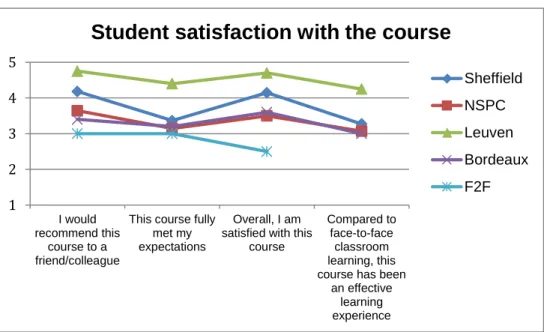
Figure 3 - Student satisfaction with the course by partner ... 28
Figure 4 - Consort diagram of the flow of included studies from systematic searches ... 34
Figure 5 – The Yerkes-Dodson law ... 49
Figure 6 - Data collection of LIWC and Well-being measures during 2008-10 ... 86
Figure 7 - Data collection of LIWC and Well-being measures during a module ... 87
Figure 8 - Simplified flow of a netnographic research project ... 105
Figure 9 - Amended flow of current research project ... 107
Figure 10 - Overview of research design ... 122
Figure 11 - Pre- and post-module well-being measures ... 124
Figure 12 - Role of emotions in individual and collaborative e- learning ... 177
Figure 13 - Role of assessment & feedback in individual / collaborative e- learning .... 179
Figure 14 - Electronic identity model ... 254
Figure 15 - Disidentification online model ... 255
List of Tables Table 1 - Research projects providing data for thesis ... 15
Table 2 - Data collected from students ... 20
Table 3 - Mode of assessment in a course module ... 22
Table 4 - Student activity levels by partnerships ... 25
Table 5 - Mean satisfaction scores by partner ... 26
Table 6 - Mean student mark by module ... 27
Table 7 - Summary table of correlations between all measures ... 29
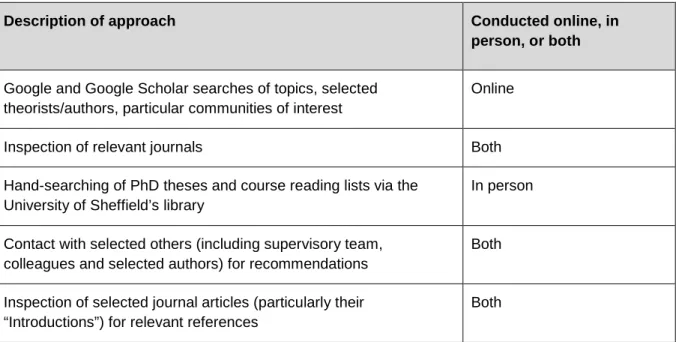
Table 8 - "Low-hanging fruit" approaches for literature searching... 32
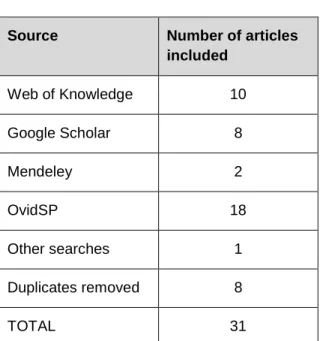
Table 9 - Sources of included articles ... 34
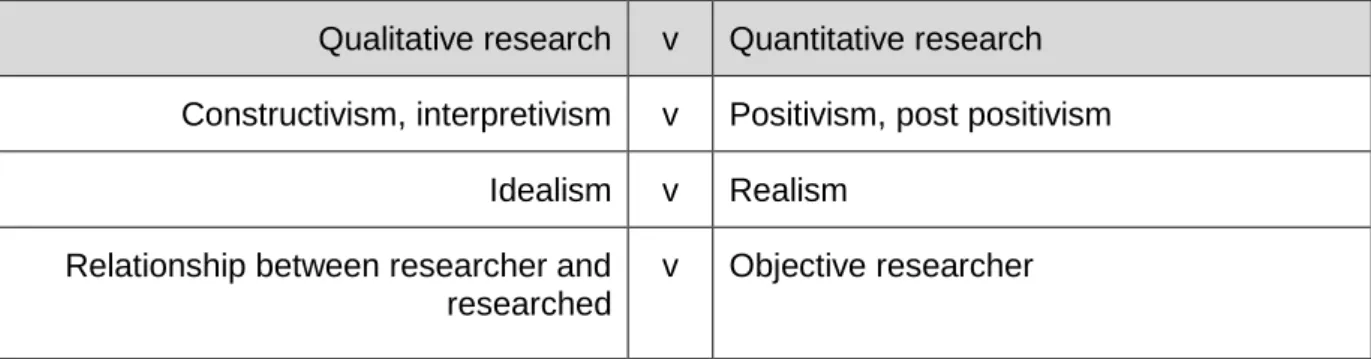
Table 10 - Comparison of quantitative and qualitative research paradigms ... 71
Table 11 - Characteristics of CEP partners ... 76
Table 12 - Students providing outcome measure data ... 79
Table 13 - Students providing LIWC data ... 85
Table 14 - Demographics of first group of interviewees ... 91
Table 15 - Mixed Methods Appraisal Tool (MMAT) criteria ... 103
Table 16 - Pre- and post-module well-being measures ... 123
Table 17 – Comparison of pre- and post-module well-being scores for non-normally distributed data ... 124
Table 18 – Comparison of pre- and post-module well-being scores for normally distributed data ... 124
7
Table 20- Mean change scores and t-test (outcome measures) ... 128
Table 21- Correlation of Well-being and Collaborative learning scores ... 129
Table 22 - Correlation of Well-being and module marks ... 130
Table 23 - Correlation of Well-being and weekly activity ... 130
Table 24 - Correlation of Well-being and student satisfaction ... 131
Table 25 - Summary table of correlations between all measures ... 131
Table 26 - T-test for Equality of Means ... 134
Table 27 - LIWC and COLLES scores ... 135
Table 28 - LIWC and student activity ... 136
Table 29 - LIWC and student satisfaction ... 137
Table 30 - LIWC and module mark... 138
Table 31 - LIWC and well-being measures ... 139
Table 32 - Demographics of students providing data... 188
Acknowledgements
I would like to thank the supervisory team which has constituted first supervisors Professor Nick Fox (School of Health and Related Research- ScHARR), Phil Levy and Nigel Ford (Information School) and second supervisor/mentor Digby Tantam (School of Health and Related Research) for guidance, patience, encouragement and inspiration. Crucially, Professors Digby Tantam and Emmy van Deurzen, who led the SEPTIMUS, DEEP and CEP projects (which I participated in as Research Assistant/Associate- details below) for the University of Sheffield and NSPC, provided not only my introduction to e-learning and psychotherapy studies, and led the development of the courses which form the basis for this research, but through many formative conversations, they provided the inspiration for this thesis and guidance in its development. In addition, Prof Tantam provided particular support around the quantitative component of the thesis, along with dialogue and encouragement when most needed. The WEMWBS scale was used with permission from the authors (Tennant et al., 2007). A World Universities Network grant enabled me to spend 3 months in Seattle in 2008, exploring the use of linguistic analysis. Dr James Pennebaker provided valuable support around the use of the Linguistic Inquiry and Word Count (LIWC). ScHARR supported me with 3 months’ study leave in 2012 to work on the upgrade to this thesis. Thanks to the students who provided the data for this research, colleagues with whom I collaborated on the various research projects, colleagues at the University of Sheffield who worked with me in the development of e-learning strategy and practice, and finally to my family for love and understanding throughout the long years of study.
8
Research projects:
"Strengthening European Psychotherapy Training through Innovative Methods & Unification of Standards: SEPTIMUS”. Leonardo da Vinci Programme, European Union project no. UK/01/B/F/PP/129_387, £400,000
“Disseminating European Education in Psychotherapy: DEEP”. £120,000 Socrates/ Erasmus grant, EU project no. 28686-IC-2002-1-UK-ERASMUS-PROGUC-2
“Continuing Education in Psychotherapy- CEP”. £300,000 Leonard da Vinci grant, EU project no. UK/08/LLP-LdV/TOI/163_145
9
Abstract
Research questions
1. What is the role of emotions in e-learning (in particular as it relates to a case example of online psychotherapy education)?
2. What methods can be used to detect and measure emotions in e-learning?
Methodology
These research questions are addressed by a systematic literature review and analysis of the following student data from the University of Sheffield’s online MSc in Psychotherapy Studies:
i. a set of mental health/well-being outcome measures
ii. a linguistic analysis of forum postings using Linguistic Inquiry and Word Count (LIWC)
iii. qualitative interviews with ex-students
Findings
i. the mental health/well-being measure scores do not reliably detect changes in emotional processing
ii. the LIWC picks up individuals’ emotional change but does not correlate strongly with the outcome measures.
iii. those learners who can trust others online are more satisfied, and more likely to engage in transformative learning. Of the methods employed, the student interviews gave the best insight into students’ emotional experience.
Conclusions
Emotions are central topics for learning in a psychotherapy course; they are pivotal in terms of how students engage with an e-learning course, and with learners and tutors. Student engagement and satisfaction in e-learning are engendered by a collaborative learning approach, which encourages sharing of emotions through self-disclosure. Being online may provoke anxiety and make it harder for some students to develop the kind of trusting relationships needed to self-disclose; for other students, the anxiety is less problematic, and being online is a liberating and positive factor in their learning. The research suggests that learning could be personalized according to students’ emotional preferences by adopting a learning analytics approach – providers of e-learning need to be aware of the emotional experience of e-learners, and equipped to respond appropriately to maximise opportunities for engagement and transformative learning.
10
1 INTRODUCTION
“First, anyone who seriously intends to become a philosopher must ‘once in his life’ withdraw into himself and attempt, within himself, to overthrow and build anew all the sciences that, up to then, he has been accepting.”
(Husserl, 1977, p.2)
1.1 Research questions
The primary research question addressed by this thesis is “What is the role of emotions in e-learning in psychotherapy?” and the thesis does this by examining student data using a variety of different methods for measuring emotions online. The comparison of these different methods informs a secondary research question, namely “Which methods are most appropriate for examining the role of emotions in e-learning in psychotherapy?”
The context for this investigation is an e-learning MSc in Psychotherapy Studies at the University of Sheffield. The research comprises the following:
Literature review on:
i. role of emotions in learning from (from psychotherapy education and e-learning literatures)
ii. methods for measuring emotions
Study 1- Analysis of student data from a set of mental health/well-being measures
Study 2- Analysis of student data with a linguistic analysis tool
Study 3- Analysis of qualitative interviews of students from the programme to gain their views on the role of emotion in their e-learning
Conclusions from these analyses are then placed into context with what is known from the literature about the role of emotions in e-learning.
1.2 Background
This thesis arose from personal and professional interest in the topic, gained during my time as a researcher and online tutor on the MSc in Psychotherapy Studies at the University of Sheffield between 2002 and 2014. This provided me with daily opportunity to observe and engage in e-learning with an explicitly emotional component. Early on in this experience, I noticed that as a tutor, I found myself more comfortable in participating in online groups than I did in face-to-face settings, which struck me as significant. I also noticed some interesting issues surfacing among students, such as a tendency for some (but not all) of them to disclose very personal information to the group, after only a few
11
weeks on the course. I also found that some students were, like me, finding themselves freed up to contribute more online than in an attendance setting, whereas for others, the reverse seemed to be the case, and they felt more inhibited. These questions led me to consider studying the topic as a PhD, as I had access to an e-learning course in which to consider these issues, and was by this point, in 2004, contributing to project reports and peer-reviewed publications looking in to the effectiveness of e-learning in this context, e.g. along with colleagues who were co-ordinating the initial SEPTIMUS project, I was both surprised and fascinated by the intensity of emotions displayed and reported by students and tutors online (van Deurzen, Blackmore, & Tantam, 2006).
This work is important because emotions have a widely acknowledged role in learning, but the research base on the role of emotions in e-learning is still relatively small. In addition, approaches to large online datasets are rapidly developing, with the advent of “learning analytics”. A number of questions arise - what are the particular emotional experiences which e-learning students encounter, and what impact do these have on their learning? How can e-learning courses be designed to take advantage of the power of emotional experiences to enhance learning, whilst also providing students with a safe and supportive environment in which to learn? What can new approaches to large datasets tell us about students’ experiences of emotions in their learning? In this thesis, a variety of methods of tracking e-learners’ emotional experiences during their studies will be used and assessed, to shed light on not only the impact of emotions in e-learning but also on the best methods for measuring this impact.
A word about terminology and definitions - the term “e-learning” has been used to describe the kind of learning that students engaged in. Occasionally, “online learning” has been used, or the context of “being online”. The University of Sheffield refers to online programmes as “Distance Learning”, “e-learning” or - increasingly – “online learning”. As Jones (2015) notes, there are a number of terms, including “networked learning” and “technology enhanced learning”, and each term has a different history, and emphasizes different aspects of the experience. Whilst the importance of networks, communities and collaborative learning might point towards the use of “networked learning”, and this is discussed later along with pedagogical considerations, the concept of “e-learning” will be the focus for this thesis, given the use of this term by the University of Sheffield during the period when the course was running, and its use by the wider group of institutions who participated as research partners. Various definitions of e-learning are available, but Ally’s version from 2004 provides a useful basis – “the use of the Internet to access learning materials; to interact with the content, instructor, and other learners; and to obtain support during the learning process, in order to acquire
12
knowledge, to construct personal meaning, and to grow from the learning experience” (Ally, 2004).
As the internet continues to spread in availability and speed, the popularity and influence of e-learning continues to grow. In 2013, about 4.6 out of 10 US college students were taking at least one course online, and estimates suggest that by 2019, roughly half of all college classes will be e-learning based (Elearning industry, n.d.). Increasing numbers of attendance courses are becoming “blended” by offering certain aspects of the educational experience online. The 2014 and 2015 NMC Horizon Reports identify several key trends which are accelerating Higher Education technology adoption, such as the growing ubiquity of social media, the integration of online, hybrid and collaborative learning, and the rise of data-driven learning and assessment (Johnson, Becker, Estrada, & Freeman, 2014) and increasing use of blended learning and redesigning learning spaces (Johnson, Adams Becker, Estrada, & Freeman, 2015). In terms of the continued evolution of online learning, the 2014 report states:
“Over the past several years, there has been a shift in the perception of online learning to the point where it is seen as a viable alternative to some forms of face-to-face learning… Progress in learning analytics, adaptive learning, and a combination of cutting-edge asynchronous and synchronous tools will continue to advance the state of online learning and keep it compelling, though many of these are still the subjects of experiments and research by online learning providers and higher education institutions”.
(Johnson, Becker, Estrada, & Freeman, 2014, p.18)
Not only is e-learning as a whole in the ascendancy, but its applications to health-related education are increasingly being recognised and valued. A WHO report concludes that e-learning is as good as traditional training for health professionals, and that it could greatly increase accessibility to students wanting to train as doctors and nurses worldwide; similar findings are noted by myself and colleagues in the context of psychotherapy training (Blackmore, van Deurzen, & Tantam, 2007), and it is this training course which provides the data for the current thesis.
As e-learning continues to be integrated as an approach to teaching and learning, both students and teachers need to understand how being online affects the dynamics of the learning community. Whilst e-learning has many strengths, it also presents challenges to learners and educators, and without an appreciation of these challenges, and some preparedness to face and overcome them, then efforts to implement e-learning and blended learning can backfire- “when education based on computer conferencing fails, it is usually because there has not been a responsible teaching presence and appropriate
13
leadership and direction exercised’’ (Garrison, Anderson, & Archer, 1999, p.96). Some researchers go so far as to say that “the full promise of web-based education will not be realized, unless affective aspects are properly acknowledged (Goldsworthy, 2000; Spitzer, 2001)” (Zembylas, 2008a). At the end of their 2005 review article, Wosnitza and Volet comment:
“The importance of research on emotion arousal in general and online learning in particular is widely acknowledged. Emotions are likely to take a more significant place in theory development and research in the future. The emphasis will be on the development of methodological tools and the study of the mechanism of disclosure of emotions. Online teachers and tutors are waiting for reliable instruments and explanations of the role of emotions in online-learning situations.”
(Wosnitza & Volet, 2005, p. 462)
This thesis aims to make a contribution to the development of such instruments and explanations.
The research has taken place within the context of a succession of research grants, funded by the European Union and led from the University of Sheffield. The table below summarises the research projects under which the data were collected, and the type of data available:
14
Year Project name Project partners Description of project Type of data available
2002-5 “Strengthening European
Psychotherapy Training through Innovative Methods & Unification of Standards:
SEPTIMUS”. Leonardo da Vinci Programme, European Union project no.
UK/01/B/F/PP/129_387 , £400,000
1. Austria- Österreichischer Arbeitskreis für Gruppentherapie und Gruppendynamik
2. Czech Republic- Prazska vysoka skola psychosocialnich studii; Prazsky psychoterapeuticky institute
3. Ireland- Clanwilliam Institute; Institute of Creative Counselling and Psychotherapy
4. Italy- Scuola di Psicoterapia Comparata-SPC;
Associazione per lo Sviluppo Psicologico dell'Individuo e della Comunita-ASPIC; CSTG
5. Poland- Department of Psychotherapy, Jagiellonian University; Medical College, Institute of Psychiatry and Neurology, Warsaw
6. Portugal- Associação Portuguesa de Terapias Comportamental e Cognitiva Lisboa; Sociedade Portuguesa de Psicoterapia Centrada Lisboa 7. Romania- Romanian Federation of Psychotherapy;
Department of Psychology, Babes-Bolyai University 8. UK- University of Sheffield; New School of Psychotherapy
& Counselling, London
SEPTIMUS, a European project led by University of Sheffield which
implemented and evaluated a new, online psychotherapy training course across 8 European partner countries
- Student quantitative data from
questionnaires about the background of students, and their satisfaction with the course
(including a comparison of distance learners and face-to-face learners) - Student drop-out rates, and reasons for drop-outs
- Student qualitative data from external evaluations 2004-6 “Disseminating European Education in Psychotherapy: DEEP”. £120,000 Socrates/ Erasmus grant, EU project no. 28686-IC- 2002-1-UK-ERASMUS-PROGUC-2
9. Austria - Sigmund Freud University 10. Czech Republic - Masaryk University 11. Romania - Hyperion University 12. Sweden - Linkoping University 13. UK- University of Sheffield
DEEP, a European project led by University of Sheffield which developed the SEPTIMUS programme into Masters level
programmes across 5 European partner countries
Same as above- dataset combined with that of SEPTIMUS 2008-10 “Continuing Education in Psychotherapy- CEP”. £300,000 Leonard da Vinci grant,
14. Belgium- Psychology Department University Leuven 15. France- Université Victor Sagelen Bordeaux 2 16. UK- The University of Sheffield
17. UK- Dilemma Consultancy Limited/NSPC
CEP, a European project led by University of Sheffield which translated the SEPTIMUS/DEEP
- Student data from a variety of
participation/satisfaction measures
15
Year Project name Project partners Description of project Type of data available
EU project no. UK/08/LLP-LdV/TOI/163_145
resources into Masters level programmes in 2 new European partner countries
- Student data from a set of mental
health/well-being measures - Student online
postings (analysis with a linguistic analysis tool) Table 1 - Research projects providing data for thesis
16
The data being considered in this thesis arose from the Continuing Education in Psychotherapy (CEP) project, funded by the Leonardo da Vinci fund from 2008-10. This project was designed to disseminate an e-learning Psychotherapy Masters programme developed under previous funding arrangements (Tantam, Blackmore, & van Deurzen, 2006) by the University of Sheffield, the New School of Psychotherapy and Counselling (both UK), and various European partners to two new partners- Leuven University (Belgium) and Bordeaux University (France). Some of the CEP data were gathered to enable reporting to funders on the outcomes of the project; this thesis then substantially developed the analysis of the data, and added some new methods which were part of a speculative approach to find ways of providing an answer to the research question “What is the role of emotions in e-learning?” The following table lists all of the data used in the research, with an indication of whether their use originated from the CEP project or specifically for this thesis; what my role in generating the data was; why, how and when they were generated; and whether the data were used in the “Background” section 1.2 of this thesis, or in the main “Findings” section 4:
17 Type of student data Decision made by CEP partnership or author alone Author’s involvement in generating data
Reason for creating data sub-set
Data collection tool used (including reference if relevant) Method of data collection When data were collected Partners who provided data Back-ground or thesis data Factors relevant to collaborative learning (quantitative) CEP partnership No involvement in producing data, but involved in collating data from online database
Data gathered as part of the funding
arrangements for the course
“Constructivist On-Line Learning Environment Survey (COLLES)”- ratings by students of their own collaborative learning on the following- relevance, reflective thinking, interactivity, tutor support, peer support, interpretation (Taylor & Maor, 2000) Online survey completed by students Middle of taught modules, 2008-10 Sheffield, NSPC, Leuven, Bordeaux Background Online activity (quantitative) CEP partnership I was an active member of the learning community or “Community of Inquiry”
Data created by the learning environment, and are a reflection of the activity required of students on the course Frequency count of student activities (viewing content pages, participating in online chat, asynchronous forum) Collected automatically by Moodle database, and expressed as page views per week Through-out taught modules, 2008-10 Sheffield, NSPC, Leuven, Bordeaux Background Student satisfaction (quantitative) CEP partnership No involvement in producing data, but involved in designing measure and collating data from online database
Data gathered as part of the funding
arrangements for the course
Questionnaire items Online survey completed by students End of taught modules, 2008-10 Sheffield, NSPC, Leuven, Bordeaux Background Module mark (quantitative) CEP partnership Involvement in assessment of student work, and
These data are a requirement of the University for From assessment of students’ academic performance Collated by tutors and course End of taught modules, Sheffield Background
18 Type of student data Decision made by CEP partnership or author alone Author’s involvement in generating data
Reason for creating data sub-set
Data collection tool used (including reference if relevant) Method of data collection When data were collected Partners who provided data Back-ground or thesis data involved in collating marks students to be awarded credits director 2008-10 Depression (quantitative) CEP partnership No involvement in producing data, but involved in collating data from online database
Data gathered as part of the funding
arrangements for the course
PHQ-9: Depression scale of the Patient Health Questionnaire; (Kroenke, Spitzer, & Williams, 2001)- 10 items; high scores indicate increasing depression Online survey completed by students Start and end of taught modules, 2008-10 Sheffield, NSPC, Leuven, Bordeaux Findings Anxiety (quantitative) CEP partnership No involvement in producing data, but involved in collating data from online database
Data gathered as part of the funding
arrangements for the course
GAD-7: Scale of Generalized Anxiety Disorder; (Spitzer, Kroenke, Williams, & Löwe, 2006)- 7 items; high scores indicate increasing anxiety Online survey completed by students Start and end of taught modules, 2008-10 Sheffield, NSPC, Leuven, Bordeaux Findings Well-being (quantitative) CEP partnership No involvement in producing data, but involved in collating data from online database
Data gathered as part of the funding
arrangements for the course
WEMWBS: The Warwick-Edinburgh Mental Well-being Scale; (Tennant et al., 2007)- 14 items; high scores indicate increasing well-being Online survey completed by students Start and end of taught modules, 2008-10 Sheffield, NSPC, Leuven, Bordeaux Findings Well-being (quantitative) CEP partnership No involvement in producing data, but involved in collating data from online database
Data gathered as part of the funding
arrangements for the course
SWLS: Satisfaction with Life Scale); (Diener, Emmons, Larsen, & Griffin, 1985)- 5 items; high Online survey completed by students Start and end of taught modules, 2008-10 Sheffield, NSPC, Leuven, Bordeaux Findings
19 Type of student data Decision made by CEP partnership or author alone Author’s involvement in generating data
Reason for creating data sub-set
Data collection tool used (including reference if relevant) Method of data collection When data were collected Partners who provided data Back-ground or thesis data scores indicate increasing well-being Spiritual well-being (quantitative) CEP partnership No involvement in producing data, but involved in collating data from online database
Data gathered as part of the funding
arrangements for the course
SIWB: Spirituality Index of Well-Being Scale; (Daaleman & Frey, 2004)- 12 items; high scores indicate decreasing spiritual well-being Online survey completed by students Start and end of taught modules, 2008-10 Sheffield, NSPC, Bordeaux* Findings Spiritual well-being (quantitative) CEP partnership No involvement in producing data, but involved in collating data from online database
Data gathered as part of the funding
arrangements for the course
SAIL: Spiritual Attitude and Involvement List); (Meezenbroek et al., 2012)- 26 items; high scores indicate increasing spiritual well-being Online survey completed by students Start and end of taught modules, 2008-10 Sheffield, NSPC, Leuven** Findings Linguistic analysis of emotional content of students’ postings on an online discussion forum (quantitative)
Myself alone I was an active participant in chatroom and forums; involved in collating data from online database
Data arose naturally as part of students’ experience of being online with one another and discussing relevant topics; they were also a requirement of participating, and passing, a module
Linguistic Inquiry and Word Count (LIWC) text analysis software program (Pennebaker, Chung, Ireland, Gonzales, & Booth, 2007) Discussion forum postings collected automatically by Moodle database and put through LIWC by myself Througho ut taught modules, 2008-10 Sheffield, NSPC, Leuven, Bordeaux Findings Interview data (qualitative)
Myself alone I interviewed a sample of students on their
Data collected to obtain students’ subjective accounts
Qualitative interviews Interview led by myself - whether these Aug 2013- Dec 2014 Sheffield Findings
20 Type of student data Decision made by CEP partnership or author alone Author’s involvement in generating data
Reason for creating data sub-set
Data collection tool used (including reference if relevant) Method of data collection When data were collected Partners who provided data Back-ground or thesis data experience; involved in transcribing data from voice recorder
of the role of emotion in their online learning are conducted online or in person, and individually or as a focus group, is to be decided) Table 2 - Data collected from students
* - Leuven opted not to administer the SIWB to students ** - Bordeaux opted not to administer the SAIL to students
21
For the CEP project, the e-learning programme was run from the University of Sheffield, from a Moodle learning environment with webhosting provided by Dilemma Training Ltd. Moodle is “a free, open-source PHP web application for producing modular internet-based courses that support a modern social constructionist pedagogy” (Moodle, n.d.).
The MSc in Psychotherapy Studies, delivered by the University of Sheffield, was a 2-year part-time e-learning programme; it was not a clinical training course, and did not contain the necessary elements, such as supervised placements, for a practical qualification in psychotherapy (see Appendix I for course curriculum). Other partners implemented their programmes in slightly different ways, as will be described in due course. The Sheffield programme was implemented as a combination of course materials (webpages), discussion forums and weekly chatrooms. The programme aimed to provide e-learners with an increased knowledge base of the theoretical aspects of psychotherapy theory, along with the opportunity to reflect on clinical practice (if they were clinicians) and/or personal experience. An emphasis on the importance of students’ emotional development (both in their personal/professional lives and in their time on the programme) was evident from the learning objectives of the modules/programme, the kinds of activities and assessments used in the learning, and the choice of collaborative learning as a model. For example, the “Existential Issues” module, as implemented by the University of Sheffield, had as its learning objectives the following:
1. knowledge of categorisation of existential and human issues
2. ability to demonstrate an integrated perspective on existential philosophy and its relevance to psychological treatment
3. ability to evaluate individual problems relating to these existential and human issues 4. ability to select the appropriate theoretical model for therapeutically intervening with
these issues
5. ability to justify theoretical model and interventions to peers
6. update of contemporary psychotherapy/counselling literature and developments in the field
7. ability to use written expression in conjunction with appropriate academic sources and conventions to present logical analysis and argument in relation to the unit 8. skills in use of collaborative eLearning methods and online resources
Several of these learning objectives (e.g. 1,2,5,7) involved the learners’ ability to understand and communicate the emotional impact of existential issues, and thus required engagement of emotional processes during the learning.
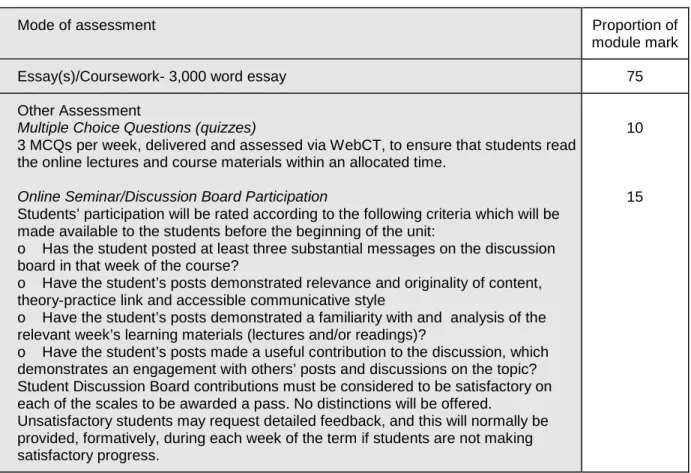
The mode of assessment used at the University of Sheffield was split between the following (other partners were free to use their own assessment protocols):
22
Mode of assessment Proportion of
module mark
Essay(s)/Coursework- 3,000 word essay 75
Other Assessment
Multiple Choice Questions (quizzes)
3 MCQs per week, delivered and assessed via WebCT, to ensure that students read the online lectures and course materials within an allocated time.
Online Seminar/Discussion Board Participation
Students’ participation will be rated according to the following criteria which will be made available to the students before the beginning of the unit:
o Has the student posted at least three substantial messages on the discussion board in that week of the course?
o Have the student’s posts demonstrated relevance and originality of content, theory-practice link and accessible communicative style
o Have the student’s posts demonstrated a familiarity with and analysis of the relevant week’s learning materials (lectures and/or readings)?
o Have the student’s posts made a useful contribution to the discussion, which demonstrates an engagement with others’ posts and discussions on the topic? Student Discussion Board contributions must be considered to be satisfactory on each of the scales to be awarded a pass. No distinctions will be offered.
Unsatisfactory students may request detailed feedback, and this will normally be provided, formatively, during each week of the term if students are not making satisfactory progress.
10
15
Table 3 - Mode of assessment in a course module
This gave appropriate emphasis on the need to be able to communicate effectively in academic terms, with citations of relevant literature, as well as to engage with the course materials, and with peers in online discussions. All categories were potentially accessing emotional material, and especially the last one of online discussion.
The partnership (including myself as a Research Assistant) wanted to evaluate student experience on a number of dimensions and selected a variety of tools to do so, as shown in table 2. Although some of these were more focused on students’ emotional experience than others, the results have been included in this “Background” section 1.2 as being important exploratory steps in the journey towards measuring students’ emotions, and in formulating the research question for this thesis. Analyses of data in the “Background” section 1.2 were undertaken for the Final Report of the CEP project, and were conducted by myself with support from Prof Tantam, although have not hitherto been published in a peer-reviewed journal. Data are shown for the following categories:
1. Collaborative learning measure 2. Data on student activity
3. Student satisfaction measure 4. Module mark
23
The other tools (“well-being” measures, linguistic analysis of forum postings and qualitative interviews with ex-students) are more directly focused on students’ emotions, and thus data from these are included in the main body of this thesis (under “Methodology”, “Findings” and “Discussion” sections).
1.2.1 Collaborative learning
The “Constructivist On-Line Learning Environment Survey (COLLES)” (Taylor & Maor, 2000) was chosen by CEP partners as it measures exactly the kind of collaborative learning processes that project partners were interested in, and the links between collaborative learning, student engagement and the role of emotions needed to be explored. Speaking about the COLLES, Taylor and Maor comment:
“Because our teaching is based on the referent of social constructivism, we designed the COLLES to help assess the extent to which our web teaching enriches our distance students' ways of knowing. The COLLES generates a measure of students' perceptions of both their preferred and actual on-line classroom environments… Social constructivism is an epistemology, or way of knowing, in which learners collaborate reflectively to co-construct new understandings, especially in the context of mutual inquiry grounded in their personal experience.”
(Taylor & Maor, n.d.) Furthermore, the COLLES was available via Moodle so it was simple for partners to implement and give to their students. As the students were being asked to complete pre- and post-module measures (see below), it was decided to give the COLLES, a 24-item questionnaire, at the mid-point of the module to space out the burden of completing questionnaires.
The COLLES scale provided feedback on student self-rated levels of perceptions of both their preferred and actual on-line classroom environments by providing feedback on self-rated levels of:
• relevance, e.g. “my learning focuses on issues that interest me”;
• reflective thinking, e.g. “I think critically about how I learn”;
• interactivity, e.g. “other students respond to my ideas”;
• tutor support, e.g. “the tutor models good discourse”;
• peer support, e.g. “other students value my contribution”;
• interpretation, e.g. “I make good sense of other students' messages”;
Whilst these factors are not purely emotional, they do have connections to emotional experience, e.g. experiencing peer support is likely to have a strongly positive emotional component.
24
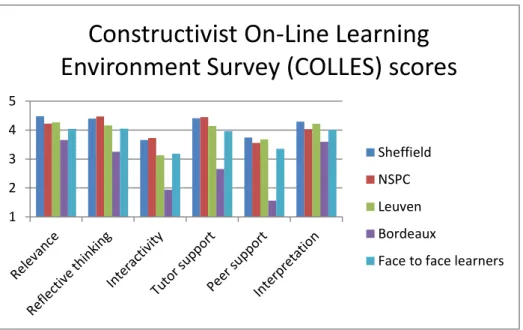
In the 2009-10 year, students from Sheffield (n=35), NSPC (n=9), Leuven (n=14) and Bordeaux (n=8) provided data; students on a comparable face-to-face psychotherapy training (n=47) also provided data (see Appendix XIXa). The data are shown below graphically:
1- Almost never; 2- Seldom; 3- Sometimes ; 4- Often; 5- Almost always Figure 1 - COLLES scores by partner
The results suggest that students from Sheffield and NSPC self-rated their collaborative learning experience more highly than those from Leuven, Bordeaux and F2F learners. In fact, e-learners from Bordeaux were the only online learners to rate their experience lower than F2F students. As will be discussed, Bordeaux did not implement synchronous chatrooms and rarely used asynchronous forums.
1.2.2 Student activity
Student activity levels were agreed by CEP partners to be important markers of participation and engagement, and to be able to consider emotional engagement, it was important to have a conception of how practically engaged students were. Activity was measured via frequency counts from the Moodle database, which listed activity under the following categories:
• course view
• resource view
• user login
• user logout
It was unclear how these categories could be realistically weighted - a login might precede a short 1 minute visit to a webpage, a 1 hour chatroom session or a 2 hour block of reading
1 2 3 4 5
Constructivist On-Line Learning
Environment Survey (COLLES) scores
Sheffield NSPC Leuven Bordeaux
25
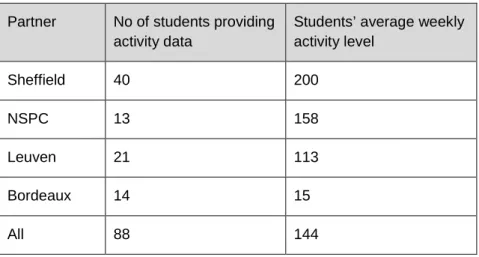
the course materials. Data were not available to verify exactly how long each visit was for, or what activity took place, and the sheer volume of activity necessitated a method which did not involve detailed consideration for each figure. Therefore, all visits were assigned equal weightings and aggregated to provide a numerical figure for each student for each module. Figures were then calculated for activity by all students in the year 2009-10 across the “Existential Issues”, “Conflict” and “Ethics” modules:
Partner No of students providing activity data
Students’ average weekly activity level Sheffield 40 200 NSPC 13 158 Leuven 21 113 Bordeaux 14 15 All 88 144
Table 4 - Student activity levels by partnerships
Based on these average activity levels, and the COLLES scores shown previously, it was possible to differentiate between partners in terms of the extent of collaborative e-learning activity that students engaged in, and characterise them as adopting a high, medium or low collaborative e-learning approach:
Figure 2 - Student activity levels by partner 0 50 100 150 200 250 Sheffield (high
collab e-learning) NSPC (med collabe-learning) collab e-learning)Leuven (med collab e-learning)Bordeaux (low
Av er ag e w eb si te u ni ts o f a ct iv ity
26
The marked difference in activity for Bordeaux was attributable to reduced use of forums and chatrooms by this partner- although there was discussion of best practice amongst partners, each partner was free to implement the e-learning programme in their own way and to adopt pedagogical approaches as they wished.
1.2.3 Student satisfaction
Student satisfaction levels were calculated by looking at scores for the following four items in post-module questionnaires:
• I would recommend this course to a friend/colleague
• This course fully met my expectations
• Overall, I am satisfied with this course
• Compared to face-to-face classroom learning, this course has been an effective learning experience
where participants replied from a 5-point scale (1 - strongly disagree; 2 - disagree; 3 - neither agree nor disagree; 4 - agree; 5 - strongly agree). Data were collected from all modules, in the year 2009-10:
I would recommend this course to a friend/ colleague This course fully met my expectations Overall, I am satisfied with this course Compared to face-to-face classroom learning, this course has been an effective learning experience Sheffield (n=84) 4.18 3.37 4.15 3.27 NSPC (n=14) 3.64 3.14 3.50 3.07 Leuven (n=20) 4.75 4.40 4.70 4.25 Bordeaux (n=5) 3.40 3.20 3.60 3.00 Face-to-face learners (n=6) 3.00 3.00 2.50 -
Table 5 - Mean satisfaction scores by partner
27
1.2.4 Module mark
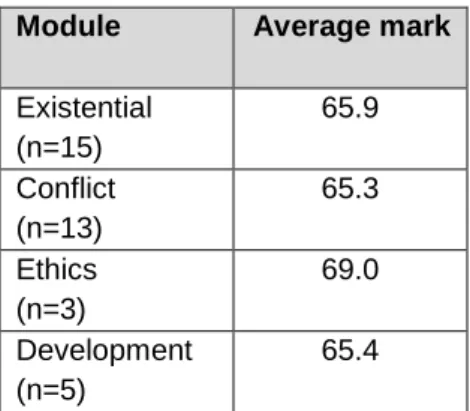
Module marks were awarded according to the individual partners’ institutional assessment criteria, and marks collated for analysis. Whilst students typically place a high level of importance on the marks they receive, and these are very often the source of strong emotional reactions, on their own they are of little significance. Given that student marks were not reported in the CEP project, only marks for Sheffield students were available to me (2009-10):
Module Average mark
Existential (n=15) 65.9 Conflict (n=13) 65.3 Ethics (n=3) 69.0 Development (n=5) 65.4
Table 6 - Mean student mark by module
1.3 Correlations
The key relationships for examination were between collaborative learning and the other measures, due to the links between collaborative learning and emotions in learning. The distribution of data had a bearing on which statistical tests could be used, and calculations of normality or otherwise are shown via ‘z’ scores in Appendix XXb. Where one or both datasets were not normally distributed, a Kendall’s Tau test was used; where one or more components of a measure were not normally distributed, the overall measure scores were considered to be not normally distributed, as was the case with COLLES scores. It should be noted that given that these are correlations, it is not possible to comment on causation, merely on the significance or otherwise of relationship.
1.3.1 Collaborative learning and student activity
To investigate the relationship between COLLES scores and student activity, a Kendall’s Tau test was undertaken for all partners’ data (see Appendix XIXb). The data suggest there are strongly significant correlations between students’ online activity levels and self-rated levels of relevance, interactivity and peer support of their learning, with significant connections between student activity and reflective thinking, i.e. student activity levels and various collaborative learning factors are positively related.
28
1.3.2 Collaborative learning and student satisfaction
Student satisfaction levels by partner are shown below, where P1 is Sheffield, P2 is NSPC, P3 is Leuven and P4 is Bordeaux:
Figure 3 - Student satisfaction with the course by partner
As suggested by the previous correlation, student activity levels and various collaborative learning factors are positively related, so it is possible to hypothesize that high-medium collaborative e-learning produces higher levels of student satisfaction than low collaborative e-learning, which in turn produces higher levels of student satisfaction than face-to-face learning. To investigate the relationship between COLLES scores and student satisfaction, a Kendall’s Tau test was undertaken (see Appendix XIXc). The data suggest that there is a significant correlation between students’ satisfaction levels and self-rated COLLES scores.
1.3.3 Collaborative learning and student mark
Student marks were available for P1 only - other institutions gave a pass/fail only. Sheffield students were assessed by combining a 3,000 word assignment (75% of mark) and an assessment of their performance throughout the module (25% of mark) (this latter included attendance and contribution in chatrooms and forums, plus scores in online MCQs). To investigate the relationship between COLLES scores and student mark, a Kendall’s Tau test was undertaken (see Appendix XIXd). The data suggest that there are no significant correlations between student mark and collaborative learning measures.
1 2 3 4 5 I would recommend this course to a friend/colleague
This course fully met my expectations
Overall, I am satisfied with this
course
Compared to face-to-face
classroom learning, this course has been
an effective learning experience
Student satisfaction with the course
Sheffield NSPC Leuven Bordeaux F2F
29
1.3.4 Student activity and student satisfaction
To investigate the relationship between student activity and student satisfaction, a Kendall’s Tau test was undertaken (see Appendix XIXe). The data suggest that that there are no significant correlations between student activity and student satisfaction.
1.3.5 Student activity and student mark
To investigate the relationship between student activity and student mark, a Kendall’s Tau test was undertaken (see Appendix XIXf). The data suggest that that there are no significant correlations between student activity and student mark.
1.3.6 Student satisfaction and student mark
To investigate the relationship between student satisfaction and student mark, a Pearson’s test was undertaken (see Appendix XIXg). The data suggest that that there are no significant correlations between student satisfaction and student mark.
From these correlations, a summary of the relationships is shown below:
Collaborative learning (COLLES)
Student activity Student satisfaction Student end of module mark Collaborative learning (COLLES)
- Strongly related Strongly related No statistically significant relationships
Student activity - - No statistically
significant relationships No statistically significant relationships Student satisfaction - - - No statistically significant relationships Student end of module mark - - - -
Table 7 - Summary table of correlations between all measures
1.4 Conclusion
In terms of what the measures considered in this Background section 1.2 can tell us about the role of emotions in e-learning, we can conclude the following:
• Collaborative learning (CL), which is understood from the research literature to have a high (but not yet fully characterized) affective tone, increases with increasing student activity and student satisfaction; this suggests that those students who are
30
more willing to engage with one another’s emotional processes are more likely to be active online, and satisfied with their experience (and vice versa)
• There is no relation between CL and student mark, i.e. the better performing (academically speaking) students are not engaging in more CL
• Student activity on its own is not related to levels of satisfaction or academic mark
• Student satisfaction increases with increasing CL, i.e. the more satisfied students are the ones who engage in a type of learning which involves collaboration, and possibly emotional transactions (and vice versa)
• Student mark is not related to satisfaction levels
Whilst some of these conclusions are counter-intuitive, e.g. one might expect student mark to be related to student activity, and/or satisfaction levels, it may be that low student numbers account for the lack of a correlation. In terms of these tools’ ability to measure the emotions of e-learners, the COLLES scores look like they can potentially give an indication of emotional and cognitive engagement, but we will return to test this further in study 1 (section 4.1) where these background measures are compared with the well-being/mental health measures.
31
2 LITERATURE REVIEW
The purpose of the literature review is to summarize the existing evidence on the role of emotions in e-learning, and the methods of measuring them.
From initial scoping searches and reading of the literature, the base of published research is relatively small. There is however a substantial history of research into the role of emotions in face-to-face learning, and clearly, much of the literature on emotion and learning is also relevant to e-learning contexts; this will be briefly summarised in the “Narrative Summary”, in order to provide some insight into the ways in which e-learning differs from other learning formats in terms of emotional processes. Is it the case that some aspects of e-learning are importantly different to face-to-face learning, and have an impact on the kinds of emotional experiences and transactions which take place online? And if so, is it possible to understand what these differences are, and what effect they have?
Marchand and Gutierrez characterize the literature on emotions in online learning environments as focusing on three areas:
1. in-depth description of both the arousal and expression of emotion during online learning tasks
2. reports of instructional techniques and course design that can be used to enhance e-learners’ emotional experiences and engagement with coursework
3. quantitative considerations of emotion as a personal factor that influences student learning and performance.
(Marchand & Gutierrez, 2012, p.2)
The motivation for the current thesis is primarily to explore the third of the three areas outlined above - with the caveat that qualitative considerations are given equal importance - whilst bearing in mind implications for the other two.
2.1 Search strategy
It is important to ensure that high quality academic sources are utilised throughout a literature review. Discussing strategies for finding such high quality resources, Ford (2012) suggests that this task can be approached in one of two ways:
1. going for “low-hanging fruit”; or
2. engaging in controlled systematic searching
Ford suggests that “The controlled systematic searching approach is appropriate when you want to maximise your chances of finding the best information sources and minimise the chances of missing potentially important ones” (Ford, 2012, p. 68) whereas “The ‘low-hanging fruit’ approach is suitable when you want quick, least-effort access to some relevant
32
scholarly information sources to get you started” (Ford, 2012, p.69). The systematic searches in this thesis were based on my previous experience of conducting systematic reviews (Blackmore, Tantam, Parry, & Chambers, 2012) and thus largely followed the guidelines in the Cochrane Handbook for reporting such work (Higgins & Green, 2011).
2.1.1 “Low-hanging fruit” and other searches
The research question requires a theoretical background on both emotions and (e-) learning. The “low hanging fruit” strategy was used first, in order to gain an overall sense of the literature before going on to more detailed systematic searches, and under this umbrella term, a variety of approaches was used to pick up relevant literature, as detailed below:
Description of approach Conducted online, in
person, or both
Google and Google Scholar searches of topics, selected theorists/authors, particular communities of interest
Online
Inspection of relevant journals Both
Hand-searching of PhD theses and course reading lists via the University of Sheffield’s library
In person
Contact with selected others (including supervisory team, colleagues and selected authors) for recommendations
Both
Inspection of selected journal articles (particularly their “Introductions”) for relevant references
Both
Table 8 - "Low-hanging fruit" approaches for literature searching
There were no restrictions on where the research came from, beyond the indexing schemes employed by Google Scholar itself. Thus the “low-hanging fruit” search can be considered to have covered all relevant types of literatures. However, initial scanning of search results confirmed that certain important areas of thought on the research question were not well-represented, e.g. neurobiological research on the brain’s ability to process emotions and to engage in learning online, and the philosophical underpinnings of links between emotion and learning. It was therefore necessary to target particular topics using the strategies outlined above.
33
2.1.2 Controlled systematic searching
Controlled, systematic searches were undertaken in March and April 2012. To avoid unmanageable numbers, searches focused initially on publications with relevant keywords appearing in the title alone. Keywords selected were emotion and its synonym affect, and e-learning and its synonyms elearning, online learning, technology enhanced learning, networked learning and computer-assisted learning. The term “affect” did produce a number of false results, due to its use as a verb (“to act on, produce an effect or change in”) instead of a noun (“feeling or emotion”); also the term “affect” was erroneously used in several papers when “effect” was the grammatically correct word.
Studies examining “emotional intelligence” were generally avoided, unless they also commented specifically on emotions per se, as the term “emotional intelligence” is often used in a variety of ways. The most commonly accepted definition is the “ability to monitor one's own and other people's emotions, to discriminate between different emotions and label them appropriately, and to use emotional information to guide thinking and behaviour” (Colman, 2009) which is too general to be applicable to the research question under examination here. Similarly, studies focusing on “learning styles” were not included unless there was specific comment on the role of emotion in learning.
Databases were selected to ensure wide coverage of topic areas (for details of the search strategy, see Appendix II). A total of 261 relevant articles were identified; after de-duplication across all searches, this number dropped to 233. These results were screened for relevance and 201 were excluded from title, abstract or, where necessary, from the full article (see figure 4 below):
34
Figure 4 - Consort diagram of the flow of included studies from systematic searches The 31 relevant articles were identified from the following sources:
Source Number of articles
included Web of Knowledge 10 Google Scholar 8 Mendeley 2 OvidSP 18 Other searches 1 Duplicates removed 8 TOTAL 31
Table 9 - Sources of included articles Potentially relevant studies identified and screened for retrieval (n=233)
Studies excluded on screening of title and abstract (n=187)
Studies retrieved for more detailed evaluation (n=46)
Studies included in the literature review (n=32)
Studies excluded (n=14)
Reviews (n=5)
Studies with usable outcome data included in the literature review (n=26)
35
Characteristics of the studies are shown in a table (see Appendix III). NB - Google Scholar covers material found in two major educational databases, ERIC and BEI, so they did not need to be queried separately.
After the initial “low-hanging fruit” and “controlled systematic” searches were undertaken, the results were collated and analysed. From this point onwards, and for the remaining duration of the research, subsidiary searches were undertaken, and references added incrementally as they came to my attention via further reading and “low-hanging fruit” searches.
2.1.3 Excluded materials
The most common reasons for excluding materials were that the research did not in fact focus on the role of emotions in e-learning, but looked at more general concepts such as student motivation, learning style, emotional intelligence, readiness for e-learning, student/staff adoption of learning courses, cultural issues or other issues relating to e-learning design. There were also several articles relating to “affective computing”, speech recognition, facial recognition and eye-tracking systems and other related technologies which are being developed to enable detection of students’ emotional states. A few papers reported on efforts to develop virtual teaching systems using avatars or similar methods. Finally, as mentioned above, a number of articles were picked up by the search strategy via their incorrect use of the term “affect”.
2.2 Narrative summary - role of emotions in learning
This section summarises findings from the literature review as a narrative synthesis (Popay et al., 2006), by aiming to “survey the state of knowledge on a particular topic” (Baumeister & Leary, 1997). The summary focuses on findings from the final data set of the systematic literature and “low-hanging fruit” searches; but where appropriate, other findings from general reading and from included studies’ reference lists are also integrated.
2.2.1 The nature of emotions
The literature reviewed for this thesis encompasses a number of different basic theories of what emotions are, and it is important for this thesis to be clear from the start on theoretical underpinnings. The concept of “emotion” has been studied from a large number of perspectives, including evolutionary, behaviourist, componential, socio-cultural and neuro-scientific (Feidakis, Daradoumis, & Caballe, 2011). Similarly, emotions have been conceptualized as “multi-component, coordinated processes of psychological subsystems
36
including affective, cognitive, motivational, expressive, and peripheral physiological processes” (Pekrun, 2006, p.316) and as “holistic episodes that include physiological, psychological, and behavioral aspects” (Schutz, Hong, Cross, & Osbon, 2006, p.345).
Clearly, it is not possible to do justice to all of these areas in this review, but it is possible to pull out the major themes identified in the e-learning literature, to come to an understanding of the existing knowledge-base on what impact emotions have in the e-learning context.
There are longstanding difficulties in reconciling emotional and cognitive processes. O’Regan notes that:
“learning theories, particularly those concerned with learning at higher levels of education, have largely treated emotion and cognition as occupying separate realms, cognitive processes having prime (or even sole) place in the educational scheme of things.”
(O’Regan, 2003, p.78) Indeed, if we accept the distinction between emotion and cognition, and wish to go beyond the experiencing of emotions to describing, defining or theorizing about them (as we are doing here), then a (cognitive) process of intellectualising does need to take place. But cognitive processes do not emerge via an emotion-less process, any more than emotions can be evoked or experienced without cognitive action. Some theorists have done this, and proposed definitions of emotion. For example, Gerrig and Zimbardo define emotion as “a complex pattern of changes, including physiological arousal, feelings, cognitive processes, and behavioural reactions, made in response to a situation perceived to be personally significant” (Gerrig & Zimbardo, 2002, p. 394).
But others speak of the impossibility of the task:
“One of the reasons for the continuing separation of emotion and cognition is the difficulty in defining just what it is we are talking about when we speak of emotion, there being many perspectives and a multitude of definitions.”
(O’Regan, 2003, p.78)
Given this difficulty, also noted by others e.g. Ortony & Turner (1990), and the unlikelihood of finding a definition which will be satisfactory from all theoretical perspectives, it might be advisable to adopt a more pragmatic, open attitude to their definition. Writing about “The flavour of emotions”, Tantam comments:
“What is obviously at issue is what an emotion is. If we choose it to be only an experience associated with a feeling, then we experience emotions in distinct episodes. These are likely to be less frequent mental occurrences than thoughts, and the number of happenings that cause emotions are quite limited. If we choose to consider that emotions enter into the processing of any new or changed happening, then it is likely that there is a constant undercurrent of emotion in our minds and that these emotions do not supplant thought, but
37
complement it. We can also associate emotions particularly with feelings that occur at times of mental conflict when they may be disruptive, or we can associate them with gut feelings or heart promptings which show us a direction when our thoughts cannot. It seems likely that all of these differing views of emotion are right: that emotions can function in all of these ways, and more, just as thought may be the means to philosophize or to deceive oneself.”
(Tantam, 2003, p.26) As well as the variety of approaches to theories of emotion, various taxonomies of emotion have been proposed (see Appendix V). Zembylas comments that:
“while both the psychological and the sociological perspectives offer important insights, claiming that emotions are simply a matter of the individual or the group does not sufficiently address the complex role of emotions. Rather, a more useful approach locates emotions in the liminal space between individual and social constructivist approaches, challenging the divisions between individual vs. social, private vs. public, and emphasizing that emotion operates as a constitutively reciprocal component in the interaction/transaction of the individual and the social (Leavitt, 1996)”.
(Zembylas, 2008a, p.73) Given this multiplicity of perspectives, perhaps what an emotion does, or makes possible, is more important than what an emotion is. By this reasoning, a definition of emotion should, in fact, be a description of its action, and what it makes possible, rather than what it appears to be. Perhaps as well as reasoning, it is permitted here to employ feeling or sensing, and if so, an aspect of theory of emotion which feels important is that emotions are not simply things which happen to us, they are “intimately bound up with judgements we make, and they represent strategies for living these judgements within the world” (Dirkx, 2008). Dirkx cites Solomon who says “We live our lives through emotions, and it is our emotions that give our lives meaning” (Solomon, 2007). This accords with the idea of emotions as processes, and ones that contribute to our life’s narrative.
Nevertheless, it is important - if only for this thesis - to settle on a workable definition of emotion. How can we hope to consider the role of emotions if we have no conception of what emotions are? Schutz et al provide a useful conceptualisation of emotion as:
“… socially constructed, personally enacted ways of being that emerge from conscious and/or unconscious judgments regarding perceived successes at attaining goals or maintaining standards or beliefs during transactions as part of social-historical contexts.”
(Schutz et al., 2006, p.344)
By “socially constructed, personally enacted”, the authors contend that emotions are “relational”, i.e. particular emotional experiences are brought into being by the interactions of individual and environment rather than existing as “exclusive features of a person or of an