POUR L'OBTENTION DU GRADE DE DOCTEUR ÈS SCIENCES
acceptée sur proposition du jury: Prof. K. Aberer, président du jury Prof. P. Dillenbourg, directeur de thèse
Prof. P. Olivier, rapporteur Prof. K. Reinecke, rapporteuse
Prof. D. Gillet, rapporteur
Contextual Information Scent
THÈSE N
O6767 (2015)
ÉCOLE POLYTECHNIQUE FÉDÉRALE DE LAUSANNE
PRÉSENTÉE LE 27 NOVEMBRE 2015À LA FACULTÉ INFORMATIQUE ET COMMUNICATIONS LABORATOIRE D'ERGONOMIE ÉDUCATIVE
PROGRAMME DOCTORAL EN INFORMATIQUE ET COMMUNICATIONS
Suisse PAR
the urge to reach your full potential... these are the keys that will unlock the door to personal excellence. — Confucius
This thesis work would not have been possible without the help of many people.
First and foremost I want to thank my thesis supervisorProf. Pierre Dillenbourgfor the support and guidance throughout the past five years. I experienced some difficulty at the beginning of my PhD, but you trusted me and guided me through the "darkness". It was you who introduced me to the new but exciting field of MOOC research, where I have learned a lot and made my own research contributions. I could not have had a more patient and supportive supervisor. Thank you for giving me the opportunity to purse a PhD under your supervision. You really have changed my life.
Patrick Jermann, thanks very much for being my "part-time supervisor" for five years, your
feedback has always been valuable. Florence Colomb, thanks for your help in too many aspects of my life at EPFL and in Switzerland. You are always very patient and nice to me.
Frédéric KaplanandOmar Mubin, thank you for your support and advices during the first
years of my Phd. I also would like to thankGuillaume ZuffereyandJan Blom, you both helped me a lot with my experiments.Łukasz Kidzi ´nski, thanks for your support in my data analysis and paper writing. My PhD research got a boost since you came to the lab and worked together with me.
Hamed AlaviandSon Do-Lenh, I often asked advices from you, and you both have spent
very much time in helping me with my research. I learned a lot from you.Quentin Bonnard
andOlivier Guédat, thank you for your technical help when I was working on the Tinkerlamp
project. My thanks also go toAndrea MazzeiandSebastien Cuendet, you also gave me lots of advices for my research.
Julia FinkandHimanshu Verma, I was the first among us to arrive at the lab but I leave the
last. We had very good memories in the lab, I still remember we attended the course together in our first year. It is my pleasure to have you as my colleagues. Kshitij SharmaandMirko Raca, thank you for helping me with many things from time to time, especially your feedback of talk.
Many thanks go to my thesis juries, includingProf. Karl Aberer,Prof. Denis Gillet,Prof.
Patrick OlivierandProf. Katharina Reinecke. My thanks also go to the people who have
worked closely with me for some projects, includingAndrei Popescu-Belis, Phil Garner,
partici-Students often have information needs while carrying out a multitude of learning activities at universities. When information is needed for investigating a problem, the student may interrupt the work and switch to an information seeking task. As Internet connectivity be-comes ubiquitous, searching information has been routinized and integrated in the learning experience. However, information needs are not always fully recognized, or they can not be well articulated. A MOOC student may perceive a video to be difficult, but fails to express what information can be helpful. Sometimes it is improper to interrupt the learning task for searching information, especially when social factors are concerned, e.g. in a seminar talk. These situations create research potentials for making ambient information cues, hereafter referred to ascontextual information scent (CIS), available to address students’ situational information needs in learning activities. The CIS is designed to combine context-awareness with information seeking, ambient interaction as well as serendipitous encounter.
In this thesis, we investigate the CIS mainly in collaborative learning activities. We explore three different contexts: conversation, groupware interaction and video content for MOOC learning. RaindropSearchinvestigates capturing conversational words as CIS for building search queries, while theTileSearchtriggers Web searches based on group discussions and retrieved image and Wikipedia results as CIS for serendipitous interactions. These two explo-rations both focus on conversation context and provide initial insights into the CIS design practice. Next, we presentMeetHub Search, which includes three CIS components based on text interactions in a groupware. Our last prototype, theBOOC Playeremploys textbook pages as CIS and links them to MOOC videos during the course of collaborative video viewing. All prototypes show how we manipulated design parameters to reduce distraction, increase relevance and ensure timeliness. The studies also exhibit the influence of group dynamics on the use of CIS. We finally extend our research scope to individual MOOC learning and summarize the design insights obtained from MOOC analytics.
The contributions of this thesis are summarized as (1) a dedicated research framework derived from both research literature and requirement analysis for recognizing the design challenges, design principles and design space of CIS. The framework lays the foundation for us to explore different contexts in this thesis, where we generated (2) design implications that identify the key attributes of CIS. Last but not least, we employed (3) a variety of evaluation methodologies in this thesis for assessing the usability as well as the benefit and appeal of CIS.
Les étudiants ressentent souvent un besoin d’information quand ils font face à une multitude d’activités d’apprentissage dans les universités. Lorsque l’information est nécessaire pour résoudre un problème, l’élève peut interrompre son travail et prendre le temps de chercher les éléments dont il a besoin. Alors qu’Internet devient omniprésent, la recherche d’information en ligne s’intègre de plus en plus dans l’apprentissage au quotidien. Cependant, les besoins d’information ne sont pas toujours pleinement reconnus et peuvent parfois être mal traités. Pour un étudiant inscrit à un MOOC il est possible de percevoir la difficulté d’une vidéo sans parvenir à identifier l’information qui peuvent être utile. Dans d’autres cas il n’est pas conce-vable d’interrompre la tâche d’apprentissage pour la recherche d’informations, par exemple, lors d’une présentation d’un séminaire. Ces situations créent des potentiels de recherche pour la fabrication d’indices ambiants d’information, ci-après dénommés contextual informa-tion scent (CIS). Ces indices sont disponibles pour répondre aux besoins d’informainforma-tions des élèves en fonction de la situation. Les CIS s’adaptent au contexte afin de favoriser l’accès à l’information.
Dans cette thèse, nous étudions les CIS principalement dans le cadre d’activités d’apprentis-sage collaboratives. Nous explorons trois contextes différents : la conversation, l’interaction à travers un groupware et le contenu vidéo pour l’apprentissage sur les MOOCs.RaindropSearch
cherche à capturer des mots dans une conversation en tant que CIS pour aider à construire des requêtes de recherche, tandis queTileSearchdéclenche des recherches sur le Web basées sur des discussions de groupe et affiche des images et du contenu récupérés sur Wikipédia. Ces deux études se concentrent toutes deux sur le contexte de la conversation et fournissent un premier aperçu de la pratique de la conception de CIS. Ensuite, nous présentonsMeetHub Search, qui comprend trois composantes de CIS basées sur des échanges de texte d’un group-ware. Notre dernier prototype, leBOOC Playeraffiche des pages de manuels scolaires en tant que CIS et les relie aux vidéos d’un MOOC dans le cadre de visionnements en groupe. Tous nos prototypes montrent comment nous avons manipulé les paramètres de conception pour réduire les distractions, accroître la pertinence et favoriser les opportunités de recherche. Les études montrent également l’influence de la dynamique de groupe sur l’utilisation de CIS. Nous avons finalement étendu notre champ de recherche à l’apprentissage individuel sur les MOOCs et nous présentons nos idées de conception obtenus à partir de notre analyse des MOOCs.
Acknowledgements i
Abstract (English/Français) iii
List of figures xi
List of tables xv
1 Introduction 1
1.1 Motivation . . . 2
1.2 Calm Technology . . . 2
1.3 Contextual Information Scent . . . 3
1.4 Research Objectives . . . 4
1.5 Research Approach . . . 4
1.6 Thesis Outline . . . 5
2 Attention, Activity and Learning 9 2.1 Attention and Cognition . . . 9
2.1.1 Selective Attention . . . 10
2.1.2 Divided Attention . . . 13
2.1.3 Work Interruption and Multitasking Continuum . . . 16
2.1.4 Priming Effect . . . 19
2.2 Activity and Learning . . . 20
2.2.1 Activity Theory . . . 21
2.2.2 Learning Taxonomies and Collaborative Learning . . . 25
3 Information and Help Seeking 29 3.1 Information Seeking and Searching . . . 29
3.1.1 Information Seeking Models . . . 31
3.1.2 Information Seeking Principles . . . 35
3.1.3 Context . . . 37
3.1.4 Modes . . . 39
3.2 Help-seeking . . . 42
3.2.1 Help Seeking Behavior . . . 42
5 Research Framework and Perspectives 71
5.1 Gathering Information Needs : A Survey Study . . . 71
5.1.1 Research Methodology . . . 72
5.1.2 Survey Results . . . 74
5.2 Research Framework . . . 78
5.2.1 Research Scope, Challenge and Design Principle . . . 79
5.2.2 Design Space and Interaction Phases . . . 83
6 Exploring Conversation Context 89 6.1 Exploration : RaindropSearch . . . 89
6.1.1 Related work . . . 90
6.1.2 System Design . . . 91
6.1.3 Interactions . . . 96
6.1.4 Piloting RaindropSearch . . . 98
6.1.5 Evaluating RaindropSearch with the Activity Checklist . . . 100
6.1.6 Lessons Learned . . . 105
6.2 Exploration : TileSearch . . . 106
6.2.1 Research Questions . . . 106
6.2.2 The TileSearch interface . . . 107
6.2.3 Experiment . . . 110
6.2.4 Result . . . 112
6.2.5 Lessons Learned . . . 117
7 Exploring Interaction Context 119 7.1 Exploration: MeetHub Search . . . 119
7.1.1 MeetHub: Setup and Components . . . 120
7.1.2 MeetHub Search . . . 122
7.1.3 MeetHub Search in the Design Space . . . 127
7.2 MeetHub Search: Research Questions . . . 128
7.3 MeetHub Search: Study . . . 129
7.3.2 Tasks . . . 130
7.3.3 Condition . . . 131
7.3.4 Procedures . . . 131
7.3.5 Data Collection . . . 132
7.3.6 Results and Findings . . . 133
7.3.7 Discussions . . . 136
7.3.8 Conclusion . . . 138
8 Exploring Content Context 139 8.1 Exploration: BOOC Player . . . 139
8.1.1 Related Work . . . 141
8.1.2 Design of the BOOC Player . . . 143
8.2 BOOC Player: Research Questions . . . 146
8.3 Experimenting BOOC Player in MOOC Study Groups . . . 147
8.3.1 Participants . . . 147
8.3.2 Formats of MOOC Study Groups . . . 148
8.3.3 Procedure . . . 149
8.3.4 Data Collection . . . 151
8.3.5 Revealing Group Dynamics . . . 152
8.3.6 Understanding the Use of Textbook . . . 160
8.3.7 Addressing Videos Difficulty and Facilitating Group Discussion . . . 164
8.3.8 Discussion . . . 166
8.3.9 Conclusion . . . 168
9 Evaluating Zone of Intervention 169 9.1 Background . . . 170
9.1.1 Video Interaction Analysis . . . 170
9.1.2 MOOC Video Interaction Analysis . . . 171
9.2 Research Questions . . . 171
9.3 Investigating MOOC Video Interactions . . . 172
9.3.1 Video Interaction Datasets . . . 172
9.3.2 Data Wrangling Pipleline . . . 173
9.3.3 Methodology . . . 173
9.3.4 Inspecting Video Interaction Features . . . 174
9.3.5 Inspecting Video Interaction Patterns . . . 183
9.3.6 Clustering Pipeline . . . 185
9.3.7 Video Interaction Patterns . . . 185
9.3.8 Perceived Video Difficulty . . . 186
9.3.9 Video Revisiting Behaviors . . . 188
9.3.10 Student Performance . . . 190
9.3.11 Discussions . . . 192
B RaindropSearch Study: Questionnaire 211
B.1 RaindropSearch Questionnaire . . . 212
C TileSearch Study: Instruction and Questionnaire 215 C.1 Experiment Instructions . . . 216
C.2 Pre-test Questionnaire . . . 217
C.3 Post-test Questionnaire 1 (After the first task) . . . 219
C.4 Post-test Questionnaire 2 (After the second task) . . . 221
D MeetHub Search Study: Tasks and Questionnaires 223 D.1 Task 1: The Thumb Problem . . . 224
D.2 Task 2: The Energy Crisis Problem . . . 225
D.3 Task 3: The Neuroscience Task . . . 226
D.4 Post-test Questionnaire . . . 227
E BOOC Player Study: Questionnaires 231 E.1 Pre-test Questionnaire . . . 232
E.2 Post-test Questionnaire . . . 235
Bibliography 262
1.1 Overview of the Thesis Structure . . . 6
2.1 Early selection, late selection and attenuation models . . . 11
2.2 Two-stage model of feature integration theory (Treisman, 1988) . . . 13
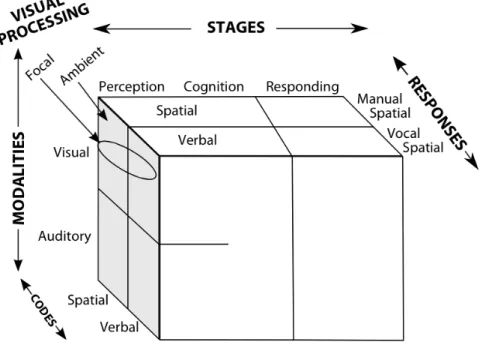
2.3 The 4-D multiple resource model (redrawn from (Wickens, 2008)) . . . 14
2.4 The multitasking continuum (redrawn from (Salvucci et al., 2009b)) . . . 18
2.5 The stages of interruption and resumption (redrawn from (Bogunovich and Salvucci, 2011)) . . . 19
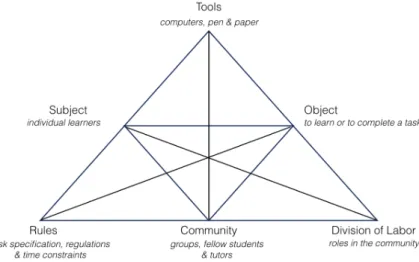
2.6 The activity system models . . . 22
2.7 Activity, actions and operations (redrawn from (Wilson, 2005)) . . . 23
2.8 Bloom’s cognitive taxonomy of learning (adapted from (Bloom et al., 1956) and (Anderson et al., 2001)) . . . 25
2.9 Statements of learning objectives (adapted from (Heer, 2015)) . . . 27
3.1 Taxonomy of information seeking (Bates, 2002) . . . 30
3.2 The information journey model (Blandford and Attfield, 2010) . . . 32
3.3 Model of information search process (Kuhlthau, 2004) . . . 33
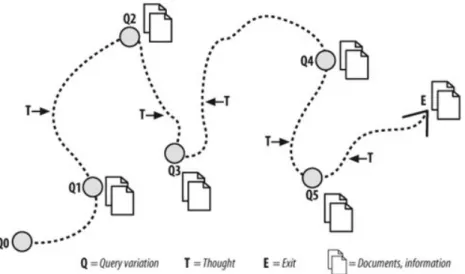
3.4 Berry-picking model (Bates, 1989) . . . 34
3.5 The lens model (Brunswik, 1956) . . . 35
3.6 Taxonomies of search activities (Marchionini, 2006) . . . 41
3.7 Adaptive help-seeking model (Newman, 1994) . . . 45
3.8 Help-seeking model in interactive learning environment (Aleven et al., 2006) . 47 4.1 A framework for interaction phases (Vogel and Balakrishnan, 2004) . . . 53
4.2 Five dimensions of proxemics of Ubicomp (Greenberg et al., 2011) . . . 54
4.3 Dangling String (Weiser and Brown, 1996) represented in the taxonomy of ambi-ent information systems (Pousman and Stasko, 2006) . . . 55
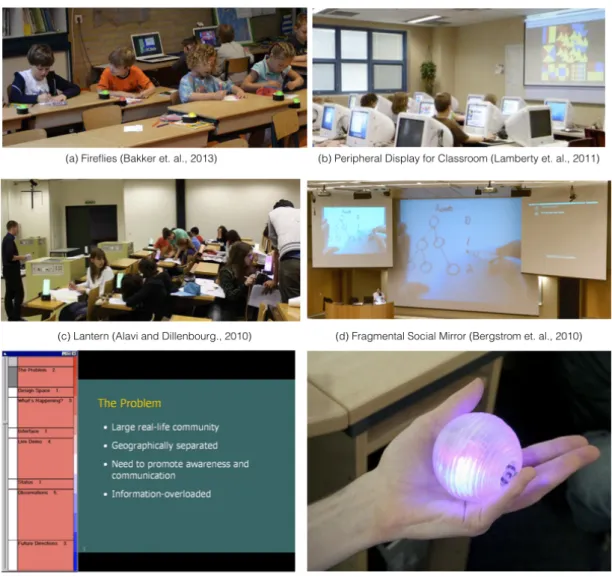
4.4 Ambient information systems in classroom . . . 59
4.5 Ambient Information Systems in Collaborative Setup . . . 60
4.6 Taxonomy of serendipitous information behaviors (adapted from (André et al., 2009)) . . . 62
4.7 Cognitive model of opportunistic browsing (De Bruijn and Spence, 2001) . . . . 63
4.8 Process model of serendipitous experiences (McCay-Peet and Toms, 2015) . . . 64
6.7 TileSearch in the design space . . . 107
6.8 TileSearch tabletop interface . . . 109
6.9 Frequency of TileSearch interactions . . . 112
6.10 TileSearch interactions in divergent and convergent phases. For each of the eight brainstorming sessions, the red ling segment connects the number of selected contextual information scents during the divergent and convergent thinking phases respectively. . . 113
7.1 MeetHub system setup . . . 120
7.2 MeetHub shared workspace . . . 121
7.3 Contextual information scents in MeetHub . . . 123
7.4 MeetHub Search in the design space . . . 128
7.5 Task design for the MeetHub study . . . 130
7.6 Searching with dedicated search tools in the MeetHub . . . 133
7.7 Interacting with information scents in the MeetHub . . . 135
8.1 The BOOC Player . . . 144
8.2 BOOC Player in the design space . . . 146
8.3 The CC and DD study group formats . . . 149
8.4 Learning material and tools for the experiment . . . 150
8.5 Sample video navigation patterns of the study groups. Each plot corresponds to the navigation patterns for a weekly session. The horizontal axis represents the session time (in seconds). The vertical axis corresponds to the position in the video (in seconds). Each video is associated with a specific color. . . 153
8.6 Computing group synchronicity index with varying thresholds . . . 155
8.7 Changes in group-synchronicity index over weeks . . . 156
8.8 Sample speech patterns of the study groups . . . 157
8.9 Amount of speech in study groups . . . 158
8.10 Relationship between video interactivity, synchronicity and amount of speech 159 8.11 Frequencies of the print book interaction modes in pre-BOOC sessions . . . 161
9.1 Example end-video survey about perceived video difficulty . . . 174
9.2 Schematic diagram of video interaction profiles . . . 175
9.3 LS means of perceived difficulty in video sessions with different initial speed . 177 9.4 GAMM fit for amount of average speed change with confidence interval band . 178 9.5 GAMM fit for pausing profile with confidence interval band . . . 179
9.6 Model fit for skipping profile with confidence interval band . . . 181
9.7 Model fit for replaying profile with confidence interval band . . . 182
9.8 Cluster data distributions for the RP dataset . . . 186
9.9 Video interaction patterns and perceived video difficulty . . . 187
9.10 Example video frame with code snippet . . . 191
3.1 Model searchers in unmediated and classic mediated search (Buzikashvili, 2005) 37
5.1 Information about the six seminar talks . . . 74
5.2 Motives and modes of information needs observed in seminar talks . . . 75
5.3 Overview of web searches driven by information needs. Needs are the total number of information needs in the corresponding category; Searches are the number of Web searches made, and successes refer to the number of searches that successfully resolve the information need. . . 77
6.1 Effects of TileSearch interaction on perceived group performance . . . 114
6.2 Comparison of effects of image and Wikipedia information scents . . . 116
8.1 Participants in the study . . . 147
8.2 Two dimensional configuration space for MOOC study groups . . . 148
8.3 Textbook interaction modes. "Mode" is the type of book interaction. "Expla-nation" describes each mode in details. "Type of Book" refers to whether the corresponding mode applies to physical or digital book. "Scope of Interaction" indicates the interaction can be performed individually or collectively. . . 160
9.1 Overview of the two MOOCs in our dataset. . . 172
9.2 Descriptive statistics of interaction profiles. The cells with percentage values represent the proportions that the corresponding profile accounts for in the dataset for the course. Other cells with decimal values are the average perceived difficulty. . . 176
9.3 Video features used for clustering . . . 184
9.4 Cluster centers for the RP dataset . . . 185
9.5 Proportion of video revisiting for complete and in-video dropout sessions . . . 188
9.6 Proportion of video revisiting for complete sessions . . . 189
It is a regular Monday morning. Alice, a university student in Computer Science starts her campus week by attending a seminar about "Big Data". She is very interested in this trending topic but is new to it. "Data warehouse? Is he referring to the database?" Alice is uncertain about this term when she hears it from the speaker, who does not give further explanation. At first, she leaves it alone. Soon she finds the term is mentioned from time to time during the presentation, so she brings her laptop and looks for an explanation online. The web search temporarily deviates her attention away from the talk. When Alice finishes the information seeking, she finds it more difficult to catch up with the presentation.
After attending the seminar, Alice meets up with her friends to study a flipped HCI course in a group. Following the last week’s lectures, their group must brainstorm and finalize a project idea to work on for the semester. "How about a restaurant finder application for travelers?" Alice says. "Can you articulate your idea?", Elisabeth asks. "Sure! I mean, we can design a service similar to Booking.com, but focus on restaurant, and with more social features.", answers Alice. But Elisabeth and others still do not get her point. Alice then takes her pen out and starts sketching an interface. Suddenly, she stops and utters: "Well, let me illustrate my idea with some concrete examples". She opens the website of Booking.com and Facebook on her laptop and compares them. The whole brainstorming session then goes like this, i.e. switching between web searching and discussion. After they agree on the project, the group starts watching the lecture videos together. "I don’t get the difference between storyboarding and scenario mapping, do you?" Alice paused the video and asks this question in the group. After a heated debate on this issue, they do not reach an agreement. The group then tries to look for external help. Five minutes later, Alice finds an answer from the textbook and shares it with the others.
In the evening, Alice decides to follow a Web programming MOOC to acquire necessary skills for her HCI course project. She studies the subject alone, because she has never done any web programming before. She feels the syntax awkward compared to the language she is familiar with. Every now and then, she replays some specific video segments multiple times. Sometimes she also checks online documentation and guidelines in order to understand the code examples in the video.
such interruptions are a matter of "inefficiency", while in other situations (e.g. the seminar talk), interruptions may lead to frustrations for not being able to catch up with the task, which deteriorates the learning experiences.
In fact, human beings have the capability to perform multiple tasks at a time. For example, we can listen to music while jogging or drink while writing a report. These activities happen routinely in our everyday life, and we may not even realize they are happening at the same time. There is no apparent problem in performing them simultaneously, because one of such parallel tasks usually requires no conscious attention, allowing a person to carry it out in the periphery. In contrast, the information seeking in the described scenarios often requires focused attention, so interruptions and attention shifts are unavoidable given existing technologies. Numerous studies (Adamczyk and Bailey, 2004; Czerwinski et al., 2004; González and Mark, 2004; Mark et al., 2005) have recognized managing multiple tasks and interruptions as a challenge for information workers. As our interests lie in the interruptions for information seeking in learning activities, the presented issue easily provokes one to think "What if ready-to-use information is timely prompted to the learners? "
1.2 Calm Technology
Timely prompting useful information implies systems should first be able to capture the context and then appropriately interrupt the task with relevant information. These ideas are not new in human computer interaction, and can be traced back to Mark Weiser’s vision of
ubiquitous computing(Weiser, 1991), also calledpervasive computing(Satyanarayanan, 2001). It describes "The most profound technologies are those that disappear. They weave them-selves into the fabric of everyday life until they are indistinguishable from it." The essence of this vision is however not the physical disappearance of technologies, but rather the seamless integration of technologies into everyday routines so that the users do not necessarily perceive them. Put it in other words, this vision implies that future technologies should work in the background, without demanding focused attention. Weiser and Brown (1997) further articu-lated this vision and coined the termcalm technologyas a way to minimize the invasiveness of
computers.
The concept ofcalm technologyhas inspired researchers to investigate computing powers that are deployed in the users’ periphery of attention, thus breeding the notion ofambient display
(Mankoff et al., 2003; Stasko et al., 2005) andperipheral interaction(Bakker et al., 2012; Hausen and Butz, 2011). The former focuses on subtly presenting information without distracting or burdening the user, whilst the latter explores physical interactions taken place in the periphery of attention. Both concepts emphasize subconscious perception and interaction rather than context-awareness. That is, the information being interacted with may not subordinate to the main task. For example, interactions with an ambient time indicator or a stress monitor while engaging in a task do not directly help accomplish the task.
Devices that work in concert to seamlessly support people in carrying out their activities and tasks are embraced withambient intelligence (Aml)(Zelkha et al., 1998). Aml attempts to capture "all information that is available for a distinct user with a conscious or subconscious desire at a certain place and time" (Lugmayr et al., 2009). Compared toambient displayand
peripheral interaction, this paradigm underlines the pervasiveness of embedded intelligent systems as well as the interconnections between them, whereas unobtrusive task interruptions are not the focus.
1.3 Contextual Information Scent
Calm technologies are seemingly the right paradigm we are looking for, but existing termi-nologies as described before are all umbrella terms that are either too general or emphasize slightly different aspects. Before proceeding to the main body of our research, we pursue a terminology to frame the context of this thesis, i.e. supporting information behaviors in learning tasks.
Information foraging (Pirolli and Card, 1999) is one of the most important concepts. As users traverse the Web, they encounter "trigger Web elements" that they perceive as meaningful to the task. Such trigger elements may have different forms, such as texts, images or links that drive the users towards the right direction for finding useful information. Information foraging theory describes such information hunting behaviors with an analogy of wild animals hunting for food by following the scent. In this analogy, the "trigger Web elements" become
information scent, which are proximal cues that help the users to judge distal information sources and to navigate towards them.
Adapted from the concept ofinformation scent,contextual information scent (CIS)is defined as
ambient information cues, which are perceived from the activity context and made
avail-able for a user with a conscious or subconscious situational information need.The form of
CIS is not defined, so theoretically the scents can be of any media of any level of details, e.g. images, videos, Web pages, book pages or text. The gist is that the CIS is provisioned through a smart media environment which aggregates external content with the semantics of certain
the prevalence of MOOCs in recent years, we intended to deliver data-driven insights in designing contextual information scent for this online learning environment. To be specific, this dissertation aimed to answer the following research questions:
1. What types of situational information needs may arise during learning activities and what are the challenges, principles and potential design space for augmenting the activities with contextual information scent?
2. How can ambient technologies be designed as contextual information scent and what are the benefits and overall appeal of them?
3. Can big educational data (MOOC) provide insights for designing contextual information scent?
1.5 Research Approach
All the research questions have been addressed by different empirical studies or analyses of research literature.
Research Question 1:We first conducted a literature review covering the following aspects:
(1) theories about human cognitive capabilities and limitations for attending to multiple tasks and stimuli either concurrently or sequentially; (2) conceptual frameworks and theories about activities as well as learning; (3) well-established information seeking and interaction models, and (4) related interactive systems that applied the discussed theories for presenting or interacting with information. Then we initiated a survey aimed at understanding situational information needs and classifying them. The survey study was conducted with lab participants of six seminar talks, due to the convenience of data collection for these activities.
Based on the literature review and the findings from the survey study, we identified the design challenges, which are in turn transformed to a set of design principles. These principles further informed the design space for contextual information scent. The design space contains five
axes :Privacy,Context,Information Capacity,Information UncertaintyandActivation, each of which includes two or three conditions.
Research Question 2: Given numerous potential solutions suggested by the design space,
this thesis cannot deliver an exhaustive exploration on all design possibilities. To answer the research question 2, we built four different prototypes that are derived from design space, and then evaluated them in collaborative learning settings with lab experiments. Both qualitative and quantitative methods were employed in the evaluation. In addition, thorough analyses with the Activity Theory is also presented in order to explain the successful and failed aspects of the designs.
Research Question 3: This research question was addressed by large-scale behavioral data
analyses on video lecture viewing, which is the central MOOC learning activity. We associated perceived video difficulty with individual student’s video interactions, and identified the occasions when information scent in terms of contextual help can be prompted. Research in this section do not include the implementation and evaluation of concrete designs, but rather shed some light on potential design solutions that could be experimented in future work.
1.6 Thesis Outline
Figure 1.1 illustrates the outline of this thesis, which is divided into 6 block chapters. Each block contains one to three chapters.
Chapter 2, 3 and 4 aim at anchoring contextual information scent by reviewing related work in literature. InChapter 2we first introduce human attention and cognition theories, including selective attention, divided attention, multi-tasking and priming. Then we present a second-wave HCI theory, the Activity Theory and its analytical tools for structuring context. Finally, fundamental learning theories as well as collaborative theories are reviewed. Chapter 3
starts with a discussion about information seeking behaviors, including its models, principles, contexts and modes. This is followed by a review of help seeking theories in learning context.
Chapter 4 introduces a rich body of theories in ambient information and serendipitous
information. We also show example applications for ambient interaction and serendipitous encountering, with a focus on systems designed for learning.
InChapter 5we present a survey study conducted in seminar talks to learn about information
needs in learning activities. Based on the research literature and insights obtained from the survey, we further develop a research framework and identify the design challenges, principles and design space of contextual information scent. This chapter answers the first research question of the thesis.
Chapter 6, 7, 8 present a few design prototypes with user studies for exploring the design space with three contexts: conversation, group interaction and MOOC video content. In each explo-ration, we manipulate the design parameters to reduce distractions, increase relevance and
ensure timeliness. InChapter 6we introduce two prototypes of contextual information scents generated with conversation context.RaindropSearchinvestigates capturing and displaying conversational words for building search queries, whileTileSearchtriggers Web searches based on group discussions and retrieves image and Wikipedia results for serendipitous interactions.
InChapter 7, we describeMeetHub Search, which includes three kinds of contextual
informa-tion scent based on text interacinforma-tion in the groupware.Chapter 8presents a study of theBOOC Player, which displays textbook content corresponding to the MOOC video being viewed. The presented studies answer the second research question raised in the thesis and demonstrate the benefit and overall appeal of contextual information scent.
Chapter 9answers the third research question in the thesis by employing data science methods
to derive design insights for contextual information scent in MOOC learning.
Chapter 10reflects on the lessons learned from the studies presented in the thesis, and states
As a multidisciplinary discipline, human-computer interaction (HCI) lies at the intersection between social and behavioral science on one hand, engineering and computer science on the other. During the course of its development, a number of theories and frameworks have merged, providing us with guidance on designing and evaluating interactive interfaces and techniques. This thesis focuses specifically oncalm technologiesapplied in learning activities, which implies the requirement of understanding how people manage attention and perform activities especially in the learning domain. This chapter therefore starts by reviewing a selection of attention theories, which are then followed by related work on high-level abstractions of activities. Finally, cognitive taxonomies of learning and the notion of collaborative learning are reviewed.
2.1 Attention and Cognition
This section is concerned with some of the classical theories that have attempted to explain attention. Before launching into a detailed overview, it would be helpful to establish grounds on which the follow-up discussions will be based upon. This ground is the definition of attention, the earliest of which dates back to the 1890 by William James (James, 1890):
"It is the taking possession in the mind, in clear and vivid form, of one out of several simulta-neous possible objects or trains of thought. Focalization, concentration of consciousness are of its essence. It implies withdrawal from some things in order to deal effectively with others".
Underwood (1993) described James’ definition as an "elegant summary". This definition exposes the relationship between attention and consciousness, which many researchers thereafter have made their attempts to conceptualize. During the course of development of attention theories, distinct subcultures have emerged. Some explain man’s attention limitation by assuming the existence of structural bottlenecks (bottleneck theories), whereas others believe there is a limit on man’s capacity to perform mental work (capacity theories). There are also different aspects of attention research issues to be addressed. For example, the issue
by someone chatting around. This phenomena indicates that humans selectively attend to certain pieces of information while unattending the rest. The key question is how much of the unattended message could be detected. Cherry found that his participants were unable to recall any specific words in the unattended message. Similar results were produced in a dichotic listening experiement (Moray, 1959), which was widely used in early studies of auditory attention, e.g. in Broadbent (1958) and Treisman (1964). The above findings imply a filtering process where the attended message is let in and the unattended message is filtered out, and this is where the concept ofselective attentionoriginated.
Selective attention assumes the existence of structural bottlenecks, so that one cannot con-sciously attend to all of our sensory input at the same time. The related theories are therefore called bottleneck theories (Welford, 1952). Researchers have come up with several bottleneck theories, all of which posit that information must be filtered before entering into the short memory store, so the main question is where the filtering process occurs. Developed by several psychologists, multiple classic attention theories were proposed in history to answer this question.
Bottleneck Theories of Attention
Donald Broadbent was one of the first researchers to characterize the attention selection process. He proposed an early selection model (Broadbent, 1958), which claims that the selection occurs very early, and only one channel of the messages is semantically analyzed and attended to. The selecton process may look like Figure 2.1(a). Broadbent’s theory is all-or-nothing, meaning that the unattended messages are completely blocked by the filter. The early selection model was criticized largely due to its inability to explain why the mentioning of names can be attended in the cocktail party scenario. In addition, the filter component in Broadbent’s model operates on the basic physical characteristics of the messages (e.g. genders of the speaker, types of sournds, etc). Gray and Wedderburn (1960) revealed that the meaning of the unattended message can be processed as well in a later study.
Figure 2.1: Early selection, late selection and attenuation models
argues that the selection and filtering occur much later. As illustrated in Figure 2.1(b), all the messages are processed on the basis of meaning and then filtered based on whether or not the information is pertinent or not. Pertinence refers to the perceived significance level of information, e.g. the utterance of one’s names or the sight of those that one cares about or is related to the task. The late selection model is clearly capable of fully explaining the cocktail party phenomena. The main objections to this view is that it is not parsimonious or cognitively economical, i.e. "It is intuitively very unlikely evolution would equip us to process all stimuli to the highest level possible when virtually all of those stimuli are quite irrelevant to our survival, particularly when having the large brain needed to carry our that processing may impose certain physiological costs" (Groome, 2013).
Perhaps the most satisfactory model of attention is the attenuation model proposed by Treis-man (1964). Similar to the argument in the early selection model, TreisTreis-man also postulated that the selection starts at the physical level and is then followed by a filter, but the unattended information is not completely blocked, it is just attenuated. As a result, highly pertinent infor-mation such as one’s name will get through the filter and the meaning of it gets processed. The model is depicted in 2.1(c). Treisman further elaborated the model by introducing the concept of threshold to explain how certain information is more likely to be attended. She claimed that every chunk of information had its own threshold depending on, for example, the context or subjective importance, that determines the likelihood to be perceived after attenuation. Like in the late selection model, all the exposed messages in Treisman’s attenuation model undergo full processing, but irrelevant stimuli often have high threshold to be fully analyzed, resulting in only physical characteristics rather than semantics of the unattended messages being remembered.
right at them. In fact, the participants perceived something was happening, but could not remember the details. A revised version of this study was conducted by Neisser in 1979 with the well-knownInvisible Gorilla Test (Neisser, 1979), where he asked the subjects to watch a short video of two groups of players, wearing white and black shirts respectively. Subjects were asked to capture whenever the players in white successfully passed a ball, but to ignore the players in black. Partway through the same video, a woman wearing a gorilla suit or carrying an umbrella (depending on the versions of the video) strolls in the scene. Participants were found to intently focus on counting the passes, and 50% of the subjects did not report seeing the gorilla (or the woman carrying an umbrella). This phenomenon is now known asinattentional blindness(Mack and Rock, 1998), which refers to the failure to see unexpected stimuli when the attention is focused on something else.Inattentional blindness
is much affected by the intensity of focused attention. Researchers have shown that the greater the demands on focused attention, the less likely people are to notice objects outside their attention (Macdonald and Lavie, 2011; Simons and Chabris, 1999; Simons and Jensen, 2009). An important aspect of visual attention is visual search, which requires detection of particular target against a background of other items. Visual search was first investigated in (Neisser et al., 1963; Neisser, 1963, 1964), where Neisser and his colleagues studied the reaction time for locating specific letters presenting in groups of various characters at various locations. The most profound finding was that the recognition of targets against a dissimilar background has a considerable advantage in visual search, and this is calledpop-out effect. An intuitive real-world experiment he used to demonstrate thepop-out effectin his later article (Neisser, 1967) is that his subjects could rapidly recognize the face of the then president John Kennedy among a background of other faces, which were reported by the subjects as simply "blur". Thepop-out effect indicates no extra effort needs to be devoted to mentally process each of the dissimilar faces. A later study (Treisman and Gelade, 1980) further revealed that for
pop-out effect, an increased size of distracters does not increase the scanning time accordingly. However this claim holds only if the visual feature of the objects is defined as simple as in the aforementioned example. Conversely, when the objects are complex (e.g. both shapes and colors differ), reaction time is increased. This phenomena can be explained systematically byfeature integration theory(Treisman and Gelade, 1980; Treisman, 1988), which is regarded
Figure 2.2: Two-stage model of feature integration theory (Treisman, 1988)
as the most influential model of human visual attention. This theory postulates a two-stage process in visual search as illustrated in Figure 2.2 . The first stage is a pre-attentive stage, where visual objects are analyzed in parallel according to their individual features such as shape, color, orientation etc. For the situations where objects have only a single feature, targets will rapidly pop out in this stage. The second stage is a focused attention stage, where the individual features recognized in the first stage are combined to be processed coherently. Objects that are defined by two or more features have to be processed serially for identification, giving rise to increased reaction time.
Though our targeted scenarios do not explicitly imply visual search tasks, the presentation of information scents during learning activities may involve conscious or subconscious scan of pertinent information,requiring the system to reduce the scanning time as minimal as possible.
2.1.2 Divided Attention
Rather than studying how much one can be aware of the unattended information while focusing on something else,divided attentionstudies one’s ability to attend to more than one concurrent tasks. The question concerns what kind of tasks can be processed in parallel and how well we can perform them at the same time.
Factors Determining Multi-task Performance
Before converging on a well-founded theory, early research explored the factors related to the performance issue of multi-tasking. With a classic dichotic listening experiment, Allport et al. (1972) found a chance level performance in a subsequent recognition test of the words presented in the unattended channel. However, when the to-be-remembered words were presented visually with pictorial representations, the recognition performance was excellent. The finding suggested that the tasks interfere to the extent if their sensory inputs are from the same stimulus modality (e.g. visual or auditory). Put in other words, employing different modalities has the advantage of improving task performance. Similar findings were confirmed by many other researchers (Mcleod, 1977; Treisman and Davies, 1973). This sensory modality factor is usually referred to astask similarity.
Figure 2.3: The 4-D multiple resource model (redrawn from (Wickens, 2008))
Sullivan and his colleagues designed a dual task Sullivan (1976) , i.e. shadowing an auditory message and detecting words on a non-shadowed message at the same time. When the difficulty of the task was increased by using a less redundant message, fewer words were successfully detected on the non-shadowed message. This indicates that higher task difficulty may deteriorate task performance. However, task difficulty is a very subjective notion and is itself difficult to measure. One of the most influential frameworks is the one proposed by (Navon and Gopher, 1979), where the authors summarized difficult tasks as either data-limited or resource-data-limited. The former refers to the limitation in the available information. For example, writing a literature review relies heavily on information about related work that is "external" to the writing task. The latter are the tasks that demand cognitive resources, for example, attending a lecture in classroom is cognitively demanding. Clearly, resource-limited tasks are prone to breakdowns in performance.
Several early studies demonstratedtask practicealso affected our ability to multitask. Allport et al. (1972) showed an expert pianist can sight-read at the piano whilst shadowing. Another study (Shaffer, 1975) exhibited proficient typist can type whilst shadowing. The most direct evidence that shows practice improves multitask performance is from Spelke et al. (1976). Two volunteers were trained extensively on an unfamiliar task which is a combination of reading and dictation at the same time. Initially the subjects suffered a lot. After six weeks of daily practice, their writing and reading speed were greatly improved. Four months afterwards, they could even perform another activity, i.e. categorizing dictated words.
Capacity Theories of Attention
Human beings have the ability to divide attention for multitasking, with deteriorated perfor-mance on one of the tasks, if not all. The studies presented before are concerned with factors that determine one’s ability of divided attention. Such ability is clearly beyond the scope of bottleneck theories which assume one task at a time. Therefore, a more flexible theory, the
single resource theoryis brought forward by Kahneman (1973). Though the new theory also claims attentional resource is limited as the bottleneck theories do, capacity can be allocated to a wide range of activities at the same time. Single resource theory posits that a single pool of cognitive resources (aka. capacity) is shared amongst competing tasks. The limits of the capacity vary depending on the environment, task difficulty, and individual differences (e.g. level of arousal, expert or novice). If the cognitive demands of the combined tasks do not exceed the resources in the central pool, then the tasks will not interfere with each other, otherwise divided attention is detrimental to the performance of one or both tasks.
A notable limitation of the single resource theory is its inability to explain one of the empirical findings presented before: for concurrent tasks in the same modality, allocation of attentional resources is much more difficult. The multiple resource theory (MRT) (Wickens, 1980, 1984) is then developed to account for this limitation. The original MRT model consists of 3 dimen-sions. Thestages of processingincludes perception, cognition and responding stages. The former two stages may interfere if parallel tasks competing for attention resources in the same pool, but the responding stage, which is concerned with selection and execution of actions uses a different resource pool.Modalitiesdimension comprises visual and auditory senses. As previously stated, one can attend to tasks of different modalities with little interference, but tasks with the same modality would experience great performance decrement. Thecodes of processingdimension consists of spatial and verbal processes, which corresponds to man-ual control and speech actions. The fourth dimension,visual processing channelswas later added to the model (Leibowitz and Post, 1982; Previc, 1998), discriminating between focal and ambient vision. The former refers to central vision with high fixations, whereas the latter addresses the peripheral vision. Even when concentrating on something (e.g. reading a book), we are still able to perceive fast changes or movements happening around us (e.g. someone is approaching). The complete 4-D MRT model is depicted visually with a cube in Figure 2.3. This model nicely demonstrates that it is easier to perform simultaneous tasks that require resources from different dimensions. For tasks that demand resources of different levels along the same dimension, a time-sharing scheme is implicitly employed to make task executions more efficient.
Automatic Processes
While capacity theory uses multiple dimensions to model attention resources of different kinds, it does not explain the performance improvement caused by practice, which is an important factor that affects simultaneous task performance. This involves the notion of
exists a contention scheduling mechanism that resolves conflicts so that the processes do not interfere with each other. The theory provides a natural explanation for the key phenomena that some processes are not completely automatic. In fact, processes may become automatic through practices because practice leads to the storage of increased information about the stimulus, so "automaticity is memory retrieval : performance is automatic when it is based on a single-step direct-access retrieval of past solutions from memory" (Logan, 1988). This explains why automatic processes affect little on the cognitive capacity available to other tasks.
2.1.3 Work Interruption and Multitasking Continuum
Divided attention mainly concerns how attention is devoted to the execution of parallel tasks. Practically, multiple tasks are not always parallel but also interleaved. Put it differently, multitasking behaviors can be characterized by the time spent on one task before switching to another. If the time is very short (e.g. in seconds), then the tasks are characterized asconcurrent multitasking, which coincides our discussions in the divided attention section. Researchers attempt to understand how human can divide attention to multiple tasks simultaneously. In contrast,sequential multitaskingoften requires longer time (e.g. in minutes to hours) to be spent on one task before switching to another. Broadly speaking, research in the area of sequential multitasking largely overlaps with the fields oftask switching(Monsell, 2003) and
work interruption(Brixey et al., 2007), which concerns shifts of attentions or even changes of goals in the working memory (Altmann and Trafton, 2002; Frese and Zapf, 1994; Salvucci et al., 2009a).
Work Interruption
Typical interruptions may be initiated externally or internally (Miyata and Norman, 1986; Jett and George, 2003). External interruptions are usually from the surroundings, which are probably neither anticipated nor controlled. Such interruptions include pure distractions or the interruptions that lead to secondary tasks. The former can be seen as noise. An example of distraction is when certain objects suddenly fall down to the ground, diverting one’s attention
away from on-going work. Distractions as such usually last shortly. However, distractions can also be long-lasting, for example, telephone conversations from one’s neighbor in the office may constantly distract attention. These long distractions are termed by Hacker (2003) as regulation difficulties. Distractions, regardless of durations do not direct one to a secondary task with new goals, they simply inhibit the primary task from being smoothly executed. Unlike distractions, some external interruptions may temporarily pull individuals out of their action and divert them to a new goal (Frese and Zapf, 1994). For example, while a student is watching MOOC videos, an in-video quiz may pop out, so that the student has to suspend the video watching and complete the quiz first. Numerous studies have shown that external interruptions as such can result in prolonged time in both primary and the interruption task (Bailey and Konstan, 2006; Eyrolle and Cellier, 2000; Trafton et al., 2003), duplicated work (Wickens and McCarley, 2007), as well as increased anxiety, frustration, and stress (Carton and Aiello, 2009; Mark et al., 2008; Zijlstra et al., 1999). Interruptions are not always negative to the primary task, Speier et al. (2003) found out that interrupting in simple tasks increased the performance while interrupting in complex task experienced the opposite. Speier argued that the subjects perceive the simple tasks as too easy so they did not devote full attention to it. In this case, unpredicted interruptions forced the subjects to focus more on the task which consequently lead to better performance.
In some occasions, interruptions are also self-initiated. Individuals who invoke the inter-ruptions have full control of them. Thus they are conscious about the task switching. As an example, a student engaged in watching a MOOC video may deliberately pauses the video to search relevant study materials online. Internal interruptions can also be breaks, which are defined as resources that help individuals maintain optimal mental and physical performance (Hobfoll, 1989; Sonnentag and Zijlstra, 2006). For example, a MOOC student may want to make a reflection of the knowledge he has learned so far after finish watching 2 videos, and will continue with the rest after the break. A more comprehensive classification of self-interruption can be found in (Jin and Dabbish, 2009), where the authors have identified 7 types of self-interruptions as follows: (1) Adjustment (improving some aspects of the environment, which is intended to increase the productivity of the primary task) (2) Break (temporarily switching to another task to alleviate stress and fatigue with the primary task) (3) Inquiry (seeking external information to facilitate the primary task) (4) Recollection ( a prospective memory event which recalls another task that must be performed immediately in case of forgetting) (5) Routine (performing a task as a routine based on prior experiences) (6) Trigger (performing a new task which is stimulated from the current task) (7) Wait (perform another task maximize pro-ductivity because some bottlenecks are encountered so that the continuation of the primary task is suspended). These 7-style categorization clearly demonstrates that self-initiated task switching can be employed as work strategies (Konig et al., 2005).
Concurrent and sequential multitasking were originally separated areas of research until Salvucci et al. (2009b) proposed a unified theory ofmultitasking continuum. As depicted in Figure 2.4, the left side of the continuum is characterized as concurrent multitasking, exemplified as concurrent tasks such as driving and talking, listening and note-taking. On the other hand, sequential multitasking activities such as cooking and reading book at the same time can be found on the right side of the continuum.
The multitasking continuum encompasses several cognitive theories to explain multitasking. First, theACT-R cognitive architecture(Anderson et al., 2004; Mellon et al., 2007) defines a set of cognitive modules that work in parallel, including (1) a declarative memory module (keeping memories for factual knowledge and task instructions); (2) a goal module (tracking the goal of activity); (3) a problem representation module (holding problem representations such as intermediate steps) and (4) a procedural module (connecting all other modules and controlling the flow of information). According to ACT-R, only one task is permitted per module at a time. However, multitasking continuum theory also combinesthreaded cognition theory(Salvucci and Taatgen, 2008) which allows multiple tasks to work simultaneously across the ACT-R modules with a greedy threading policy. Finally, the multitasking continuum incorporates
memory-for-goals theory(Altmann and Trafton, 2002) as well. This theory posits that when people need to initiate a new goal, they must strengthen this goal in memory to increase its activation level above the current goal, so as to set the new goal as the primary one. In the meanwhile, the suppressed old goal decays until the interruption goal is completed, when the decayed old goal can be recalled and resumed. In fact, if interruption task requires to process the problem representation module, the old problem representation can not be maintained at the same time, it must be swapped out and stored in the declarative memory, from where it is retrieved later when the interruption task is completed. However, the representation may require time to be retrieved, resulting in resumption lag (Altmann and Trafton, 2004). Moreover, memory retrievals are not always successful. Performance in the primary task recall can be improved by rehearsing the problem representation before storing it, but this usually issue in interruption lag (Altmann and Trafton, 2004). The previous described interruption and resumption stages are analogous to the stack actions in computer science, i.e. push and pop. The whole procedure is illustrated in Figure 2.5.
Figure 2.5: The stages of interruption and resumption (redrawn from (Bogunovich and Salvucci, 2011))
2.1.4 Priming Effect
Primingis a concept that stresses the potential interferences between consecutive actions. It is asserted that exposing one stimulus (calledprime) affects a person’s responses to a subsequent stimulus (calledtarget). To be precise, priming may increase or decrease the recognition speed of the subsequent item. In the former case, the priming effect is facilitatory, whereas the latter is inhibitory (Tipper and Cranston, 1985). Priming effect was first demonstrated by Meyer and Schvaneveldt (1971). Using a lexical decision task, they found that a word was recognized faster if it is preceded by another related word. For example, it is quicker for a person who sees "car" to recognize the word "train" than the word "apple", because the former two are semantically associated as "transportation means". This type of priming effects is called
semantic priming(McNamara, 2005). In this section we reviewsemantic primingtogether with an important theory, thespreading activation model, which explains how priming effects occur.
Semantic Priming
Semantic Primingis arguably the most common type of priming in word recognition tasks. When we look back at the previously reviewed attenuation model, which claims that unat-tended stimuli are attenuated and can probably still be identified if they are semantically related, we can now identify it as an example of semantic priming. The semantically related words are actually primed so that it reaches the threshold for being recognized.
Apart from the aforementioned original seminal experiments by Meyer and Schvaneveldt (1971), the priming effect of semantically related words has thus far been investigated in hundreds of studies, most of which were summarized in two meta analyses (Lucas, 2000; Van den Bussche et al., 2009). Researchers have identified two different types of semantic priming based on whether or not the prime and the target words are normatively associative. For example, a prime-target pair of NURSE-DOCTOR will haveassociative semantic priming
Spreading Activation Model
Spreading Activation Model, proposed by Collins and Loftus (1975) is an important theory that explains how semantic priming effect occurs. The model assumes that words and their mean-ings are stored in separate networks in our mind. One network is lexical, storing phonemic and orthographic information about the words whereas the other is semantic, containing concepts of the words as well as their links to the lexical network. Nodes in each network are inter-connected based on their lexical and semantic distances (i.e. similarities). Between-network links are equally easily to be activated compared to the their within-network counterpart. The key idea behind semantic priming is that visually presenting words activates the links to semantically associated concepts more quickly.
2.2 Activity and Learning
The preceding section presents a set of cognitive-science based theories, which has provided us with significant background knowledge in understanding how humans manage their at-tentions. However, for HCI researchers, these findings that are derived or synthesized from simple psychological experiments, often lack considerations of the context, such as why the subjects are performing the tasks and what they can obtain from completing the tasks. As Norman (1980) pointed out:
"The problem seemed to be in the lack of consideration of other aspects of human behavior, of interaction with other people and with the environment, of the influence of the history of the person, or even the culture, and of the lack of consideration of the special problems and issues confronting an animate organism that must survive as both an individual and as a species"
Norman’s statement was not specifically in response to applying attention theories in HCI, but to a broader range of cognitive theories that are known as theinformation processing psychologyorfirst-wave HCI theories(Kaptelinin et al., 2003). The key message of this prob-lem articulation for HCI research and practice is, rather than focusing merely on cognitive performance on the tasks, the major concern is to understand and design technologies in the
context of meaningful activities. Specifically to this dissertation, the context is aboutlearning activities. In this section, we briefly review elaborated concepts of both activities and learning in literature. The former is offered by activity theory which will be presented in the first place, followed by the taxonomies of learning as well as its collaborative aspects.
2.2.1 Activity Theory
As the limitations of adopting cognitive theories in HCI was widely acknowledged in the early 1990s (Carroll, 1991), a number of theories were proposed to extend the scope of human capabilities to understanding and supporting meaningful actions and social interactions in everyday contexts (Kaptelinin et al., 2003). These theories include activity theory (Bdker, 1991; Kuutti, 1991; Nardi, 1996), distributed cognition (Hutchins, 1995; Hollan et al., 2000), phenomenology (Flores and Winograd, 1986), situated action (Suchman and Reconfigurations, 1986) etc. We selectActivity Theory (AT)among others for discussion because it emphasizes and centers on activity, which is a fundamental concept that constitutes our everyday contexts. In addition, the AT also provides many useful tools, e.g. the activity triangle and checklist for understanding and diagnosing interactive systems, and these tools are used extensively in the discussions hereafter in this dissertation.
Activity System Model
Modern Activity Theory is known to originate from cultural-historical psychology developed by Lev Vygotsky and his colleagues in the 1920s and 1930s. Vygotsky (1978) models human activities as subject-object interaction: Any activity is directed by asubjecttowards anobject, and the interaction is mediated by artifacts, also known astoolsor instruments. The object refers to either physical objects being interacted or the objective of the activity. Similarly,the tools can be either physical tools (e.g. a hammer) or psychological tools (language and signs). Take MOOC learning as an example, a student (subject) studies a course (object) through interacting with the MOOC learning materials (tools). Vygotsky’s idea can be illustrated as a triangle model as shown in Figure 2.6(a).
Vygotsky’s model is mainly concerned with individual activities. Alexei Leontiev, one of Vy-gotsky’s students, however mentioned in his work (Leont’ev, 1978) that activities can also be carried out by collective subjects. In other words, the subject-object interaction can mediated by the social entities, known ascommunity(Figure 2.6(b)). The concept of community was developed but not explored systematically in Leontiev’s original work. A more comprehensive model, calledactivity system model(Engeström, 1987) was developed by Engeström, who expanded Vogotsky and Leontiev’s models with more societally constituted forms of medi-ation: tools, rules, and division of labor. Put another way, Engeström posits that an activity system describes the interactions between subjects and objects, intertwined with the afore-mentioned elements (Figure 2.6(c)). Again, let us consider the scenario of a student studying MOOCs. Theobjectof the activity is to learn the course, and theexpected outcomeis the gained
Figure 2.6: The activity system models
knowledge or experience through learning, which may or may not be reflected by the score he or she obtains. The student uses a variety of tools on the MOOC platform to support is learning objective, including Web browser, lecture videos, wikis and discussion forums. The
community comprises other members of the MOOC learning activity, e.g. the instructors, teaching assistants, his or her fellow students. The community is mediated by many explicit and implicitrules, e.g. taking quizzes or exams, peer-grading and forum rules etc. To achieve the learning objective, the student may participate in the discussion forum to get help as well as to help others. The role he plays in the community is actually mediated by thedivision of labour.
Principles of Activity Theory
The main message that the Activity Theory conveys is that our interactions with the world cannot be understood without the context where the interactions take place. The interactions and contexts are indispensable elements of an activity, which is socially cultivated. This message can be elaborated into five basic principles (Kaptelinin, 2006):
1. Object Orientedness.Each activity is oriented towards an object. The object can be an
entity that objectively exists. It can be a physical object (e.g. a car), a virtual object (e.g. a software application) or even certain properties residing in one’s mind (e.g. learning a MOOC). All human activities are driven and directed by the object, and the different activities can be differentiated by their corresponding objects.
2. Hierarchical Structure of Activity. This principle is directly derived from (Leont’ev,
1978), which claims that an activity is built from a three-level hierarchy. The top layer includes amotivewhich generates theactivity. For instance, a student in Computer Science may want to take a course in Computer Graphics, but he lacks background
Figure 2.7: Activity, actions and operations (redrawn from (Wilson, 2005))
knowledge in Linear Algebra. He is then motivated to take an Algebra MOOC which generates a MOOC learning activity. In order to fulfil the object, his activity is decom-posed into many actions, such as watching video lectures, completing assignments and posting in forums etc. Eachactionis associated with a differentgoal( e.g. the goal of watching videos is to learn the lecture content). Actions are implemented through low-leveloperationsoriented towardsconditions. People are often unaware of the oper-ations. For example, the student watches MOOC videos through combinations of video interactions. At the beginning, the student may need to learn how to make forward jumps in the video. Once familiar, performing forward jumps will immediately become automated processes that do not require conscious awareness.
3. Internalization and Externalization.Internalization means external activities can be
transformed in such way that people can perform them without interacting with the actual object, i.e. the activities are internalized in one’s mind. For example, simple arithmetic calculations can be performed mentally, so the activity becomes internal. On the contrary, internal activities can also be transformed to external ones. Calculations in-volving complex arithmetic operations may require calculators. In addition, in collective settings, people need to externalize their thoughts for collaboration or cooperation.
4. Tool Mediation.Activity Theory stresses that tools represent the accumulated
experi-ences of people who designed and improved them to solve similar problems in the past. Such experiences are reflected on the affordances of the tool as well as the knowledge about how to use the tool. Tools may shape external activities as well as internal ones. For example, MOOCs (tools) foster self-paced individual learning activities whereas classroom teaching cultivates more teacher-student, student-student interactions (exter-nal activities). A person’s mental calculation processes (inter(exter-nal activities) may depend on whether the person is used to calculating by hand or with a abacus (tools).