
T
ECHNISCHE
U
NIVERSITÄT
D
RESDEN
DOCTORAL
THESIS
LEARNING
SAMPLING-BASED
6D O
BJECT
POSE
ESTIMATION
Author:
ALEXANDERKRULL
Born on 22 December 1982 in Aachen
Supervisor and First Referee:
Prof. PhD. ROTHER
Second Referee:
Prof. Ing. PhD. MATAS
Advisor: Prof. Dr. GUMHOLD Submitted: 20 November 2017 Defended: 16 January 2018
A thesis submitted in fulfillment of the requirements
for the degree of DOCTOR RERUM NATURALIUM (DR. RER. NAT.)
in the
CHAIR OFIMAGEPROCESSING INSTITUTE OF ARTIFICIALINTELLIGENCE
iii
Declaration of Authorship
I hereby certify that I have authored this Dissertation entitled “Learning Sampling-Based 6D Object Pose Estimation” independently and without undue assistance from third parties. No other than the resources and references indicated in this thesis have been used. I have marked both literal and accordingly adopted quotations as such. There were no additional persons involved in the intellectual preparation of the present thesis. I am aware that violations of this declaration may lead to subsequent withdrawal of the degree.
v
“Nature laughs at the difficulties of integration.”
vii
Abstract
The task of 6D object pose estimation,i.e.of estimating an object’s position (three
de-grees of freedom) and orientation (three dede-grees of freedom) from images is an es-sential building block of many modern applications, such as robotic grasping, au-tonomous driving, or augmented reality. Automatic pose estimation systems have to overcome a variety of visual ambiguities, including texture-less objects, clutter, and occlusion. Since many applications demand real time performance the efficient use of computational resources is an additional challenge.
In this thesis, we will take a probabilistic stance on trying to overcome said is-sues. We build on a highly successful automatic pose estimation framework based on predicting pixel-wise correspondences between the camera coordinate system and the local coordinate system of the object. These dense correspondences are used to generate a pool of hypotheses, which in turn serve as a starting point in a final search procedure. We will present three systems that each use probabilistic modeling and sampling to improve upon different aspects of the framework.
The goal of the first system, System I, is to enable pose tracking, i.e. estimating
the pose of an object in a sequence of frames instead of a single image. By including information from previous frames tracking systems can resolve many visual ambi-guities and reduce computation time. System I is a particle filter(PF) approach. The PF represents itsbelief about the pose in each frame by propagating a set of samples
through time. Our system uses the process of hypothesis generation from the original framework as part of a proposal distribution that efficiently concentrates samples in the appropriate areas.
InSystem II, we focus on the problem of evaluating the quality of pose hypotheses.
This task plays an essential role in the final search procedure of the original frame-work. We use aconvolutional neural network(CNN) to assess the quality of an
hypothe-sis by comparing rendered and observed images. To train the CNN we view it as part of an energy-based probability distribution in pose space. This probabilistic perspec-tive allows us to train the system under themaximum likelihood paradigm. We use a
sampling approach to approximate the required gradients. The resulting system for pose estimation yields superior results in particular for highly occluded objects.
viii
InSystem III, we take the idea of machine learning a step further. Instead of learn-ing to predict an hypothesis quality measure, to be used in a search procedure, we present a way of learning the search procedure itself. We train areinforcement learn-ing(RL) agent, termed PoseAgent, to steer the search process and make optimal use
of a given computational budget. PoseAgent dynamically decides which hypothesis should be refined next, and which one should ultimately be output as the system’s es-timate. Since the search procedure includes discrete non-differentiable choices, train-ing of the system via gradient descent is not easily possible. To solve the problem, we model PoseAgent’s behavior as non-deterministic stochastic policy, which is ulti-mately governed by a CNN. This allows us to use a sampling-basedstochastic policy gradienttraining procedure.
We believe that some of the ideas developed in this thesis, such as the sampling-driven probabilistically motivated training of a CNN for the comparison of images or the search procedure implemented by PoseAgent have the potential to be applied in fields beyond pose estimation as well.
ix
Acknowledgements
First of all, I would like to thank my supervisors. I want to thank Carsten Rother for his introduction and guidance in the world of computer vision research, but also for creating the wonderful work environment that was his research group in Dresden. I want to thank Stefan Gumhold for his much appreciated feedback and the discussions we had, especially on the problems of differential geometry. I also want to thank my previous supervisors Iva Toli´c and Uwe Petersohn, who guided me during my first publication and played an important role in my decision to be a PhD student.
In the last year, I was able to spend some time as a visitor at Microsoft Research in Cambridge. I want to thank Sebastian Nowozin and Jamie Shotton, but also again Carsten Rother, for making this awesome and intellectually simulating experience possible. I sincerely enjoyed Sebastian’s and Jamie’s supervision and collaboration during this time.
I owe gratitude to many of the people I met at during my time as a student in Dresden. My fellow PhD students and office mates Frank Michel and Eric Brachmann contributed a lot in making my research possible. I am thankful for all their input, discussions, and the good times we had at the office. Remembering my time as a diploma student, I am thankful to Dimitrij Schlesinger and Boris Flach who helped to spark my interest in probabilistic methods. I also have to thank Joachim Staib, for his much appreciated help with the problems of software rendering, Linux, and the CGV software framework.
Finally, I want to express the deepest gratitude for the help, support, and love I have received from my family and friends. I want to thank my girlfriend Dorit for all her patience and encouragement through busy times and also for her help in proof-reading. I want to thank my dear friend Peter for reading part of the thesis and for being a true friend. I want to thank Eva and Achim for their sympathy and advice. I want to thank my brother Cornelius for his comments, discussion, and counsel, as well as for being a brother in the best sense imaginable. Last but certainly not least, I want to thank my mother and father for their continuous and unconditional support.
xi
List of Publications
During my thesis I present the methods from the following previously published papers:
• PoseAgent: Budget-Constrained 6D Object Pose Estimation via Reinforcement Learning
Alexander Krull, Eric Brachmann, Sebastian Nowozin, Frank Michel, Jamie Shotton, Carsten Rother
CVPR2017
• Learning Analysis-by-Synthesis for 6D Pose Estimation in RGB-D Images
Alexander Krull, Eric Brachmann, Frank Michel, Michael Ying Yang, Stefan Gumhold, Carsten Rother
ICCV2015
• 6-DOF Model-Based Tracking via Object Coordinate Regression
Alexander Krull, Frank Michel, Eric Brachmann, Stefan Gumhold, Stephan Ihrke, Carsten Rother
ACCV2014
I additionally contributed to the following papers on similar topics during the work on the thesis. They are however not explicitly discussed in the thesis.
• DSAC - Differentiable RANSAC for Camera Localization
Eric Brachmann, Alexander Krull, Sebastian Nowozin, Jamie Shotton, Frank Michel, Stefan Gumhold, Carsten Rother
CVPR2017
• Global Hypothesis Generation for 6D Object Pose Estimation
Frank Michel, Alexander Kirillov, Eric Brachmann, Alexander Krull, Stefan Gumhold, Bogdan Savchynskyy, Carsten Rother
xii
• Random Forests versus Neural Networks - What’s Best for Camera Relocalization?
Daniela Massiceti, Alexander Krull, Eric Brachmann, Carsten Rother, Philip H.S. Torr
ICRA2017
• Uncertainty-Driven 6D Pose Estimation of Objects and Scenes from a Single RGB Image
Eric Brachmann, Frank Michel, Alexander Krull, Michael Ying Yang, Stefan Gumhold, Carsten Rother
CVPR2016
• Pose Estimation of Kinematic Chain Instances via Object Coordinate Regression
Frank Michel, Alexander Krull, Eric Brachmann, Michael Ying Yang, Stefan Gumhold, Carsten Rother
BMVC2015
• Learning 6D Object Pose Estimation using 3D Object CoordinatesEric Brachmann,
Alexander Krull, Frank Michel, Stefan Gumhold, Jamie Shotton, Carsten Rother
xiii
Contents
1 Introduction 1
1.1 Different Tasks of 6D Object Pose Estimation . . . 5
1.1.1 One-Shot Pose Estimation . . . 5
1.1.2 Pose Tracking . . . 6
1.1.3 Pose Estimation and Object Detection . . . 7
1.1.4 Camera Pose Estimation . . . 7
1.2 Challenges . . . 8
1.2.1 Similar Appearance of Different Poses . . . 9
Texture-less Objects . . . 9
Symmetric Objects . . . 9
1.2.2 Variable Appearance under a Fixed Pose . . . 9
Lighting . . . 9
Difficult Materials . . . 10
1.2.3 Combined Challenges . . . 10
Cluttered Background . . . 10
Occlusion . . . 11
1.2.4 Efficient Use of Computational Resources . . . 11
1.3 Related Work . . . 11
1.3.1 Sparse Key-Point-Based Methods . . . 12
1.3.2 Template-Based Methods . . . 13
1.3.3 Voting Methods . . . 14
1.3.4 Dense Correspondence-Based Methods . . . 15
1.3.5 Direct Regression Methods . . . 17
1.4 Thesis Overview . . . 17
1.4.1 System I: Pose Tracking . . . 17
1.4.2 System II: Learning Analysis-By-Synthesis . . . 19
1.4.3 System III: Pose Estimation on a Budget . . . 19
1.5 Contributions . . . 20
1.6 Structure of the Thesis . . . 20
xiv 2.1 Random Forest . . . 24 2.2 Hypothesis Generation . . . 25 2.3 Search Procedure . . . 25 2.3.1 Refinement . . . 26 2.4 Scoring Function . . . 27 2.4.1 Depth Component . . . 27 2.4.2 Object Component . . . 28 2.4.3 Coordinate Component . . . 28 2.5 Simplified Notation . . . 28
3 Probability Distributions in Pose Space 31 3.1 Rotations . . . 32
3.1.1 Representing Rotations . . . 32
Matrix Representation . . . 32
Euler Angles . . . 33
Axis-Angle and Euler Vector . . . 34
3.1.2 Lie Group of Rotations . . . 35
SO(3) as Group . . . 35
SO(3) as Manifold . . . 35
Tangent Space at the Identity Element . . . 36
Exponential Map and Logarithmic Map . . . 37
Tangent Spaces at Other Locations . . . 38
3.1.3 Averaging Rotations . . . 38
3.1.4 Probability Distributions over Rotations . . . 39
Probability Distributions in Tangent Space . . . 40
UARS distributions . . . 42
3.2 A Probability Distribution over Poses . . . 44
4 System I: Pose Tracking 47 4.1 Introduction . . . 47
4.1.1 Contributions . . . 49
4.2 Related Work . . . 49
4.3 Method . . . 50
4.3.1 Bayes Filter . . . 51
4.3.2 PF for Pose Tracking . . . 52
4.3.3 Our Motion Model . . . 53
4.3.4 Our Observation Likelihood . . . 55
4.3.5 Our Proposal Distribution . . . 55
Prior Knowledge . . . 56
xv
Global Estimate . . . 57
4.4 Experiments . . . 57
Dataset of Choi and Christensen [127] . . . 58
Our dataset . . . 59
4.5 Conclusion . . . 62
5 System II: Learning Analysis-By-Synthesis 63 5.1 Introduction . . . 64 5.1.1 Contributions . . . 65 5.2 Related Work . . . 65 5.2.1 CNNs . . . 66 5.2.2 Analysis-by-synthesis . . . 66 5.3 Method . . . 67
5.3.1 The Pose Estimation Task . . . 67
5.3.2 Probabilistic Model . . . 68
5.3.3 Convolutional Neural Network . . . 69
5.3.4 Maximum Likelihood Training . . . 70
Sampling . . . 70
Proposal Distribution . . . 71
Initialization and Burn-in-phase . . . 72
5.3.5 Inference Procedure . . . 72
5.4 Experiments . . . 72
5.4.1 Datasets, Evaluation Protocol, Competitors . . . 72
Datasets . . . 72 Evaluation Protocol . . . 73 Competitors . . . 73 5.4.2 Random Forests . . . 74 5.4.3 CNN Training Procedure . . . 74 5.4.4 Comparison . . . 74
Occlusion Dataset from [31] and [14] . . . 74
Dataset of Krullet al. . . . 74
5.4.5 Discussion of Failure Cases . . . 75
5.5 Conclusion . . . 75
6 System III: Pose Estimation on a Budget 79 6.1 Introduction . . . 80
6.1.1 Contributions . . . 81
6.2 Related Work . . . 81
6.2.1 Relation to System II . . . 82
xvi 6.3 Method . . . 83 6.3.1 PoseAgent . . . 83 State Space . . . 84 Policy . . . 85 CNN Architecture . . . 85
6.3.2 Policy Gradient Training . . . 86
Efficient Gradient Calculation . . . 87
6.4 Experiments . . . 89
6.4.1 Training and Validation Procedure . . . 90
6.4.2 Additional Baselines . . . 91
6.4.3 Testing Conditions . . . 91
6.4.4 Results . . . 92
6.4.5 Efficiency of the Training Algorithm . . . 93
6.5 Conclusion . . . 93
7 Discussion and Future Work 95 7.1 Pose Domain versus Hypothesis Domain . . . 95
7.2 Maximum Likelihood versus Reward Maximization . . . 96
7.3 Particle Filer and Learned Posteriors . . . 97
7.4 Particle Filer and Reinforcement Learning . . . 98
7.5 Conclusion . . . 99
Appendices 101 Appendix A Derivations Regarding SO(3) 103 A.1 Derivation of the Density Factor Between Tangent Spaces inSO(3) . . . 103
A.1.1 Definition of the Problem . . . 103
A.1.2 Derivation . . . 104
A.2 Derivation of UARS Density in Tangent Space . . . 105
Appendix B Further Details on System I 109 B.1 Details on Fitting the Continuous Distribution . . . 109
B.2 Hypothesis Generation . . . 109
B.3 List of Parameters . . . 110
B.4 Approximate UARS Density . . . 111
Appendix C Further Details on System II 113 C.1 Further Details on our Training Procedure . . . 113
C.2 Detailed Experimental Results . . . 114
Dataset by Hinterstoisser [14] and Brachmann [31] . . . 114
xvii C.3 Details on the Calculation of Occlusion . . . 115 C.4 Additional Qualitative Results . . . 115
Appendix D List of Abbreviations 121
Appendix E List of Symbols 123
1
Chapter 1
Introduction
Contents
1.1 Different Tasks of 6D Object Pose Estimation . . . 5
1.1.1 One-Shot Pose Estimation . . . 5
1.1.2 Pose Tracking . . . 6
1.1.3 Pose Estimation and Object Detection . . . 7
1.1.4 Camera Pose Estimation . . . 7
1.2 Challenges . . . 8
1.2.1 Similar Appearance of Different Poses . . . 9
1.2.2 Variable Appearance under a Fixed Pose . . . 9
1.2.3 Combined Challenges . . . 10
1.2.4 Efficient Use of Computational Resources . . . 11
1.3 Related Work . . . 11
1.3.1 Sparse Key-Point-Based Methods . . . 12
1.3.2 Template-Based Methods . . . 13
1.3.3 Voting Methods . . . 14
1.3.4 Dense Correspondence-Based Methods . . . 15
1.3.5 Direct Regression Methods . . . 17
1.4 Thesis Overview . . . 17
1.4.1 System I: Pose Tracking . . . 17
1.4.2 System II: Learning Analysis-By-Synthesis . . . 19
1.4.3 System III: Pose Estimation on a Budget . . . 19
1.5 Contributions . . . 20
1.6 Structure of the Thesis . . . 20
The idea of solving difficult numerical problems through computerized random sam-pling goes back roughly 70 years. Stanislaw Ulam, Nicholas Metropolis, and John von Neumann first applied the technique during their work in the Manhattan project [1]. In their 1949 paper [2] Metropolis and Ulam already argued for application of this idea
2 Chapter 1. Introduction
for problems as diverse as the solving integrals in high dimensional space, inference in probabilistic models, and studying the penetration of cosmic rays in the atmosphere. The technique has since become known as theMonte Carlomethod. The development of theMetropolis algorithm[3] in 1953, which allowed Monte Carlo sampling from
dif-ficult distributions lead to an enormous success of the approach.
Nowadays, the Monte Carlo method is applied in a variety of fields [4] such as as-tronomy [5], biology [6], chemistry [7], geology [8], electrical engineering [9], medicine [10], finance [11], or even archeology [12]. Likewise, it is widely used in the field of artificial intelligence and computer vision. Here, it has become an essential tool for taming complex probabilistic models [13], allowing us to perform inference, where it would otherwise be infeasible.
Figure includes images and models from the dataset by Hinterstoisseret al.[14], published in 2012 under a CC BY 4.0 Licence.
FIGURE1.1: The 6D object pose estimation task: Given an RGB-D image and an object of interest, we want to estimate the position and orientation (thepose) of the object.
During this thesis we will examine the computer vision problem of6D object pose estimation(Figure 1.1), the task of finding an object’s position and orientation (thepose)
from a visual input.1 Any automatic system trying to solve this task has to address a multitude of uncertainties and visual ambiguities, arising from clutter, occlusion, or similar problems. In this thesis we will demonstrate that probabilistic models can help to cope with these uncertainties and that the Monte Carlo method is the right tool for their implementation.
To appreciate the potential impact of automatic pose estimation systems, it is worth considering the importance of the human brain’s ability in this regard. Pose estima-tion is deeply tied to our skill in grasping objects with our hands. This process of manual grasping and manipulation is known asprehension. While humans are
gener-ally capable of blind prehension, we usugener-ally rely on visual information to first assess the pose of the object we want to grasp [15, 16]. In fact, it is a widely accepted hy-pothesis in neuroscience that the human brain contains two separate visual systems [17–19]. While one, termedventral system, provides us with information to construct a
1The pose of an object has six degrees of freedom, three for the position and three for the orientation. we will use the termobject pose estimationsynonymously.
Chapter 1. Introduction 3
conscious model of our environment, the seconddorsal systemis profoundly connected to our motor skills at an non-conscious level. When we attempt to grasp an object, it is the dorsal system that provides the assessments of the object’s position, orientation, and shape required for a skillful grasp.
Although humans are not the only animals with the ability for dexterous prehen-sion, the role it played for human cultural and technological development can hardly be overestimated [20]. This ability is an essential requirement for handling basic tools, be it a stone, a handaxe, or a screwdriver. It enabled us to arrange rocks, timber, and bricks into buildings, and later allowed us to produce the goods we consume and to assemble the machinery we rely on to sustain our life style.
Nowadays, many production processes have been automated and tasks previously done by the human hand and visual systems are now executed by robots. For the most part however, these robots operate in the controlled environment of a factory and perform only highly specialized and repetitive tasks that do not require a much flexibility. As a result the human brain’s ability for prehension and pose estimation is still essential to the economic processes of our world. For instance, the manufacturing of products or the construction of buildings still relies on our manual skills and the use of basic hand held tools. Beyond this, very basic and even mindless tasks are also still performed by humans: For example, workers are still required to manually pick items from a shelf to place them in the delivery packages of the online retailers and supermarkets [21, 22]. Sometimes they work in warehouses where almost all other processes are completely automated and designed around the human ability of prehension, which robotic systems don not yet posses reliably enough.
Prehension is of course not the only human ability relying on our brain’s capacity for pose estimation. We require pose estimation on a larger scale whenever we drive a car, ride a bicycle through traffic, or when we navigate as a pedestrian across a busy street. In such a situation our brain has to estimate the position and orientation of vehicles. It furthermore has to assess their movement and speed, in real-time to allow a safe participation in traffic [23, 24].
In order to allow robotic systems to carry out tasks involving prehension or navi-gation in traffic, we need to equip them with a capacity for pose estimation compara-ble to our own. Automatic pose estimation becomes a key building block in enabling robotic systems to interact with our complex material world. Robotic systems require this skill to execute mindless tasks as the filling of packages for delivery [25], but also to collaborate with us by handing us objects or receiving them from us [26]. Au-tonomous vehicles are already at the verge of revolutionizing the way we travel and transport goods. They navigate busy traffic with pose estimation playing an important role [27–29].
4 Chapter 1. Introduction
Another important application for pose estimation comes from a different realm, summarized under the termaugmented reality(AR). AR is the real-time composition
of real and computer generated images to create the illusion of a modified reality.AR systems such asHoloLens[30] can be used for different purposes: They can combine
our visual reality with elements of a computer game for entertainment, or annotate real world objects with additional useful information in a professional setting. In order to create a believable AR experience, the virtual content must be rendered under the correct perspective. Thus, to modify the appearance of a real object, its pose relative to the viewer has to be estimated first.
Current automatic pose estimation systems function well in some settings. They however still have to overcome a number of challenges before approaching the human level of robustness and reliability. Automatic pose estimation most importantly has to address said visual ambiguities such as clutter or occlusion. Considering that many applications require real-time performance an automatic pose estimation system has to additionally cope with its potentially limited computational resources.
We believe that probabilistic approaches can be the next step towards resolving these challenges. In this thesis, we will use probabilistic models to address the prob-lems of visual ambiguity and the distribution of computational resources. We will use machine learning to train said models and rely on Monte Carlo methods to make training and inference feasible.
Our methods will build upon on the multi step pose estimation framework intro-duced by Brachmannet al.[31]. This framework will serve as our starting point for
exploring different sampling-based approaches. Sampling will allow us to cope with the uncertainties and visual ambiguities of the task, and it will help us to train a sys-tem to make optimal use of a computational budget. We believe that the techniques we develop in this thesis are not restricted to the problem of pose estimation, but can be useful in other areas as well.
We will present these techniques in three systems, each focusing on different com-ponents of the original framework and each addressing different challenges of the pose estimation problem.
The first system (System I) we will present, is an adaption of the framework from
[31], which processes one image at a time, for real-time pose tracking,i.e.for process-ing a sequence of images. Trackprocess-ing methods have a potential advantage over methods that process single images as they can make assumptions about the motion of an ob-ject between frames and resolve ambiguities over time. We use aparticle filter(PF) [32]
approach that represents uncertainty in every video frame as a set of samples, propa-gated through time.
1.1. Different Tasks of 6D Object Pose Estimation 5
In our second system (System II), we will focus on the problem of assessing the quality of pose hypotheses. This is especially challenging when the object is strongly occluded. We propose aconvolutional neural network (CNN) that compares rendered and observed images to solve this task. To train the CNN, we use a probabilistically motivated sampling procedure.
Finally, in our third system (System III) we will replace a static search procedure
in [31] with a dynamicreinforcement learning(RL) [33] -based system that is trained to
optimally distribute a limited computational budget. Training of this system becomes possible through a sampling-based approach.
We will now continue this chapter by describing the different variants of the pose estimation task in Section 1.1. In the following Section 1.2 we will discuss the most important challenges for a pose estimation system. In Section 1.3 we will provide a survey of the related work on the topic. In Section 1.4 we will give an brief overview of the three systems we will present in this thesis. Finally, We will conclude the chapter by summarizing our main contributions, in Section 1.5, and outlining the structure of the remaining thesis in Section 1.6.
1.1
Different Tasks of 6D Object Pose Estimation
In literature the term pose estimation is used to a refer to variety of different tasks. In the course of this thesis we will focus on two specific formulations, the tasks of
one-shot pose estimationand onlinepose tracking.
One-shot pose estimation is the problem of finding an object’s position and ori-entation in a single image. Pose tracking on the other hand is the task of estimating position and orientation of an object in an image sequence. In the following sections we will start by providing a definition for these tasks (Sections 1.1.1 and 1.1.2). We will then go on to discuss the related problems ofobject detection(Section 1.1.3 ) and camera pose estimation(Section 1.1.4).
1.1.1 One-Shot Pose Estimation
One-shot pose estimation describes the problem of estimating an object’s pose from a single image, as opposed to a sequence. Many methods, e.g. [14, 31, 34, 35], focus on this problem, as it is the foundation for many other tasks.
In this thesis we will use the term to refer to the following specific problem: Given an input RGB-D input imagex, our goal is find an estimateHˆ of the pose of a partic-ular objectcrelative to the camera. We make the following assumptions:
6 Chapter 1. Introduction
• A 3D model of the object is known.
• All internal camera parameters are known.
We consider our imagex = (I,d)to consist of an RGB componentI = (I1. . . In)
and a depth componentd = (d1. . . dn). Withndenoting the number of pixels in the
image.
The termsIi anddi shall denote the color and depth information for a particular
pixeli. We will use di when referring to the 3D coordinates of the pixel in the
co-ordinate system of the camera, as opposed todi when referring to the 1D depth vale
information. The 1D depth valuediis equal to the negative z-coordinate of the camera
coordinatesdi. Since, all internal camera parameters are known, we can calculatedi
fromdi.
During this thesis, we will often rely on additional features computed on x as a type of preprocessing. To allow a simplified notation, we summarize the original imagexand such precomputed features asobservation, denoted byz.
Let us now consider the poseH = (R,v). It consists of a rotational component, in matrix description2R and a translational component described as a 3D vectorv. Together, they describe a transformation that maps a pointyifrom the local coordinate system of the object to its representation in the coordinate system of the camera. This transformation is defined as the application of the rotation followed by the application of the translation. It will be denoted as
H(yi) =v+Ryi. (1.1)
Such transformations are known asrigid body transformations. They will receive a
more thorough discussion in Chapter 3.
1.1.2 Pose Tracking
We can define the pose estimation problem for a sequence of images, as opposed to a single image. This kind of task will be referred to as pose tracking.
In a situation where a sequence of images is available as input, tracking an object can have a number of advantages compared to doing repeated one-shot pose estima-tion for each image separately. By making assumpestima-tions about the movement of an object, a tracking system can help to resolve many ambiguities. Even when an ob-ject is fully occluded, a tracking system can still provide a sensible estimation for the object’s pose, by assuming that the object moves smoothly and with a limited speed. Tracking problems can be formulated as anofflineor as anonlinetask.
1.1. Different Tasks of 6D Object Pose Estimation 7
In the offline formulation of pose tracking we are given a sequence of observations z1. . .zT and our task is to find estimatesHˆ1. . .HˆT of the corresponding poses.
Mak-ing assumptions about the motion of the objects in between frames can help us to find a joint estimate, which is superior to separate estimates done frame by frame.
In this thesis we will focus on the online formulation of pose tracking (see e.g. [36– 39]). Here, we are not given the entire sequence of observations, but only observations up the current point in timet. Our task is now to find an estimateHˆt of the current pose while making use of all previous observationsz1. . .zt.
This kind of formulation is used in systems, where new observations come in se-quentially and have to be processed in real-time to create an updated estimate for every time step. Consider for example an augmented reality application adjusting the perspective of virtual elements to react to the movements of a real object, or a robot attempting to grasp an object handed to it by a human.
1.1.3 Pose Estimation and Object Detection
The term object detection often refers to the problem of finding the 2D bounding boxes that contain different objects, e.g. [40, 41]. Many methods in literature combine the tasks of object pose estimation and object detection. They essentially drop the as-sumption we made in Section 1.1.1 that the object is present exactly once. Such a task is studied e.g. in [14, 36, 38, 42].
While we see this task as highly practically relevant, we will not consider this problem during this thesis. Instead, we will focus on the task from Section 1.1.1 and the online tracking task from Section 1.1.2.
1.1.4 Camera Pose Estimation
Camera pose estimation is the task of finding the position and orientation of the cam-era from an observed image taken in a known scene (see e.g. [43–46]). The problem is structurally identical to the problem of object pose estimation.
In both tasks–object pose estimation and camera pose estimation–we want to find the rigid body transformation between two coordinate systems. To make the equiva-lence clear, we can view the entire environment as the object we are interested in.
In practice there are however some differences to be considered. The most impor-tant one in our opinion is the following: In camera pose estimation, every pixel in the image belongs to the object,i.e.the scene, and potentially contains information about
the pose we are interested in. On the other hand, in object pose estimation often only a small subset of pixels is part of the object while the vast majority will belong to an uninformative background.
8 Chapter 1. Introduction
1.2
Challenges
a) b) c)
FIGURE1.2: Visual ambiguities in pose estimation:a):Different poses can have a similar appearance. Top: Texture-less objects make it difficult to distinguish between different poses. Bottom: Some objects appear symmetric when viewed from a certain perspective. This can make it impossible to estimate the correct pose.b): An object can have variable appearance even under the same pose. Top: Lighting conditions can drastically change the appearance of an object. Bottom: Reflective and transparent materials can change the object’s appearance depending on background, and perspective.c): Sometimes a combi-nation of a) and b) can occur. Top: A cluttered background can have a highly variable ap-pearance, but can also contain elements that look similar to the object of interest, making it difficult to distinguish between different possible positions. Bottom: Occlusion changes the appearance of an object, but it also reduces available information and can make it hard to distinguish different poses.
An automatic pose estimation system has to face a number of different challenges when it is used in a non-controlled real life environment. Here, we want to attempt a categorization. Most challenges have to do with visual ambiguity of some kind. We want to distinguish the following three categories of visual ambiguity:
• Some objects have asimilar or identical appearancewhen viewed under different
poses. Texture-less objects and symmetric or seemingly symmetric objects fall into this category.
• Sometimes a single object can have a highlyvariable appearanceeven when viewed
from the same perspective. We see lighting as well as transparent or reflective materials as factors that can make the appearance of an object highly variable.
• Sometimes both said issues occur jointly and have a common origin. We will
1.2. Challenges 9
Finally, we will discuss a challenge that we see as critical, but that does not arise from visual ambiguity, namely theefficient use of computational resources.
1.2.1 Similar Appearance of Different Poses
Texture-less Objects
Texture-less objects are challenging (see Figure 1.2 a, top). It is difficult to distinguish between the different perspectives of an object without texture.
Especially many traditional methods for pose estimation rely on detecting key-points-based on texture [14]. Texture-less objects are however quite common in real life scenes. The systems we will present in this thesis do not require the detection of interest points, and are thus not as susceptible to the issue.
Recently Hoda ˇnet al.[47] published a benchmark dataset specialized on the
prob-lem of texture-less objects. We have not yet evaluated the methods presented in this thesis on this dataset. However, the datasets [14, 31, 48] we use in this thesis include many objects without, or with very little texture.
Symmetric Objects
Objects can be symmetric in a variety of different ways. Some objects are continuously rotationally symmetric around one axis. Consider for example a plate or a vase. Other objects exhibit more complex discrete symmetries, such as a cube (see Figure 1.3). For some objects these symmetries are nearly perfect, for other objects there are small hints that break the symmetry. For the former it is impossible to determine the precise 6D pose, because there are multiple correct answers. For the latter it is very challenging. The dataset from [47] includes a variety of such symmetries and self similarities.
Sometimes objects only appear be symmetric when viewed from a certain perspec-tive. Consider for example a cylindrical coffee mug viewed from a perspective that is hiding its handle (see Figure 1.2 a, bottom). When viewed from such a perspective it is impossible to pinpoint a single correct 6D pose, as long as the handle is not visible.
Recently Hoda ˇnet al.[49] argued that one should consider this fact when measur-ing the error of a pose estimation system. They suggest to use a novel error measure, termedvisual surface discrepancyto punish only visible errors.
1.2.2 Variable Appearance under a Fixed Pose
Lighting
The same object can appear radically different under different illumination (see Fig-ure 1.2 b, top). Illumination can include arbitrarily complex patterns and is difficult to estimate. As a result many systems try to deal with the problem by using features
10 Chapter 1. Introduction
Image by Zumthie, published 2009 on German Wikipedia, public domain.
FIGURE1.3: The Platonic solids exhibit many discrete symmetries.
that are invariant to light conditions, e.g. [14, 31]. A system that can rely on depth sensor has a big advantage in this respect, as depth sensors can produce a mostly il-lumination invariant image of the object. In [31] Brachmannet al. present a dataset
specialized on difficult light conditions. It is however quite unrealistic with respect to background variability or clutter. We will not focus on difficult lighting in this thesis.
Difficult Materials
Certain materials can make pose estimation challenging (see Figure 1.2 b, bottom) [50]. Apart from few exceptions, e.g. [51, 52], the vast majority of pose estimation methods has focused on objects made from opaque and approximately Lambertian materials. The appearance of such materials is largely independent of the perspective and their surroundings. Reflective and transparent materials however, can change their appearance drastically depending on their surroundings and the relative position of the camera. To complicate things further, depth sensors are often not able to provide reliable estimates for such materials.
In this thesis, we will not explicitly examine the problem of difficult materials. We see it however as an important problem for future research.
1.2.3 Combined Challenges
Cluttered Background
Scenes with a large amount of clutter are challenging (see Figure 1.2 c, top) [14]. It can be argued that the problem of clutter creates both kinds of ambiguities we mentioned. On the one hand, different poses of an object in a cluttered scene may have a similar appearance: If the scene contains an object that is visually similar to the object we are interested in, a pose estimation system might confuse the positions of the two. The appearance would be similar if the two objects were switched.
On the other hand, a cluttered scene can lead to a highly variable appearance of an object under the same pose: Since the clutter itself is highly variable the same object under the same pose can result in highly variable images.
1.3. Related Work 11
The datasets [14, 31, 48] we will use during this thesis reflect this challenge well.
Occlusion
The potential occlusion of objects (see Figure 1.2 c, bottom) is especially challenging [31]. It also introduces both kinds of ambiguity.
On the one hand, different poses of an occluded object will have a similar appear-ance, whenever important features of the object are hidden. The more of an object is hidden the more similar will be its appearance under different poses. Considering the extreme case, if an object is fully occluded, all different orientations of the object will produce identical images.
On the other hand, occlusions can occur in a countless number of ways. The same object under the same pose can appear very differently depending on which part of the object is occluded and what is the appearance of the occluding object.
For some depth sensors occlusions will cause a depth shadow artifact around the borders of an occluding object. This can make pose estimation even more challenging. In general, methods which make use of local information, such as local feature de-scriptors or predicted correspondences are at an advantage here, compared to meth-ods that rely on the appearance of the object in its entirety.
Occlusion will be one of the challenges we focus on. We will evaluate our methods on datasets [14, 31, 48] featuring heavy occlusion.
1.2.4 Efficient Use of Computational Resources
Finally, we would like to mention the challenge of making efficient use of limited com-putational resources. In pose estimation as in many other problems, there is a trade-off between computation time and the quality of the results. Spending more computation time to find the pose of an object in a cluttered scene will increase the chance of finding it. In situations however, where computation time is limited or costly, the designer of a pose estimation system has to account for this. This is especially true for real-time tracking systems [53]. A system that spends to much time computing the pose in a particular frame, might miss the next frame coming from the camera and potentially loose the object altogether if it is moving quickly. In other words inefficient use of the computational resources at one point in time, can lead to the reduced accuracy in later time points.
1.3
Related Work
In this section we will provide a general overview of approaches for the problem of 6D pose estimation and camera pose estimation. At this point, we do not include
12 Chapter 1. Introduction
the work that is methodologically related to the specific systems presented in Chap-ters 4, 5,and 6. Such overviews can be found in Sections 4.2, 5.2, and 6.2, respectively.
A variety of different approaches can be found in literature. We divide the methods into five major categories:
• Sparse key-point-based methods first detect significant key-points in the image.
They compute descriptors for the region around these key-points and match them to previously determined points on the surface of the object.
• Template-based methodscreate a set of appearance templates for different discrete
perspectives. The templates are then compared with different parts of the image, usually in a sliding window scheme.
• Voting methodsaggregate local information by allowing pixels or image patches
to vote for pose hypotheses.
• Dense correspondence-based methods use a trained discriminative function to
pre-dict pixel-wise correspondences between the coordinate system of the object and the coordinate system of the camera. The information of multiple pixels is then combined to create pose hypotheses. This is the approach we will follow.
• Direct regression methodsuse machine learning to directly predict the pose from
an observed image.
1.3.1 Sparse Key-Point-Based Methods
Such methods consist of two major steps: First, the system detects a set of key-points in the image and calculates descriptors for their local neighborhoods. Then, these descriptors are matched with descriptors on sparse 3D model, which has been con-structed beforehand. Often a RANSAC [54] search is used to find sets of correspon-dences to produce pose hypotheses.
The so called SIFT (scale-invariant feature transform) features, introduced by Lowe in [55] provide arguably the most widely known algorithm to detect and describe such local key-points. Following a similar method by Rothgangeret al.[56], Gordon and
Lowe [57] describe a sparse key-point-based method for object pose estimation using SIFT features.
The basic approach was the foundation of multiple more efficient systems such as [58] or [59].
A major advantage of sparse key-point-based methods is their robustness to clutter as well as to partial occlusion. The major drawback of the approach is its reliance on the texture of the object. When dealing with texture-less objects, key-points can often only be found along the edge of an object. This is highly problematic because such points can drastically change their appearance, when the object is slightly rotated.
1.3. Related Work 13
1.3.2 Template-Based Methods
Template-based methods can be a solution when dealing with texture-less objects. Such methods store descriptors, called templates, for the appearance of the entire ob-ject under different orientations. Even if the obob-ject is texture-less the shape of the object’s silhouette as a whole can be informative enough to identify a template. Often, these methods use a sliding window approach to compare their templates to different image locations. If a well fitting template is found the accordant orientation can be used together with the location in the image to give an estimate of the pose.
A downside of this approach is that the exhaustive sliding window search can be computationally expensive. However, a number of solutions has been suggested to address this issue. A second more severe issue is that partially occluded objects often fail to be matched with their template.
Sliding window template matching has been used for a long time to localize 2D patterns in images [60]. In such methods the template was often a small image patch and the system would calculated simple distance measures as between the pixel in-tensities in the image and in a template.
More recently Hinterstoisseret al.[14] presented an extremely successful template
matching system for 6D pose estimation. Hinterstoisseret al.create templates by
ren-dering the object under different perspectives. Instead of storing images for each tem-plate they calculate gradient-based discretized descriptors, which allow them to do extremely efficient comparisons. While their sliding window matching algorithm is in principle linear in complexity with the number of templates, Hinterstoisser et al.
achieved impressive speeds by using a highly efficient implementation.
More recently Kehlet al.[61] build on the system from [14] and achieve a sublinear
complexity in the number of templates by using a hash function to reduce the number of required comparisons. In [62] Konishiet al.use a hierarchical tree system to improve
the scalability of the matching procedure.
Other authors focus on developing learned template descriptors for pose estima-tion. In [35] Rios-Cabrera and Tuytelaars use the general pipeline from [14] but train their templates in a discriminative way to increase accuracy. A modified cascaded scheme for template matching allows them to greatly speed up their system. In [63] Wohlhart and Lepetit use a CNN to map image patches to a descriptor space, where they perform a nearest neighbor search among templates to find an approximate pose. The system is trained to ensure that images of similar pose are mapped to similar po-sitions in the pose space. Once the CNN is trained it can be used with unseen objects as well.
Note that some methods combine the idea of templates with a voting scheme. We will discuss them in Section 1.3.3.
14 Chapter 1. Introduction
All in all, template-based methods have achieved impressive results and compu-tation times. They deal well with texture-less or symmetric objects and cluttered back-grounds, but still struggle with occlusion.
1.3.3 Voting Methods
Voting methods allow image regions or even individual pixels to cast votes for plausi-ble pose estimates. Similarly to key-point-based methods, voting methods aggregate information from multiple local sources. This makes them inherently more stable with respect to occlusion.
The idea of voting goes back to Hough voting schemes [64] introduced by Duda
and Hart to estimate the position and orientation of 2D lines. In their scheme every pixel casts votes in a discretized 2D parameter space. The local maxima in this space are later used to identify lines. In [65] Ballard showed how to generalize the idea to arbitrary shapes.
More recently Sunet al.[66] and Gallet al.[67] applied the same general approach
for the detection and coarse pose estimation of real world objects.
In [34] Tejaniet al.use Hough voting for 6D pose estimation. They use arandom for-est[68] to process the image and cast votes for the position of the object. The rotational
component is found in a second step.
Doumanoglouet al.[69] train an autoencoder system to map sampled image patches to a descriptor space. In a second step, they use a random forest, which ultimately casts votes directly into the 6D pose space.
Some modern methods combine the idea of voting in combination with templates (see Section 1.3.2). In such methods, a patch usually directly votes for a template-based on its similarity. The multi stage pipeline presented by Hoda ˇnet al.in [42] uses
a voting scheme to perform template-matching-based on the template construction from [14]. The method achieves sublinear complexity.
Another example is [70] by Kehlet al.. Like [69], they use an autoencoder method
to learn a mapping from image patches to a descriptor space. During test time they sample patches from the image and allow them to distribute votes based on the simi-larity to a set of templates.
Drost et al. [71] use voting in a geometrically driven approach to find the pose
of an object from a 3D point cloud. They select reference points and pair each of them with all other points. Then, they calculate features on these point pairs and use them in a voting scheme. Votes for each reference point are cast in its own discrete voting array, which is only 2D. The voting scheme accomplishes two things: (i) It finds a correspondence between the reference point and a point on the surface of the 3D Model of the object, this coincides with one dimension of the array. (ii)It finds
1.3. Related Work 15
the 1D rotation angle of the point around its normal. When combined, these two parameters allow the direct calculation of a pose hypothesis. In [71] this hypothesis generation is followed by a clustering operation in pose space.
Hinterstoisser et al. [72] build on this system and increase its performance and
speed by streamlining the pairing and voting process.
Voting methods are able to cope well with occlusion and most other said chal-lenges. We see voting as a promising approach for future systems.
1.3.4 Dense Correspondence-Based Methods
The systems we will present in this thesis all fall into the category of dense correspondence-based methods. Such methods use a trained function to predict corre-spondences between the pixels of the image and positions in the local coordinate sys-tem of the object. Similarly to the key-point-based methods, multiple correspondences are selected in a RANSAC like fashion and combined to generate pose hypotheses.
The general idea of densely predicting correspondences was first introduced for the problem human body pose estimation. In theVirtuvian Manifold[73] Tayloret al.
address this problem by predicting each pixel’s position on the surface of the human body, before finally fitting a parametric model.
Following this work, Shottonet al.describe a similar system for camera pose
esti-mation in known scenes. They predict each pixel’s position in the coordinate system of the scene and use it as stepping stone for their final estimate.
Inspired by this approach, Brachmannet al.[31] published a method for 6D object
pose estimation. This method will provide the framework for the systems we will present in this thesis. We will give a description of the framework in Chapter 2. An overview is provided in Figure 1.4.
The method from [31] uses a random forest to jointly predict whether or not a pixel is part of the object and where it is located in the object’s local coordinate system, in case it is part of the object. The former prediction is referred to asobject probabilities,
the latter prediction asobject coordinates.
Brachmann et al. use a RANSAC-based sampling scheme to generate a pool of
pose hypotheses, which serve as starting point for a search procedure. During this procedure, pose hypotheses are evaluated via a scoring function, based on analysis-by-synthesis: The function uses a 3D model of the object to render images under the pose hypothesis and then does a pixel-wise comparison against observed images.
The framework from [31] unifies a number of advantages: (i) The predicted cor-respondences can be trained to be invariant against lighting changes. (ii) By using
16 Chapter 1. Introduction
densely predicted correspondences, the method is able to combine some inherent ro-bustness against occlusion, as found in sparse key-point-based methods, with an abil-ity to handle texture-less objects. (iii)They perform well in cluttered scenes, as their hypothesis-based search and analysis-by-synthesis-based scoring allows them to ef-fectively tell similar looking objects apart. The systems presented in this thesis will build on [31] to benefit from these advantages.
We see the biggest limitation of [31] in its handling of occluded objects. Even though dense predictions bring inherent robustness to occlusion, the simple analysis-by-synthesis approach struggles, when applied with occluded objects, which can have a dramatically different appearance compared to an unoccluded rendered 3D model. InSystem II we will present a machine learning-based way to improve this scoring
function.
While Brachmannet al. also use sampling to generate hypotheses, their view on
sampling differs significantly from the one we will take in this thesis. The RANSAC-based sampling procedure in [31] functions as a black box, producing hypotheses. The systems, we will present in this thesis will include this procedure as well. However, they will additionally introduce different Monte Carlo sampling schemes in the vari-ous parts of the framework.
In Contrast to [31], we will always view sampling as a way to represent various probability distributions we are interested in. InSystems IandIIsampling is used to
represent a posterior distribution over poses that ultimately coincides with our knowl-edge of the pose. InSystems IIIwe use samples to describe a probability distribution,
governing the behavior of an RL agent.
Apart from the systems to be presented in this thesis, multiple other works have successfully build upon [31]. In [74] Michelet al.extend the method for objects, which
are not rigid, but include moving parts, such laptop computers or cupboards with drawers and doors. In [75] Mund et al. adapt the system for the use with a LiDAR
sensor to improve airfield safety. In [45] the system is modified to work without depth information and applied to camera pose estimation. Finally, in [46] Brachmannet al.
replace the random forest with a CNN and find an RL inspired perspective to allow end-to-end training.
The approach from [46] is related to System III, which we will present in Chap-ter 6. Both systems use RL to learn a pose estimation pipeline including discrete choices. However, Brachmannet al.learn only a single discrete choice at the end of
their pipeline, namely which of the hypotheses is to be selected as final estimate. This enables them to learn the prediction of object coordinates at an earlier stage of the pipeline in an end-to-end fashion. In contrast, we will describe how to train an iter-ative system to dynamically make repeated discrete choices with the goal of making best use of a restricted budget.
1.4. Thesis Overview 17
1.3.5 Direct Regression Methods
Finally, we want to mention methods that attempt to directly regress the pose from an observed image. This is a difficult task and the approach has until recently not been very influential with respect to object pose estimation. It remains to be seen whether this will change in the future.
Direct regression has been applied with limited success to the task of camera pose estimation [43, 76].
In [77], Mahendranet al.apply the method to extract the pose of an object from an
RGB image. They assume that the bounding box of the object is known and use a CNN to process this patch and to do a regression of the 3D object orientation. Doumanoglou
et al.[78] follow a similar approach, using the network to regress only the orientation of the object.
Very recently however, Xiang et al. [79] have proposed a state-of-the-art system that uses a CNN to directly predict a semantic segmentation of an image as well as the full 6D pose of objects. We believe that this line of research could bear a significant potential for the future.
1.4
Thesis Overview
In this section we want to provide a brief overview over the most important elements of the thesis. At the center of this thesis we will present three systems. All of them use probabilistic models and sampling techniques in different ways to address different aspects of the pose estimation problem. All three systems are based on the common framework presented by Brachmannet al.in [31]. Figure 1.4 provides an illustration
and introduces the framework’s main components. A more detailed description can be found in the following Chapter 2.
The thesis will address the online tracking task from Section 1.1.2 (System I) and
the one-shot pose estimation task defined in Section 1.1.1 (System IIandSystem III).
InSystem I, we will present a real-time PF-based system that uses a set of samples
in pose space to represent and propagate uncertainty over time. InSystem IIwe use
a CNN to assess the quality of pose hypotheses, using a probabilistic sampling-based approach during training. Finally, inSystem III, we attempt to directly learn an optimal
search procedure that makes best use of a restricted computational budget. We will now give a brief summary of the these three systems.
1.4.1 System I: Pose Tracking
System Iis a PF-based [32] adaptation of the one-shot pose estimation framework (see
18 Chapter 1. Introduction
Figure includes images and models from the dataset by Hinterstoisseret al.[14], published in 2012 under a CC BY 4.0 Licence.
FIGURE1.4: The pose estimation framework from [31]. The important components are shown as colored boxes. a): The system takes an RGB-D image as input. b): A random forest processes each pixel in the image by looking at the surrounding patch.c):It predicts two labels for every pixel. Top: Object probabilities, indicating whether the pixel is part of the object. Bottom: The position of the pixel in the local coordinate system of the object, termed object coordinates. Here, the predicted coordinates are mapped to the RGB cube for visualization. d): A sampling procedure uses the predictions to generate pose hypotheses. e): These hypotheses are summarized in a hypothesis pool. f): A search procedure takes the hypothesis pool as starting point and attempts to optimize a scoring function to find a good pose estimate. g): The scoring function judges the quality of a pose by comparing rendered and observed images.h):The highest scoring pose that was found is chosen as final estimate.
The PF is an established tracking approach. It models the knowledge about the pose at any point in time as probability distribution, represented by a set of samples in itsstate space. These samples are termedparticles. In our case the state space
cor-responds to the 6D pose space. Whenever a new frame is processed the samples are updated to account for the newly made observation and a possible motion of the ob-ject that might have occurred in the mean time.
The PF is based on a probabilistic model consisting of two components: An ob-servation modelthat describes the probability of observing a particular image, given a
1.4. Thesis Overview 19
particular state and amotion modelthat probabilistically describes the expected motion of the object. We use a variant of the scoring function from [31] (Figure 1.4 g) as basis of our observation model and combine it with a simple motion model, based on the assumption of smooth movements.
The fact that the pose space is 6D is challenging because high dimensional do-mains require a large number of samples to be covered adequately. It is common practice in PFs to reduce the number of required particles through an adequate pro-posal distribution. Proposal distributions are a part of the sampling scheme that can
help to concentrate particles in the relevant areas. We follow this approach and use a specialized proposal distribution that is based on the hypothesis generation scheme (Figure 1.4 d) from [31].
1.4.2 System II: Learning Analysis-By-Synthesis
In System II we address the one-shot pose estimation problem. Again we use the
framework from [31] as a starting point. We focus on improving the scoring function (Figure 1.4 g) of [31] to gain additional robustness with respect to occlusion.
The framework already provides some inherent stability in this respect because it is based on dense pixel-wise correspondences. Even when a part of the object is occluded the correspondences of the remaining visible part can still be used to create valid pose hypotheses.
The analysis-by-synthesis scoring function (Figure 1.4 g) used to assess the quality of the pose hypotheses is however vulnerable to occlusion. It performs a simple pixel-wise comparison of the observed images and images created by rendering a 3D model under a particular pose hypothesis.
We propose to replace this pixel-wise comparison with a CNN that takes rendered and observed images as input and outputs a score. Training such a system in a super-vised fashion is not straightforward, since we have no ground truth scores available. Instead, we take a probabilistic approach and interpret the CNN as the energy function in an energy-based probabilistic model. Training our CNN as part of the energy-based model requires integration over pose space. We approximate the integral via a Monte Carlo sampling technique.
The final system is able to outperform the original approach from [31], in particular in images with high levels of occlusion.
1.4.3 System III: Pose Estimation on a Budget
InSystem IIIwe go a step further. Instead of learning only a function to score
hypothe-ses we propose to directly learn thesearch process(Figure 1.4 f) to find the correct pose while making optimal use of a computational budget.
20 Chapter 1. Introduction
The method from [31] uses a fixed algorithm to search for the correct pose. It refines the highest ranking hypotheses and then outputs the single highest ranking among the refined ones. Instead, we propose to train a system to dynamically dis-tribute a predefined budget of refinement steps among hypotheses. The system works iteratively, choosing a new hypothesis for refinement in every step until its budget is exhausted. Training such a system in a principled end-to-end fashion is not trivial because choosing the next hypothesis from the pool for refinement is a discrete non-differentiable operation.
We find that a stochasticpolicy gradientmethod [80] from the field of RL can
pro-vide an adequate answer to this problem. The core idea is to think of discrete choices as non-deterministic and governed by probability distributions. During training, we can optimize the expected number of correctly classified poses using gradient descent over the parameters of said probability distributions.
1.5
Contributions
Here, we want to give a short summary of the main contributions presented in this thesis. In this work, we present three major contributions:
• We present a PF method for real-time 6D pose tracking-based on the framework of [31].
• We present a probabilistically motivated system that learns to compare rendered and observed images to assess the quality of a pose hypothesis. When we use it in the framework of [31], we are able to significantly improve accuracy, in particular for highly occluded objects.
• We present an RL-based procedure that learns to dynamically distribute a
com-putational budget in a search for the correct pose. The procedure includes non-differentiable discrete choices that can be trained via stochastic policy gradient.
1.6
Structure of the Thesis
This work is structured into seven chapters. The following two chapters contain dif-ferent preliminary considerations. In Chapter 2 we will give a detailed description of the framework from [31], which is the foundation of the systems we will present afterwards. In Chapter 3 we will take a closer look at the 6D pose space. We will in particular discuss the mathematical peculiarities which are to be considered when working with probability distributions in pose space.
The Chapters 4 to 6 will present our main contributions: In Chapter 4 we will describeSystem I(published in [48]), the PF-based real-time pose tracking system. In
1.6. Structure of the Thesis 21
Chapter 5 (published in [81]), we will discussSystem II, the replacement of the simple scoring function (Figure 1.4 g) from [31] with a learned function, implemented by a CNN and trained using a probabilistic perspective. In Chapter 6 (published in [82]) we will go a step further and describeSystem III, an RL-based method replacing not
only the scoring function, but the entire search procedure (Figure 1.4 f).
Finally, in Chapter 7 will conclude with a discussion and an outlook into possible directions of future research.
23
Chapter 2
Pose Estimation Framework
Contents 2.1 Random Forest . . . 24 2.2 Hypothesis Generation . . . 25 2.3 Search Procedure . . . 25 2.3.1 Refinement . . . 26 2.4 Scoring Function . . . 27 2.4.1 Depth Component . . . 27 2.4.2 Object Component . . . 28 2.4.3 Coordinate Component . . . 28 2.5 Simplified Notation . . . 28
In this chapter, we will give a description of the pose estimation framework from [31], which provides the background for the systems we will present in Chapters 4, 5, and 6. The framework addresses the one-shot pose estimation problem as described on Sec-tion 1.1.1. It takes an RGB-D imagexas input and outputs an estimated poseHˆ for a known objectc ∈ C, which is part of a set of known objectsC. Let us remember the general scheme, depicted in Figure 1.4, with its four major components:
• In a first step, the image is processed by arandom forest, which provides
pixel-wise predictions for two things: (i) The object probabilities, i.e. an estimated probability that the pixel belongs to the particular objectc. (ii)The object coor-dinates,i.e.the position of the pixel in the local coordinate system of the object.
• In a second step, asampling procedureuses the forest prediction to generate a pool
of pose hypothesesH = (H1, . . . , HN).
• Then, asearch proceduretakes the hypothesis pool as starting point.
• The goal of the search is to optimize ascoring function, assessing the quality of
24 Chapter 2. Pose Estimation Framework
In the following sections we will take a closer look at each of these components. We will conclude the chapter by introducing a simplified notation in the context of this framework that will be used in the remaining part of the thesis.
2.1
Random Forest
The authors use a random forest [68], denoted byT. It consists of|T |= 3trees. Each treej independently processes each pixeli. At every split node, the tree performs a feature test on a patch surrounding the pixel. Depending on the outcome, the pixel is routed to the left or right child node. The authors apply the basic feature tests from [83]. These tests use two pixel offsets relative the central pixel of the patch and calculate the difference in the depth and color intensities at the two corresponding locations. If the difference lies below or above a threshold, the test result is positive or negative, respectively. As in [83], the authors use the depth value at the central pixel to adjust the offsets accordingly, using larger offsets for close pixels and smaller offsets for pixels that are further away.
The trees can be trained using recorded images or rendered images of the object. Training images are annotated with the true segmentation of the object and the ground truth object coordinates for every pixel. Additionally generic training images contain-ing no object fromCare used to represent the appearance of the background.
Training is done in a two step procedure. First, the authors train the structure and feature tests at each node via a proxy classification problem. They discretize the space of object coordinates for each object c ∈ C into 5×5 ×5 = 125 regular bins and add an additional bin for background pixels. This allows for the use of the standard information gain target over the resulting125× |C|+ 1classes. The authors combine it with the randomized training procedure from [84].
In a second step, after the training of the tree structure is completed, the authors again feed training pixels from all objects and from the background images through the trees and store the ground truth object coordinates at every leaf. For every objectc and at every leaf, they then performmean-shiftclustering [85] on the ground truth
ob-ject coordinates, using an isotropic Gaussian kernel with standard deviation of 25mm. They store the positions of the largest mode of every object at each leaf together with the empirical distribution over the objects,i.e.the percentage of training pixels at that
leaf which belong to the objectc.
During testing, each pixeliis processed by each treej. The pixel is routed through the tree’s nodes and ultimately ends up in one of the tree’s leaf nodes. The tree then outputs the information about the object stored at the leaf: The position yji,c of the largest mode of object coordinates and the empirical probabilitypji,cthat the pixel be-longs to the object. The predicted probabilities from all trees are combined to a single
![Figure includes images and models from the dataset by Hinterstoisser et al. [14], published in 2012 under a CC BY 4.0 Licence.](https://thumb-us.123doks.com/thumbv2/123dok_us/9217031.2805842/20.892.152.778.441.597/figure-includes-images-models-dataset-hinterstoisser-published-licence.webp)
![Figure includes images and models from the dataset by Hinterstoisser et al. [14], published in 2012 under a CC BY 4.0 Licence.](https://thumb-us.123doks.com/thumbv2/123dok_us/9217031.2805842/36.892.147.798.163.619/figure-includes-images-models-dataset-hinterstoisser-published-licence.webp)
![Figure includes images and models from the dataset by Hinterstoisser et al. [14], published in 2012 under a CC BY 4.0 Licence.](https://thumb-us.123doks.com/thumbv2/123dok_us/9217031.2805842/45.892.146.765.551.771/figure-includes-images-models-dataset-hinterstoisser-published-licence.webp)
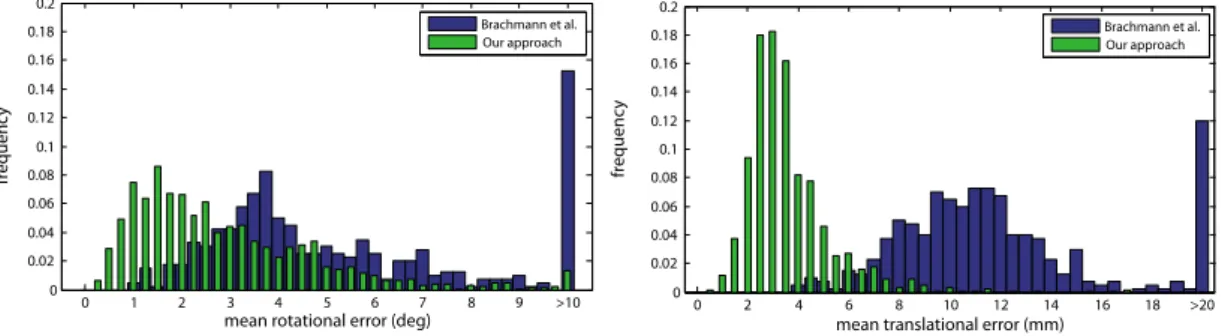
![Figure includes images and models from the dataset by Hinterstoisser et al. [14], published in 2012 under a CC BY 4.0 Licence.](https://thumb-us.123doks.com/thumbv2/123dok_us/9217031.2805842/82.892.177.728.212.364/figure-includes-images-models-dataset-hinterstoisser-published-licence.webp)
![Figure includes images and models from the dataset by Hinterstoisser et al. [14], published in 2012 under a CC BY 4.0 Licence.](https://thumb-us.123doks.com/thumbv2/123dok_us/9217031.2805842/86.892.202.703.297.505/figure-includes-images-models-dataset-hinterstoisser-published-licence.webp)
![Figure includes images and models from the dataset by Hinterstoisser et al. [14], published in 2012 under a CC BY 4.0 Licence.](https://thumb-us.123doks.com/thumbv2/123dok_us/9217031.2805842/91.892.258.628.810.918/figure-includes-images-models-dataset-hinterstoisser-published-licence.webp)
![Figure includes images and models from the dataset by Hinterstoisser et al. [14], published in 2012 under a CC BY 4.0 Licence.](https://thumb-us.123doks.com/thumbv2/123dok_us/9217031.2805842/95.892.135.749.458.921/figure-includes-images-models-dataset-hinterstoisser-published-licence.webp)
![Figure includes images and models from the dataset by Hinterstoisser et al. [14], published in 2012 under a CC BY 4.0 Licence.](https://thumb-us.123doks.com/thumbv2/123dok_us/9217031.2805842/104.892.147.820.152.435/figure-includes-images-models-dataset-hinterstoisser-published-licence.webp)
![Figure includes images and models from the dataset by Hinterstoisser et al. [14], published in 2012 under a CC BY 4.0 Licence.](https://thumb-us.123doks.com/thumbv2/123dok_us/9217031.2805842/134.892.188.711.136.934/figure-includes-images-models-dataset-hinterstoisser-published-licence.webp)
