Autonomous Mobile Robot Control
and Learning with the PELEA Architecture
Ezequiel Quintero
Universidad Carlos III de Madrid [email protected]
Vidal Alc´azar
Universidad Carlos III de MadridDaniel Borrajo
Universidad Carlos III de MadridJuan Fdez-Olivares
Universidad de Granada [email protected]
Fernando Fern´andez
Universidad Carlos III de Madrid´
Angel Garc´ıa-Olaya
Universidad Carlos III de MadridC´esar Guzm´an
Universidad Polit´ecnica de Valencia [email protected]
Eva Onaind´ıa
Universidad Polit´ecnica de ValenciaDavid Prior
Universidad de GranadaAbstract
In this paper we describe the integration of a robot con-trol platform (Player/Stage) and a real robot (Pioneer P3DX) withPELEA(Planning, Execution and LEarning Architecture).PELEAis a general-purpose planning ar-chitecture suitable for a wide range of real world ap-plications, from robotics to emergency management. It allows planning engineers to generate planning ap-plications since it integrates planning, execution, re-planning, monitoring and learning capabilities. We also present a relational learning approach for automati-cally modeling robot-action execution durations, with the purpose of improving the planning process ofPE
-LEAby refining domain definitions.
Introduction
Automated Planning (AP) has been successfully applied to different real-world problems, such as robot control (Mc-Gann et al. 2009). Some of the benefits of applying AP to robotics are: it provides long-term deliberative reasoning, there is a standard representation language (PDDL (Fox and Long 2003)), and it allows users to exploit models that were previously employed in other types of tasks. In AP it is typ-ically assumed that a complete and perfect domain descrip-tion can be defined, but in robotics this is rarely the case. As the generation of accurate robot control task descriptions for planning is usually a complex task, abstract models are used instead. Creating these models is not easy either and for this reason, other AI techniques such as Machine Learning (ML) are usually used to support models generation.
To take advantage of the benefits of AP we introduce the use of the general-purpose architecturePELEA (Alc´azar et al. 2010) as an autonomous mobile robot control system.
PELEA is a domaindependent platform that currently in-cludes state-of-the-art components for performing a wide range of planning tasks. Among other features PELEA al-lows users to: plan using several planning paradigms (clas-sical, temporal, hierarchical, probabilistic...), control robot task execution independently of the robot control platform and devices, monitor the correct plan execution, resolve
un-certainty by re-planning when needed, and learn planning knowledge. In this paper we want to show that this generpurpose architecture can be used in robotics and that it al-lows to take advantage of AP technology. To test PELEA
as a robot control system we worked with theRovers do-main from the International Planning Competition (IPC1).
This domain is a simplified version of the planning tasks performed by the Mars Rovers.
In many domains, the actions costs depend on the context (state) where that action is applied. And the specific condi-tions of the state that makes an action have one cost or an-other may be difficult to predict when modelling the domain. To address this challenge, we present a learning approach to be included in the PELEA architecture. We focus on mod-elling action durations (cost equal to execution time) on un-known terrains, like the ones that could exist in other plan-ets such as Mars. Even if we have details on how the robot performs on Earth, the actual execution of actions on Mars (or on an unknown environment) might be quite diverse. Thus, we propose the use of ML to automatically acquire that knowledge from actual actions execution. Although we focus on the Rovers domain, the studied approach could be useful in other mobile-robotics domains, including all kinds of tasks. Action durations (or similar metrics) usually de-pend on unpredictable factors such as weather conditions, presence of other interacting agents, navigation terrain, ma-terials to be handled, etc.
This paper is organized as follows. First, PELEA archi-tecture is summarized. Then, the mobile robot control inte-gration is described. After that, a learning technique is pre-sented. Then, we evaluate the learning proposal. And finally, related work and conclusions are discussed.
PELEA
Architecture
PELEA architecture (Alc´azar et al. 2010) includes compo-nents that allow to integrate planning, execution, monitor-ing, re-planning and learning techniques in a dynamic way. There are two main types of reasoning: high-level (mostly
1
IPC: http://ipc.icaps-conference.org/ Automated Action Planning for Autonomous Mobile Robots: Papers from the 2011 AAAI Workshop (WS-11-09)
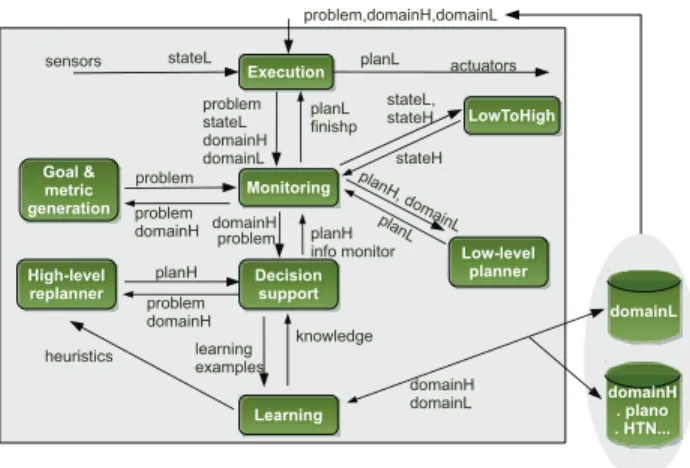
Figure 1: Architecture ofPELEA.
deliberative) and low-level (mostly reactive). This is com-mon to most robotics applications and reflects the separation between a reactive component and a deliberative component. In our architecture, these are simply two planning levels. As shown in Figure 1, PELEA is composed of eight mod-ules that exchange a set of Knowledge Items (KI) during the reasoning and execution steps. The main KIs that we have used are:stateL, low-level state composed of the sensory in-formation;stateH, abstracted high-level state obtained from stateL;goals, set of high-level goals to be achieved;metrics, metrics that will be used in the high-level planning process;
planH, set of high level plans; domainH, definition of the
model for high-level planning; domainL, definition of be-haviors (skills) for low-level planning;learning examples, set of training instances used by the learning component to acquire knowledge;heuristics, knowledge derived from a learning process used in future planning episodes; and
monitoringInfo, parameters that help to perform the
mon-itoring process. The PELEA architecture is controlled by a module, called Top-level control, which coordinates the ex-ecution and interaction of the Exex-ecution and Monitoring modules.PELEAuses a two-level knowledge approach. The high-level knowledge describes general information, actions in terms of its preconditions and effects, and typically repre-sents an abstraction of the real problem. High-level knowl-edge is concerned with the description of the high-level do-main, problems, goals and metrics, and they are required for the purpose of planning sequences of actions, and for the modifications of these sequences (repair or re-planning). We use PDDL to represent this information. However, since high-level knowledge descriptions are rarely directly exe-cutable they must be complemented by the low-level knowl-edge, which specifies how the operations are actually per-formed in terms of continuous change, sensors and actua-tors. Low-level knowledge describes the more basic actions in the simulated or real world, and it is typically concerned with specific rather than general functions, and how they op-erate. The low-level knowledge is read from the environment through the sensors in the Execution module. The
environ-ment is either a hardware device, a software application, a software simulator or the input from an user. Now, the main modules of the architecture will be described.
Execution Module. The starting point of PELEA is the
Execution module, which is initialized by the Top-level con-troller, receiving a high/low-level domain, and a problem. The Execution module keeps only the static part of the initial state, given that the dynamic part, calledstateL, will come from the environment through sensors. It is in charge of re-ceiving the new low-level state and sending out the next ac-tions to be executed at each step.
Monitoring Module. Both the problem (stateL) and do-main definition are sent by the Top-level control to the Mon-itoring module to obtain a high-level plan (planH). Then, this plan is translated into a low-level plan (planL). The ac-tions inplanLare finally sent to the Execution module. The modules LowToHigh and Low-level planner are only used in case the domain is modeled at the high/low levels. Other-wise, the Monitoring calls directly the Decision Support to obtain a high-level plan (planH). Once the Monitoring mod-ule receives the necessary knowledge (state, problem and domain), it starts the monitoring process. The first step of the plan monitoring is to check whether the problem goals have already been achieved (goalsLandgoalsHin case we are dealing with the two processes). If so, the plan execution finishes; otherwise, the Monitoring module begins with the first iteration of the plan monitoring.
Low-level planner. The Monitoring module, with the help of the Low-level planner module, generates a set of ex-ecutable low-level actions (planL). If the Low-level planner module is not being used, the Monitoring assumes that the high-level actions inplanHare executable, and they are di-rectly sent to the Execution module.
LowToHigh Translator. It is in charge of translating the low-level state (stateL) into a high-level state (stateH).
Decision Support Module. It selects the variables to be observed by Monitoring and takes the decision of re-pairing or re-planning by an Anytime Plan-Adaptation ap-proach (Garrido, Guzman, and Onaind´ıa 2010). It also com-municates the Monitoring module with the High-level Plan-ner module and retrieves training instances from the execu-tion and the plans to be sent to the Learning module.
Learning Module. It infers knowledge from a training set sent by the Decision support module. The knowledge can be used either to modify the domain planning model or to improve the planning process (heuristics).
Currently PELEA integrates the following environments: temporal probabilistic simulator, developed within the project that allows users to simulate temporal probabilis-tic domains in the spirit of MDPSim (Younes and Littman 2004); Virtual Robot Simulator (VRS2), which is a freeware
software suite for robotics applications; Alive (Fern´andez et al. 2008), an open platform for developing social and emotion-oriented applications; and TIMI (Florez et al. 2010), a planning tool for real logistic problems.
2
Mobile Robot Control with
PELEA In this section we summarize the adjustments made inPE-LEA in order to support the Pioneer P3DX control. The three modules that required extensions were: Execution, Low Level Planner and LowtoHigh.
Execution Module (EM). Actuators/sensors manage-ment is implemanage-mented in this module as a set of basic con-trol skills. EM sends low level action requests to the robot control interface, which sends the appropriate commands to the robot actuators, handling the communication with the control platform server. After each action is executed, it reads the new stateLfrom the sensors. The chosen con-trol platform for commanding the robot and for which we implemented a control interface to interact with the EM is Player/Stage (Gerkey, Vaughan, and Howard 2003). It is a TCP-based network server that provides an interface for robot device (sensors/actuators) control, designed to be lan-guage and platform independent.
Low-level Planner. Implements a planner translator for
theRoversdomain and the Pioneer P3DX. Each high level
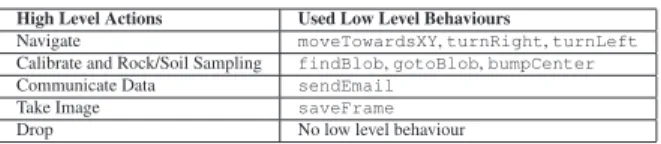
domain action is decomposed into the corresponding low level actions (behaviours), executable by the robot (See ta-ble 1). In this work, high level actions correspond to the
Roversdomain and low level skills correspond to the robot.
High Level Actions Used Low Level Behaviours
Navigate moveTowardsXY,turnRight,turnLeft
Calibrate and Rock/Soil Sampling findBlob,gotoBlob,bumpCenter
Communicate Data sendEmail
Take Image saveFrame
Drop No low level behaviour
Table 1: Low level skills used for the Rovers domain actions.
LowToHigh. Low/high translation (for the P3DX robot with the Rover domain) is implemented as shown in table 2. The low-level state consists of the following sensor readings: odometry information, x, y andyaw real values; bumper information, one binary value for each bumper,b1, . . . , b5; the readings of the eight sonars,s1, . . . , sn ∈ R; and the information of the largest blob (x-y coordinates, top, bottom, area and color). The high-level state is defined by the domain predicates:at,calibrated,have-rock-analysis,
have-soil-analysis,have-image, etc.
The odometry information (x, y and yaw) of the low level is used to determine the current waypoint (atpredicate, on the Rovers domain) and orientation. Each waypoint has a cell on a high level grid. The current high level position is computed by checking in which cell the x, ypair is lo-cated. To represent that a sample has been picked up and loaded in the robot store, we check that the blob of the cor-responding color has been found and successfully reached (maximum size and sonar distance) and that the front cen-ter bumper has been bumped. In this case, we set to true the full predicate for that store and the corresponding
have-xxx-analysis literal. We used that representa-tion for those acrepresenta-tions, because we had no actuator (like a gripper/robotic-arm) for performing the actual actions. No-tice that when a high level task is executed the domain action preconditions are also checked (not mentioned on Table 2).
Learning Action Durations
In this section, we present a learning technique, intended to be part of the Learning Module of PELEA. The approach has been tested with a real robot using a previous architec-ture, similar to PELEA (Quintero et al. 2011), and remains to be integrated in the architecture. Machine Learning is commonly use to improve the planning process. One of the biggest advantages of applying it to robotic control based on AP is that we can increase the autonomy of the system and enhance its adaptation capability. The aim of this prelimi-nary work is to improve the plan generation and execution by acquiring knowledge from the real world. We try to over-come the modeling difficulties by automatically improving the domain model, focusing on the adaptation of tasks to specific environments.
When applying AP to mobile robot control, having a pre-cise navigate action description is crucial in any domain. De-scribing a model that accurately represents the navigation task is a challenge. Specially if we want to take into account characteristics as duration or cost, features that state-of-the-art planners can deal with and that are really useful for the planning process. In this work we learn the duration of the navigate action on a real P3DX robot to show that it is feasi-ble to improve the action model by learning action durations. A rover navigating the surface of Mars will probably tra-verse unknown terrains types and it seems relevant to study whether these types of land may lead to different navigation times. Also, it is difficult to establish precise estimations for those times from Earth without knowing the exact character-istics of the terrains. This is just an example of knowledge that is needed in the domain model for which we do not have a priori precise estimations.
Inducing regression trees is a well-known approach to build models for numeric variables, making it particularly appropriate for learning durations. Given that AP domain models are expressed in predicate logic, Relational Learn-ing (RL) is an appropriate technique to learn plan-action duration models through regression, as shown in previous work (Lanchas et al. 2007). The general learning process used in this work can be summarized as follows: knowledge gathering, where examples are extracted from plan execu-tions; model learning, where the previous observations are used to induce the durations models with relational regres-sion; and knowledge usage, where we integrate the learned knowledge with the previous domain model in PDDL.
For experimentation, the classical specification of the
Roversdomain was modified (Changes shown in bold in
Fig-ure 2). This IPC domain provides a scenario to study a possi-ble navigation time dependency on terrain types and to make a relevant contribution to other mobile-robotic domains. Two types of terrains (sandyandrocky) were added on line8. Also, a temporal component was incorporated to keep track of the navigation time (navigationtime, line11). The time that the robot needs to go from one waypoint to another is 6 seconds, so the navigationtimefluent is increased 6seconds every time a navigation action is exe-cuted (line18). We used this modified domain to test the ef-fect of terrain types on the navigation with simulated delays on a real robot. To sum up the work, it was assumed that: a
Low Level High Level Mapping
Robotrin position x, y (at ?x - rover ?y - waypoint) ifx,y in cellwthen(at r w)
Blob, sonar and bumper data (have-rock-analysis ?r - rover ?w - waypoint)and(full ?s - store) ifmax blue blob reached and center bumper bumpedthen
of robotrwith stores Sample location: waypointw (have-rock-analysis r w)and(full s)
Blob, sonar and bumper data (have-soil-analysis ?r - rover ?w - waypoint)and(full ?s - store) ifmax yellow blob reached and center bumper bumpedthen
of robotrwith stores Sample location: waypointw (have-soil-analysis r w)and(full s)
Blob data of robotr (calibrated ?c - camera ?r - rover) ifmax red blob foundthen(calibrated r c)
with camerac
Table 2: Low to high level states translation.
1 (define (domain Rover)
2 (:requirements :typing)
3 (:types rover waypoint store camera mode lander objective)
4 (:predicates
5 (at ?x - rover ?y - waypoint) (available ?r - rover)
6 (can_traverse ?r - rover ?x - waypoint ?y - waypoint)
7 (visible ?w - waypoint ?p - waypoint)
8 (sandy ?x - waypoint) (rocky ?x - waypoint)
9 ...
10 )
11 (:functions (navigationtime))
12
13 (:action navigate
14 :parameters (?x - rover ?y - waypoint ?z - waypoint)
15 :precondition (and (can_traverse ?x ?y ?z) (available ?x)
16 (visible ?y ?z) (at ?x ?y))
17 :effect (and (not (at ?x ?y)) (at ?x ?z)
18 (increase (navigationtime) 6)))
19 ...
Figure 2: Rovers domain with navigation time.
waypoint only belongs to one type of terrain, the delay in-duced by each type of terrain is constant, the odometry is not affected and the orientation tasks do not introduce any navi-gation delay. Instead of modifying the terrain of the hallway where we performed the experiments, we usedsleep com-mands during thenavigateaction execution to simulate navigation delays. Specifically, the introduced delays were the following:0seconds, for the case where the origin and destination waypoints are both sandy;4 seconds, when the origin or the destination waypoint are of type rocky; and8 seconds when both the origin and the destination waypoints are rocky. For example, to navigate from a sandy waypoint to a consecutive sandy one, the expected navigation time is
6s of navigation plus0s ofsandy-sandydelay. The resulting total navigation times obtained by adding the terrain type delays (mentioned just above:0s,4s and8s) to the the ac-tual navigation time (6s) are as follows:6s for the case of
sandy-sandy,10s forrocky-sandyandsandy-rocky, and14s
forrocky-rocky. Thenavigationtimefluent defined
al-lows us to compute the planned navigation time.
For learning, we use the relational learning tool TILDE (Blockeel and Raedt 1998) to build regression trees representing the extracted knowledge. The inputs of TILDE are a language bias and a knowledge base, and the output a set of prolog rules representing the inferred knowledge. In the language bias we specify the learning domain and in the knowledge base we provide the learning examples of the target concept (in our case: the duration of thenavigate
action). In our approach the language bias is manually ex-tracted from the domain and the learning examples are ob-tained from planning and executing different problems with
PELEA, automatically collecting observations from
execu-tion. Once relational trees are generated, new action mod-els are created by automatically translating the TILDE re-sulting prolog rules into the domain action description in PDDL. For the preliminary experiments we just focus on the navigation times, so learned rules only affect this action. TILDE configuration and rule translation is based on previ-ous works (Quintero 2011; Lanchas et al. 2007).
As we did with our robot in-doors, in the real rovers, examples could be obtained during its exploration and the learning step could be performed on or off-board the robots. Training episodes could be obtained before sending rovers on the exploration missions and later refined during the mis-sion.
Preliminary Learning Evaluation
A real Pioneer P3DX, equipped with sonar, bumpers and a motor-base, was used along with a Logitech Sphere cam (with PTZ capabilities). To locate the robot we use the odometry information (x, y, yaw) provided by the P3DX motor-base. And experiments were performed with a forward-speed of0.2m/s and a turn speed of0.2rads/s, in the hallway of our laboratory.
Total Navigation Time
For this experiment we use a single problem with two dif-ferent maps. The solution for this problem is of length21, where11of the21planned actions are of type navigate.
60 70 80 90 100 110 120 1 2 3 4 Estimated time Real time Episode Execution Time
(a) Learning in map 1.
60 70 80 90 100 110 120 1 2 3 4 Estimated Time Real Time Episode Execution Time (b) Learning in map 2.
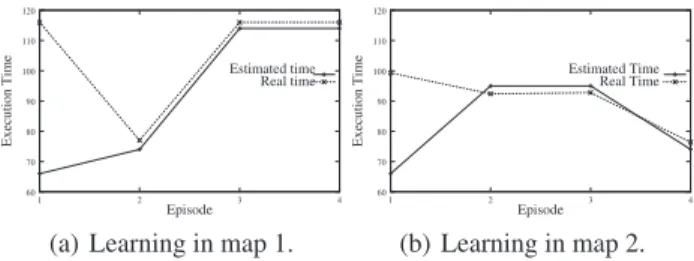
Figure 3: Estimated vs real navigation times. In this experiment we study the convergence of the ex-pected navigation time to the real one. The objective is to compare how close the estimated-navigation-time (with a learned domain) can get to the real-navigation-time. We per-formed online learning and generated a new model on each episode, that was used as the starting point for the next one. The knowledge base grew progressively with the examples of each episode. The obtained results are summarized in Fig-ure 3. In FigFig-ure 4, the navigation maps are shown. Black
(a) Map1 (b) Map2 (c) Map3
Figure 4: Navigation maps.
cells are the rocky waypoints, white cells the sandy ones and gray cells represent the exterior of the map (for supervision). Figure 3(a) presents the results for the navigation map with two adjacent rocky waypoints and six sandy ones (map
1: Figure 4(a)). We can observe that in the first episode the model is not accurate and the real navigation time is very dif-ferent from the estimated time. In the second episode (with
22training examples), as well as in the following episodes, the estimated time by the learned models is closer to the real times. In Figure 3(b) we can see the results for the execution of the same problem for the map of Figure 4(b). In the first episode we get a slightly worse model, although we obtain similar results in the following episodes.
Navigation Time for Terrain Combinations
For this experiment we use a navigation map of four way-points (Figure 4(c)), where two adjacent tiles are rocky and the other two sandy. To traverse the whole map only four navigation actions are needed, and these four actions gen-erate an example of each possible navigation case (
sandy-sandy,rocky-sandy,sandy-rockyandrocky-rocky).
Ten episodes were executed, where each episode was a complete navigation of the map. Each episode generated four examples (one of each type), so in the tenth episode we had ten examples of the corresponding case. Unlike the previous experiment, in this one no learning was performed during execution. The modified Rovers domain from
6 7 8 9 10 11 12 13 14 15 1 2 3 4 5 6 7 8 9 10 Real (rocky−rocky) Estimated (rocky−rocky) Navigation Time Episode (a)rocky-rocky 6 7 8 9 10 11 12 13 14 15 1 2 3 4 5 6 7 8 9 10 Real (sandy−rocky) Estimated (sandy−rocky) Episode Navigation Time (b)sandy-rocky 6 7 8 9 10 11 12 13 14 15 1 2 3 4 5 6 7 8 9 10 Navigation Time Episode Estimated (sandy−sandy)Real (sandy−sandy)
(c)sandy-sandy 6 7 8 9 10 11 12 13 14 15 1 2 3 4 5 6 7 8 9 10 Navigation Time Episode Estimated (rocky−sandy)Real (rocky−sandy)
(d)rocky-sandy
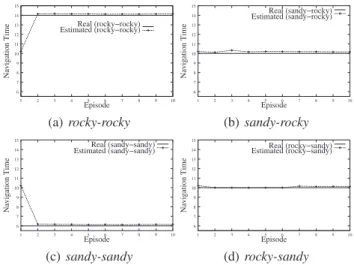
Figure 5: Learned traversing times.
ure 2 was used to analyze how the number of examples
affected the learning process. In Figure 5 we show the re-sults for this experiment. For each episode (x-axis) four ad-ditional examples are generated (4in the first episode,8in the second and so on).y-axis shows the real navigation time in continuous line and the estimated time in dotted line. In Figure 5(a) the learned time for the navigation time between two rocky waypoints is shown (rocky-rocky). In Figure 5(b) we can see the evolution of the learned time for the navi-gation from a sandy waypoint to a rocky one (sandy-rocky), while therocky-sandycase is shown in Figure 5(d). In Fig-ure 5(c) we observe the learned time for navigation between sandy waypoints (sandy-sandy). In all the graphics we can see that initially a similar duration is learned (approximately
10seconds). The reason is that, at that point, we only have enough training data to learn the mixed terrain type navi-gation (rocky-sandyandsandy-rocky) time. As the robot is traversing a map with two adjacent rocky waypoint and two adjacent sandy ones, in the first episode we only have one example of each navigation case; but as therocky-sandyand
sandy-rockynavigation durations are the same, we have two
examples with similar durations (close to 10s). That is the value that is learned at the beginning of the process. This causes that in the first episode of Figure 5(a) and Figure 5(c) we learn a slightly distanced value from the real navigation time, because the estimated duration for these cases (
sandy-sandyandrocky-rocky) is far from10s (is4s and14s). This is
also the reason for the good learned times on the first episode of the other two learning cases (Figure 5(b) and Figure 5(d)). However, results are close to the real time in all the showed graphics. So, in this specific scenario, isolated from external learning noise, under controlled conditions, we can learn ac-tion duraac-tions close to the real ones with very few examples.
Related Work
There has been previous work that defines generic architec-tures used for different purposes. Examples can be found in space and robotics applications with platforms like Map-gen (Ai-Chang et al. 2004) and APSI (Cesta et al. 2009). These types of platforms are usually designed for particu-lar planning techniques. The goal of thePELEAproject is to build a component-based architecture able to exploit differ-ent planning techniques and perform execution, monitoring, learning in an integrated way, in the context of PDDL-based and HTN-based planning and suitable for a wide range of planning problems.
Model and Test based Transformational Learning (MTTL) has been used to improve the performance of a robot control system by autonomously adapting it to spe-cific tasks. XFRMLEARN (Beetz and Belker 2000) inte-grates MTTL into a controller using reactive parametrization (SRPAs). This implementation has successfully improved the path planning process on an indoor navigation task. Our work has also been tested indoor, but without a specific path planning component. In the XFRMLEARN approach, spe-cific parameters (such as velocity and position) are learned to improve a reactive controller, while in our contribution we learn action durations to refine a high level deliberative planning process. Behavior Models for robot execution con-trol have successfully been learned with structured
stochas-tic processes as the Dynamic Bayesian Network formalism. It has been shown that this technique can be used to learn models for behaviors with controllable parameters, such as reactive navigation (Infantes, Ingrand, and Ghallab 2006). Even though stochastic methods allow robots take into ac-count environment uncertainty during the learning process, we worked with deterministic techniques because we are currently using deterministic planning and dealing with the non-determinism during execution by monitoring and re-planning. Classical versions of both regression and decision trees have been used for action modelling in autonomous robots in ROGUE (Haigh and Veloso 1999). ROGUE used decision trees to acquire rules that prioritize its activities ac-cording to the values of its sensors. It learned rules that are compiled into heuristics (in the form of control rules) used when planning, while in our work we change the domain model. ROGUE used feature-based ML and we use rela-tional ML instead. Notice that PELEAwill be able to inte-grate both learning approaches.
Conclusions
In this paper we have introduced the generic AP-based archi-tecturePELEAas a robot control system.PELEA integrates planning related processes, such as sensing, planning, execu-tion, monitoring, re-planning and learning. We successfully tested it as a robot control system with a real robot (Pioneer P3DX) in scenarios under controlled conditions. As part of this work, we also presented a learning technique to improve the robot control and showed its performance on a specific robotic domain. We presented preliminary experiments that show that is feasible to perform plan generation/execution with knowledge acquisition from the environment, focus-ing on the adaptation of the navigation task. Specifically, we learned the navigate action duration on a P3DX robot depending on terrain types from a modified PDDL domain.
Acknowledgments
This research is partially supported by the Spanish MICINN projects TIN2008-06701-C03-03, TRA-2009-008 and Comunidad de Madrid - UC3M(CCG10-UC3M/TIC-5597).
References
Ai-Chang, M.; Bresina, J.; Charest, L.; Chase, A.; Hsu, J.-J.; Jon-sson, A.; Kanefsky, B.; Morris, P.; Rajan, K.; Yglesias, J.; Chafin, B.; Dias, W.; and Maldague, P. 2004. MAPGEN: Mixed-initiative planning and scheduling for the Mars Exploration Rover mission.
IEEE Intelligent Systems19(1):8–12.
Alc´azar, V.; Guzm´an, C.; Prior, D.; Borrajo, D.; Castillo, L.; and Onaindia, E. 2010. PELEA: Planning, learning and execution ar-chitecture. InProcs. of the 28th Workshop of the UK Planning and Scheduling Special Interest Group (PlanSIG’10).
Beetz, M., and Belker, T. 2000. Autonomous environment and task adaptation for robotic agents. In Horn, W., ed.,Procs. of the 14th European Conference on Artificial Intelligence (ECAI-2000), 648–652.
Blockeel, H., and Raedt, L. D. 1998. Top-down induction of first-order logical decision trees. Artificial Intelligence101(1-2):285– 297.
Cesta, A.; Cortellessa, G.; Fratini, S.; and Oddi, A. 2009. Devel-oping an End-to-End Planning Application from a Timeline Repre-sentation Framework. InProcs. of the 21stInnovative Applications of Artificial Intelligence Conference, Pasadena.
Fern´andez, S.; Asensio, J.; Jim´enez, M.; and Borrajo, D. 2008. A social and emotional model for obtaining believable emergent be-havior. In Traverso, P., and Pistore, M., eds.,Artificial Intelligence: Methodology, Systems, and Applications, volume 5253/2008 of
Lecture Notes in Computer Science, 395–399. Varna, Bulgaria: Springer Verlag.
Florez, J. E.; Garc´ıa, J.; Torralba, A.; Linares, C.; Garcia-Olaya, A.; and Borrajo, D. 2010. Timiplan: An application to solve multi-modal transportation problems. In Steve Chien, G. C., and Yorke-Smith, N., eds.,Procs. of the 2010 Scheduling and Planning Appli-cations woRKshop (SPARK’10), 36–42.
Fox, M., and Long, D. 2003. PDDL2.1: An extension to PDDL for expressing temporal planning domains. Journal of Artificial Intelligence Research61–124.
Garrido, A.; Guzman, C.; and Onaind´ıa, E. 2010. Anytime plan-adaptation for continuous planning. InProcs. of the 28th Workshop of the UK Planning and Scheduling Special Interest Group (Plan-SIG’10).
Gerkey, B.; Vaughan, R.; and Howard, A. 2003. The player/stage project: Tools for multi-robot and distributed sensor systems. In
11th International Conference on Advanced Robotics (ICAR 2003). Haigh, K. Z., and Veloso, M. M. 1999. Learning situation-dependent rules. InAAAI Spring Symposium on Search Techniques for Problem Solving under Uncertainty and Incomplete Informa-tion.
Infantes, G.; Ingrand, F.; and Ghallab, M. 2006. Learning behaviors models for robot execution control. InECAI, 678–682.
Lanchas, J.; Jim´enez, S.; Fern´andez, F.; and Borrajo, D. 2007. Learning action durations from executions. InWorking notes of the ICAPS’07 Workshop on AI Planning and Learning.
McGann, C.; Py, F.; Rajan, K.; and Olaya, A. G. 2009. Integrated planning and execution for robotic exploration. InProcs. of Inter-national Workshop on Hybrid Control of Autonomous Systems. Quintero, E.; Garc´ıa-Olaya, A.; Borrajo, D.; and Fern´andez, F. 2011. Control of autonomous mobile robots with automated plan-ning.Journal of Physical Agents.
Quintero, E. 2011. Improving plan execution on mobile robots by learning action durations. InICAPS 2011 Doctoral Consortium. Younes, H. L. S., and Littman, M. L. 2004. PPDDL1.0: An ex-tension to pddl for expressing planning domains with probabilistic effects. Technical Report CMU-CS-04-167, School Of Computer Science, Carnegie Mellon University, Pittsburgh, Pennsylvania.