Streams
∗
Xiaoming Sun
1and David P. Woodruff
2 1 Institute of Computing Technology, CAS, China2 IBM Almaden, USA
Abstract
Despite the large amount of work on solving graph problems in the data stream model, there do not exist tight space bounds for almost any of them, even in a stream with only edge insertions. For example, for testing connectivity, the upper bound isO(nlogn) bits, while the lower bound is only Ω(n) bits. We remedy this situation by providing the first tight Ω(nlogn) space lower bounds for randomized algorithms which succeed with constant probability in a stream of edge insertions for a number of graph problems. Our lower bounds apply to testing bipartiteness, connectivity, cycle-freeness, whether a graph is Eulerian, planarity,H-minor freeness, finding a minimum spanning tree of a connected graph, and testing if the diameter of a sparse graph is constant. We also give the first Ω(nklogn) space lower bounds for deterministic algorithms for k-edge connectivity andk-vertex connectivity; these are optimal in light of known deterministic upper bounds (fork-vertex connectivity we also need to allow edge duplications, which known upper bounds allow). Finally, we give an Ω(nlog2n) lower bound for randomized algorithms approximating the minimum cut up to a constant factor with constant probability in a graph with integer weights between 1 andn, presented as a stream of insertions and deletions to its edges. This lower bound also holds for cut sparsifiers, and gives the first separation of maintaining a sparsifier in the data stream model versus the offline model.
1998 ACM Subject Classification F.2 Analysis of Algorithms and Problem Complexity
Keywords and phrases communication complexity, data streams, graphs, space complexity
Digital Object Identifier 10.4230/LIPIcs.APPROX-RANDOM.2015.435
1
Introduction
In a data stream one sees a sequence of elementsa1, . . . , amone by one and one would like
to evaluate certain functions of the stream. There are example data streams which come from internet search logs, network traffic, sensor networks, and scientific data streams. The elements ai may be numbers, points, edges in a graph, etc. Due to the sheer size of the
sequence, very stringent requirements are imposed on a data stream algorithm. For instance, it is often assumed that the algorithm can only make one, or a small number, of passes over the stream. Moreover, the algorithm is assumed to have very limited memory, which in particular makes storing the stream in its entirety infeasible. We refer the reader to the surveys [4, 29] for a more thorough introdution to this area.
∗ Xiaoming Sun was supported in part by the National Natural Science Foundation of China Grant
61170062, 61222202, 61433014 and the China National Program for support of Top-notch Young Professionals.
© Xiaoming Sun and David P. Woodruff; licensed under Creative Commons License CC-BY
In this paper we focus on the case when the elements ai are edges of an underlying
graphG. That is, we insert edges into the graph one at a time, and would like to compute a function of G. Graphs arise is many applications to model relationships bewteen basic entities, such as links between webpages or network flows between destinations. These graphs are often massive and running classical algorithms on such graphs has proven quite challenging. This has motivated the recent work on processing graphs in the data stream model. In the case when only edges are inserted into the stream (as opposed to also being deleted), we have algorithms for a number of problems, including testing connectivity, finding minimum spanning trees, computing cut and spectral sparsifiers, counting subgraphs, finding matchings, and many other problems. We refer the reader to the survey by McGregor [28] for an overview of these results.
It is known for many graph problems that there is a space lower bound of Ω(n) [16, 17]. The graph streaming model is therefore sometimes identified with the “semi-streaming” model, which allows the streaming algorithm to usen·polylog(n) bits of space. Note that this is still a substantial improvement over the naïve algorithm of storing the graph, which may take Ω(n2) bits of space. Despite the fact that we haven·polylog(n) space upper bounds and Ω(n) space lower bounds for a number of graph problems in the data stream model, we are not aware of a single natural problem for which we have asymptotically tight bounds. Could it be that simple upper bounds, such as theO(nlogn) bit upper bound for testing if a graph is connected by maintaining a spanning forest in the stream, can be improved using more clever hashing techniques to represent the edges, perhaps chosen adaptively as the stream is presented? Such a scheme could potentially allow us to avoid spendingO(logn) bits to remember each edge in the spanning forest.
Dowling and Wilson [14] show that the deterministic communication complexity of connectivity is Ω(nlogn) bits, see also [31] for a discussion. Via standard connections to data streams (see Section 1.3 below), this implies any deterministic streaming algorithm requires Ω(nlogn) bits. However, to the best of our knowledge, there was no lower bound for randomized 1-way protocols known, prior to this work, stronger than Ω(n) bits.
Graph problems in a data stream should be contrasted to a number of other areas in streaming for which tight asymptotic space bounds are known, such as estimating frequency moments [2, 7, 18, 22, 23, 27], empirical entropy [8, 11, 20, 21, 22], numerical linear algebra [10], and compressed sensing [3, 30]. The goal of this paper is to remedy this situation.
1.1
Our Results
Throughout this paper we will restrict our attention to 1-pass algorithms and focus on their space complexity. Our focus is on the model in which edges are only allowed to be inserted into the graph, i.e., the “insertion model”, rather than also being allowed to be deleted, which is referred to as the “turnstile model”. Since we prove lower bounds, this only makes our bounds stronger. We will, however, show how to use our techniques to obtain stronger lower bounds in the turnstile model for approximating the minimum cut of a graph.
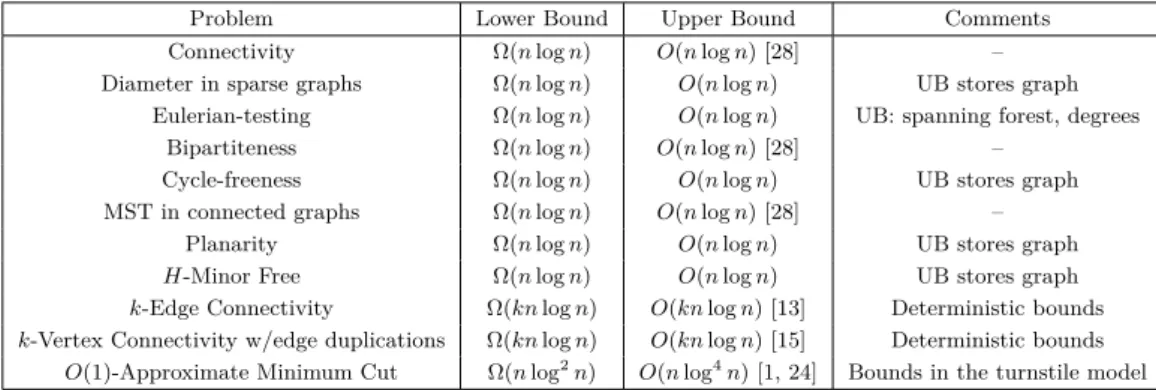
Our results are summarized in Table 1. We provide the first tight space lower bounds for a number of graph problems in a stream of edge insertions. In particular, for randomized algorithms which succeed with constant probability, we show an Ω(nlogn) lower bound for testing if a graph is connected, testing if a graph withO(n) edges has diameter at most 5 or diameter∞, testing if a graph is Eulerian, testing if a graph is bipartite, testing if a graph is cycle-free, finding a minimum spanning tree in a graph that is promised to be connected, testing if a graph is planar, and testing whether a graph contains a fixed graphH as a minor. No lower bounds better than Ω(n) were known for any of these problems. Many of the upper
Table 1Summary of our results. All lower bounds are new and given by this work. In the comments we say “UB stores graph” for those problems for which there is no graph with more than
C·nedges, for a constantC >0, satisfying the property. For such problems it suffices to store all edges in the graph and abort if more thanC·nedges are inserted, yielding anO(nlogn) bit upper bound. All upper bounds, with the exception of Eulerian-testing, either come from previous work or “UB stores graph” applies to the problem. For Eulerian-testing the upper bound maintains a spanning forest and the parities of node degrees, using that a graph is Eulerian iff it is connected and all node degrees are even.
Problem Lower Bound Upper Bound Comments Connectivity Ω(nlogn) O(nlogn) [28] – Diameter in sparse graphs Ω(nlogn) O(nlogn) UB stores graph
Eulerian-testing Ω(nlogn) O(nlogn) UB: spanning forest, degrees Bipartiteness Ω(nlogn) O(nlogn) [28] –
Cycle-freeness Ω(nlogn) O(nlogn) UB stores graph MST in connected graphs Ω(nlogn) O(nlogn) [28] –
Planarity Ω(nlogn) O(nlogn) UB stores graph
H-Minor Free Ω(nlogn) O(nlogn) UB stores graph
k-Edge Connectivity Ω(knlogn) O(knlogn) [13] Deterministic bounds
k-Vertex Connectivity w/edge duplications Ω(knlogn) O(knlogn) [15] Deterministic bounds
O(1)-Approximate Minimum Cut Ω(nlog2n) O(nlog4n) [1, 24] Bounds in the turnstile model
bounds follow simply by storing all edges in the graph and aborting if the number of edges is too large; see Table 1 for details.
Next, we turn to k-edge connectivity, which is equivalent to testing if the minimum cut of the graph is at least k. There is a deterministic space upper bound ofO(knlogn) bits [13, 28]. We show a matching Ω(knlogn) bit lower bound for deterministic algorithms. For randomized algorithms our space bound is a weaker Ω(kn), and closing the logn factor gap for deterministic and randomized k-edge connectivity algorithms remains an important open question. For k-vertex connectivity, there is a deterministic space upper bound of O(knlogn) bits due to [15]. We are able to prove a matching Ω(knlogn) bit lower bound for deterministic algorithms, but require that multiple edges are allowed, i.e., our hard instance is a multi-graph for this problem. We notice, however, that the upper bound of [15] also holds for multi-graphs. Our lower bound becomes a weaker Ω(kn) in the case of randomized algorithms, and closing the lognfactor gap for randomized algorithms for k-vertex connectivity and/or removing the edge duplication assumption is an important open problem.
Finally, we illustrate the power of our technique by proving an Ω(nlog2n) lower bound for approximating the minimum cut up to a constant factor of a graph with integer weights between 1 and n, in the turnstile model. The same lower bound holds for cut sparsifiers (since they can be used to approximate the minimum cut), and gives the first separation of maintaining a sparsifier in the data stream model versus the offline model. Indeed, in the offline model, by a result of Batson et al. [6] it is possible to build a cut sparsifier (in fact, a stronger notion of a spectral sparsifier) of a graph using onlyO(n) reweighted edges of the input graph, withO(logn) bits to specify each edge and its weight. Our Ω(nlog2n) bit lower bound shows it is fundamentally impossible to implement the algorithm of [6] in a dynamic stream. For general integer edge weights between 1 and W, our lower bound is Ω(nlognlogW).
1.2
Our Techniques
Our results come from identifying a new two-player one-way communication problem which generalizes the well-studiedIndexproblem [26], to a problem Permwhich is more suitable for proving graph lower bounds. Despite the simplicity of thePermproblem, we are able to apply it to the wide array of problems above. In this problem, Alice is given a permutationσ on [n]def={1,2, . . . , n}, which she represents in a slightly redundant way as annlogn-length bitstring σ(1), . . . , σ(n) formed by concatenating the images of 1,2, . . . , n under σ. We call this the redundant encoding of σ. Bob is interested in obtaining the i-th bit in the redundant encoding ofσ. We show that if Alice sends a single message to Bob, then for Bob to succeed with constant probability, Alice’s message needs to be Ω(nlogn) bits long. In other words, the randomized 1-way communication complexityR1−way(Perm) = Ω(nlogn). We generalize this to the case where Alice hasr permutationsσ1, . . . , σr each on [n], while
Bob now has an indexi∈[n], an index k∈[r], as well as Alice’s permutationsσk+1, . . . , σr,
and Bob is interested in thei-th bit in the redundant encoding of σk. We call this problem
r-AugmentedPermand showR1−way(r-AugmentedPerm)= Ω(rnlogn).
After identifyingPermandr-AugmentedPermas the right problems to study, the proofs of their respective lower bounds follow standard information-theoretic arguments used to prove lower bounds forIndex and direct sum theorems in streaming [5, 9], with small modifications to account for the redundancy. The second part of our proofs is reducing graph problems to these communication problems. The core idea of our lower bounds is to identify a permutation σas a random matching on a bipartite graph withnvertices in the left partLandnvertices in the right partR. This is Alice’s input graphGin many of our reductions. Alice runs the streaming algorithm on G, sends the state to Bob, who then inserts edges into Gin a problem-specific way. As Bob is interested in learning a bit of the redundant encoding of Alice’s permutation, this corresponds to a bitj of the unique neighbor inR of a vertex u∈L. We therefore create gadgets which group all vertices in R into two groups, based on the value of theirj-th bit, and connect these groups to vertices inLin different ways depending on the particular problem.
1.3
Preliminaries
Letf :X×Y → {0,1}be a Boolean function, whereX andY are two arbitrary sets. In the
one-waycommunication model Alice receives an inputx∈Xand Bob receives an inputy∈Y. Alice is only allowed to send one message to Bob and no message is allowed to be sent from Bob to Alice. The goal is for Bob to computef(x, y). The communication cost is measured by the number of bits Alice sends in the worst case. Denote byD1−way(f) the minimum
communication cost over all deterministic one-way protocols forf. For a randomized protocol P, we say P has error probability at mostif Pr(P(x, y) =f(x, y))≥1− for all inputs xandy. The randomness here is only over the private coin tosses of Alice and Bob. The one-way (bounded-error) randomized communication complexity off, denote byR1−way(f),
is the minimum communication cost over all randomized one-way protocols forf with error probability at most 1/3.
Communication lower bounds onD1−way(f) andR1−way(f) provide lower bounds on
the memory required of deterministic and randomized data stream algorithms, respectively, via a standard reduction. Indeed, Alice creates a stream σx from her input x, and runs
the streaming algorithm onσx, passing the state of the algorithm to Bob. Bob creates a
streamσy from his inputy, and continues the execution of the streaming algorithm onσy.
to solve the problemf, either deterministically or with constant error probability, then the space complexity of the streaming algorithm must be at least D1−way(f) or R1−way(f),
respectively.
We also need a few concepts and notation from information theory. We refer the reader to [12] for a more comprehensive introduction. We give a short primer on the standard properties we use in Appendix A.
2
Permutation Problems
We consider the following communication problem Perm which will be used in our reduc-tions. In this problem Alice is given a permutationσof [n], represented as an ordered list σ(1), σ(2), . . . , σ(n). This list hasnlognbits. Bob is given an indexi∈[nlogn] and would like to know thei-th bit ofσ. This problem is similar to the well-studiedIndexproblem in randomized 1-way communication complexity, but it is slightly different in thatσ(1), . . . , σ(n) is a redundant encoding of a permutation.
ILemma 1. R1−way(Perm) = Ω(nlogn).
Proof. Let us place the uniform distribution on strings σ. Let M(σ) be Alice’s message to Bob, which is a random variable depending on the randomness of σ and the private random coin tosses of Alice. ThenR1−way(Perm)≥H(M(σ))≥I(M(σ);σ), so it suffices to lower boundI(M(σ);σ). We writeσj to denote thej-th bit in the listσ(1), . . . , σ(n), where
j∈ {1,2, . . . , nlogn}. By the chain rule,
I(M(σ);σ) = nlogn X j=1 I(M(σ);σj |σ<j) = X j (H(σj |σ<j)−H(σj |M(σ), σ<j)) ≥ X j H(σj|σ<j)− X j H(σj|M(σ)) = H(σ)−X j H(σj|M(σ)).
Using Stirling’s approximation, H(σ) = logn! = nlog(n/e) +O(logn). Now consider H(σj|M(σ)). SinceM is randomized protocol which succeeds on every pair of inputs (σ, i)
with probability at least 9/10, andM does not depend onj, it follows that from M(σ) Bob can predictσi for any giveniwith probability at least 9/10. By Fano’s inequality, for eachj
this impliesH(σj|M(σ))≤H(1/10). Hence,
I(M(σ);σ)≥nlog(n/e)−H(1/10)nlogn≥(1−H(1/10))nlogn−O(n).
This completes the proof. J
We also define the problemr-AugmentedPerm, used in our reductions. In this problem, Alice is givenrpermutationsσ1, . . . , σr, where each σj is represented as a list ofnlognbits. Bob
is given an indexi∈[nlogn], an index k∈[r], and is givenσk+1, σk+2, . . . , σr. Bob’s goal is to outputσk
i, which is thei-th bit ofσk.
Proof. As in the proof of Lemma 1, we place the uniform distribution on strings σj, for each j ∈ [r], and the σj are independent. Let M(σ1, . . . , σr) be Alice’s message
to Bob, which is a random variable depending on the randomness of σ1, . . . , σr and
her private random coin tosses. Then R1−way(r-AugmentedPerm)≥H(M(σ1, . . . , σr)) ≥
I(M(σ1, . . . , σr);σ1, . . . , σr), so it suffices to lower boundI(M(σ1, . . . , σr);σ1, . . . , σr).
By the chain rule,
I(M(σ1, . . . , σr);σ1, . . . , σr) =
r
X
k=1
I(M(σ1, . . . , σr);σk|σk+1, . . . , σr) (1) We claim that for eachk∈[r],
I(M(σ1, . . . , σr);σk|σk+1, . . . , σr) = Ω(nlogn).
To see this, consider any fixing of the random variables σk+1, . . . , σr, and let Π be a
randomized protocol which succeeds on every input toAugmentedPermwith probability at least 9/10, over its random coin tosses. Then, given an input (σ, i) to the Permproblem, Alice and Bob can use Π as follows. Alice hardwires the fixed values ofσk+1, . . . , σr. Alice also setsσk=σ. Finally, she randomly and independently samples uniform permutations
σ1, . . . , σk−1. Bob, givenias the input toPerm, also holds the inputkand has the hardwired values ofσk+1, . . . , σr. Alice and Bob run Π on these inputs toAugmentedPerm, and output
whatever Π outputs. By correctness of Π, it follows that this is a correct 1-way protocol for thePermproblem with probability at least 9/10. Hence, as argued in the proof of Lemma 1,I(M0(σ);σ) = Ω(nlogn), where M0 is Alice’s resulting message function in the created protocol forPerm. By construction,
I(M(σ1, . . . , σr);σk|σk+1, . . . , σr) =I(M0(σ);σ) = Ω(nlogn), as claimed. Plugging into (1), it follows that
I(M(σ1, . . . , σr);σ1, . . . , σr) = Ω(rnlogn),
which completes the proof. J
3
Lower Bounds for Graph Problems
3.1
Connectivity
We start with an Ω(nlogn) bit lower bound for the randomized one-way communication of the graph connectivity problem, denotedConn. In this problem, Alice has a subsetEA of
edges of an undirected graph Gon a set V of n vertices, while Bob has a disjoint subset EB of the edges ofG. Alice sends a single randomized messageM(EA) to Bob, who should
decide if the graph (V, EA∪EB) is connected. Bob should succeed with probability at least
9/10. We letR1−way(Conn) denote the minimum, over all correct protocol for Connwith
probability at least 9/10, of the maximum length message sent, over all inputs and random coin tosses.
ITheorem 3. R1−way(Conn) = Ω(nlogn).
Proof. We perform a reduction fromPermon instances of sizen/2. Alice, given a permutation σ, creates a perfect matching from [n/2] to [n/2] where thei-th left vertex connects to the σ(i)-th right vertex. Alice’s edgeset EA consists of the edges in this perfect matching. LetL
Suppose Bob has the input itoPerm. This corresponds to the`-th bit inσ(j) for some j ∈[n/2] and`∈[log(n/2)]. Bob creates his input edgeset toConnfromias follows. Let S ⊂R denote the subset of vertices whose`-th bit is equal to 0. Bob’s input edgesetEB
consists of a spanning tree on the vertices in (L\ {j})∪S. We can ensure the edges of the spanning tree are disjoint fromEA by including a new vertex w, and including edges from
all vertices in (L\ {j})∪S tow.
Observe that since the vertices inL\ {j}are connected, it follows that since we placed a perfect matching fromLtoR, that any vertexuis connected to any other vertex except possibly toj orσ(j). Now, if theσ(j)-th right vertex has its`-th bit equal to 0, thenσ(j) is connected toS, and hence to L\ {j}. It follows that the graph is connected. On the other hand, if theσ(j)-th right vertex has its`-th bit equal to 1, then the edge from thej-th left vertex to theσ(j)-th right vertex is isolated, that is, it is not incident to any other vertices. In this case the graph is disconnected.
LetM(EA) be Alice’s message to Bob in a protocol forConn. Suppose Bob can decide,
fromM(EA) and EB, if the resulting graph on vertex set L∪R and edgeset EA∪EB is
connected with probability at least 9/10. It follows that Bob can solvePermwith probability at least 9/10, and therefore from Lemma 1,R1−way(Conn) = Ω(nlogn).
J I Remark. The lower bound in Theorem 3 is matched by a simple O(nlogn) bit upper bound in which Alice sends a spanning forest of her edges to Bob.
3.2
Diameter
As a corollary of Conn, we show a lower bound for the following Diameter-k problem on sparse graphs, i.e., graphs withO(n) edges: Givenk∈[n−1], Bob wants to decide if the diameterdof (V, EA∪EB) is at mostk, or∞.
ITheorem 4. For any k≥4,R1−way(diameter-k) = Ω(nlogn).
Proof. In theConnproof, instead of only putting a spanning tree on the vertices in (L\{j})∪S, we also put a clique on the vertices inL\ {j}and a clique on the vertices inS. It follows that the diameter of (V, EA∪EB) is either +∞if the graph is disconnected, or 4 if the graph
is connected. Therefore, theDiameter-k problem is as hard asConn. J
IRemark. For sparse graphs the upper bound is just to store the entire graph withO(n) edges.
3.3
Eulerian-Testing
In this part we show a lower bound for the Eulerian problem: Bob wants to decide if (V, EA∪EB) is an Eulerian graph.
ITheorem 5. R1−way(Eulerian) = Ω(nlogn).
Proof. In theConn proof, call the graphG1= (L, R, E), make another copy of the graph G2 = (L0, R0, E0), i.e., in G2 the edges are the same as in G1. Alice and Bob also add the following edges to EA andEB: if there is an edge (u, v) in G1, add edges (u, v0) and (u0, v). Let V = L∪R∪L0∪R0. It is easy to check that the degree of every vertex is twice its degree in G1, thus is an even number. Therefore, the resulting graph is Eulerian if and only if it is connected, but this is equivalent to the connectivity of G1. Hence,
IRemark. An upper bound is to maintain a spanning forest to test connectivity, as well as to maintain the parities of all node degrees. Then one uses that a graph is Eulerian if and only if it is connected and all node degrees are even.
3.4
Bipartiteness
We now give a lower bound for the theBipartiteproblem. In this problem Alice has a subset EA of edges of an undirected graph Gon a set V of n vertices, while Bob has a disjoint
subsetEB of the edges of G. Alice sends a single randomized message M(EA) to Bob, who
should decide if the graph (V, EA∪EB) is bipartite. ITheorem 6. R1−way(Bipartite) = Ω(nlogn).
Proof. We again reduce fromPermon instances of sizen/2. Alice, given a permutationσ, creates a perfect matching from [n/2] to [n/2] where the i-th left vertex connects to the σ(i)-th right vertex. Alice’s edgeset EA consists of the edges in this perfect matching. LetL
andRdenote the two parts of the vertex setV, each of sizen/2.
Suppose Bob has the inputitoPerm. This corresponds to the`-th bit inσ(j) for some j∈[n/2] and`∈[log(n/2)]. Bob creates his input edgeset to Bipartitefromi as follows. We create a new nodew(so the input graph hasn+ 1 nodes) and Bob includes an edge in EB
from thej-th vertex inL, denotedv, tow. Bob also includes all edges inEB fromw to any
vertex inRwhose`-th bit is equal to 0.
SinceEAis a perfect matching, it is bipartite. Further, all edges inEB are incident to
w, and thereforeG is bipartite if and only if there is no odd cycle which contains w. If we remove the edge{v, w}then the graph is acyclic, and so any cycle must contain{v, w}, and hence also{v, σ(v)}, and hence also {σ(v), w}. It follows that an odd cycle exists iff {σ(v), w} is inEB, that is, iff the`-th bit ofσ(j) is equal to 0.
It follows that Bob can solvePerm with probability at least 9/10, and therefore from Lemma 1,R1−way(Bipartite) = Ω(nlogn).
J IRemark. There is an upper bound ofO(nlogn) bits for bipartiteness; see section 3.1 of [28]. It is stated as a streaming algorithm which immediately gives rise to a 1-way communication protocol.
3.5
Cycle-free
As a corollary ofBipartite, we show a lower bound for the followingCycle-freeproblem: Bob wants to decide if there is a cycle in (V, EA∪EB).
ITheorem 7. R1−way(cycle-free) = Ω(nlogn).
Proof. In theBipartite proof, if the`-th bit of σ(j) is 0, then there is a cycle between j, σ(j) and w. If the `-th bit of σ(j) is 0, then there is no cycle. Therefore, R1−way(
cycle-free) = Ω(nlogn). J
IRemark. There is an upper bound ofO(nlogn) bits by storing the firstn−1 edges ofG. IfGhas more thann−1 edges, it necessarily contains a cycle. If it has fewer, one can test whether it contains a cycle.
3.6
Minimum Spanning Tree
We now present an application to the minimum spanning tree (MST) of a connected graph. In theMSTproblem, Alice has a subsetEA of edges of an undirected graphGon a setV of
nvertices, while Bob has a disjoint subsetEB of the edges ofG= (V, EA,∪EB), and the
players are promised thatGis a connected graph. Alice sends a single randomized message M(EA) to Bob, who should output a spanning tree ofG. Note that in the case thatGis
unweighted, all such spanning trees are minimal. ITheorem 8. R1−way(MST) = Ω(nlogn).
Proof. We again reduce fromPermon instances of sizen/2. Alice, given a permutationσ, creates a perfect matching from [n/2] to [n/2] where the i-th left vertex connects to the σ(i)-th right vertex. Alice’s edgesetEA consists of the edges in this perfect matching. LetL
andR denote the two parts of the vertex setV, each of sizen/2.
Bob’s edgesetEBis just a line connecting the vertices inL. Observe thatG= (V, EA∪EB)
is connected and hasn−1 edges, and therefore is itself the only spanning tree ofG. Therefore, Bob can reconstruct G. Hence, the players can solve the Perm problem with probability at least 9/10 given a protocol forMSTwhich succeeds with probability at least 9/10, and
therefore and therefore from Lemma 1,R1−way(MST) = Ω(nlogn). J
IRemark. There is an O(nlogn) bits of space upper bound forMST for integer weights bounded by poly(n), see section 2.1 of [28].
3.7
k
-Edge Connectivity
ITheorem 9. D1−way(k-Edge Connectivity) = Ω(nklogn).
Proof. Consider a bipartite graph with parts L andR. L is partitioned into k/2 blocks Li each of n/kvertices. Similarly Ris partitioned intok/2 blocksRi each ofn/k vertices.
For each pair (Li, Rj) containing a left block and a right block, we have a random perfect
matching between the blocks. Alice has all of these edges. Bob is interested in thet-th bit of the neighbor of vertexain the blockRb.
We show a knlogn lower bound for deterministic protocols. Bob guesses each vertex c in Rb to see if it the neighbor of vertex a in Rb; since the protocol is deterministic it
does not err, and so he will figure out the correct neighbor and thus reconstruct the graph as follows. Supposecis the current candidate. Bob adds edges connecting vertices in the set (L\a)∪(R\c) to make the graph on these vertices k-edge-connected. This can be done without edge duplications by introducing a clique ofk new vertices, and connecting all vertices in (L\a)∪(R\c) to each of theseknew vertices. Bob also adds a setW of O(k) additional vertices and places a k-connected graphH on vertex set{a, c} ∪W. The resulting graph isk-edge-connected iff there is an edge {a, c}; if there is such an edge, then by deletingk/2−1 neighbors ofaandk/2−1 neighbors ofc, one deletes in totalk−2 edges and causesH to be disconnected from the rest of the graph. On the other hand if there is no such edge, then at leastkedges need to be deleted.
Hence, Bob reconstructs the input graph, which by construction has Ω(nklogn) bits of entropy, since there are (k/2)2 random perfect matchings, so the logarithm of the number of possible graphs is log2(((n/k)!)k2/4
), which gives the desired Ω(nklogn) bits of entropy lower bound. This impliesD1−way(k-Edge Connectivity) = Ω(nklogn). J IRemark. There is a deterministic upper bound ofO(knlogn) bits. See Theorem 1 in [13].
3.8
k
-Vertex Connecvitiy
ITheorem 10. D1−way(k-Vertex Connectivity) = Ω(nklogn).
Proof. Consider a bipartite graph with partsLandR. Lis partitioned intok−1 blocksLi
each ofn/(k−1) vertices. SimilarlyR is partitioned intok−1 blocksRi each of n/(k−1)
vertices. For each pair of left block and right block (Li, Rj), we have a random perfect
matching between the blocks. Alice has all of these edges. Bob is interested in thet-th bit of the neighbor ofain the blockRb. Bob guesses each vertexcinRb to see ifc is the neighbor
of ainRb; since the protocol is deterministic, it does not err, so Bob will figure out the
correct neighbor as follows. Supposecis the current candidate.
Bob addsknew vertices and connects every vertex exceptato allk new vertices. Bob also puts a clique on theknew vertices. Finally, Bob adds the edge{a, c}to the graph.
Then if{a, c} existed in the graph before Bob added it, then vertexastill has onlyk−1 neighbors and so the graph is disconnected by deleting thesek−1 neighbors. On the other hand, if{a, c} did not exist in the graph, then vertex a now haskneighbors and the graph isk-vertex connected.
Thus, since the protocol is deterministic, Bob can reconstruct the input graph, which has Ω(knlogn) bits of entropy by construction. This showsD1−way(k-Vertex Connectivity) =
Ω(nklogn). J
IRemark. There is a streaming algorithm due to Eppstein et al. [15] (see also [19] for a discussion) which includes a new edge{a, b}iff there are nok-vertex disjoint paths connecting atobamong the edges already stored. Correctness follows from Menger’s theorem for vertex connectivity. Note that the algorithm is insensitive to edge duplications, and is deterministic. It achievesO(knlogn) bits of space.
3.9
H
-minor-free
LetH be a fixed graph. In theH-minor-freeproblem Alice has a subsetEAof edges of an
undirected graphGon a set V of nvertices and Bob has a subsetEB of the edges of G.
Alice sends a single randomized message M(EA) to Bob, who should decide if the graph
(V, EA∪EB) isH-minor-free. Bob should succeed with probability at least 9/10.
ITheorem 11. For any fixed graphH with minimum degree at least 2, R1−way(H- minor-free) = Ω(nlogn).
Proof. We again reduce fromPermon instances of sizen/2. Alice, given a permutationσ, creates a perfect matching from [n/2] to [n/2] where the i-th left vertex connects to the σ(i)-th right vertex. Alice’s edgeset EA consists of the edges in this perfect matching. LetL
andRdenote the two parts of the vertex setV, each of sizen/2.
Suppose Bob has the inputitoPerm. This corresponds to the`-th bit inσ(j) for some j∈[n/2] and`∈[log(n/2)]. Bob creates his input to H-minor-freefrom iandH as follows. SupposeH hasr+ 1 verticesh0, h1, . . . , hr. Sinceδ(H)≥2, w.l.o.g., we assume there are
two edges{h0, h1} and{h0, h2} inE(H). Bob createsr new vertices p1, . . . , pr and puts
a copy of H\ {h0, h1} between j and p1, . . . , pr with the mapping h0 → j andhi → pi
(i= 1, . . . , r), i.e.,j,p1, . . . , pr, is an isomorphism toH except for the one edge (j, p1). Let V =L∪R∪ {p1, . . . , pr} andS ⊂R denote the subset of vertices whose`-th bit is equal to
1. Bob also includes all edges inEB from p1 to all vertices inS.
Now we claim that there is an H-minor in (V, EA∪EB) iff the `-th bit of σ(j) is 1.
contract the edges{j, σ(j)}and{σ(j), p1} and we obtain a copy ofH. HenceH is a minor ofEA∪EB.
For the case that the `-th bit of σ(j) is 0, thenσ(j)∈/ S andj is not adjacent to any vertex inS. Note that we can delete all isolated matching edges sinceδ(H)≥2. Also since j is not adjacent to a vertex in S andH has minimum degree at least 2, we can contract all edges incident to S, and then contract all nodes inS top1. These operations preseve the property of having anH-minor since the minimum degree ofH is at least 2. We can also contractσ(j)∈Rtoj since deg(σ(j)) = 1 andδ(H)≥2. At this point we are left with verticesp1, ..., pr, andj, with edgeset exactly equal to that ofH except we are missing the
edge (p1, j). This impliesH is not a minor. J
IRemark. Kostochka [25] shows that anH-minor-free graph has at mostO(n|H|p
log|H|) edges. Storing all these edges can be done usingO(nlogn) bits. So our lower bound is tight. As a corollary, we show that the Planar problem in which Bob want to decide if (V, EA∪EB)
is planar also has a lower bound of Ω(nlogn) bits. ICorollary 12. R1−way(Planar) = Ω(nlogn).
Proof. ConsiderH =K5in the previous proof. The graph (V, EA∪EB) is either contracted
to aK5, or aK5with one missing edge, according to the`-th bit ofσ(j). Notice that the former one is non-planar and the latter is planar. Therefore,Planaris as hard asPerm. J IRemark. There is anO(nlogn) bit upper bound forPlanar, simply store up to 3nedges and use that any graph with more than 3nedges cannot be planar.
3.10
Approximate Min-Cut
In this section we show an Ω(nlog2n) lower bound for 1-way protocols which provide a constant-factor approximation with constant probability to the minimum cut value of a graph with integer edge weights between 1 andn. Our lower bound also implies an Ω(nlog2n) bit lower bound forO(1)-approximate cut sparsifiers of such graphs, as such sparsifiers can be used to approximate the minimum cut value. We letc-approx Min-Cutdenote the problem of approximating the minimum cut up to a factor ofc >1.
I Theorem 13. Suppose a graph has edges with weights in the set {1,2, . . . , W}, where
W is at most 2γn for a sufficiently small constant γ > 0. Then for any constant c >1,
R1−way(c-approx Min-Cut) = Ω(nlognlogW). In particular, if W = n, then R1−way(c -approx Min-Cut) = Ω(nlog2n).
Proof. We can reduce the r-AugmentedPermproblem toc-approx Min-Cut, which we abbre-viate as theMin-Cutproblem in the remainder of the proof. Letα= 2c+ 1 andr= logαW. Suppose Alice is givenrrandom permutationsσ1, . . . , σr of sizen/2. As in the construction in the proof ofConn, Alice createsrperfect matchings fromσ1, . . . , σr as her input to the
Min-Cutproblem. All edge weights in thei-th instance are equal toαi (i= 1, . . . , r). The
largest weight is αr = W. In expectation there will be O(r2) duplicate edges when we overlay the matchings. Alice can send the identities of all the duplicate edges together with which instances they occur in to Bob, and not include these in her graph. This only requires O(log2W(logn+ loglogW)) additional communication from Alice to Bob, using our choice ofr. This is negligible given the upper bound onW in the theorem statement.
Suppose in ther-AugmentedPermproblem Bob is given an indexi∈[nlogn], and index k ∈[r], and σk+1, . . . , σr. For the Min-Cut problem, Bob will delete all the edges in the
matchings corresponding to σk+1, . . . , σn. Bob, depending on which instances he deletes fromr-AugmentedPerm, can decide which of the duplicate edges to put back in Alice’s graph. As in theConnproblem, Bob also adds a spanning tree to the vertices (L\ {j})∪S in the matching corresponding toσk.
Now if σk
i = 0, then the graph is connected. Hence the minimum cut is at least αk.
On the other hand, if σik = 1, then the k-th instance is disconnected. In the instances corresponding toσ1, . . . , σk−1, all the vertices have degree one, so if we cut{j, σk(j)} from
other vertices, the total weight of this cut is at most 2(α+α2+· · ·+αk−1)< 2·αk α−1 =
αk c .
Therefore, if Bob canc-approximate the total weight of the min-cut, then he can distinguish the caseσk
i = 0 fromσki = 1, i.e., he can solver-AugmentedPerm. J
Acknowledgements. We thank Andrew McGregor for helpful discussions regarding this work.
References
1 Kook Jin Ahn, Sudipto Guha, and Andrew McGregor. Graph sketches: sparsification, spanners, and subgraphs. In Proceedings of the 31st ACM SIGMOD-SIGACT-SIGART Symposium on Principles of Database Systems, PODS 2012, Scottsdale, AZ, USA, May 20-24, 2012, pages 5–14, 2012.
2 Alexandr Andoni, Huy L. Nguyên, Yury Polyanskiy, and Yihong Wu. Tight lower bound for linear sketches of moments. InAutomata, Languages, and Programming – 40th Interna-tional Colloquium, ICALP 2013, Riga, Latvia, July 8-12, 2013, Proceedings, Part I, pages 25–32, 2013.
3 Khanh Do Ba, Piotr Indyk, Eric Price, and David P. Woodruff. Lower bounds for sparse recovery. InProceedings of the Twenty-First Annual ACM-SIAM Symposium on Discrete Algorithms, SODA 2010, Austin, Texas, USA, January 17-19, 2010, pages 1190–1197, 2010.
4 Brian Babcock, Shivnath Babu, Mayur Datar, Rajeev Motwani, and Jennifer Widom. Mod-els and issues in data stream systems. InProceedings of the Twenty-first ACM SIGACT-SIGMOD-SIGART Symposium on Principles of Database Systems, June 3-5, Madison, Wisconsin, USA, pages 1–16, 2002.
5 Ziv Bar-Yossef, T. S. Jayram, Ravi Kumar, and D. Sivakumar. An information statistics approach to data stream and communication complexity.J. Comput. Syst. Sci., 68(4):702– 732, 2004.
6 Joshua D. Batson, Daniel A. Spielman, and Nikhil Srivastava. Twice-ramanujan sparsifiers.
SIAM J. Comput., 41(6):1704–1721, 2012.
7 Vladimir Braverman, Jonathan Katzman, Charles Seidell, and Gregory Vorsanger. An optimal algorithm for large frequency moments using o(nˆ(1-2/k)) bits. In Approxima-tion, RandomizaApproxima-tion, and Combinatorial Optimization. Algorithms and Techniques, AP-PROX/RANDOM 2014, September 4-6, 2014, Barcelona, Spain, pages 531–544, 2014.
8 Amit Chakrabarti, Graham Cormode, and Andrew McGregor. A near-optimal algorithm for estimating the entropy of a stream. ACM Transactions on Algorithms, 6(3), 2010.
9 Amit Chakrabarti, Yaoyun Shi, Anthony Wirth, and Andrew Chi-Chih Yao. Informational complexity and the direct sum problem for simultaneous message complexity. In 42nd Annual Symposium on Foundations of Computer Science, FOCS 2001, 14-17 October 2001, Las Vegas, Nevada, USA, pages 270–278, 2001.
10 Kenneth L. Clarkson and David P. Woodruff. Numerical linear algebra in the streaming model. InProceedings of the 41st Annual ACM Symposium on Theory of Computing, STOC 2009, Bethesda, MD, USA, May 31 – June 2, 2009, pages 205–214, 2009.
11 Peter Clifford and Ioana Cosma. A simple sketching algorithm for entropy estimation over streaming data. InProceedings of the Sixteenth International Conference on Artificial Intelligence and Statistics, AISTATS 2013, Scottsdale, AZ, USA, April 29 – May 1, 2013, pages 196–206, 2013.
12 T. Cover and J. Thomas. Elements of Information Theory. John Wiley and Sons, Inc., 1991.
13 Michael S. Crouch, Andrew McGregor, and Daniel Stubbs. Dynamic graphs in the sliding-window model. In Algorithms – ESA 2013 – 21st Annual European Symposium, Sophia Antipolis, France, September 2-4, 2013. Proceedings, pages 337–348, 2013.
14 T.A. Dowling and R.M. Wilson. Whitney number inequalities for geometric lattices. Proc. Amer. Math. Soc., 47:504–512, 1975.
15 David Eppstein, Zvi Galil, Giuseppe F. Italiano, and Amnon Nissenzweig. Sparsification – a technique for speeding up dynamic graph algorithms. J. ACM, 44(5):669–696, 1997.
16 Joan Feigenbaum, Sampath Kannan, Andrew McGregor, Siddharth Suri, and Jian Zhang. On graph problems in a semi-streaming model. InAutomata, Languages and Programming: 31st International Colloquium, ICALP 2004, Turku, Finland, July 12-16, 2004. Proceedings, pages 531–543, 2004.
17 Joan Feigenbaum, Sampath Kannan, Andrew McGregor, Siddharth Suri, and Jian Zhang. Graph distances in the streaming model: the value of space. InProceedings of the Sixteenth Annual ACM-SIAM Symposium on Discrete Algorithms, SODA 2005, Vancouver, British Columbia, Canada, January 23-25, 2005, pages 745–754, 2005.
18 Sumit Ganguly. Polynomial estimators for high frequency moments.CoRR, abs/1104.4552, 2011.
19 Sudipto Guha, Andrew McGregor, and D. Tench. Vertex and hyperedge connectivity in dynamic graph streams. InPODS, 2015.
20 Nicholas J. A. Harvey, Jelani Nelson, and Krzysztof Onak. Sketching and streaming entropy via approximation theory. In49th Annual IEEE Symposium on Foundations of Computer Science, FOCS 2008, October 25-28, 2008, Philadelphia, PA, USA, pages 489–498, 2008.
21 T. S. Jayram and David P. Woodruff. Optimal bounds for johnson-lindenstrauss transforms and streaming problems with subconstant error.ACM Transactions on Algorithms, 9(3):26, 2013.
22 Daniel M. Kane, Jelani Nelson, and David P. Woodruff. On the exact space complexity of sketching and streaming small norms. InProceedings of the Twenty-First Annual ACM-SIAM Symposium on Discrete Algorithms, SODA 2010, Austin, Texas, USA, January 17-19, 2010, pages 1161–1178, 2010.
23 Daniel M. Kane, Jelani Nelson, and David P. Woodruff. An optimal algorithm for the distinct elements problem. In Proceedings of the Twenty-Ninth ACM SIGMOD-SIGACT-SIGART Symposium on Principles of Database Systems, PODS 2010, June 6-11, 2010, Indianapolis, Indiana, USA, pages 41–52, 2010.
24 Michael Kapralov, Yin Tat Lee, Cameron Musco, Christopher Musco, and Aaron Sidford. Single pass spectral sparsification in dynamic streams. In 55th IEEE Annual Symposium on Foundations of Computer Science, FOCS 2014, Philadelphia, PA, USA, October 18-21, 2014, pages 561–570, 2014.
25 Alexandr Kostochka. The minimum hadwiger number for graphs with a given mean degree of vertices. Metody Diskret. Analiz., 38:37–58, 1982.
26 Ilan Kremer, Noam Nisan, and Dana Ron. On randomized one-round communication complexity. InProceedings of the Twenty-Seventh Annual ACM Symposium on Theory of Computing, 29 May-1 June 1995, Las Vegas, Nevada, USA, pages 596–605, 1995.
27 Yi Li and David P. Woodruff. A tight lower bound for high frequency moment estima-tion with small error. InApproximation, Randomization, and Combinatorial Optimization.
Algorithms and Techniques – 16th International Workshop, APPROX 2013, and 17th Inter-national Workshop, RANDOM 2013, Berkeley, CA, USA, August 21-23, 2013. Proceedings, pages 623–638, 2013.
28 Andrew McGregor. Graph stream algorithms: a survey. SIGMOD Record, 43(1):9–20, 2014.
29 S. Muthukrishnan. Data streams: Algorithms and applications. Foundations and Trends in Theoretical Computer Science, 1(2), 2005.
30 Eric Price and David P. Woodruff. (1 + eps)-approximate sparse recovery. InIEEE 52nd Annual Symposium on Foundations of Computer Science, FOCS 2011, Palm Springs, CA, USA, October 22-25, 2011, pages 295–304, 2011.
31 Ran Raz and Boris Spieker. On the "log rank”-conjecture in communication complexity. In
34th Annual Symposium on Foundations of Computer Science, Palo Alto, California, USA, 3-5 November 1993, pages 168–176, 1993.
A
Information Theory Facts
For a discrete random variableX with possible values{x1, x2, . . . , xn}, the Shannon entropy
ofX is defined asH(X) =−Pn
i=1Pr(X =xi) log2Pr(X =xi). LetHb(p) =−plog2p−(1− p) log2(1−p) denote the binary entropy function whenp∈(0,1). For two random variablesX andY with possible values{x1, x2, . . . , xn}and{y1, y2, . . . , ym}, respectively, the conditional
entropy ofX givenY is defined asH(X |Y) =P
i,jPr(X =xi, Y =yj) log2
Pr(Y=yj)
Pr(X=xi,Y=yj).
Let I(X;Y) = H(X)−H(X | Y) = H(Y)−H(Y | X) denote the mutual information between two random variablesX, Y. LetI(X;Y |Z) denote the mutual information between two random variablesX, Y conditioned onZ, i.e.,I(X;Y |Z) =H(X |Z)−H(X |Y, Z). The following summarizes several basic properties of entropy and mutual information. IProposition 14. Let X, Y, Z, W be random variables.
1. If X takes value in {1,2, . . . , m}, thenH(X)∈[0,logm].
2. H(X)≥H(X |Y) andI(X;Y) =H(X)−H(X |Y)≥0.
3. IfX andZ are independent, then we haveI(X;Y | Z)≥I(X;Y). Similarly, ifX, Z are independent given W, thenI(X;Y | Z, W)≥I(X;Y |W).
4. (Chain rule of mutual information) I(X, Y;Z) =I(X;Z) +I(Y;Z | X).
More generally, for any random variablesX1, X2, . . . , Xn, Y,
I(X1, . . . , Xn;Y) =P n
i=1I(Xi;Y |X1, . . . , Xi−1).
Thus, I(X, Y;Z | W)≥I(X;Z |W).
5. (Fano’s inequality) LetX be a random variable chosen from domainX according to distri-butionµX, andY be a random variable chosen from domainY according to distribution
µY. For any reconstruction function g:Y → X with errorδg,