Responding to Climate Change in Vietnam
A Study of Climate Action Planning at Provincial Level
A thesis submitted in fulfilment of the requirements for the degree of
Doctor of Philosophy
Linh Nguyen Sy
M.Sc. in Physical Land Resources (Ghent University, Belgium)
B.Sc. in Environmental Science (Vietnam National University, Hanoi)
School of Global, Urban and Social Studies
College of Design and Social Context
RMIT University
ii
Declaration
I certify that except where due acknowledgement has been made, the work is that of the author alone; the work has not been submitted previously, in whole or in part, to qualify for any other academic award; the content of the thesis is the result of work which has been carried out since the official commencement date of the approved research program; any editorial work, paid or unpaid, carried out by a third party is acknowledged; and, ethics procedures and guidelines have been followed.
Nguyen Sy Linh
iii
Acknowledgements
Many people supported me during the conduct of this research project. Without their assistance and encouragement, this dissertation would not have been completed. I would like to take this opportunity to express my sincere and deep gratitude to all of them.
First of all, I would like to express my deepest gratitude to my primary supervisor, Professor Ralph Horne, for his tremendous support, guidance, and encouragement throughout my PhD study journey. His guidance on conducting sound research and academic writing will go beyond the completion of this dissertation to my future research career. My gratitude is also given to my co-supervisor, Professor John Fien, for being so supportive and with invaluable comments throughout the research stages.
I record my thankfulness to the Government of Australia for sponsoring my study at RMIT, Melbourne, through the Australian Development Scholarship (ADS), now called Australia Award Scholarship (AAS), and thanks also are granted to Australia Leadership Award (ALA) program for giving me chances to participate in seminars and workshops during my study time in Australia. Without the financial support from AAS I could not be able to come over to the beautiful city of Melbourne, Australia to pursue my Ph.D study. Thank you!
I wish to express my gratitude to Associate Professor Robin Goodman, Dr. Georgina Heydon and Associate Professor Paul Ramcharan, who had chaired my milestone seminars, and Associate Professor Karien Dekker, Brian Walsh, Jenny Morris and other staff in the School of Global, Urban and Social Studies for their assistance in every aspect of my study. Special thanks go to Jamie Low, a Sponsored Student Officer (Australian Scholarships), for warm assistance during my study period at RMIT University.
My special thanks also go to Dr. Nguyen Van Tai, former Director of Institute of Strategy and Policy for National Resources and Environment (ISPONRE) and Associate Professor Nguyen The Chinh, the current Director of ISPONRE, for allowing me to study in Australia. I would like to make a special note of appreciation to all the participants in Ho Chi Minh city, Quang Nam and Lao Cai provinces for their participation in interviews. I also sincerely appreciate the assistance of people at the Department of Meteorology, Hydrology and Climate Change, in giving me permission to copy the provincial climate action plan documents. I also express my sincere thanks to Dr Bradley A. Smith, who has proofread this dissertation within the tight timeline and under the RMIT University guidelines.
Last but not least, I would like to thank my family. I am indebted to my parents, parents-in-law, sisters and brothers for their support and for giving me the motivation to complete this dissertation. Special thanks to my beloved wife, Pham Thanh Huong and my two sons, Hoang Lam and Hoang Giang, for their unconditional support, encouragement and understanding throughout my Ph.D study journey.
iv
Peer reviewed papers
Nguyen Sy, L and Horne, R 2014, 'Responding to climate change in Vietnam: A study of local action plans', in S. Perera, H. J. Henriksen, A. Revez and I. Shklovski (ed.)
Proceedings of ANDROID Residential Doctoral School 4th International Conference on Building Resilience, United Kingdom, 8-11 September 2014, pp. 91-100.
v
Abstract
Climate change is a global issue, but its impacts are localised. It is also a ‘wicked’ problem that requires innovative approaches to formulate and implement policies and measures that respond to the impacts of climate change effectively. Vietnam is extremely vulnerable to climate change and has been identified as among the five countries, globally, that are most affected by the impacts of climate change. In addition, Vietnam has limited resources to prepare and respond to such impacts.
This PhD research brings a new understanding to climate action planning processes, particularly at provincial level in Vietnam. The aims of the research were to identify and analyse the patterns and procedures in climate action planning in Vietnam’s provinces and major cities between 2011 and 2013, and to explain the reasons behind the choices that were made with a view to recommending ways of improving policy making processes in the future. The research involved analysing the content of 40 climate action plans, and then conducting qualitative research into the processes of climate action planning or plan-making in three sample provinces.
Results of the research indicate that the objectives, priorities and activities in the provincial action plans were strongly influenced by national climate policy prescriptions. In addition, those approved in 2012 and 2013 adopted more innovative approaches to climate change and requested larger budgets than the action plans approved in 2011. The timelines for the implementation of action plans also varied among the provinces, with the provincial climate action plans that were developed and approved in the later years having longer implementation timelines than those approved earlier.
The findings of the research also reveal that climate change policy making in Vietnam is quite dynamic, and tends to be more innovative than other areas of public policy of the country. The policy-making process at national level indicates two approaches: strong political commitment in the early stage; then moving forward to a more mainstreaming approach. The study also reveals that capacity of the provincial government is critically important in designing a climate action plan and delivering the proposed measures. The national climate change policy framework provides a direction for reframing the action plans at provincial level; but the local context and local capacity influences the plans that are made. At provincial level, due to limited resources (both technical and financial), climate action planning has inherited a traditional plan-making process, in which the participation of civil societies and the private sector are very limited. Budget allocation for implementing action plans is still heavily reliant on the state budget, and some provinces did not even propose any budget estimation in their action plans. Furthermore, 70% of provinces set out the objectives of ‘improve and strengthen capacity’ and ‘increase awareness and responsibility’ although the budget allocated for these capacity building and awareness
vi
raising was very limited. This means that, in order to implement their climate action plans, provinces have to prepare other action plans or adopt further budget planning. In addition, the lack of staff time and capacity has created challenges to the transformation of conventional plan-making practice into more robust and interactive planning, in which more resources can be mobilised from interested stakeholders, and necessary resources can be secured for implementation.
This research found that even in the centralised-orientation policy-making system of Vietnam, sub-national governments still have a certain level of autonomy in developing their climate action plans based on the general guideline of central government. The differences in institutional setting, participation and budget planning, as well the plan adoption of the provinces, appear to be influenced by factors such as motivation, institutional capacity, and knowledge of local governments.
This study suggests that, in order to improve the effectiveness of a new policy in general and climate action plan making in particular, it is essential to have an appropriate institutional setting that can mobilise human and financial resources to support the formulation and implementation of a new policy. Policy network should be established as soon as the policy issue is initially raised and put on an agenda. Networking with NGOs and private sectors should be put in place as soon as possible, to leverage contributions of technical and financial supports, particularly for climate change adaptation. Leadership and autonomy of provincial governments on the climate change issue should be strengthened, as these are important in proposing activities to respond to local climate change impacts effectively. A mainstreaming approach in climate action planning should also be promoted, as the political-commitment approach is not effectively applicable, as it requires clear allocated resources that, in the context of Vietnam's limited resources, are not able to be allocated in full amount for climate change activities at local level. Provincial governments, therefore, should be more active in diversifying budget sources to undertake their climate activities.
Future studies should be undertaken to examine the dynamic of multi-level climate action plan making in other policy-making systems and in the other socio-economical contexts, and to understand the evolution of climate change policy-making within a country in relation to the international climate change policy agenda. Studies on factors that influence learning processes across borders should also be recommended. In addition, future research should seek to identify the role of wider participation, particularly NGOs and the private sector, in reframing national climate change policies at the provincial level, in order to better mobilise resources to improve the design of policies and implement them more effectively.
vii
TABLE OF CONTENTS
Declaration ... ii
Acknowledgements ... iii
Peer reviewed papers ... iv
Abstract ... v
TABLE OF CONTENTS ...vii
List of Abbreviations ... xi
List of Figures ... xiii
List of Tables ... xv
List of Appendices ... xvi
CHAPTER I: INTRODUCTION ... 1
1.1 Background to the problem ... 1
1.2 Research problem statement ... 3
1.3 Research objectives and research questions ... 5
1.4 Research design ... 6
1.5 Research findings ... 7
1.6 Significance of the research ... 8
1.7 Structure of the thesis ... 8
CHAPTER II: CLIMATE POLICY MAKING- A COMPLEX PROBLEM ... 10
2.1 Introduction ... 10
2.2 Understanding public policy making and policy analysis ... 11
2.2.1 Introduction... 11
2.2.2 Processes of policy making ... 12
2.2.3 Public policy analysis ... 15
2.3 Climate policy making and evaluation ... 17
2.3.1 Introduction... 17
2.3.2 Approaches in climate adaptation planning ... 17
2.3.3 Local climate action planning ... 22
2.3.4 Evaluation and monitoring of climate policies ... 26
2.3.5 Common challenges in climate adaptation process ... 38
viii
2.4 Factors influencing local climate action planning ... 46
2.4.1 Introduction... 46
2.4.2 Motivation and power sharing of local government ... 47
2.4.3 Institutional setting and coordination ... 50
2.4.4 Local capacity and resources ... 52
2.4.5 Stakeholder participation and networking ... 54
2.5 Chapter summary... 57
CHAPTER III: POLICY MAKING AND CLIMATE POLICY IN VIETNAM ... 59
3.1 Policy-making system in Vietnam ... 59
3.2 Climate change policy framework in Vietnam ... 63
3.2.1 The actors in formulation of climate change policy... 63
3.2.2 Institutional setting for climate change policy-making in Vietnam ... 64
3.2.3 The mechanisms for budget and resource allocation ... 65
3.2.4 National climate change policy frameworks ... 68
3.2.5 Sub-national climate change policies ... 80
3.3 Chapter summary... 81
CHAPTER 4: RESEARCH DESIGN AND METHODS ... 82
4.1 Research aims, objectives and questions ... 82
4.1.1 Research aims ... 82
4.1.2 Research objectives ... 82
4.1.3 Research questions ... 83
4.2 Research overview ... 83
4.3 Research methods ... 86
4.3.1 Methods for Phase 1: Content of climate action plans ... 86
4.3.2 Methods for Phase 2: Climate action plan making ... 92
4.3.3 Methods for synthesizing the findings ... 99
CHAPTER V: CONTENT OF FORTY PROVINCIAL CLIMATE ACTION PLANS ... 101
5.1 Introduction ... 101
5.2 The content of forty selected provincial climate action plans ... 101
5.2.1 Objectives of the action plans ... 102
5.2.2 Proposed budgets for implementation of the climate action plans ... 110
5.2.3 Timelines of the climate action plans ... 114
5.2.4 Intervention areas in the climate action plans ... 117
ix
5.2.6 Evaluation and monitoring framework ... 119
5.3 Chapter summary... 120
CHAPTER 6: PROVINCIAL CLIMATE ACTION PLAN MAKING PROCESSES ... 123
6.1 Introduction ... 123
6.2 Climate action plan making process in three selected provinces ... 124
6.2.1 Overview of the climate action planning process ... 124
6.2.2 Climate action plan making process in HCMC ... 127
6.2.3 Climate action plan making process in Quang Nam ... 132
6.2.4 Climate action plan making process in Lao Cai ... 134
6.2.5 Summary ... 138
6.3 Key variations of the plan making processes in three provinces ... 139
6.3.1 Introduction... 139
6.3.2 Institutional setting and coordination ... 139
6.3.3 Participation of local government agencies ... 148
6.3.4 Budget planning and areas of intervention ... 153
6.3.5 Adoption and delivery of the action plan ... 155
6.3.6 Summary ... 158
6.4 Chapter summary... 161
CHAPTER 7: FACTORS INFLUENCING CLIMATE ACTION PLANNING PROCESSES ... 162
7.1 Introduction ... 162
7.2 Motivation and power sharing ... 162
7.3. Institutional setting and policy coordination ... 164
7.4 Local capacity and resources ... 171
7.5 Participation and networking ... 177
7.6. Knowledge and information exchange ... 184
7.7 Chapter summary... 189
CHAPTER 8: CONCLUSIONS ... 192
8.1 Introduction ... 192
8.2 Summary of findings ... 192
8.2.1 The content of 40 provincial action plans ... 192
8.2.2 Explaining the process of climate action planning ... 194
x
8.3 Contribution to knowledge ... 200
8.4 Research implications ... 203
8.4.1 Theoretical implication ... 203
8.4.2 Practical implication ... 204
8.5 Limitations of the research ... 204
8.6 Future research ... 206
List of References ... 207
xi
List of Abbreviations
AAA Awareness, Analysis and Action
ACCCRN Asian Cities Climate Change Resilience Network ADB Asia Development Bank
AfD Agence Française de Développement
AusAID Australian Agency for International Development CAP Climate Action Plan
CBOs Community-Based Organizations CCB Climate Change Bureau
CIDA Canadian International Development Agency COP Conference of the Parties
CPV Communist Party of Vietnam DANIDA Danish Development Agency
DARD Department of Agriculture and Rural Development
DFID Department for International Development (of UK government DLA Department of Legal Affairs
DMHCC Department of Meteorology, Hydrology and Climate Change DONRE Department of Natural Resources and Environment
GDP Gross Domestic Product
GHG Greenhouse Gases
GIZ Deutsche Gesellschaft für Internationale Zusammenarbeit- the German Federal Enterprise for International Cooperation
HCMC Ho Chi Minh City
ICEM International Centre for Environmental Management ISET Institute for Social and Environment Transition JICA Japan International Cooperation Agency LAPA Local Adaptation Plans of Action
MARD Ministry of Agriculture and Rural Development MLG Multi-level Governance
MoC Ministry of Construction MoF Ministry of Finance MoH Ministry of Health
MOIT Ministry of Industry and Trade
xii
MPI Ministry of Planning and Investment
NA National Assembly
NAS National Adaptation Strategies
NCCARF National Climate Change Adaptation Research Facility NCCC National Committee for Climate Change
NGOs Non-Governmental Organizations
NISTPAS National Institute for Science and Technology Policy and Strategy NSCC National Strategy for Climate Change
NSGG National Strategy for Green Growth NTP National Targeted Program
NTP-RCC National Targeted Program to Respond to Climate Change OECD Organization for Economic Cooperation and Development PPC Provincial People Committee
SCCC Steering Committee for Climate Change SEDPs Socio-Economic Development Plans SOCC Standing Office for Climate Change
SP-RCC Supporting Program to Respond to Climate Change UNDP United Nations Development Program
UNEP United Nations Environment Program
UNFCCC United Nations Framework Convention on Climate Change
US United States
USA United States of America
USAID United States Agency for International Development USD United States Dollar
VND Vietnam Dong
xiii
List of Figures
Figure 1.1: Schematic structure of the thesis ... 9
Figure 2.1: Political commitment in the dedicated approach in climate adaptation planning 21 Figure 2.2: Political commitment in the mainstreaming approach in climate adaptation planning 21 Figure 2.3: Schematic procedures in development of climate adaptation strategies ... 23
Figure 2.4: Framework for assessing challenges of ecosystem service governance ... 47
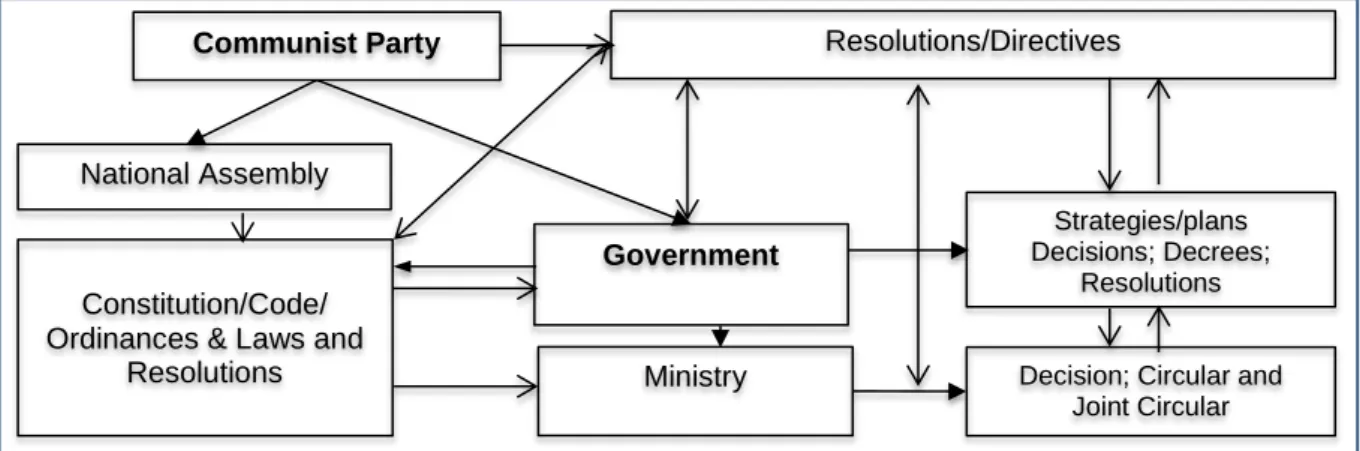
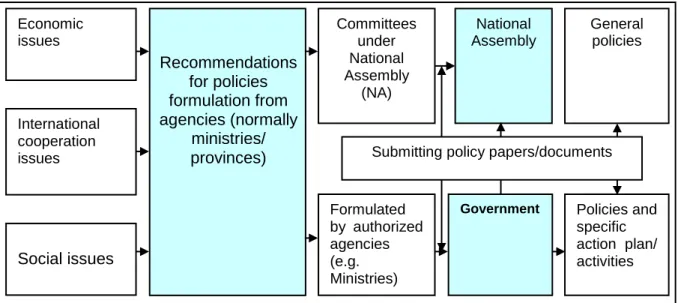
Figure 3.1: Structure of national policy formulation system (legal documents formulated by different state agencies) in Vietnam ... 59
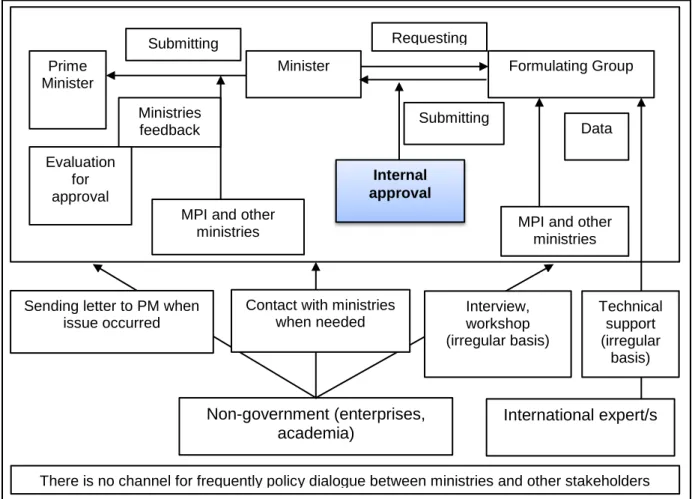
Figure 3.2: The diagram of current public policy formulation procedure in Vietnam ... 62
Figure 3.3: The schematic diagram of policy formulation steps in Vietnam ... 63
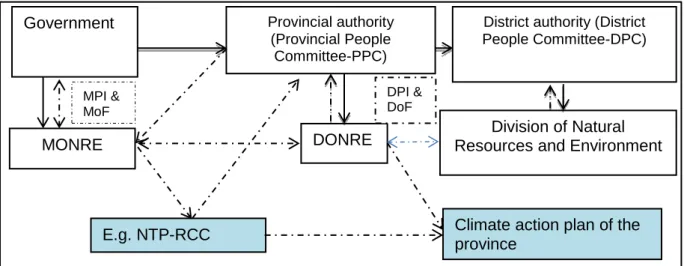
Figure 3.4: Schematic diagram of relations among the actors within the government system in formulation of climate change policy (e.g. NTP-RCC) in Vietnam ... 65
Figure 3.5: Working Structure of the SP-RCC in 2011... 72
Figure 4.1: Approach in selection of study samples and studied locations ... 84
Figure 4.2: Detail of Research Design ... 85
Figure 4.3: Steps in content analysis ... 87
Figure 4.4: Number of climate action plans approved vs. analysed ... 88
Figure 4.5: Locations of forty provinces in the study ... 89
Figure 4.6: Geographical locations of three studied provinces ... 95
Figure 5.1: Objective of climate action plans and frequency of their presence ... 106
Figure 5.2: Number of objectives in action plan by the location of provinces ... 109
Figure 5.3: Proposed budget and year of approval ... 111
Figure 5.4: Plan proposed budget vs. geographical location of provinces ... 113
Figure 5.5: Year of approval and end-date of 40 provincial climate action plans ... 115
Figure 5.6: The plan implementation timelines vs. locations of provinces ... 116
Figure 6.1: Generic procedure in climate action planning at provincial level ... 124
Figure 6.2: Climate action planning timeline in HCMC... 128
xiv
Figure 6.4: Climate action planning timeline in Lao Cai province ... 134
Figure 6.5: Structure of the Steering Committee for Climate Change in HCMC ... 141
Figure 6.6: Structure of the Steering Committee for Climate Change in Quang Nam ... 143
Figure 6.7: Structure of the Steering Committee for Climate Change in Lao Cai ... 146
Figure 6.8: Procedure for provincial climate action plan approval ... 155
xv
List of Tables
Table 2.1. Paradigms and perspectives in policy study ... 16
Table 2.2. Four approaches in climate adaptation planning... 18
Table 2.3. Approaches in climate adaptation planning in Netherland ... 20
Table 2.4. Impact factors and their characteristics for climate action planning ... 24
Table 2.5. Vulnerability assessment areas ... 25
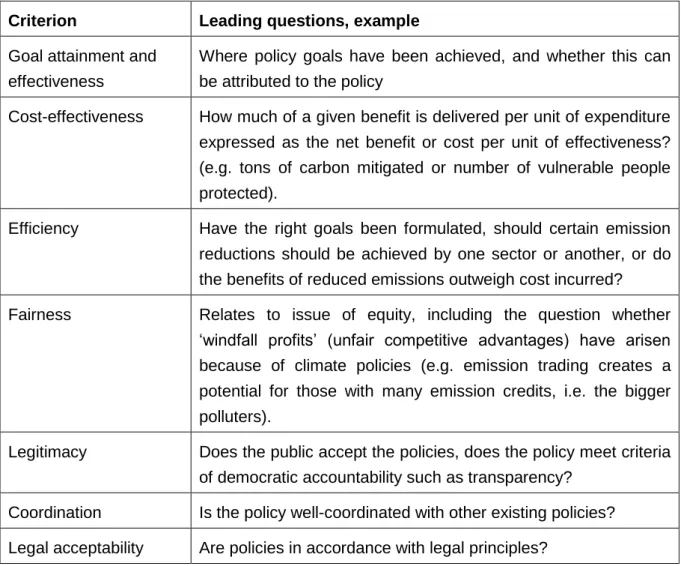
Table 2.6. Criterion and leadings questions for policy evaluation ... 27
Table 2.7. Key research and evaluation focus for adaptation plans ... 30
Table 2.8. Outcome criteria for the evaluation of the action plans ... 33
Table 2.9. Three domains and 36 indicators used for local climate action plan evaluation in the United States ... 35
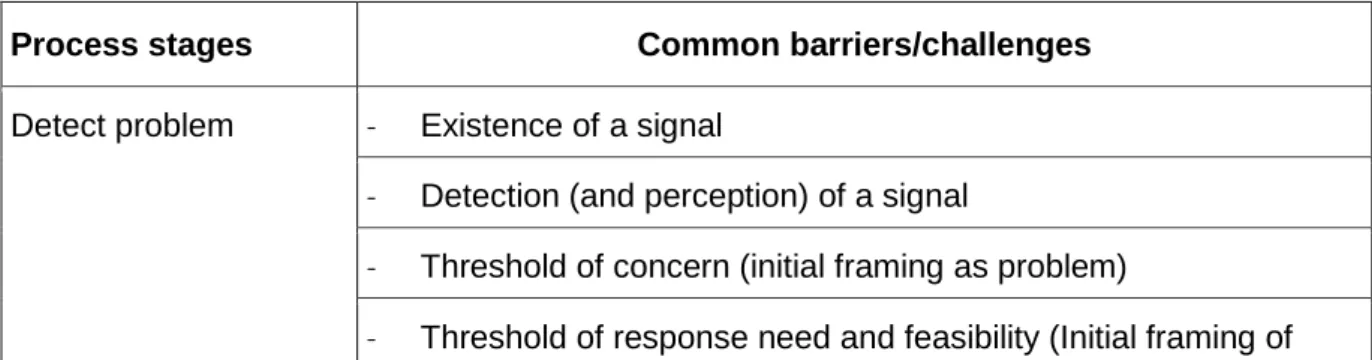
Table 2.10. Common barriers in the stages of climate adaptation process ... 39
Table 2.11. Overview of potential relevant variables in adapting to climate change ... 42
Table 3.1. Financial contribution of development partners to SP-RCC 2009-2014 ... 73
Table 3.2. Target Sectors/Areas of the SP-RCC in 2012 ... 74
Table 4.1. Steps in coding text (the Weber Protocol) ... 90
Table 4.2. Criteria for selection of cases ... 94
Table 4.3. Overview information of three studied example provinces/city ... 96
Table 4.4. Key informants in the case study ... 97
Table 4.5. List of interview participants in HCMC ... 98
Table 4.6. List of interview participants in Quang Nam province ... 98
Table 4.7. List of interview participants in Lao Cai province ... 98
Table 4.8. List of participants in consulting discussion ... 99
Table 5.1. Action plan objectives by year of formulation/adoption ... 108
Table 6.1. Overview of three climate action plans ... 125
Table 6.2. Areas of intervention in three climate action plans ... 126
xvi
List of Appendices
Appendix 1: Guiding questions for interviewing (English version) ... 224
Appendix 2: Guiding questions for interviewing (Vietnamese version) ... 228
Appendix 3: Second round interviews-Guiding question (English version) ... 231
Appendix 4: Second round interviews-Guiding question (Vietnamese version) ... 233
Appendix 5: Protocol for conducting interview with local stakeholders ... 235
Appendix 6: List of provinces and their climate action plans in the analysis ... 236
Appendix 7: Area, population, economic growth and GDP of the 40 provinces ... 238
Appendix 8: Participant information and Consent form ... 240
Appendix 9: Thư mời tham gia phỏng vấn trong đề tài nghiên cứu ... 243
Appendix 10: CONSENT FORM ... 246
1
CHAPTER I: INTRODUCTION 1.1 Background to the problem
The changing climate is no longer an abstract issue, and the realities of its impact are being observed across the globe. Climate change is affecting millions of people, and frustrating their efforts to escape poverty, particularly in developing countries (Munang et al. (2013). Climate change has been considered as the most critical challenge to human kind in the 21st century, and there is a real possibility that it will stall the progress of human development (UNDP, 2007). It is an issue receiving the attention of every government in the world (IPCC, 2007, 2012, 2014). UNDP (2007) outlines five specific risk-multipliers of climate change- induced barriers to human development: (1) reduced agriculture productivity; (2) heightened water insecurity; (3) increased exposure to coastal flooding and extreme weather events; (4) the collapse of ecosystems; and (5) increased health risks.
The annual Conference of the Parties (COP) on climate change has sought agreements on solutions dealing with climate change. At COP18 in Doha, Qatar, in December 2012, all participating countries agreed to detail their carbon emissions reduction six months in advance of the 2015 COP in France. They also committed, in total, over 6 billion USD to address climate change, mostly from European countries. At COP20 in Lima, Peru, governments of both developed and developing countries reached an agreement to further tackle climate change for both mitigation and adaptation purposes (IPCC, 2014). At COP 21 in Paris, France in December 2015, the United Nations Framework Convention on Climate Change (UNFCCC) adopted the Paris Agreement, in which it recognises that climate change represents an urgent and potentially irreversible threat to human societies and the planet, and thus requires the widest possible cooperation by all countries and their participation in an effective and appropriate international response, with a view to accelerating the reduction of global greenhouse gas emissions. The agreement acknowledges that:
“climate change is a common concern of humankind, Parties should, when taking action to address climate change, respect, promote and consider their respective obligations on human rights, the right to health, the rights of indigenous peoples, local communities, migrants, children, persons with disabilities and people in vulnerable situations and the right to development, as well as gender equality, empowerment of women and intergenerational equity” (UNFCCC, 2015, p. 1).
The specific needs and concerns of developing country parties arising from the impact of the implementation of response measures are emphasized. It also stresses the urgency of
2 accelerating the implementation of the Convention and its Kyoto Protocol, in order to enhance the pre-2020 ambitions. This recognises the urgent need to enhance the provision of finance, technology and capacity-building support by developed country parties in a predictable manner, to enable enhanced pre-2020 action by developing country parties, and emphasizing the enduring benefits of ambitious and early action, including major reductions in the cost of future mitigation and adaptation efforts. The Paris Agreement also agrees to uphold and promote regional and international cooperation, in order to mobilize stronger and more ambitious climate action by all parties and non-party stakeholders, including civil society, the private sector, financial institutions, cities and other subnational authorities, local communities and indigenous people (UNFCCC, 2015).
Despite efforts to date to deal with climate change, inequalities in capacity to adapt are still commonplace, particularly in developing countries. Furthermore, planning for climate change adaptation confronts governments in developing countries with challenges at many levels, including a lack of resources and capacity to reduce climate change impacts, and a lack of concrete commitment by both developed and developing nations to combat climate change. These challenges pose systemic threats that are becoming increasingly apparent around the globe (IPCC, 2007, 2013, 2014; UNDP, 2007). Developed and developing countries are trying to combat climate change in different ways. Developed countries have generally concentrated on greenhouse gas reduction or mitigation measures, while developing countries have tended to prioritise adaptation to the impact of climate change (IPCC, 2007, 2012). However, adaptation and mitigation measures are now becoming common in both developed and developing countries, particularly at the sub-national or local level. Although national and regional governments are active, provincial and local governments are of particular importance. Indeed, municipal governments and cities around the world have been considered to be the most active level in initiating efforts to tackle climate change impacts (Bulkeley & Betsill, 2013).
The 2014 IPCC report found that many challenges have emerged as adaptation activities have been implemented. These include, how to manage the decision-making process, how to develop strategies and plans, and how to implement them effectively. It is clear that all nations face great challenges in developing and delivering effective policies to respond to climate change, particularly at sub-national levels, where climate change impacts are most visible. Various studies have been undertaken to analyse and assess the effectiveness of climate change policies and strategies at different levels of administration (global, regional, national and local level), although most to date have been conducted in developed countries (Preston et al., 2011).
3
1.2 Research problem statement
UNDP (2009) identifies Vietnam as among the five countries, globally, that are most affected by the impacts of climate change; and, like the others on this list, Vietnam has limited resources to prepare and respond to such impacts. Located in South East Asia, Vietnam has a total land area of 329,569 square kilometres, and it has a population of over 89 million, as at 2014. Vietnam has the highest population density in Southeast Asia, just after Singapore, with a national average of 232 people per square kilometres and up to 1,000 per square kilometres in the Northern Delta. Vietnam has been in economic transition since the introduction of the renovation policy (Doi Moi) in 1986, with major liberalisation of the market. Gross domestic product (GDP) per capita has increased more than 10 times over the last two decades, from 90 USD in 1990 to 1,596 USD in 2012. Vietnam is now considered as a middle-income country (Higashi et al., 2013; World Bank, 2011, 2012b). However, Vietnam is also facing the middle-income trap, among other challenges (Ohno, 2009); and is extremely vulnerable to climate change, being particularly exposed to sea-level rise and the occurrence of extreme weather events (GoV, 2011c; IPCC, 2012, 2014; MPI et al., 2015). Among the most severe effects of climate change in Vietnam are rising temperatures and sea levels, and an increase in the irregularity, frequency and force of extreme weather events such as tropical storms, floods, and droughts. Vietnam climate change scenarios show that, by the end of the 21st century: annual average temperatures will rise by 2-3oC; that total rainfall will increase, and dry-season rain will decrease; and sea levels will rise by as much as one meter relative to the 1980-1999 level (GoV, 2011c; MONRE, 2011).
These expected changes will have impacts on habitats and human lives. With the sea-level rise of one meter, about 40% of the Mekong River Delta, 11% of the Red River Delta, and 3% of other regions will be submerged, with 20% of Ho Chi Minh City under water. Associated losses in property and damages to the national economy are significant, with 10-12% of the population directly affected, costing about 10% of GDP, according to the National Strategy on Climate Change (GoV, 2011c). Such severe consequences in Vietnam are an explicit threat to poverty alleviation and hunger eradication, as well as to the achievements of the United Nations’ Millennium Development Goals and the new Sustainable Development Goals. The sustainable development of the country is placed in severe jeopardy (UNDP, 2009). Already, in recent years, natural disasters stemming from climate change have become more severe and more frequent, bringing damage and destruction to economies, cultures, and natural environments. Between 2001 and 2010, floods, storms, landslides, droughts, saltwater intrusion and other climate-related disasters have left 9,500 people dead and missing, with economic losses of 1.5% of GDP each year, as analysed in the National Strategy for Climate Change 2011.
4 Climate change in Vietnam is also a great threat to food security in the country. Agricultural land, especially in low-lying coastal plains such as the Red River and Mekong River deltas, may shrink due to increased salinity induced by sea-level rise. Crop yields and growing seasons are expected to be increasingly altered, with higher risks of disease outbreaks. Livestock reproduction and growth are hampered by increased risks of epidemics. With the changing climate come higher risks of drought, threatening agriculture, hydropower generation, and water supplies in rural and urban areas. Changes in rainfall patterns can cause severe floods in the rainy season and exacerbate drought in the dry season, potentially inducing conflicts between water users (MONRE, 2011). Hazardous events such as flood, storms and droughts count for nearly 80% of the natural disasters in Vietnam (UNDP, 2008). The most severe impacts of rising seawater levels are expected in the Red River Delta and in the Mekong River Delta (UNDP, 2009; World Bank, 2007). As mentioned above, an increase of seawater level by one meter may cause the inundation of nearly 40% of the Mekong River delta, directly impacting the livelihoods of 10.8% of the delta population. These devastating outlooks on the potential impacts of climate change have raised the concern of all governments and of the international community (ICEM, 2009).
A key tool for anticipating and addressing damage from climate change is through specifically directed policies and planning of actions to avoid, ameliorate, mitigate and adapt. Vietnam has a centralized national approach to policy development and implementation (Clement & Amezaga, 2009; Ohno, 2009). Vietnam is a one-party state, with a strong central government at the national level, and 63 provincial governments. In most cases, policy is developed by national ministries, adopted by the national government and then passed to provincial authorities for implementation by provincial departments.
The decision-making process in Vietnam provides checks and balances horizontally (across ministries and departments), vertically (between central and local levels), and geographically (North, South, Middle and remote areas). There are three national leadership entities: (1) the Communist Party of Vietnam; (2) the National Assembly; and (3) the Government of Vietnam. This system has produced stability and continuity, but it may be less suitable for staging bold reforms or responding quickly to a changing world. Furthermore, the public policy-making process in Vietnam tends to be mostly reactive rather than proactive (Ohno, 2009). Climate change policy-making is not an exception to this.
In regard to climate change, the Government of Vietnam (GoV) has taken a range of actions, including: ratifying the Kyoto Protocol in 1994; initiating the National Targeted Program to Respond to Climate Change (NTP-RCC) in 2008; approving the National Strategy for Climate Change (NSCC) in 2011; and formulating the National Strategy for Green Growth
5 (NSGG) in 2012. In June 2013, the Central Executive Committee of the Party adopted Resolution No. 24/NQ-TW, on ‘Active Response to Climate Change, Improvement of Natural Resource Management and Environmental Protection’, as the key policies and directions for
climate change actions in Vietnam. Thus, at the national level, a climate change policy framework has been created to leverage action at lower levels (province, district and commune). However, the formulation and implementation of climate change policies at the provincial level has not been analysed and evaluated systematically from the concerned agencies although a few independent reviews have been completed including the one by a group of international and local experts (Nguyen Phuong Nam et al., 2015). Within the framework of the NTP-RCC, all line ministries and provinces were required to formulate their action plans to respond to climate change by the end of 2011 (GoV, 2008; MONRE, 2009). However, only 33 out of 63 provinces and central cities had formulated their climate action plans by the due date. There were only 40 provinces that had submitted their climate action plans to Ministry of Natural Resources and Environment (MONRE) by the end of 2013. Those that were developed followed the general guidelines prepared by MONRE in 2009. However, climate change impacts on provinces are markedly varied, because of geographic factors and the varying types and levels of vulnerability to climate change, which require specific actions suitable to local characteristics. Furthermore, there has been very little effort to analyse how these action plans have been prepared and implemented, and which challenges and drawbacks are prevalent (MONRE, 2015; World Bank, 2012a; Nam, Phuong Nguyen et al., 2015 ).
Given the problems facing Vietnam, there is an urgent need to: examine the efficacy of the procedures and approaches in the formulation and implementation of climate change policies, particularly the adopted action plans that are designed to inform targeted capacity development for provincial agencies; and to improve the comprehensiveness, effectiveness and feasibility of climate change action plans at the provincial level. Specifically, there is a need to understand the diffusion of national policies on climate change across lower levels of the administration system, and to identify gaps in the effectiveness of local climate change action plans on the ground.
1.3 Research objectives and research questions
This PhD research project aims to bring a new understanding to climate action planning processes, particularly in a developing country context, at subnational level. Focussing on Vietnam as a case study, the research involves analysing the content of 40 climate action plans, and conducting qualitative research into climate action planning or plan-making processes, in three provinces.
6 The primary research objectives of this study are to analyse the content of provincial climate action plans and to understand climate action plan-making processes. In turn, it is expected that this will reveal ways of improving the prospects for national-level climate change policies and strategies, through the development and implementation of local climate action plans. There are four specific objectives that were made for this research:
1. To develop an analysis framework, taking account of literature and practice to date, and of the policy environment of the case study country, Vietnam.
2. To analyse the content of provincial climate action plans, in order to assess the activities proposed in these action plans throughout the country.
3. To analyse the policy formulation process, in order to identify the relationships between the policy-making process and the quality of the plans.
4. To explain the differences in the content of the provincial plans in selected provinces, which represent different vulnerabilities, and to develop recommendations for more effective policy formulation and implementation in Vietnam, especially in relation to climate change action plans.
The overarching research question is, how might the process of climate change policy-making and implementation in Vietnam at different levels be understood, and improved? Three specific research questions were asked:
1. How does content of the provincial action plans for responding to climate change vary, and what might explain this variation?
2. How are these action plans prepared, and how are they being implemented? 3. What factors influence the interpretation and implementation of the national policies
at the provincial level?
1.4 Research design
The research is designed into two phases. Firstly, the national climate change policy framework was reviewed, and 40 provincial climate action plans were analysed, to understand the key contents of these climate policy papers. Then, the processes of the climate action plan-making of three provinces were investigated, to identify key factors that influence the action plan content and implementation results. This research deployed a qualitative method, with the application of a content analysis technique in the first phase, and semi-structure interviews in the second phase. In this research, policy analysis was applied as a core paradigm for understanding climate change policy-making in Vietnam from the national to sub-national levels, and for analysing the content of local action plans of
7 provinces as well as the action plan making process.
The formulation and implementation of provincial climate action plans is the main analytical focus in this study. Climate action plans would be expected to be the same in all provinces, as provincial governments receive the same guidelines, are allocated the same budget, and receive the same timeline from the national government. However, in this research I seek to reveal that the situation may vary from one province to another, due to a wide variety of factors such as differences in natural conditions, community engagement and stakeholder participation, qualifications and interests of local policy makers, institutional setting, policy coordination, and networking. Field research in the three selected provinces, through interviews and group discussions with provincial stakeholders, in particular people who had participated directly in the formulation of action plans, was conducted to collect data, which have been analysed to answer the questions, “How were these action plans prepared and how are they being implemented?”, “What factors influence the implementation of the national policies at the provincial level?”, and “How can the differences in provincial policies be explained?”. Selection of the three provinces for the second phase of the research will be detailed in Chapter 4.
1.5 Research findings
Results of the present research indicate that 70% provinces purposely set out the objectives of ‘improve and strengthen capacity’ and ‘increase the awareness and responsibility’, although the budget allocated for capacity building and awareness raising was very neglected (5%). The action plans approved in 2012 and 2013 requested more budget than the action plan approved in 2011. Timeline for implementation of these action plans also varied among provinces and was strongly influenced by the national climate policy direction, which indicates that provincial climate action plans approved later have had longer implementation timelines than those approved earlier. The findings of the research also reveal that climate change policy-making in Vietnam is quite dynamic, and tends to be more innovative than other areas of public policy of the country. The policy-making process at national level indicates two approaches: strong political commitment in the early stage; then moving forward to a more mainstreaming approach. At provincial level, due to limited resources (both technical and financial resources), climate action planning still inherits a traditional plan-making process, in which the participation of civil societies and the private sector can be seen to be very limited. Budget allocation for implementing action plans is still heavily reliant on the state budget, and some provinces did not even propose any budget estimation in their action plans. This means that, in order to implement their climate action plans, these provinces have to prepare other action plans or budget planning. In addition,
8 lack of staff time and capacity has created challenges to the transformation of conventional plan-making practice into more robust and interactive planning, in which more resources can be mobilised from interested stakeholders and necessary resources can be secured for implementation. There are a number of factors influencing the climate action planning at provincial level, which include: (i) motivation and power sharing; (ii) institutional setting and policy coordination; (iii) local capacity and resources; (iv) stakeholder participation and networking; and (v) knowledge and information exchange.
1.6 Significance of the research
Climate policy is considered to be a relatively young and dynamic area of public policy-making (Massey & Huitema, 2013), particularly in developing countries such as Vietnam. Multi-level policy-making is an emerging concept, and has not been subject to comprehensive study in Vietnam. Climate change is a global issue, but its impacts are localised (Ayers, 2011). It is also a ‘wicked’ issue that requires innovative approaches, to formulate and implement policies and measures to effectively respond to the impacts of climate change. Vietnam is considered a country with a centralised-oriented policy-making system, and a prevailing top-down approach; but climate change is a new challenge that needs the government of Vietnam to be more innovative in proposing and implementing its climate change policies. New knowledge that can be drawn from this research reveals the dynamics of sub-national authorities in a centralised policy-making country regarding climate change action planning. The significance of policy networks and institutional settings in shaping the formulation and implementation of climate action plans is demonstrated across the three provinces studied. In particular, participation and learning processes in climate policy-making are critical factors in determining the efficacy of the plans produced. The research reveals that provincial governance is contingent at present, and therefore lacks capacity and power in addressing national policy frameworks in ways that reflect the local context. The research also highlights the importance of collaboration among policy makers, scientists, educators, media and citizens. This collaboration is part of the process of plan making, and is manifest during the formulation and implementation of the action plans.
1.7 Structure of the thesis
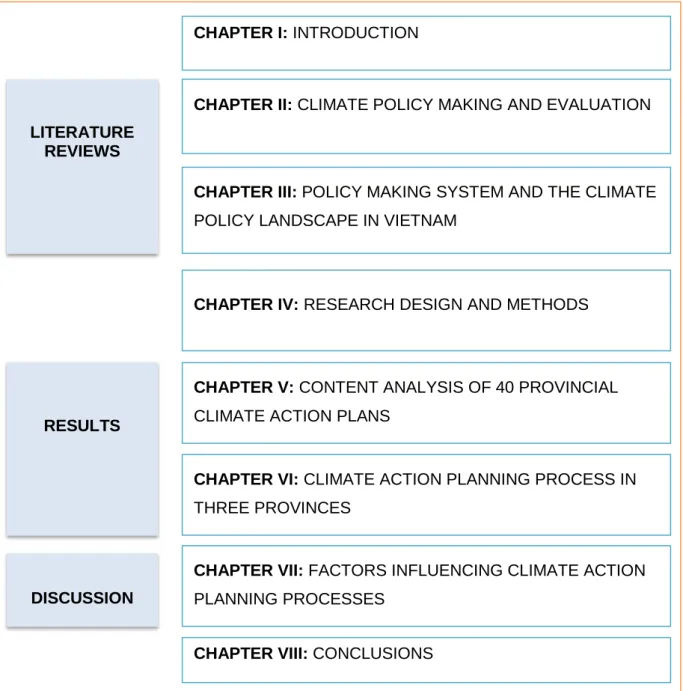
This PhD dissertation comprises eight chapters (Figure 1.1). Following this introductory chapter, Chapter 2 describes the state of knowledge on public policy-making in general, and climate policy-making and evaluation in particular, through a critical review of the most relevant and up-to-date literature. Chapter 3 presents an overview of the context of Vietnam as the country of study, particularly the political system within which climate action planning is being attempted, and the national climate change policy framework. Chapter 4 presents
9 the research design, including the research objectives and research questions, as well as research strategies and methodologies. Chapter 5 presents an analysis of the content of 40 provincial climate action plans. Chapter 6 reports on the climate action planning processes of three provinces in Vietnam, and compares the main variations among these provinces in the formulation and implementation of their climate action plans. Chapter 7 analyses key factors influencing climate action planning at provincial level, and identifies challenges to the development of a robust action plan to respond to climate change in Vietnam. Chapter 8 provides conclusions to the thesis, including its contribution to knowledge and implications for climate action planning, as well as the limitations of the research; and speculates on future research directions.
Figure 1.1: Schematic structure of the thesis CHAPTER I: INTRODUCTION
CHAPTER II: CLIMATE POLICY MAKING AND EVALUATION
CHAPTER V: CONTENT ANALYSIS OF 40 PROVINCIAL
CLIMATE ACTION PLANS
CHAPTER IV: RESEARCH DESIGN AND METHODS
CHAPTER VI: CLIMATE ACTION PLANNING PROCESS IN
THREE PROVINCES
CHAPTER VII: FACTORS INFLUENCING CLIMATE ACTION PLANNING PROCESSES
CHAPTER VIII: CONCLUSIONS
LITERATURE REVIEWS
RESULTS
DISCUSSION
CHAPTER III: POLICY MAKING SYSTEM AND THE CLIMATE POLICY LANDSCAPE IN VIETNAM
10
CHAPTER II: CLIMATE POLICY MAKING- A COMPLEX PROBLEM 2.1 Introduction
Climate change is a contemporary issue that requires coordination and joint effort to effectively respond to its impact. Thus, it is an issue that places demands on governance across international, national, regional and local scales vertically, and between sectors horizontally (e.g. across departments that deal with environmental, energy and financial issues, and between private and public sector actors). The question therefore arises, can conventional policy making work effectively for climate change issues, at different geographical scales and administrative levels? This question has received attention from many scholars and governments around the world (Aall et al., 2007; Bahadur & Tanner, 2014; Bhave et al., 2014; Cashmore & Wejs, 2014; Galarraga et al., 2011; Mazmanian et al., 2013).
Adaptation to climate change is an emerging issue for policy makers, particularly in developing countries, where other issues also are prioritised in policy agendas. Massey and Huitema (2013) tackle the question of whether climate change can be considered as a policy field, given that policy fields or policy domains are three-dimensional entities comprised of substantive authority, institutional order, and substantive expertise. Climate policy is a relatively young and dynamic area of public policy making, and its development has, to date, appeared to draw more attention than deliver results in practice (Huitema et al., 2011(Massey & Huitema, 2016)). Due to its scientific, social and economic complexity and the difficulty of securing agreement on policy responses, climate change has been labelled a ‘wicked problem’ (Australian Government, 2007; World Bank, 2014). While many climate policies have been developed at international, national and local levels to tackle climate change impacts by reducing greenhouse gas emissions (mitigation) and improving resilience to climate change (adaptation), the evaluation of climate change policies remains challenging and encounters many difficulties (Measham et al., 2011). Such difficulties include the manner in which the decisions that inform evaluation practices are framed and undertaken. Indeed, criteria for the evaluation of climate policies in general, and climate action plans in particular, remain in the early stage of development (Huitema et al., 2011). In order to understand climate policy making, particularly climate action planning, it is important to first review climate change governance at different scales, from global to local contexts. Understanding principles and theories of public policy making is also essential in analysing climate policy and its evolution. Public policy-making and policy analysis are discussed in detail in Section 2.2. In Section 2.3, a discussion of climate change policy and
11 plan making will be presented, in which local climate action planning, evaluation of climate policies, and approaches in climate action planning are detailed. Section 2.4 focuses on the factors that influence local climate adaptation, which include the motivation of local government, institutional capacity, networks and connections between agents, and adaptive capacity in climate adaptation planning. Section 2.5 provides conclusions on key messages derived from the relevant literature related to the research questions.
2.2 Understanding public policy making and policy analysis
2.2.1 Introduction
This section presents an overview of general public policy, and introduces processes of policy making and public policy analysis. Public policy is the set of policies (laws, plans, actions, behaviours) of a government; plans and methods of action that govern that society; and a system of laws, courses of action, and priorities directing a government action (Matheson, 2009). In an increasingly complex world of interrelated problems, many governments have tried to modernise and improve their institutional structure and the way they prepare for policy making (Burton, 2006). This has boosted public policy as a research topic for policy makers and academics. Public policy study, therefore, draws more attention when the policy problem has issues that are complex and cut across disciplinary boundaries, as is the case with climate change.
Arguably, understanding the policy-making process is a prerequisite to enable improved outcomes. This section reviews the policy development approaches and models that are widely found in the literature; and highlights the principles of policy making as well as the processes of policy-making in general and the situation in Vietnam in particular, in order to compare differences in policy making and to understand potential pitfalls of current climate change policy making. Giddens (2009 p.2) indicates that, “since the dangers posed by global warming aren’t tangible, immediate or visible in the course of day-to-day life, however awesome they appear, many will sit on their hands and do nothing of a concrete nature about them. Yet waiting until they become visible and acute before stirred to serious action will, by definition, be too late”. It is clear that responding to climate change requires humanity to reduce risks and to build better resilience to cope with impacts of climate change, not only today but also into the future. This observation is itself a basis for treating climate policy as different to other, more traditional administration tasks, and also marks out this policy area as one that requires urgent and specific actions at various levels of administration (international, regional, national, and local levels).
12
2.2.2 Processes of policy making
Although there is no concrete concept or definition of the policy-making process, there are many models. For example, according to Howlett and Giest (2013), the five steps or stages of the policy process typically seen in the literature comprise:
(1) Agenda setting; (2) Policy formulation; (3) Policy adoption;
(4) Policy implementation; and (5) Policy evaluation.
Agenda setting refers to the first stage of the policy-making process, when a problem or an issue is initially captured by policy actors, then a range of solutions or options are proposed for intervention. Policy formulation refers to the development of specific policy options within government or administration, when possible choices are eliminated by excluding the infeasible ones, and efforts are made by various actors to have their best solutions prioritised among the remaining few. Decision making refers to the third stage, in which governments or administrations adopt a particular course of action. In the fourth stage of policy implementation, governments put their decisions into effect, using some combination of public administration tools in order to change the distribution of goods and services in society in a way that is broadly compatible with the sentiments and values of affected parties. Finally, policy evaluation refers to the fifth stage in the process, in which the results of policies are monitored by both state and societal actors, often leading to the re-conceptualisation of policy problems and solutions in the light of experiences encountered with the policy in question (Howlett, 2009). In reality, the policy-making process, or policy process, is a more complex and less smooth process than that of the five stages of the model referred to above. Wit et al. (2012, p. 9) indicate that the “policy-making process is rather a messy, complex, hard to manage and in fact rather unpredictable process”.
In many cases, stages 1, 2 and 3 are carried out at the upper level and by policy makers, while stage 4 (policy implementation) is carried out at the community level. Within the policy process, participation of policy actors or stakeholders in each stage differs greatly. According to Wit et al. (2012), in practice the role of citizens and non-governmental actors in stages 1, 2 and 3 may not be as important as it is in stages 4 and 5. Indeed, government agencies in stage 3 play an important role when approving the policy and setting the legal framework for
13 implementation in stage 4. In stage 5, the role of other stakeholders such as academia, non-governmental organisations, and the community at large becomes more important. However, the linkage among these stages in developing countries is typically loose. ‘Good’ policy is achieved by a clear agenda, feasible targets, timely decisions, and appropriate implementation activities (Wit et al., 2012).
Other formulates of the policy-making process have been recommended, for instance, Wheelan (2011) describes a policy process of 5 steps:
(1) Identify a social goal; (2) Diagnose the problem;
(3) Identify appropriate institutions for action;
(4) Evaluate the substance and politics of the completing policy options; and (5) Implement enforce, and monitor the policy changes.
It is clear that making ‘good’ policy requires a set of tools to analyse the nature of a problem and to implement a solution that is both effective and political acceptable. Therefore, these steps of the policy-making process are interrelated. In developing countries, steps 3 to 5 have been labelled as typically weak, otherwise suffering from lack of coordination, implementation capacity, and monitoring of policy impacts (Wit et al., 2012).
Although there are variations, a ‘five-steps model’ variant of policy making tends to identify and emphasise the essential stages and sub-stages, each of which can be investigated alone (Howlett & Giest, 2013). This helps in the policy-making process to identify the relationship of each stage to any or all of the other stages of the process. The simplification of the policy development cycle allows key questions about public policy-making to be addressed, for example regarding the effectiveness of different tools and the identification of bottlenecks in policy making. Without this simplification of the policy development cycle, it would be very challenging to understand how a public policy was developed and what can be learnt from a policy-making process.
In the literature, the first stage of agenda setting often focuses on the difference between the systemic or unofficial public agenda, and the institutional or formal, ‘official’ agenda, which helps to conceptualise policy-making dynamics at this stage of the process (Howlett & Giest, 2013). The systemic agenda refers to all issues that are commonly perceived by interested stakeholders, while the institutional agenda consists only of a limited number of issues in which or to which attention or purpose is devoted by policy makers or government agencies. Requests for policy intervention may arise from different stakeholders, which makes agenda
14 setting prioritise urgent priorities or challenges (Howlett, 2009).
In the policy formulation stage, many studies have emphasised the importance of specific kinds of actors interacting to develop and refine policy options for government, for example Howlett and Giest (2013). However, unlike agenda setting, where the public or all actors often actively participate in the formulation stage, the relevant actors are restricted to those who not only have positions in but also some knowledge of the subject area, enabling them to comment at least on the feasibility of the proposed options. This requires an open channel for the contributions of academia or the research community. In reality, not every government opens up this channel effectively.
Decision making is the third stage of the policy development cycle. This has received a lot of attention since the 1950s, and Howlett and Giest (2013) describe different models of decision making, including the rational model and the incremental model. Decision making in the policy-making process is affected by the number of agents involved in a decision, their organisational setting, how well the problem is defined, the information available on the problem, its causes and consequences, and the amount of time available to decision makers to consider possible contingencies and the present and future consequences of decisions. Decision making at the level of ownership (or legal process) is important, as the higher the level of government that makes a decision, the stronger the legal binding will be (Howlett & Giest, 2013).
The above-mentioned models of policy-making processes apply to public policy, whereas other policy (such as corporate) may differ (Wheelan, 2011). In shaping public policy, politics plays a greater role than it does in shaping corporate strategy, as states share power with external policy actors to a greater degree than do corporate bureaucracies (Matheson, 2009). Clement and Amezaga (2009), in their research on the linkage of policy outcomes with factors located beyond the local level, through analysis of decision-making processes at the policy implementation stage of afforestation and forestry land allocation in Vietnam, also indicate that national policy makers allow flexibility in policy implementation but develop mechanisms of accountability and control between the provincial and central authorities. They also propose that discrepancies between policy intentions and outcomes are partly linked to the relative freedom provinces have to interpret and adapt policies during the implementation stage. This raises a question of how policy-making processes for other issues such as climate change responses in Vietnam can or should be formulated and implemented, and whether there is any freedom for provinces to interpret national guidelines in preparation of their provincial climate action plans.
15
2.2.3 Public policy analysis
Public policy analysis has been defined as a means of synthesising information, including research results, to produce a format for policy decisions (the laying out of alternative choices) and of determining future needs for policy relevant information (Williams, 1971). More recently, Weimer and Vining (2005) define policy analysis as an applied social science discipline in which multiple methods are used to inquire and argue in producing and transforming knowledge on social issues, and hence relevant information that may be created and utilised in political settings to resolve policy problems. It has been argued that policy analysis has sharpened and improved the quality of adopted policies, as the world becomes more complex with many issues interrelated (Wheelan, 2011).
As discussed by Considine (2005), social and economic structures not only shape the work of policy makers, they may themselves also be the subject of policy intervention. Policy analysis, therefore, seeks to identify the stakeholders’ interests, including those of policy makers. Different social and economic structures, hence, require their own policy making, including policy analysis objectives. The next section will focus on the evaluation of climate change policies, particularly local climate action plans, in order to understand the nature of policy-making processes (in this case, local climate change policies), which include both the formulation and implementation of policies at local level.
In policy analysis, different stakeholders set different objectives. Each stakeholder brings different objectives, clients’ interests, common styles, time constraints, and weaknesses, as illustrated in Table 2.1. Each paradigm also has its own strengths and weaknesses as well as objectives, clients, time constraints, and common styles of policy study (Weimer & Vining, 2005). For example, the objective of policy study in a traditional planning paradigm is to define and to achieve the future desirable state of future society. In such a paradigm, there is no immediate time constraint, as it deals with the long-term future; but it has the weakness of wishful thinking or intention while ignoring the political process. In this paradigm, policy analysis has the objective of systematic comparison and evaluation of alternatives available to public actors for solving social problems. Policy analysis requires quick results and tight timelines, as it normally ties to a specific decision; and it has the weakness of bias due to client orientation and time pressure. In the present research project, the focus is on a systematic evaluation of actions and processes available to public actors for solving the social problem of climate action.
16 Table 2.1. Paradigms and perspectives in policy study
Paradigms Major objectives Client Common style Time constraints General Weakness
Academic social science research
Construct theories for understanding society
‘Truth’ as defined by the discipline, other scholars
Rigorous methods for constructing and testing theories; usually
retrospective
Rarely external time constraints Often irrelevant to information needs of decision makers Policy research Predict impacts of
changes in variables that can be altered by public policy
Actors in the policy arena; the related disciplines Application of formal methodology to policy-relevant questions; prediction of consequences Sometimes deadline pressure, perhaps mitigated by issue recurrence Difficulty in translating findings into government action Classical planning
Defining and achieving desirable future state of society
‘Public interest’ as professionally defined
Established rules and professional norms; specification of goals and objectives
Little immediate time pressure because deals with long-term future
Wishful thinking in plans when political processes ignored Public administration Efficient execution of programs established by political processes ‘Public interest’, as embodied in mandated program
Managerial and legal Time pressure tied to routine decision-making such as budget cycles Exclusion of alternatives external to program
Journalism Focusing public attention on societal problems
General public Descriptive Strong deadline
pressure-strike while issue is topical
Lack of analytical depth and balance Policy analysis Systematic comparison and evaluation of alternatives available to public actors for solving social problems
Specific person or institution as decision maker
Synthesis of existing research and theory to predict consequences of alternative policies Strong deadline pressure-completion of analysis usually tied to specific decision
Myopia resulting from client orientation and time pressure
17 Table 2.1 illustrates that policy-making is not a uni-directional nor uni-dimensional process. Moreover, a systematic approach is required to reveal the multiple dimensions of the process in any particular case. Such a systematic approach was adopted to perform comparison, analysis and evaluation of climate change policy and planning in Vietnam. Understanding the paradigms of policy study, particularly public policy, provides improved guidance to policy-making processes.
The above review on the extant literature on public policy analysis reveals that policy analysis is critically important in designing and redesigning measures to respond to climate change. In the following section, detail of climate action planning and evaluation of climate policy (a form of climate policy analysis) will be reviewed based on the most relevant available literature.
2.3 Climate policy making and evaluation
2.3.1 Introduction
Literature on climate policy making in general and climate action planning in particular has increased significantly in recent years, both in number and degree of contextual diversity (Cloutier et al., 2014; Regmi et al., 2014; Tang et al., 2010). In this section, knowledge and experience of local climate action planning, evaluation and monitoring of local climate policies and measures, and approaches in developing climate adaptation, will be reviewed and analysed.
2.3.2 Approaches in climate adaptation planning
In order to cope with climate change, many measures have been undertaken at different levels of management (Cloutier et al., 2014). At first, efforts were devoted internationally to seek joint action in reducing greenhouse gas emissions, particularly commitments from developed nations and emerging economies. Recently, as adaptation to climate change has drawn more attention from governments around the world, a number of initiatives have been proposed and applied to climate change adaptation at local, regional and national levels. Common approaches in climate adaptation planning have been reviewed by Amaru and Chhetri (2013), including the science-based approach, technological- or information-based approach, experience-based approach, and managerial or organizational approach. These approaches can be applied simultaneously depending on the stage of the planning process and the available resources for adaptation planning. Each approach has its own aim in designing a climate action plan (Table 2.2).