International Journal of Curriculum and Instruction 8(1) (2016) 9–21
International Journal of Curriculum and Instruction
Institutionalizing culture of peace in basic education
through appropriate curriculum implementation
Lilian-Rita I. Akudolu
a*, Doris Chinyere Umenyi
b a Department of Educational Foundations, Nnamdi Azikiwe University, Awka 5025 , Nigeriab Department of Educational Foundations, Nnamdi Azikiwe University, Awka 5025, Nigeria
Abstract
This paper reports a study that was aimed at revealing the extent to which teachers implement Peace Education curriculum in Nigeria. The study was a survey and covered junior secondary schools in Enugu North and South Local Government Education Authorities in Enugu State, Nigeria. The sample constituted randomly selected 200 junior secondary school teachers. Questions that guided the study were based on how frequently teachers engaged in peace-prone instructional activities involving Interactive Instruction, Cooperative Learning, Conflict Resolution and Empathy. Data was analyzed using mean and standard deviation. The major findings showed that a good number of the respondents did not adopt peace-prone instructional strategies in curriculum implementation.
© 2016 IJCI & the Authors. Published by International Journal of Curriculum and Instruction (IJCI). This is an open-access article distributed under the terms and conditions of the Creative Commons Attribution license (CC BY-NC-ND) (http://creativecommons.org/licenses/by-nc-nd/4.0/).
Keywords: Instructional strategies; questionnaire; method; discussion
1.Introduction
This discussion is based on the findings of the study which sought to investigate the extent Junior Secondary School (JSS) teachers implement Peace Education curriculum. The discussion begins by situating peace in the educational context and X-rays the implementation strategies of Peace Education curriculum. The paper then presents the findings of the study and discusses these findings in the light of local and global events.
One of the qualities of peace is the existence of harmony or absence of hostility in an individual or between /among individuals, groups or nations. Peace is not just absence of violence and war. It involves all harmonious relationships and interactions that are based on mutual respect and social justice. It is a relationship variable that takes much time to build but takes little or no time to destroy. When it is destroyed, development is
* Corresponding author. Tel.: +0-000-000-0000 E-mail address: [email protected]
negatively affected and even the existence of the society is threatened. Consequently, despite the fact that the world entered the 21st century on the throes of unprecedented technological developments that have continued to facilitate human activities in ways that could not be imagined since human existence, problems of violence and war are making it difficult, if not impossible for people in the affected areas to enjoy the fruits of technological development. In the midst of technological developments, human beings are struggling under the yoke of intrapersonal, interpersonal and group violence and war that span from local to national and international levels.
The World Bank (2011) traces the root cause of violence to security, economic and political stresses. Security stresses include terrorist attacks, Boko Haram invasion, kidnapping, as well as ethnic conflicts. Economic stresses include poverty, unemployment and corruption while political stresses include discrimination and all forms of ethnic and religious based injustice. Apart from these global triggers of violence, the issue of violence among adolescents can arise from inability to achieve one’s expectations, feeling of marginalization, frustration, peer influence, and unemployment among others. Unemployment and idleness make a youth vulnerable to violence and such a person easily joins gangs, rebel and militant movements. Research findings indicate that young people mentioned unemployment, idleness, respect and self-protection as the main factors that motivate them to join gangs and rebel movements (The World Bank, 2011). Also people join militant movements to fight for a cause they believe in and that is the case with most members of the Niger Delta Militancy group in Nigeria. To say that these security stresses destroy peace and hamper development is an understatement. They often give rise to loss of lives and property. To curb conflict and establish peace in the society, people in different countries started discussing peace issues at different levels and places and this gave rise to peace research movement in the late 1950s. An example of field of peace research that flourished in the late 1950s was Science of Peace. Also the 1958 Campaign for Nuclear Disarmament in the United Kingdom contributed to the peace research movement
As of today, a lot of research has been done on conflict and conflict prevention issues. Many Peace Research Institutes have been established in different countries and these promote research, organize workshops and even give lectures on Peace Education such as the University of Peace in Costa Rica. At the association level, since her first conference in England in 1974, the World Council for Curriculum and Instruction (WCCI) has been adopting peace concept in most of her world conferences. UNESCO has also collaborated with some local and international agencies in implementing Peace Education programmes. Also, the United Nations efforts to establish initiatives for the promotion of reconciliation among different groups and cultures of the world, dates back to 1994 with the creation of the Culture of Peace Programme (CPP). Developments in the CPP led to the declaration of the year 2000 as the UN Year for the Culture of Peace and Non-Violence and finally to the declaration of 2001 to 2010 as the International Decade for
Culture of Peace and Non- violence for the Children of the World. However, it appears that the more human beings study conflict or intensify efforts to eradicate it , the more elusive its management becomes and the more difficult it is to establish peace in the society. This may be because not much attempt has been made to sow the seeds of peace in the young ones through education. Reiterating this point, Galtung, (2008, p.1) laments that the peace research movement is “a movement strong on research and action, but weak on education, generally failing to bring findings into schools and universities”. While government and nongovernment organizations incorporate conflict preventive policies into their programmes and there is a global “progress in incorporating a preventive core into the international policy agenda of various international actors” (Ackermann, 2003, p. 244), strategies for conflict prevention and for learning other aspects of peace education need to be mainstreamed appropriately into the instructional strategies of different subjects. It is good but not enough for students to learn some elements of Peace Education in a few courses or subjects of instruction because this will confine Peace Education to the shelf along with other subjects that most students study for examination purposes. Elements of Peace Education constitute life skills that every student needs to acquire to promote peaceful existence in the society. Consequently, effective Peace Education instruction requires that the elements of Peace Education be presented to the students through every aspect of curriculum implementation within and outside the classroom. Presenting elements of Peace Education at every instance of instruction institutionalizes Peace Education and ensures that conflict prevention and the manifestation of other aspects of Peace Education become routine to the students. Among the instructional strategies that could be adopted for inculcating these elements of Peace Education in the learners are interactive instruction and conflict resolution skills (CRS) acquisition strategies. There are many conflict resolution skills and the Conflict Resolution Network (2013) grouped these into the following conflict resolution skill areas: the win/win approach, creative response, empathy, appropriate assertiveness, cooperative power, managing emotions, willingness to resolve, mapping the conflict, development of options, introduction to negotiations, introduction to mediation and broadening perspectives. In this study, attention is focused only on the extent teachers engage students in instructional activities that are based on Interactive Instruction, Cooperative Learning, Conflict Resolution and Empathy.
Interactive instruction or interactive teaching implies all teaching strategies that enable the learner to be actively involved in the learning process by giving each learner the opportunity to generate and share ideas. In fact, interactive teaching (IT) is based on the premise that learning takes place through the action of the learner and not through that of the teacher. The activities of the teacher in the learning process are geared towards helping the learner to make connections, interpretations and sense of the learning content. IT gives the learner the opportunity to actively participate in the learning process through meaningful engagement with the content, the teacher and
fellow learners. In this regard, IT enhances the learning process; promotes student motivation, interest and participation and enables the teacher to easily assess students’ mastery of the learning material. Effective use of IT leads to authentic learning and consequently equips learners with the ability to be successful learners, responsible individuals and peace building citizens. One of the instructional strategies that lend themselves to IT is Cooperative Learning Strategy (CLS). This is an interactive instructional strategy that is based on constructivist epistemology which postulates learning as occurring through knowledge construction, discovery and transformation. CLS involves students working together in small groups that are structured on academic and cooperative interdependence in which the success of every individual member is dependent on the success of the group. As they cooperatively work in groups, students share ideas, solve problems collectively and contribute to each other’s learning (Baghcheghi, Koohestani and Rezaei, 2011, p: 4). Bearing in mind that there are different types of groups, based among other things on structure and purpose of formation, for a group to be designated CLS group it must possess the elements of positive interdependence, individual accountability, face – to – face promotive interaction, interpersonal and small group social skills and group processing (Science Education Resource Center, 2014). These elements constitute the basic requirements for structuring cooperative learning activities. Apart from the use of CLS, Peace Education can be promoted through the instructional use of conflict resolution activities.
Conflict resolution implies ways people reduce or eliminate disagreements among themselves or others. Due to individual differences in human beings, differences in values, opinions and desires often give rise to conflicts. By its’ nature, conflict can be interpersonal (between two groups), intrapersonal (within an individual), intragroup (among individuals within a team), or intergroup (among teams within an organization). When each type of conflict is effectively managed, it can be educational and creative but it becomes destructive when it is not well managed. Besides, the volatile nature of life in the contemporary society exposes individuals to conflict situations. Experiences have shown that unemployment, lack of security and justice are some of the issues that increase conflict among people. Consequently, learners need to acquire conflict resolution skills to enable them cope with challenges in the society. In fact engaging learners in conflict resolution based activities in different instructional endeavours both inside and outside the classroom will institutionalize the practice of conflict prevention and conflict resolution. There is also need to expose learners to creative response activities so as to develop in them the mind set for peace.
Creative response is a conflict resolution or prevention skill that enables a learner see conflicts as opportunities for growth. Such a learner concentrates on the opportunity side of a problem instead of viewing the problem as a dead end. The learner sees problems as challenges that can be transformed into creative opportunities. Creative response as conflict resolution skill may also involve the use of humour and play to reduce tension. A
person “can avoid many confrontations and resolve arguments and disagreements by communicating in a humorous way” (CAOS, 2014, p.1). In fact, creative response as conflict resolution skill refers to all strategies for melloying down tensions and disagreements so as to offer the person opportunity to view the situation from another angle that is non-threatening. Apart from the skill of creative response, a learner can use empathy to douse tension and establish peace.
Empathy plays a major role in establishing peace through the maintenance of human relationships. Empathy enables a person to view a situation from another person or other persons’ perspectives and to act in ways that lead to peaceful solutions to conflicts. It implies the ability to care for and help other people. Riggio, (2011, p. 1) presents empathy as a person’s ability to recognize, feel in tune with and show appropriate concern to another persons’ emotional state. While affirming that empathy is the root of both sympathy and compassion, Thomas (2013) discusses two types of empathy; cognitive and emotional empathy. Cognitive empathy is the ability to accurately recognize the other person’s feelings or point of view. This type of empathy is also called perspective taking. In the same vein, emotional empathy is the ability to be well-attuned to another person’s or other persons’ inner emotional feelings. There is no doubt that the acquisition of the skills of empathy by the learners is a veritable means for building a culture of empathy and compassion in the society. This will occur through the institutionalization of peace education in the society.
However, institutionalization of Peace Education can only be achieved over time and in stages. One of those stages is at teacher preparation level. Teachers are the chief curriculum implementers and elements of Peace Education cannot be presented to the learners if the teachers do not have the knowledge, attitude and skills (KAS) for Peace Education instruction. Only teachers with KAS for Peace Education can effectively implement Peace Education overt and hidden curriculum inside and outside the classrooms.
It is encouraging that some governments have introduced peace education in their schools’ curricula. For instance, in Nigeria, one of the goals of Basic Education is to “inspire national consciousness and harmonious coexistence irrespective of differences in endowment, religion, ethnic and socio-economic backgrounds (Federal Government of Nigeria, 2008: 15). To achieve this goal, Religion and Moral Values which is one of the subjects in Basic Education Curriculum, has some peace education topics. Since the proper acquisition of elements of Peace Education goes beyond subject areas and covers all activities through which learning takes place, one wonders the extent Basic Education teachers cover elements of Peace Education in curriculum implementation. Do these teachers implement elements of Peace Education and yet a good number of the learners promote anti-peace activities as demonstrated by the high rate of gang and different violent activities in the society? Do the learners engage in peace-prone instructional
activities and yet resort to violence for conflict resolution? To what extent do teachers implement Peace Education curriculum and thereby promote the institutionalization of a culture of peace? These are some of the questions that present the problems of this study. 2.Research questions
Four research questions which were derived from reviewed studies on instructional strategies for inculcating elements of peace education in the learners, as presented earlier in this communication, guided the study as follows: During instruction how frequently do teachers engage in
1. Peace-prone activities involving interactive instructional activities? 2. Cooperative learning activities?
3. Conflict resolution activities? and 4. Empathy activities?
3.Method
Design: The study was a descriptive survey which was delimited to junior secondary level of Basic Education. It covered junior secondary schools in Enugu North and South Local Government Education Authorities in Enugu State, Nigeria.
Sampling Procedures: The sample comprised of 200 junior secondary school teachers that were randomly selected from a population of 1,597 teachers.
Measurement Approach: Instrument for data collection was a 23-item questionnaire titled Teachers’ Use of Peace-Prone Instructional Activities Questionnaire (TUPPIAQ). The TUPPIAQ had two sections. While section A which sought information on the biodata of the respondents had 3 items, section B had 20 items and these were structured on a modified 4 point Likert scale of Very High Extent (VHE), High Extent (HE), Low Extent (LE) and Very Low Extent (VLE). For the administration of the questionnaires, four research assistants were trained. As they distributed the questionnaires, they waited to render possible explanations to the respondents and to collect the completed questionnaires. In a few occasions, copies of the questionnaires were left with the respondents and later collected by the research assistants.
Instrument Validity and Reliability: The TUPPIAQ was content validated by two lecturers, one each from Curriculum Studies and Measurement and Evaluation. Based on their useful contributions, three of the items were restructured to avoid misinterpretation. For test of reliability, copies of the questionnaire were administered on ten junior secondary school teachers from Awgwu Local Education Authority of Enugu State. Using the split- half method, their responses to section B of the questionnaire were put into two groups with one constituting of odd- numbered items and the other had the
even-numbered items. The application of Pearson Product Moment Correlation Co-efficient yielded a score of 0.81.
Method of Data Analysis: After the analysis of individual items, the questionnaire was analyzed thematically in order to answer the research questions. The collected data were analysed using mean and standard deviation scores. For decision rule, the items and their calculated mean scores were interpreted as follows: 3.50 – 4.00 for Very High Extent, 2.50 – 3.49 for High Extent, 1.50 – 2.49 for Low Extent and 0.05 – 1.49 for Very Low Extent. Consequently, 2.50 was the minimum acceptable mean on a 4- point scale. 4.Results
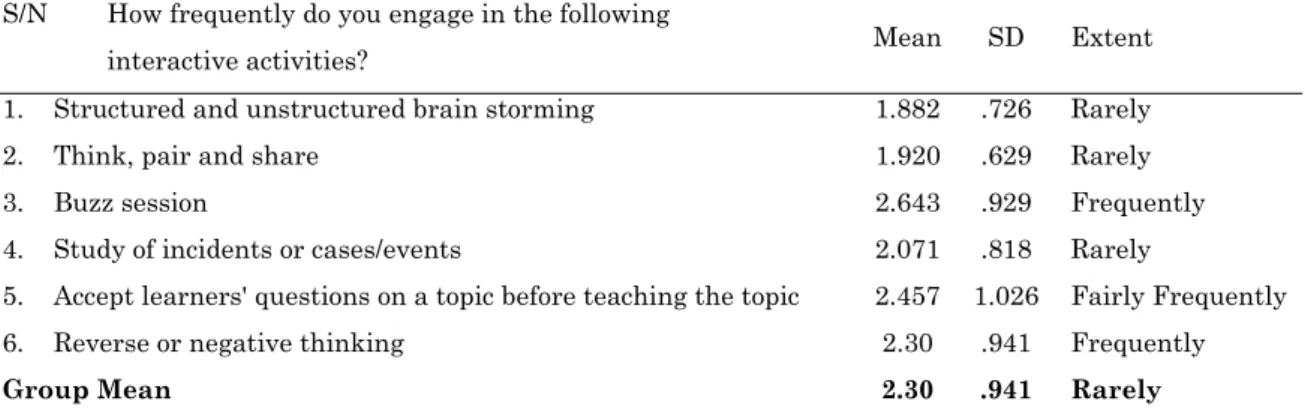
Table 1. Frequency of Teachers’ Engagement in Interactive Activities During Instruction S/N How frequently do you engage in the following
interactive activities? Mean SD Extent 1. Structured and unstructured brain storming 1.882 .726 Rarely
2. Think, pair and share 1.920 .629 Rarely
3. Buzz session 2.643 .929 Frequently
4. Study of incidents or cases/events 2.071 .818 Rarely
5. Accept learners' questions on a topic before teaching the topic 2.457 1.026 Fairly Frequently 6. Reverse or negative thinking 2.30 .941 Frequently
Group Mean 2.30 .941 Rarely
Table 1 shows that only items 3 (Buzz session) and 6 (Reverse or negative thinking) scored above the acceptable mean of 2.5. Item 5 (Acceptance of learners’ questions on a topic before teaching the topic) had a score of 2.457 which was interpreted as being done fairly frequently. Therefore, with a group mean of 2.30 and a standard deviation of .941, the teachers did not frequently use the interactive activities during instructional process (teaching).
Table 2. Frequency of Teachers’ Engagement in Cooperative Learning Activities During Instruction How frequently do you engage in the following cooperative learning
activities? Mean SD Extent
7. Plan cooperative learning 1.757 .644 Rarely
8. Organize students in groups for cooperative learning activities
1.986 .767 Rarely 9. State clearly what each student is expected to do 1.757 .820 Rarely 10. Hold a post-activity reflection on students'
behavior in their group
2.114 .839 Rarely 11. Structure cooperative learning tasks to enable
students acquire social and group
1.986 .767 Rarely 12 Structure tasks so that students depend upon
one another for personal and the group success
2.230 .748 Rarely
Group Mean 1.97 .821 Rarely
None of the items in Table 2 scored up to the acceptable mean of 2.5. Therefore the teachers rarely used any of the six listed cooperative learning activities during instructional process (teaching). With a group mean of 1.97 and a standard deviation score of .821, the teachers rarely engaged in cooperative learning activities during instruction.
Table 3. Frequency of Teachers’ Use of Conflict Resolution-Based Activities During Instruction How frequently do you engage in the following conflict resolution- based
learning activities? Mean SD Extent
13. Engage students in peer mediation 2.00 .678 Rarely 14. Help students realize that errors/failures are
opportunities for learning
1.943 .756 Rarely 15. Discussed with students how to resolve conflicts without violence 1.829 .633 Rarely 16. Teach students creative response to conflict 1.792 .708 Rarely
Group Mean 1.87 .688 Rarely
With the highest mean score of 2.00 which is below the acceptable mean of 2.5, data in Table 3 reveals that the respondents rarely used conflict based activities during instructional process. They rarely engaged students in peer mediation, rarely helped students realize that errors/failures are opportunities for learning, rarely discussed with students how to resolve conflicts without violence and rarely taught students creative response to conflict. Therefore, with a group mean of 1.87 and a standard deviation score of .688, conflict based activities were rarely used by the respondents.
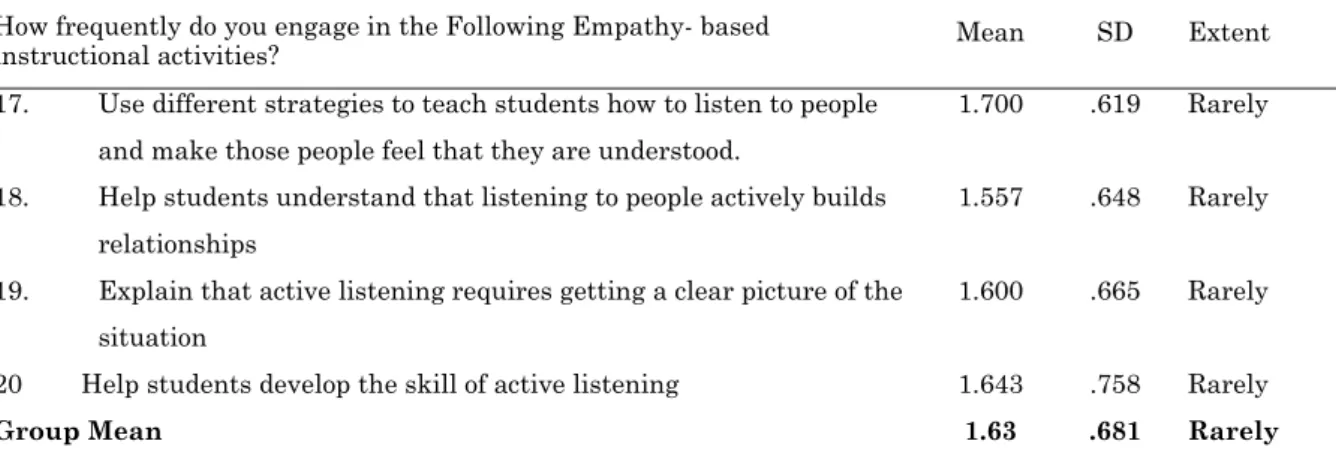
Table 4. Frequency of Teachers’ Use of Empathy-Based Activities During Instruction How frequently do you engage in the Following Empathy- based
instructional activities? Mean SD Extent
17. Use different strategies to teach students how to listen to people and make those people feel that they are understood.
1.700 .619 Rarely 18. Help students understand that listening to people actively builds
relationships
1.557 .648 Rarely 19. Explain that active listening requires getting a clear picture of the
situation
1.600 .665 Rarely 20 Help students develop the skill of active listening 1.643 .758 Rarely
Group Mean 1.63 .681 Rarely
Table 4 shows that none of the items had up to the acceptable mean score of 2.5. This indicates that the respondents rarely performed any of the listed activities during the instructional process. Therefore with a group mean of 1.63 and standard deviation score of .681, the respondents rarely used empathy-based activities in the instructional process (teaching).
Decision: Tables 1 – 4 show that the respondents rarely engaged in peace education
during the instructional process. 5.Discussion
The major finding of this study was that the respondents rarely exposed their students to peace-prone activities. Falade, Adeyemi, and Olowo (2011: 6) already established in their study that though the Nigerian Upper Basic Education curriculum contains concepts of Peace Education, teachers are still using the conventional teacher-centred methods involving memorization and repetition and consequently, “learners are not stimulated to develop and demonstrate the skills and attitudes of peace”. To develop knowledge, attitude and skills (KAS) of Peace Education requires a holistic shift in the instructional process, from teacher-centered to learner- centered instructional strategies, from static to dynamic and authentic learning content and from emphasis on classroom learning to learning inside and outside the classroom.
The fact that teachers in the present study rarely engaged learners in interactive activities could be among the reasons for the inability to achieve authentic learning among the students. When a student achieves authentic learning, such a student is likely to assimilate the learning content in a personalized way, and perform well in examinations. Experiences have shown that the inability to achieve ones’ goals in life often leads to frustration and manifestation of deviant as well as violent behaviors. Since
interactive teaching (IT) techniques bring life into the instructional process and thereby generate creative thoughts and ideas, it is expected that these techniques will help learners not only to achieve and exceed educational goals but also to promote peace in and outside the classrooms. The education literature abounds with numerous IT techniques. Though Yee (2014) listed 186 IT techniques, a teacher can generate different types of IT techniques depending on that teacher’s imaginative ability and level of expertise in group dynamics. It is lamentable that a good number of teachers used in this study rarely used these techniques in the instructional process. Among the rarely used instructional techniques is cooperative learning.
In this study, planning cooperative learning has a mean score of 1.8 while organizing students in groups for cooperative learning activities has a mean score of 2.0. This shows that a good number of the respondents do not often engage students in cooperative learning activities. It is necessary to remember that cooperative learning is aimed at developing in students not only academic but also social skills such as communication and trust-building skills. These aims of cooperative learning make it an indispensable instructional strategy for the implementation of peace education. Apart from the fact that many research findings such as Johnson and Johnson (2013), indicate that cooperative learning experiences promote higher learning achievement more than competitive and individualistic ones, exposing students to cooperative learning activities promotes in these students the development of social and moral decision making abilities as well as the tendency to “take other people’s perspectives into account when making decisions” (Johnson and Johnson, 2013, p. 13). This reiterates the fact that exposure to cooperative learning activities will sow the seed of peace making in the learners and consequently prevent and alleviate most of the social problems encountered by individuals in the society.
The present study also reveals that a good number of teachers do not engage learners in conflict resolution based activities. Since conflict is inherent in life, students’ acquisition of conflict resolution skills will enable them manage and resolve personal and interpersonal conflicts. Comparatively, students who are able to manage their own conflicts are more likely to experience less anxiety and stress and thereby maintain peace in the society than students that lack this aspect of knowledge. Besides, equipping students with conflict resolution skills will increase their academic achievement and constructive behaviour as well as decrease problems of aggression and discipline (Conflict Resolution Education in Teacher Education – CRETE, 2014). Among the questionnaire items on conflict resolution skills, engaging students in peer mediation has the highest mean score of 2.0 which is still below the acceptable mean of 2.5 while teaching creative response to conflict has the lowest mean score of 1.8. This is unfortunate. Jones (2004:18) quotes the data from the Comparative Peer Mediation Evaluation Project –CREEP by Jones et al (1997) as affirming that “exposure to peer mediation reduces personal conflict and increases prosocial values, decreases aggressiveness, and increases perspective
taking and conflict competence”. Therefore, for peace to be established in the society, learners need to possess the skill of peer mediation and other conflict resolution skills. Learners also need to acquire the skills of empathy.
Empathy is one of the competencies in social emotional learning (SEL) which develops in students the ability to understand one’s and other people’s feelings as well as the ability to listen, care and show compassion. Empathy skills are indispensable in the present day society where people are experiencing tension from local and global events and from political, economic and religious matters to mention but a few. Besides, effective learning rarely occurs under tension. To promote effective learning, teachers are expected to inject empathy and kindness into the instructional process so as to equip learners with the skills for living and working together with other people in the face of the complexities of life in the society. While stressing the need to foster empathy in the students, Burnside (2014) quotes Swick (2005, p.448) as stating that “caring is not only the core value for a decent society, but also a major antidote to violence”. Unfortunately it was found in this study that the respondents did not demonstrate empathy skills in the instructional process. While teaching students how to listen has the highest mean score of 1.7, helping students understand that listening to people actively builds relationships has the lowest mean score of 1.5. These low mean scores indicate that most teachers do not consider it necessary to give empathy fostering instruction to learners. Incidentally, empathy is a relationship variable and its skills will enable a person relate with people from other cultures and religious backgrounds with care and compassion. Students’ acquisition of empathy skills is necessary not only for academic achievement but also for peer relationship and for the promotion of peace in the society. Besides, empathy will reduce bullying, name calling and other forms of anti-social/aggressive behaviour among learners. The high rate of violence in the society is a clear indication of the need to develop the empathy skills in the learners. Among the empathy skills are listening, caring, trusting and compassion. Again among these empathy skills, listening appears to be the one everybody does and yet most people do not really listen empathically or listen with full attention which implies listening with the aim of understanding and helping the other person. While discussing eight levels of listening (passive/not listening, pretend listening, biased/projective listening or selective listening, misunderstood listening, attentive listening, active listening, empathic listening and facilitative listening), BusinessBall.com (2014) notes that empathic listening stands out among the others because it involves “listening in its fullest sense” and “includes many verbal and non-audible factors such as body language, facial expressions, reactions of others, cultural elements and the reactions of the speaker and the listeners to each other” (Businessballs.com, 2014, p 1). The level of listening engaged in by an individual affects how much information the person hears and is a demonstration of the level of importance attached to the message or the person. The establishment of peace requires empathic listening to ensure that attention is given to all the relevant details of a discussion, with
the listener putting herself/himself at the speaker’s place and demonstrating to the speaker that she/he has been heard. Though listening is an aspect of human development and the other levels of listening may not be taught, empathic listening (also called empathetic listening) needs to be taught. The practice of empathic listening will reduce misunderstanding among people and incidences of violence in the society.
6.Conclusions
Effort has been made in the study reported in this communication to examine the extent teachers engaged students in peace – prone instructional activities. The findings revealed that teachers to a low extent engaged students in interactive activities and to a very low extent engaged them in cooperative learning activities, conflict resolution skills-building activities and empathy based activities. The implication is that Basic Education does not adequately equip learners with the necessary skills for conflict prevention and resolution. If nothing is done to redress the situation, the nation can achieve neither the Millennium Development Goals by 2015 nor the goals of the post-2015 United Nations Sustainable Development Agenda. There is no sustainable development in a country with violent conflict. To establish peace in the society, it is necessary to sow the seeds of conflict resolution in the learners. This exercise should cover formal and non – formal curriculum implementation at the Pre-Basic, Basic and Post-Basic education levels. This will institutionalize culture of peace not only in Basic Education but in the society.
Besides, in a country such as Nigeria that is home to an estimated 178 million people (The World Bank, 2014) with multiple ethnic and religious divides, the institutionalization of peace in Basic Education is one of the indispensable strategies for achieving long lasting peace and sustainable development. However, the institutionalization of peace education cannot be achieved if teachers who are the chief curriculum implementers do not possess the necessary knowledge, attitude and skills (KAS) for Peace Education instruction. There is therefore an urgent need for a revision of teacher education programmes to ensure that teachers are equipped with adequate KAS for peace education to enable them develop and implement Peace Education curriculum as well as contribute to the establishment of sustainable peace and development in the society.
References
Ackermann, A. (2003). The idea and practice of conflict prevention. Journal of Peace
Research, 40(3), 339-347.
Baghcheghi, N, Koohestani, H., & Rezaei, K. (2011). A comparison of the cooperative learning and traditional learning methods in theory classes on students’ communication skill with patients at clinical settings. Nurse Education Today, 31(8), 877-882.
Burnside, R. (2014). Stepping into someone else’s shoes: The effects of empathy development on student behaviors. Retrieved from http://.BurnsideEmpathy.pdf
Businessballs.com (2014). Empathy skills - Levels of listening. Retrieved from http://www.businessballs.com
COAS (2014). Welcome to COAS conflict management. Retrieved from http://caos-conflict-management.co.uk
Conflict Resolution Education in Teacher Education (2014). No teacher left behind. Retrieved from http://www.creducation.org.
Conflict Resolution Network. (2014). CR KIT. Retrieved from http://www.crnhq.org
Falade, D. A., Adeyemi, B. A., & Olowo, O.O. (2011). Participatory means of teaching peace education concepts in the universal basic education social studies curriculum.
Retrieved from http://nau.edu/uploadFiles/Academic/COE
Federal Government of Nigeria (2008). National Policy on Education. Lagos. Nigeria Educational Research and Development Council (NERDC) Press.
Galtung, J. (2008). Form and Content of Peace Education. Encyclopedia of Peace Education. Retrieved from http://www.tc.edu/centers/epe/
Johnson, D., & Johnson, R. (2013). Introduction to Cooperative Learning: An overview to cooperative learning. In Cooperative Learning Interactioin Book Company. Retrieved from http://www.co-operation.org/wp-content/uploads/2013/07/banner.png
Jones, T. S. (2004). Conflict resolution education: The field, the findings, and the future. Retrieved from http://www.creducation/resources/Jones_Articles.pdf
Riggio, R. (2011). Cutting Edge Leadership. Retrieved from http://www.psychologytoday.com Science Education Resource Center (2014). What is cooperative learning? Retrieved from http://serc.carleton.edu/introgeo/cooperative/whatis.html
The World Bank (2011). Conflict, Security and Development. Reconstruction and Development / The World Bank. Retrieved from http://wdronlinbe.worldbank.org The World Bank (2014). Nigeria Country at a Glance.
Retrieved from http://www.worldbank.org/en/country/nigeria
Copyrights
Copyright for this article is retained by the author(s), with first publication rights granted to the Journal. This is an open-access article distributed under the terms and conditions of the Creative Commons Attribution license (CC BY-NC-ND) (http://creativecommons.org/licenses/by-nc-nd/4.0/).