Improve Web-based Applications
A Dissertation Presented to
the faculty of the School of Engineering and Applied Science University of Virginia
In Partial Fulfillment of the requirements for the Degree
Doctor of Philosophy Computer Science
by
Kinga Dobolyi May 2010
c
Copyright May 2010 Kinga Dobolyi All rights reserved
This dissertation is submitted in partial fulfillment of the requirements for the degree of Doctor of Philosophy
Computer Science
Kinga Dobolyi
Approved:
Westley R. Weimer (Advisor)
Mary Lou Soffa (Chair)
John C. Knight
William A. Wulf
Chad S. Dodson (Psychology)
Accepted by the School of Engineering and Applied Science:
James H. Aylor (Dean)
Abstract
Web-based applications are one of the most widely used types of software and have become the backbone of the e-commerce and communications businesses. These applications are often mission-critical for many organizations, but generally suffer from low customer loyalty and approval. Al-though such concerns would normally motivate the need for highly-reliable and well-tested systems, web-based applications are subject to constraints in their development lifecycles that often preclude complete testing.
To address these constraints, this research explores user-visible web-based application errors in the context of web-based application error detection and classification. The main thesis of this work is thatuser-visible web-based application errors have special properties that can be exploited to improve the current state of web application error detection, testing, and development. This the-sis is evaluated using seven specific falsifiable hypotheses. This research presents highly-precise, automated approaches to the testing of web-based applications that reduce the cost of such testing, making its adoption more feasible for developers. Additionally, a model of user-visible web ap-plication error severity is constructed, backed by a human study, to refute the current underlying assumption of error severity uniformity in defect seeding for this domain, as well as to propose software engineering guidelines to avoid high severity errors, and facilitate testing techniques in finding high-severity defects.
Studying error severities from the consumer perspective is a novel contribution to the web ap-plication testing field. This research approaches testing web-based apap-plications by recognizing that errors in web applications can be successfully modeled using the tree-structured nature of XM-L/HTML output, that unrelated web applications fail in similar ways, and that these failures can be modeled according to their consumer-perceived severities, with the ultimate goal of improving the current state of web application testing and development.
The strategies presented in this dissertation have the potential to (1) increase the perceived return-on-investment for testing web-based applications, thereby improving their reliability, and (2)
decrease consumer loss due to errors and their perceived severity.
Acknowledgments
This has been a long journey, with many challenging stretches, and I would like to take this op-portunity to thank all those involved in this voyage, starting from the final destination and working back to the point of departure.
I would like to begin by thanking my advisor, Wes Weimer, for his support over the past four years. In 2006, I was an incoming student with no research experience and a relatively weak com-puter science background, but I believe he saw potential in me despite these apparent shortcomings. There were countless lunches spent reviewing questions for the qualifying exams, as I had no back-ground in theory, operating systems, or compilers. Wes remained patient while we essentially took off a year to catch up on this relevant background. Although these exams have been a great source of debate in our department, I’m thankful I was responsible for going through the process because I believe it changed me for the better; I learned there was nothing I could not master.
I’d also like to thank Wes for trusting me enough to allow me to explore my own research ideas the entire time we’ve worked together. It is incredibly rewarding to look back and have a significant body of work in which I am emotionally invested. While web applications may not have been an area Wes would have explored on his own, I’d like to thank him again for seeing potential in me and in this line of research. I hope that he’s able to enjoy its success as much as I am.
In addition, Wes has been a great friend. Between research group movie nights, dinners, camp-ing trips, and other activities, he made these four years here a pleasure for me. He was always available for emotional support, and I think he has a talent for choosing entertaining, intelligent, and supportive students — I’d like to thank Claire Le Goues, Pieter Hooimeijer, and Ray Buse for their friendship (as well as their comments). Although Krasi Kapitanova and Patrick Graydon were not technically part of our research group, I’d also like to thank them for their kindness and charm.
I am greatly indebted to John Knight for his inspiration, advice, and mentorship these past years. Furthermore, I’d like to thank the other members of my committee, Mary Lou Soffa, Bill Wulf, and
vi
Chad Dodson for their support and insights.
Michelle Hugue (University of Maryland) has always been a shoulder to lean on and the source of encouragement these past years — thank you for showing me that I can accomplish whatever I set out to do.
Finally, I’d like to thank all my family and friends for standing by me — especially my brother David, my mother Hanna, and Linda Stevens. Most of all, I would like to thank my father, Zsolt, for his complete love and support. Without you, I would have never realized my dream, nor had the courage to go after it. Thank you for keeping me calm and reminding me always “amilyen olyan”.
1 Introduction 1
1.1 Challenges for Testing Web-based Applications . . . 5
2 Background 11 2.1 Web Applications . . . 11
2.2 Software Testing . . . 14
2.3 Summary . . . 19
3 Testing Web-based Applications 20 3.1 Defining Errors in Web-based Applications . . . 20
3.2 Existing Approaches . . . 22
3.3 Graphical User Interface Testing . . . 29
3.4 Improving the Current State of the Art . . . 30
4 Research Outline 31 4.1 Improving Error Detection During Regression Testing . . . 32
4.2 Focusing on Severe Errors to Improve Error Detection . . . 34
4.3 Summary . . . 36
5 Improving Error Detection During Regression Testing 38 5.1 Challenges in Regression Testing Web-based Applications . . . 38
5.2 Reducing the Cost of Regression Testing Web-based Applications . . . 42
5.3 Validating the Assumptions of the Model . . . 47
5.4 Selecting a Model for Differences in Web-based Applications . . . 49
5.5 Evaluating the Oracle Comparator . . . 54
5.6 Threats to Validity . . . 59
5.7 Experimental Summary . . . 60
Contents viii
5.8 Related Work to Error Detection in Web-based Applications . . . 60
5.9 Summary . . . 62
6 Automating Error Detection During Regression Testing 64 6.1 Challenges in Automatic Regression Testing of Web-based Applications . . . 65
6.2 Fully Automating Regression Testing of Web-based Applications . . . 65
6.3 Evaluating Automated Oracle Comparators . . . 66
6.4 Training Data from Defect Seeding . . . 73
6.5 Summary of Experiments . . . 74
6.6 Threats to Validity . . . 76
6.7 Related Work to Automated Error Detection in Web Applications . . . 76
6.8 Summary . . . 77
7 Modeling Consumer-Perceived Web Application Error Severities for Testing 78 7.1 Challenges with Consumer Retention . . . 79
7.2 Strategies For Modeling Consumer Perceived Severity . . . 80
7.3 Consumer-Perceived Error Severity Study . . . 82
7.4 Modeling Consumer-Perceived Severities of Web Errors . . . 89
7.5 Automatically Predicting Error Severity . . . 95
7.6 Summary of Experiments . . . 99
7.7 Related Work to Studying Web Errors and Severity . . . 101
7.8 Summary . . . 102
8 Addressing High Severity Errors in Web Application Testing 104 8.1 Strategies For Addressing High Severity Errors in Web Testing . . . 105
8.2 Fault Severity Distribution by Application . . . 106
8.3 Fault Features Related to Severities . . . 107
8.4 Fault Causes Related to Severities . . . 111
8.6 Threats to Validity . . . 118
8.7 Related Work to Web Failures, Severity, and Test Suites . . . 119
8.8 Summary . . . 120
9 Combining Error Detection During Regression Testing with Error Severity 122 9.1 Motivation . . . 122
9.2 Feature Analysis . . . 124
9.3 Severity of Missed Errors using SMART . . . 128
9.4 Summary . . . 131
10 Conclusions and Future Work 133 10.1 Improving Error Detection During Regression Testing . . . 134
10.2 Automating Error Detection During Regression Testing . . . 135
10.3 Modeling Consumer-Perceived Web Application Error Severities for Testing . . . 135
10.4 Addressing High Severity Errors in Web Application Testing . . . 136
10.5 Combining Error Detection and Error Severity . . . 137
10.6 Conclusions and Future Implications . . . 137
A 139 A.1 Web Application Fault Severity Study . . . 139
A.2 Web Application Fault Severity Survey . . . 144
A.3 Dominant Technologies Used in Current Web Applications . . . 146
A.4 Decision Tree For Consumer-perceived Fault Severity Prediction Model . . . 151
A.5 Definition of Web-based Applications . . . 154
List of Figures
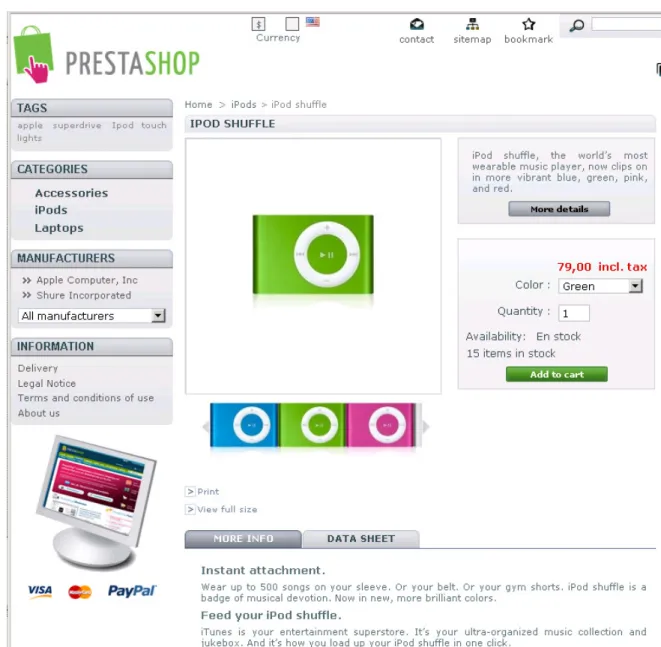
1.1 A correct, expected rending of an example webpage. . . 2
1.2 An incorrect, unexpected rending of the example webpage. Note in particular that the formatting of the webpage is missing, making navigation difficult and likely confusing or upsetting users. . . 3
1.3 Three-tiered web application . . . 7
1.4 Server-side dynamic content generation . . . 8
2.1 An oracle-comparator . . . 16
3.1 Web fault taxonomy by Marchettoet al., reprinted from [69]. . . 21
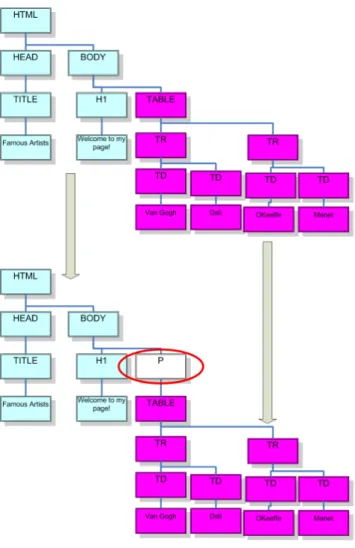
5.1 An example alignment between two HTML trees . . . 43
5.2 The benchmarks used in the experiments . . . 48
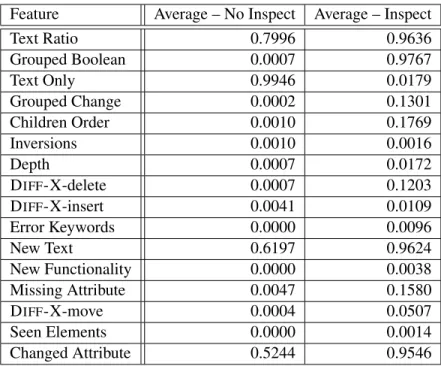
5.3 The average values of features for test cases . . . 49
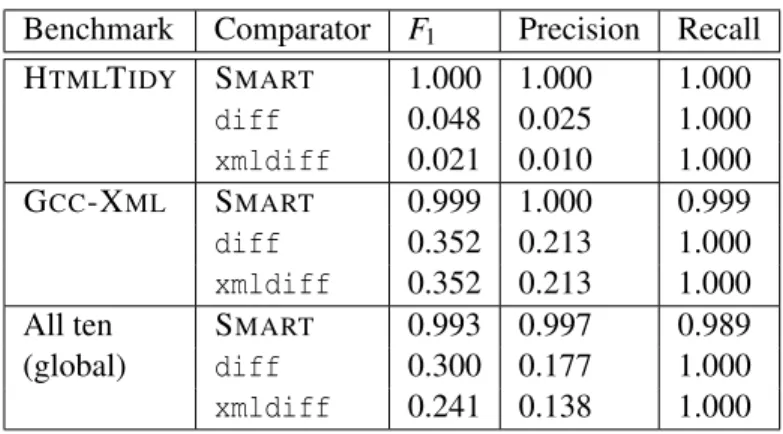
5.4 TheF1-score, precision, and recall values for SMARTon the entire dataset . . . 51
5.5 Analysis of variance of the oracle comparator model . . . 52
5.6 F1-score, precision, and recall when trained and tested on individual projects, as well as all ten benchmarks . . . 54
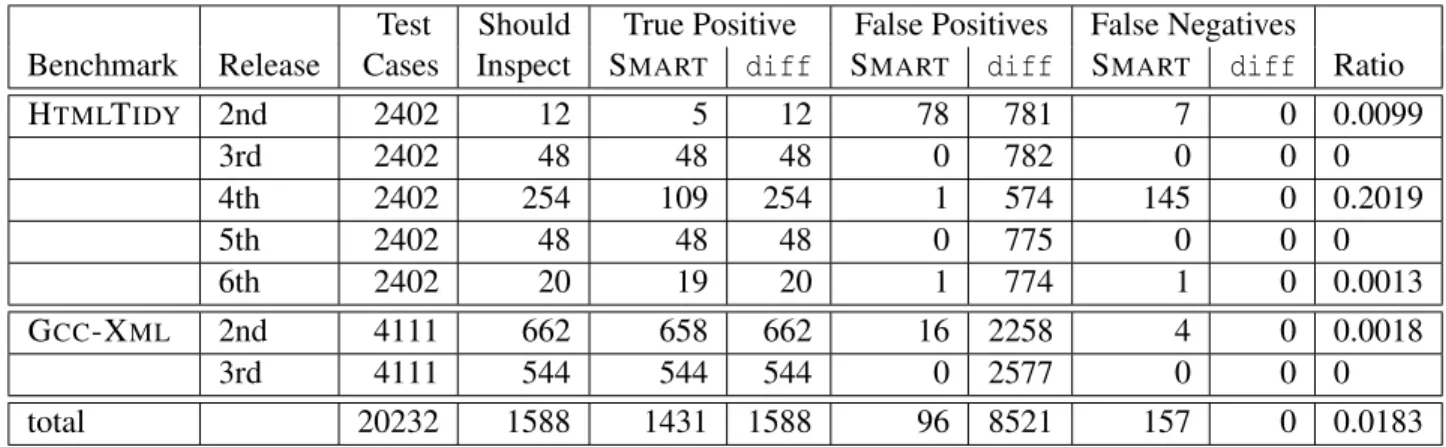
5.7 Simulated performance of SMART on 20232 test cases from multiple releases of two projects . . . 56
6.1 The benchmarks used astest datafor Experiment 1 . . . 67
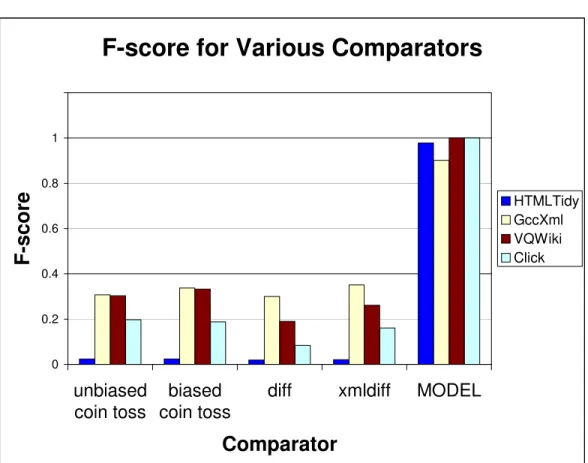
6.2 F1-score on each test benchmark using the Model, and other baseline comparators . 69 6.3 Recall on each test benchmark using the Model, and other baseline comparators . . 70
6.4 Precision on each test benchmark using the Model, and other baseline comparators 71 6.5 F1-score for GCC-XMLusing the model with different numbers of test case output pairs from original-mutant versions of the source code . . . 75
7.1 Severity scale for web application faults . . . 83
7.2 Real-world web applications mined for faults . . . 84
7.3 2-way analysis of variance of the response variable of fault severity as judged by human subjects . . . 86
7.4 Average severity ratings from a total of 12,600 human judgments of 900 scenarios . 87 7.5 Kolmogorov-Smirnov test results for the dataset . . . 89
7.6 Comparison of real-world and injected faults per application . . . 90
7.7 Severity distribution of faults according to developer responses . . . 91
7.8 Boolean surface features associated with web application faults . . . 92
7.9 Average Spearman’s Ranking Correlation Coefficient (SRCC) between each model and the average human over 100 held-out faults . . . 93
7.10 Analysis of variance showing relative feature predictive power for finding high-severity faults . . . 95
7.11 Cumulative severity over time when prioritizing faults . . . 97
7.12 Performance of the automated model against the human-annotation-based model and other baselines . . . 98
7.13 Analysis of variance showing feature predictive power for the automated model with no human annotation . . . 99
8.1 The breakdown of severe faults for each benchmark application . . . 106
8.2 Spearman’s Ranking Correlation Coefficient (SRCC) between an application fea-ture and the severity of its faults . . . 107
8.3 Context-independentfault features. . . 108
8.4 Severity distribution as a function of context-independentfault characteristics. . . . 110
8.5 Common defect causes from the four hundred real-world faults in the human study 112 8.6 Fault severity as a function of underlying defect causes. . . 113
8.7 Fault severity uncovered via reduced test suites . . . 117
List of Figures xii
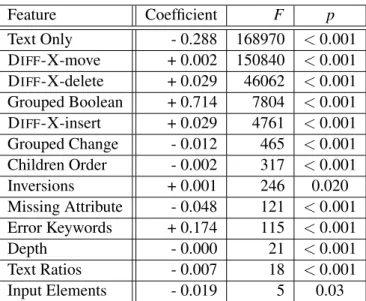
9.2 Coefficients of significant (p<0.05) feature values across all test benchmarks, plus
the generic training dataset. . . 125
9.3 Severity of missed faults across the 3 PHP benchmarks. . . 130
A.1 The “current” page . . . 141
A.2 The “next” page . . . 142
A.3 The severity rating used in the human study . . . 145
In the United States, 73% of the population used the Internet in 2008 [9], which contributed to the over $204 billion dollars in Internet retail sales in the same year [7]. While the global average for Internet usage was only 24% of the population by comparison [9], online business-to-business e-commerce1transactions total several trillions of dollars annually [5]. Therefore, there is a powerful economic incentive to produce and maintain high quality web-based applications.2
Although other types of software, such as operating systems, are also widely used and highly distributed, web-based applications face additional challenges in ensuring acceptability and main-taining a consumer base. Customer loyalty towards any particular website is notoriously low, and is primarily determined by the usability of the application [76]; unlike customers purchasing software such as Microsoft Windows, web consumers can easily switch providers without buying another product or installing another application. This challenge of customer allegiance is compounded by high availability and quality requirements: for example, one hour of downtime at Amazon.com has been estimated to cost the company $1.5 million dollars [81]. User-visible failures are endemic to top-performing web applications: several surveys have reported that about 70% of such sites are subject to user-visible failures, a majority of which could have been prevented through earlier detec-tion [98]. For example, Figure 1.1 shows the correct representadetec-tion of a webpage, while Figure 1.2 shows the same page with an example of a user-visible error: the website is missing some format-ting components, making navigation difficult. One solution to maintaining a faithful consumer base and avoiding preventable monetary losses is to design web-based applications to meet high reliabil-ity, usabilreliabil-ity, securreliabil-ity, and availability requirements [76], which translates into well-designed and well-tested software that is as free from error as possible.
Delivering high quality web-based applications has additional, domain-specific challenges be-1The definition of business-to-business e-commerce includes all transactions of goods and services for which the order-taking process is completed via the Internet.
2see Section 2.1 for a formal definition of web applications and Section A.5 (in the Appendix) for a formal definition of web-based applications.
Chapter 1. Introduction 2
Figure 1.2: An incorrect, unexpected rending of the example webpage. Note in particular that the formatting of the webpage is missing, making navigation difficult and likely confusing or upsetting users.
Chapter 1. Introduction 4
yond those of consumer retention. Most web applications are developed without a formal process model [82]. Despite having strong quality requirements that would normally dictate the need for testing and stability, web applications have short delivery times, high developer turnover rates, and quickly evolving user needs that translate into an enormous pressure to change [86]. Web appli-cation developers often deliver the system without testing it [86]. The construction of web-based applications is subject to strenuous economic constraints revolving around time-to-market concerns in the face of rapid change.
Web-based applications are not fundamentally different from other software in terms of tech-nologies used, however they deserve further attention due to three main characteristics:
• Web applications have become an integral part of the global economy, with Internet-based e-commerce projected to reach over one trillion dollars by 2010 [100], and therefore they are subject to unique and powerful economic considerations,
• Web-based applications provide a variety of services, but are commonly built as three-tiered architectures that output browser-readable code (see Figure 1.3), and consequently unrelated web-based applications often fail in similar ways, and
• Web-based applications are human-centric, implying not only a “consumer” use-case, but also defining the perceived acceptability of results through the eyes of the user.
While the economic urgency of delivering high-quality web-based applications is compounded by the lack of investment in formal processes and testing for this type of software, two insights offer hope of targeting development and testing strategies towards producing high-quality appli-cations. First, as Figure 1.3 illustrates, although web applications are frequently complex, with opaque, loosely-coupled components, are composed in multiple programming languages, and main-tain persistent session requirements, as this research demonstrates, they tend to fail in similar and predictable ways. This similarity is due to the fact that web-based applications render output in XM-L/HTML, where lower-level faults manifest themselves as user-visible output [81, 104]. Although web applications are often complicated amalgamations of various heterogeneous components, the
requirement that they produce HTML output corrals failures, even those from lower levels of the system, to the browser. This insight allows developers to centralize their testing strategies to this top level of the application.
Second, web applications are meant to be viewed by humans. While this implies that faults in the system will manifest themselves at the user level and drive away consumers, this human-centric quality of web applications can actually be viewed as an advantage. The acceptability of output becomes dependent on whether or not users were able to complete their tasks satisfactorily — a definition that encompasses a natural amount of leeway. Rather than viewing verification in absolute terms, developers that are subject to the extreme resource constraints web-based projects often entail may focus on reducing the number of high severity faults that will drive away consumers, as opposed to giving the same priority to all faults, regardless of their severity.
This research focuses on exploring user-visible errors in web-based applications to improve web-based application error detection, as well as studying the consumer-perceived severity of errors to guide web-based application design and testing. Before discussing various approaches towards more effective fault detection in Chapter 2, and in this domain in particular in Chapter 3, a general background of web-based application testing challenges is presented below.
1.1
Challenges for Testing Web-based Applications
Testing is a major component of any software engineering process meant to produce high quality applications. Maintenance activities consume 70% [31] to 90% [97] of the total life cycle cost of software, summing to over $70 billion per year in the United States [109], with regression testing accounting for as much as half of this cost [55, 90]. Despite the drive to retain consumers, testing of web-based applications is limited in current industrial practice due to a number of challenges:
• Rate of Change. The usage profile for any particular web-based application can quickly
change, potentially undermining test suites written with certain use cases in mind [39]. Simi-larly, websites undergo maintenance faster than other applications [39]. Unlike other types of software, web-based applications are frequently patched in real-time in response to consumer
Chapter 1. Introduction 6
suggestions or complaints. Regression testing of web-based applications must be flexible enough to handle such small, incremental changes.
• Resource Constraints.Testing of web applications is often perceived as lacking a significant
payoff [52]. This mindset is a consequence of short delivery times, the pressure to change, developer turnover, and evolving user needs [86, 119]. Given this human misconception of the value of testing, every effort to reduce the burden of testing for applications with such resource constraints must be made: applying automation to web testing methodologies increases their viability.
• Dynamic Content Generation. Unlike traditional client-server systems, client side
func-tionality and content may be generated dynamically in web applications [119]. Figure 1.4 shows an example setup with server-side scripting, where the page source is tailored to in-dividual users. User input, in the form of parameters passed in the URL, can change the control flow of the application — for example, pressing the back button may have unex-pected consequences [61]. In a dynamically generated environment, the content of a page may be customized according to data in a persistent store, the server state, or session vari-ables. Dynamic content may also be generated on the client side through actions within a webpage, such as mouse clicks. Validating dynamically-generated webpages is challenging because it often requires testing every possible execution path, and static analyses often have difficulty capturing the behavior of code generated on-the-fly by dynamic languages [26]. Hidden interfaces that are not exposed through static or dynamically generated pages cannot be tested by traditional testing techniques [48].
• Persistent State and Concurrency.Web-based applications frequently persist user
informa-tion, and can be concurrently accessed by global clientele around the clock [36, 106]. Testing concurrent applications is known to be difficult [111]. A successful testing approach must account for the concurrent and continuous nature of user accesses as well as successfully model user interactions that update persistent state.
Chapter 1. Introduction 8
Figure 1.4: Server-side dynamic content generation. Adapted from
Web-based applications are subject to unique challenges because of their development circum-stances and the complexities of dynamic content generation. Although web applications have espe-cially high reliability, usability, security, and availability requirements [76], time-to-market, other resource constraints, and the pressure-to-change often prevent these system from being tested [86]. In order for testing of web-based applications to be widely and successfully adopted, testing methodologies must be flexible, automatic, and able to handle their dynamic nature.
This research explores user-visible errors in web-based applications in the context of web-based application error detection. In doing so, the goal is to develop new techniques to reduce the cost of testing web-based applications as well as provide recommendations to make current testing tech-niques more cost-effective. The overall thesis of this work is that:
Web-based applications have special properties that can be harnessed to build tools and models that improve the current state of web application user-visible error detection, testing, and development.
(Thesis)
This main thesis is evaluated in terms of seven specific falsifiable hypotheses (H1) through (H7) that are detailed and experimentally tested in subsequent chapters.
This dissertation approaches the problem of error detection in web-based applications by recog-nizing that errors in web-based applications can be successfully modeled due to the tree-structured nature of XML/HTML output, and that unrelated web-based applications fail in similar ways. Addi-tionally, by analyzing errors in web applications, this work defines a model ofconsumer-perceived severity. This model targets error detection and classification methodologies and evaluation tech-niques toward flagging and preventing high-severity errors to retain users in the face of low cus-tomer loyalty.
This work focuses on errors in web-based applications, in the context of web-based application testing. Although the termtestingrefers to both test case generation and test case execution, the research in this document will focus only on the latter, under the assumption that a test suite has already been generated. Because Chapter 5 and Chapter 6 also assume multiple versions of the same software, with the possibility for benign program evolutions, those chapters additionally focus on
Chapter 1. Introduction 10
regression testing in particular; the remainder of the dissertation speaks to testing in general. The main contributions of this research are:
1. Reducing the cost of regression testing through improved error detection by capitalizing on the special structure of web-based application output to precisely identify user-visible errors.
2. Automating error detection during web-based application regression testing by relying on the discovery that unrelated web-based applications tend to fail in similar ways.
3. Formally grounding the current state of industrial practice by refuting fault injection as a standard for measuring web application test suite quality. This research assesses whether or not the assumption that all injected faults have the same non-trivial severity, and thus, the same benefit to developers, holds.
4. Understanding consumer-perceived severities of user-visible web application errors to build a model of consumer-perceived error severity.
5. Understanding how to avoid high-severity errors during web application design and develop-ment.
6. Reducing the cost of testing web applications by exposing high-severity errors through test case design, selection, and prioritization (test suite reduction).
The remainder of this dissertation is structured in the following manner. The next chapter in-troduces web-based applications and software testing in general, while Chapter 3 provides a back-ground for the state-of-the-art in web application testing. Chapter 4 introduces and summarizes the contributions of this research. Chapter 5 discusses how to improve error detection during regres-sion testing, and Chapter 6 expands upon the previous chapter by investigating automated ways to approach the same goal. Chapter 7 explores a model of consumer-perceived error severity to be used in testing, which Chapter 8 extends into concrete ways to address high severity errors in web application design and testing. Chapter 9 simultaneously explores automated error detection and error severity in the context of popular, real-world web-based applications. Chapter 10 summarizes the research presented in this document.
This chapter provides an overview of web applications (Section 2.1) as well as general software testing as related to this work (Section 2.2). Readers already familiar with the web domain and generic testing may proceed to Chapter 3 for a more detailed survey of testing as it relates of web-based applications in particular.
2.1
Web Applications
Aweb application is a type of software that is hosted on a server and can be accessed remotely through an Internet browser, usually by a human. The server is responsible for receiving requests from users, processing these requests, and then returning information to the user. Interaction with a web application is usually a three step process: 1) the user makes a request to the server through the browser, 2) the server processes the user request, and 3) the browser renders the response. These steps are detailed below.
2.1.1 The user makes a request to the server through the browser
In this first step, a user specifies the server as well as the information being re-quested by typing in a URL (Universal Resource Locator) into a browser such as Mozilla Firefox or Microsoft Internet Explorer. The browser is responsible for pass-ing the request to the server through Hypertext Transfer Protocol (HTTP). A request, such as http://www.mysite.com/register.php?id=John&age=32, specifies the server name (www.mysite.com), the location of the requested information on the server (i.e., a file name —
register.php), and other information such as the type of request (GET or POST). The browser may also collect information from the user through a web form, in the format of name-value pairs which it also passes to the server in the HTTP request. For example, the request above passes a variable namedidwith valueJohnand a variable namedagewith value32to the server.
Chapter 2. Background 12
2.1.2 The server processes the user request
A newuser session is started the first time a new user makes a request of a server. The server is responsible for managing thesession data, such as identification information, associated with multiple and possibly simultaneous users. In the simplest interaction, the server locates a static request such as a file or image, to be sent back as a response to the user. Thesestatic pagesare simply copied verbatim from an underlying filesystem or data store and do not depend on any information from the user or session state.
A user may also request adynamic page, which is customized based on user provided data, session state, or other variables. During such a dynamic page request, the server is responsible for executing code that adjusts the output of the request based on whatever information was provided. For example, a user interacting with an online bookstore may request to see their purchase history over the past year. In this case the server will receive a request from the user which contains an account number or other information. The server can then use this account number to retrieve all purchases by that customer from a database, and generate a customized output page based on the user’s purchase history. The response generated by the server is usually in the form of browser-renderable output in the Hyper Text Markup Language (HTML). The server then parcels the static or dynamic response into an HTTP response which it sends back to the browser.
Server-side application code may be written in various languages such as Java or PHP, using technologies such as JavaServer Pages (JSP) or Application Server Pages (ASP), and servers fre-quently have accesses to databases or other remote components. Sometimes the server encounters an error during the processing of the user request. For example, the server may be unable to find the requested resource, and respond with a “Page Not Found” or 404 error. Alternatively, the server-side application code may encounter an unexpected state, such as an empty object, and raise a
NullPointerException. Components that the server interacts with, such as databases, may also be unable to provide desired information and can lead to additional errors. This work primarily focuses on studying such exceptions and error cases. This dissertation uses the terms error, fault, failure, defect, and bug interchangeably: Section 3.1 provides a formal definition of a failure in a web-based application. Although the source of the error may be in the web server level (responsible
for finding files), the application server level (responsible for generating dynamic content), or in ex-ternal components (such as a database), the techniques discussed in this dissertation are applicable to all three locales as such errors generally manifest in user-visible output. Formally, this work examines user-visible errors in web-based applications. Other errors, such as an email not being sent by the server, are beyond the scope of this research.
2.1.3 The browser renders the response
Browsers are equipped to interpret HTML responses and render them visible to users. Various HTML tags and features can specify the format of text, multimedia, and functional components, although each browser may display equivalent HTML pages differently. Consequently, browser compatibility is a common concern when HTML does not render the same across different applica-tions.
Browsers primarily render HTML code, although such responses frequently contain other in-formation. Beyond images and multimedia objects, HTML files often embed client-side scripting components such as Javascript. Client-side scriptingis used for simple tasks such as validating form inputs to save time, but cannot be used in all cases. For example, a user entering an email and password can be validated on the client side by checking whether either of these fields are non-empty — a requirement that is generic to all users, without having to pass a request to the server to do so. Authenticating the user, that is, ensuring the email and password match the expected val-ues, however, cannot be accomplished on the client side because it is impossible for the browser to know what the correct email-password pair is without consulting the server (among other issues). A recent development in the web application domain is that of Asynchronous Javascript (AJAX), which is a client-side scripting language that allows for the retrieval of information from the server without reloading the web page. Testing the client-side functionality of web applications, as well as browser comparability concerns, are active research areas that are only explored in the consumer-perceived severities of potential errors of such a nature, and not in their detection or prevention, in this work.
Chapter 2. Background 14
2.2
Software Testing
Software testingis a broad term that classifies various techniques aimed at gaining confidence that the software implementation meets its specification. Asoftware specificationis a set of descriptions that indicates how the software implementation will meet thesoftware requirements, which are the user-specified functional and non-functional objectives of the system to be designed. Examples of software testing activities include source code inspection, formal verification [113], and running test cases. The latter is referred to asexecution-based testing[95], and is the focus of testing techniques in this work. Execution-based testing involves the generation, execution, and inspection of a group of individual test cases that are collectively referred to as atest suite. A test suite is a collection of
test cases, where a test case verifies some desired property of the implementation.
2.2.1 Types of Testing
This section provides an overview of various types of testing approaches that are related to the re-search in this dissertation. For a thorough discussion of software testing, see for example Ammann and Offutt [22] or Mathur [70].
Functional and Non-Functional Testing
Both functional and non-functional testing goals are traceable to software requirements.Functional testingrefers to verifying the implementation of requirements that specify the actions that a user or code can take. For example, demonstrating that pressing a button logs a user into a website, or that ordering a product from a vendor results in an email being sent to the consumer, are functional testing activities. By contrast,non-functional testingincludes verifying issues such as scalability, availability, and security requirements. For example, guaranteeing that a server will be able to simultaneously process a predetermined number of user requests, or that adequate authentication policies exist, fall under non-functional testing. This work focuses on functional testing when proposing new approaches towards regression testing web-based applications.
Testing During the Software Lifecycle
Ideally, testing activities are an ongoing effort at the beginning of (or even before) source code implementation, and many fall into the following chronologically-ordered categories:
• Unit Testing and Integration Testing. Unit testingoccurs before, during, or immediately
after sections of code (such as classes or functions) have been written. Developers generate various tests that exercise the expected functionality of the code, corner cases, and individ-ual components. By contrast,integration testingverifies that software components interface properly.
• Regression Testing. Regression testingis a supplementary approach to unit and integration
testing that serves to ensure that changes to the code do not (re-)introduce defects. Regres-sion tests are frequently executed after major changes to previously-working code have been dispatched, or as part of a nightly build or prerequisite to source code check-in in repositories.
• Alpha and Beta Testing. Alpha and Beta testing involve simulated or actual consumers
exercising the source code in a realistic operational manner. This type of testing is generally applied when the software reaches a reasonable level of maturity with relatively few defects.
This research primarily focuses on regression testing of web-based applications under the as-sumption of a pre-existing test suite. Test suites can be run using all test cases they contain, which is known as aretest-allstrategy. Re-running all test cases in a test suite may be an expensive task, consuming resources outside the range of what is available, especially in the web domain. In such cases, running a subset of the original test suite is referred to as atest suite reductionstrategy; this issue is returned to in Section 8.5.
2.2.2 Oracles and Oracle Comparators
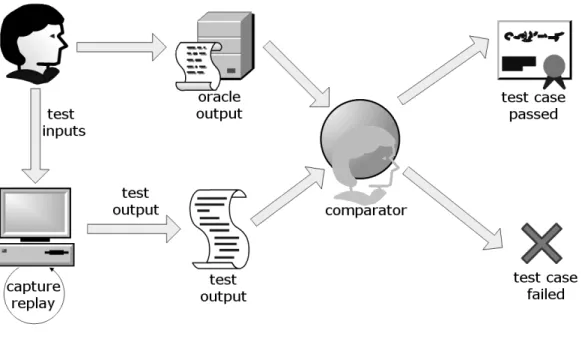
Inherent to almost all types of testing is the need for oracles, which are responsible for providing the correct, expected output of a test case. Formally, anoracleis a mechanism that produces an ex-pected result and acomparatorchecks the actual result against the expected result [28]. Figure 2.1
Chapter 2. Background 16
Figure 2.1: An oracle-comparator. A human (or in some cases software) provides test input to the system. The application is run on the test inputs and produces output. These test outputs are compared against oracle outputs (which must be specified in advance by a human or other software) using a comparator. The comparator may either be a developer manually examining output pairs, or it can be software. The comparator determines if the test case passed or failed.
diagrams the process of using an oracle comparator in testing. In the case of unit testing the oracle output may be manually specified. For other types of testing, and regression testing in particular, the oracle is commonly a previous, trusted version of the code.
Testing is often limited by the effort required to compare results between the oracle and test case outputs. Theoracle problem[39] defines the need for comparison between obtained results and expected results. For many types of software, comparing the output of two versions of the application using textual differencing utilities such as the standard UNIX commanddiff is an effective means by which to identify defects in the code. Using diff-like tools for web-based applications, however, may return a large number of non-errors as requiring human inspection; this concern is further explored in the following chapter.
2.2.3 Test Suite Evaluation
Testing usually involves an oracle comparator that is responsible for correctly identifying passed test cases and test cases that reveal defects. For many types of software, and web applications in particular, however, determining whether or not a test case uncovers an actual fault may be difficult with an automated oracle comparator. Consequently, the performance of an oracle comparator can be described by the following four metrics:
• True Positivesrefer to actual defects in the source code uncovered by a test case, when the
oracle comparator also flags the test case as requiring inspection.
• False negativesoccur when a test case uncovers a fault in the code, but the oracle comparator
labels the test case as passed. False negatives leave the potential to inadvertently ignore actual bugs.
• True Negativesare test cases that do not reveal any defects and that the oracle comparator
also labels as not requiring human inspection. True negatives represent savings in terms of developer time by obviating the need to examine test case output manually.
• False Positivesexist when a test case does not exhibit a fault, but the oracle comparator flags
the output as requiring human inspection. False positives represent wasted developer effort, because a human examines such cases manually even though no actual defects exist.
Theprecisionof a comparator is the number of true positives divided by the sum of true posi-tives and false posiposi-tives. Therecallof a comparator is the number of true positives divided by the sum of true positives and false negatives. Ideally, an oracle comparator would beperfectly precise
with a precision of 1.0, implying that there are no false positives. Ideally, an oracle comparator would also have perfect recall, with a recall of 1.0, implying that there are no false negatives. Precision can be trivially maximized by returning a single test case, while recall can similarly be maximized by returning all test cases. Combining the two measures by taking their harmonic mean results in theF1-score. This metric gives equal weight to precision and recall. In practice recall, which penalizes missing real bugs, may be more important.
Chapter 2. Background 18
Arelatively-preciseorreasonably-preciseoracle comparator seeks to minimize both the num-ber of false positives and false negatives to below an acceptable threshold. In this work a highly-preciseoracle comparator is defined as one where the ratio of the cost of examining true positive and false positive bug reports, compared to the cost of missing true negative bugs, is less than or equal to a previously published value of 0.023 [54], when comparing test case outputs between two program versions; for a formal definition of this notion of high precision see Section 5.5.2.
Although different oracle comparators may vary in their ability to correctly classify faults and non-faults, the burden of effective fault detection still lies with the test suite itself. Consequently, researchers and developers are frequently interested not only in measuring oracle comparator per-formance, but also in investigating the related domain oftest suite efficacy. Unfortunately, defects in source code cannot be known a priori, which makes determining the effectiveness of a test suite’s ability to reveal actual bugs challenging. Two widely-adopted complementary criteria are used to identify the efficacy of various test suites:
• Code coverageis a standard software engineering technique used to measure test suite
effi-cacy. Each test case is mapped to some part of the code it exercises; coverage is often broken down into function, statement, branch, and other categories depending on the desired granu-larity. The goal is usually to maximize code coverage; for example, a test suite that exercises every statement in the code at least once is said to have full statement coverage. High code coverage is a desirable property due to the underlying assumption that executing code as part of a test suite will reveal defects.
• Fault detection.An orthogonal approach to code coverage is to directly measure the number
of faults found through the use of a specific test suite. Because real-world faults are not known in advance (except when looking at older versions of a program),fault-based testing
is used to introduce faults into the code meant to be uncovered by the test suite [28, 106]. A common approach for this is referred to asfault seedingorfault injection: faults can be manually inserted by individuals with programming expertise, ormutation operatorscan be used to automatically produce faulty versions of code, as in [24]. Examples of mutation
operators are deleting a line of code, replacing a logicalANDwith anORin a line of code, and switching a+with a - operation.
Previous work has demonstrated that automatically-seeded faults using source code mutation are at least as difficult to find as naturally occurring ones for software in general [24, 56]. Whether or not manually seeded faults are equivalent to naturally occurring faults in the specific domain of web applications remains an open question.
Cost is also an important factor in determining test suite efficacy. This work presents a cost model where the quality of a testing methodology is defined as the product of the cost of an error and the number of such errors exposed by the test suite, divided by the cost of designing and running the test suite.
(cost of an error in terms of dollars lost)×(number of errors exposed)
cost of running the test suite
Under this cost model a moreeffectivetest suite may ultimately discover fewer faults then a com-petitor. In reality, all testing is subject to this constraint, as an optimal test suite could theoretically uncover all faults by running the application on all possible inputs, an infeasible approach in prac-tice. Given the large size of the input space, test suite reduction is one technique that aims to select test cases that are most likely to find bugs, or alternatively, to filter out test cases that are unlikely to find new bugs (such as duplicate tests).
2.3
Summary
This chapter provided a general background on web applications and software testing. Web applica-tions involve passing information between a server and a client that may or may not be customized according to user data. Software testing is a means by which defects in the source code are un-covered. The following chapter explains the current state-of-the-art of applying general software testing techniques to web applications in particular.
Chapter 3
Testing Web-based Applications
This chapter presents an overview of the current state-of-the-art in web-based application testing technologies, as well as the criteria researchers use to evaluate competing approaches. Many stan-dard software testing techniques have been adopted and adapted to this domain. Testing of web-based applications remains an open research area, however, due to their combination of high quality requirements and resource constraints. Most web-based application testing approaches either tackle the challenge of cost reduction through automation, or aim to provide guidelines or techniques to increase fault coverage in testing this type of software, where HTML code is often dynamically generated.
3.1
Defining Errors in Web-based Applications
Web-based applications present additional challenges in testing because the term “error” may have different meanings to different people. As an example, usability issues, such as the incapability of a customer to locate aLoginlink, may not be considered as errors in testing. Ma and Tian define a
web failureas “the inability to obtain and deliver information, such as documents or computational results, requested by web users.” [66]. It remains unclear whether usability (as opposed to correct-ness) issues are adequately considered in the automated testing processes of web applications.
Faults uncovered in testing can also be classified into different types, and some techniques are better at exposing certain types of faults [106]. Ostrand and Weyuker initially classified faults in terms of their fix-priorities [79], but later rejected that approach, concluding that using such severity measures was subjective and inaccurate [80, 106]. Thesedeveloper-perceivedfault severities are in contrast toconsumer-perceivedfault severities, which are presumably free of such biased and mis-leading judgments that are often due to internal politics within the development organization [80].
Fault taxonomies for web applications are in their infancy, in that only a few preliminary models exist. For web applications in particular, Guo and Sampath identify seven types of faults as an
Characteristics Sub-Characteristics Classes of F aults A. Multi-tier architecture 1. client pages interpreted by bro wsers f1. faults related to bro wser incompatibility f2. faults related to back b utton f3. faults related to the needed plugins 2. serv er pages can dynamically generate client pages f1. faults in the construction of dynamically b uilt client-side pages f2. faults related to inputs of serv er -side pages 3. use serv er -side components (e.g. Ja v aBeans) f4. faults during file-system access f8. faults related to serv er en vironment (e.g., web serv er) f9. faults related to character encoding of the input data 4. form and link are used to exchange data between components f1. faults during form construction 6. are database-based f1. faults during database access or mangmt f4. faults on the information search process 7. client-side page can be stored in proxies or bro wser cache f4. wrong storage of information in cache B. GUI 1. interf aces can by HTML-based f1. faults related HTML interpretation by the bro wser f3. faults while manipulating DOM objects 3. client pages can be or g anized on frames and framesets f1. faults on frame synchronization f2. faults on frame loading 5. interf aces need to be internationalized and multi-languages f1. faults related to characters encoding f3. unintended jump among languages C. Session-based 1. serv er components can use session objects f2. faults in session synchronization f4. faults in persistence of session objects f5. faults while manipulating cookies D. Hyperlink ed structure 1. support h yperte xt and h yperlink f2. faults related to web pages inte grations f8. faults while b uild dynamic URL 2. resources are accessed by URL f1. faults due to the unreached resources f2. faults due to the not av ailable resources E. Protocols-based 1. can use the data encryption f1. faults related to the use of encrypted communication 2. can be used through proxies distrib uted on the net f1. proxies do not support a gi v en used protocols F . Authentication 1. manage authorizations to allo w the users to use/access resources f2. fault during user authentication f3. faults in account management f6. faults in accessing/using resources without permission f8. faults in role management Figure 3.1: W eb fault taxonomy by Marchetto et al. , reprinted from [69].
Chapter 3. Testing Web-based Applications 22
initial step towards web fault classification [47]. Marchettoet al.validate a web fault taxonomy to be used towards fault seeding in [69]. Their fault categories are summarized in Figure 3.1, and are organized by characteristics of the fault that generally have to do with what level in the three-tiered architecture the fault occurred on or some of the underlying, specific web-based technologies (such as sessions). Faults are broken down into several categories and subcategories to aid developers when considering what types of defects to inject into their code. Despite their comprehensive nature, in these fault classifications [47, 69] there is no explicit concept or analysis of severity — while some categories of faults may, in general, produce more errors that would turn customers away (such as Authentication problems in Figure 3.1), this consideration is not explored. One of the main goals of the research presented in this document is to explicitly investigate the consumer-perceived severity of faults, which includes a breakdown of fault severity according to the source of the defect.
3.2
Existing Approaches
Several tools and techniques exist for testing web applications, but most of them focus on protocol conformance, load testing, broken link detection, HTML validation, and static analyses that do not address functional validation [39, 106]. These are low-cost approaches with a relatively high return on investment, in the sense that they can easily detect, without manual effort, some errors that are likely to drive away users. Static components of websites, such as links, HTML conformance, and spelling can be easily checked by automated spider-like tools that recursively follow all static links of the application, inspecting for errors [27].
3.2.1 Capture-Replay
Testing dynamic, functional components automatically is an active research area [26]. Validating the functionality of a web-based application can be challenging due in part to the manual effort required to generate, run, or verify test cases. For example, unit testing of web applications, using tools such as CACTUS[6], requires the developer to manually create test cases and oracles of
ex-pected output. Similarly, structural testing techniques require the construction of a model of UML or structural and behavioral test artifacts [58, 64, 85], which is usually carried out manually [106]. Other approaches towards functional validation are usually of acapture-replaynature [88], where interactions with the browser are recorded and then replayed during testing. In these cases, a devel-oper manually records a set of test scenarios, possibly by interacting directly with the application, which can then be automatically rerun through the browser.
Although capture-replay is a highly portable testing approach [106], these types of tests can easily fail for trivial reasons. In what is known as thefragile test problem, replayed scenarios are subject to behavior, interface, data, and context sensitivities [73]. It is especially important to avoid these types of failures by maintaining flexibility of the test suite and verification strategies. Such sensitivities become apparent during an attempt to use an automated oracle comparator to compare test output of web-based applications (see Section 3.2.2).
User Session Based Testing
Inuser session based testing, user accesses are recorded by the server and replayed during test-ing [39, 101]. A user session is composed of a list of suchURLrequests, in order, starting when a request from a new IP address reaches the server and ending when the user leaves the website (or the session times out) [101]. BecauseURLs can contain form data as name-value pairs passed to the server, an important advantage of user-session based testing is the possibility of testing the dynamic (form) elements of the application without relying on the developer to provide inputs manually.
This specific type of capture-replay has the advantage that a small modification to the server can provide a large set of easily-collected data. Additionally, such input may be more representative of how users would interface with the website than interactions fabricated by in-house test creators. Elbaumet al.pioneered the study of leveraging user sessions as test cases to detect a high number of faults [39, 41]. The effectiveness of their approach increases as the number of recorded sessions grows. Replaying many user sessions may exceed the resource constraints typically placed on web application development. Consequently, optimizing the playback of recorded user sessions [102], reducing the size of these test suites [41, 93, 105], and statistically modeling user sessions to derive
Chapter 3. Testing Web-based Applications 24
test cases [94] are important steps to reduce the cost of replaying user sessions.
Although user session data is easy to capture and replay, one drawback of this approach is that it is meant to be applied during beta-testing phases or to supplement an existing test suite [39]. Like any testing methodology, a test suite composed of user sessions must still have a predefined set of correct outputs to be compared against. This oracle is often taken to be a test suite run on a previous, trusted version of the code, although without manual verification of all such test outputs, guaranteeing that no defects exist in these oracle files is impossible.
3.2.2 Oracles
Recent work [41,64,101,103,104] uses HTML output as oracles, because such data is easily visible and because lower-level faults typically manifest themselves as user-visible output [81,104]. Oracle comparators are frequently used for testing web applications, and in practice discrepancies are examined through human intervention [39, 64, 86, 104]. For many types of software, using a textual
diffis an effective method for differentiating between passed and failed test cases. Unfortunately, adiff-based comparator for web-based applications produces frequent false positives [104] which must be manually interpreted, and manual inspection is an expensive process. False positives are generated through the use ofdiff when the incremental nature of website updates (described in Section 1.1) may not change the appearance or functionality experienced by the user. That is, natural web-based application development may cause an imprecise comparator, such asdiff, to flag an output pair for manual inspection when such inspection is not actually needed.
Consider thediffoutput from twoTXT2HTMLtest case versions [3] (TXT2HTMLis a tool that converts textual documents into HTML):
1 < <P>The same table could be indented.
2 < <TABLE border="1">
3
---4 > <p>The same table could be indented.</p>
5 > <table border="1" summary="">
displayed the same way in most browsers. Assuming the first version is the oracle output and the second version is the corresponding test case output, a na¨ıvediff-like comparator would return a false positive for the example above, unnecessarily requiring manual inspection.
Change Detection
Detecting changes between domain-specific documents is a frequent challenge is many applica-tions. Change detection in web pages has been explored in the context of plagiarism detection [96] and web page update monitoring [25, 43, 62]. For example, users may want to monitor changes in stock prices, updates to a class webpage, or other pre-specified data through one of these ap-proaches [1, 8, 25]. Such monitor and change detection tools are often faced with long runtimes, and recent work has focused on optimizing such algorithms to run faster [25]. Flesca and Masciari use three likeness measures to detect the percentage of similar words, measures of tree element po-sitions, and similar attributes between two XML-based documents [43]. Such structure-aware anal-yses may be useful in designing highly-precise oracle-comparators, as long as the focus is shifted towards error detection. An ideal oracle comparator for web-based applications would be able to handle both the structural evolutions (as inDIFFX — see below) as well as updates to content (as in natural language tools) in order to specifically differentiate between defects and correct output, as opposed to pinpointing or summarizing updates. This dissertation presents such a highly-precise oracle comparator (see Section 2.2.3) that uses structural and semantic judgments to classify faults and non-faults.
In other types of software, differencing in tree-based documents (such as XML and abstract syntax trees) can be accomplished by a tool such asDIFFX [20], which characterizes the number of insertions, moves, and deletes required to convert one tree to the other as a minimum-cost edit script [20,116]. Change detection for natural language text can be achieved through a bag-of-words model [60], standarddiff, and other natural language approaches. Detecting changes between different source code versions is often accomplished throughdiffas well. Although recent work has explored using semantic graph differencing [83] and abstract syntax tree matching [75] for analyzing source code evolution, such approaches are not helpful in comparing XML and HTML
Chapter 3. Testing Web-based Applications 26
text outputs. Not only do they depend on the presence of source code constructs such as functions and variables, which are not present in generic HTML or XML, to make distinctions, but they are meant to summarize changes, rather than to decide whether or not an update signals an error.
Oracle Comparators for the Web
Traditional testing for programs with tree-structured output is particularly challenging [101] due to the number of false positives returned by adiff-like comparator [104]. Additionally, if such na¨ıve comparators are employed, oracle output quickly becomes invalidated as the software evolves, as test cases are unable to pass the comparator due to minor updates. Instead, web-based applica-tions would benefit from a highly-precise oracle comparator that is able to differentiate between unimportant syntactic differences and meaningful semantic ones. One approach is for developers to customizediff-like comparators for their specific applications (for example, filtering out mis-matching timestamps), but these one-off tools must be manually configured for each project and potentially each test case — a human-intensive process that may not be amenable to the frequent nature of updates in the web domain.
Providing a reasonably-precise oracle comparator for web-based applications is an active area of research. Sprenkleet al. have focused on oracle comparators for testing web applications [101, 103, 104]. They use features derived fromdiff, web page content, and HTML structure, and refine these features into oracle comparators [104] based on HTML tags, unordered links, tag names, attributes, forms, the document, and content. Applying decision tree learning allowed them to target combinations of oracle comparators for a specific application, however this approach requires manual annotation [103].
3.2.3 Automation
Given the extraordinary resource constraints in web development environments (see Section 1.1), the automation of testing techniques has been a main focus of research in this domain. Automation can occur at any level of the testing life cycle, including test case generation, replay, and error de-tection. This dissertation focuses on automated error detection in web application testing though the
use of highly-precise oracle comparators (as described in Section 2.2.3) to verify the functionality of the website.
Automation of Test Case Generation
Two main approaches have been adopted for automatically generating test cases for web applica-tions: harnessing user session data (as described in Section 3.2.1), and determining a list of valid
URLs in the style of a normal user access through other analyses. One example of the latter is VERI-WEB[27], where links on a website are visited and dynamicURLs are generated by exercising the forms present with pre-defined form inputs. Other methods are able to automatically generate test cases [86, 87] or repair session data [21] once a model of the system has been built. For scripting languages such as PHP, constraint-solving can be used to automatically generate form inputs that will crash the system [26, 117]. This dissertation explores the orthogonal area of automated test case comparison, which can be combined with any type of test case generation approach, including the automated ones discussed above.
Automated Test Case Replay
One advantage of testing web applications, as opposed to other types of software, is that the au-tomation of test case replay is relatively straightforward if the test cases consist ofURLs, as such tests can easily be replayed in a browser. For applications that persist data, care must be taken to ensure each run of the test suite is conducted on an appropriate version of the items in the database. With the exception of restoring database state between test suites, test case replay is otherwise easily accomplished in this domain without added infrastructure beyond the ability to make requests to the server. Experiments in this dissertation frequently use UNIX transfer utilities such aswget[12] and
curl[13] to make such server requests as an effective way of replaying test cases automatically.
Automated Failure Detection
Relying on a human to manually verify all test case outputs places an unreasonably high burden on developers in the web application field. Instead, approaches such asdiff and more
sophis-Chapter 3. Testing Web-based Applications 28
ticated oracle comparators seek to reduce the amount of test case output humans must manually examine. Automated failure detection in web application testing can be achieved though the use of reasonably-precise oracle comparators [101] (as described in Section 2.2.3) to verify the function-ality of the website. Application-level failures in component-based services can also be detected automatically [34], although this approach is directed more at monitoring activities than testing. Validating large amounts of output or state remains a difficult problem and is the subject of ongoing research [53, 106]. One primary focus of this dissertation is such automated error detection through the use of a highly-precise oracle comparator. In contrast to other work that employs a partially-automatedoracle comparator [106], Chapter 6 explores a fully-automatedoracle comparator that does not depend upon manual annotations or configurations.
3.2.4 Test Suite Efficacy in Web-based Applications
Similar to the testing of other types of software, web-based application testing methodologies are frequently evaluated on some metric other than their ability to detect real-world faults in the current version of the application, as real-world faults cannot always be known in advance. Code coverage metrics are frequently used in web application testing [26, 39, 48, 64, 94, 101, 102, 103, 104, 105], although the average percentage of statement coverage falls well short of 100% (and is often closer to 60%) in many studies [26, 48, 94, 101, 102, 103, 104, 105]. As a complementary approach, fault injection through source code mutation (see Section 2.2.3) has also been used extensively in the web application testing community [26, 37, 39, 77, 101, 103, 104, 105].
The cost of developing and running a test suite is also an important consideration in the web-based application domain due to the frequent nature of updates and the rate at which this type of software is typically developed. Under the cost model of test suite efficacy, a smaller test suite is preferable to a larger one when its ability to detect defects is comparable. Traditional test suite reduction techniques such as Harrold, Gupta, and Soffa’s reduction methodology [51] have been successfully applied to user-session based testing [41]. Other approaches focus on web applica-tions characteristics in particular, such as data-flow [63] and finite state machine [23] analyses, and use case [35] and URL-based coverage [92]. Being able to reduce the size of the test suite
is an important consideration given the resource constraints which web applications are subject to. As Chapter 7 explores, however, it is important to perform both a quantitative andqualitative assess-ment of error detection preservation with such reduction approaches, in that not only the quantity, but also the severity, of faults be considered when comparing reduced test suites to their original counterparts.
3.3
Graphical User Interface Testing
Many similarities exist between Graphical User Interfaces (GUIs) and web applications — a browser-displayed webpage is a kind of GUI. Like a webpage, a GUI can be characterized in terms of its widgets1and their respective values. Xie and Memon define a GUI as a “hierarchical, graphi-cal front-end to a software system that accepts input as user-generated and system-generated events, from a fixed set of events, and produces deterministic graphical output.” [122]. Notably, they ex-clude web-user interfaces that have “synchronization and timing constraints among objects” and “GUIs that are tightly coupled with the back-end code, e.g., ones whose content is created dy-namically...” [122]. Therefore, this definition of GUIs excludes many web applications, and as a consequence, some GUI testing research is not applicable to testing web applications and vice-versa.
Like web applications, GUIs are difficult to test due to the exponential number of states the software can be in [121], as well as the manual effort required to develop test scripts and detect failures [32]. Similarly, they are often not tested at all, or are tested using capture-replay tools that capture either GUI widgets or mouse coordinates [72]. While advances in GUI testing technology may apply to the web application testing domain, the latter has its own additional challenges. Pri-marily, most GUIs lack a dynamically-generated HTML description. The availability of HTML as a standard description language for both content and presentation control implies that further analyses are possible on this output, and some GUI testing methodologies are not directly applicable. Web application content is very likely to by dynamically generated, while GUIs are relatively static by 1A widget is a visual element of a GUI that is used by a human to manipulate data. Windows, text boxes, and buttons are examples of widgets.
Chapter 3. Testing Web-based Applications 30
comparison. Additionally, customers using the web frequently have the option of easily switching providers, while GUI-based systems are often purchased and installed, making a direct comparison of consumer-perceived fault severity between the two types of software difficult. Faults are likely to manifest themselves in different ways; for example, web applications frequently fail and display stack traces in experiments in this work, while GUIs may be less likely to do so in the middle of normal GUI content. This dissertation focuses on web-based application user interfaces only. In future work, faults in GUI applications can be analyzed and some of the guidelines and techniques in the current work can potentially be extend to that domain.
3.4
Improving the Current State of the Art
Research in web-based application testing often focuses on reducing costs through (1) the automa-tion of activities, and (2) more effective error exposure. By studying user-visible errors in web-based applications in the context of web-web-based application testing, one main goal of this disserta-tion is to further cut the costs of testing by modeling errors in web-based applicadisserta-tions to identify them more accurately, as well as further automating the oracle comparator process. Specifically, this dissertation focuses on user-visible error detection, with the assumption of a provided test-suite with a retest-all strategy.
Additionally, this dissertation aims to make web testing more cost-effective by devising a model of user-visible error severity that will guide test case design, selection, and prioritization. This model of error severity has the additional benefits of refuting the underlying assumption that all faults are equally severe in fault-based testing [40, 108] for web applications, and offering soft-ware engineering techniques for high-severity fault avoidance to developers who do not have the resources to invest in testing. Unlike the severities explored by Ostrand and Weyuker [79, 80], these severities are not the developer-assigned severities to faults (such as found in bug reporting databases), but are instead based on human studies of consumer-perceived severities of real-world faults. Such human-driven results can be more indicative of true monetary losses and especially relevant in the web domain.